Proceedings of the 57th Annual Meeting of the Association for Computational Linguistics, pages 6197–6203 6197
Exploiting Sentential Context for Neural Machine Translation
Xing Wang Tencent AI Lab
Zhaopeng Tu Tencent AI Lab
Longyue Wang Tencent AI Lab
Shuming Shi Tencent AI Lab
Abstract
In this work, we present novel approaches to exploit sentential context for neural machine translation (NMT). Specifically, we first show that a shallow sentential context extracted from the top encoder layer only, can improve translation performance via contextualizing the encoding representations of individual words. Next, we introduce adeep sentential context, which aggregates the sentential context representations from all the internal layers of the encoder to form a more compre-hensive context representation. Experimental results on the WMT14 English⇒German and English⇒French benchmarks show that our model consistently improves per-formance over the strong TRANSFORMER model (Vaswani et al.,2017), demonstrating the necessity and effectiveness of exploiting sentential context for NMT.
1 Introduction
Sentential context, which involves deep syntactic and semantic structure of the source and target lan-guages (Nida,1969), is crucial for machine trans-lation. In statistical machine translation (SMT), the sentential context has proven beneficial for predicting local translations (Meng et al., 2015; Zhang et al.,2015). The exploitation of sentential context in neural machine translation (NMT, Bah-danau et al.,2015), however, is not well studied. Recently,Lin et al.(2018) showed that the trans-lation at each time step should be conditioned on the wholetarget-side context. They introduced a deconvolution-based decoder to provide the global information from the target-side context for guid-ance of decoding.
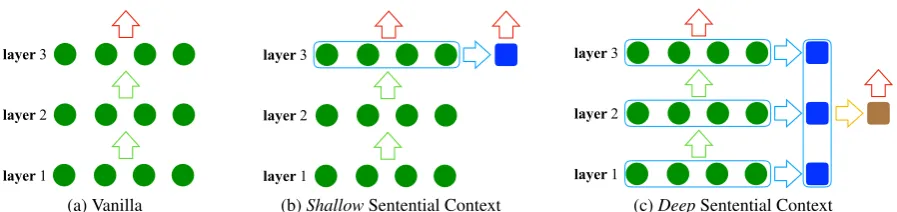
In this work, we propose simple yet effec-tive approaches to exploiting source-side global sentence-level context for NMT models. We use encoder representations to represent the
source-side context, which are summarized into a senten-tial contextvector. The source-side context vector is fed to the decoder, so that translation at each step is conditioned on the wholesource-side con-text. Specifically, we propose two types of senten-tial context: 1) theshallowone that only exploits the top encoder layer, and 2) thedeepone that ag-gregates the sentence representations of all the en-coder layers. The deep sentential context can be viewed as a more comprehensive global sentence representation, since different types of syntax and semantic information are encoded in different en-coder layers (Shi et al.,2016;Peters et al.,2018; Raganato and Tiedemann,2018).
We validate our approaches on top of the state-of-the-art TRANSFORMERmodel (Vaswani et al., 2017). Experimental results on the benchmarks
WMT14 English⇒German and English⇒French
translation tasks show that exploiting sentential context consistently improves translation perfor-mance across language pairs. Among the model variations, the deep strategies consistently outper-form their shallow counterparts, which confirms our claim. Linguistic analyses (Conneau et al., 2018) on the learned representations reveal that the proposed approach indeed provides richer linguis-tic information.
The contributions of this paper are:
• Our study demonstrates the necessity and ef-fectiveness of exploiting source-side senten-tial context for NMT, which benefits from fusing useful contextual information across encoder layers.
layer 2
layer 1 layer 3
layer 2
layer 1 layer 3
layer 2
layer 1 layer 3 (a) Vanilla layer 2
layer 1 layer 3
layer 2
layer 1 layer 3
layer 2
layer 1 layer 3
(b)ShallowSentential Context
layer 2
layer 1 layer 3
layer 2
layer 1 layer 3
layer 2
layer 1 layer 3
[image:2.595.75.524.69.175.2](c)DeepSentential Context
Figure 1: Illustration of the proposed approache. As on a 3-layer encoder: (a) vanilla model without sentential context, (b)shallowsentential context representation (i.e. blue square) by exploiting the top encoder layer only; and (c)deep sentential context representation (i.e. brown square) by exploiting all encoder layers. The circles denote hidden states of individual tokens in the input sentence, and the squares denote the sentential context representations. Theredup arrows denote that the representations are fed to the subsequent decoder. This figure is best viewed in color.
2 Approach
Like a human translator, the encoding process is analogous to reading a sentence in the source lan-guage and summarizing its meaning (i.e. senten-tial context) for generating the equivalents in the target language. When humans translate a source sentence, they generally scan the sentence to cre-ate a whole understanding, with which in mind they incrementally generate the target sentence by selecting parts of the source sentence to trans-late at each decoding step. In current NMT mod-els, the attention model plays the role of selecting parts of the source sentence, but lacking a mech-anism to guarantee that the decoder is aware of the whole meaning of the sentence. In response to this problem, we propose to augment NMT mod-els with sentential context, which represents the whole meaning of the source sentence.
2.1 Framework
Figure1illustrates the framework of the proposed approach. Letg =g(X)be the sentential context vector, and g(·) denotes the function to summa-rize the source sentenceX, which we will discuss in the next sections. There are many possible ways to integrate the sentential context into the decoder. The target of this paper is not to explore this whole space but simply to show that one fairly straight-forward implementation works well and that sen-tential context helps. In this work, we incorporate the sentential context into decoder as
dil = f(LAYERdec(Dbl−1),cli), (1)
b
Dl−1 = FFNl(Dl−1,g), (2)
wheredli is thel-th layer decoder state at decod-ing stepi, cli is a dynamic vector that selects cer-tain parts of the encoder output, FFNl(·)is a
dis-tinct feed-forward network associated with thel-th layer of the decoder, which reads thel−1-th layer outputDl−1 and the sentential contextg. In this way, at each decoding stepi, the decoder is aware of the sentential contextgembedded inDbl−1.
In the following sections, we discuss the choice of g(·), namely shallow sentential context (Fig-ure 1b) and deep sentential context (Figure 1c), which differ at the encoder layers to be exploited. It should be pointed out that the new parameters introduced in the proposed approach are jointly updated with NMT model parameters in an end-to-end manner.
2.2 Shallow Sentential Context
Shallow sentential context is a function of the top encoder layer outputHL:
g=g(HL) =GLOBAL(HL), (3)
where GLOBAL(·)is the composition function.
Choices of GLOBAL(·) Two intuitive choices are mean pooling (Iyyer et al., 2015) and max pooling (Kalchbrenner et al.,2014):
GLOBALMEAN = MEAN(HL), (4)
GLOBALMAX = MAX(HL). (5)
Recently, Lin et al. (2017) proposed a
g3
g2
g1 r2
r1 r3
r0
g3
g2
g1
gi
βi,1
βi,2
βi,3
di-1
g3
g2
g1
gi (a) RNN
g3
g2
g1
r2
r1
r3
r0
g3
g2
g1
gi
βi,1
βi,2
βi,3
di-1
g3
g2
g1
gi
[image:3.595.107.255.73.176.2](b) TAM
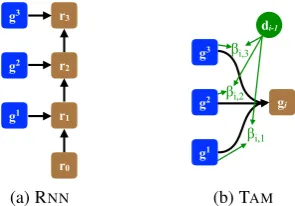
Figure 2: Illustration of the deep functions. “TAM” model dynamically aggregates sentence representa-tions at each decoding step with statedi−1.
we propose an attentive mechanism to learn sen-tence representation:
GLOBALATT = ATT(g0,HL), (6)
g0 = MAX(H0), (7)
where H0 is the word embedding layer, and its max pooling vectorg0 serves as the query to ex-tract features to form the final sentential context representation.
2.3 Deep Sentential Context
Deep sentential context is a function of all encoder layers outputs{H1, . . . ,HL}:
g=g(H1, . . . ,HL) =DEEP(g1, . . . ,gL), (8)
whereglis the sentence representation of thel-th layerHl, which is calculated by Equation3. The motivation for this mechanism is that recent stud-ies reveal that different encoder layers capture lin-guistic properties of the input sentence at different levels (Peters et al.,2018), and aggregating layers to better fuse semantic information has proven to be of profound value (Shen et al.,2018;Dou et al., 2018;Wang et al.,2018;Dou et al.,2019). In this work, we propose to fuse the global information across layers.
Choices of DEEP(·) In this work, we investigate two representative functions to aggregate informa-tion across layers, which differ at whether the de-coding information is taken into account.
RNNIntuitively, we can treatG= {g1, . . . ,gL}
as a sequence of representations, and recurring all the representations with an RNN:
DEEPRNN =RNN(G). (9)
We use the last RNN state as the sentence rep-resentation: g = rL. As seen, the RNN-based
aggregation repeatedly revises the sentence rep-resentations of the sequence with each recurrent step. As a side effect coming together with the proposed approach, the added recurrent induc-tive bias of RNNs has proven beneficial for many sequence-to-sequence learning tasks such as ma-chine translation (Dehghani et al.,2018).
TAM Recently, Bapna et al. (2018) proposed a
noveltransparent attention model (TAM) to train very deep NMT models. In this work, we apply TAMto aggregate sentence representations:
DEEPTAM =
L
X
l=1
βi,lgl, (10)
βi = ATTg(dli−1,G), (11)
where ATTg(·)is an attention model with its own
parameters, that specifics which context repre-sentations is relevant for each decoding output. Again,dli−1is the decoder state in thel-th layer.
Comparing with its RNNcounterpart, the TAM
mechanism has three appealing strengths. First, TAMdynamically generates the weightsβi based
on the decoding information at every decoding step dli−1, while RNN is unaware of the decoder states and the associated parameters are fixed after training. Second, TAMallows the model to adjust the gradient flow to different layers in the encoder depending on its training phase.
3 Experiment
We conducted experiments on WMT14 En⇒De
and En⇒Fr benchmarks, which contain 4.5M
and 35.5M sentence pairs respectively. We re-ported experimental results with case-sensitive 4-gram BLEU score. We used byte-pair encoding (BPE) (Sennrich et al.,2016) with 32K merge op-erations to alleviate the out-of-vocabulary prob-lem. We implemented the proposed approaches on top of TRANSFORMER model (Vaswani et al., 2017). We followedVaswani et al. (2017) to set the model configurations, and reproduced their re-ported results. We tested bothBaseandBig mod-els, which differ at the layer size (512 vs. 1024) and the number of attention heads (8 vs. 16).
3.1 Ablation Study
We first investigated the effect of components in the proposed approaches, as listed in Table1.
# Model GLOBAL(·) DEEP(·) # Para. Train Decode BLEU
1 BASE n/a n/a 88.0M 1.39 3.85 27.31
2 MEDIUM n/a n/a +25.2M 1.08 3.09 27.81
3
SHALLOW
Mean Pooling
n/a
+18.9M 1.35 3.45 27.58
4 Max Pooling +18.9M 1.34 3.43 27.81↑
5 Attention +19.9M 1.22 3.23 28.04⇑
6
DEEP Attention RNN +26.8M 1.03 3.14 28.38
⇑
[image:4.595.111.488.62.175.2]7 TAM +26.4M 1.07 3.03 28.33⇑
Table 1: Impact of components on WMT14 En⇒De translation task. BLEU scores in the table are case sensitive. “Train” denotes the training speed (steps/second), and “Decode” denotes the decoding speed (sentences/second) on a Tesla P40. “TAM” denotes the transparent attention model to implement the function DEEP(·). “↑ / ⇑”: significant over TRANSFORMERcounterpart (p <0.05/0.01), tested by bootstrap resampling (Koehn,2004).
baselineBasemodel, validating the importance of sentential context in NMT. Among them, atten-tive mechanism (Row 5) obtains the best perfor-mance in terms of BLEU score, while maintains the training and decoding speeds. Therefore, we used the attentive mechanism to implement the function GLOBAL(·) as the default setting in the following experiments.
Deep Sentential Context (Rows 6-7) As seen, both RNNand TAMconsistently outperform their shallow counterparts, proving the effectiveness of deep sentential context. Introducing deep context significantly improves translation performance by over 1.0 BLEU point, while only marginally de-creases the training and decoding speeds.
Compared to Strong Base Model (Row 2) As
our model has more parameters than the Base
model, we build a new baseline model (MEDIUM
in Table 1) which has a similar model size as the proposed deep sentential context model. We change the filter size from 1024 to 3072 in the de-coder’s feed-forward network (Eq.2). As seen, the proposed deep sentential context models also out-perform the MEDIUMmodel over 0.5 BLEU point.
3.2 Main Result
Experimental results on both WMT14 En⇒De
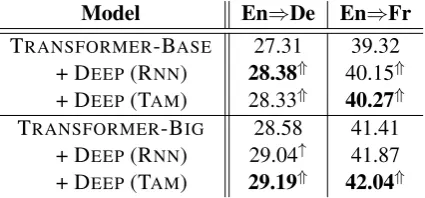
and En⇒Fr translation tasks are listed in Table 2. As seen, exploiting deep sentential context rep-resentation consistently improves translation per-formance across language pairs and model archi-tectures, demonstrating the necessity and effec-tiveness of modeling sentential context for NMT.
Among them, TRANSFORMER-BASE with deep
sentential context achieves comparable perfor-mance with the vanilla TRANSFORMER-BIG, with only less than half of the parameters (114.4M
Model En⇒De En⇒Fr
TRANSFORMER-BASE 27.31 39.32
+ DEEP(RNN) 28.38⇑ 40.15⇑
+ DEEP(TAM) 28.33⇑ 40.27⇑
TRANSFORMER-BIG 28.58 41.41
+ DEEP(RNN) 29.04↑ 41.87
+ DEEP(TAM) 29.19⇑ 42.04⇑
Table 2: Case-sensitive BLEU scores on WMT14 En⇒De and En⇒Fr test sets. “↑/⇑”: significant over TRANSFORMER counterpart (p < 0.05/0.01), tested by bootstrap resampling.
vs. 264.1M, not shown in the table).
Fur-thermore, DEEP (TAM) consistently outperforms DEEP(RNN) in the TRANSFORMER-BIG config-uration. One possible reason is that the big models benefit more from the improved gradient flow with the transparent attention (Bapna et al.,2018).
3.3 Linguistic Analysis
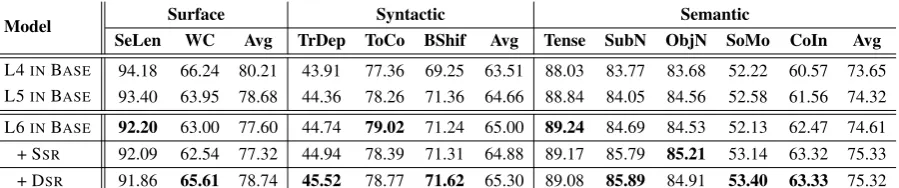
To gain linguistic insights into the global and deep sentence representation, we conducted prob-ing tasks1 (Conneau et al.,2018) to evaluate lin-guistics knowledge embedded in the encoder out-put and the sentence representation in the varia-tions of theBasemodel that are trained on En⇒De translation task. The probing tasks are classifica-tion problems that focus on simple linguistic prop-erties of sentences. The 10 probing tasks are cate-gories into three groups: (1) Surface information. (2) Syntactic information. (3) Semantic informa-tion. For each task, we trained the classifier on the train set, and validated the classifier on the vali-dation set. We followedHao et al.(2019) andLi
1https://github.com/facebookresearch/
[image:4.595.311.524.252.351.2]Model Surface Syntactic Semantic
SeLen WC Avg TrDep ToCo BShif Avg Tense SubN ObjN SoMo CoIn Avg
L4INBASE 94.18 66.24 80.21 43.91 77.36 69.25 63.51 88.03 83.77 83.68 52.22 60.57 73.65 L5INBASE 93.40 63.95 78.68 44.36 78.26 71.36 64.66 88.84 84.05 84.56 52.58 61.56 74.32
[image:5.595.77.527.62.156.2]L6INBASE 92.20 63.00 77.60 44.74 79.02 71.24 65.00 89.24 84.69 84.53 52.13 62.47 74.61 + SSR 92.09 62.54 77.32 44.94 78.39 71.31 64.88 89.17 85.79 85.21 53.14 63.32 75.33 + DSR 91.86 65.61 78.74 45.52 78.77 71.62 65.30 89.08 85.89 84.91 53.40 63.33 75.32
Table 3: Performance on the linguistic probing tasks of evaluating linguistics embedded in the encoder outputs. “BASE” denotes the representations from TRANFORMER-BASEDencoder. “SSR” denotes shallow sentence repre-sentation. “DSR” denotes deep sentence reprerepre-sentation. “AVG” denotes the average accuracy of each category.
et al.(2019) to set the model configurations. We also listed the results of lower layer representa-tions (L= 4,5) in TRANSFORMER-BASEto con-duct better comparison.
The accuracy results on the different test sets are shown in Table3. From the tale, we can see that
• For different encoder layers in the baseline model (see “L4 in BASE”, “L5 in BASE” and “L6 in BASE”), lower layers embed more about surface information while higher lay-ers encode more semantics, which are consis-tent with previous findings in (Raganato and Tiedemann,2018).
• Integrating the shallow sentence representa-tion (“+ SSR”) obtains improvement over the baseline on semantic tasks (75.33 vs. 74.61), while fails to improve on the surface (77.32 vs. 77.60) and syntactic tasks (64.88 vs. 65.00). This may indicate that the shallow representations that exploits only the top en-coder layer (“L6 in BASE”) encodes more
se-mantic information.
• Introducing deep sentence representation (“+ DSR”) brings more improvements. The rea-son is that our deep sentence representation is induced from the sentence representations of all the encoder layers, and lower layers that contain abound surface and syntactic infor-mation are exploited.
Along with the above translation experiments, we believe that the sentential context is necessary for NMT by enriching the source sentence repre-sentation. Thedeep sentential contextwhich is in-duced from all encoder layers can improve trans-lation performance by offering different types of syntax and semantic information.
4 Related Work
Sentential context has been successfully applied in SMT (Meng et al., 2015;Zhang et al., 2015). In these works, sentential context representation which is generated by the CNNs is exploited to guided the target sentence generation. In broad terms, sentential context can be viewed as a sen-tence abstraction from a specific aspect. From this point of view, domain information (Foster and Kuhn,2007;Hasler et al.,2014;Wang et al., 2017b) and topic information (Xiao et al., 2012; Xiong et al.,2015;Zhang et al.,2016) can also be treated as the sentential context, the exploitation of which we leave for future work.
In the context of NMT, several researchers leverage document-level context for NMT (Wang et al., 2017a; Choi et al., 2017;Tu et al., 2018), while we opt for sentential context. In addition, contextual information are used to improve the en-coder representations (Yang et al.,2018,2019;Lin et al., 2018). Our approach is complementary to theirs by better exploiting the encoder represen-tations for the subsequent decoder. Concerning guiding the NMT generation with source-side con-text, Zheng et al. (2018) split the source content into translated and untranslated parts, while we fo-cus on exploiting global sentence-level context.
5 Conclusion
References
Dzmitry Bahdanau, Kyunghyun Cho, and Yoshua Ben-gio. 2015. Neural Machine Translation by Jointly Learning to Align and Translate. InICLR.
Ankur Bapna, Mia Chen, Orhan Firat, Yuan Cao, and Yonghui Wu. 2018. Training deeper neural machine translation models with transparent attention. In
EMNLP.
Heeyoul Choi, Kyunghyun Cho, and Yoshua Bengio. 2017. Context-dependent word representation for neural machine translation. Computer Speech & Language, 45:149–160.
Alexis Conneau, Germ´an Kruszewski, Guillaume Lample, Lo¨ıc Barrault, and Marco Baroni. 2018. What you can cram into a single $&!#* vector: Probing sentence embeddings for linguistic proper-ties. InACL.
Mostafa Dehghani, Stephan Gouws, Oriol Vinyals, Jakob Uszkoreit, and Łukasz Kaiser. 2018. Univer-sal transformers.arXiv preprint arXiv:1807.03819.
Zi-Yi Dou, Zhaopeng Tu, Xing Wang, Shuming Shi, and Tong Zhang. 2018. Exploiting deep representa-tions for neural machine translation. InEMNLP.
Zi-Yi Dou, Zhaopeng Tu, Xing Wang, Longyue Wang, Shuming Shi, and Tong Zhang. 2019. Dynamic layer aggregation for neural machine translation with routing-by-agreement. InAAAI.
George Foster and Roland Kuhn. 2007. Mixture-model adaptation for smt. In Proceedings of the Second Workshop on Statistical Machine Translation, pages 128–135. Association for Computational Linguis-tics.
Jie Hao, Xing Wang, Baosong Yang, Longyue Wang, Jinfeng Zhang, and Zhaopeng Tu. 2019. Modeling recurrence for transformer. InNAACL.
Eva Hasler, Barry Haddow, and Philipp Koehn. 2014. Combining domain and topic adaptation for smt. In
Proceedings of AMTA, volume 1, pages 139–151.
Mohit Iyyer, Varun Manjunatha, Jordan Boyd-Graber, and Hal Daum´e III. 2015. Deep unordered compo-sition rivals syntactic methods for text classification. InACL.
Nal Kalchbrenner, Edward Grefenstette, and Phil Blun-som. 2014. A convolutional neural network for modelling sentences. InACL.
Philipp Koehn. 2004. Statistical Significance Tests for Machine Translation Evaluation. InEMNLP.
Jian Li, Baosong Yang, Zi-Yi Dou, Xing Wang, Michael R. Lyu, and Zhaopeng Tu. 2019. Infor-mation aggregation for multi-head attention with routing-by-agreement. InNAACL.
Junyang Lin, Xu Sun, Xuancheng Ren, Shuming Ma, Jinsong Su, and Qi Su. 2018. Deconvolution-based global decoding for neural machine translation. In
COLING.
Zhouhan Lin, Minwei Feng, Cicero Nogueira dos San-tos, Mo Yu, Bing Xiang, Bowen Zhou, and Yoshua Bengio. 2017. A structured self-attentive sentence embedding. InICLR.
Fandong Meng, Zhengdong Lu, Mingxuan Wang, Hang Li, Wenbin Jiang, and Qun Liu. 2015. Encod-ing source language with convolutional neural net-work for machine translation. InACL.
Eugene A Nida. 1969. Science of translation. Lan-guage, pages 483–498.
Matthew E Peters, Mark Neumann, Mohit Iyyer, Matt Gardner, Christopher Clark, Kenton Lee, and Luke Zettlemoyer. 2018. Deep Contextualized Word Rep-resentations. InNAACL.
Alessandro Raganato and J¨org Tiedemann. 2018. An analysis of encoder representations in transformer-based machine translation. InEMNLP 2018 work-shop BlackboxNLP.
Rico Sennrich, Barry Haddow, and Alexandra Birch. 2016. Neural Machine Translation of Rare Words with Subword Units. InACL.
Yanyao Shen, Xu Tan, Di He, Tao Qin, and Tie-Yan Liu. 2018. Dense information flow for neural ma-chine translation. InNAACL.
Xing Shi, Inkit Padhi, and Kevin Knight. 2016. Does string-based neural mt learn source syntax? In
EMNLP.
Zhaopeng Tu, Yang Liu, Shuming Shi, and Tong Zhang. 2018. Learning to remember translation his-tory with a continuous cache.TACL.
Ashish Vaswani, Noam Shazeer, Niki Parmar, Jakob Uszkoreit, Llion Jones, Aidan N Gomez, Łukasz Kaiser, and Illia Polosukhin. 2017. Attention is All You Need. InNIPS.
Longyue Wang, Zhaopeng Tu, Andy Way, and Qun Liu. 2017a. Exploiting cross-sentence context for neural machine translation. InEMNLP.
Qiang Wang, Fuxue Li, Tong Xiao, Yanyang Li, Yin-qiao Li, and Jingbo Zhu. 2018. Multi-layer repre-sentation fusion for neural machine translation. In
COLING.
Rui Wang, Andrew Finch, Masao Utiyama, and Ei-ichiro Sumita. 2017b. Sentence embedding for neu-ral machine translation domain adaptation. InACL.
Deyi Xiong, Min Zhang, and Xing Wang. 2015. Topic-based coherence modeling for statistical ma-chine translation. IEEE/ACM Transactions on Au-dio, Speech and Language Processing (TASLP), 23(3):483–493.
Baosong Yang, Jian Li, Derek F. Wong, Lidia S. Chao, Xing Wang, and Zhaopeng Tu. 2019. Context-aware self-attention networks. InAAAI.
Baosong Yang, Zhaopeng Tu, Derek F. Wong, Fan-dong Meng, Lidia S. Chao, and Tong Zhang. 2018. Modeling localness for self-attention networks. In
EMNLP.
Jiajun Zhang, Dakun Zhang, and Jie Hao. 2015. Local translation prediction with global sentence represen-tation. InIJCAI.
Jian Zhang, Liangyou Li, Andy Way, and Qun Liu. 2016. Topic-informed neural machine translation. InCOLING.