Munich Personal RePEc Archive
Recent Research on the Minimum Wage:
Implications for Missouri
Meer, Jonathan
Texas AM University
2018
Online at
https://mpra.ub.uni-muenchen.de/93926/
Recent Research on the Minimum Wage:
Implications for Missouri
Jonathan Meer
*Texas A&M University
and NBER
May 14, 2019
Abstract
I discuss the sources of the policy disputes surrounding the mini-mum wage, both theoretical and empirical. I focus on recent research, particularly on margins other than the level of employment, and ex-amine the distributional implications of minimum wage increases. I consider the impacts of recent proposals to increase the minimum wage in the state of Missouri.
*Meer: [email protected]. I am grateful to Jeffrey Clemens and Jeremy West for comments. Funding was
2
1. Introduction
The minimum wage has long been a contentious policy issue, but particularly so in
Missouri in recent years. When St. Louis raised its city minimum wage in 2015, with
in-creases planned to $11 per hour by 2018, legal battles held up implementation and a state
law eventually overrode the local ordinance. The minimum wage increased to $10 per hour
in that city for just three months in the middle of 2017, before returning back to the state
level of $7.70. But lost in much of this bitter battle is a broader view of the history and
economics of the minimum wage.
This essay delves into the sources of this policy dispute. I begin with a discussion of
the theoretical issues involved, then focus on recent research, particularly regarding
out-comes other than the traditional focus on employment outout-comes. I conclude with an analysis
of who benefits from a minimum wage increase and whether it is a policy well-suited to
3
2. Modeling the Effects of Minimum Wage Increases
The academic and policy debate over the minimum wage is over a century old, dating
back to well before the first minimum wage law in the United States was enacted, in
Mas-sachusetts in 1912.1 On one side of the debate, the argument is simple: workers whose
pro-duction is worth less to their employers than the minimum wage cannot remain employed.2
Originally, this was a feature of the policy, rather than an unintended consequence; much
of the original intent of minimum wage laws were to reduce the demand for low-skill labor,
often with explicitly racist and eugenicist reasoning. In 1912, Sidney Webb, co-founder of
the London School of Economics, wrote regarding those whose productivity did not generate
enough income to make a living, that “of all the ways of dealing with these unfortunate
parasites, the most ruinous to the community is to allow them to unrestrainedly compete
as wage earners.”3 This suggests a role for substitution of one type of labor for another that
might reduce the employment response. Indeed, Webb felt that employment would not
de-crease overall, even as certain groups lost their jobs – employers would substitute towards
1 For a thorough review, see Thomas C. Leonard, “The Very Idea of Applying Economics: The
Modern Minimum-Wage Controversy and its Antecedents,” History of Political Economy 32, no. Suppl_1 (2000): 117-144.
2 Henry Sidgwick, “Economic Socialism,” The Contemporary Review, 1866-1900 50 (1886):
620-631; George J. Stigler, “The Economics of Minimum Wage Legislation,” The American Economic Review 36, no. 3 (1946): 358-365.
3 Quoted in Thomas C. Leonard, Illiberal Reformers: Race, Eugenics, and American Economics in
4 higher-skilled workers. Webb further argued that increased wages for low-skilled workers
would be passed through to consumers in the form of higher prices or that profits would
simply be reduced, with businesses continuing to employ the same number of workers as
before.4
A straightforward economic analysis reveals the problem with these latter claims,
which are still being made today. As H.B. Lees Smith put it in 1907, “a rise in the price of
a commodity will lead to a decrease in the demand for it. This means that a certain amount
of the labour and capital hitherto employed in the production of the commodity must seek
other occupations. But this is likely to involve both the labourers and employers in a loss…
It is no kindness to the workers in a trade to merely turn them out of it.”5 Lees Smith made
the same counter-argument regarding falling profits: reducing the returns to a business
re-liant on low-skill labor leads to a shift in resources towards other activities, reducing the
demand for labor and leading to the creation of “a class prevented by the State from
ob-taining employment.” These arguments were based on theory rather than empirical analysis,
and Lees Smith noted that the amount of displaced labor depended on the characteristics
of the industry.
4 Sidney Webb and Beatrice Webb, Industrial Democracy (London: Longmans, Green, and
Com-pany, 1897).
5 HB Lees Smith, “Economic Theory and Proposals for a Legal Minimum Wage,” The Economic
5 In the intervening decades, a number of more sophisticated models of the labor
mar-ket have been utilized to analyze the effects of the minimum wage. These models primarily
revolve around how much market power is held by employers – that is, whether employers
are able to exert some control over the wages they pay, rather than paying the prevailing
wage rate set in a smoothly-functioning market. In the presence of monopsony (employer
market power) in the labor market, a higher minimum wage (up to a certain level) can
actually increase employment even as it increases wages.
But there is reason to doubt that this sort of market power is at play for low-skill
labor of the type that is affected by minimum wages. Most minimum-wage workers are
employed by small establishments, with fewer than half of such workers at firms with 100
or more employees.6 It is difficult to imagine that a fast-food restaurant on one corner exerts
control over the low-skill labor market, as does the fast-food restaurant across the street.
More to the point, low-skill labor is, by definition, fungible across firms and industries. An
individual employed as a janitor in for a fast-food restaurant can work as a janitor at any
sort of establishment, or in similar manual-labor occupations. Therefore, firms must exert
monopsony power over vast swaths of the low-skill labor market – an unlikely proposition.
6 Sarah Flood, Miriam King, Steven Ruggles, and J. Robert Warren, Integrated Public Use
6 But monopsony of the traditional, textbook type – that is, a “company town” in
which there is only one employer – is not fully necessary for these conditions to hold. The
presence of search frictions in the labor market can give rise to this kind of local
wage-setting power, at least in the short run, because workers cannot easily switch to employers
who offer slightly higher wages.7 But in the longer run, as movement by workers between
firms is more common, this type of market power seems less likely to be a factor.8 Any rents
generated by underpaying workers will be dissipated in a competitive market for the output
of these firms. For example, even if a restaurant is able to pay wages below the competitive
market level, the profits generated will be competed away as other establishments enter.
Increased labor costs in the form of a minimum wage increase must drive some marginal
firms out, reducing overall employment even if some remaining firms increase their level of
employment. The razor-thin profit margins of the restaurant industry, which employs the
largest share of minimum-wage workers, suggest that there is little scope for broad-based
employment increases of this nature.
These models also generate some implications that have been tested and found
want-ing. The monopsony model suggests that a well-designed minimum wage will increase firms’
7 Kenneth Burdett and Dale T. Mortensen, “Wage Differentials, Employer Size, and
Unemploy-ment,” International Economic Review (1998): 257-273; Alan Manning, Monopsony in Motion: Im-perfect Competition in Labor Markets (Princeton, NJ: Princeton University Press, 2003).
8 Peter Kuhn, “Is Monopsony the Right Way to Model Labor Markets? A Review of Alan
7 labor input and therefore the firm’s output. This increase in output implies that prices for
the goods and services produced by that labor are likely to decrease. Empirical evidence in
the restaurant industry finds, however, that prices increase after a minimum wage increase.9
Further, the monopsony model of the labor market predicts that there will be substantial
bunching of workers at a new, higher minimum wage, as employers are forced to pay workers
at that higher level. That is, a number of workers will be paid at exactly the level of the
new minimum wage. In contrast, the competitive model of the labor market, in which
work-ers who produce value below the minimum wage are unemployed, predicts no such bunching.
Recent research suggests that the prevalence of employment at the higher minimum wages
that went into effect at the end of the first decade of the 21st century was significantly below
the predictions of these monopsony models.10
Some search-and-matching models of the labor market add an additional layer of
sophistication. Workers’ search effort could respond to higher minimum wages, potentially
inducing them to enter the labor force or search more vigorously for better jobs.11 Under
9 Daniel Aaronson and Eric French, “Product Market Evidence on the Employment Effects of the
Minimum Wage,” Journal of Labor Economics 25, no. 1 (2007): 167-200; Charles Brown, Com-ment for Review Symposium “Myth and MeasureCom-ment: The New Economics of the Minimum Wage.” Industrial & Labor Relations Review 48, no. 4 (1995): 827.
10 Jeffrey Clemens, “The Low-Skilled Labor Market from 2002 to 2014: Measurement and
Mecha-nisms,” SIEPR Discussion Paper No. 16-006 (2016).
11 Daron Acemoglu, “Good Jobs versus Bad Jobs,” Journal of Labor Economics 19, no. 1 (2001):
8 certain conditions, this entry and additional effort generates more productivity for
employ-ers, potentially enough to reverse negative employment effects. However, there is no evidence
that higher minimum wages leads to labor-market entry, and increases in search effort
among those already searching tends to be very short-lived.12
3. What are the Empirical Effects of Minimum Wage Increases?
The empirical literature on the minimum wage was fairly dormant until the early
1990s, with the handful of papers on the subject generally finding small but meaningful
disemployment effects for less-experienced workers.13 The publication of Card and Krueger’s
study of fast-food restaurants in New Jersey (which had increased its minimum wage) and
Pennsylvania (which had not), sparked a renewed interest in the topic.14 They found no
evidence of employment losses in their phone survey of several hundred establishments
across the two states, and potentially some evidence of employment increases. A vigorous
12 Camilla Adams, Jonathan Meer, and Carly Will Sloan, “The Minimum Wage and Search
Ef-fort,” Working Paper (2018). Texas A&M University.
13 Charles Brown, Curtis Gilroy, and Andrew Kohen, “The Effect of the Minimum Wage on
Em-ployment and UnemEm-ployment,” Journal of Economic Literature 20, no. 2 (1982): 487-528.
14 David Card and Alan B. Krueger, “Minimum Wages and Employment: A Case Study of the
9 debate ensued, with criticisms of their empirical approach and difficulties replicating their
findings using administrative data.15
The empirical literature on the employment effects of minimum wage increases in
more recent years has homed in on the question of forming the correct counterfactual – that
is, how would the labor market in the area that increased its minimum wage have evolved
in the absence of such a change? This is a difficult question because there are numerous
factors that might lead to spurious correlation between minimum wage increases and
de-creases in employment levels, like other employment regulations enacted in close proximity
to those increases or changes in business conditions. Some researchers argue for the
im-portance of accounting for spatial heterogeneity – that is, more closely controlling for
re-gional differences.16 One popular approach in this literature is the use of border
discontinu-ities, in which counties in states that are adjacent to each other, but have different minimum
wages, are used as a comparison group. This branch of the literature can be summarized as
arguing that when the correct controls are included, there tends to be no statistically
sig-nificant effect from an increase in the minimum wage on the level of employment. But others
argue that these approaches are invalid since they are sensitive to the time periods being
15 John Kennan, “The Elusive Effects of Minimum Wages,” Journal of Economic Literature 33, no.
4 (1995): 1950-1965; David Neumark and William Wascher, “Minimum Wages and Employment: A Case Study of the Fast-Food Industry in New Jersey and Pennsylvania: Comment,” American Economic Review 90, no. 5 (2000): 1362-1396.
16 Sylvia A. Allegretto, Arindrajit Dube, Michael Reich, and Ben Zipperer, “Credible Research
10 examined, contiguous counties may not be good controls for each other, and ultimately,
these models push the data beyond useful inference.17 Regardless, even study designs that
find negative and statistically significant employment effects tend to find relatively small
effects.18
What might be the sources of this empirical confusion? It is possible that the
mo-nopsony or search-and-matching explanations discussed above are, in fact, true. More
im-portantly, the minimum wage increases enacted prior to the last few years have tended to
be fairly small, binding on only a small percentage of the workforce. In 2017, those paid at
or below their state’s minimum wage made up just 3.5% of employees; even among workers
paid by the hour, fewer than 6% were paid at or below the minimum wage. Many researchers
focus on groups that are more likely to be affected, like teenagers and restaurant workers.
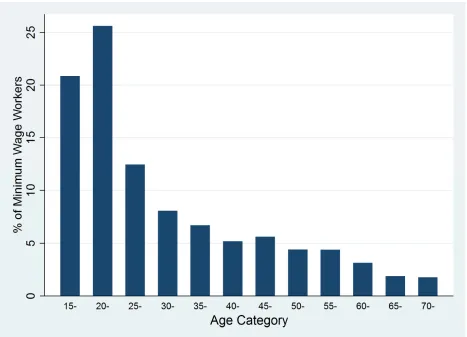
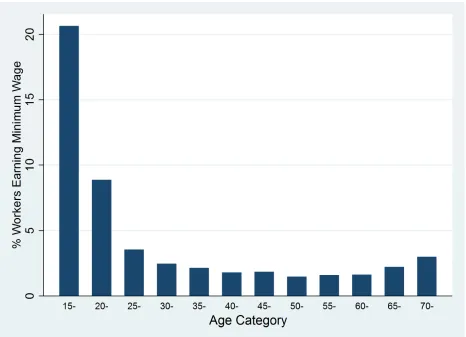
But, as illustrated in Figures 1 and 2, only about one in five working teenagers earns
mini-mum wage and only about one-fifth of minimini-mum wage workers are teenagers , making it
difficult to see effects in the data. And while the food services industry employs the largest
share of minimum wage workers (about 36% in 2017), only about one-quarter of the workers
in the industry are minimum wage workers. And among those workers, about half receive
17 David Neumark, JM Ian Salas, and William Wascher, “Revisiting the Minimum
Wage—Em-ployment Debate: Throwing Out the Baby with the Bathwater?” ILR Review 67, no. 3_suppl (2014): 608-648.
18 Jeffrey Clemens and Michael Strain, “Minimum Wage Analysis Using a Pre-Committed
11 tips, making their true hourly wage much higher than what their employer pays. In many
states, tipped workers are subject to a lower minimum wage than other workers; for example,
the tipped minimum wage in Missouri is $3.93 in 2018, as compared to $7.85 overall. This
lower level for tipped workers often does not increase when the general minimum wage does.
It is therefore not surprising that those workers are relatively unaffected by minimum wage
increases. A focus on less-educated workers and those working in low-wage occupations
seems to be a more effective approach.19 Another reason for a relatively muted impact on
the number of jobs is that employers may reduce hours of work even as they maintain the
same number of workers; due to data limitations, few studies have been able to examine
this margin of adjustment with much precision.
The new wave of high minimum wages in recent years provides a useful laboratory
for examining effects on employment. Twenty-two states and the District of Columbia have
raised their minimum wages since 2014, and a number of municipalities have increased local
minimum wages. Local minimum wages are a relatively new (and still fairly limited)
phe-nomenon, with only 41 municipalities having a minimum wage higher than their state’s in
2018, compared to just five in 2012. Some of these are quite high compared to other areas.
Seattle has had a $15 per hour minimum wage since 2017, a level that exceeds wages for
19 Jeffrey Clemens and Michael Wither, “The Minimum Wage and the Great Recession: Evidence
12 over half of the hourly workforce if it were in effect in Missouri. It is difficult for even the
most ardent minimum wage proponent to credibly argue that a minimum wage of this level
and scope would have no impact on the workforce.
Seattle’s minimum wage increase was a useful case study for researchers for several
reasons: it was quite large relative to other previously-studied changes; it was a city-level
policy that raised the minimum wage to a much higher level than neighboring areas (the
proposed increase considered by St. Louis would create a similar disparity); and finally, the
state of Washington tracks hours of work, unlike most other states. The Seattle Minimum
Wage Project research team found very large effects, to the extent that total hours worked
in low-wage jobs fell by 9% after the incremental increase to $13 per hour in 2016 from $11
in 2015 and $9.32 in 2014 (the final step of the increase, to $15 per hour in 2017, is still
being studied; the city’s minimum wage is now indexed to inflation and rises automatically
each year).20 Following the minimum wage increase, total payroll for low-wage workers
ac-tually fell by an average of $125 per month: those workers for whom the increase was
sup-posed to help were actually receiving fewer dollars on average after the minimum wage
20 Ekaterina Jardim, Mark C. Long, Robert Plotnick, Emma Van Inwegen, Jacob Vigdor, and
13 increase than before. Unsurprisingly, the study came in for immediate criticism from
mini-mum wage advocates, but its methodological approach is sound and most of the critiques
are groundless.21
A recent line of inquiry takes a different tack, suggesting that the econometric
spec-ifications used in previous research may have been incorrect. The sorts of empirical models
frequently used in the minimum wage literature are well-designed for capturing the effects
of sharp changes in the level of employment when one state changes its policies and others
do not. But there are good reasons to believe that the shifts in employment will be more
gradual. For example, substituting away from low-skill labor (counter help) towards capital
(self-service kiosks) in fast-food restaurants takes time as employers adjust their patterns or
new types of establishments replace older, more labor-intensive ones.22 There is evidence
that employers do indeed look to automate work in response minimum wage increase.23
Further, if employers may be reluctant to fire workers for morale reasons, they reduce the
21 Jonathan Meer, “A Minimum-Wage Study Faces Misplaced Skepticism,” National Review, June
29, 2017, accessed May 18, 2018, https://www.nationalreview.com/2017/06/seattle-minimum-wage-university-washington-study-critics-wrong/
22 Daniel Aaronson, Eric French, Isaac Sorkin, and Ted To, “Industry Dynamics and the
Mini-mum Wage: A Putty‐Clay Approach,” International Economic Review 59, no. 1 (2018): 51-84; Isaac Sorkin, “Are There Long-Run Effects of the Minimum Wage?” Review of Economic Dynam-ics 18, no. 2 (2015): 306-333.
23 Grace Lordan and David Neumark, “People Versus Machines: The Impact of Minimum Wages
14 size of their workforce through attrition by simply not hiring as many replacements for
workers who leave. They can also demand more effort from their remaining employees in
exchange for higher wages, which will lead to a slowdown in hiring expansion.24 In that case,
each employee is expected to work more, so the return to hiring an additional employee is
reduced. The search-and-matching models described previously also imply more gradual
changes, rather than the sudden drop in employment predicted by simpler supply and
de-mand kinds of models. These types of slow adjustments are not a novel insight in labor
economics,25 yet had rarely been considered in the context of the minimum wage.
Taken together, then, the impact of the minimum wage on employment may be
dynamic, operating through reductions in job growth that take several years to be fully
reflected in the level of employment. The specifications used in most previous research on
this topic are ill-suited for capturing these longer-lived impacts and, indeed, lead to biased
estimates that are far smaller than the true impacts.26 As an example, using three
adminis-trative data sets and a more flexible econometric model, Jeremy West and I found that
24 Marie Louise Obenauer and Bertha Marie von der Nienburg, Effect of Minimum-Wage
Determi-nations in Oregon: July, 1915 (Washington D.C.: US Government Printing Office, 1915), No. 6; Mark Bils, Yongsung Chang, and Sun-Bin Kim, “How Sticky Wages in Existing Jobs Can Affect Hiring,” National Bureau of Economic Research No. 19821 (2014).
25 Daniel S. Hamermesh, “Labor Demand and the Structure of Adjustment Costs,” The American
Economic Review (1989): 674-689; Walter Y. Oi, “Labor as a Quasi-Fixed Factor,” Journal of Po-litical Economy 70, no. 6 (1962): 538-555.
26 Jonathan Meer and Jeremy West, “Effects of the Minimum Wage on Employment Dynamics,”
15 minimum wage increases reduced job growth that took several years to be reflected in the
level of employment.27 And the overall negative effect on employment was significantly larger
than that found in much of the earlier research.
The early proponents of minimum wages, who were often driven by a desire to
ex-clude women, immigrants, and minorities from the labor force, understood that employers
might substitute towards different types of labor if statutory wages made it unprofitable to
employ more low-skilled workers. But the evidence on whether this exclusion occurs is
lim-ited. Studies have examined whether the impacts of the minimum wage vary by demographic
group and have found inconsistent results.28 However, recent work that I conducted with
Jeffrey Clemens and Lisa Kahn shows that minimum wage increases tend to reduce the
employment of young adults and high school dropouts. We also find that employers’ job
postings following minimum wage increases see an increase in requirements for high school
degrees, reducing the job opportunities for the least-credentialed workers in the labor force.29
Evidence from the Seattle Minimum Wage Project also suggests that employers reallocate
27 Jonathan Meer and Jeremy West, “Effects of the Minimum Wage on Employment Dynamics,”
Journal of Human Resources 51, no. 2 (2016): 500-522.
28 David Neumark and William Wascher, “The Effects of Minimum Wages on Teenage
Employ-ment and EnrollEmploy-ment: Estimates from Matched CPS Data,” Research in Labor Economics (1996), 25-64.
Arindrajit Dube, T. William Lester, and Michael Reich, “Minimum Wage Effects Across State Borders: Estimates Using Contiguous Counties,” The Review of Economics and Statistics 92, no. 4 (2010): 945-964.
29 Jeffrey Clemens, Jonathan Meer, and Lisa Kahn, “Dropouts Need Not Apply: Labor
16 hours towards higher-paid workers, indicating substitution towards more highly-skilled
em-ployees at the expense of lower-skilled ones.30 This has important implications for the
dis-tributional impact of minimum wage increases, discussed below.
Another avenue to consider how changes in the minimum wage affect the composition
of compensation. After all, cash wages are just one part of a labor contract. Flexibility of
work hours, working conditions, and non-wage benefits also are important aspects of the
job experience that have, for the most part, received little attention in this research. It is
difficult, after all, to objectively measure working conditions or track employee perks like
free parking, uniforms, or meals. However, a more easily-observed benefit is
employer-pro-vided health insurance (EPHI). The prevalence of EPHI in low-wage jobs is higher than
might be expected, with about 45% of those in low-paying jobs receiving it. Earlier research,
using data from 1979 to 2000, found no impact on the provision of health insurance by
employers.31 But more recent work, after the passage of the Affordable Care Act, finds that
minimum wage increases significantly reduce EPHI, clawing back some of the wage gains
even for those workers who retain their employment.32 Depending on how gains and losses
30 Ekaterina Jardim and Emma van Inwegen, “Payroll, Revenue, and Labor Demand Effects of the
Minimum Wage,” Working Paper (2017). University of Washington.
31 Kosali Ilayperuma Simon and Robert Kaestner, “Do Minimum Wages Affect Non-Wage Job
At-tributes? Evidence on Fringe Benefits,” ILR Review 58, no. 1 (2004): 52-70.
32 Jeffrey Clemens, Lisa Kahn, and Jonathan Meer, “The Minimum Wage, Fringe Benefits, and
17 are distributed and the value workers place on these benefits, worker well-being can be
harmed by an increase in minimum wages even without employment losses.
A final line of recent research has important implications for the accuracy of the
border-discontinuity designs discussed above, and particularly for Missouri, whose two
larg-est cities - Kansas City and St. Louis - border other states. A growing consensus has emerged
that local minimum wage increases affect the location and commuting decisions of low-wage
workers. Low-skill immigrants are less likely to locate in areas with high minimum wages.33
Low-wage workers increase commuting out of those areas and reduce commuting into them.34
Recent results from the Seattle Minimum Wage Project show that hours of work fell in the
areas very close to Seattle, likely the result of changes in the composition of workers.35 These
kinds of spillovers make the “natural experiment” of contiguous counties across state borders
less precise and can reduce the estimated impact on employment, even as workers are
dis-placed to other areas.
33Brian C. Cadena, “Recent Immigrants as Labor Market Arbitrageurs: Evidence from the
Mini-mum Wage,” Journal of Urban Economics 80 (2014): 1-12.
34 Terra McKinnish, “Cross-State Differences in the Minimum Wage and Out-of-State Commuting
by Low-Wage Workers,” Regional Science and Urban Economics 64 (2017): 137-147; Jorge Perez Perez, “City Minimum Wages,” Working Paper (2018). Brown University.
35 Ekaterina Jardim, Mark C. Long, Robert Plotnick, Emma van Inwegen, Jacob Vigdor, and
18
4. The Minimum Wage as an Anti-Poverty Program
Along with an attempt to increase workers’ power in the labor market, the minimum
wage is often promoted as an attempt to reduce poverty. Even if employers, rather than
consumers or workers, bear much of the cost of the minimum wage, many of them are the
owners of small single-establishment firms like restaurants or convenience stores. The owners
may not be particularly wealthy themselves. With rigorous evidence of the impact on
busi-ness owners essentially nonexistent, focus necessarily turns to minimum wage workers
them-selves.
The composition of the minimum wage workforce is not tilted towards low-income
households, to the surprise of many observers. Yet this is not a new observation: only a
quarter of minimum wage workers were poor in the 1980s, and about 30% in the
mid-1990s.36 Despite significant changes in the labor force over the past few decades, this is still
true today. Using data from the Bureau of Labor Statistics Current Population Survey, I
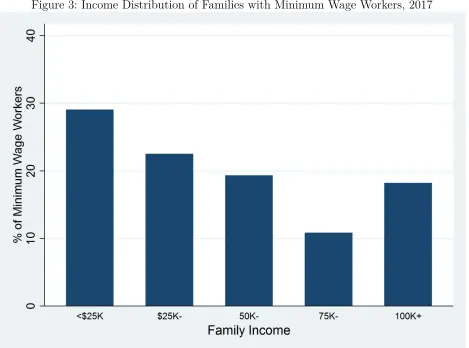
find that median cash income for families with a minimum wage earner in them was $49,500
in 2017, with 10% of those families earning over $150,000 (see Figure 3). Only 14% of those
families receive Supplemental Nutrition Assistance Program aid (commonly known as Food
36 Ralph E. Smith and Bruce Vavrichek, “The Minimum Wage: Its Relation to Incomes and
Pov-erty,” Monthly Labor Review 110, no. 6 (1987): 24-30; David Card and Alan B. Krueger, Myth
and Measurement: The New Economics of the Minimum Wage, (Princeton, NJ: Princeton
19 Stamps), and 40% of minimum wage workers live in households earning more than double
the supplemental poverty line, while only 20% live below it.
It is no surprise, then, that the purported benefits of an increase in the minimum
wage do not generally accrue to low-income households. The Congressional Budget Office
estimated that nearly three times as much income would accrue to families above the
pov-erty line than those below.37 A recent study by MaCurdy (2015) began with an assumption
that there would be no employment losses at all and that higher minimum wages would be
passed through to prices, so as to estimate the impact of the most optimistic possibilities.
He found that these price increases would be regressive, costing low-income households
relatively more than high-income ones, and that the benefits from higher wages would not
be concentrated among poor households.38 It then follows that, despite the hopes of
advo-cates that minimum wage increases will reduce reliance on government income-support
pro-grams, that does not seem to be the case.39
Who, then, makes up the minimum wage workforce? Again relying on Current
Pop-ulation Survey data, I find that half are 25 years old or younger, and nearly 70% are under
35. Figure 1 shows the age distribution of minimum wage workers. Only about a third are
37 Congressional Budget Office, “The Effects of a Minimum-Wage Increase on Employment and
Family Income,” (2014), https://www.cbo.gov/publication/ 44995.
38 Thomas MaCurdy, “How Effective is the Minimum Wage at Supporting the Poor?” Journal of
Political Economy 123, no. 2 (2015): 497-545.
39 Jeffrey Clemens, “Redistribution Through Minimum Wage Regulation: An Analysis of Program
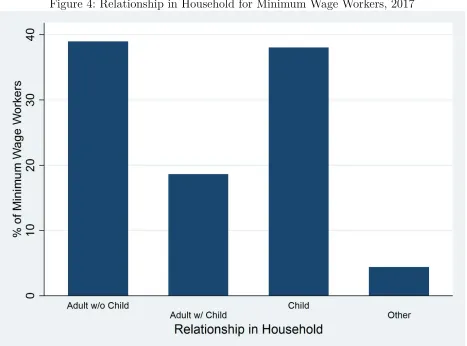
20 full-time workers, and slightly over a quarter are enrolled in high school or college. Figure 4
shows that nearly 40% live with their parents, and fewer than one-fifth are adults with
children. Simply put, the minimum wage is badly targeted for poverty alleviation. Further,
when job losses do occur because of increases in the minimum wage, they are likely to be
concentrated among those who are most marginally attached to the labor force. After all,
when an employer must pay a very high wage even for entry-level work, why would he or
she take a chance on someone with a felony conviction, a single mother who needs some
flexibility to care for her children, or a high school dropout struggling to gain work
experi-ence?
Labor force participation among many marginalized groups is shockingly low, and
increases in the minimum wage may only exacerbate this fact. For example, among
African-American high school dropouts under the age of 65 who are not currently incarcerated or
in the military, only 19% held a full-time job in 2017. And for those in labor force, the
unemployment rate was 16%, four times the level for all others. It is difficult to see,
there-fore, how the prospects for those individuals are improved by making it illegal to pay them
less than $11, $12, or the popular $15 per hour, a wage latter rate would bind on 89% of
that group. It simply beggars belief that their chances for employment would be not be
21 In Missouri, the median wage for hourly workers is $14.25, with a quarter being paid
$10.50 or less. Of all hourly workers, only 3.6% earn less than or equal to the state minimum
wage in 2017, making up 2.2% of all workers. But in the center-city area of St. Louis, most
likely to be affected by the proposed city minimum wage hike, the median wage was $12.75.
Here 37% of hourly workers earned less than or equal to the $11 per hour proposed wage
and thus are in most danger of seeing reduced benefits, hours of work, or possibly losing
their jobs entirely.
5. Conclusions
Good anti-poverty policy should preserve incentives on one side of the market to
work and on the other side to hire, and be well-targeted to the needy. Workers certainly
want to be paid more, but the minimum wage fails on the other counts. While the empirical
evidence using more traditional models is decidedly mixed, once we allow for longer-lived
dynamic effects, the evidence shows that job growth declines among those most often viewed
as beneficiaries of minimum wage increases. Already-marginalized groups are likely to be
hardest hit as employers substitute towards workers with more experience.
Minimum wage increases of the magnitude recently proposed would have much more
negative economic and social impacts, especially in areas where the prevailing market wages
22 $15 per hour would have serious consequences for states like Missouri, where over half of
hourly workers currently earn less than that amount. And for cities like St. Louis, Seattle’s
experience serves as a cautionary tale: Even though Seattle is experiencing an economic
boom, low-wage workers, on average, saw a reduction in their earnings relative to what they
would have been without the minimum wage increase. Even if there is employer market
power over low-skill labor, there is no reason to believe that policymakers are capable of
designing an optimal minimum wage across all industries and localities that meets the
cri-teria necessary to prevent employment such losses.
Anti-poverty efforts should be concentrated on more effective policies, like the earned
income tax credit, which supplements low-income households’ labor earnings. Unlike the
minimum wage advocates of the late 19th and early 20th centuries, today’s advocates are,
in general, well-intentioned in trying to tackle difficult issues of poverty and economic
23 Figure 1: Age Distribution of Minimum Wage Workers in 2017
24 Figure 2: Share of Minimum Wage Workers in Each Age Group, 2017
25 Figure 3: Income Distribution of Families with Minimum Wage Workers, 2017
26 Figure 4: Relationship in Household for Minimum Wage Workers, 2017