Munich Personal RePEc Archive
Sweden’s Trilemma Trade-offs
Cortuk, Orcan
Center for Analytical Finance, UC Santa Cruz
February 2018
Sweden
’s Trilemma Trade
-Offs
Orcan Cortuk1
February 2018
Abstract
In this paper, we empirically examine the theoretical concept of “impossible trinity” (financial trilemma) for Sweden for the period of 2010-2017. While doing this, we modified the Aizenman, Chinn and Ito approach by adding an extra interaction term to the main regression which shows whether these three policies are implemented in harmony without creating any trade-offs. Similarly, this interaction term also reflects the effectiveness of all supportive policies (i.e. hoarding international reserves, liquidity policies etc.) in order to eliminate the trade-offs between the monetary independence, exchange rate stability and capital openness. Our results indicate that the standard ACI approach is not sufficient in explaining Sweden’s economic policies and adding an interaction term to the main trilemma regression is both necessary and critical. From the latter perspective, the interaction term has a negative contribution indicating that Sweden could achieve to relax the binding trilemma trade-offs in this period. Lastly, our analysis continues by exploring the implications of the interaction term for inflation in a VAR and Granger Causality analyses where we find that interaction term has certain decreasing impact on inflation.
Keywords: Trilemma, impossible trinity, mitigating policies JEL Classification: E44; E58; F41
1
SWEDISH TRILEMMA TRADE-OFFS
1. INTRODUCTION
A critical challenge for an open economy is mainly on managing exchange rates, interest
rates and capital account openness concurrently given the certain trade-offs among policies.
These trade-offs may exist between interest rate policy independence, exchange rate
stability, and financial integration as manifested by Mundell and Fleming (1963). Accordingly,
changing one component is necessarily associated with a corresponding change in other two
components. Accordingly, an economy cannot position itself on all three vertexes of the
triangle of Figure 1 at once. On the other hand, since each of the three goals is desirable for
economies, it is conceivable that policy makers still try to meet all three at least partially. This
can be illustrated as being at a point in the interior area of the triangle. For example, a
country might have a managed float and some monetary independence, sacrificing some
capital openness.
There have been works in the literature on achieving all three goals to some extent: Obstfeld
(1998) introduces the term as “open-economy trilemma” and Calvo and Reinhart (2001 and
2002) discusses that there could be limited monetary autonomy even under the free float
regime. Rodrik (2000) presented a general overview of the trilemma in an international
environment. Bordo and Flandreau (2003) show that monetary autonomy is considerable
even under the classical gold standard. Obstfeld, Shambaugh and Taylor (2004) reinterpret
the constraints of the trilemma as they are mostly driven by historical applications rather than
the necessary theoretical implications of the Mundell-Fleming model.
While there have been such studies in the literature, the underlying theoretical framework of
the trilemma, is not easily adapted to analyzing the partial attainment of all three goals in
formal theoretical modelling. More recently Aizenman, Chinn and Ito (ACI, 2008 and 2011),
develop a new methodology to empirically characterize trade-offs in practical policymaking.
In their approach, ACI initially measure each policy dimension via an empirical index which
takes values between zero and one. The theoretical constraint of trade-offs between the
three policy-goals is then captured by the coefficients in a regression where a constant is
regressed on the trilemma indices. Multiplying these coefficients with their means result in
study, ACI has performed a panel data analysis employing the data of 170 countries whereas
Hutchison, Sengupta, and Nirvikar Singh (2012) and Cortuk and Singh (2013) adapt ACI’s
methodology to emerging market economies in a time series analysis. This paper also
adapts a similar approach to these time series analyses but focuses on a developed country,
Sweden, and also proposes to add a new term into the main trilemma regression.
The paper proceeds as follows: Section 2 gives a brief description of Sweden
macroeconomic policies. Section 3 describes the methodology and the dataset used. Lastly,
Section 4 concludes.
2. SWEDISH ECONOMY
Swedish economy is classified as a small open economy as the term is used in textbooks.
Sweden liberalised its policies with respect to cross-border movement of capital and there
are no obstacles to cross-border transactions for over two decades in this respect.
With regard to monetary policy, the objective is to maintain price stability and hence to attain
the inflation target. Weak inflationary pressures and low global interest rates are determinant
issues that define Sweden’s monetary policy in the post global crisis period (Riksbank,
2017). In this respect, the Central bank of Sweden, the Riksbank, has gradually cut its policy
rate to below zero percent level together with special contingency plans to intervene in the
foreign exchange market. The monetary policy has affected the financial conditions in an
expansionary way with regard to interest rates and the exchange rate (Riksbank, 2017). In
this context, the Swedish krona is considered to be considerably stronger today if the
Riksbank had not conducted such an expansionary monetary policy (Riksbank, 2017). Within
this context, during the period of 2010-2017, Sweden implemented an active monetary policy
whose one of the aims is to attain a more stable exchange rate in a financially open
environment.
3. DATA and METHODOLOGY
3.1 Data
Our approach of constructing the trilemma indices mainly follows ACI approach with some
departures. We initially construct indices for each of the three policy objectives of the
trilemma: monetary independence, exchange rate stability and capital openness. But instead
a single country, Sweden for the period of 2010:1-2017:6. We also use a different measure
of capital account openness which is dictated by the needs of a time series analysis of
trilemma policy stances.
The data we employ, being monthly, is higher in frequency than employed by ACI, and
subject to substantial time variation. For composing the trilemma indices, we obtain monthly
data on exchange rate and capital flows from the Riksbank website. Effective overnight rates
are collected from Federal Reserve Bank of St. Louis website. Industrial Production and
inflation data are collected from Statistics Sweden website (www.scb.se).
Trilemma indices are constructed as follows:
3.2. Exchange Rate Stability (ERS) Index
Using the monthly standard deviations of the daily change in the log of the Swedish
Krona-US dollar exchange rate, the index is constructed according to the formula below:
))
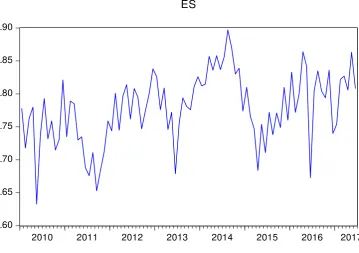
The scaling ensures that the index takes values between 0 and 1 whereas the highest value
indicates to the greatest degree of exchange rate stability. The Figure 2 illustrates the MI
index.
3.3. Monetary Independence (MI) Index
We again follow ACI (2008) in measuring MI as the reciprocal of the correlation of interest
rates between Sweden and the base country (US). Monthly correlations of overnight rates
are used as opposed to the yearly correlations of monthly rates used in ACI (2008). The
index is constructed as:
( ) ) )
This index also lies between 0 and 1, with the highest value implying to the greatest degree
3.4. Capital Openness (KO) Index
Constructing a Capital Openness Index is the most critical and problematic issue for our
purposes. In the literature, there are both de jure and de facto measures. ACI use the de
jure measure capital account openness index developed by Chinn and Ito (2006, 2008).
According to them, capital openness is based on information regarding restrictions in the
IMF’s Annual Report on Exchange Arrangements and Exchange Restrictions (AREAER).
Specifically, capital openness is the first standardized principal component of the variables
that indicate the presence of multiple exchange rates, restrictions on i) current account
transactions, ii)capital account transactions, iii) the requirement of the surrender of export
proceeds. According to this Index, capital openness is essentially constant over the entire
period for Sweden, and may not capture well the changes that have been occurring in
management of the capital account. Other de jure measures also suffer from the same
problem as they are only annual, and do not change for Sweden over time during the period
of 2010-2017M6.
Oppositely, de facto measures which are classified mainly based on price differentials and
quantities of capital flows vary over time. Thus, price based measures deal with interest
parity conditions while quantity based measures take into consideration of capital flow
volumes. The uncovered or real interest rate parity (Cheung, et al., 2003) and international
arbitrage pricing model (IAPM) or capital asset pricing model (ICAPM) (see De Gregorio,
1998) are examples of the de facto measures based on price differentials. De facto
measures based on quantities make use of capital flows such as volumes of capital flows, or
the ratio of these flows to GDP as discussed by Lane and Milesi-Ferretti (2007). This type of
measure can provide sufficient frequency for our purposes.
In our case, the lack of data with sufficient frequency on de jure controls dictates us
employing a de facto measure. On the other hand, de facto measures are more susceptible to other macroeconomic effects than solely on policy decisions. Hence, they reflect changes
in macroeconomic conditions even if there is no regulatory change on capital account
transactions. Given the varying nature of de facto measures, we employ a quantity based de
facto measure in our analysis.
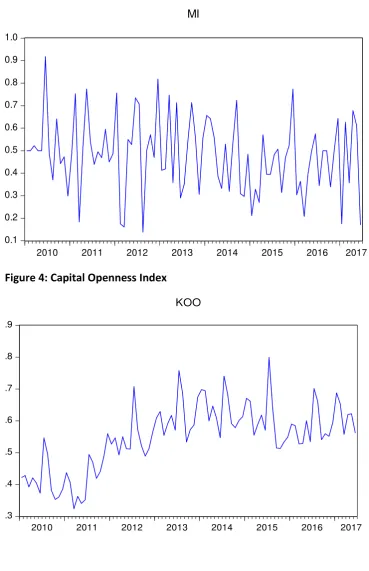
Following Lane and Milesi-Ferretti (2007), we employed portfolio investments monthly data of
quarterly, we simply adjusted portfolio investments with the industrial production index. The
Figure 4 illustrates this and this index fluctuates between 0 and 1.
Yet, for robustness, we also develop a new index that takes values of only 0.25, 0.50, 0.75
and 1 depending on intensity of the capital flows. This new index can be classified between a
de facto measure and de jure measure in terms of its varying behaviour given the fact that it
is not constant like a de jure measure but it does not vary each month like a de facto
measure as well.
3.5. Methodology
Following ACI (2008), we initially test the validity of the trilemma assuming a linear relation
among the policy choices. This reduces to examining the goodness of fit of this linear
regression.
(1)
The contributions obtained from equation (1) for the subsamples are reported in Table 1.
This table reports the means, coefficients and contributions of the three indices. The overall
fit is extremely good, reflected in the high adjusted R-squared figure. The total contribution is
1.99 being close to 2. This indicates that trilemma trade-offs are binding for Sweden. Results
show that contribution of exchange rate stability is the sole dominant factor in the trilemma of
Sweden and other policies have almost no role in this set up. Besides, capital openness,
albeit insignificant, has negative contribution in the trilemma.
In reality, these contributions do not quite reflect the economic policies of Sweden. Especially
capital openness having negative contribution is not realistic. This is mainly because even
though capital openness may not have a direct contribution, yet it definitely has indirect effect
on the policies. Thus, we propose a modified version of ACI approach to capture this.
In this new set-up; we propose to add an interaction term which is the multiplicative term of
three policies of MI, ERS and KO. The interaction term acts as the common contribution in
implemented in harmony in a way to minimize the trade-offs. Accordingly, we expect this
term to have a negative coefficient and contribution so that the total contribution of other
three policies is higher than 2. This is because this interaction term gives more space to
three main policies and mitigates the trade-offs between the policies of monetary
independence, capital openness and exchange rate stability. This is in line with the ACI’s
explanation of reserves indicating that a massive amount of foreign reserves might allow the
relaxation of the trilemma, i.e., achieve all three goals at the same time. In other words, if the
country has accumulated sufficient amount of international reserves, then it can make use of
its policies (MI, ERS and KO) in a way to support each other and hence eliminate the
trade-offs among each other. The interaction term represents not only international reserves but
also all other supportive policies i.e. liquidity policies, requires reserve policies etc. that can
be employed in order to eliminate the trade-offs.
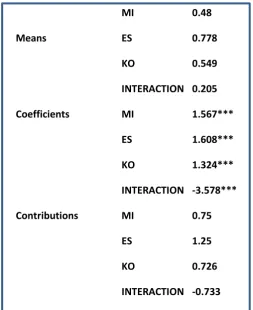
Table 2 shows the results of this new modified trilemma regression. Results indicate that
exchange rate stability has again the highest contribution. However, contributions of
monetary independence and capital openness become statistically significant. As expected,
the interaction term has a negative contribution enabling the total contribution of monetary
independence, exchange rate stability and capital openness close 3.
3.6. Impact of Interaction Term On Inflation
In this section, we aim to test whether the interaction term is economically meaningful or not.
By showing this, we can validate that this term has also significant effect on macroeconomic
indicators (namely inflation) and it is a necessary term in the trilemma regression. Similarly,
ACI has also shown that reserves have such mitigating impact on macroeconomic variables,
namely inflation and growth. In this context, we perform a VAR and a Granger causality
analysis between inflation and this interaction term. Table 4A illustrates these results.
According to VAR results, the interaction term significantly affects inflation with its first lag2.
Moreover, the sign of the impact is negative hence policy mix has a decreasing effect on
inflation as expected. Similarly, Granger causality analysis is shown in Table 4B supporting
the view that the interaction term (representing all the supportive policy mix) has a significant impact on inflation by rejecting the null hypothesis of no Granger causality at 99% confidence
level.
2
3.6 Robustness
As a robustness check, we employ a different capital openness index for Capital Openness
for all regressions to eliminate disadvantages of using a de facto capital openness measure.
Thus, to construct a new capital openness measure, we divide the capital flow data into 4
sub-categories in a way to represent the highest and lowest 25% percentile, 50% and 75%
percentiles. Later, we assign values 0.25, 0.5, 0.75 and 1 to each group. In this set-up, the
new index is different from a de facto measure as it does not change each month and as it
does not solely depend on the capital flows. Likewise, it is also different from a de jure
measure as it is not constant throughout the period. Results from the main trilemma
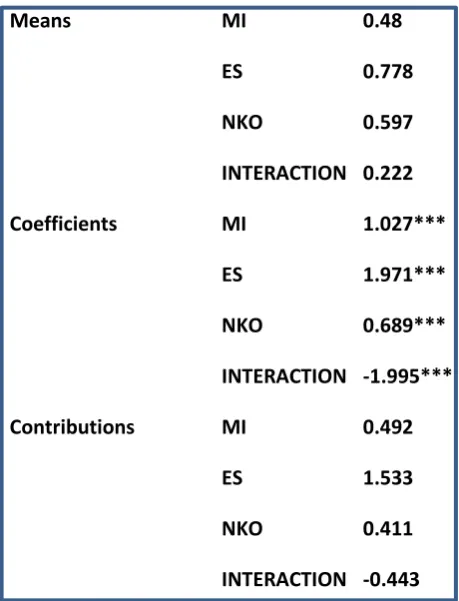
regressions are shown at Table 3A and 3B. Results of this table are parallel to what is found
in Table 2 in the sense that while capital openness has a negative contribution in the first
equation, it becomes positive in the second equation. Yet, the contribution figures differ from
each other indicating to a stronger exchange rate stability contribution and the interaction
term has a smaller impact on the trilemma trade-offs as well.
4. CONCLUSION
In this paper, we investigate Sweden’s macroeconomic policies for 2010-2017 M6 in the
context of financial trilemma trade-offs. Our methodology starts with following ACI (2008)
approach. Using monthly data, we construct trilemma indices for each of the three policy
objectives: monetary independence, exchange rate stability and capital account openness.
Using the main trilemma regression of ACI resulted in poor results in terms of reflecting
Sweden’s economic policies. According to those, exchange rate stability is the sole factor
that drives the policies making all other policies insignificant over the period. Yet, this is not
accurate as the exchange rate stability is affected directly from monetary policy as
Riksbank’s Inflation Report presents. Besides, capital openness should not have negative contribution as indicated by ACI trilemma regression results.
We propose to improve ACI methodology by introducing an interaction term which is the
multiplication of three policy indices to better capture Sweden’s policies. With addition of this
interaction term, the trilemma regressions result in a more realistic picture: exchange rate
stability has less contribution giving room to monetary independence and capital openness
even though it is still the main factor. The interaction term reflecting the harmony of all
run a VAR and Granger causality analysis between inflation and the interaction term.
According to our analyses, this interaction term is suggestive in the sense that it has
TABLES
Table 1: Results for Standard Trilemma Regression (ACI Approach)3
MI 0.48
Means ES 0.778
KO 0.549
Coefficients MI 0.178**
ES 2.534***
KO -0.12
Contributions MI 0.085
ES 1.97
[image:11.595.55.309.396.707.2]KO -0.066
Table 2: Results for Modified Trilemma Regression
MI 0.48
Means ES 0.778
KO 0.549
INTERACTION 0.205
Coefficients MI 1.567***
ES 1.608***
KO 1.324***
INTERACTION -3.578***
Contributions MI 0.75
ES 1.25
KO 0.726
INTERACTION -0.733
3
Table 3A: Results for Standard Trilemma Regression with new Capital Openness Measure (NKO)
MI 0.48
Means ES 0.778
NKO 0.597
Coefficients MI 0.148*
ES 2.589***
NKO -0.157**
Contributions MI 0.07
ES 2.01
NKO -0.09
Table 3B: Results for Modified Trilemma Regression with new Capital Openness Measure (NKO)
Means MI 0.48
ES 0.778
NKO 0.597
INTERACTION 0.222
Coefficients MI 1.027***
ES 1.971***
NKO 0.689***
INTERACTION -1.995***
Contributions MI 0.492
ES 1.533
NKO 0.411
[image:12.595.66.296.373.674.2]TABLE 4A: VAR Analysis
INTERACTION TERM INFLATION
Variable Coefficient t-stat Coefficient t-stat
Int. Term(-1) 0.075 0.71 -1.522 -3.305
Inflation (-1) -0.052 -2.41 -0.327 -3.439
Constant 0.193 8.20 0.418 4.067
TABLE 4B: Granger Causality Test
Variable F stat Prob. Value
Int. Term does not Granger Cause Inflation 2.842 0.006
Inflation does not Granger Cause Int. Term 1.001 0.453
TABLE 4C: Robustness
INTERACTION TERM INFLATION
Variable Coefficient t-stat Coefficient t-stat
Int. Term(-1) 0.33 3.39 -1.015 -3.316
Inflation (-1) -0.08 -2.65 -0.347 -3.617
FIGURE 1: Trilemma Triangle
Exchange Rate Stability (ES)
Capital Openness (KO)
[image:14.595.71.431.341.594.2]Monetary Independence (MI)
Figure 2: Exchange Rate Stability Index
.60 .65 .70 .75 .80 .85 .90
2010 2011 2012 2013 2014 2015 2016 2017
Figure 3: Monetary Independence Index
Figure 4: Capital Openness Index
0.1 0.2 0.3 0.4 0.5 0.6 0.7 0.8 0.9 1.0
2010 2011 2012 2013 2014 2015 2016 2017
MI
.3 .4 .5 .6 .7 .8 .9
2010 2011 2012 2013 2014 2015 2016 2017
REFERENCES:
Aizenman, J., Chinn, M. and Ito, H. (2008). “Assessing the Emerging Global Financial Architecture: Measuring the Trilemma’s Configurations over Time.” NBER Working Paper, No. 14533.
Aizenman, J., Chinn, M. and Ito, H. (2011). “Surfing the Waves of Globalization: Asian and Financial Globalization in the Context of the Trilemma.” Journal of the Japanese and International Economies, 25(3): 290-320.
Bordo, M. and Flandreau, M. (2003). “Core, Periphery, Exchange Rate Regimes, and
Globalization.” in Globalization in Historical Perspective, edited by M. D. Bordo, A. M. Taylor and J. G. Williamson (pp.417-473). Chicago: University of Chicago Press.
Calvo, G. and Reinhart, C. (2001). “Fixing for Your Life.” in Brookings Trade Forum 2000, edited by Susan Collins and Dani Rodrik (pp.1-39). Washington D.C. Brookings Institution.
Calvo, G. and Reinhart, C. (2002). “Fear of Floating.” Quarterly Journal of Economics, 117 (2): 379-408.
Cheung Y-W, Ito H (2007) Cross-sectional analysis on the determinants of international reserves accumulation. UC Santa Cruz mimeo
Chinn, M. D. and H. Ito. 2008 “A New Measure of Financial Openness.” Journal of Comparative Policy Analysis, Volume 10, Issue 3 (September), p. 309 - 322.
Cortuk, O., and Singh, N. (2011). Turkey’s trilemma trade-offs: is there a role for reserves?.
De Gregorio, J. 1998. “Financial integration, financial development and economic growth”.
Unpublished manuscript, Department of Industrial Engineering, Universidad de Chile
Hutchison, M., Sengupta, R. and Singh, N. (2010). “India’s Trilemma: Financial Liberalization, Exchange Rates and Monetary Policy.” The World Economy, 35(1), 3-18
Lane, Philip and Gian Maria Milesi-Ferretti (2007), “The external wealth of nations mark II: Revised and extended estimates of foreign assets and liabilities, 1970-2004,” Journal of International Economics 73(2): 223-25
Mundell, Robert A. (1963) Capital mobility and stabilization policy under fixed and flexible exchange rates, Canadian Journal of Economic and Political Science 29 (4): 475–485. doi:10.2307/139336.
Obstfeld, M. (1998). “The Global Capital Market: Benefactor or Menace?” Journal of Economic Perspectives, 12(4): 9-30
Obstfeld, M., Shambaugh, J. and Taylor, A. (2004). “The Trilemma in History: Tradeoffs among Exchange Rates, Monetary Policies, and Capital Mobility.” NBER Working Paper, No. 10396.
Riksbank website, 2017. Inflation Report, April-December 2017, www.riksbank.se