5392
Training Neural Response Selection for Task-Oriented Dialogue Systems
Matthew Henderson, Ivan Vuli´c, Daniela Gerz, Iñigo Casanueva, Paweł Budzianowski, Sam Coope, Georgios Spithourakis, Tsung-Hsien Wen, Nikola Mrkši´c,andPei-Hao Su
PolyAI Limited London, United Kingdom [email protected] [email protected]
Abstract
Despite their popularity in the chatbot liter-ature, retrieval-based models have had mod-est impact on task-oriented dialogue systems, with the main obstacle to their application be-ing the low-data regime of most task-oriented dialogue tasks. Inspired by the recent suc-cess of pretraining in language modelling, we propose an effective method for deploying
response selection in task-oriented dialogue. To train response selection models for task-oriented dialogue tasks, we propose a novel method which:1)pretrains the response selec-tion model on large general-domain conversa-tional corpora; and then2)fine-tunes the pre-trained model for the target dialogue domain, relying only on the small in-domain dataset to capture the nuances of the given dialogue domain. Our evaluation on six diverse appli-cation domains, ranging from e-commerce to banking, demonstrates the effectiveness of the proposed training method.
1 Introduction
Retrieval-based dialogue systems conduct conver-sations by selecting the most appropriate system response given the dialogue history and the input user utterance (i.e., the full dialogue context). A typical retrieval-based approach to dialogue en-codes the input and a large set of responses in a joint semantic space. When framed as an ad-hoc re-trieval task (Deerwester et al.,1990;Ji et al.,2014; Kannan et al.,2016;Henderson et al.,2017), the
system treats each input utterance as aqueryand
retrieves the most relevant response from a large re-sponse collection by computing semantic similarity between the query representation and the encod-ing of each response in the collection. This task
is referred to as response selection(Wang et al.,
2013;Al-Rfou et al.,2016;Yang et al.,2018;Du
and Black,2018;Weston et al.,2018;Chaudhuri
et al.,2018), as illustrated in Figure1.
Input Candidate Responses
Is that place affordable? Absolutely, call me any time!
There is no place like home. The restaurant serves Japanese food. I would say that the prices are reasonable. This was their second warning. It was so unfortunate to concede the goal.
Figure 1: The conversational response selection task: given the input sentence, the goal is to identify the rele-vant response from a large collection of candidates.
Formulating dialogue as a response selection task stands in contrast with other data-driven di-alogue modeling paradigms such as modular and
end-to-end task-based dialogue systems (Young,
2010; Wen et al., 2017b; Liu and Perez, 2017;
Li et al.,2017;Bordes et al.,2017). Unlike stan-dard task-based systems, response selection does not rely on explicit task-tailored semantics in the form of domain ontologies, which are hand-crafted
for each task by domain experts (Henderson et al.,
2014a,b;Mrkši´c et al.,2015). Response selection also differs from chatbot-style systems which gen-erate new responses by generalising over training data, their main deficiency being the tendency to-wards generating universal but irrelevant responses
such as“I don’t know”or“Thanks”(Vinyals and
Le,2015;Li et al.,2016;Serban et al.,2016;Song et al.,2018). Therefore, response selection removes the need to engineer structured domain ontologies, and to solve the difficult task of general language generation. Furthermore, it is also much easier to constrain or combine the output of response selec-tion models. This design also bypasses the construc-tion of dedicated decision-making policy modules. Although conceptually attractive, retrieval-based
dialogue systems still suffer fromdata scarcity, as
well as limited in size.1
Recent work on language modelling (LM)
pre-training (Peters et al., 2018;Howard and Ruder,
2018) has shown that task-specific architectures
are not necessary in a number of NLP tasks. The best results have been achieved by LM pretraining on large unannotated corpora, followed by
super-vised fine-tuning on the task at hand (Devlin et al.,
2019). Given the compelling benefits of large-scale
pretraining, our work poses a revamped question
for response selection: can wepretraina general
response selection model and then adapt it to a
variety of different dialogue domains?
To tackle this problem, we propose a two-step
training procedure which:1)pretrains a response
selection model on large conversational corpora
(such as Reddit); and then 2)fine-tunes the
pre-trained model for the target dialogue domain. Throughout the evaluation, we aim to provide an-swers to the following two questions:
1. (Q1)How to pretrain?Which encoder
struc-ture can best model the Reddit data?
2. (Q2)How to fine-tune?Which method can
ef-ficiently adapt the pretrained model to a spec-trum of target dialogue domains?
Regarding the first question, the results support
findings from prior work (Cer et al.,2018;Yang
et al.,2018): the best scores are reported with
sim-ple transformer-style architectures (Vaswani et al.,
2017) for input-response encodings. Most
impor-tantly, our results suggest that pretraining plus fine-tuning for response selection is useful across six different target domains.
As for the second question, the most effective training schemes are lightweight: the model is pre-trained only once on the large Reddit training cor-pus, and the target task adaptation does not require expensive retraining on Reddit. We also show that the proposed two-step response selection training regime is more effective than directly applying
off-the-shelf state-of-the-art sentence encoders (Cer
et al.,2018;Devlin et al.,2019).
1For instance, the recently published MultiWOZ dataset
(Budzianowski et al.,2018) comprises a total of 115,424 di-alogue turns scattered over 7 target domains. It is several times larger than other standard task-based dialogue datasets such as DSTC2 (Henderson et al.,2014b) with 23,354 turns, Frames (El Asri et al.,2017) with 19,986 turns, or M2M (Shah et al.,2018) with 14,796 turns. To illustrate the difference in magnitude, the Reddit corpus used in this work for response selection pretraining comprises 727M dialogue turns.
We hope that this paper will inform
fu-ture development of response-based
task-oriented dialogue. Training and test datasets,
described in more detail by Henderson
et al. (2019), are available at: github.com/
PolyAI-LDN/conversational-datasets.
2 Methodology
Why Pretrain and Fine-Tune? By simplifying the conversational learning task to a response se-lection task, we can relate target domain tasks to general-domain conversational data such as
Red-dit (Al-Rfou et al., 2016). This also means that
parameters of response selection models in target domains with scarce training resources can be ini-tialised by a general-domain pretrained model.
The proposed two-step approach, described in
§2.1and §2.2, can be seen as a “lightweight” task
adaptation strategy: the expensive Reddit model pretraining is run only once (i.e., training time
is typically measured in days), and the model is
then fine-tuned onN target tasks (i.e., fine-tuning
time is in minutes). The alternatives are
“heavy-weight” data mixing strategies. First, in-domain and Reddit data can be fused into a single train-ing set: besides expensive retraintrain-ing for each task, the disbalance between in-domain and Reddit data sizes effectively erases the target task signal. An improved data mixing strategy keeps the identities of the origin datasets (Reddit vs. target) as features in training. While this now retains the target signal, our preliminary experiments indicated that the re-sults again fall short of the proposed lightweight fine-tuning strategies. In addition, this strategy still relies on expensive Reddit retraining for each task.
2.1 Step 1: Response Selection Pretraining
Reddit Data. Our pretraining method is based on the large Reddit dataset compiled and made
pub-licly available recently byHenderson et al.(2019).
This dataset is suitable for response selection pre-training due to multiple reasons as discussed by Al-Rfou et al.(2016). First, the dataset offers or-ganic conversational structure and it is large at the same time: all Reddit data from January 2015 to December 2018, available as a BigQuery dataset, span almost 3.7B comments. After preprocessing the dataset to remove both uninformative and long
comments2 and pairing all comments with their
2
self-attention self-attention self-attention self-attention
positional emb positional emb positional emb positional emb H fully-connected hidden layers (H=3)
1024-dim + swish H fully-connected hidden layers 1024-dim + swish (H=3)
input: x response: y
[image:3.595.74.290.63.213.2]dot product loss
Figure 2: Schematic input-response encoder model structure. We show the best-performing architecture for brevity, while we evaluate a variety of other encoder ar-chitecture configurations later in §4.1.
responses, we obtain more than 727M comment-response pairs which are used for model pretrain-ing. This Reddit dataset is substantially larger than
the previous Reddit dataset ofAl-Rfou et al.(2016),
which spans around 2.1B comments and 133M conversational threads, and is not publicly avail-able. Second, Reddit is extremely diverse topically (Schrading et al.,2015;Al-Rfou et al.,2016): there are more than 300,000 sub-forums (i.e., subred-dits) covering diverse topics of discussion. Finally, compared to message-length-restricted Twitter
con-versations (Ritter et al., 2010), Reddit
conversa-tions tend to be more natural. In summary, all these favourable properties hold promise to support a large spectrum of diverse conversational domains.
Input and Response Representation. We now turn to describing the architecture of the main pre-training model. The actual description focuses on
the best-performing architecture shown in Figure2,
but we also provide a comparative analysis of other
architectural choices later in §4.1.
First, similar toHenderson et al.(2017), raw text
is converted to unigrams and bigrams, that is, we
extractn-gram features from each inputxand its
corresponding responseyfrom (Reddit) training
data. During training we obtaind-dimensional
fea-ture representations (d= 320, see Figure2) shared
between inputs and responses for each unigram and bigram jointly with other neural net parameters. In addition, the model can deal with out-of-vocabulary unigrams and bigrams by assigning a random id from 0 to 50,000 to each, which is then used to look up their embedding. When fine-tuning, this allows the model to learn representations of words
that otherwise would be out-of-vocabulary.
Sentence Encoders. The unigram and bigram embeddings then undergo a series of transforma-tions on both the input and the response side, see
Figure2again. Following the transformer
architec-ture (Vaswani et al.,2017), positional embeddings
and self-attention are applied to unigrams and bi-grams separately. The representations are then
com-bined as follows (i.e., this refers to thereduction
layer in Figure2): the unigram and bigram
embed-dings are each summed and divided by the square root of the word sequence length. The two vectors
are then averaged to give a single320-dimensional
representation of the text (input or response). The averaged vector is then passed through a
series of H fully connected h-dim feed-forward
hidden layers (H = 3;h = 1,024) withswishas
the non-linear activation, defined as:swish(x) =
x·sigmoid(βx)(Ramachandran et al.,2017).3The
final layer is linear and maps the text into the final
l-dimensional (l= 512) representation:hxfor the
input text, andhyfor the accompanying response
text. This provides a fast encoding of the text, with
some sequential information preserved.4
Scaled Cosine Similarity Scoring. The rele-vance of each response to the given input is then
quantified by the scoreS(x, y). It is computed as
scaled cosine similarity:S(x, y) =C·cos(hx, hy),
whereC is a learned constant, constrained to lie
between0and√l. We resort to scaled cosine
sim-ilarity instead of general dot product as the abso-lute values are meaningful for the former. In conse-quence, the scores can be thresholded, and retrained models can rely on the same thresholding.
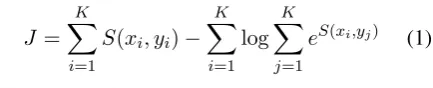
Training proceeds in batches of K (input,
re-sponse) pairs (x1, y1), . . . ,(xK, yK). The
objec-tive tries to distinguish between the true relevant response and irrelevant/random responses for each
input sentencexi. The training objective for a
sin-gle batch ofKpairs is as follows:
J =
K X
i=1
S(xi, yi)− K X
i=1
log
K X
j=1
eS(xi,yj) (1)
3We fixβ= 1as suggested byRamachandran et al.(2017).
The use of swish is strictly empirically driven: it yielded slightly better results in our preliminary experiments than the alternatives such astanhor a family of LU/ReLU-related activations (He et al.,2015;Klambauer et al.,2017).
4Experiments with higher-order n-grams, recurrent, and
[image:3.595.309.526.636.680.2]Reddit (Source)
Train
Train1 Test1
Train2 Test2
TrainN TestN
Target Domain 1
Target Domain 2
Target Domain N
(a)REDDIT-DIRECT
Reddit (Source)
Train
Train1 Test1
Train2 Test2
TrainN TestN
Target Domain 1
Target Domain 2
Target Domain N
(b)FT-DIRECT
Reddit (Source)
Train
Train1 Test1
Train2 Test2
TrainN TestN
Target Domain 1
Target Domain 2
Target Domain N
(c)FT-MIXED
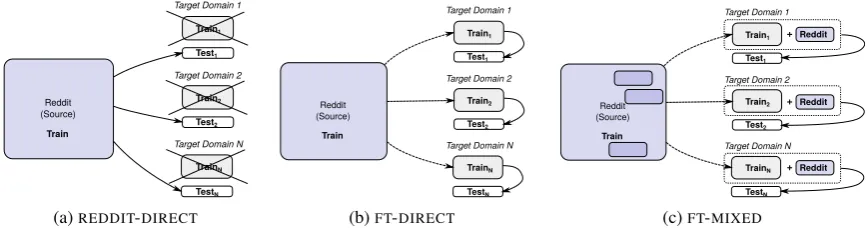
Figure 3: High-level overview of baseline and fine-tuning strategies used in our evaluation.(a)REDDIT-DIRECT: a pretrained general-domain (Reddit) response selection model is directly applied on each target task, without any target domain fine-tuning;(b)FT-DIRECT: after pretraining the large response selection model on Reddit, the model is fine-tuned for each target task by directly continuing the training on (much smaller) target domain data;(c)
FT-MIXED: similar toFT-DIRECT, but the crucial difference is in-batch mixing of Reddit input-response pairs with target domain pairs during the target fine-tuning procedure. Another baseline (TARGET-ONLY) trains a response selection model on each target task separately without leveraging general-domain Reddit data (not shown).
Effectively, Eq. (1) maximises the score of pairs
(xi, yi)that go together in training, while
minimis-ing the score of pairminimis-ing each inputxiwithK0
neg-ative examples, that is, responses that are not
asso-ciated with the inputxi. For simplicity, as in prior
work (Henderson et al.,2017;Yang et al.,2018),
for each inputxi, we treat all otherK−1responses
in the current batchyj 6=yias negative examples.5
As discussed byHenderson et al.(2017) in the
context of e-mail reply applications, this design enables efficient response search as it allows for precomputing vectors of candidate responses inde-pendently of input queries, and searching for re-sponses with high scaled cosine similarity scores in the precomputed set. It also allows for approximate
nearest neighbour search (Malkov and Yashunin,
2016) which speeds up computations drastically at
the modest decrease of retrieval performance.6
Finally, in this work we rely on a simple strat-egy based on random negative examples. In future work, we plan to experiment with alternative (non-random) negative sampling strategies. For instance, inspired by prior work on semantic specialisation
(Mrkši´c et al., 2017b) and parallel corpora
min-ing (Guo et al.,2018), difficult negative examples
might comprise invalid responses that are semanti-cally related to the correct response (measured by e.g. dot-product similarity).
5
Note that the matrix S = C · [hy1, . . . , hyK] · [hx1, . . . , hxK]
T
is inexpensive to compute.
6
E.g., experiments on Reddit test data reveal a 130×
speed-up using the approximate search method ofMalkov and Yashunin(2016) while retaining 95% top-30 recall.
2.2 Step 2: Target Domain Fine-Tuning
The second step concerns the application of the
pre-trained general Reddit model onN target domains.
We assume that we have the respective training
and test sets ofKN,trandKN,tein-domain
input-response pairs for each of theN domains, where
KN,trandKN,teare considerably smaller than the
number of Reddit training pairs. We test two
gen-eral fine-tuning strategies, illustrated in Figure3.
FT-DIRECT directly continues where the Red-dit pretraining stopped: it fine-tunes the model
pa-rameters by feeding the KN,tr in-domain(input,
response) pairs into the model and by following
exactly the same training principle as described in
§2.1. The fine-tuned model is then tested in the
in-domain response selection task usingKN,tetest
pairs, see Figure3b.
FT-MIXED attempts to prevent the “specialisa-tion” of the Reddit model to a single target do-main, that is, it aims to maintain stable performance on the general-domain Reddit data. This way, the model can support multiple target tasks simultane-ously. Instead of relying only on in-domain training pairs, we now perform in-batch mixing of
Red-dit pairs with in-domain pairs: M% of the pairs
in each batch during fine-tuning are Reddit pairs,
while(100−M)% of the pairs are in-domain pairs,
whereM is a tunable hyper-parameter. With this
fine-tuning strategy, outlined in Figure 3c, each
dataset provides negative examples for the other one, enriching the learning signal.
We compareFT-DIRECTandFT-MIXEDagainst
two straightforward and insightful baselines: the
ap-plies the pretrained Reddit model on the target task without any in-domain fine-tuning. Comparisons to this baseline reveal the importance of fine-tuning.
On the other hand, theTARGET-ONLYbaseline
sim-ply trains the response selection model from
Fig-ure2from scratch directly on the in-domainKN,tr
pairs. Comparisons to this baseline reveal the
im-portance of Reddit pretraining. For all TARGET
-ONLYmodels in all target tasks, we tuned the word
embedding sizes and embedding dropout rates on the corresponding training sets.
3 Experimental Setup
Training Setup and Hyper-Parameters. All in-put text is lower-cased and tokenised, numbers with 5 or more digits get their digits replaced by a
wild-card symbol#, while words longer than 16
char-acters are replaced by a wildcard token
LONG-WORD. Sentence boundary tokens<S>and</S>
are added to each sentence. The vocabulary con-sists of the unigrams that occur at least 10 times in a random 1M subset of the Reddit training set –this results in a total of 105K unigrams– plus the 200K most frequent bigrams in the same random subset. The following training setup refers to the final
Reddit model, illustrated in Figure2, and used in
fine-tuning. The model is trained by SGD setting the initial learning rate to 0.03, and then decaying the learning rate by 0.3x every 1M training steps after the first 2.5M steps. Similar to learning rate
scaling by the batch size used in prior work (Goyal
et al.,2017;Codreanu et al.,2017), we scale the unigram and bigram embedding gradients by the batch size. The batch size is 500, and attention projection dimensionality is 64.
We also apply the label smoothing technique (Szegedy et al.,2016), shown to reduce overfitting by preventing a network to assign full
probabil-ity to the correct training example (Pereyra et al.,
2017). Effectively, this reshapes Eq. (1): each
posi-tive training example in each batch gets assigned the probability of 0.8, while the remaining probabil-ity mass gets evenly redistributed across in-batch negative examples. Finally, we train the model on 13 GPU nodes with one Tesla K80 each for 18 hours: the model sees around 2B examples and it
is sufficient for the model to reach convergence.7
Fine-tuning is run by relying on early stopping on
7Training is relatively cheap compared to other large
mod-els: e.g., BERT models (Devlin et al.,2019) were pre-trained for 4 days using 4 Cloud TPUs (BERT-SMALL) or 16 Cloud TPUs (BERT-LARGE).
in-domain validation data. The ratio of Reddit and
in-domain pairs with FT-MIXED is set to 3:1 (in
favour of Reddit) in all experimental runs.
Test Domains and Datasets. We conduct exper-iments on six target domains with different prop-erties and varying corpora sizes. The diversity of evaluation probes the robustness of the proposed pretraining and fine-tuning regime. The summary of target domains and the corresponding data is
pro-vided in Table1. All datasets are in the form of
(in-put, response)pairs. ForUBUNTU8,SEMEVAL159,
andAMAZONQA10we use standard data splits into training, dev, and test portions following the
orig-inal work (Lowe et al.,2017;Nakov et al.,2015;
Wan and McAuley,2016). For the OpenSubtitles
dataset (OPENSUB) (Lison and Tiedemann,2016),
we rely on the data splits introduced byHenderson
et al.(2019). We evaluate pretrained Reddit models
on theREDDITheld-out data: 50K randomly
sam-pled(input, response)pairs are used for testing.
We have also created a new FAQ-style dataset in the e-banking domain which includes question-answer pairs divided into 77 unique categories with well-defined semantics (e.g., “card activation”, “closing account”, “refund request”). Such FAQ in-formation can be found in various e-banking cus-tomer support pages, but the answers are highly hi-erarchical and often difficult to locate. Our goal is to test the fine-tuned encoder’s ability to select the relevant answers to the posed question. To this end, for each question we have collected 10 paraphrases
that map to the same answer. All unique
(ques-tion, answer)pairs are added to the final dataset,
which is then divided into training (70%),
valida-tion (20%) and test porvalida-tions (10%), see Table1.
Baseline Models. Besides the direct encoder model training on each target domain without
pre-training (TARGET-ONLY), we also evaluate two
standard IR baselines based on keyword matching:
1) a simpleTF-IDFquery-response scoring (
Man-ning et al.,2008), and 2) OkapiBM25 (Robertson
and Zaragoza,2009).
Furthermore, we also analyse how pretraining plus fine-tuning for response selection compares to a representative sample of publicly available neural network embedding models which embed inputs and responses into a vector space. We in-clude the following embedding models, all of
8
https://github.com/rkadlec/
9
http://alt.qcri.org/semeval2015/task3/
Dataset Reference Domain Training Size Test Size
REDDIT (Henderson et al.,2019) discussions on various topics 654,396,778 72,616,937 OPENSUB (Lison and Tiedemann,2016) movies, TV shows 283,651,561 33,240,156
AMAZONQA (Wan and McAuley,2016) e-commerce, retail 3,316,905 373,007
UBUNTU (Lowe et al.,2017) computers, technical chats 3,954,134 72,763
BANKING New e-banking applications, banking FAQ 10,395 1,485
[image:6.595.76.525.64.143.2]SEMEVAL15 (Nakov et al.,2015) lifestyle, tourist and residential info 9,680 1,158
Table 1: Summary of all target domains and data. Data sizes: a total number of unique(input, response)pairs. Note that some datasets contain many-to-one pairings (i.e., multiple inputs are followed by the same response;
BANKING) and one-to-many pairings (i.e., one input generates more than one plausible response;SEMEVAL15).
which are readily available online.11(1) Universal
Sentence Encoder ofCer et al. (2018) is trained
using a transformer-style architecture (Vaswani
et al.,2017) on a variety of web sources such as
Wikipedia, web news, discussion forums as well as on the Reddit data. We experiment with the base
USEmodel and its larger variant (USE-LARGE). (2)
We run fixed mean-pooling of ELMO
contextu-alised embeddings (Peters et al.,2018) pretrained
on the bidirectional LM task using the LM 1B
words benchmark (Chelba et al.,2013):ELMO. (3)
We also compare to two variants of the
bidirec-tional transformer model of Devlin et al. (2019)
(BERT-SMALLandBERT-LARGE).12
We compare to two model variants for each of the above vector-based baseline models. First, the
SIMmethod ranks responses according to their
co-sine similarity with the context vector: it relies solely on pretrained models without any further fine-tuning or adaptation, that is, it does not use the
training set at all. TheMAPvariant learns a linear
mapping on top of the response vector. The final
score of a response with vectorhyfor an input with
vector hx is the cosine similaritycos(·,·) of the
context vector with the mapped response vector:
cos hx,(W +αI)·hy
. (2)
W, αare parameters learned on a random sample
of 10,000 examples from the training set using the
same dot product loss from Eq. (1), andI is the
identity matrix. Vectors are`2-normalised before
being fed to theMAPmethod. For all baseline
mod-els, learning rate and regularization parameters are tuned using a held-out development set.
11https://www.tensorflow.org/hub 12
Note that the encoder architectures similar to the ones used byUSEcan also be used in the Reddit pretraining phase in lieu of the architecture shown in Figure2. However, the main goal is to establish the importance of target response selection fine-tuning by comparing it to direct application of state-of-the-art pretrained encoders, used to encode both input and responses in the target domain.
Full Reddit Model 61.3 - Wider hidden layers;h= 2,048, 24h training 61.1 - Narrower hidden layers;h= 750, 18h training 60.8 - Narrower hidden layers;h= 512 59.8 - Batch size 50 (before 500) 57.4
-H= 2(beforeH= 3) 56.9
-tanhactivation (beforeswish) 56.1
- no label smoothing 55.3
- no self-attention 48.7
- remove bigrams 35.5
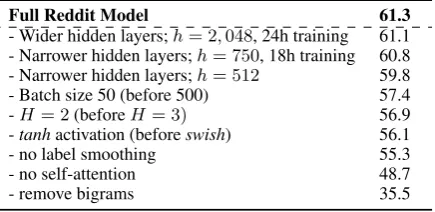
Table 2: The results of different encoder configurations on the Reddit test data (R100@1scores×100%). Start-ing from the full model (top row), each subsequent row shows a configuration with one component removed or edited from the configuration from the previous row.
The combination of the two model variants with the vector-based models results in a total of 10
baseline methods, as listed in Table3.
Evaluation Protocol. We rely on a standard IR evaluation measure used in prior work on
retrieval-based dialogue (Lowe et al., 2017; Zhou et al.,
2018;Chaudhuri et al.,2018):Recall@k. Given a
set ofN responses to the given input/query, where
only one response is relevant, it indicates whether
the relevant response occurs in the topkranked
can-didate responses. We refer to this evaluation
mea-sure asRN@k, and setN = 100;k= 1:R100@1.
This effectively means that for each query, we in-dicate if the correct response is the top ranked re-sponse between 100 candidates. The final score is the average across all queries.
4 Results and Discussion
This section aims to provide answers to the two
main questions posed in §1: which encoder
ar-chitectures are more suitable for pretraining (Q1;
§4.1), and how to adapt/fine-tune the pretrained
model to target tasks (Q2; §4.2).
4.1 Reddit Pretraining
The full encoder model is described in §2.1and
[image:6.595.309.527.201.307.2]anal-REDDIT OPENSUB AMAZONQA UBUNTU BANKING SEMEVAL15
TF-IDF 26.7 10.9 51.8 27.5 27.3 38.0
BM25 27.6 10.9 52.3 19.6 23.4 35.5
USE-SIM 36.6 13.6 47.6 11.5 18.2 36.0
USE-MAP 40.8 15.8 54.4 17.2 79.2 45.5
USE-LARGE-SIM 41.4 14.9 51.3 13.6 27.3 44.0
USE-LARGE-MAP 47.7 18.0 61.9 18.5 81.8 56.5
ELMO-SIM 12.5 9.5 16.0 3.5 6.5 19.5
ELMO-MAP 19.3 12.3 33.0 6.2 87.0 34.5
BERT-SMALL-SIM 17.1 13.8 27.8 4.1 13.0 13.0
BERT-SMALL-MAP 24.5 17.5 45.8 9.0 77.9 37.5
BERT-LARGE-SIM 14.8 12.2 25.9 3.6 10.4 10.0
BERT-LARGE-MAP 24.0 16.8 44.1 8.0 68.8 34.5
REDDIT-DIRECT 61.3 19.1 61.4 9.6 27.3 46.0
TARGET-ONLY - 29.0 (18.2) 83.3 (11.6) 6.2 ( 2.3) 88.3 ( 1.2) 7.5 ( 1.1)
FT-DIRECT - 30.6(40.0) 84.2(30.8) 38.7(51.9) 94.8(55.3) 52.5 (55.2)
FT-MIXED - 25.5 (60.0) 77.0 (59.6) 38.1 (59.4) 90.9 (59.8) 56.5(59.4)
Table 3: Summary of the results (R100@1scores ×100%) with fine-tuning on all six target domains. Datasets are ordered left to right based on their size. The scores in the parentheses in theTARGET-ONLY,FT-DIRECTand
FT-MIXED rows give the performance on the general-domain REDDITtest data. The scores are computed with de-duplicated inputs for SEMEVAL15 (i.e., the initial dataset links more responses to the same input), and de-duplicated answers for banking.
yse performance of other encoder configurations, which can be seen as ablated or varied versions of
the full model. The results on theREDDITresponse
selection task are summarised in Table2.
Results and Discussion. The scores suggest that the final model gets contribution from its multiple
components: e.g., replacingtanhwith the recently
proposed swish activation (Ramachandran et al.,
2017) is useful, and label smoothing also helps.
De-spite contradictory findings from prior work related
to the batch size (e.g., compare (Smith et al.,2017)
and (Masters and Luschi,2018)), we obtain better
results with larger batches. This is intuitive given the model design: increasing the batch size in fact means learning from a larger number of negative examples. The results also suggest that the model saturates when provided with a sufficient number of parameters, as wider hidden layers and longer training times did not yield any substantial gains.
The scores also show the benefits of self-attention and positional embeddings instead of deep feed-forward averaging of the input unigram
and bigram embeddings (Iyyer et al.,2015). This is
in line with prior work on sentence encoders (Cer
et al.,2018;Yang et al.,2018), which reports simi-lar gains on several classification tasks. Finally, we observe a large gap with the unigram-only model variant, confirming the importance of implicitly
representing underlying sequences withn-grams
(Henderson et al.,2017;Mrkši´c et al.,2017a). Fol-lowing the results, we fix the pretraining model in
all follow-up experiments (top row in Table2).
4.2 Target-Domain Fine-Tuning
Results and Discussion.The main results on all target tasks after fine-tuning are summarised in
Table 3. First, the benefits of Reddit pretraining
and fine-tuning are observed in all tasks regard-less of the in-domain data size. We report large
gains over theTARGET-ONLYmodel (which trains
a domain-specific response selection encoder from scratch) especially for tasks with smaller
train-ing datasets (e.g., BANKING, SEMEVAL15). The
low scores ofTARGET-ONLYwith smaller training
data suggest overfitting: the encoder architecture cannot see enough training examples to learn to generalise. The gains are also present even when
TARGET-ONLYgets to see much more in-domain input-response training data: e.g., we see slight
im-provements on OPENSUBandAMAZONQA, and
large gains onUBUNTUwhen relying on the FT
-DIRECTfine-tuning variant.
What is more, a comparison toREDDIT-DIRECT
further suggests that fine-tuning even with a small amount of in-domain data can lead to large
im-provements: e.g., the gains overREDDIT-DIRECT
are +67.5% on BANKING, +32.5% on UBUNTU,
+22.8% onAMAZONQA, and +11.5% on OPEN
-SUB. These results lead to the following crucial
(a)ELMO-SIM (b)USE-MAP
[image:8.595.75.523.63.275.2](c)REDDIT-DIRECT(no fine-tuning) (d)FT-MIXED(with fine-tuning)
Figure 4: t-SNE plots (van der Maaten and Hinton,2012) of encoded questions/inputs for a selection of 10 cate-gories from theBANKINGtest set. The most coherent clusters for each category with well-defined semantics are observed with theFT-MIXEDfine-tuning model applied on top of Reddit response selection pretraining.
selection Reddit data and scarce in-domain data is effectively achieved through the proposed training regime, and both components are crucial for the final improved performance in each target domain. In simple words, this finding confirms the impor-tance of fine-tuning for the response selection task.
Comparison to Baselines. The results ofTF-IDF
and BM25 reveal that lexical evidence from the
preceding input can partially help in the response selection task and it achieves reasonable perfor-mance across the target tasks. For instance, on some
tasks (e.g., AMAZONQA, BANKING), such
key-word matching baselines even outperform some of the vector-based baseline models, and are
compara-ble to theREDDIT-DIRECTmodel variant. They are
particularly strong forAMAZONQA andUBUNTU,
possibly because rare and technical words (e.g., the product name) are very informative in these do-mains. However, these baselines are substantially outperformed by the proposed fine-tuning approach across the board.
A comparison to other pretrained sentence
en-coders in Table3further stresses the importance
of training for the response selection task in par-ticular. Using off-the-shelf sentence encoders such
asUSE orBERTdirectly on in-domain sentences
without distinguishing the input and the response space leads to degraded performance compared
even toTF-IDF, or theREDDIT-DIRECT baseline
without in-domain fine-tuning. The importance of
learning the mapping from input to response ver-sus simply relying on similarity is also
exempli-fied by the comparison between theMAPmethod
and the simpleSIMmethod: regardless of the
ac-tual absolute performance,MAPleads to substantial
gains overSIMfor all vector-based baseline models.
However, even theMAPmethod cannot match the
performance of our two-step training regime: we
report substantial gains with ourFT-DIRECTand
FT-MIXEDfine-tuning on top of Reddit pretraining
for all target domains but one (SEMEVAL15).
Further Discussion. The comparison of two
fine-tuning strategies suggests that the simplerFT
-DIRECT fine-tuning has an edge overFT-MIXED,
and it seems that the gap betweenFT-DIRECTand
FT-MIXEDis larger on bigger datasets. However, as
expected,FT-DIRECTadapts to the target task more
aggressively: this leads to its degraded performance on the general-domain Reddit response selection
task, see the scores in parentheses in Table3. With
more in-domain training dataFT-DIRECTbecomes
worse on theREDDITtest set. On the other hand,FT
-MIXEDmanages to maintain its high performance onREDDITdue to the in-batch mixing used in the
fine-tuning process.13
Qualitative Analysis. The effect of fine-tuning
is also exemplified by t-SNE plots for theBANK
-13
INGdomain shown in Figure4.14Recall that in our
BANKINGFAQ dataset several questions map to the same response, and ideally such questions should be clustered together in the semantic space. While
we do not see such patterns at all with ELMO
-encoded questions without mapping (ELMO-SIM,
Figure4a), such clusters can already be noticed
withUSE-MAP(Figure4b) and with the model
pre-trained on Reddit without fine-tuning (Figure4c).
However, fine-tuning yields the most coherent clus-ters by far: it attracts encodings of all similar ques-tions related to the same category closer to each other in the semantic space. This is in line with the
results reported in Table3.
5 Related Work
Retrieval-Based Dialogue Systems.
Retrieval-based systems (Yan et al.,2016;Bartl and Spanakis,
2017;Wu et al.,2017;Song et al.,2018;Weston et al., 2018,inter alia) provide less variable
out-put than generative dialogue systems (Wen et al.,
2015,2017a;Vinyals and Le,2015), but they offer a crucial advantage of producing more informative, semantically relevant, controllable, and
grammati-cally correct responses (Ji et al.,2014). Unlike
mod-ular and end-to-end task-oriented systems (Young,
2010;Wen et al.,2017b;Mrkši´c and Vuli´c,2018;Li et al.,2018), they do not require expensive curated domain ontologies, and bypass the modelling of complex domain-specific decision-making policy modules (Gaši´c et al.,2015;Chen et al.,2017). De-spite these desirable properties, their potential has not been fully exploited in task-oriented dialogue. Their fundamental building block is response
selection (Banchs and Li,2012;Wang et al.,2013;
Al-Rfou et al.,2016;Baudis and Sedivý,2016). We have witnessed a recent rise of interest in neural
architectures for modelling response selection (Wu
et al., 2017;Chaudhuri et al., 2018; Zhou et al., 2018;Tao et al.,2019), but the progress is still hin-dered by insufficient domain-specific training data (El Asri et al.,2017;Budzianowski et al.,2018). While previous work typically focused on a
sin-gle domain (e.g., Ubuntu technical chats (Lowe
et al.,2015,2017)), in this work we show that much larger general-domain Reddit data can be leveraged to pretrain response selection models that support more specialised target dialogue domains.
14
For clarity, we show the plots with 10 (out of 77) se-lected categories, while the full plots with all 77 categories are available in the supplemental material.
To the best of our knowledge, the work of
Hen-derson et al.(2017) andYang et al.(2018) is closest to our response selection pretraining introduced in
§2.1. However,Henderson et al.(2017) optimise
their model for one single task: replying to e-mails
with short messages (Kannan et al.,2016). They use
a simpler feed-forward encoder architecture and do not consider wide portability of a single general-domain response selection model to diverse target
domains through fine-tuning.Yang et al.(2018) use
Reddit conversational context to simply probe
se-mantic similarity of sentences (Agirre et al.,2012,
2013; Nakov et al., 2016), but they also do not
investigate response selection fine-tuning across diverse target domains.
Pretraining and Fine-Tuning. Task-specific fine-tuning of language models (LMs) pretrained
on large unsupervised corpora (Peters et al.,2018;
Devlin et al.,2019;Howard and Ruder,2018;
Rad-ford et al.,2018;Lample and Conneau,2019;Liu
et al., 2019) has taken NLP by storm. Such
LM-based pretrained models support a variety of NLP tasks, ranging from syntactic parsing to natural
lan-guage inference (Peters et al.,2018;Devlin et al.,
2019), as well as machine reading comprehension
(Nishida et al.,2018;Xu et al.,2019) and
informa-tion retrieval tasks (Nogueira and Cho,2019;Yang
et al.,2019). In this work, instead of the LM-based pretraining, we put focus on the response selection pretraining in particular, and show that such
mod-els coupled with target task fine-tuning (Howard
and Ruder,2018) lead to improved modelling of
conversational data in various domains.
6 Conclusion and Future Work
References
Eneko Agirre, Daniel Cer, Mona Diab, and Aitor Gonzalez-Agirre. 2012. SemEval-2012 Task 6: A pilot on semantic textual similarity. InProceedings of *SEM, pages 385–393.
Eneko Agirre, Daniel Cer, Mona Diab, Aitor Gonzalez-Agirre, and Weiwei Guo. 2013. *sem 2013 shared task: Semantic textual similarity. InProceedings of *SEM, pages 32–43.
Rami Al-Rfou, Marc Pickett, Javier Snaider, Yun-Hsuan Sung, Brian Strope, and Ray Kurzweil. 2016.
Conversational contextual cues: The case of person-alization and history for response ranking. CoRR, abs/1606.00372.
Rafael E. Banchs and Haizhou Li. 2012. IRIS: A chat-oriented dialogue system based on the vector space model. InProceedings of ACL System Demos, pages 37–42.
Alexander Bartl and Gerasimos Spanakis. 2017. A retrieval-based dialogue system utilizing utterance and context embeddings. CoRR, abs/1710.05780.
Petr Baudis and Jan Sedivý. 2016. Sentence pair scor-ing: Towards unified framework for text comprehen-sion.CoRR, abs/1603.06127.
Antoine Bordes, Y.-Lan Boureau, and Jason Weston. 2017. Learning end-to-end goal-oriented dialog. In
Proceedings of ICLR.
Paweł Budzianowski, Tsung-Hsien Wen, Bo-Hsiang Tseng, Iñigo Casanueva, Stefan Ultes, Osman Ra-madan, and Milica Gaši´c. 2018. MultiWOZ - A large-scale multi-domain wizard-of-oz dataset for task-oriented dialogue modelling. InProceedings of EMNLP, pages 5016–5026.
Daniel Cer, Yinfei Yang, Sheng-yi Kong, Nan Hua, Nicole Limtiaco, Rhomni St. John, Noah Constant, Mario Guajardo-Cespedes, Steve Yuan, Chris Tar, Yun-Hsuan Sung, Brian Strope, and Ray Kurzweil. 2018. Universal sentence encoder. CoRR, abs/1803.11175.
Debanjan Chaudhuri, Agustinus Kristiadi, Jens Lehmann, and Asja Fischer. 2018. Improving response selection in multi-turn dialogue systems by incorporating domain knowledge. InProceedings of CoNLL, pages 497–507.
Ciprian Chelba, Tomas Mikolov, Mike Schuster, Qi Ge, Thorsten Brants, and Phillipp Koehn. 2013. One bil-lion word benchmark for measuring progress in sta-tistical language modeling. In Proceedings of IN-TERPSEECH, pages 2635–2639.
Hongshen Chen, Xiaorui Liu, Dawei Yin, and Jiliang Tang. 2017. A survey on dialogue systems: Recent advances and new frontiers. SIGKDD Explorations Newsletter, 19(2):25–35.
Valeriu Codreanu, Damian Podareanu, and Vikram A. Saletore. 2017. Scale out for large minibatch SGD: Residual network training on ImageNet-1K with im-proved accuracy and reduced time to train. CoRR, abs/1711.04291.
Scott C. Deerwester, Susan T. Dumais, Thomas K. Lan-dauer, George W. Furnas, and Richard A. Harshman. 1990. Indexing by Latent Semantic Analysis. Jour-nal of the American Society for Information Science, 41(6):391–407.
Jacob Devlin, Ming-Wei Chang, Kenton Lee, and Kristina Toutanova. 2019. BERT: Pre-training of deep bidirectional transformers for language under-standing. In Proceedings of NAACL-HLT, pages 4171–4186.
Wenchao Du and Alan Black. 2018. Data augmenta-tion for neural online chats response selecaugmenta-tion. In
Proceedings of the 2nd International Workshop on Search-Oriented Conversational AI, pages 52–58.
Layla El Asri, Hannes Schulz, Shikhar Sharma, Jeremie Zumer, Justin Harris, Emery Fine, Rahul Mehrotra, and Kaheer Suleman. 2017. Frames: A corpus for adding memory to goal-oriented dialogue systems. InProceedings of SIGDIAL, pages 207– 219.
Milica Gaši´c, Nikola Mrkši´c, Pei-Hao Su, David Vandyke, Tsung-Hsien Wen, and Steve Young. 2015.
Policy committee for adaptation in multi-domain spoken dialogue systems. InProceedings of ASRU, pages 806–812.
Priya Goyal, Piotr Dollár, Ross B. Girshick, Pieter No-ordhuis, Lukasz Wesolowski, Aapo Kyrola, Andrew Tulloch, Yangqing Jia, and Kaiming He. 2017. Ac-curate, large minibatch SGD: Training ImageNet in 1 hour.CoRR, abs/1706.02677.
Mandy Guo, Qinlan Shen, Yinfei Yang, Heming Ge, Daniel Cer, Gustavo Hernandez Abrego, Keith Stevens, Noah Constant, Yun-hsuan Sung, Brian Strope, and Ray Kurzweil. 2018. Effective parallel corpus mining using bilingual sentence embeddings. InProceedings of WMT, pages 165–176.
Kaiming He, Xiangyu Zhang, Shaoqing Ren, and Jian Sun. 2015. Delving deep into rectifiers: Surpass-ing human-level performance on ImageNet classifi-cation. InProceedings of ICCV, pages 1026–1034.
Matthew Henderson, Rami Al-Rfou, Brian Strope, Yun-Hsuan Sung, László Lukács, Ruiqi Guo, Sanjiv Ku-mar, Balint Miklos, and Ray Kurzweil. 2017. Effi-cient natural language response suggestion for smart reply.CoRR, abs/1705.00652.
Matthew Henderson, Blaise Thomson, and Jason D. Wiliams. 2014a. The Second Dialog State Tracking Challenge. InProceedings of SIGDIAL, pages 263– 272.
Matthew Henderson, Blaise Thomson, and Steve Young. 2014b. Word-based dialog state tracking with recurrent neural networks. InProceedings of SIGDIAL, pages 292–299.
Jeremy Howard and Sebastian Ruder. 2018. Universal language model fine-tuning for text classification. In
Proceedings of ACL, pages 328–339.
Mohit Iyyer, Varun Manjunatha, Jordan Boyd-Graber, and Hal Daumé III. 2015. Deep unordered compo-sition rivals syntactic methods for text classification. InProceedings of ACL, pages 1681–1691.
Zongcheng Ji, Zhengdong Lu, and Hang Li. 2014. An information retrieval approach to short text conver-sation.CoRR, abs/1408.6988.
Anjuli Kannan, Karol Kurach, Sujith Ravi, Tobias Kaufmann, Andrew Tomkins, Balint Miklos, Greg Corrado, László Lukács, Marina Ganea, Peter Young, and Vivek Ramavajjala. 2016. Smart Reply: Automated response suggestion for email. In Pro-ceedings of KDD, pages 955–964.
Günter Klambauer, Thomas Unterthiner, Andreas Mayr, and Sepp Hochreiter. 2017. Self-normalizing neural networks.CoRR, abs/1706.02515.
Guillaume Lample and Alexis Conneau. 2019. Cross-lingual language model pretraining. CoRR, abs/1901.07291.
Jiwei Li, Michel Galley, Chris Brockett, Jianfeng Gao, and Bill Dolan. 2016. A diversity-promoting objec-tive function for neural conversation models. In Pro-ceedings of NAACL-HLT, pages 110–119.
Xiujun Li, Yun-Nung Chen, Lihong Li, Jianfeng Gao, and Asli Celikyilmaz. 2017. End-to-end task-completion neural dialogue systems. InProceedings of IJCNLP, pages 733–743.
Xiujun Li, Sarah Panda, Jingjing Liu, and Jianfeng Gao. 2018. Microsoft dialogue challenge: Building end-to-end task-completion dialogue systems. CoRR, abs/1807.11125.
Pierre Lison and Jörg Tiedemann. 2016. OpenSub-titles2016: Extracting large parallel corpora from movie and TV subtitles. InProceedings of LREC.
Fei Liu and Julien Perez. 2017.Gated end-to-end mem-ory networks. InProceedings of EACL, pages 1–10.
Xiaodong Liu, Pengcheng He, Weizhu Chen, and Jianfeng Gao. 2019. Multi-task deep neural net-works for natural language understanding. CoRR, abs/1901.11504.
Ryan Lowe, Nissan Pow, Iulian V. Serban, and Joelle Pineau. 2015. The Ubuntu dialogue corpus: A large dataset for research in unstructured multi-turn dia-logue systems. InProceedings of SIGDIAL, pages 285–294.
Ryan Thomas Lowe, Nissan Pow, Iulian Vlad Serban, Laurent Charlin, Chia-Wei Liu, and Joelle Pineau. 2017. Training end-to-end dialogue systems with the ubuntu dialogue corpus. Dialogue & Discourse, 8(1):31–65.
Laurens van der Maaten and Geoffrey E. Hinton. 2012.
Visualizing non-metric similarities in multiple maps.
Machine Learning, 87(1):33–55.
Yury A. Malkov and D. A. Yashunin. 2016. Efficient and robust approximate nearest neighbor search using Hierarchical Navigable Small World graphs.
CoRR, abs/1603.09320.
Christopher D. Manning, Prabhakar Raghavan, and Hinrich Schütze. 2008. Introduction to Information Retrieval. Cambridge University Press.
Dominic Masters and Carlo Luschi. 2018. Revisit-ing small batch trainRevisit-ing for deep neural networks.
CoRR, abs/1804.07612.
Nikola Mrkši´c and Ivan Vuli´c. 2018. Fully statistical neural belief tracking. InProceedings of ACL, pages 108–113.
Nikola Mrkši´c, Diarmuid Ó Séaghdha, Blaise Thom-son, Milica Gaši´c, Pei-Hao Su, David Vandyke, Tsung-Hsien Wen, and Steve Young. 2015. Multi-domain dialog state tracking using recurrent neural networks. InProceedings of ACL, pages 794–799.
Nikola Mrkši´c, Diarmuid Ó Séaghdha, Blaise Thom-son, Tsung-Hsien Wen, and Steve Young. 2017a.
Neural Belief Tracker: Data-driven dialogue state tracking. InProceedings of ACL, pages 1777–1788.
Nikola Mrkši´c, Ivan Vuli´c, Diarmuid Ó Séaghdha, Ira Leviant, Roi Reichart, Milica Gaši´c, Anna Korho-nen, and Steve Young. 2017b. Semantic specialisa-tion of distribuspecialisa-tional word vector spaces using mono-lingual and cross-mono-lingual constraints. Transactions of the ACL, pages 314–325.
Preslav Nakov, Lluís Màrquez, Walid Magdy, Alessan-dro Moschitti, Jim Glass, and Bilal Randeree. 2015.
SemEval-2015 Task 3: Answer selection in com-munity question answering. InProceedings of SE-MEVAL, pages 269–281.
Preslav Nakov, Lluís Màrquez, Alessandro Moschitti, Walid Magdy, Hamdy Mubarak, abed Alhakim Frei-hat, Jim Glass, and Bilal Randeree. 2016. SemEval-2016 Task 3: Community question answering. In
Proceedings of SEMEVAL, pages 525–545.
Multi-task learning of information retrieval and read-ing comprehension. InProceedings of CIKM, pages 647–656.
Rodrigo Nogueira and Kyunghyun Cho. 2019.Passage re-ranking with BERT.CoRR, abs/1901.04085.
Gabriel Pereyra, George Tucker, Jan Chorowski, Lukasz Kaiser, and Geoffrey E. Hinton. 2017. Regu-larizing neural networks by penalizing confident out-put distributions.CoRR, abs/1701.06548.
Matthew Peters, Mark Neumann, Mohit Iyyer, Matt Gardner, Christopher Clark, Kenton Lee, and Luke Zettlemoyer. 2018. Deep contextualized word rep-resentations. InProceedings of NAACL-HLT, pages 2227–2237.
Alec Radford, Karthik Narasimhan, Tim Salimans, and Ilya Sutskever. 2018. Improving language under-standing with unsupervised learning. Technical Re-port, OpenAI.
Prajit Ramachandran, Barret Zoph, and Quoc V. Le. 2017. Searching for activation functions. CoRR, abs/1710.05941.
Alan Ritter, Colin Cherry, and Bill Dolan. 2010. Unsu-pervised modeling of Twitter conversations. In Pro-ceedings of NAACL-HLT, pages 172–180.
Stephen Robertson and Hugo Zaragoza. 2009. The probabilistic relevance framework: BM25 and be-yond. Foundations and Trends in Information Re-trieval, 3(4):333–389.
Nicolas Schrading, Cecilia Ovesdotter Alm, Ray Ptucha, and Christopher Homan. 2015. An analysis of domestic abuse discourse on Reddit. In Proceed-ings of EMNLP, pages 2577–2583.
Iulian Vlad Serban, Alessandro Sordoni, Yoshua Ben-gio, Aaron C. Courville, and Joelle Pineau. 2016.
Building end-to-end dialogue systems using genera-tive hierarchical neural network models. In Proceed-ings of AAAI, pages 3776–3784.
Pararth Shah, Dilek Hakkani-Tür, Bing Liu, and Gokhan Tür. 2018. Bootstrapping a neural conversa-tional agent with dialogue self-play, crowdsourcing and on-line reinforcement learning. InProceedings of NAACL-HLT, pages 41–51.
Samuel L. Smith, Pieter-Jan Kindermans, and Quoc V. Le. 2017. Don’t decay the learning rate, increase the batch size. InProceedings of ICLR.
Yiping Song, Cheng-Te Li, Jian-Yun Nie, Ming Zhang, Dongyan Zhao, and Rui Yan. 2018. An ensem-ble of retrieval-based and generation-based human-computer conversation systems. InProceedings of IJCAI, pages 4382–4388.
Christian Szegedy, Vincent Vanhoucke, Sergey Ioffe, Jonathon Shlens, and Zbigniew Wojna. 2016. Re-thinking the inception architecture for computer vi-sion. InProceedings of CVPR, pages 2818–2826.
Chongyang Tao, Wei Wu, Can Xu, Wenpeng Hu, Dongyan Zhao, and Rui Yan. 2019. Multi-representation fusion network for multi-turn re-sponse selection in retrieval-based chatbots. In Pro-ceedings of WSDM, pages 267–275.
Ashish Vaswani, Noam Shazeer, Niki Parmar, Jakob Uszkoreit, Llion Jones, Aidan N. Gomez, Lukasz Kaiser, and Illia Polosukhin. 2017. Attention is all you need. In Proceedings of NIPS, pages 6000– 6010.
Oriol Vinyals and Quoc Le. 2015. A Neural Conversa-tional Model. InProceedings of ICML Deep Learn-ing Workshop.
Mengting Wan and Julian McAuley. 2016. Modeling ambiguity, subjectivity, and diverging viewpoints in opinion question answering systems. In Proceed-ings of ICDM, pages 489–498.
Hao Wang, Zhengdong Lu, Hang Li, and Enhong Chen. 2013. A dataset for research on short-text conversa-tions. InProceedings of EMNLP, pages 935–945.
Tsung-Hsien Wen, Milica Gasic, Nikola Mrkši´c, Pei-Hao Su, David Vandyke, and Steve Young. 2015.
Semantically conditioned LSTM-based natural lan-guage generation for spoken dialogue systems. In
Proceedings of EMNLP, pages 1711–1721.
Tsung-Hsien Wen, Yishu Miao, Phil Blunsom, and Steve J. Young. 2017a. Latent intention dialogue models. InProceedings of ICML, pages 3732–3741.
Tsung-Hsien Wen, David Vandyke, Nikola Mrkši´c, Milica Gaši´c, Lina M. Rojas-Barahona, Pei-Hao Su, Stefan Ultes, and Steve Young. 2017b. A network-based end-to-end trainable task-oriented dialogue system. InProceedings of EACL, pages 438–449.
Jason Weston, Emily Dinan, and Alexander Miller. 2018. Retrieve and refine: Improved sequence gen-eration models for dialogue. InProceedings of the 2018 EMNLP Workshop SCAI: The 2nd Interna-tional Workshop on Search-Oriented ConversaInterna-tional AI, pages 87–92.
Yu Wu, Wei Wu, Chen Xing, Ming Zhou, and Zhou-jun Li. 2017. Sequential matching network: A new architecture for multi-turn response selection in retrieval-based chatbots. InProceedings of ACL, pages 496–505.
Hu Xu, Bing Liu, Lei Shu, and Philip S. Yu. 2019.
BERT post-training for review reading comprehen-sion and aspect-based sentiment analysis. CoRR, abs/1904.02232.
Rui Yan, Yiping Song, and Hua Wu. 2016. Learning to respond with deep neural networks for retrieval-based human-computer conversation system. In Pro-ceedings of SIGIR, pages 55–64.
Yinfei Yang, Steve Yuan, Daniel Cer, Sheng-Yi Kong, Noah Constant, Petr Pilar, Heming Ge, Yun-hsuan Sung, Brian Strope, and Ray Kurzweil. 2018. Learn-ing semantic textual similarity from conversations. InProceedings of The 3rd Workshop on Representa-tion Learning for NLP, pages 164–174.
Steve Young. 2010. Still talking to machines (cogni-tively speaking). InProceedings of INTERSPEECH, pages 1–10.