5484
Robust Zero-Shot Cross-Domain Slot Filling with Example Values
Darsh J Shah*1,Raghav Gupta*2,Amir A Fayazi2, andDilek Hakkani-T ¨ur3
1MIT CSAIL, Cambridge, MA
2Google Research, Mountain View, CA
3Amazon Alexa AI, Sunnyvale, CA
[email protected], {raghavgupta,amiraf}@google.com, [email protected]
Abstract
Task-oriented dialog systems increasingly rely on deep learning-based slot filling models, usually needing extensive labeled training data for target domains. Often, however, little to no target domain training data may be available, or the training and target domain schemas may be misaligned, as is common for web forms on similar websites. Prior zero-shot slot filling models use slot descriptions to learn concepts, but are not robust to misaligned schemas. We propose utilizing both the slot description and a small number of examples of slot values, which may be easily available, to learn seman-tic representations of slots which are transfer-able across domains and robust to misaligned schemas. Our approach outperforms state-of-the-art models on two multi-domain datasets, especially in the low-data setting.
1 Introduction
Goal-oriented dialog systems assist users with tasks such as finding flights, booking restaurants and, more recently, navigating user interfaces, through natural language interactions. Slot fill-ing models, which identify task-specific parame-ters/slots (e.g. flight date, cuisine) from user ut-terances, are key to the underlying spoken lan-guage understanding (SLU) systems. Advances in SLU have enabled virtual assistants such as Siri, Alexa and Google Assistant. There is also signif-icant interest in adding third-party functionality to these assistants. However, supervised slot fillers (Young,2002;Bellegarda,2014) require abundant labeled training data, more so with deep learning enhancing accuracy at the cost of being data inten-sive (Mesnil et al.,2015;Kurata et al.,2016).
[image:1.595.310.523.222.265.2]Asterisk (*) denotes equal contribution. Research conducted when all authors were at Google Research.
Figure 1: Misaligned schemas for flight booking from kayak.com(top) and southwest.com(bottom): slot name departin the two schemas refers to depar-ture date and depardepar-ture city respectively, hence models trained on one schema may falter on the other.
Two key challenges with scaling slot fillers to new domains are adaptation and misaligned schemas (here, slot name mismatches). Extent of supervision may vary across domains: there may be ample data forFlightsbut none forHotels, re-quiring models to leverage the former to learn se-mantics of reusable slots (e.g. time, destination). In addition, schemas for overlapping domains may be incompatible by way of using different names for the same slot or the same name for different slots. This is common with web form filling: two sites in the same domain may have misaligned schemas, as in Figure 1, precluding approaches that rely on schema alignment.
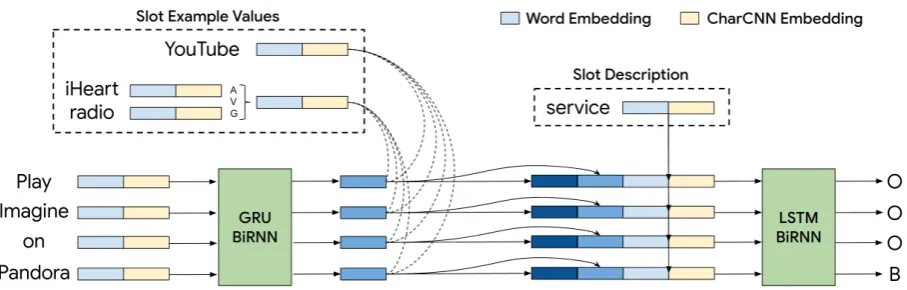
Figure 2: Illustration of the overall model with all inputs and outputs shown.
2 Related Work
Settings with resource-poor domains are typically addressed by adapting from resource-rich domains (Blitzer et al.,2006;Pan et al.,2010;Chen et al., 2018;Guo et al.,2018;Shah et al.,2018). To this end approaches such as domain adversarial learn-ing (Liu and Lane,2017) and multi-task learning (Jaech et al., 2016; Goyal et al., 2018; Siddhant et al.,2018) have been adapted to SLU and related tasks (Henderson et al.,2014). Work targeting do-main adaptation specifically for this area includes, modeling slots as hierarchical concepts (Zhu and Yu,2018) and using ensembles of models trained on data-rich domains (Gaˇsi´c et al., 2015; Kim et al.,2017;Jha et al.,2018).
The availability of task descriptions has made zero-shot learning (Norouzi et al., 2013; Socher et al.,2013) popular. In particular, work on zero-shot utterance intent detection has relied on varied resources such as click logs (Dauphin et al.,2013) and manually defined domain ontologies (Kumar et al.,2017), as well as models such as deep struc-tured semantic models (Chen et al.,2016) and cap-sule networks (Xia et al.,2018). Zero-shot seman-tic parsing is addressed in Krishnamurthy et al. (2017) andHerzig and Berant(2018) and specifi-cally for SLU utilizing external resources such as label ontologies in Ferreira et al. (2015a,b) and handwritten intent attributes inYazdani and Hen-derson (2015); Chen et al. (2015). Our work is closest in spirit to Bapna et al. (2017) and Lee and Jha(2018), who employ textual slot descrip-tions to scale to unseen intents/slots. Since slots tend to take semantically similar values across ut-terances, we augment our model with example values, which are easier for developers to define than manual alignments across schemas (Li et al., 2011).
3 Problem Statement
We frame our conditional sequence tagging task as follows: given a user utterance withT tokens and a slot type, we predict inside-outside-begin (IOB) tags{y1, y2. . . yT}using 3-way classification per
token, based on if and where the provided slot type occurs in the utterance. Figure 3 shows IOB tag sequences for one positive (slotservice, present in the utterance) and one negative (slot timeRange, not present in the utterance) instance each.
service O O O B I
↑ ↑ ↑ ↑ ↑
Play Imagine on iHeart Radio
↓ ↓ ↓ ↓ ↓
[image:2.595.316.519.395.449.2]timeRange O O O O O
Figure 3: Example semantic frame withIOBslot an-notations for a positive and a negative instance.
4 Model Architecture
Figure2 illustrates our model architecture where a user utterance is tagged for a provided slot. To represent the input slot, along with a textual slot description as inBapna et al.(2017), we supply a small set of example values for this slot, to pro-vide a more complete semantic representation.1 Detailed descriptions of each component follow.
Inputs:We use as inputdwc-dimensional
embed-dings for 3 input types: T user utterance tokens {ui ∈Rdwc,1≤i≤T},Sinput slot description
to-kens{di ∈Rdwc,1≤i≤S}, andKexample values
for the slot, with theNktoken embedding for the
kthexample denoted by{eki ∈Rdwc,1≤i≤N
k}.
Utterance encoder:We encode the user utterance using aden-dimensional bidirectional GRU
recur-1Note that the slot description is still needed since example
Intent Slot Names (Training and Evaluation)
AddToPlaylist artist, entityName, musicItem, playlist, playlistOwner
BookRestaurant city, cuisine, partySizeNumber, restaurantName, restaurantType, servedDish, spatialRelation, state. . . GetWeather city, conditionDescription, country, geographicPoi, spatialRelation, state, timeRange. . .
PlayMusic album, artist, genre, musicItem, playlist, service, sort, track, year
RateBook bestRating, objectName, objectPartOfSeriesType, objectSelect, objectType, ratingUnit, ratingValue SearchCreativeWork objectName, objectType
FindScreeningEvent locationName, movieName, movieType, objectLocationType, objectType, spatialRelation, timeRange
Intent Training Slot Names Evaluation Slot Names
BookBus from, to, leaving, returning, travelers, tripType, departureTime
from, to, departOn, addReturnTrip, tripType, promoCode, discountOptions, children, adults, seniors
FindFlights from, to, depart, return, cabinClass, flightType depart, arrive, departDate, returnDate, searchType, promoCode BookRoom where, checkIn, checkOut, guests, homeType,
propertyType, priceRange, amenities
[image:3.595.77.522.61.217.2]location, hotelName, checkIn, checkOut, rooms, roomType, pricePerNight, rating, amenities
Table 1: Intents and training/evaluation slot schemas for SNIPS (top) and XSchema (bottom) datasets.
rent neural network (RNN) (Chung et al., 2014). We denote the set of per-token RNN hidden states byH ={hi ∈Rden,1≤i≤T}, which are used as
contextual utterance token encodings.
H=BiGRU({ui,1≤i≤T}) (1)
Slot description encoder:We obtain an encoding
ds∈
Rdwc of the slot description by mean-pooling
the embeddings for theSslot description tokens.
ds= 1
S
S X
i=1
di (2)
Slot example encoder: We first obtain encod-ings{ex
k ∈Rdwc,1≤k≤K}for each slot example
value by mean-pooling theNktoken embeddings.
Then, we compute an attention weighted encod-ing of allK slot examples{ea
i ∈ Rdwc, i≤1≤T}
for each utterance token, with the utterance token encoding as attention context. Here,αxi ∈RK
de-notes attention weights over all K slot examples corresponding to theithutterance token, obtained with general cosine similarity (Luong et al.,2015).
exk= 1
Nk Nk
X
i=1
eki,1≤k≤K (3)
αxi =sof tmax({hiWaexk∀k}),1≤i≤T (4)
eai = K X
k=1
αxi
k×e
x
k (5)
Tagger: We feed the concatenated utterance, slot description and example encodings to aden
-dimensional bidirectional LSTM. The output hid-den statesX={xi ∈Rden,1≤i≤T}are used for
a 3-way IOB tag classification per token.
X=BiLST M({hi⊕ds⊕eai,1≤i≤T}) (6)
yi =sof tmax(Wtxi+bt),1≤i≤T (7)
Parameters: We use fixed dw=128-dim
pre-trained word embeddings2for all tokens. We also train per-character embeddings, fed to a 2-layer convolutional neural network (Kim, 2014) to get adc=32-dim token embedding. For all inputs, the
dwc=160-dim final embedding is the concatena-tion of the word and char-CNN embeddings. The RNN encoders have hidden state size den=128.
All trainable weights are shared across intents and slots. The model relies largely on fixed word em-beddings to generalize to new intents/slots.
5 Datasets and Experiments
In this section we describe the datasets used for evaluation, baselines compared against, and more details on the experimental setup.
Datasets: In order to evaluate cross-domain transfer learning ability and robustness to mis-aligned schemas, respectively, we use the follow-ing two SLU datasets to evaluate all models.
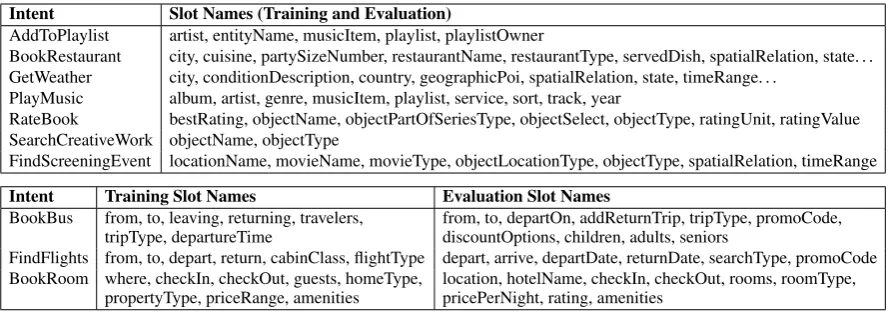
• SNIPS: This is a public SLU dataset (Coucke et al., 2018) of crowdsourced user utterances with 39 slots across 7 intents and∼2000 train-ing instances per intent. Since 11 of these slots are shared (see Table1), we use this dataset to evaluate cross-domain transfer learning.
• XSchema: This is an in-house crowdsourced dataset with 3 intents (500 training instances each). Training and evaluation utterances are annotated with different schemas (Table1) from real web forms to simulate misaligned schemas.
Baselines: We compare with two strong zero-shot baselines: Zero-shot Adaptive Transfer (ZAT) (Lee and Jha, 2018) and Concept Tagger
Target training e.g. 0 50
[image:4.595.74.291.61.175.2]Intent↓Model→ CT ZAT +2Ex LSTM CT ZAT +10Ex AddToPlaylist 53.3 46.8 55.2 59.4 74.4 73.4 76.2* BookRestaurant 45.7 46.648.6* 57.5 63.8 63.5 63.6 GetWeather 63.5 60.766.0* 75.7 72.1 71.1 77.5* PlayMusic 28.7 30.133.8* 49.3 56.4 56.0 58.8 RateBook 24.5 31.0 28.5 85.1* 82.9 83.8 82.2 SearchCreativeWork 24.7 26.7 26.2 52.9 62.8 63.7 65.9 FindScreeningEvent 23.7 19.725.5* 60.8 64.9 64.6 67.0* Average 37.7 37.440.6* 62.8 68.2 68.0 70.1*
Table 2: Slot F1 scores for baselines (CT, ZAT, LSTM) and our best models (with 2 slot values for zero-shot and 10 values for 50 train instances) on SNIPS. Rows represent different train-test splits, defined in Section 5. Our model consistently outperforms the baselines, with∼3%absolute gain in the zero-shot setting.3
(CT) (Bapna et al., 2017), in addition to a 2-layer multi-domain bidirectional LSTM baseline (Hakkani-T¨ur et al., 2016) for non-zero-shot setups. ZAT and CT condition slot filling only on slot descriptions, with ZAT adding slot description attention, char embeddings and CRFs on top of CT. Since labor-intensive long text descriptions are unavailable for our data, we use tokenized slot names in their place, as inBapna et al.(2017).
Experimental Setup: We use SNIPS to test zero/few-shot transfer: for each target intentI, we train on all∼2000training instances from intents other thanI, and varying amounts of training data forI, evaluating exclusively onI. For XSchema, we train and evaluate on a single intent, specifi-cally evaluating cross-schema performance.
We sample positive and negative instances (Fig-ure 3) in a ratio of 1:3. Slot values input dur-ing traindur-ing and evaluation are randomly picked from values taken by the input slot in the rele-vant domain’s training set, excluding ones that are also present in the evaluation set. In practice, it is usually easy to obtain such example values for each slot either using automated methods (such as crawling from existing web forms) or have them be provided as part of the slot definition, with neg-ligible extra effort.
To improve performance on out-of-vocabulary entity names, we randomly replace slot value to-kens in utterances and slot examples with a special token, and raise the replacement rate linearly from 0 to 0.3 during training (Rastogi et al.,2018).
The final cross-entropy loss, averaged over all utterance tokens, is optimized using ADAM (Kingma and Ba, 2014) for 150K training steps.
Target training e.g. 0 50 Intent↓Model→ CT ZAT +10Ex CT ZAT +10Ex BookBus 70.9 70.1 74.1* 86.8 85.2 89.4 FindFlights 43.5 44.8 53.2* 62.3 59.7 69.2* BookRoom 23.6 23.4 33.0* 49.7 52.1 58.7*
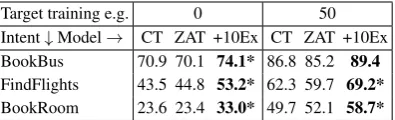
Table 3: Slot F1 scores on the XSchema dataset4. We train and evaluate on a single intent, but with different schemas, thus precluding the LSTM baseline.
Slot F1 score (Sang and Buchholz, 2000) is our final metric, reported after 3-fold cross-validation.
6 Results
For the SNIPS dataset, Table 2 shows slot F1 scores for our model trained with randomly-picked slot value examples in addition to slot de-scriptions vis-`a-vis the baselines. Our best model consistently betters the zero-shot baselines CT and ZAT, which use only slot descriptions, overall and individually for 5 of 7 intents. The average gain over CT and ZAT is∼3% in the zero-shot case. In the low-data setting, all zero-shot models gain ≥5%over the multi-domain LSTM baseline (with the 10-example-added model further gaining∼2%
on CT/ZAT). All models are comparable when all target data is used for training, with F1 scores of
87.8%for the LSTM, and 86.9%and 87.2%for CT and our model with 10 examples respectively.
Table3shows slot F1 scores for XSchema data. Our model trained with 10 example values is ro-bust to varying schemas, with gains of ∼3% on
BookBus, and ∼10% on FindFlights and Book-Roomin the zero-shot setting.
For both datasets, as more training data for the target domain is added, the baselines and our ap-proach perform more similarly. For instance, our approach improves upon the baseline by ∼0.2%
on SNIPS when 2000 training examples are used for the target domain, affirming that adding example values does not hurt in the regular setting.
Results by slot type: Example values help the most with limited-vocabulary slots not encoun-tered during training: our approach gains ≥20%
on slots such asconditionDescription,bestRating,
service(present in intentsGetWeather,RateBook,
PlayMusic respectively). Intents PlayMusic and
GetWeather, with several limited-vocabulary slots, see significant gains in the zero-shot setting.
3Asterisk (*) indicates a statistically significant gain over the
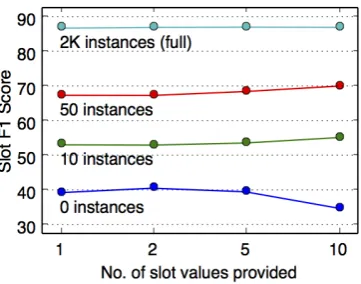
[image:4.595.319.517.62.122.2]Figure 4: Variation of overall slot F1 score with number of slot value examples input to the model, with varying number of target intent training instances for SNIPS.
For compositional open-vocabulary slots (city,
cuisine), our model also compares favorably - e.g.
53% vs27% slot F1 for unseen slot cuisine (in-tentBookRestaurant) - since the semantic similar-ity between entsimilar-ity and possible values is easier to capture than between entity and description.
Slots with open, non-compositional vocabular-ies (such as objectName,entityName) are hard to infer from slot descriptions or examples, even if these are seen during training but in other contexts, since utterance patterns are lost across intents. All models are within 5% slot F1 of each other for such slots. This is also observed for unseen open-vocabulary slots in the XSchema dataset (such as
promoCodeandhotelName).
For XSchema experiments, our model does significantly better on slots which are confusing across schemas (evidenced by gains of>20%on
departinFindFlights,roomTypeinBookRoom).
Effect of number of examples: Figure4 shows the number of slot value examples used versus performance on SNIPS. For the zero-shot case, using 2 example values per slot works best, possibly due to the model attending to perfect matches during training, impeding generalization when more example values are used. In the few-shot and normal-data settings, using more example values helps accuracy, but the gain drops with more target training data. For XSchema, in contrast, adding more example values consistently improves performance, possibly due to more slot name mistmatches in the dataset. We avoid using over 10 example values, in contrast to prior work (Krishnamurthy et al., 2017; Naik et al., 2018) since it may be infeasible to easily provide or extract a large number of values for unseen slots.
Ablation: Slot replacement offsets overfitting in our model, yielding gains of2−5%for all models incl. baselines. Fine-tuning the pretrained word embeddings and removing character embeddings yielded losses of ∼1%. We tried more complex phrase embeddings for the slot description and ex-ample values, but since both occur as short phrases in our data, a bag-of-words approach worked well.
Comparison with string matching: A train-ing and evaluation setup includtrain-ing example val-ues for slots may lend itself well to adding string matching-based slot fillers for suitable slots (for example, slots taking numeric values or having a small set of possible values). However, this is not applicable to our exact setting since we ensure that the slot values to be tagged during evaluation are never provided as input during training or evalua-tion. In addition, it is difficult to distinguish two slots with the same expected semantic type using such an approach, such as for slotsratingValueand
bestRatingfrom SNIPS intentRateBook.
7 Conclusions and Future Work
We show that extending zero-shot slot filling mod-els to use a small number of easily obtained exam-ple values for slots, in addition to textual slot de-scriptions, is a scalable solution for zero/few-shot slot filling tasks on similar and heterogenous do-mains, while resistant to misaligned overlapping schemas. Our approach surpasses prior state-of-the-art models on two multi-domain datasets.
The approach can, however, be inefficient for intents with many slots, as well as potentially sacrificing accuracy in case of overlapping pre-dictions. Jointly modeling multiple slots for the task is an interesting future direction. Another di-rection would be to incorporate zero-shot entity recognition (Guerini et al.,2018), thus eliminating the need for example values during inference.
In addition, since high-quality datasets for downstream tasks in dialogue systems (such as di-alogue state tracking and didi-alogue management) are even more scarce, exploring zero-shot learn-ing approaches to these problems is of immense value in building generalizable dialogue systems.
Acknowledgements
References
Ankur Bapna, G¨okhan T¨ur, Dilek Hakkani-T¨ur, and Larry P. Heck. 2017. Towards zero-shot frame semantic parsing for domain scaling. In speech 2017, 18th Annual Conference of the Inter-national Speech Communication Association, Stock-holm, Sweden, August 20-24, 2017.
Jerome R Bellegarda. 2014. Spoken language under-standing for natural interaction: The siri experience. In Natural Interaction with Robots, Knowbots and Smartphones, pages 3–14. Springer.
John Blitzer, Ryan McDonald, and Fernando Pereira. 2006. Domain adaptation with structural correspon-dence learning. InProceedings of the 2006 confer-ence on empirical methods in natural language pro-cessing, pages 120–128. Association for Computa-tional Linguistics.
Xilun Chen, Yu Sun, Ben Athiwaratkun, Claire Cardie, and Kilian Weinberger. 2018. Adversarial deep av-eraging networks for cross-lingual sentiment classi-fication. Transactions of the Association for Com-putational Linguistics, 6:557–570.
Yun-Nung Chen, Dilek Hakkani-T¨ur, and Xiaodong He. 2016. Zero-shot learning of intent embed-dings for expansion by convolutional deep struc-tured semantic models. In Acoustics, Speech and Signal Processing (ICASSP), 2016 IEEE Interna-tional Conference on, pages 6045–6049. IEEE.
Yun-Nung Chen, William Yang Wang, Anatole Gersh-man, and Alexander Rudnicky. 2015. Matrix fac-torization with knowledge graph propagation for un-supervised spoken language understanding. In Pro-ceedings of the 53rd Annual Meeting of the Associ-ation for ComputAssoci-ational Linguistics and the 7th In-ternational Joint Conference on Natural Language Processing (Volume 1: Long Papers), volume 1, pages 483–494.
Junyoung Chung, Caglar Gulcehre, KyungHyun Cho, and Yoshua Bengio. 2014. Empirical evaluation of gated recurrent neural networks on sequence model-ing. arXiv preprint arXiv:1412.3555.
Alice Coucke, Alaa Saade, Adrien Ball, Th´eodore Bluche, Alexandre Caulier, David Leroy, Cl´ement Doumouro, Thibault Gisselbrecht, Francesco Calta-girone, Thibaut Lavril, et al. 2018. Snips voice plat-form: an embedded spoken language understanding system for private-by-design voice interfaces. arXiv preprint arXiv:1805.10190.
Yann N Dauphin, Gokhan Tur, Dilek Hakkani-Tur, and Larry Heck. 2013. Zero-shot learning for semantic utterance classification. arXiv preprint arXiv:1401.0509.
Emmanuel Ferreira, Bassam Jabaian, and Fabrice Lefevre. 2015a. Online adaptative zero-shot learn-ing spoken language understandlearn-ing uslearn-ing word-embedding. In 2015 IEEE International
Confer-ence on Acoustics, Speech and Signal Processing (ICASSP), pages 5321–5325. IEEE.
Emmanuel Ferreira, Bassam Jabaian, and Fabrice Lefevre. 2015b. Zero-shot semantic parser for spo-ken language understanding. In Sixteenth Annual Conference of the International Speech Communi-cation Association.
M Gaˇsi´c, N Mrkˇsi´c, Pei-hao Su, David Vandyke, Tsung-Hsien Wen, and Steve Young. 2015. Pol-icy committee for adaptation in multi-domain spo-ken dialogue systems. In2015 IEEE Workshop on Automatic Speech Recognition and Understanding (ASRU), pages 806–812. IEEE.
Anuj Goyal, Angeliki Metallinou, and Spyros Mat-soukas. 2018. Fast and scalable expansion of natural language understanding functionality for intelligent agents. arXiv preprint arXiv:1805.01542.
Marco Guerini, Simone Magnolini, Vevake Balara-man, and Bernardo Magnini. 2018. Toward zero-shot entity recognition in task-oriented conversa-tional agents. In Proceedings of the 19th Annual SIGdial Meeting on Discourse and Dialogue, pages 317–326.
Jiang Guo, Darsh Shah, and Regina Barzilay. 2018. Multi-source domain adaptation with mixture of ex-perts. In Proceedings of the 2018 Conference on Empirical Methods in Natural Language Process-ing, pages 4694–4703, Brussels, Belgium. Associ-ation for ComputAssoci-ational Linguistics.
D. Hakkani-T¨ur, G. Tur, A. Celikyilmaz, Y.-N. Chen, J. Gao, L. Deng, and Y.-Y. Wang. 2016. Multi-domain joint semantic frame parsing using bi-directional rnn-lstm. InProceedings of Interspeech.
Matthew Henderson, Blaise Thomson, and Jason D Williams. 2014. The third dialog state tracking chal-lenge. In2014 IEEE Spoken Language Technology Workshop (SLT), pages 324–329. IEEE.
Jonathan Herzig and Jonathan Berant. 2018. Decou-pling structure and lexicon for zero-shot semantic parsing. InProceedings of the 2018 Conference on Empirical Methods in Natural Language Process-ing, pages 1619–1629.
A. Jaech, L. Heck, and M.Ostendorf. 2016. Domain adaptation of recurrent neural networks for natural language understanding. In Proceedings of Inter-speech.
Yoon Kim. 2014. Convolutional neural networks for sentence classification. In Proceedings of the 2014 Conference on Empirical Methods in Natural Lan-guage Processing (EMNLP), pages 1746–1751. As-sociation for Computational Linguistics.
Young-Bum Kim, Karl Stratos, and Dongchan Kim. 2017. Domain attention with an ensemble of ex-perts. InProceedings of the 55th Annual Meeting of the Association for Computational Linguistics (Vol-ume 1: Long Papers), volume 1, pages 643–653.
Diederik P Kingma and Jimmy Ba. 2014. Adam: A method for stochastic optimization. arXiv preprint arXiv:1412.6980.
Jayant Krishnamurthy, Pradeep Dasigi, and Matt Gard-ner. 2017. Neural semantic parsing with type con-straints for semi-structured tables. InProceedings of the 2017 Conference on Empirical Methods in Nat-ural Language Processing, pages 1516–1526.
Anjishnu Kumar, Pavankumar Reddy Muddireddy, Markus Dreyer, and Bj¨orn Hoffmeister. 2017. Zero-shot learning across heterogeneous overlapping do-mains. InInterspeech 2017, 18th Annual Confer-ence of the International Speech Communication As-sociation, Stockholm, Sweden, August 20-24, 2017, pages 2914–2918.
Gakuto Kurata, Bing Xiang, Bowen Zhou, and Mo Yu. 2016. Leveraging sentence-level information with encoder lstm for semantic slot filling. arXiv preprint arXiv:1601.01530.
Sungjin Lee and Rahul Jha. 2018. Zero-shot adaptive transfer for conversational language understanding.
arXiv preprint arXiv:1808.10059.
Xiao Li, Ye-Yi Wang, and Gokhan Tur. 2011. Multi-task learning for spoken language understanding with shared slots. In Twelfth Annual Conference of the International Speech Communication Associ-ation.
Bing Liu and Ian Lane. 2017. Multi-domain adversar-ial learning for slot filling in spoken language under-standing. arXiv preprint arXiv:1711.11310.
Thang Luong, Hieu Pham, and Christopher D Man-ning. 2015. Effective approaches to attention-based neural machine translation. In Proceedings of the 2015 Conference on Empirical Methods in Natural Language Processing, pages 1412–1421.
Gr´egoire Mesnil, Yann Dauphin, Kaisheng Yao, Yoshua Bengio, Li Deng, Dilek Hakkani-Tur, Xi-aodong He, Larry Heck, Gokhan Tur, Dong Yu, et al. 2015. Using recurrent neural networks for slot fill-ing in spoken language understandfill-ing. IEEE/ACM Transactions on Audio, Speech, and Language Pro-cessing, 23(3):530–539.
Chetan Naik, Arpit Gupta, Hancheng Ge, Mathias Lambert, and Ruhi Sarikaya. 2018. Contextual slot carryover for disparate schemas. Proc. Interspeech 2018, pages 596–600.
Mohammad Norouzi, Tomas Mikolov, Samy Bengio, Yoram Singer, Jonathon Shlens, Andrea Frome, Greg S Corrado, and Jeffrey Dean. 2013. Zero-shot learning by convex combination of semantic embed-dings. arXiv preprint arXiv:1312.5650.
Sinno Jialin Pan, Xiaochuan Ni, Jian-Tao Sun, Qiang Yang, and Zheng Chen. 2010. Cross-domain senti-ment classification via spectral feature alignsenti-ment. In
Proceedings of the 19th international conference on World wide web, pages 751–760. ACM.
Abhinav Rastogi, Raghav Gupta, and Dilek Hakkani-Tur. 2018. Multi-task learning for joint language understanding and dialogue state tracking. In Pro-ceedings of the 19th Annual SIGdial Meeting on Dis-course and Dialogue, pages 376–384.
Erik F Tjong Kim Sang and Sabine Buchholz. 2000. Introduction to the conll-2000 shared task: Chunk-ing. InProceedings of the 2nd workshop on Learn-ing language in logic and the 4th conference on Computational natural language learning-Volume 7, pages 127–132. Association for Computational Lin-guistics.
Darsh Shah, Tao Lei, Alessandro Moschitti, Salva-tore Romeo, and Preslav Nakov. 2018. Adversar-ial domain adaptation for duplicate question detec-tion. In Proceedings of the 2018 Conference on Empirical Methods in Natural Language Process-ing, pages 1056–1063, Brussels, Belgium. Associ-ation for ComputAssoci-ational Linguistics.
Aditya Siddhant, Anuj Goyal, and Angeliki Metalli-nou. 2018. Unsupervised transfer learning for spo-ken language understanding in intelligent agents.
arXiv preprint arXiv:1811.05370.
Richard Socher, Milind Ganjoo, Christopher D Man-ning, and Andrew Ng. 2013. Zero-shot learning through cross-modal transfer. In Advances in neu-ral information processing systems, pages 935–943.
Congying Xia, Chenwei Zhang, Xiaohui Yan, Yi Chang, and Philip Yu. 2018. Zero-shot user intent detection via capsule neural networks. In
Proceedings of the 2018 Conference on Empir-ical Methods in Natural Language Processing, pages 3090–3099. Association for Computational Linguistics.
Majid Yazdani and James Henderson. 2015. A model of zero-shot learning of spoken language under-standing. InProceedings of the 2015 Conference on Empirical Methods in Natural Language Process-ing, pages 244–249. Association for Computational Linguistics.
Steve Young. 2002. Talking to machines (statistically speaking). InSeventh International Conference on Spoken Language Processing.