Proceedings of the 57th Annual Meeting of the Association for Computational Linguistics, pages 4873–4883 4873
A Hierarchical Reinforced Sequence Operation Method for
Unsupervised Text Style Transfer
Chen Wu1∗, Xuancheng Ren2∗, Fuli Luo2, Xu Sun2,3
1Department of Foreign Languages and Literatures, Tsinghua University
2MOE Key Laboratory of Computational Linguistics, School of EECS, Peking University 3Center for Data Science, Beijing Institute of Big Data Research, Peking University
{renxc, luofuli, xusun}@pku.edu.cn
Abstract
Unsupervised text style transfer aims to al-ter text styles while preserving the content, without aligned data for supervision. Exist-ing seq2seq methods face three challenges: 1) the transfer is weakly interpretable, 2) gener-ated outputs struggle in content preservation, and 3) the trade-off between content and style is intractable. To address these challenges, we propose a hierarchical reinforced sequence op-eration method, namedPoint-Then-Operate (PTO), which consists of a high-level agent that proposes operation positions and a low-level agent that alters the sentence. We pro-vide comprehensive training objectives to con-trol the fluency, style, and content of the out-puts and a mask-based inference algorithm that allows for multi-step revision based on the single-step trained agents. Experimental re-sults on two text style transfer datasets show that our method significantly outperforms re-cent methods and effectively addresses the aforementioned challenges.1
1 Introduction
Text style transfer aims to convert a sentence of one style into another while preserving the style-independent content (Shen et al., 2017; Fu et al.,2018). In most cases, aligned sentences are not available, which requires learning from non-aligned data. Previous work mainly learns dis-entangled content and style representations using seq2seq (Sutskever et al., 2014) models and de-composes the transfer intoneutralizationand styl-ization steps. Although impressive results have been achieved, three challenges remain: 1) the in-terpretability of the transfer procedure is still weak in seq2seq models, 2) generated sentences are usu-ally highly stylized with poor content
preserva-∗
Equal Contributions.
1 Our code is available at https://github.com/
ChenWu98/Point-Then-Operate.
I will be going back and enjoying this great place !
I will be going back and enjoying this horrible place !
I will be going back and avoid this horrible place !
I will not be going back and avoid this horrible place ! Replace(great,horrible)
Replace(enjoying,avoid)
[image:1.595.307.524.223.327.2]InsertBefore(be,not) [Input]
[Iteration 1]
[Iteration 2]
[Iteration 3]
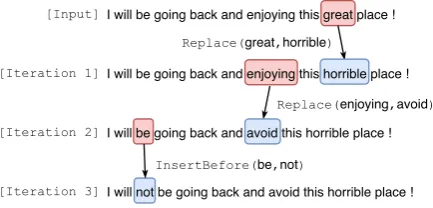
Figure 1: Our proposed Point-Then-Operate (PTO) ap-plied to a real test sample. A high-level agent (red squares) iteratively proposes operation positions, and a low-level agent (arrows) alters the sentence based on the high-level proposals. Compared with seq2seq methods, PTO is more interpretable and better pre-serves style-independent contents.
tion, and 3) the trade-off between content preser-vation and style polarity is intractable.
To address these challenges, we propose a se-quence operation-based method within the hierar-chical reinforcement learning (HRL) framework, namedPoint-Then-Operate(PTO). It consists of a hierarchy of a high-level agent that proposes operation positions and a low-level agent that al-ters the sentence based on high-level proposals. We propose a policy-based training algorithm to model the key aspects in text style transfer, i.e., fluency, style polarity, and content preservation. For fluency, we use alanguage model reward; for style polarity, we introduce aclassification confi-dence rewardand an auxiliary classification task; for content preservation, we adopt a reconstruc-tion reward and a self-supervised reconstruction loss. We introduce a mask-based inference al-gorithm that applies multi-step sequence opera-tions to the input sentence, allowing for single-step training which is more stable. Figure1shows an example of our method applied to a real test sample from Yelp.
sequence operation method has three merits. 1) In-terpretability: our method explicitly modelswhere andhowto transfer. 2)Content preservation: se-quence operations are targeted at stylized parts; thus, style-independent content can be better pre-served. 3) Controllable trade-off: the trade-off between content preservation and style polarity could be tuned in our method. Specifically, we tune it by biasing the number of operation steps.
We conduct extensive experiments on two text style transfer datasets, i.e., Yelp and Amazon. We show that our proposed method outperforms re-cent methods and that it addresses the challenges of existing seq2seq methods. The contributions of this paper are:
• We propose a sequence operation method, i.e., Point-Then-Operate, for unsupervised text style transfer. The transfer procedure is modeled as explicit revisions on the input sentences, which improves interpretability, content preservation, and controllable style-content trade-off.
• The method is interpreted and trained in the HRL framework with a high-level agent that proposes operation positions and a low-level agent that applies explicit operations. We design comprehensive learning objectives to capture three important aspects of text style transfer and propose a mask-based inference algorithm that allows for multi-step revision based on the single-step trained agents.
• Experiments on Yelp and Amazon show that our method significantly improves BLEU, fluency, and content preservation compared with recent methods and effectively ad-dresses the aforementioned challenges.
2 Related Work
Text Style Transfer Most work on text style transfer learns disentangled representations of style and content. We categorize them based on how they represent content. Hidden vec-tor approaches represent content as hidden vec-tors, e.g., Hu et al. (2017) adversarially incor-porate a VAE and a style classifier; Shen et al. (2017) propose a cross-aligned AE that adversar-ially aligns the hidden states of the decoder; Fu et al.(2018) design a multi-decoder model and a style-embedding model for better style represen-tations;Yang et al.(2018) use language models as
style discriminators;John et al.(2018) utilize bag-of-words prediction for better disentanglement of style and content. Deletion approachesrepresent content as the input sentence with stylized words deleted, e.g., Li et al. (2018) delete stylized n-grams based on corpus-level statistics and stylize it based on similar, retrieved sentences; Xu et al. (2018) jointly train a neutralization module and a stylization module the with reinforcement learn-ing; Zhang et al.(2018a) facilitate the stylization step with a learned sentiment memory.
As far as we know, there are two work that avoid disentangled representations.Zhang et al.(2018b) construct a pseudo-aligned dataset with an SMT model and then learn two NMT models jointly and iteratively. A concurrent work,Luo et al.(2019), propose to learn two dual seq2seq models between two styles via reinforcement learning, without dis-entangling style and content.
Sequence Operation Methods Our work is also closely related to sequence operation methods, which are widely used in SMT (Durrani et al., 2011,2015;Pal et al., 2016) and starts to attract attention in NMT (Stahlberg et al., 2018). Com-pared with methods based on seq2seq models, se-quence operation methods are inherently more in-terpretable (Stahlberg et al., 2018). Notably, our method is revision-based, i.e., it operates directly on the input sentence and does not generate from scratch as in machine translation systems.
Hierarchical Reinforcement Learning In this work, we adopt the Options Framework (Sutton et al.,1999) in HRL, in which a high-level agent learns to determine more abstract options and a low-level agent learns to take less abstract ac-tions given the option. Recent work has shown that HRL is effective in various tasks, e.g., Atari games (Kulkarni et al., 2016), relation classi-fication (Feng et al., 2018), relation extraction (Takanobu et al., 2018), and video captioning (Wang et al.,2018).
3 Formulation
We start by formalizing the problem of our in-terest. Given two non-aligned sets of sentences
X1 = {x(1)1 ,· · · ,x1(n)} of style s1 and X2 =
{x(1)2 ,· · · ,x2(m)} of style s2. Unsupervised text
style transfer aims to learn two conditional dis-tributionsp(x1→2|x1)andp(x2→1|x2)which
style-independent content. However, definingcontentis not trivial. Different from previous text style trans-fer methods that explicitly model contents with disentangled representations, weimplicitlymodel content with reconstruction, similar to the idea proposed adopted in CycleGAN (Zhu et al.,2017). Given the discreteness nature of natural language texts, we use sequence operations to approximate
p(x1→2|x1) and p(x2→1|x2). In our notations,
x1→2 andx2→1 aretransferred sentences, which
are the outputs of a text style transfer system; xˆ2
andxˆ1 areoperated sentences, which are not
nec-essarily fully transferred.
4 Our Approach
Our proposed sequence operation-based method,
Point-Then-Operate (PTO), decomposes style transfer into two steps: 1) findingwhereto transfer and 2) determininghowto transfer. It could be nat-urally formulated as an HRL problem, in which a high-level agent (i.e.,pointer) proposes operation positions and a low-level agent (i.e.,operators) al-ters the sentence based on high-level proposals.
In this section, we first briefly review the Op-tions Framework in HRL. Then we introduce the proposed pointer module (§4.2) and operator mod-ules (§4.3). The training algorithm is in §4.4, in which two extrinsic rewards, an intrinsic reward, and a self-supervised loss are proposed for fluency, style polarity, and content preservation. The infer-ence algorithm is in§4.5, in which a mask mech-anism is proposed to iteratively and dynamically apply sequence operations to the input.
4.1 Review: The Options Framework in HRL
The Options framework (Sutton et al.,1999) is a well-known formulation in HRL. We denote the state space as S; the option space, O; the action space,A. The high-level agent learns a stochastic policyµ : S × O → [0,1]. The low-level agent learns a stochastic policyπo:S ×A →[0,1],
con-ditioned on an optiono ∈ O. Additionally, each optiono ∈ O has a low-level stochastic termina-tion conditermina-tion βo : S → [0,1] which indicates
whether the current option should end. In each episode, the high-level agent executes a trajectory (o1,· · ·, oL) based on µ; once an option ot is
sampled, the low-level agent executes a trajectory (a1
t,· · · , a lt
t) based onπot, whereltis dependent
onβot. Intuitively, the flattened trajectory for one
episode is(o1, a11,· · ·, a l1
1,· · · , oL, a1L,· · · , a lL L).
Module Operation
IFφ1 Insert a wordwˆinFront of the position
IBφ2 Insert a wordwˆBehind the position
Repφ
3 Replace it with another wordwˆ
DC Delete theCurrent word
[image:3.595.323.510.65.155.2]DF Delete the word inFront of the position DB Delete the wordBehind the position Skip Do not change anything
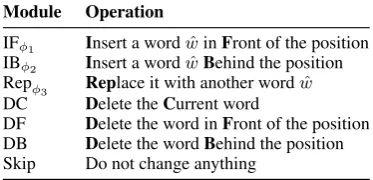
Table 1: Operator modules. Parametersφ1,φ2, andφ3
are meant to generate their correspondingwˆ.
4.2 High-Level Agent: Pointer
The high-level policyµaims to propose operation positions; thus, we model it as an attention-based (Bahdanau et al.,2015)pointernetwork, which as-signs normalized probability to each position.
Option Given a sentence x = {x1,· · · , xT},
the option space isO ={1,· · ·, T}. Note thatT
changes within an episode, since operations may change the length of a sentence.
State The state is represented by the sentence representation hT and each position
representa-tionhi, where{h1,· · · ,hT}is mapped from the
sentencexby a bi-LSTM encoder.
Policy We adopt an attention-based policyµ:
µ(i|x) = PTexp(a(hT,hi))
t=1exp(a(hT,ht))
(1)
wherea(·,·) is the scoring function for attention, andi ∈ {1,· · · , T}denotes each position in the intput sentence.
4.3 Low-Level Agent: Operators
The low-level policyπ alters the sentence around the positioni(i.e., option) sampled fromµ. We re-strict the operations to those listed in Table1. Note that these operations are complete to generate all natural language sentences in multiple steps.
Action Given the sentencex = {x1,· · · , xT}
and the operation positioni, the action of the low-level agent can be decomposed into two step, i.e.,
1. Operator selection. Select an operator mod-ule from Table1.
State Compared with the high-level agent, our low-level agent focuses on features that are more local. We mapxto{h1,· · · ,hT}2through a
bi-LSTM encoder and take hi as the state
represen-tation.
Low-Level Termination Condition Different from the original Options Framework in which a stochastic termination conditionβois learned, we
adopt a deterministic termination condition: the low-level agent takesoneaction in each option and terminates, which makes training easier and more stable. Notably, it does not harm the expressive-ness of our method, since multiple options can be executed.
Policy for Operator Selection For training, we adopt auniformpolicy for operator selection, i.e., we uniformly sample an operator module from Ta-ble1. In preliminary experiments, we explored a learned policy for operator selection. However, we observed that the learned policy quickly collapses to a nearly deterministic choice of Repφ3. Our ex-planation is that, in many cases, replacing a styl-ized word is the optimal choice for style transfer. Thus, the uniform policy assures that all operators are trained on sufficient and diversified data. For inference, we adopt a heuristic policy based on flu-ency and style polarity, detailed in§4.5.3.
Policy for Word Generation As shown in Ta-ble1, three operators are parameterized, which are burdened with the task of generating a proper word to complete the action. For each parameterized op-eratorM, the probability of generatingwˆis
M( ˆw|x, i) =softmaxwˆ(W hi) (2)
Notably, for eachM we train two sets of parame-ters fors1 →s2ands2 →s1. For readability, we
omit the direction subscripts and assure that they can be inferred from contexts; parameters of the opposite direction are denoted asφ01,φ02, andφ03.
4.4 Hierarchical Policy Learning
We introduce comprehensive training objectives to model the key aspects in text style transfer, i.e., fluency, style polarity, and content preservation. For fluency, we use an extrinsic language model reward; for style polarity, we use an extrinsic classification confidence reward and incorporate an auxiliary style classification task; for content
2We reusehandW notations for all modules for brevity.
Input
Operators
Transferred
lm
,conf
conf
Style Label
cls Input
Pointer
re
c,
re
c
Operators
Transferred
[image:4.595.307.526.60.182.2]Reconstruction
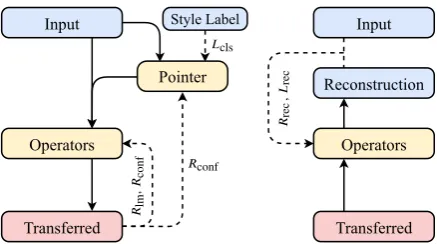
Figure 2: Graphical overview for the training algo-rithm, which consists of atransferstep (left) and a
re-constructionstep (right). Solid lines denote forward
pass; dotted lines denote rewards or losses. Blue / red items belong to the source / target styles; yellow items denotes the agents. Best viewed in color.
Algorithm 1Point-Then-Operate Training 1: Input:Non-aligned sets of sentencesX1,2 2: Initializeθ,φ1,2,3
3: Train language models LM2onX2 4: Pre-trainθby optimizingLθ
cls .Eq.6
5: foreach iterationi= 1,2,· · ·, mdo 6: Samplex1fromX1
7: Sampleifromµθ(i|x1) .Eq.1
8: Uniformly sampleM .Table1
9: xˆ2←Transfer(x1, M, i) .Table1 10: ComputeRconfandRlm .Eq.3and4
11: Updateθbased onLθ
clsand∇θJ(θ) .Eq.6and9
12: GetM0andi0 .Table2
13: ifM0is parameterized byφ0then
14: x¯1←Reconstruct( ˆx2, M0, i0) .Table1 15: Updateφ0by optimizingLφ0
rec .Eq.7
16: end if
17: ifMis parameterized byφthen
18: ComputeRrecifM is Repφ3 .Eq.8
19: Updateφwith∇φJ(φ) .Eq.11
20: end if 21: end for
preservation, we use a self-supervised reconstruc-tion loss and an intrinsic reconstruction reward. In the following parts, we only illustrate equations related to x1 → xˆ2 operations and xˆ2 → x1
reconstructions for brevity; the opposite direction can be derived by swapping1and2. The training algorithm is presented in Algorithm1. A graphical overview is shown in Figure2.
4.4.1 Modeling Fluency
Language Model Reward To improve the flu-ency, we adopt a language model reward. Let LM1, LM2denote the language models fors1and
s2, respectively. Given the generated word wˆ in
the operated sentencexˆ2, the language model
re-ward is defined as
M M0 i0
Repφ3 Repφ03 i
DC IFφ01or IBφ02 iori−1
DF IFφ0
1or IBφ02 i−1ori−2
DB IFφ0
[image:5.595.109.255.62.129.2]1or IBφ02 i+ 1ori
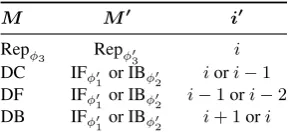
Table 2: Construction of self-supervised data.
where LM2( ˆw|xˆ2) denotes the probability of wˆ
givenotherwords inxˆ2. In our experiments, the
probability is computed by averaging a forward LSTM-LM and a backward LSTM-LM.
4.4.2 Modeling Style Polarity
Classification Confidence Reward We observe that language models are not adequate to capture style polarity; thus, we encourage larger change in the confidence of a style classifier, by adopting a classification confidence reward, i.e.,
Rconf=λconf[p(s2|xˆ2)−p(s2|x1)] (4)
where we reuse the classifier defined in Eq.5.
Auxiliary Task: Style Classification In HRL, the high-level policy usually suffers from the high variance of gradients since the estimated gradients are dependent on the poorly trained low-level pol-icy. To stabilize the high-level policy learning, we introduce auxiliary supervision to the pointer. Specifically, we extend the pointer to an attention-based classifier, i.e.,
p(sj|x) =softmaxj(W T X
i=1
µ(i|x)hi) (5)
forj = 1,2. Letθdenotes the parameters of the pointer. The auxiliary classification loss forθis
Lθ cls =
X
j=1,2
Exj∼Xj[−logpθ(sj|xj)] (6)
The underlying assumption is that positions with larger attention weights for classification are more likely to be critical to style transfer.
4.4.3 Modeling Content Preservation
Self-Supervised Reconstruction Loss To im-prove content preservation, we propose a recon-struction loss that guides the operator modules with self-supervision. Suppose the wordwat the
ithposition is deleted or replaced by operatorM, we identify the reconstruction operatorM0and re-construction positioni0in Table2. ThenM0is up-dated with MLE, by operating on positioni0 inxˆ2
withwas gold output. For those with two (M0,i0) pairs, we uniformly sample one for training. For-mally, the reconstruction loss is defined as
Lφrec0 =−logM0(w|xˆ2, i0) (7)
Reconstruction Reward One-to-one transfer (e.g., {delicious↔bland, caring↔unconcerned}) is usually preferable to many-to-one transfer (e.g.,
{delicious→bad,caring→bad}). Thus, we intro-duce a reconstruction reward for Repφ3 to encour-age one-to-one transfer, i.e.,
Rrec=−λrecL φ03
rec (8)
whereLφ03
recis the reconstruction loss in Eq.7.
4.4.4 Training with Single-Option Trajectory
Instead of executing multi-option trajectories, we only allow the high-level agent to execute a sin-gle option per episode during training, and leave the multi-option scenario to the inference algo-rithm (§4.5). We have two motivations for execut-ing sexecut-ingle-option trajectories: 1) executexecut-ing multi-option trajectories is less tractable and stable, es-pecially in the case of style transfer which is sensi-tive to nuances in the sentence; 2) self-supervised reconstruction is ambiguous in a multi-option tra-jectory, i.e., the gold trajectory for reconstruction is not deterministic.
High-Level Policy Gradients Since the lan-guage model reward is more local and increases the variance of estimated gradients, we only use the classification confidence reward for the high-level policy. The policy gradient is
∇θJ(θ) =Ei[Rconf· ∇θlogµθ(i|x1)] (9)
where gradients are detached fromRconf.
Low-Level Policy Gradients All the extrinsic and intrinsic rewards are used for low-level policy learning. Specifically, the rewards forφ1,2,3are
R1,2 =Rlm+Rconf
R3 =Rlm+Rconf+Rrec
(10)
Forφ=φ1,φ2,φ3, the policy gradient is
∇φJ(φ) =Ewˆ[R· ∇φlogMφ( ˆw|x1, i)] (11)
Overall Objectives The overall objectives forθ
are the classification loss in Eq.6 and the policy gradient in Eq.9. The overall objectives forφ1,2,3
Algorithm 2Point-Then-Operate Inference
1: Input:Input sentencex1, additional classifierpadd
2: Initializexˆ2←x1,xˆm2 ←x1,j←1 3: whilepadd(s1|xˆm2)> pstopandj≤jmaxdo
4: Mask the options inµθ(i|xˆ2) .§4.5.1 5: Selectithat maximizes the maskedµθ(i|xˆ2) 6: Select thebestMfrom Table1 .§4.5.3
7: Updatexˆ2←Transfer( ˆx2, M, i) .§4.3
8: Updatexˆm2 .§4.5.2
9: j←j+ 1
10: end while
11: The output isx1→2←xˆ2 12: return x1→2
4.5 Inference
The main problems in applying single-step trained modules to the multi-step scenario are 1) previ-ous steps of operations may influence later steps, and 2) we need to dynamically decide when the trajectory should terminate. We leverage a mask mechanism to address these problems. The basic idea is that given an input sentence, the high-level agent iteratively proposes operation positions for the low-level agent to operate around. In each iter-ation, the high-level agent sees the whole sentence but with some options (i.e., positions) masked in its policy. The trajectory termination condition is modeled by an additional pre-trained classifier. The algorithm for style transfer froms1 to s2 is
detailed in Algorithm2.
4.5.1 Masked Options
To tackle the first problem, we mask the options (i.e., positions) in the high-level policy which ap-pear in the contexts in which any words are in-serted, replaced, or skipped (but not for deleted words). Note that we only mask the options in the policy but donot mask the words in the sen-tence (i.e., both agents still receive the complete sentence), since we cannot bias the state represen-tations (§4.2and§4.3) with masked tokens. We set the window size as 1 (i.e., three words are masked in each step). We find the use of window size nec-essary, since in many cases, e.g., negation and em-phasis, the window size of 1 is capable of covering a complete semantic unit.
4.5.2 Termination Condition
A simple solution to the second problem is to ter-minate the trajectory if the operated sentence is confidently classified as the target style. The prob-lem with this simple solution is that the highly stylized part may result in too early termination. For example,Otherwise a terrible experience and
we will go again may be classified as negative with high confidence. Thus, we propose to mask words in the operated sentence for the termination condition. The masking strategy is the same as
§4.5.1 and masked words are replaced by hunki. To tackle the excessive number ofhunki, we train an additional classifier as defined in §4.4.2, but trained on sentences with words randomly re-placed ashunki.
4.5.3 Inference Policy for Operator Selection
As discussed in §4.3, we adopt a heuristic infer-ence policy for operator selection. Specifically, we enumerate each operator and select the oper-ated sentence xˆ2 which maximizes the criterion:
c( ˆx2) =LM2( ˆx2)·p(s2|xˆ2)η (12)
where LM2( ˆx2) denotes the probability of xˆ2
computed by the language model LM2,p(sj|·)is
the classifier defined in§4.4.2, andηis a balancing hyper-parameter.
5 Experiments
5.1 Datasets
We conduct experiments on two commonly used datasets for unsupervised text style transfer, i.e., Yelp and Amazon, following the split of datasets inLi et al.(2018). Dataset statistics are shown in Table3. For each dataset,Li et al.(2018) provided a gold output for each entry in the test set written by crowd-workers on Amazon Mechanical Turk. Since gold outputs arenotwritten for development sets, we tune the hyper-parameters on the develop-ment sets based on our intuition of English.
Yelp The Yelp dataset consists of business re-views and their labeled sentiments (from 1 to 5) from Yelp. Those labeled greater than 3 are considered as positive samples and those labeled smaller than3are negative samples.
Amazon The Amazon dataset consists of prod-uct reviews and labeled sentiments from Amazon (He and McAuley, 2016). Positive and negative samples are defined in the same way as Yelp.
Dataset Attributes Train Dev Test
Yelp Positive 270K 2000 500
Negative 180K 2000 500
Amazon Positive 277K 985 500
[image:7.595.314.521.63.219.2]Negative 278K 1015 500
Table 3: Dataset statistics.
on the Yelp training set using the Amazon vocab-ulary and test the method on Amazon test set. Ex-perimental results show the effectiveness of our method under this cross-domain setting.
5.2 Evaluation Metrics
Automatic Evaluation Following previous work (Shen et al., 2017; Xu et al., 2018), we pre-train a style classifier TextCNN (Kim, 2014) on each dataset and measure the style polarity of system outputs based on the classification accuracy. Also, based on the human references provided by Li et al. (2018), we adopt a case-insensitive BLEU metric, which is computed using the Mosesmulti-bleu.perlscript.
Human Evaluation Following previous work (Shen et al., 2017; Xu et al., 2018), we also conduct human evaluations. For each input sen-tence and corresponding output, each participant is asked to score from 1 to 5 for fluency, content preservation, and style polarity. If a transfer gets scores of 4 or 5 on all three aspects, it is considered as a successful transfer. We count the success rate over the test set for each system, which is denoted asSucin Table5.
5.3 Baselines
We make a comprehensive comparison with state-of-the-art style transfer methods. CrossAligned
(Shen et al.,2017) aligns decoder hidden states ad-versarially.MultiDecoder(Fu et al.,2018) adopts multiple decoders for different styles. StyleEm-bedding(Fu et al.,2018) adopts a single decoder conditioned on learned style embeddings. Tem-plateBased(Li et al.,2018) retrieves and replaces stylized words. DeleteOnly(Li et al.,2018) only deletes the stylized words in the input sentence.
Del-Ret-Gen(Li et al.,2018) is the same as Tem-plateBased except that an RNN is adopted to gen-erate the output. BackTranslate (Prabhumoye et al.,2018) stylizes the back-translated input. Un-pairedRL(Xu et al.,2018) deletes stylized words and generates with a denoising AE.UnsuperMT
Yelp Amazon
Acc BLEU Acc BLEU
CrossAligned 74.7 9.06 75.1 1.90
MultiDecoder 50.6 14.54 69.9 9.07
StyleEmbedding 8.4 21.06 38.2 15.07 TemplateBased 81.2 22.57 64.3 34.79
DeleteOnly 86.0 14.64 47.0 33.00
Del-Ret-Gen 88.6 15.96 51.0 30.09
BackTranslate 94.6 2.46 76.7 1.04
UnpairedRL 57.5 18.81 56.3 15.93
UnsuperMT 97.8 22.75 72.4 33.95
Human 74.7 - 43.2
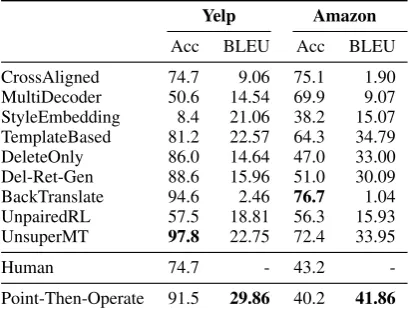
-Point-Then-Operate 91.5 29.86 40.2 41.86
Table 4: Automatic evaluation results for classification accuracy and BLEU with human reference.Human de-notes human references. Note that Acc for human ref-erences are relatively low; thus, we donotconsider it as a valid metric for comparison.
(Zhang et al., 2018b) produces pseudo-aligned data and iteratively learns two NMT models.
The outputs of the first six baselines are made public byLi et al. (2018). The outputs of Back-Translate and UnpairedRL are obtained by run-ning the publicly available codes. We get the out-puts of UnsuperMT from the authors of Zhang et al.(2018b).
5.4 Evaluation Results
Table4shows the results of automatic evaluation. It should be noted that the classification accuracy for human reference is relatively low (74.7% on Yelp and 43.2% on Amazon); thus, we do not consider it as a valid metric for comparison. For BLEU score, our method outperforms recent sys-tems by a large margin, which shows that our out-puts have higher overlap with reference sentences provided by humans.
To lighten the burden on human participants, we compare our proposed method to only four of the previous methods, selected based on their perfor-mance in automatic evaluation. Given the obser-vation discussed in§5.1, we remove the wrongly labeled test samples for human evaluation. Ta-ble5shows the results of human evaluation. Our proposed method achieves the highest fluency and content preservation on Yelp and performs the best on all human evaluation metrics on Amazon.
5.5 Controllable Trade-Off
Yelp Amazon
Fluency Content Style Suc Fluency Content Style Suc
TemplateBased 3.47 3.76 3.25 68.0 % 3.46 4.08 2.15 9.0 %
Del-Ret-Gen 3.82 3.73 3.52 70.3 % 4.02 4.31 2.69 21.0 %
UnpairedRL 3.54 3.59 2.90 53.8 % 2.58 2.55 2.44 4.5 %
UnsuperMT 4.26 4.24 4.03 82.5 % 4.24 4.13 3.05 35.5 %
[image:8.595.321.512.211.324.2]Point-Then-Operate 4.39 4.56 3.78 81.5 % 4.28 4.47 3.31 47.0 %
Table 5: Human evaluation results. Methods are selected based on automatic evaluation. Style: style polarity;
Content: content preservation;Fluency: fluency;Suc: the proportion of successful transfer (refer to§5.2)
0.0 0.2 0.4pstop0.6 0.8 1.0
0 20 40 60 80 100
value (%)
Metric BLEU Acc
(a) Yelp
0.0 0.2 0.4 0.6 0.8 1.0
pstop
25 30 35 40 45 50
value (%)
Metric BLEU Acc
(b) Amazon
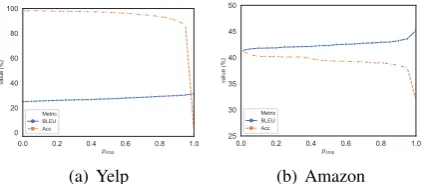
Figure 3: The controllable trade-off between content preservation and style polarity. Thex-axis ispstop
(de-fined in Algorithm2). They-axis is the value of differ-ent automatic metrics, i.e., BLEU (the blue lines) and classification accuracy (the orange lines).
pstop is larger, classification accuracy drops and
BLEU increases. Based on our observation of human references, we find that humans usually make minimal changes to the input sentence; thus, BLEU computed with human references can be viewed as an indicator of content preservation. From this perspective, Figure 3shows that if we stop earlier, i.e., when the current style is closer to the source style, more content will be preserved and more weakly stylized words may be kept. Thus, controllable trade-off is achieved by man-ually settingpstop.
5.6 Ablation Studies
We conduct several ablation studies to show the effect of different components in our method:
Ablations of Operators To show that incorpo-rating various operators is essential, we evaluate the performance of the following ablations: Inser-tOnly, ReplaceOnly, and DeleteOnly, in which op-erator choices are restricted to subsets of Table1.
Ablation of Reconstruction Reward and Recon-struction Loss To show the effectiveness of our reconstruction-based objectives, we remove the reconstruction reward and the reconstruction loss as an ablation.
Yelp Amazon
Acc BLEU Acc BLEU
InsertOnly 68.6 23.93 48.2 36.77
ReplaceOnly 93.8 26.41 47.8 37.39
DeleteOnly 37.6 25.70 25.0 41.68
w/oRrecandLrec 39.1 27.80 46.3 40.52
Human 74.7 - 43.2
-Full 91.5 29.86 40.2 41.86
Table 6: Ablation Studies.
Table6shows the ablation results. It shows that BLEU drops if operators are restricted to a fixed set, showing the necessity of cooperating opera-tor modules. It also shows that BLEU drops if we remove the reconstruction loss and the recon-struction reward, indicating the generated words overlap less with human references in this ablation case. As discussed in§5.4, we ignore Acc since it is low on human references.
5.7 Qualitative Study
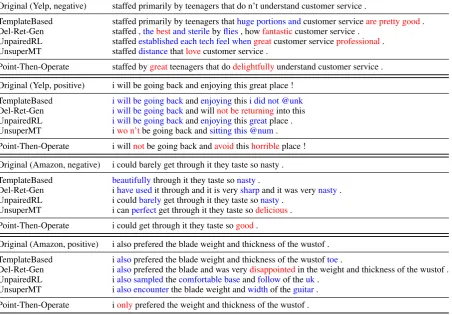
Figure1is an example of our method applied to a test sample. The transfer starts from more stylized parts and ends at less stylized parts, while keeping neutral parts intact. It also shows that our method learnslexical substitutionandnegationin an unsu-pervised way. Table7displays some comparisons of different systems. It shows that our proposed method is better at performing local changes to re-verse the style of the input sentence while preserv-ing most style-independent parts.
6 Discussions
We study the system outputs and observe two cases that our method cannot properly handle:
[image:8.595.76.292.213.305.2]Original (Yelp, negative) staffed primarily by teenagers that do n’t understand customer service .
TemplateBased staffed primarily by teenagers thathuge portions andcustomer serviceare pretty good. Del-Ret-Gen staffed, thebestand sterilebyflies, howfantasticcustomer service .
UnpairedRL staffedestablished each tech feel whengreatcustomer serviceprofessional. UnsuperMT staffeddistancethatlovecustomer service .
Point-Then-Operate staffed bygreatteenagers that dodelightfullyunderstand customer service .
Original (Yelp, positive) i will be going back and enjoying this great place !
TemplateBased i will be going backandenjoyingthisi did not @unk Del-Ret-Gen i will be going backand willnot be returninginto this UnpairedRL i will be going backandenjoyingthisgreatplace . UnsuperMT iwo n’tbe going back andsitting this @num.
Point-Then-Operate i willnotbe going back andavoidthishorribleplace !
Original (Amazon, negative) i could barely get through it they taste so nasty .
TemplateBased beautifullythrough it they taste sonasty.
Del-Ret-Gen ihave usedit through and it is verysharpand it was verynasty. UnpairedRL i couldbarelyget through it they taste sonasty.
UnsuperMT i canperfectget through it they taste sodelicious.
Point-Then-Operate i could get through it they taste sogood.
Original (Amazon, positive) i also prefered the blade weight and thickness of the wustof .
TemplateBased ialsoprefered the blade weight and thickness of the wustoftoe.
Del-Ret-Gen ialsoprefered the blade and was verydisappointedin the weight and thickness of the wustof . UnpairedRL ialso sampledthecomfortable baseandfollowof theuk.
UnsuperMT ialso encounterthe blade weight andwidthof theguitar.
[image:9.595.75.528.65.380.2]Point-Then-Operate ionlyprefered the weight and thickness of the wustof .
Table 7: Sampled system outputs. The dataset and the original style for each input sentence are parenthesized. We mark improperly generated or preserved words inblue, and mark words that show target style and are grammatical in the context inred. Best viewed in color.
@num months ago., which shows that the high-level policy is not well learned for some neutral sentences.
Adjacent Stylized Words We introduce a win-dow size of 1 in§4.5.1to deal with most seman-tic units. However, we observe in some cases two adjacent stylized words occur, e.g., poor watery food. If the first step is to replace one of them, then the other will be masked in later iterations, leading to incomplete transfer; if the first step is deletion, our method performs well, since we do not mask the context of deletion as stated in§4.5.1. Notably, phrases likecompletely horribleis not one of these cases, sincecompletelyitself is not stylized.
Experiments in this work show the effectiveness of our proposed method for positive-negative text style transfer. Given its sequence operation nature, we see potentials of the method for other types of transfers that require local changes, e.g., polite-impolite and written-spoken, while further empir-ical verification is needed.
7 Conclusions
We identify three challenges of existing seq2seq methods for unsupervised text style transfer and propose Point-Then-Operate (PTO), a sequence operation-based method within the hierarchical re-inforcement learning (HRL) framework consisting of a hierarchy of agents for pointing and operating respectively. We show that the key aspects of text style transfer, i.e., fluency, style polarity, and con-tent preservation, can be modeled by comprehen-sive training objectives. To make the HRL training more stable, we provide an efficient mask-based inference algorithm that allows for single-option trajectory during training. Experimental results show the effectiveness of our method to address the challenges of existing methods.
Acknowledgments
References
Dzmitry Bahdanau, Kyunghyun Cho, and Yoshua Ben-gio. 2015. Neural machine translation by jointly learning to align and translate. In 3rd Inter-national Conference on Learning Representations, ICLR 2015, San Diego, CA, USA, May 7-9, 2015,
Conference Track Proceedings.
Nadir Durrani, Helmut Schmid, and Alexander M. Fraser. 2011. A joint sequence translation model with integrated reordering. In The 49th Annual Meeting of the Association for Computational Lin-guistics: Human Language Technologies, Proceed-ings of the Conference, 19-24 June, 2011, Portland,
Oregon, USA, pages 1045–1054.
Nadir Durrani, Helmut Schmid, Alexander M. Fraser, Philipp Koehn, and Hinrich Sch¨utze. 2015. The operation sequence model - combining n-gram-based and phrase-n-gram-based statistical machine transla-tion.Computational Linguistics, 41(2):185–214.
Jun Feng, Minlie Huang, Li Zhao, Yang Yang, and Xi-aoyan Zhu. 2018. Reinforcement learning for re-lation classification from noisy data. In Proceed-ings of the Thirty-Second AAAI Conference on Ar-tificial Intelligence, (AAAI-18), the 30th innovative Applications of Artificial Intelligence (IAAI-18), and the 8th AAAI Symposium on Educational Advances in Artificial Intelligence (EAAI-18), New Orleans,
Louisiana, USA, February 2-7, 2018, pages 5779–
5786.
Zhenxin Fu, Xiaoye Tan, Nanyun Peng, Dongyan Zhao, and Rui Yan. 2018. Style transfer in text: Exploration and evaluation. InProceedings of the Thirty-Second AAAI Conference on Artificial Intelli-gence, (AAAI-18), the 30th innovative Applications of Artificial Intelligence (IAAI-18), and the 8th AAAI Symposium on Educational Advances in Artificial Intelligence (EAAI-18), New Orleans, Louisiana,
USA, February 2-7, 2018, pages 663–670.
Ruining He and Julian McAuley. 2016. Ups and downs: Modeling the visual evolution of fashion trends with one-class collaborative filtering. In Pro-ceedings of the 25th International Conference on World Wide Web, WWW 2016, Montreal, Canada,
April 11 - 15, 2016, pages 507–517.
Zhiting Hu, Zichao Yang, Xiaodan Liang, Ruslan Salakhutdinov, and Eric P. Xing. 2017. Toward con-trolled generation of text. In Proceedings of the 34th International Conference on Machine Learn-ing, ICML 2017, Sydney, NSW, Australia, 6-11
Au-gust 2017, volume 70 of Proceedings of Machine
Learning Research, pages 1587–1596.
Vineet John, Lili Mou, Hareesh Bahuleyan, and Olga Vechtomova. 2018. Disentangled represen-tation learning for text style transfer. CoRR, abs/1808.04339.
Yoon Kim. 2014. Convolutional neural networks for sentence classification. In Proceedings of the 2014
Conference on Empirical Methods in Natural Lan-guage Processing, EMNLP 2014, October 25-29,
2014, Doha, Qatar, pages 1746–1751.
Tejas D. Kulkarni, Karthik Narasimhan, Ardavan Saeedi, and Josh Tenenbaum. 2016. Hierarchical deep reinforcement learning: Integrating temporal abstraction and intrinsic motivation. InAdvances in Neural Information Processing Systems 29: Annual Conference on Neural Information Processing
Sys-tems 2016, December 5-10, 2016, Barcelona, Spain,
pages 3675–3683.
Juncen Li, Robin Jia, He He, and Percy Liang. 2018. Delete, retrieve, generate: A simple approach to sen-timent and style transfer. In Proceedings of the 2018 Conference of the North American Chapter of the Association for Computational Linguistics: Human Language Technologies, NAACL-HLT 2018, New Orleans, Louisiana, USA, June 1-6, 2018,
Vol-ume 1 (Long Papers), pages 1865–1874.
Fuli Luo, Peng Li, Jie Zhou, Pengcheng Yang, Baobao Chang, Zhifang Sui, and Xu Sun. 2019. A dual rein-forcement learning framework for unsupervised text style transfer.CoRR, abs/1905.10060.
Santanu Pal, Marcos Zampieri, and Josef van Genabith. 2016. USAAR: An operation sequential model for automatic statistical post-editing. In Proceedings of the First Conference on Machine Translation, WMT 2016, colocated with ACL 2016, August
11-12, Berlin, Germany, pages 759–763.
Shrimai Prabhumoye, Yulia Tsvetkov, Ruslan Salakhutdinov, and Alan W. Black. 2018. Style transfer through back-translation. In Proceedings of the 56th Annual Meeting of the Association for Computational Linguistics, ACL 2018, Melbourne,
Australia, July 15-20, 2018, Volume 1: Long Papers,
pages 866–876.
Tianxiao Shen, Tao Lei, Regina Barzilay, and Tommi S. Jaakkola. 2017.Style transfer from non-parallel text by cross-alignment. In Advances in Neural Infor-mation Processing Systems 30: Annual Conference on Neural Information Processing Systems 2017,
4-9 December 2017, Long Beach, CA, USA, pages
6833–6844.
Felix Stahlberg, Danielle Saunders, and Bill Byrne. 2018.An operation sequence model for explainable neural machine translation. InProceedings of the Workshop: Analyzing and Interpreting Neural Net-works for NLP, BlackboxNLP@EMNLP 2018,
Brus-sels, Belgium, November 1, 2018, pages 175–186.
Ilya Sutskever, Oriol Vinyals, and Quoc V. Le. 2014. Sequence to sequence learning with neural net-works. InAdvances in Neural Information Process-ing Systems 27: Annual Conference on Neural In-formation Processing Systems 2014, December
8-13 2014, Montreal, Quebec, Canada, pages 3104–
Richard S. Sutton, Doina Precup, and Satinder P. Singh. 1999. Between MDPs and semi-MDPs: A framework for temporal abstraction in reinforcement learning.Artif. Intell., 112(1-2):181–211.
Ryuichi Takanobu, Tianyang Zhang, Jiexi Liu, and Minlie Huang. 2018. A hierarchical framework for relation extraction with reinforcement learning.
CoRR, abs/1811.03925.
Xin Wang, Wenhu Chen, Jiawei Wu, Yuan-Fang Wang, and William Yang Wang. 2018. Video captioning via hierarchical reinforcement learning. In 2018 IEEE Conference on Computer Vision and Pattern Recognition, CVPR 2018, Salt Lake City, UT, USA,
June 18-22, 2018, pages 4213–4222.
Jingjing Xu, Xu Sun, Qi Zeng, Xiaodong Zhang, Xu-ancheng Ren, Houfeng Wang, and Wenjie Li. 2018. Unpaired sentiment-to-sentiment translation: A cy-cled reinforcement learning approach. In Proceed-ings of the 56th Annual Meeting of the Associa-tion for ComputaAssocia-tional Linguistics, ACL 2018, Mel-bourne, Australia, July 15-20, 2018, Volume 1: Long
Papers, pages 979–988.
Zichao Yang, Zhiting Hu, Chris Dyer, Eric P. Xing, and Taylor Berg-Kirkpatrick. 2018. Unsupervised text style transfer using language models as discrimina-tors. InAdvances in Neural Information Processing Systems 31: Annual Conference on Neural Informa-tion Processing Systems 2018, NeurIPS 2018, 3-8
December 2018, Montr´eal, Canada., pages 7298–
7309.
Yi Zhang, Jingjing Xu, Pengcheng Yang, and Xu Sun. 2018a. Learning sentiment memories for sentiment modification without parallel data. InProceedings of the 2018 Conference on Empirical Methods in Natural Language Processing, Brussels, Belgium,
October 31 - November 4, 2018, pages 1103–1108.
Zhirui Zhang, Shuo Ren, Shujie Liu, Jianyong Wang, Peng Chen, Mu Li, Ming Zhou, and Enhong Chen. 2018b. Style transfer as unsupervised machine translation. CoRR, abs/1808.07894.
Jun-Yan Zhu, Taesung Park, Phillip Isola, and Alexei A. Efros. 2017. Unpaired image-to-image translation using cycle-consistent adversarial net-works. InIEEE International Conference on Com-puter Vision, ICCV 2017, Venice, Italy, October