Proceedings of the BioNLP 2018 workshop, pages 47–55 47
Ontology Alignment in the Biomedical Domain
Using Entity Definitions and Context
Lucy Lu Wang†, Chandra Bhagavatula, Mark Neumann, Kyle Lo, Chris Wilhelm, and Waleed Ammar
Allen Institute for Artificial Intelligence
†Department of Biomedical Informatics and Medical Education, University of Washington
Seattle, Washington, USA
Abstract
Ontology alignment is the task of identi-fying semantically equivalent entities from two given ontologies. Different ontologies have different representations of the same entity, resulting in a need to de-duplicate entities when merging ontologies. We pro-pose a method for enriching entities in an ontology with external definition and con-text information, and use this additional information for ontology alignment. We develop a neural architecture capable of encoding the additional information when available, and show that the addition of external data results in an F1-score of 0.69 on the Ontology Alignment Evalua-tion Initiative (OAEI) largebio SNOMED-NCI subtask, comparable with the entity-level matchers in a SOTA system.
1 Introduction
Ontologies are used to ground lexical items in var-ious NLP tasks including entity linking, question answering, semantic parsing and information re-trieval.1 In biomedicine, an abundance of on-tologies (e.g., MeSH, Gene Ontology) has been developed for different purposes. Each ontology describes a large number of concepts in health-care, public health or biology, enabling the use of ontology-based NLP methods in biomedical appli-cations. However, since these ontologies are typ-ically curated independently by different groups, many important concepts are represented inconsis-tently across ontologies (e.g., “Myoclonic Epilep-sies, Progressive” in MeSH is a broader concept
1Ontological resources include ontologies, knowledgebases, terminologies, and controlled vocabularies. In the rest of this paper, we refer to all of these with the term ‘ontology’ for consistency.
that includes “Dentatorubral-pallidoluysian atro-phy” from OMIM).
This poses a challenge for bioNLP applica-tions where multiple ontologies are needed for grounding, but each concept must be repre-sented by only one entity. For instance, in
www.semanticscholar.org, scientific pub-lications related to carpal tunnel syndrome are linked to one of multiple entities derived from UMLS terminologies representing the same con-cept,2making it hard to find all relevant papers on this topic. To address this challenge, we need to automatically map semantically equivalent entities from one ontology to another. This task is referred to as ontology alignment or ontology matching.
Several methods have been applied to ontol-ogy alignment, including rule-based and statisti-cal matchers. Existing matchers rely on entity fea-tures such as names, synonyms, as well as rela-tionships to other entities (Shvaiko and Euzenat, 2013; Otero-Cerdeira et al., 2015). However, it is unclear how to leverage the natural language text associated with entities to improve predic-tions. We address this limitation by incorporating two types of natural language information (defini-tions and textual contexts) in a supervised learning framework for ontology alignment. Since the def-inition and textual contexts of an entity often pro-vide complementary information about the entity’s meaning, we hypothesize that incorporating them will improve model predictions. We also discuss how to automatically derive labeled data for train-ing the model by leveragtrain-ing existtrain-ing resources. In particular, we make the following contributions:
• We propose a novel neural architecture for on-tology alignment and show how to effectively
2See https://www.semanticscholar.org/
topic/Carpal-tunnel-syndrome/248228 and
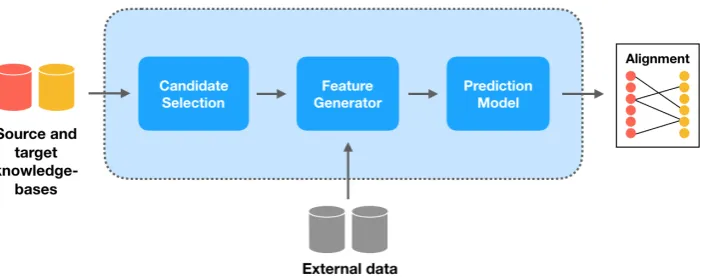
Figure 1: OntoEmma consists of three modules: a) candidate selection (see§2.2for details), b) feature generation (see§2.2for details), and c) prediction (see§2.3for deatils). OntoEmma accepts two ontolo-gies (a source and a target) as inputs, and outputs a list of alignments between their entities. When using a neural network, the feature generation and prediction model are combined together in the network.
integrate natural language inputs such as defini-tions and contexts in this architecture (see§2for details).3
• We use the UMLS Metathesaurus to extract large amounts of labeled data for supervised training of ontology alignment models (see
§3.1). We release our data set to help future re-search in ontology alignment.3
• We use external resources such as Wikipedia and scientific articles to find entity definitions and contexts (see§3.2for details).
2 OntoEmma
In this section, we describe OntoEmma, our pro-posed method for ontology matching, which con-sists of three stages: candidate selection, fea-ture generation and prediction (see Fig. 1for an overview).
2.1 Problem definition and notation
We start by defining the ontology matching prob-lem: Given a source ontology Os and a target ontology Ot, each consisting of a set of entities,
find all semantically equivalent entity pairs, i.e.,
{(es,et)∈Os×Ot:es≡et}, where≡indicates semantic equivalence. For consistency, we prepro-cess entities from different ontologies to have the same set of attributes: a canonical name (ename), a list of aliases (ealiases), a textual definition (edef),
3Implementation and data available at https://www.
github.com/allenai/ontoemma/
and a list of usage contexts (econtexts).4
2.2 Candidate selection and feature generation
Many ontologies are large, which makes it compu-tationally expensive to consider all possible pairs of source and target entities for alignment. For example, the number of all possible entity pairs in our training ontologies is on the order of1011. In order to reduce the number of candidates, we use an inexpensive low-precision, high-recall can-didate selection method using the inverse docu-ment frequency (idf) of word tokens appearing in entity names and definitions. For each source en-tity, we first retrieve all target entities that share a token with the source entity. Given the set of shared word tokens ws+t between a source and
target entity, we sum the idf of each token over the set, yielding idftotal = Piws+tidf(i).
To-kens with higheridf values appear less frequently overall in the ontology and presumably contribute more to the meaning of a specific entity. We com-pute theidf sum for each target entity and output theK = 50 target entities with the highest value for each source entity, yielding|Os|×Kcandidate pairs.
For each candidate pair (es,et), we precompute a set of 32 features commonly used in the ontology matching literature including the token Jaccard distance, stemmed token Jaccard distance, char-acter n-gram Jaccard distance, root word equiv-alence, and other boolean and probability values
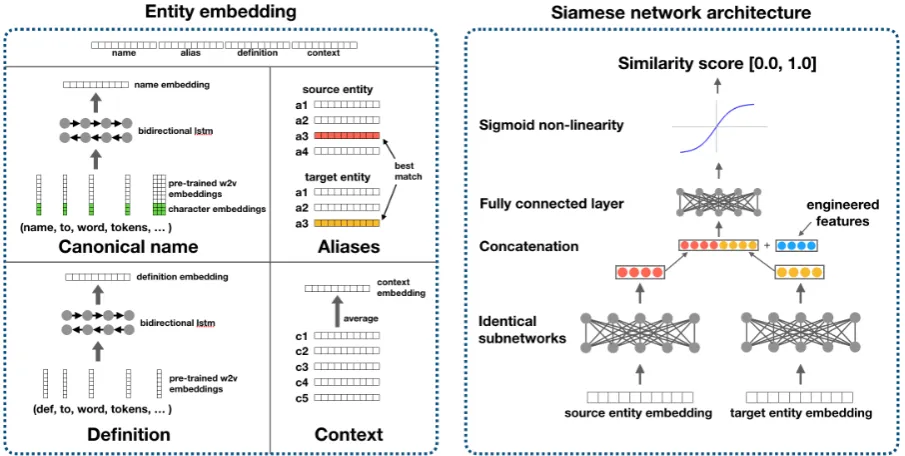
Figure 2: Siamese network architecture for computing entity embeddings for each source and target entity in a candidate entity pair.
over the entity name, aliases, and definition.5
2.3 Prediction
Given a candidate pair (es,et) and the
precom-puted features f(es,et), we train a model to pre-dict the probability that the two entities are seman-tically equivalent. Figure2illustrates the architec-ture of our neural model for estimating this proba-bility which resembles a siamese network ( Brom-ley et al.,1993). At a high level, we first encode each of the source and target entities, then concate-nate their representations and feed it into a multi-layer perceptron ending with a sigmoid function for estimating the probability of a match. Next, we describe this architecture in more detail.
Entity embedding. As shown in Fig. 2 (left), we encode the attributes of each entity as follows:
• A canonical nameenameis a sequence of tokens, each encoded using pretrainedword2vec em-beddings concatenated with a character-level convolutional neural network (CNN). The to-ken vectors feed into a bi-directional long short-term memory network (LSTM) and the hidden layers at both ends of the bi-directional LSTM
5Even though neural models may obviate the need for feature engineering, feeding highly discriminative features into the neural model improves the inductive bias of the model and reduces the amount of labeled data needed for training.
are concatenated and used as the name vector
vname.
• Each alias in ealiases is independently embed-ded using the same encoder used for canonical names (with shared parameters), yielding a set of alias vectorsvalias−ifori= 1, . . . ,|ealiases|.
• An entity definitionedefis a sequence of tokens, each encoded using pretrained embeddings then fed into a bi-directional LSTM. The definition vectorvdef is the concatenation of the final hid-den states in the forward and backward LSTMs.
• Each context in econtexts is independently em-bedded using the same encoder used for defi-nitions (with shared parameters), then averaged yielding the context vectorvcontexts.
The name, alias, definition, and context vec-tors are appended together to create the entity embedding, e.g., the source entity embedding es
is: vs = [vsname;vsalias−i∗;vdefs ;vcontextss ]. In
or-der to find representative aliases for a given pair of entities, we pick the source and target aliases with the smallest Euclidean distance, i.e.,i∗, j∗ = arg mini,jkvsalias−i−vtalias−jk2
network with ReLU non-linearities and dropout (Srivastava et al., 2014). The outputs of the two subnetworks are then concatenated together with the engineered features and fed into another feed-forward network with a ReLU layer followed by a sigmoid output layer. We train the model to mini-mize the binary cross entropy loss for gold labels. To summarize, the network estimates the proba-bility of equivalence betweenesandetas follows:
hs=RELU(RELU(vs;θ1);θ2)
ht=RELU(RELU(vt;θ1);θ2)
P(es≡et) =SIGMOID(RELU([hs;ht];θ3);θ4)
3 Deriving and enriching labeled data
In this section, we discuss how to derive a large amount of labeled data for training, and how to augment entity attributes with definitions and con-texts from external resources.
3.1 Deriving training data from UMLS
The Unified Medical Language System (UMLS) Metathesaurus, which integrates more than 150 source ontologies, illustrates the breadth of cover-age of biomedical ontologies (Bodenreider,2004). Also exemplified by the UMLS Metathesaurus is the high degree of overlap between the content of some of these ontological resources, whose terms have been (semi-)manually aligned. Significant time and effort has gone into cross-referencing se-mantically equivalent entities across the ontolo-gies, and new terms and alignments continue to be added as the field develops. These manual alignments are high quality, but considered to be incomplete (Morrey et al., 2011;Mougin and Grabar,2014).
To enable supervised learning for our mod-els, training data was derived from the UMLS Metathesaurus. By exposing our models to labeled data from the diverse subdomains covered in the UMLS Metathesaurus, we hope to learn a variety of patterns indicating equivalence between a pair of entities which can generalize to new ontologies not included in the training data.
We identified the following set of ontologies within UMLS to use as the source of our labeled data, such that they cover a variety of domains without overlapping with the test ontologies used for evaluation in the OAEI: Current Procedural Terminology (CPT), Gene Ontology (GO), Hugo Nomenclature (HGNC), Human Phenotype Ontol-ogy (HPO), Medical Subject Headings (MeSH),
Online Mendelian Inheritance in Man (OMIM), and RxNorm.
Our labeled data take the form (es,et, l ∈ {0,1}), wherel = 1indicates positive examples where es ≡ et. For each pair of ontologies, we first derive all the positive mappings from UMLS. We retain the positive mappings for which there are no name equivalences. Then, for each posi-tive example (es,et+,1), we sample negative map-pings (es,et−,0) from the other entities in the tar-get ontology. One “easy” negative and one “hard” negative are selected for each positive alignment, where easy negatives consist of entities with lit-tle overlap in lexical features while hard negatives have high overlap. Easy negatives are obtained by randomly sampling entities from the target ontol-ogy, for each source entity. Hard negatives are ob-tained using the same candidate selection method described in§2. In both easy and hard examples, we exclude all target entities which appear in a positive example.6
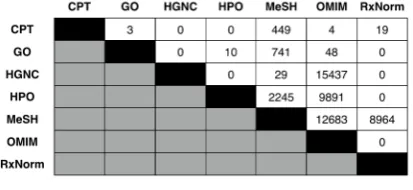
[image:4.595.313.520.481.576.2]Over all seven ontologies, 50,523 positive align-ments were extracted from UMLS. Figure 3 re-ports the number of positive alignments extracted from each ontology pair. For these positives, 98,948 hard and easy negatives alignments were selected. These positive and negative labeled ex-amples were pooled and randomly split into a 64% training set, a 16% development set, and a 20% test set.
Figure 3: Number of positive alignments ex-tracted from each pair of ontologies from UMLS.
3.2 Deriving definitions and mention contexts
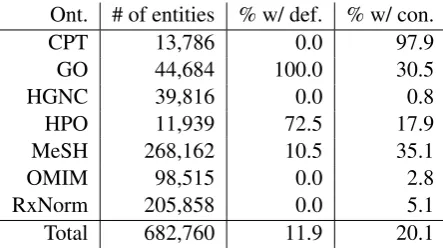
Many ontologies do not provide entity definitions (Table1). In fact, only a few (GO, HPO, MeSH) of the ontologies we included have any definitions at all.
6
Table 1: Entities with definitions and contexts for each of the training ontologies.
Ont. # of entities % w/ def. % w/ con.
CPT 13,786 0.0 97.9
GO 44,684 100.0 30.5
HGNC 39,816 0.0 0.8
HPO 11,939 72.5 17.9
MeSH 268,162 10.5 35.1
OMIM 98,515 0.0 2.8
RxNorm 205,858 0.0 5.1
Total 682,760 11.9 20.1
We can turn to external sources of entity def-initions in such cases. Many biomedical and healthcare concepts are represented in Wikipedia, a general purpose crowd-sourced encyclopedia. The Wikipedia API can be used to search for and extract article content. The first paragraph in each Wikipedia article offers a description of the concept, and can be used as a substitute for a definition. For each entity in the labeled dataset described in the previous section, we query Wikipedia using the entity’s canonical name. The first sentence from the top Wikipedia article match is extracted and used to populate the attribute
edef when undefined in the ontology. For exam-ple, a query for OMIM:125370, “Dentatorubral-pallidoluysian atrophy,” yields the following sum-mary sentence from Wikipedia: “Dentatorubral-pallidoluysian atrophy (DRPLA) is an autosomal dominant spinocerebellar degeneration caused by an expansion of a CAG repeat encoding a polyg-lutamine tract in the atrophin-1 protein.” Based on a human-annotated sample, the accuracy of our externally-derived definitions is 75.5%, based on a random sample of 200 definitions and two annota-tors with Cohen’s kappa coefficient ofκ= 0.88.7
Usage contexts are derived from scientific pa-pers in Medline, leveraging entity annotations available via the Semantic Scholar project ( Am-mar et al., 2018). In order to obtain the an-notations, an entity linking model was used to find mentions of UMLS entities in the abstracts of Medline papers. The sentences in which a UMLS entity were mentioned are added to the
econtexts attribute of that entity. For UMLS
en-tity C0751781, “Dentatorubral-Pallidoluysian
At-7Annotations are available at https://github.com/
allenai/ontoemma#human-annotations
rophy,” an example context: “Dentatorubral-pallidoluysian atrophy (DRPLA) is an autoso-mal dominant neurodegenerative disease clini-cally characterized by the presence of cerebellar ataxia in combination with variable neurological symptoms,” is extracted from Yoon et al (2012) (Yoon et al., 2012). This context sentence was scored highly by the linking model, and provides additional information about this entity, for exam-ple, its acronym (DRPLA), the type of disease (au-tosomal dominant neurodegenerative), and some of its symptoms (cerebellar ataxia). Because there are often numerous linked contexts for each en-tity, we sample up to 20 contexts per entity when available. The number of entities with context in our labeled data is given in Table1. The accuracy of usage contexts extracted using this approach is 92.5%, based on human evaluation of 200 contexts with Cohen’s kappa coefficient ofκ= 1.7
4 Experiments
In this section, we experiment with several vari-ants of OntoEmma: In the first variant (Onto-Emma:NN), we only encode native attributes ob-tained from the source and target ontologies: canonical name, aliases, and native definitions. In the second variant (OntoEmma:NN+f), we also add the manually engineered features as de-scribed in §2.2. In the third variant (Onto-Emma:NN+f+w), we incorporate external defini-tions from Wikipedia, as discussed in§3.2. In the fourth variant (OntoEmma:NN+f+w+c), we also encode the usage contexts we derived from Med-line, also discussed in§3.2.
Data. We use the training section of the UMLS-derived labeled data to train the model and use the development section to tune the model hyperpa-rameters. For evaluation, we use the test portion of our UMLS-derived data as well as the OAEI large-bio subtrack SNOMED-NCI task, the largest task in OAEI largebio. The UMLS test set includes 29,859 positive and negative mappings. The OAEI reference alignments included 17,210 equivalent mappings and 1,623 uncertain mappings between the SNOMED and NCI ontologies.
Table 2: Model performance on UMLS test dataset
Model Prec. Recall F1
OntoEmma:LR 0.98 0.92 0.95 OntoEmma:NN 0.87 0.85 0.86 OntoEmma:NN+f 0.93 0.96 0.95 OntoEmma:NN+f+w 0.93 0.97 0.95 OntoEmma:NN+f+w+c 0.94 0.97 0.96
Table 3: Model performance on OAEI largebio SNOMED-NCI task
Model Prec. Recall F1
AML:entity 0.81 0.62 0.70 OntoEmma:LR 0.75 0.56 0.65 OntoEmma:NN+f+w+c 0.80 0.61 0.69
to AgreementMakerLight (AML) which has con-sistently been a top performer in the OAEI sub-tasks related to biomedicine (Faria et al., 2013). For a fair comparison to OntoEmma, we only use the entity-level matchers in AML; i.e., relation and structural matchers in AML are turned off.8
Implementation and configuration details. We provide an open source, modular, Python implementation of OntoEmma where different candidate selectors, feature generators, and prediction modules can be swapped in and out with ease.3 We implement the neural model using PyTorch and AllenNLP9 libraries, and implement the logistic regression model using scikit-learn. Our 100-dimensional pre-trained embeddings are learned using the default settings of word2vec based on the Medline corpus. The character-level CNN encoder uses 50 filters of size 4 and 5, and outputs a token embedding of size 100 with dropout probability of 0.2. The LSTMs have output size 100, and have dropout probability of 0.2.
Results. The performance of the models is re-ported in terms of precision, recall and F1 score on the held-out UMLS test set and the OAEI large-bio SNOMED-NCI task in Tables2and3, respec-tively.
Table 2 illustrates how different variants of OntoEmma perform on the held-out UMLS test
8
The performance of the full AML system on the SNOMED-NCI subtask for OAEI 2017 is: precision: 0.90, recall: 0.67, F1: 0.77.
9https://allennlp.org/
set. We note that the bare-bones neural network model (OntoEmma:NN) does not match the per-formance of the baseline logistic regression model (OntoEmma:LR), suggesting that the representa-tions learned by the neural network are not suffi-cient. Indeed, adding the engineered features to the neural model in (OntoEmma:NN+f) provides substantial improvements, matching the F1 score of the baseline model. Adding definitions and usage context in (OntoEmma:NN+f+w+c) further improves the F1 score by one absolute point, out-performing the logistic regression model.
While the UMLS-based test set in Table2 rep-resents the realistic scenario of aligning new enti-ties in partially-aligned ontologies, we also wanted to evaluate the performance of our method on the more challenging scenario where no labeled data is available in the source and target ontologies. This is more challenging because the patterns learned from ontologies used in training may not transfer to the test ontologies. Table3 illustrates how our method performs in this scenario using SNOMED-NCI as test ontologies. For matching of the SNOMED and NCI ontologies, we enriched the entities first using Wikipedia queries. At test time, we also identified and aligned pairs of en-tities with exact string matches, using the Onto-Emma matcher only for those entities without an exact string match. Unsurprisingly, the perfor-mance of OntoEmma on unseen ontologies (in Table 3) is much lower than its performance on seen ontologies (in Table 2). With unseen on-tologies, we gain a large F1 improvement of 4 absolute points by using the fully-featured neu-ral model (OntoEmma:NN+f+w+c) instead of the logistic regression variant (OntoEmma:LR), sug-gesting that the neural model may transfer better to different domains. We note, however, that the OntoEmma:NN+f+w+c matcher performs slightly worse than the AML entity matcher. This is to be expected since AML incorporates many matchers which we did not implement in our model, e.g., us-ing background knowledge, acronyms, and other features.
5 Discussion
evalu-ated the efficacy of including definitions and usage context to improve entity matching. For the first question, we saw some success with both the lo-gistic regression and neural network models. The logistic regression model performed better than the simple neural network model without engi-neered features. Hand-engiengi-neered features encode human knowledge, and are less noisy than features trained from a neural network. The NN model re-quired more training data to learn the same sparse information encoded by pre-defined features.
To bolster performance, hand-engineered fea-tures and extensive querying of third-party re-sources were used to increase knowledge about each entity. Definitions and usage contexts had rarely been used by previous ontology matchers, and we sought to exploit the value of these ad-ditional pieces of information. Definitions espe-cially, often offer information about an entity’s re-lations and attributes, which may not be explic-itly defined in the ontology. The ontologies used for training contained inconsistent information – some had definitions for all entities, some none; some were well-represented in our context link-ing model, some were not. To take advantage of such information, therefore, we had to turn to ex-ternal sources of definitions and contexts, which are understandably more noisy than information provided in the ontology itself.
Using Wikipedia and the Medline corpus, we derived definitions and contexts for many of the entities in the UMLS training corpus. Adding def-initions improved the performance of our neural network model. However, high quality definitions native to each terminology would likely have im-proved results further, since we could not ensure that externally derived definitions were always rel-evant to the entity of interest.
Limitations. Our ontology matcher did not im-plement any structural matchers, and did not take advantage of relationship data where it existed. In ontologies with well-defined hierarchy or relation-ships, the structural component provides orthogo-nal and extremely relevant information for match-ing. By choosing to focus on entity alignment, we were unable to be competitive on global ontology matching.
Of all the entities in our UMLS training, devel-opment, and test datasets, only 11.9% of entities had definitions from their source ontology (Table 1). Similarly, we were only able to derive
con-texts for 20.1% of the training entities from the Semantic Scholar entity linking model (Table 1). We were hoping for better coverage of the overall dataset. We were, however, able to use Wikipedia to increase the overall definition coverage of the entities in our data set to 82.1%.
Although Wikipedia is a dense resource con-taining curated articles on many concepts, it is by no means exhaustive. Many of the entities in our training and test data set did not correspond di-rectly to entities in Wikipedia. We also could not review each query to ensure a correct match be-tween the Wikipedia article and the entity. The data is therefore noisy and can introduce error in some cases. Although the overall performance improved upon querying Wikipedia for additional definitions, we believe that dedicated definitions from the source terminologies would perform bet-ter where available.
Future work. We are exploring other ways to derive high-quality definitions from external re-sources, for example, by deriving definitions from synonymous entities in other ontologies, or by generating textual definitions using the logical definitions given in an ontology. Similarly, we can incorporate usage context from other sources. For example, the Semantic MEDLINE Database (SemMedDB) is a database of semantic relation-ship predictions from PubMed articles (Kilicoglu et al., 2012). The entity-relation triples in this database can be used to retrieve PubMed article context mapped to UMLS terms.
Continuing on, we aim to develop a more flex-ible ontology matching system that takes into ac-count all of the information available about an en-tity. Flexible entity embeddings would represent critical information for proper entity alignment, while accounting for a variety of data types, such as list-like and graph-like data. We would also like to incorporate ontology structure and relations in matching. Hierarchical structure is provided by most biomedical terminologies, and provides es-sential information for a matching system. One possibility is ensembling OntoEmma with other matcher systems that incorporate or focus on us-ing structural features in matchus-ing.
largebio, and more recently introduced phenotype tracks (Faria et al.,2016). Participating matchers implement a variety of matching techniques in-cluding rule-based and statistical methods (Faria et al., 2016; Gross et al., 2016; Otero-Cerdeira et al., 2015; Shvaiko and Euzenat, 2013). Fea-tures used by matchers can be element-level (ex-tracted from each individual entity), or structure-level (based on the topology of the ontology and its relationships). Content features can be based on terminology (i.e., names of entities), structure (i.e., how entities are connected), annotations (i.e., annotations made to entities), or reasoning output. Some features can also be derived from external sources, such as cross-references to other ontolo-gies, or cross-annotations in other datasets, such as term coincidence in publications, or co-annotation of experiments with terms from different ontolo-gies (Husein et al.,2016).
Notable general purpose matchers that have excelled in biomedical domain matching tasks include AgreementMakerLight (AML), YAM++, and LogMap. AML has consistently been a top performer in the OAEI subtasks related to biomedicine. It uses a combination of different matchers, such as the lexical matcher (looking for complete string matches between the names of entities), mediating matcher (performing the function of the lexical matcher through a third background ontology), word-based string similar-ity matcher (matching entities with minimal string edit distances), and others. AML then combines these various similarity scores to generate a global alignment between the two input ontologies (Faria et al.,2013). YAM++, another successful matcher, implemented a decision tree learning model over many string similarity metrics, but leaves the chal-lenges of finding suitable training data to the user, defaulting to information retrieval-based similar-ity metrics for its decision-making when no train-ing data is provided (Ngo and Bellahsene,2016). LogMap is a matcher specifically designed to ef-ficiently align large ontologies, generating logi-cal output alignments. The matcher uses high-probability matches as anchors from which to de-ploy its lexical and structural matchers ( Jim´enez-Ruiz and Cuenca Grau,2011).
Our system uses neural networks to learn entity representations and features for matching. Several published works discuss using neural networks to learn weights over similarity metrics pre-defined
by the user or developer of the matching system (Djeddi and Khadir, 2013; Peng, 2010; Huang et al., 2008;Hariri et al., 2006). These systems do not use neural networks to generate and learn the features most appropriate for entity match-ing. Qiu et al.(2017) proposes and tests an auto-encoder network for unsupervised entity represen-tation learning over a bag of words vector that treats all descriptive elements of each entity (its name, definitions etc.) equally. We are interested in investigating how these various descriptive ele-ments contribute to entity matching, how sparsity of specific descriptive fields can be offset by deriv-ing information from external resources, and also whether we can use domain-specific training data to optimize a model for the biomedical domain.
Conclusion In this paper, we propose using nat-ural language text associated with entities to im-prove ontology alignment. We describe a novel neural architecture for ontology alignment which can encode a variety of information, and derive large amounts of labeled data for training the model. To address the limited coverage of def-initions and usage contexts describing entities, we turn to external resources to supplement the available information about entities in the test ontologies. Our empirical results illustrate that externally-derived definitions and contexts can ef-fectively be used to improve the performance of ontology matching systems.
6 Acknowledgements
We would like to thank the anonymous reviewers for their helpful comments. We also thank John Gennari, Oren Etzioni, Joanna Power as well as the rest of the Semantic Scholar team at the Allen Institute for Artificial Intelligence for helpful com-ments and insights.
References
Waleed Ammar, Dirk Groeneveld, Chandra Bhagavat-ula, Iz Beltagy, Miles Crawford, Doug Downey, Ja-son Dunkelberger, Ahmed Elgohary, Sergey Feld-man, Vu Ha, Rodney Kinney, Sebastian Kohlmeier, Kyle Lo, Tyler Murray, Hsu-Han Ooi, Matthew Pe-ters, Joanna Power, Sam Skjonsberg, Lucy Lu Wang, Chris Wilhelm, Zheng Yuan, Madeleine van Zuylen, and Oren Etzioni. 2018. Construction of the litera-ture graph in semantic scholar. InNAACL (industry track).
Medical Language System (UMLS):
inte-grating biomedical terminology. Nucleic
Acids Res 32(Database issue):D267–D270. https://doi.org/10.1093/nar/gkh061.
Jane Bromley, Isabelle Guyon, Yann LeCun, Eduard S¨ackinger, and Roopak Shah. 1993. Signature veri-fication using a siamese time delay neural network. InNIPS.
Warith Eddine Djeddi and Mohamed Tarek Khadir. 2013. Ontology Alignment Using Artificial Neu-ral Network for Large-scale Ontologies. Int. J. Metadata Semant. Ontologies 8(1):75–92. https://doi.org/10.1504/IJMSO.2013.054180.
Daniel Faria, Catia Pesquita, Booma S. Balasubra-mani, Catarina Martins, Jo˜ao Cardoso, Hugo Cu-rado, Francisco M. Couto, and Isabel F. Cruz. 2016. OAEI 2016 results of AML. volume 1766, pages 138–145.
Daniel Faria, Catia Pesquita, Emanuel Santos, Matteo Palmonari, Isabel F. Cruz, and Francisco M. Couto. 2013. The AgreementMakerLight Ontology Match-ing System. In On the Move to Meaningful In-ternet Systems: OTM 2013 Conferences. Springer, Berlin, Heidelberg, Lecture Notes in Computer Sci-ence, pages 527–541. https://doi.org/10.1007/978-3-642-41030-7 38.
Anika Gross, Cedric Pruski, and Erhard Rahm. 2016. Evolution of biomedical ontologies and
mappings: Overview of recent approaches.
Comput Struct Biotechnol J 14:333–340. https://doi.org/10.1016/j.csbj.2016.08.002.
Babak Bagheri Hariri, Hassan Abolhassani, and Hassan Sayyadi. 2006. A
Neural-Networks-Based Approach for Ontology Alignment.
Japan Society for Fuzzy Theory and In-telligent Informatics, pages 1248–1252. https://doi.org/10.14864/softscis.2006.0.1248.0.
Jingshan Huang, Jiangbo Dang, Michael N. Huhns, and W. Jim Zheng. 2008. Use artificial neural network to align biological ontologies. BMC Genomics 9 Suppl 2:S16. https://doi.org/10.1186/1471-2164-9-S2-S16.
Inne Gartina Husein, Saiful Akbar, Benhard Sito-hang, and Fazat Nur Azizah. 2016. Review of ontology matching with background knowl-edge. In 2016 International Conference on Data and Software Engineering (ICoDSE). pages 1–6. https://doi.org/10.1109/ICODSE.2016.7936159.
Ernesto Jim´enez-Ruiz and Bernardo Cuenca Grau. 2011. Logmap: Logic-based and scalable ontol-ogy matching. In Lora Aroyo, Chris Welty, Harith Alani, Jamie Taylor, Abraham Bernstein, Lalana Ka-gal, Natasha Noy, and Eva Blomqvist, editors, The Semantic Web – ISWC 2011. Springer Berlin Hei-delberg, Berlin, HeiHei-delberg, pages 273–288.
Halil Kilicoglu, Dongwook Shin, Marcelo Fisz-man, Graciela Rosemblat, and Thomas C. Rindflesch. 2012. Semmeddb: a
pubmed-scale repository of biomedical semantic
predications. Bioinformatics 28:3158–60.
https://doi.org/10.1093/bioinformatics/bts591.
Xiang Li, Aynaz Taheri, Lifu Tu, and Kevin Gimpel. 2016. Commonsense knowledge base completion. InACL.
Mike Mintz, Steven Bills, Rion Snow, and Daniel Ju-rafsky. 2009. Distant supervision for relation extrac-tion without labeled data. InACL.
Charles Paul Morrey, Ling Chen, Michael Halper, and Yehoshua Perl. 2011. Resolution of redun-dant semantic type assignments for organic chemi-cals in the UMLS. Artif Intell Med52(3):141–151. https://doi.org/10.1016/j.artmed.2011.05.003.
Fleur Mougin and Natalia Grabar. 2014. Au-diting the multiply-related concepts within the UMLS. J Am Med Inform Assoc21(e2):e185–193. https://doi.org/10.1136/amiajnl-2013-002227.
DuyHoa Ngo and Zohra Bellahsene. 2016. Overview of YAM++(not) Yet Another Matcher for ontol-ogy alignment task. Web Semantics: Science, Ser-vices and Agents on the World Wide Web41:30–49. https://doi.org/10.1016/j.websem.2016.09.002.
Lorena Otero-Cerdeira, Francisco J. Rodriguez-Martinez, and Alma Gomez-Rodriguez. 2015. On-tology matching: A literature review. Ex-pert Systems with Applications 42(2):949–971. https://doi.org/10.1016/j.eswa.2014.08.032.
Yefei Peng. 2010. Ontology Mapping Neural Network: An Approach to Learning and Inferring Correspon-dences Among Ontologies.
Lirong Qiu, Jia Yu, Qiumei Pu, and Chuncheng Xi-ang. 2017. Knowledge entity learning and rep-resentation for ontology matching based on deep neural networks. Cluster Comput 20(2):969–977. https://doi.org/10.1007/s10586-017-0844-1.
Pavel Shvaiko and J´erˆome Euzenat. 2013. On-tology Matching: State of the Art and Future
Challenges. IEEE Transactions on
Knowl-edge and Data Engineering 25(1):158–176. https://doi.org/10.1109/TKDE.2011.253.
Nitish Srivastava, Geoffrey E. Hinton, Alex Krizhevsky, Ilya Sutskever, and Ruslan Salakhutdi-nov. 2014. Dropout: a simple way to prevent neural networks from overfitting. Journal of Machine Learning Research15:1929–1958.