21
A Multi-Stage Memory Augmented Neural Network
for Machine Reading Comprehension
Seunghak Yu Sathish Indurthi Seohyun Back Haejun Lee
Samsung Research, Seoul, Korea
{seunghak.yu, s.indurthi, scv.back}@samsung.com
Abstract
Reading Comprehension (RC) of text is one of the fundamental tasks in natu-ral language processing. In recent years, several end-to-end neural network mod-els have been proposed to solve RC tasks. However, most of these models suffer in reasoning over long documents. In this work, we propose a novel Memory Aug-mented Machine Comprehension Network (MAMCN) to address long-range depen-dencies present in machine reading com-prehension. We perform extensive exper-iments to evaluate proposed method with the renowned benchmark datasets such as SQuAD, QUASAR-T, and TriviaQA. We achieve the state of the art performance on both the document-level (QUASAR-T, TriviaQA) and paragraph-level (SQuAD) datasets compared to all the previously published approaches.
1 Introduction
Reading Comprehension (RC) is essential for understanding human knowledge written in text form. One possible way of measuring RC is by formulating it as answer span prediction style Question Answering (QA) task, which is finding an answer to the question based on the given doc-ument(s). Recently, influential deep learning ap-proaches have been proposed to solve this QA task.Wang and Jiang(2017);Seo et al.(2017) pro-pose the attention mechanism between question and context for question-aware contextual repre-sentation. Wang et al. (2017) refine these con-textual representations by using self-attention to improve the performance. Even further perfor-mance improvement is gained by using contextu-alized word representations for query and context
(Salant and Berant, 2017;Peters et al., 2018;Yu et al.,2018).
Based on those approaches, several methods have successfully made progress towards reaching human-level performance on SQuAD (Rajpurkar et al.,2016). Each training example in the SQuAD only has the relevant paragraph with the corre-sponding answer. However, most of the docu-ments present in the real-world are long, contain-ing relevant and irrelevant paragraphs, and do not guarantee answer presence. Therefore the models proposed to solve SQuAD have difficulty in apply-ing to real-world documents (Joshi et al., 2017). Recently, QUASAR-T (Dhingra et al.,2017) and TriviaQA (Joshi et al., 2017) datasets have been proposed to resemble real-world document. These datasets use document-level evidence as training example instead of using only the relevant para-graph and evidence does not guarantee answer presence, which makes them more realistic.
To effectively comprehend long documents present in the QUASAR-T and TriviaQA datasets, the QA models have to resolve long-range de-pendencies present in these documents. In this work, we build a QA model that can understand long documents by utilizing Memory Augmented Neural Networks (MANNs) (Graves et al.,2014; Weston et al., 2015b). This type of neural net-works decouples the memory capacity from the number of model parameters. While there have been several attempts to use MANNs in managing long-range dependencies, applications are limited to only toy datasets (Sukhbaatar et al.,2015; We-ston et al.,2015a;Kumar et al.,2016;Graves et al., 2016). Compared to the previous approaches, we mainly focus on the document-level QA task on QUASAR-T and TriviaQA. We also apply our model to SQuAD to show that our model even works well on the paragraph-level.
(1) We develop Memory Augmented Machine Comprehension Network (MAMCN) to solve document-level RC task. (2) Our method achieves the state of the art performance compared to all the published results on both the document-level (QUASAR-T and TriviaQA) and paragraph-level (SQuAD) benchmarks. In TriviaQA we achieve 71.91 and 69.60 F1 scores for Web and Wikipedia domains respectively. Also, we achieved 86.73 F1 compared to the human performance of 91.22 F1 in SQuAD benchmark. These results show that MAMCN is a crucial component for QA task, es-pecially they are useful in comprehending long documents.
2 Related Work
Many neural networks have been proposed to solve answer span QA task. Ranking continu-ous text spans within a passage was proposed by Yu et al. (2016) and Lee et al. (2016). Wang and Jiang (2017) combine match-LSTM, origi-nally introduced in (Wang and Jiang, 2016) and pointer networks to produce the boundary of the answer. Since then, most of the models adopted pointer networks as a prediction layer and then focused on improving other layers. Some meth-ods focused on devising more accurate attention method; Seo et al. (2017); Wang et al. (2017); Xiong et al. (2017) employ attention mechanism to match the question context mutually; In addi-tion,Liu et al.(2017a) apply multi-layer attention andHuang et al.(2017b) expand to multi-level at-tention to get more enriched atat-tention information. Other approaches use contextualized word rep-resentations to further improve the performance. Salant and Berant(2017);Peters et al.(2018) uti-lize embedding from pre-trained language model as an additional feature andYu et al.(2018) select machine translation model instead. Also, there are few attempts at augmenting memory capacity of the model (Hu et al.,2017;Pan et al.,2017). Hu et al. (2017) refine the contextual representation with multi-hops, andPan et al.(2017) simply use the encoded query representations as a memory vector for refining the answer prediction, which are not meant to handle long-range dependency that we consider in this work.
3 Proposed Model
We propose a memory augmented reader for answer-span style QA task. Answer-span style QA
task is defined as follows. Question and document can be represented by sequence of words q =
{wqi}m
i=1, d = {wdj}nj=1 respectively. Answer-span a = {wkd}e
k=s (where, 1 ≤ s ≤ e ≤ n)
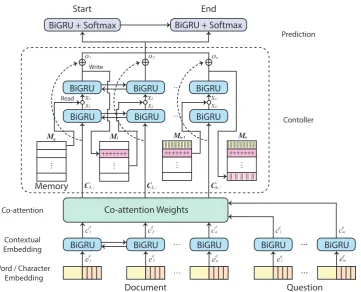
should be returned, givenqandd. We embed the sequence of words inqanddto get contextual rep-resentations. These contextual representations are used for calculating question-aware context repre-sentation which is controlled by external memory unit and used for predicting answer-span. We de-scribe more details of each layer in following sec-tions and depict overall architecture of proposed model in Figure1.
3.1 Contextual Representation
Word Embedding: We use two different kinds of embeddings to get the richer feature representa-tion for each word in the quesrepresenta-tion and document. Word-level embedding helps to have a represen-tation explaining semantic similarities as proxim-ity in high dimensional vector space. In addi-tion to this, we utilize character-level embedding by applying convolution filters to address out-of-vocabulary and infrequent words problem. We concatenate both embeddings[ew;ec]to represent each word embedding ase∈Rl.
Contextual Embedding: We compute the con-textual representation for each word in the ques-tion and document by using bi-direcques-tional GRU (Cho et al.,2014) as follows:
cqi =BiGRUq(eqi,hi−1,hi+1), (1)
cdj =BiGRUd(edj,hj−1,hj+1), (2)
where eqi,ed
j are the word embeddings for
each word in the question and document, and hi−1,hi+1 are the hidden states of the forward and reverse GRUs respectively. The final ques-tion and document contextual representaques-tion are Cq ∈Rm×2landCd∈
Rn×2l.
Co-attention: We compute question-aware rep-resentations for each word in the document by adopting the attention mechanism in (Clark and Gardner,2017). To get these representations, we first compute the similarity matrixS followed by bi-directional attention between the words in the question and document as follows:
sij =wqCqi,:+wdCdj,:+wh(Cqi,:C d j,:) (3)
wq, wd, and wh are trainable weights and
Co-attention Weights
Co-attention
BiGRU BiGRU BiGRU BiGRU BiGRU
Contextual Embedding
Document Question
Word / Character Embedding
Contoller Prediction
BiGRU BiGRU BiGRU
BiGRU BiGRU BiGRU
End Start
BiGRU + Softmax BiGRU + Softmax
cq 1
cd
1 c
d 2
ed1 e
d
2 e
q 1
cd
n c
q m
edn e
q m
M0 M1 Mn-1 Mn
o1 o2 on
C1, : C2, : Cn, :
s1 s2 sn
Read Write
[image:3.595.123.485.59.351.2]+++++++
||||||||||||||||||| +++++++
|||||||||||||||||||
|| || || || || +++++++
Memory
x1 x2 xn
Figure 1: The architecture of Memory Augmented Machine Comprehension Network (MAMCN).
similarity matrixsij represents attention between
ithword in the question andjthword in the
docu-ment. We can get the attention weights of ques-tion words to each document word by applying column-wise softmax toS.
aqij = e sij
Pm k=1eskj
(4)
Aq:,j is attention weights of questions to jth
word in the document. We can get attended ques-tion vectors for the document words by multiply-ing entire attention matrix Aq to the contextual embedding of questionCq.
˜
Cq =Aq TCq ∈Rn×2l (5)
Also, we can get attention weights on the docu-ment words for the questionad by applying soft-maxto the column-wise max values (vd) of atten-tion matrixAq.
adj =
ev
d j
Pn k=1ev
d k
, (vdj = max 1≤i≤ma
q
ij) (6)
This attention weight on the document wordsad is duplicatedntimes for each row to makeAdand
applied to contextual embedding of documentCd to get attended document vectors.
˜
Cd=AdCd∈Rn×2l (7)
Finally, we can make question-aware contextual representationCby concatenating as follows:
C = [Cd;C˜q;CdC˜q;CdC˜d]∈Rn×8l (8)
3.2 Memory Controller
Memory controller allows us to utilize external memory to compensate for the limited memory capacity of the recurrent layers. We develop the memory controller inspired by the memory frame-work of (Graves et al.,2016). The operation of the controller at time steptis given by:
ot,it=Controller(Ct,:,Mt−1) (9)
It takes the contextual representation vectorCt,: as input, and the external memory matrix of the previous time stepMt−1 ∈ Rp×q, wherepis the number of memory locations, andq is the dimen-sion of each location. We choose two layers of BiGRUs as the recurrent layer for the controller. The contextual representations are fed into the first layer to capture interactions between contexts.
Then,stand the subset of memory vectors
ob-tained from the memory matrix are concatenated to generate an input vectorxtfor the second layer,
xt= [st;m1t−1;· · ·;mst−1]∈R2l+sq, (11)
wheresis the number of read vectors. After feed-ing the input vector xt to the second recurrent
layer, the controller uses the outputs of the layer hmt to emit the output vectorotand the interface
vector it. We describe details of obtaining each
vector as follows:
hmt =BiGRU(xt,hmt−1,hmt+1) (12)
Output Vector: The controller makes the out-put vector as a weighted sumvtof hidden state of
the recurrent layer and memory vectors.
vt=Wohmt +Wm[m1t;· · ·;mst] (13)
We add a residual connection between the con-troller’s input and output to mitigate the infor-mation morphing that can occur when interacting with memory. As a result, we get a long-term dependency-aware output vector as follows:
ot=Wvvt+WcCt,:∈R2l (14)
Interface Vector: At the same time, the con-troller generates interface vectoritfor the memory
interaction based onhmt as follows:
it=Wihmt ∈Rsq+5s+3q+3. (15)
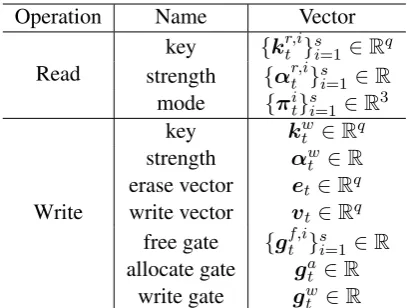
We consider it as a concatenation of various functional vectors which determine the basic op-eration of the memory such as memory address-ing, read and write. The complete list of functional vectors is described in Table1.
Memory Addressing : We use content-based addressing mechanism for read and write opera-tions. In content-based addressing, the memory locations required to read/write at the current time steptare obtained by using the probability distri-bution over the memory locations, which is a sim-ilarity function between the key vector and each memory vector.
ci=softmax(cos(Mi,:,k)α˜) (16)
cosis the cosine similarity andα˜ is a constrained strength value to[1,∞)by(1 + log(1 +eα)).
Operation Name Vector
Read
key {kr,it }s
i=1∈Rq strength {αr,it }s
i=1 ∈R mode {πit}s
i=1∈R3
Write
key kwt ∈Rq strength αwt ∈R
erase vector et∈Rq write vector vt∈Rq
free gate {gf,it }s i=1 ∈R allocate gate gat ∈R
[image:4.595.314.518.61.215.2]write gate gw t ∈R
Table 1: The list of functional vectors that make up the interface vector of controller.
Read Operation: Each read head performs a read operation by weighting over entire memory.
crt =softmax(cos(Mt,krt)α˜rt) (17)
Along with this, we use a temporal memory linkage matrix to associate memories together, which keep track of consecutively modified loca-tions in the memory. The multiplication of tempo-ral link matrix and read weights from the previous time-step gives backwardbtand forward weights
ftwhich helps to track the temporal order of the memory. The read weights are obtained from the linear combination of corresponding weights and the mode vectorsπ˜normalized by softmax.
wrt =π˜[0]bt+π˜[1]crt+π˜[2]ft (18)
These read weights are applied to memory loca-tions to get the final read vectors as follow:
mi = p X
i
Mi,:wr,it (19)
Write Operation: Similar to the read heads in read operation, a write head determines where to write by using content-based weighting.
cwt =softmax(cos(Mt−1,kwt)α˜wt) (20)
We adopted dynamic memory allocation as de-scribed in (Graves et al.,2016) to maintain a free list and a usage vector to track the memory free-ness. Based on the memory freeness, allocation weights at are calculated to indicate where to
Dataset Total ADL Train / Dev / Test
SQuAD 87,599 / 10,570 / UNK 142 QUASAR-T
25,465 / 2,043 / 2,068 221 (Short)
QUASAR-T
26,318 / 2,129 / 2,102 392 (Long)
TriviaQA
528,979 / 68,621 / 65,509 631 (Web)
TriviaQA
[image:5.595.71.299.61.217.2]110,648 / 14,229 / 13,661 955 (Wikipedia)
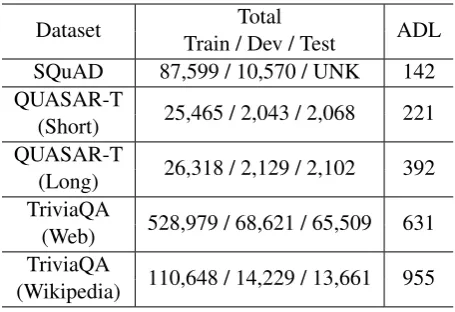
Table 2: Data statistics of SQuAD, QUASAR-T, and TriviaQA. The Average Document Length (ADL) represents the average number of words. In TriviaQA, ADL was calculated after truncating the documents to the first 1200 words.
gwt decides whether to write or not and allocation gatega
t determines the degree of interpolation.
wwt =gwt[gatat+ (1−gat)cwt] (21)
After finding the location to write with this weight, write operation on the memory is per-formed as follows:
Mt=Mt−1(Jp,q−wwteTt) +wwt vTt (22)
whereis element-wise multiplication and Jp,q
is p by q matrix of ones.
3.3 Prediction Layer
We feed output vector ofrom memory controller to prediction layer. First, it goes to bi-directional GRU and is then linearly projected to get prob-ability distribution of start position of answer
P r(as|q,d). The end positionP r(ae|q,d)is
cal-culated the same way with the hidden states of the start position concatenated as an additional input. These probabilities are also used for model op-timization while training in the form of negative log-likelihood probability.
4 Experimental Results
In this section, we present our experimental setup for evaluating the performance of our MAMCN model. We select different datasets based on their average document length to check the effective-ness of external memory on RC task. We com-pare the performance of our model with all the published results and the baseline memory aug-mented model. The baseline model is developed
by replacing modeling layer in BiDAF (Seo et al., 2017) model with the memory controller from DNC (Graves et al.,2016).
4.1 Data Set
We perform experiments with recently proposed QUASAR-T and TriviaQA datasets to see the performance of our model on the long docu-ments. The QUASAR-T dataset consists of fac-toid question-answer pairs and a corresponding large background corpus (Callan et al., 2009) to comprehend. In TriviaQA, question-answers pairs are collected from trivia and quiz-league websites. The evidence documents for these QA pairs are collected from Wikipedia articles and Web search results. The average length of the documents in these datasets are much longer than SQuAD and question-documents pairs are collected in a decou-pled way, making them more difficult to compre-hend. In the case of TriviaQA, we truncate the documents to 1200 words for training and 2000 words for the test. Even these truncated docu-ments are 3 to 5 times longer than SQuAD doc-uments. The average length of original documents in TriviaQA is about 3,000 words, so there is no guarantee that above truncated documents contain the answer for a given question.
We also conduct experiments on SQuAD dataset to show our model can even work well on paragraph-level data. The SQuAD contains a col-lection of Wikipedia articles and crowd-sourced question-answer pairs. Even though SQuAD dataset pushed existing models to achieve signif-icant performance improvements in solving RC task, the document length does not resemble the length of the real-world document.
The statistics of all these datasets are shown in Table2. We use official train, dev, and test splits provided in all these datasets for experiments.
4.2 Implementation Details
We develop MAMCN using Tensorflow1 deep learning framework and Sonnet2 library. For the word-level embedding, we tokenize the docu-ments using NLTK toolkit (Bird and Loper,2004) and substitute words with GloVe 6B (Pennington et al., 2014) 300-dimensional word embeddings. We also use 20-dimensional character-level em-beddings which are learned during training. The
1
www.tensorflow.org
Dataset Model Dev set Test set
EM F1 EM F1
Short-documents MAMCN 64.87 68.88 68.13 70.32
(ADL=221) BiDAF + DNC 51.18 54.77 54.81 58.24 BiDAF 45.40 50.90 47.60 52.40 Long-documents MAMCN 60.05 63.23 63.44 65.19
[image:6.595.143.457.63.171.2](ADL=392) BiDAF + DNC 48.67 52.25 52.15 54.43 BiDAF 37.00 42.50 39.50 44.50
Table 3: Performance results on QUASAR-T dataset.
Domain Model Full Verified
EM F1 EM F1
Web MAMCN 66.82 71.91 81.01 84.12
(ADL=631) BiDAF + SA + SN (Clark and Gardner,2017) 66.37 71.32 79.97 83.70 Reading Twice for NLU (Weissenborn,2017) 50.56 56.73 63.20 67.97 M-Reader (Hu et al.,2017) 46.65 52.89 56.96 61.48
BiDAF + DNC 42.34 48.65 51.50 57.17
MEMEN (Pan et al.,2017) 44.25 48.34 53.27 57.64 BiDAF (Seo et al.,2017) 40.74 47.05 49.54 55.80
Wikipedia MAMCN 64.41 69.60 70.21 75.49
(ADL=955) BiDAF + SA + SN (Clark and Gardner,2017) 63.99 68.93 67.98 72.88 QANet (Yu et al.,2018) 51.10 56.60 53.30 59.20 Reading Twice for NLU (Weissenborn,2017) 48.60 55.10 53.40 59.90 M-Reader (Hu et al.,2017) 46.94 52.85 54.45 59.46
BiDAF + DNC 42.57 48.30 46.23 51.61
MEMEN (Pan et al.,2017) 43.16 46.90 49.28 55.83 BiDAF (Seo et al.,2017) 40.32 45.91 44.86 50.71
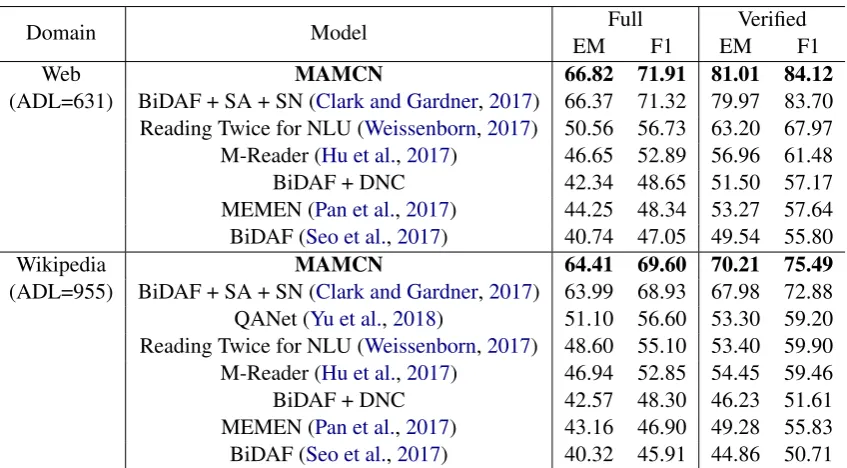
Table 4: Single model results on TriviaQA dataset3(Web and Wikipedia). SA: Self-attention, SN: Shared normalization.
hidden size is set to 200 for QUASAR-T and Triv-iaQA, and 100 for SQuAD. In the memory con-troller, we use 100 x 36 size memory initialized with zeros, 4 read heads and 1 write head. The optimizer is AdaDelta (Zeiler,2012) with an ini-tial learning rate of 0.5. We train our model for 12 epochs, and batch size is set to 30. During the training, we keep the exponential moving average of weights with 0.001 decay and use these aver-ages at test time.
4.3 Results
We use Exact Match (EM) and F1 Score as evalu-ation metrics for all the datasets. EM measures the percentage of the predictions that exactly matches with the corresponding ground truth answers. The F1 score measures the overlap between the predic-tions and corresponding ground truth answers.
QUASAR-T: The results on QUASAR-T are
3https://competitions.codalab.org/competitions/17208
shown in Table 3. As described in Table 3, the baseline (BiDAF + DNC) results in a reason-able gain, however, our proposed memory con-troller gives more performance improvement. We achieve 68.13 EM and 70.32 F1 for short docu-ments and 63.44 and 65.19 for long docudocu-ments which are the current best results.
TriviaQA: We compare proposed model with all the previously suggested approaches as shown in Table4. We perform the experiments on both Web and Wikipedia domains and report evalua-tion results for “Full” and “Verified” cases. “Full” is not guaranteed to have all the supporting fac-tors to answer the question, however, it is the en-tire dataset selected with distant supervision. The “Verified” is a subset of the “Full” dataset cleaned by the human annotators to guarantee the presence of supporting facts to answer.
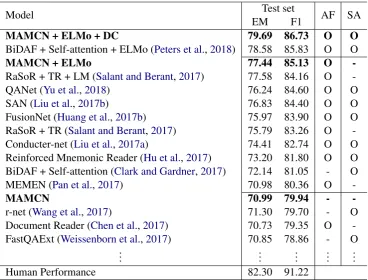
[image:6.595.88.512.202.436.2]Model Test set AF SA
EM F1
MAMCN + ELMo + DC 79.69 86.73 O O
BiDAF + Self-attention + ELMo (Peters et al.,2018) 78.58 85.83 O O
MAMCN + ELMo 77.44 85.13 O
-RaSoR + TR + LM (Salant and Berant,2017) 77.58 84.16 O
-QANet (Yu et al.,2018) 76.24 84.60 O O
SAN (Liu et al.,2017b) 76.83 84.40 O O
FusionNet (Huang et al.,2017b) 75.97 83.90 O O RaSoR + TR (Salant and Berant,2017) 75.79 83.26 O -Conducter-net (Liu et al.,2017a) 74.41 82.74 O O Reinforced Mnemonic Reader (Hu et al.,2017) 73.20 81.80 O O BiDAF + Self-attention (Clark and Gardner,2017) 72.14 81.05 - O
MEMEN (Pan et al.,2017) 70.98 80.36 O
-MAMCN 70.99 79.94 -
-r-net (Wang et al.,2017) 71.30 79.70 - O
Document Reader (Chen et al.,2017) 70.73 79.35 O -FastQAExt (Weissenborn et al.,2017) 70.85 78.86 - O
..
. ... ... ... ...
[image:7.595.115.484.61.341.2]Human Performance 82.30 91.22
Table 5: Single model results on SQuAD dataset4. The last two columns in tables indicate whether mod-els use additional feature and self-attention. AF: Additional feature augmentation for word embedding, SA: Self-attention, DC: Densely connected embedding block.
Table 4. In the case of full evaluation, we get 66.82 EM, 71.91 F1 for web domain, and 64.41 EM, 69.60 F1 for Wikipedia domain. The pro-posed model works best in noisy data with dis-tant supervision. In the case of human verified data, performance increases further. We get 81.01 EM and 84.12 F1 for web domain and 70.21 EM and 75.49 F1 for Wikipedia. It is encouraging that these results were obtained without any help of additional feature augmentation, such as utiliz-ing hidden states of pre-trained language model or additional semantic/syntactic features which are commonly used in other models. Also, our model does not need self-attention layer which is preva-lently used in previous models.
SQuAD: The results on SQuAD are shown in Table5. In the longer documents case (QUASAR-T and (QUASAR-TriviaQA), MAMCN with external mem-ory performed well because the controller can ag-gregate information effectively from the long se-quences, however, due to the small length of the documents in SQuAD, the existing methods based on the recurrent layers without external memory are also sufficient to achieve reasonable
perfor-4https://rajpurkar.github.io/SQuAD-explorer/
Self-attention
FC
Input BiGRU Output
Figure 2: Densely connected embedding block
mance. The last two columns in the Table5 indi-cate whether each model uses any additional fea-ture augmentation and/or self-attention. All the models with the help of these additional feature augmentation and/or self-attention achieve further performance gain on SQuAD dataset.
[image:7.595.349.455.410.547.2]No. Question-Document-Answer triplet
Question: In which activity are banderillas used ?
1
Context: Semi-naked animal rights activists staged a fake - bloody protest outside the European Parliament on Thursday to draw attention to the suffering of bulls during
bullfights . Around 30 people taking part in the protest organized by PETA ( People for the
Ethical Treatment of Animals ) lay on the ground with banderillas, the traditional darts used to wound and weaken bulls in the fight, attached to their backs, some spattered with fake blood. Bullfighting - ever popular in Spain - and the European Union’s ...
Ground truth: Bullfight, Bullfights
Question: What boxer was stripped of his heavyweight boxing titles when he refused his US army induction in April, 1967 ?
2
Context: ... This slideshow consists mostly of boxers who have continued to fight on, despite the hindrance of being in their senior years. It also includes two or three boxers who have launched stellar career comebacks from the brink of failure, or exile. George Foreman Al Bello retirement after being defeated by Jimmy Young in Puerto Rico in 1977 shocked the boxing community, the announcement of his return in 1987 sent the sport into raptures. In what ... Muhammad Ali made several comebacks in his career, but the one that stands out has to be the rebuilding of his career after being stripped of his titles for refusing to go to war in Vietnam ... After the U.S army found him to have sub-par reading and spelling skills, he was deemed unsuitable for service in 1966. One year later, however, they revised their criteria, making the champion eligible for national service. Ali refused, on moral grounds, and was consequently stripped of his boxing license and titles permanently. After three years of legal proceedings ...
[image:8.595.75.530.58.400.2]Ground truth: Muhammad Ali
Table 6: Examples are from devset of TriviaQA (Web). The solid and dashed rectangular text boxes indicate predictions from the MAMCN and ‘BiDAF + Self-attention’ models respectively.
ELMo (Peters et al.,2018) which is the weighted sum of hidden layers of language model with reg-ularization as an additional feature to our word embeddings. This helped our model (MAMCN + ELMo) to improve F1 to 85.13 and EM to 77.44 and is the best among the models only with the additional feature augmentation.
Secondly, we add self-attention with dense con-nections to our model. Recently, Huang et al. (2017a) have shown that adding a connection be-tween each layer to every other layer in con-volutional networks improves the performance by a huge margin. Inspired by this, we build densely connected embedding block along with self-attention to increase performance further in the case of SQuAD. The suggested embedding block is shown in Figure2. Each layer concate-nates all the inputs from the previous layers di-rectly connected to it. We replace all the BiGRU units with this embedding block except the con-troller layer in our model (MAMCN + ELMo + DC). We achieve the state of the art performance, 86.73 F1 and 79.69 EM, with the help of this
em-bedding block.
To show the effectiveness of our method in addressing long-term dependencies, we collected two examples from the devset of TriviaQA, shown in Table6. Finding an answer in these examples require resolving long-term dependencies. The first example requires understanding dependency present between two sentences while answering. The ‘BiDAF + Self-attention’ model predicts in-correct answer by shallow matching a sentence which is syntactically close to the question. Our model predicts the correct answer by better com-bining the information from the two sentences. In the second example, the answer is present remotely in the document, the ‘BiDAF + Self-attention’ model without external memory face difficulty in comprehending this long document and predicts the wrong answer whereas our model predicts correct answer.
5 Conclusion
docu-ments in QA task. The proposed model achieved the state of the art results on the recently re-leased large-scale QA benchmark datasets such as QUASAR-T, TriviaQA, and SQuAD. The re-sults suggest that proposed method is helpful for addressing long-range dependencies in QA task. The future work involves implementing scalable read/write heads to handle larger size external memory to reason over multiple documents.
Acknowledgments
We would like to thank Percy Liang and Pranav Samir Rajpurkar for helping us in the SQuAD sub-missions.
References
Steven Bird and Edward Loper. 2004. Nltk: the natural language toolkit. InProceedings of the ACL 2004 on Interactive poster and demonstration sessions. As-sociation for Computational Linguistics, page 31.
Jamie Callan, Mark Hoy, Changkuk Yoo, and Le Zhao. 2009. Clueweb09 data set.
Danqi Chen, Adam Fisch, Jason Weston, and Antoine Bordes. 2017. Reading wikipedia to answer open-domain questions. arXiv preprint arXiv:1704.00051 .
Kyunghyun Cho, Bart Van Merri¨enboer, Caglar Gul-cehre, Dzmitry Bahdanau, Fethi Bougares, Holger Schwenk, and Yoshua Bengio. 2014. Learning phrase representations using rnn encoder-decoder for statistical machine translation. arXiv preprint arXiv:1406.1078.
Christopher Clark and Matt Gardner. 2017. Simple and effective multi-paragraph reading comprehen-sion.arXiv preprint arXiv:1710.10723.
Bhuwan Dhingra, Kathryn Mazaitis, and William W Cohen. 2017. Quasar: Datasets for question an-swering by search and reading. arXiv preprint arXiv:1707.03904.
Alex Graves, Greg Wayne, and Ivo Danihelka. 2014. Neural turing machines. arXiv preprint arXiv:1410.5401.
Alex Graves, Greg Wayne, Malcolm Reynolds, Tim Harley, Ivo Danihelka, Agnieszka Grabska-Barwi´nska, Sergio G´omez Colmenarejo, Edward Grefenstette, Tiago Ramalho, John Agapiou, et al. 2016. Hybrid computing using a neural net-work with dynamic external memory. Nature 538(7626):471.
Minghao Hu, Yuxing Peng, and Xipeng Qiu. 2017. Re-inforced mnemonic reader for machine comprehen-sion.CoRR, abs/1705.02798.
Gao Huang, Zhuang Liu, Kilian Q Weinberger, and Laurens van der Maaten. 2017a. Densely connected convolutional networks. InProceedings of the IEEE conference on computer vision and pattern recogni-tion. volume 1, page 3.
Hsin-Yuan Huang, Chenguang Zhu, Yelong Shen, and Weizhu Chen. 2017b. Fusionnet: Fusing via fully-aware attention with application to machine compre-hension. arXiv preprint arXiv:1711.07341.
Mandar Joshi, Eunsol Choi, Daniel Weld, and Luke Zettlemoyer. 2017. Triviaqa: A large scale distantly supervised challenge dataset for reading comprehen-sion. InProceedings of the 55th Annual Meeting of the Association for Computational Linguistics (Vol-ume 1: Long Papers). volume 1, pages 1601–1611.
Ankit Kumar, Ozan Irsoy, Peter Ondruska, Mohit Iyyer, James Bradbury, Ishaan Gulrajani, Victor Zhong, Romain Paulus, and Richard Socher. 2016. Ask me anything: Dynamic memory networks for natural language processing. InInternational Con-ference on Machine Learning. pages 1378–1387.
Kenton Lee, Shimi Salant, Tom Kwiatkowski, Ankur Parikh, Dipanjan Das, and Jonathan Berant. 2016. Learning recurrent span representations for ex-tractive question answering. arXiv preprint arXiv:1611.01436.
Rui Liu, Wei Wei, Weiguang Mao, and Maria Chik-ina. 2017a. Phase conductor on multi-layered at-tentions for machine comprehension.arXiv preprint arXiv:1710.10504.
Xiaodong Liu, Yelong Shen, Kevin Duh, and Jian-feng Gao. 2017b. Stochastic answer networks for machine reading comprehension. arXiv preprint arXiv:1712.03556.
Boyuan Pan, Hao Li, Zhou Zhao, Bin Cao, Deng Cai, and Xiaofei He. 2017. Memen: Multi-layer embed-ding with memory networks for machine compre-hension. arXiv preprint arXiv:1707.09098.
Jeffrey Pennington, Richard Socher, and Christopher Manning. 2014. Glove: Global vectors for word representation. InProceedings of the 2014 confer-ence on empirical methods in natural language pro-cessing (EMNLP). pages 1532–1543.
Matthew E Peters, Mark Neumann, Mohit Iyyer, Matt Gardner, Christopher Clark, Kenton Lee, and Luke Zettlemoyer. 2018. Deep contextualized word rep-resentations. arXiv preprint arXiv:1802.05365.
Pranav Rajpurkar, Jian Zhang, Konstantin Lopyrev, and Percy Liang. 2016. Squad: 100,000+ questions for machine comprehension of text. InProceedings of the 2016 Conference on Empirical Methods in Nat-ural Language Processing. pages 2383–2392.
Minjoon Seo, Aniruddha Kembhavi, Ali Farhadi, and Hannaneh Hajishirzi. 2017. Bidirectional attention flow for machine comprehension. In Proceedings of the International Conference on Learning Represen-tations.
Sainbayar Sukhbaatar, Jason Weston, and Rob Fer-gus. 2015. End-to-end memory networks. In Ad-vances in neural information processing systems. pages 2440–2448.
Shuohang Wang and Jing Jiang. 2016. Learning natu-ral language inference with lstm. InProceedings of the 2016 Conference of the North American Chap-ter of the Association for Computational Linguistics: Human Language Technologies. pages 1442–1451.
Shuohang Wang and Jing Jiang. 2017. Machine com-prehension using match-lstm and answer pointer. In Proceedings of the International Conference on Learning Representations.
Wenhui Wang, Nan Yang, Furu Wei, Baobao Chang, and Ming Zhou. 2017. Gated self-matching net-works for reading comprehension and question an-swering. InProceedings of the 55th Annual Meet-ing of the Association for Computational LMeet-inguistics (Volume 1: Long Papers). volume 1, pages 189–198.
Dirk Weissenborn. 2017. Dynamic integration of back-ground knowledge in neural nlu systems. arXiv preprint arXiv:1706.02596.
Dirk Weissenborn, Georg Wiese, and Laura Seiffe. 2017. Making neural qa as simple as possible but not simpler. In Proceedings of the 21st Confer-ence on Computational Natural Language Learning (CoNLL 2017). pages 271–280.
Jason Weston, Antoine Bordes, Sumit Chopra, Alexan-der M Rush, Bart van Merri¨enboer, Armand Joulin, and Tomas Mikolov. 2015a. Towards ai-complete question answering: A set of prerequisite toy tasks. arXiv preprint arXiv:1502.05698.
Jason Weston, Sumit Chopra, and Antoine Bordes. 2015b. Memory networks.
Caiming Xiong, Victor Zhong, and Richard Socher. 2017. Dynamic coattention networks for question answering. In Proceedings of the International Con-ference on Learning Representations.
Adams Wei Yu, David Dohan, Quoc Le, Thang Luong, Rui Zhao, and Kai Chen. 2018. Qanet: Combining local convolution with global self-attention for read-ing comprehension .
Yang Yu, Wei Zhang, Kazi Hasan, Mo Yu, Bing Xi-ang, and Bowen Zhou. 2016. End-to-end reading comprehension with dynamic answer chunk rank-ing. arXiv preprint arXiv:1610.09996.