36
Regularized Training Objective for Continued Training
for Domain Adaptation in Neural Machine Translation
Huda Khayrallah Brian Thompson Kevin Duh Philipp Koehn Department of Computer Science
Johns Hopkins University
{huda, brian.thompson}@jhu.edu, {kevinduh, phi}@cs.jhu.edu
Abstract
Supervised domain adaptation—where a large generic corpus and a smaller in-domain corpus are both available for training—is a challenge for neural ma-chine translation (NMT). Standard prac-tice is to train a generic model and use it to initialize a second model, then continue training the second model on in-domain data to produce an in-domain model. We add an auxiliary term to the training ob-jective during continued training that mimizes the cross entropy between the in-domain model’s output word distribution and that of the out-of-domain model to prevent the model’s output from differ-ing too much from the original out-of-domain model. We perform experiments on EMEA (descriptions of medicines) and TED (rehearsed presentations), initialized from a general domain (WMT) model. Our method shows improvements over standard continued training by up to 1.5 BLEU.
1 Introduction
Neural Machine Translation (NMT) (Bahdanau et al., 2015) is currently the state-of-the art paradigm for machine translation. It dominated the recent WMT shared task (Bojar et al.,2017), and is used commercially (Wu et al.,2016;Crego et al.,2016;Junczys-Dowmunt et al.,2016).
Despite their successes, NMT systems require a large amount of training data and do not perform well in low resource and domain adaptation sce-narios (Koehn and Knowles,2017). Domain adap-tation is required when there is sufficient data to train an NMT system in the desired language pair, but thedomain(the topic, genre, style or level of
formality) of this large corpus differs from that of the data that the system will need to translate at test time.
In this paper, we focus on the supervised do-main adaptation problem, where in addition to a large out-of-domain corpus, we also have a smaller in-domain parallel corpus available for training.
A technique commonly applied in this situation is continued training (Luong and Manning,2015), where a model is first trained on the out-of-domain corpus, and then that model is used to initialize a new model that is trained on the in-domain corpus.
This simple method leads to empirical improve-ments on in-domain test sets. However, we hy-pothesize that some knowledge available in the out-of-domain data—which is not observed in the smaller in-domain data but would be useful at test time—is being forgotten during continued train-ing, due to overfitting. (This phenomena can be viewed as a version of catastrophic forgetting (Goodfellow et al.,2013)).
For this reason, we add an additional term to the loss function of the NMT training objective dur-ing continued traindur-ing. In addition to minimizdur-ing the cross entropy between the model’s output word distribution and the reference translation, the addi-tional term in the loss function minimizes the cross entropy between the model’s output word distribu-tion and that of the out-of-domain model.1 This prevents the distribution of words produced from differing too much from the original distribution.
We show that this method improves upon stan-dard continued training by as much as 1.5 BLEU.
1The code is available:
2 Method
In this work, we focus on the following scenario: we assume there is a model that was trained on a large, general (out-of-domain) corpus in the lan-guage pair of interest, and there is a new domain, along with a small in-domain training set, for which we would like to build a model. We begin by initializing the weights of the in-domain model with the weights of the out-of-domain model, and then continue training the new model on the in-domain data, using the modified training objective to prevent the model from differing too much from the original out-of-domain model.
Before describing our method in detail, we first review the general framework of neural machine translation and the standard continued training ap-proach.
2.1 NMT Objective
Encoder-decoder neural machine translation with attention (Bahdanau et al., 2015) consists of: an
encoder—a bidirectional recurrent neural network that encodes the source sentence as vectors; and adecoder—a recurrent neural network that condi-tions each output word on the previous output and a weighted average of the encoder states ( atten-tion).2
The standard training criteria in NMT, for the
ithtarget word, is:
LNLL(θ) =− X
v∈V
1{yi=v} (1)
× log p(yi =v|x;θ;yj<i)
where V is the vocabulary, 1{·} is the indicator function, and p is the output distribution of the model (parameterized byθ).
This objective minimizes the cross-entropy be-tween the gold-standard distribution 1{yi = v} (which is simply a one-hot vector that indicates if the correct word was produced), and the model’s distributionp(yi=v|x;θ;yj<i).
2.2 Continued Training
Continued training is a simple yet effective tech-nique for domain adaptation. It consists of three steps:
2For a detailed explanation of attention based NMT see Bahdanau et al.(2015) (the original paper), or for a gentle introduction see the textbook chapter byKoehn(2017).
1. Train a model until convergence on large out-of-domain bitext usingLNLL as the training objective.
2. Initialize a new model with the final parame-ters of Step 1.
3. Train the model from Step 2 until conver-gence on in-domain bitext, again usingLNLL as objective.
In other words, continued training initializes an in-domain model training process with parameters from an out-of-domain model. The hope is that the out-of-domain model provides a reasonable start-ing point and is better than random initialization.
In our proposal in the next section, we will re-placeLNLLin Step 3 by a interpolated regularized objective. All other steps remain the same.
2.3 Regularized NMT Objective
We use the output distribution of the trained out-of-domain model to regularize the training of our in-domain model as we perform continued train-ing to adapt to a new domain.
We add an additional regularization (reg) term to incorporate information from an auxiliary (aux) out-of-domain model into the training objective:
Lreg(θ) =−X v∈V
paux(yi=v|x;θaux;yj<i)
(2)
× log p(yi=v|x;θ;yj<i)
where paux is the output distribution from the auxiliary out-of-domain model, parameterized by
θaux,3andpis the output distribution from the in-domain model being trained, parameterized byθ.
The regularization objective (Eq. 2) min-imizes the cross-entropy between the out-of-domain model distributionpout(yi=v|x;θ;yj<i) and the in-domain model distribution p(yi =
v|x;θ;yj<i). We interpolate this with the stan-dard training objective (Eq. 1) to obtain the final training objective:
L(θ) = (1−α)LNLL(θ) + αLreg(θ) (3)
The added regularization term is formulated in the spirit of knowledge distillation (Kim and Rush,
3The out-of-domain model is fixed while training the
2016), where a student model is trained to match the output distribution of a parent model. In word-level knowledge distillation, the student model’s output distribution is trained on the same data that the parent model was trained. In contrast, our do-main specific model (which replaces the student) is trained with a loss term that encourages it to match the out-of-domain model (which replaces the parent) on in-domain training data that the out-of-domain model was not trained on.
3 Experiments
3.1 Data
For our large, out-of-domain corpus we utilize bi-text from WMT2017 (Bojar et al.,2017),4 which contains data from several sources: Europarl par-liamentary proceedings (Koehn, 2005),5 News Commentary (political and economic news com-mentary),6Common Crawl (web-crawled parallel corpus), and the EU Press Releases.
We usenewstest2015as the out-of-domain development set andnewstest2016as the out-of-domain test set. These consist of profession-ally translated news articles released by the WMT shared task.
We perform adaptation into two different do-mains: EMEA (descriptions of medicines) and TED Talks (rehearsed presentations). For EMEA, we use the data split from (Koehn and Knowles,
2017),7 which was extracted from from OPUS (Tiedemann, 2009,2012).8 For TED, we use the data split from the Multitarget TED Talks Task (MTTT) (Duh,2018).9 which was extracted from WIT3(Cettolo et al.,2012).10 Tables1–3give the number of words and sentences of each of the cor-pora in the train, dev, and test sets, respectively.
In addition to experiments on the full training sets, we also conduct experiments adapting to each given domain using only the first 2,000 sentences of each in-domain training set to simulate adapta-tion into a low-resource domain.
For all experiments we translate from English to German as well as from German to English.
4
statmt.org/wmt17 5
statmt.org/europarl
6casmacat.eu/corpus/news-commentary.html 7github.com/khayrallah/domain-adaptation-data 8
opus.nlpl.eu/EMEA.php 9
cs.jhu.edu/ kevinduh/a/multitarget-tedtalks 10wit3.fbk.eu
corpus de words en words sentences EMEA 13,572,552 14,774,808 1,104,752
TED 2,966,837 3,161,544 152,609
WMT 139,449,418 146,569,151 5,919,142
Table 1: Tokenized training set sizes.
corpus de words en words sentences
EMEA 26479 28838 2000
TED 37509 38717 1958
newstest15 44869 47569 2169
Table 2: Tokenized development set sizes.
corpus de words en words sentences
EMEA 31737 33884 2000
TED 35516 36857 1982
newstest16 64379 65647 2999
Table 3: Tokenized test set sizes.
3.2 NMT settings
Our neural machine translation systems are trained using a modified version of OpenNMT-py (Klein et al., 2017).11 We build RNN-based encoder-decoder models with attention (Bahdanau et al.,
2015), and use a bidirectional-RRN for the en-coder. The encoder and decoder both have 2 layers with LSTM hidden sizes of 1024. Source and tar-get word vectors are of size 500. We apply dropout with30%probability. We use stochastic gradient descent as the optimizer, with an initial learning rate at1and a decay of0.5. We use a batch size of 64. We keep the model parameters settings con-stant for all experiments.
We train byte pair encoding segmentation mod-els (BPE) (Sennrich et al., 2016) on the out-of-domain training corpus. We train separate BPE models for each language, each with a vocab size of 50,000 and then apply those models to each corpus, including the in-domain ones. This setup allows us to mimic the realistic setting where the computationally-expensive-to-train generic model is trained once, and when there is a new domain that needs translating the existing model is adapted to that domain without retraining on the out-of-domain corpus.
We train our out-of-domain models on the WMT corpora and use the WMT development
De-En En-De
training condition EMEA-test TED-test EMEA-test TED-test
out-of-domain 30.8 29.8 25.1 25.9
in-domain 43.2 31.4 37.0 25.1
[image:4.595.91.509.61.145.2]continued-train w/o regularization 48.5 36.4 41.0 30.8 continued-train w/ regularization 49.3(+0.8) 36.9(+0.5) 42.5(+1.5) 30.8(+0.0)
Table 4: BLEU score improvements over continued training. We compare to the out-of-domain baseline and the in-domain baseline. We also compare to continued training without the additional regularization term.
De-En En-De
training condition EMEA-test TED-test EMEA-test TED-test
out-of-domain 30.8 29.8 25.1 25.9
[image:4.595.99.510.218.290.2]continued-train w/o regularization 34.3 33.4 30.0 28.1 continued-train w/ regularization 35.2(+0.9) 33.6(+0.2) 30.2(+0.2) 28.4(+0.3)
Table 5: BLEU score improvements over continued training using the2,000sentence subsets as the in-domain corpus. We compare to the out-of-in-domain baseline and continued training without the additional regularization term.
set (newstest15) to select the best epoch as our out-of-domain model. When training our do-main specific models, we use the in-dodo-main de-velopment set to select the best epoch. When we switch to the in-domain training corpus, we reset the learning rate to1, with a decay of0.5, and con-tinue to apply dropout with30%probability.
4 Results
Table 4 shows the in-domain and out-of-domain baselines, the improvement provided by continued training, and the added improvement of regular-ization during continued training on the entire in-domain datasets.12
When translating the De-En EMEA test set, the out-of-domain model obtains30.8BLEU and the in-domain model (trained on EMEA training data) obtains43.2BLEU. As expected, standard contin-ued training (without regularization) outperforms both baselines, achieving 48.5BLEU. This is an improvement of 5.3 BLEU over the in-domain model. Our proposed regularization method fur-ther improves this by 0.8, to49.3BLEU.
The trends are similar in all four test conditions: Continued training significantly outperforms both baselines, beating the stronger of the two by
be-12For the regularized results, αis selected to maximize
BLEU on the dev set. See Section5for more details.
tween4.0and5.3BLEU points. Our regulariza-tion method provides addiregulariza-tional improvement over continued training by up to to1.5BLEU. There is one setting (En-De Ted) where there is no change. We also repeat the experiment for cases where the in-domain training data is smaller, which cor-responds to a more challenging (yet realistic) do-main adaptation scenario. Table 5 shows the re-sults of adaptation when only2,000sentences of in-domain parallel text are available. This amount of data is insufficient to train an in-domain NMT model; however, standard continued training is able to improve upon the out-of-domain baseline by2.2to4.9BLEU. Adding our additional regu-larization term improves performance by an addi-tional0.2to0.9BLEU.
In both Table 4 and Table 5, we confirm pre-vious research findings that continued training is effective, and demonstrate that our regularized ob-jective adds further gains. Furthermore, as shown in Section5, it is straightforward to choose the in-terpolation weight,α.
5 Analysis
De-En En-De
training condition EMEA-test TED-test EMEA-test TED-test
out-of-domain 30.8 29.9 25.1 25.9
in-domain 43.2 31.4 37.0 25.1
[image:5.595.101.496.61.132.2]in-domain w/ regularization 45.5(+2.3) 31.2(+0.2) 38.8(+1.8) 26.0(+0.9)
Table 6: Analysis of BLEU score improvements without continued training. We compare to the out-of-domain baseline and the in-out-of-domain baseline.
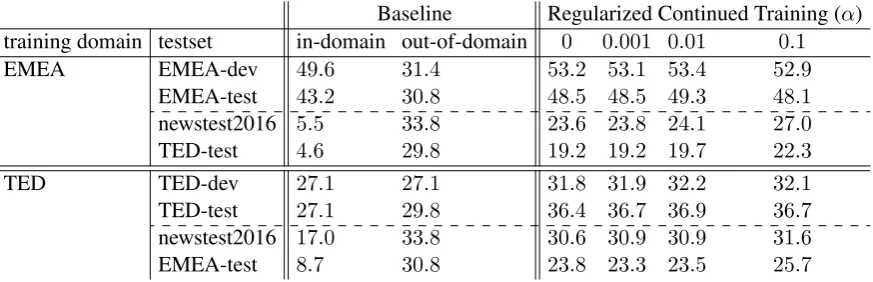
Baseline Regularized Continued Training (α) training domain testset in-domain out-of-domain 0 0.001 0.01 0.1
EMEA EMEA-dev 49.6 31.4 53.2 53.1 53.4 52.9
EMEA-test 43.2 30.8 48.5 48.5 49.3 48.1
newstest2016 5.5 33.8 23.6 23.8 24.1 27.0
TED-test 4.6 29.8 19.2 19.2 19.7 22.3
TED TED-dev 27.1 27.1 31.8 31.9 32.2 32.1
TED-test 27.1 29.8 36.4 36.7 36.9 36.7
newstest2016 17.0 33.8 30.6 30.9 30.9 31.6
EMEA-test 8.7 30.8 23.8 23.3 23.5 25.7
Table 7: Analysis of the sensitivity of BLEU scores on the domain-specific sets andnewstest2016
to the interpolation parameter (α) for De-En. Continued training with anα = 0is standard continued training, without regularization. Performance on the in-domain test sets is best with an interpolation weight of.01in this language pair, while performance on the out-of-domain test sets is better with an interpolation weight of.1, the highest value we search over.
Is the additional training objective trans-ferring general knowledge to the in-domain model? We hypothesize that the regularization term presents knowledge from the out-of-domain model to the continued training model while the later adapts. This allows the domain-adapted model to retain knowledge from the original (out-of-domain) model that is useful and would oth-erwise be lost while training continues on the domain data, due so the sparsity of the smaller in-domain dataset.
If this is true, using the additional regulariza-tion term should improve performance of an in-domain model (that does not use continued train-ing), since our technique should transfer gen-eral domain knowledge learned from the out-of-domain corpus.
To test this idea, we train an in-domain model from scratch (as opposed to initializing with the out-of-domain model) using our regularization term. The results are shown in Table6. In this set-ting, the only out-of-domain information is com-ing from the additional term in the loss function. Our method provides an improvement of up to 2.8 BLEU over the in-domain model, though in
De-En TED performance degrades by0.3BLEU. While none of these experiments outperform con-tinued training, the large improvements suggest the method is effective at transferring general do-main knowledge into the dodo-main specific model.
Additionally, these experiments suggest our method could be beneficial in situations where continued training is not an option. For example, the out-of-domain model might be much larger or perhaps a completely different architecture than the in-domain model; as long as it provides a distribution over the same vocabulary as the in-domain model, it can be used as the auxiliary model in the training objective.
How does this method impact performance on the original domain? To examine how well general domain knowledge is retained by the adapted models, we evaluate the domain spe-cific models on a more general domain test set
(newstest2016),13 as well as on the other
do-main’s test set (i.e. performance of the TED model
13
[image:5.595.82.519.179.320.2]0% 5% 10%
EMEA-de EMEA-en TED-de TED-en
OOV Types
0% 5% 10%
EMEA-de EMEA-en TED-de TED-en
OOV Tokens
in-domain
out-of-domain
[image:6.595.95.500.78.284.2]combined
Figure 1: Percentage of out-of-vocabulary words by (a)typeand (b)token.
on the EMEA test set and vice-versa). We report the results for De-En in Table 7. In each case, as regularization increases, both general-domain and cross-domain performance increase. Contin-ued training for a particular domain harms perfor-mance on the other domains when compared to the original out-of-domain model.
This suggests that there is some amount of gen-eral information about translating between the two languages that is being forgotten by the network during continued training, and the regularization term helps remember it.
Why does EMEA show larger improve-ments? Throughout our experiments, we observe larger improvements for EMEA than we do for for TED. For TED, performance is similar for both the domain and out-of-domain baselines (the in-and out-of-domain baselines are within1.6BLEU of each other for TED, whereas for EMEA the in-domain model is over 11 BLEU better in both directions—see Table4for full results).
We hypothesize that this is because TED is ac-tually similar in domain to our ‘out-of-domain’ training set. In particular, we suspect that TED talks are similar to parliamentary speech, which is a portion of the WMT training data—both are oral presentations that cover a variety of topics.
In contrast, EMEA focuses on a single topic (descriptions of medicines) and contains special-ized medical terminology throughout.
The out-of-vocabulary rates (OOV) are consis-tent with this hypothesis (see Figures1aand1bfor OOV rates by type and token, respectively). For
EMEA, the OOV rate is lower for the in-domain training set compared to the out-of-domain train-ing set while for TED, the opposite is true: the OOV rate is lower for the out-of-domain training set compared to the in-domain training set. This suggests that the EMEA domain has a unique vo-cabulary that needs to be adapted to, while TED covers a wide variety of topics, and requires a large corpus to cover its vocabulary, and the adaptation problem is more about the style of the corpus.
This contrast between a very homogeneous do-main and a heterogeneous one is typically not made: both are typically described as “domain adaptation.” However, perhaps future work should approach these problems differently.
6 Related Work
Prior work has included the use of similar tech-niques to solve problems different than ours, as well as different approaches to solve the same problem.
6.1 Regularization Techniques
We draw inspiration from a number of prior works includingYu et al.(2013), which introduces Kullback-Leibler (KL) divergence between the model being trained and an out-of-domain model as a regularization scheme for speaker adaptation. Their work adapts a context dependent deep neural network hidden Markov model (CD-DNN-HMM) using the KL-divergence between the softmax out-puts (modeling tied-triphone states) of a network trained on a large, speaker independent (SI) cor-pus the model being adapted to a specific speaker, initialized with the SI model. Our technique can also be viewed as an extension of label smooth-ing (Szegedy et al., 2016; Vaswani et al., 2017;
Pereyra et al., 2017), where instead of a simple uniform or unigram word distribution, we use the distribution of an auxiliary NMT model.
6.2 Continued Training
SinceLuong and Manning(2015) introduced con-tinued training14 in NMT, it has become the de facto standard for domain adaptation. The method has been surprisingly robust, and in-domain gains have been shown with as few as tens of in-domain training sentences (Miceli Barone et al.,2017).
Despite the success of continued training, sev-eral studies have noted that a model trained via continued training tends to significantly under-perform the original model on the original do-main. (This is an instance of catastrophic forget-ting where the subsequent task is highly related, but still different than, the initial task.15) Freitag and Al-Onaizan(2016) found that that ensembling an out-of-domain model with a model trained via continued training can significantly reduce the per-formance drop on the original domain compared to the continued training model alone. In contrast,
14This is also often referred to asfine tuning, we use the
termcontinued trainingto distinguish from the framework ofHinton and Salakhutdinov(2006), which uses supervised learning to fine tune features obtained through unsupervised learning.
15SeeKirkpatrick et al.(2017) for a recent approach in this
space which deals with independent problems.
our work focuses on further improving in-domain results.
Chu et al. (2017) present mixed fine-tuning. They begin by training an out-of-domain NMT model but they continue training on a mix of domain and out-of-domain data (with the in-domain data oversampled). They also experiment with tagging each sentence with the domain it comes from, allowing a single system to adapt to multiple domains. In contrast, our method does not require further training on (or even access to) the very large general domain dataset while adapt-ing the model to the new domain.
6.3 Regularizing Continued Training
Miceli Barone et al. (2017) share our goal of improving in-domain results and compare three methods of regularization to improve leaning dur-ing continued traindur-ing: 1) Bayesian dropout 2) L2 regularization, and 3)tuneout, which is similar to Bayesian dropout but instead of setting weights to zero, they are set to the value of the out-of-domain model. They report small gains (≈ 0.3 BLEU) with Bayesian dropout and L2, but tuneout results are inconsistent and mostly hurt BLEU. In contrast to all three methods, which regularize the weights of the model, our work regularizes only the out-put distribution and does not directly control the weights.
The work ofDakwale and Monz(2017) is very similar to ours but focuses on retaining out-of-domain performance during continued training, instead of in-domain gains. They perform multi-objective learning with most of the weight (90%) on the auxiliary objective. By contrast, our train-ing emphasizes the in-domain traintrain-ing objective (weighting the auxiliary objective0.1% to 10%) and we show much larger in-domain gains.
7 Conclusion and Future Work
in-domain data, using the modified training objec-tive to prevent the model from differing too much from the original out-of-domain model. We report potential improvements of up to1.5BLEU over a strong baseline of continued training when using the full domain adaptation corpora, and up to0.9 BLEU over continued training in our extremely low resource domain adaptation setting.
Our work can be viewed as multi-objective learning with both regular word-level NLL loss and word-level auxiliary loss. Kim and Rush
(2016) presented gains using novel sequence-level Knowledge distillation that may be useful to in-corporate in future work.
We kept the model hyperparameters fixed for all experiments, and only tuned the regularization coefficient. Future work should explore the inter-action between continued training, regularization, and other hyperparameters.
Acknowledgements
This material is based upon work supported in part by DARPA LORELEI and by the Department of Defense through the National Defense Science & Engineering Graduate Fellowship (NDSEG) Pro-gram.
References
Dzmitry Bahdanau, Kyunghyun Cho, and Yoshua Ben-gio. 2015. Neural Machine Translation by Jointly Learning to Align and Translate. Proceedings of the International Conference on Learning Represen-tations (ICLR).
Ondˇrej Bojar, Rajen Chatterjee, Christian Federmann, Yvette Graham, Barry Haddow, Shujian Huang, Matthias Huck, Philipp Koehn, Qun Liu, Varvara Logacheva, Christof Monz, Matteo Negri, Matt Post, Raphael Rubino, Lucia Specia, and Marco Turchi. 2017. Findings of the 2017 conference on machine translation (wmt17). In Proceedings of the Second Conference on Machine Translation, Volume 2: Shared Task Papers, pages 169–214, Copenhagen, Denmark. Association for Computa-tional Linguistics.
Mauro Cettolo, Christian Girardi, and Marcello Fed-erico. 2012. Wit3: Web inventory of transcribed and translated talks. In Proceedings of the 16th Con-ference of the European Association for Machine Translation (EAMT), pages 261–268, Trento, Italy.
Chenhui Chu, Raj Dabre, and Sadao Kurohashi. 2017.
An empirical comparison of domain adaptation methods for neural machine translation. In Pro-ceedings of the 55th Annual Meeting of the Associa-tion for ComputaAssocia-tional Linguistics (Volume 2: Short
Papers), pages 385–391. Association for Computa-tional Linguistics.
Josep Maria Crego, Jungi Kim, Guillaume Klein, An-abel Rebollo, Kathy Yang, Jean Senellart, Egor Akhanov, Patrice Brunelle, Aurelien Coquard, Yongchao Deng, Satoshi Enoue, Chiyo Geiss, Joshua Johanson, Ardas Khalsa, Raoum Khiari, Byeongil Ko, Catherine Kobus, Jean Lorieux, Leid-iana Martins, Dang-Chuan Nguyen, Alexandra Pri-ori, Thomas Riccardi, Natalia Segal, Christophe Ser-van, Cyril Tiquet, Bo Wang, Jin Yang, Dakun Zhang, Jing Zhou, and Peter Zoldan. 2016. Systran’s pure neural machine translation systems. CoRR, abs/1610.05540.
Praveen Dakwale and Christof Monz. 2017. Fine-tuning for neural machine translation with limited degradation across in-and out-of-domain data. Pro-ceedings of the XVI Machine Translation Summit, page 117.
Kevin Duh. 2018. The multitarget ted talks task.
http://www.cs.jhu.edu/˜kevinduh/a/
multitarget-tedtalks/.
Markus Freitag and Yaser Al-Onaizan. 2016. Fast Do-main Adaptation for Neural Machine Translation.
CoRR, abs/1612.06897.
Ian J Goodfellow, Mehdi Mirza, Da Xiao, Aaron Courville, and Yoshua Bengio. 2013. An em-pirical investigation of catastrophic forgetting in gradient-based neural networks. arXiv preprint arXiv:1312.6211.
G. E. Hinton and R. R. Salakhutdinov. 2006. Reduc-ing the dimensionality of data with neural networks.
Science, 313(5786):504–507.
Marcin Junczys-Dowmunt, Tomasz Dwojak, and Hieu Hoang. 2016. Is Neural Machine Translation Ready for Deployment? A Case Study on 30 Transla-tion DirecTransla-tions. In Proceedings of the 9th Inter-national Workshop on Spoken Language Translation (IWSLT), Seattle, WA.
Yoon Kim and Alexander M. Rush. 2016. Sequence-level knowledge distillation. InProceedings of the 2016 Conference on Empirical Methods in Natu-ral Language Processing, pages 1317–1327, Austin, Texas. Association for Computational Linguistics.
James Kirkpatrick, Razvan Pascanu, Neil Rabinowitz, Joel Veness, Guillaume Desjardins, Andrei A. Rusu, Kieran Milan, John Quan, Tiago Ramalho, Ag-nieszka Grabska-Barwinska, Demis Hassabis, Clau-dia Clopath, Dharshan Kumaran, and Raia Hadsell. 2017. Overcoming catastrophic forgetting in neural networks. Proceedings of the National Academy of Sciences, 114(13):3521–3526.
Philipp Koehn. 2005. Europarl: A parallel corpus for statistical machine translation. InProceedings of the Tenth Machine Translation Summit (MT Summit X), Phuket, Thailand.
Philipp Koehn. 2017. Neural machine translation.
CoRR, abs/1709.07809.
Philipp Koehn and Rebecca Knowles. 2017. Six Chal-lenges for Neural Machine Translation. In Pro-ceedings of the 1st Workshop on Neural Machine Translation (and Generation) at ACL. Association for Computational Linguistics.
Minh-Thang Luong and Christopher D. Manning. 2015. Stanford Neural Machine Translation Sys-tems for Spoken Language Domain. In Interna-tional Workshop on Spoken Language Translation, Da Nang, Vietnam.
Antonio Valerio Miceli Barone, Barry Haddow, Ulrich Germann, and Rico Sennrich. 2017. Regularization techniques for fine-tuning in neural machine trans-lation. In Proceedings of the 2017 Conference on Empirical Methods in Natural Language Process-ing, pages 1489–1494, Copenhagen, Denmark. As-sociation for Computational Linguistics.
Gabriel Pereyra, George Tucker, Jan Chorowski, Łukasz Kaiser, and Geoffrey Hinton. 2017. Regular-izing neural networks by penalRegular-izing confident output distributions. arXiv preprint arXiv:1701.06548.
Rico Sennrich, Barry Haddow, and Alexandra Birch. 2016. Neural Machine Translation of Rare Words with Subword Units. InProceedings of the 54th An-nual Meeting of the Association for Computational Linguistics, Berlin, Germany. Association for Com-putational Linguistics.
Christian Szegedy, Vincent Vanhoucke, Sergey Ioffe, Jon Shlens, and Zbigniew Wojna. 2016. Rethinking the inception architecture for computer vision. In
Proceedings of the IEEE Conference on Computer Vision and Pattern Recognition, pages 2818–2826.
J¨org Tiedemann. 2009. News from OPUS - A collec-tion of multilingual parallel corpora with tools and interfaces. In N. Nicolov, K. Bontcheva, G. An-gelova, and R. Mitkov, editors,Recent Advances in Natural Language Processing, volume V. John Ben-jamins, Amsterdam/Philadelphia, Borovets, Bul-garia.
J¨org Tiedemann. 2012. Parallel Data, Tools and Inter-faces in OPUS. InProceedings of the 8th Interna-tional Conference on Language Resources and Eval-uation.
Ashish Vaswani, Noam Shazeer, Niki Parmar, Jakob Uszkoreit, Llion Jones, Aidan N Gomez, Łukasz Kaiser, and Illia Polosukhin. 2017. Attention is all you need. InAdvances in Neural Information Pro-cessing Systems, pages 6000–6010.
Yonghui Wu, Mike Schuster, Zhifeng Chen, Quoc V. Le, Mohammad Norouzi, Wolfgang Macherey, Maxim Krikun, Yuan Cao, Qin Gao, Klaus Macherey, Jeff Klingner, Apurva Shah, Melvin Johnson, Xiaobing Liu, Lukasz Kaiser, Stephan Gouws, Yoshikiyo Kato, Taku Kudo, Hideto Kazawa, Keith Stevens, George Kurian, Nishant Patil, Wei Wang, Cliff Young, Jason Smith, Jason Riesa, Alex Rudnick, Oriol Vinyals, Greg Corrado, Macduff Hughes, and Jeffrey Dean. 2016. Google’s neural machine translation system: Bridging the gap between human and machine translation. CoRR, abs/1609.08144.