414
Document Embedding Enhanced Event Detection with Hierarchical and
Supervised Attention
Yue Zhao, Xiaolong Jin, Yuanzhuo Wang, Xueqi Cheng CAS Key Laboratory of Network Data Science and Technology, Institute of Computing Technology, Chinese Academy of Science (CAS);
School of Computer and Control Engineering, The University of CAS [email protected];
{jinxiaolong, wangyuanzhuo, cxq}@ict.ac.cn
Abstract
Document-level information is very im-portant for event detection even at sen-tence level. In this paper, we propose a novel Document Embedding Enhanced Bi-RNN model, called DEEB-RNN, to de-tect events in sentences. This model first learns event detection oriented embed-dings of documents through a hierarchi-cal and supervised attention based RNN, which pays word-level attention to event triggers and sentence-level attention to those sentences containing events. It then uses the learned document embedding to enhance another bidirectional RNN model to identify event triggers and their types in sentences. Through experiments on the ACE-2005 dataset, we demonstrate the effectiveness and merits of the proposed DEEB-RNN model via comparison with state-of-the-art methods.
1 Introduction
Event Detection (ED) is an important subtask of event extraction. It extracts event triggers from in-dividual sentences and further identifies the type of the corresponding events. For instance, accord-ing to the ACE-2005 annotation guideline, in the sentence “Jane and John are married”, an ED sys-tem should be able to identify the word “married” as a trigger of the event “Marry”. However, it may be difficult to identify events from isolated sen-tences, because the same event trigger might rep-resent different event types in different contexts.
Existing ED methods can mainly be categorized into two classes, namely, feature-based methods (e.g., (McClosky et al., 2011; Hong et al., 2011;
Li et al.,2014)) and representation-based methods (e.g., (Nguyen and Grishman, 2015;Chen et al.,
2015;Liu et al.,2016a;Chen et al.,2017)). The former mainly rely on a set of hand-designed fea-tures, while the latter employ distributed repre-sentation to capture meaningful semantic informa-tion. In general, most of these existing methods mainly exploit sentence-level contextual informa-tion. However, document-level information is also important for ED, because the sentences in the same document, although they may contain differ-ent types of evdiffer-ents, are often correlated with re-spect to the theme of the document. For example, there are the following sentences in ACE-2005:
... I knew it was time to leave. Isn’t that a great argument for term limits? ...
If we only examine the first sentence, it is hard to determine whether the trigger “leave” indicates a “Transport” event meaning that he wants to leave the current place, or an “End-Position” event in-dicating that he will stop working for his current organization. However, if we can capture the con-textual information of this sentence, it is more confident for us to label “leave” as the trigger of an “End-Position” event. Upon such observation, there have been some feature-based studies (Ji and Grishman, 2008; Liao and Grishman, 2010;
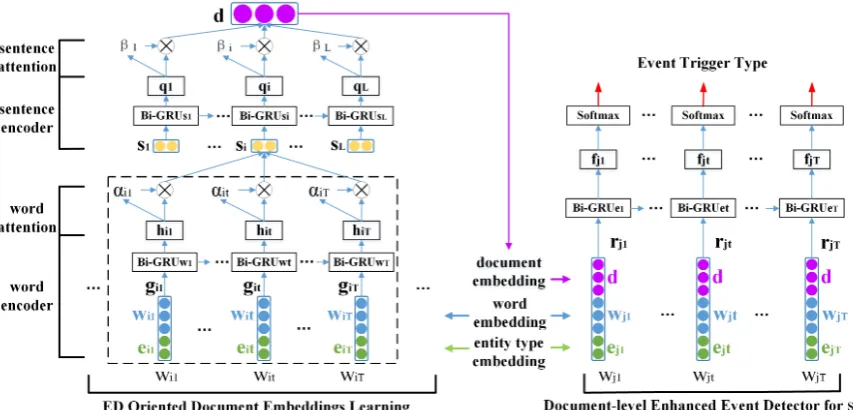
Figure 1: The schematic diagram of the DEEB-RNN model for ED at sentence level.
process, the document-level representation cannot specifically capture event-related information.
In this paper, we propose a novel Document Embedding Enhanced Bi-RNN model, called DEEB-RNN, for ED at sentence level. This model first learns ED oriented embeddings of documents through a hierarchical and supervised attention based bidirectional RNN, which pays word-level attention to event triggers and sentence-level at-tention to those sentences containing events. It then uses the learned document embeddings to fa-cilitate another bidirectional RNN model to iden-tify event triggers and their types in individual sentences. This learning process is guided by a general loss function where the loss correspond-ing to attention at both word and sentence levels and that of event type identification are integrated. It should be mentioned that although the atten-tion mechanism has recently been applied effec-tively in various tasks, including machine transla-tion (Zhang et al.,2017), question answering (Hao et al.,2017), document summarization (Tan et al.,
2017), etc., this is the first study, to the best of our knowledge, which adopts a hierarchical and supervised attention mechanism to learn ED ori-ented embeddings of documents.
We evaluate the developed DEEB-RNN model on the benchmark dataset, ACE-2005, and sys-tematically investigate the impacts of differ-ent supervised attdiffer-ention strategies on its perfor-mance. Experimental results show that the DEEB-RNN model outperforms both feature-based and
representation-based state-of-the-art methods in terms of recall and F1-measure.
2 The Proposed Model
We formalize ED as a multi-class classification problem. Given a sentence, we treat every word in it as a trigger candidate, and classify each can-didate to a certain event type. In the ACE-2005 dataset, there are 8 event types, further being di-vided into 33 subtypes, and a “Not Applicable (NA)” type. Without loss of generality, in this pa-per we regard the 33 subtypes as 33 event types. Figure 1 presents the schematic diagram of the proposed DEEB-RNN model, which contains two main modules:
1. The ED Oriented Document Embedding Learning (EDODEL) module, which learns the distributed representations of documents from both word and sentence levels via the well-designed hierarchical and supervised at-tention mechanism.
2. The Document-level Enhanced Event Detec-tor (DEED) module, which tags each trigger candidate with an event type based on the learned embedding of documents.
2.1 The EDODEL Module
(a)
[image:3.595.81.278.65.156.2](b)
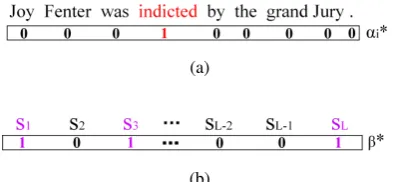
Figure 2: Examples of the gold word- and sentence-level attention without normalization. (a) Word-level attention. “Indicated” is a candi-date trigger; (b) Sentence-level attention. The sen-tences in purple contain trigger words.
and a sentence-level Bi-GRU encoder with atten-tion on sentences with events. Given a document with Lsentences, DEEB-RNN learns its embed-ding for detecting events in all sentences.
Word-level embeddings Given a
sen-tence si (i= 1,2, ..., L) consisting of words
{wit|t= 1,2, ..., T}. For each wordwit, we first concatenate its embeddingwit and its entity type
embedding1 eit (Nguyen and Grishman, 2015)
as the inputgit of a Bi-GRU and thus obtain the
bidirectional hidden statehit:
hit = [ −−−−→
GRUw(git), ←−−−−
GRUw(git)]. (1)
We then feed hit to a perceptron with no bias to
get uit= tanh(Wwhit) as a hidden
representa-tion of hit and also obtain an attention weight
αit =uTitcw, which should be normalized through a softmax function. Here, similar to that in (Yang et al.,2016),cwis a vector representing the word-level context ofwit, which is initialized at random. Finally, the embedding of the sentencesi can be
obtained by summing uphit with their weights:
si=
T ∑
t=1
αithit. (2)
To pay more attention to trigger words than other words, we construct thegold word-level attention signalsα∗i for the sentencesi, as illustrated in Fig-ure2a. We can then take the square error as the general loss of the attention at word level to super-vise the learning process:
Ew(α∗,α) = L ∑
i=1
T ∑
t=1
(α∗it−αit)2. (3)
1The words in the ACE-2005 dataset are annotated with
their entity types (annotated as “NA” if they are not an entity).
Sentence-level embeddingsGiven the sentence embeddings {si|i= 1,2, ..., L}, we first get the hidden stateqivia a Bi-GRU:
qi = [−−−→GRUs(si),←−−−GRUs(si)]. (4)
Then we feedqito a perceptron with no bias to get
the hidden representation ti = tanh(Wsqi) and
also obtain an attention weight βi =tTics to be normalized via softmax. Similarly, cs represents the sentence-level context ofsito be randomly ini-tialized. We eventually obtain the document em-beddingdas:
d= L ∑
i=1
βisi. (5)
We also think that the sentences containing event should obtain more attention than other ones. Therefore, similar to the case at word level, we construct thegold sentence-level attention signals β∗for the documentd, as illustrated in Figure2b, and further take the square error as the general loss of the attention at sentence level to supervise the learning process:
Es(β∗,β) = L ∑
i=1
(βi∗−βi)2. (6)
2.2 The DEED Module
We employ another Bi-GRU encoder and a soft-max output layer to model the ED task, which can handle event triggers with multiple words. Specif-ically, given a sentencesj (j= 1,2, ..., L) in doc-umentd, for each of its wordwjt(t= 1,2, ..., T), we concatenate its word embeddingwjtand entity
type embeddingejtwith the corresponding
docu-ment embeddingdas the inputrjtof the Bi-GRU
and thus obtain the hidden statefjt:
fjt= [−−−→GRUe(rjt),←−−−GRUe(rjt)]. (7)
Finally, we get the probability vectorojt withK dimensions through a softmax layer forwjt, where thek-th element,o(jtk), ofojt indicates the proba-bility of classifyingwjtto thek-th event type. The loss function,J(y,o), can thus be defined in terms of the cross-entropy error of the real event typeyjt and the predicted probabilityo(jtk)as follows:
J(y,o) =− L ∑
j=1
T ∑
t=1
K ∑
k=1
I(yjt=k)logo(jtk), (8)
2.3 Joint Training of the DEEB-RNN model
In the DEEB-RNN model, the above two modules are jointly trained. For this purpose, we define the joint loss function in the training process upon the losses specified for different modules as follows:
J(θ) =∑
∀d∈ϕ
(J(y,o)+λEw(α∗,α)+µEs(β∗,β)),
(9) whereθdenotes, as a whole, the parameters used in DEEB-RNN,ϕis the training document set, and
λ andµ are hyper-parameters for striking a bal-ance amongJ(y,o),Ew(α∗,α)andEs(β∗,β).
3 Experiments
3.1 Datasets and Settings
We validate the proposed model through compar-ison with state-of-the-art methods on the ACE-2005 dataset. In the experiments, the validation set has 30 documents from different genres, the test set has 40 documents and the training set con-tains the remaining 529 documents. All the data preprocessing and evaluation criteria follow those in (Ghaeini et al.,2016).
Hyper-parameters are tuned on the validation set. We set the dimension of the hidden layers cor-responding toGRUw, GRUs, andGRUe to 300, 200, and 300, respectively, the output size ofWw andWs to 600 and 400, respectively, the dimen-sion of entity type embeddings to 50, the batch size to 25, the dropout rate to 0.5. In addition, we utilize the pre-trained word embeddings with 300 dimensions from (Mikolov et al., 2013) for initialization. For entity types, their embeddings are randomly initialized. We train the model using Stochastic Gradient Descent (SGD) over shuffled mini-batches and using dropout (Krizhevsky et al.,
2012) for regularization.
3.2 Baseline Models
In order to validate the proposed DEEB-RNN model through experimental comparison, we choose the following typical models as the base-lines.
Sentence-level is a feature-based model pro-posed in (Hong et al.,2011), which regards entity-type consistency as a key feature to predict event mentions.
Joint Localis a feature-based model developed in (Li et al., 2013), which incorporates such fea-tures that explicitly capture the dependency among multiple triggers and arguments.
Methods λ µ P R F1
Bi-GRU - - 66.2 72.3 69.1
DEEB-RNN 0 0 69.3 75.2 72.1
[image:4.595.325.509.60.136.2]DEEB-RNN1 1 0 70.9 76.7 73.7 DEEB-RNN2 0 1 72.3 74.5 73.4 DEEB-RNN3 1 1 72.3 75.8 74.0
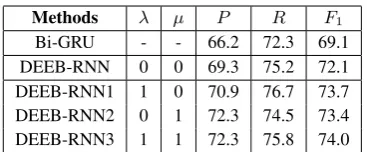
Table 1: Experimental results with different atten-tion strategies.
JRNN is a representation-based model pro-posed in (Nguyen et al.,2016), which exploits the inter-dependency between event triggers and argu-ment roles via discrete structures.
Skip-CNNis a representation-based model pre-sented in (Nguyen and Grishman, 2016), which proposes a novel convolution to exploit non-consecutive k-grams for event detection.
ANN-S2is a representation-based model devel-oped in (Liu et al.,2017), which explicitly exploits argument information for event detection via su-pervised attention mechanisms.
Cross-eventis a feature-based model proposed in (Liao and Grishman, 2010), which learns rela-tions among event types from training corpus and futher helps predict the occurrence of events.
PSLis a feature-based model developed in (Liu et al., 2016b), which encods global information such as event-event association in the form of logic using the probabilistic soft logic model.
DLRNN is a representation-based model pro-posed in (Duan et al.,2017), which automatically extracts cross-sentence clues to improve sentence-level event detection.
3.3 Impacts of Different Attention Strategies
In this section, we conduct experiments on the ACE-2005 dataset to demonstrate the effective-ness of different attention strategies.
Bi-GRUis the basic ED model, which does not employ document-level embeddings.
DEEB-RNN uses the document embeddings and computes attentions without supervision, in which hyper-parametersλandµare set to 0.
sen-Methods P R F1
Sentence-level (2011) 67.6 53.5 59.7 Joint Local (2013) 73.7 59.3 65.7 JRNN (2016) 66.0 73.0 69.3 Skip-CNN (2016) N/A N/A 71.3 ANN-S2 (2017) 78.0 66.3 71.7 Cross-event (2010)† 68.7 68.9 68.8 PSL (2016)† 75.3 64.4 69.4 DLRNN (2017)† 77.2 64.9 70.5
[image:5.595.94.270.61.211.2]DEEB-RNN1† 70.9 76.7 73.7 DEEB-RNN2† 72.3 74.5 73.4 DEEB-RNN3† 72.3 75.8 74.0
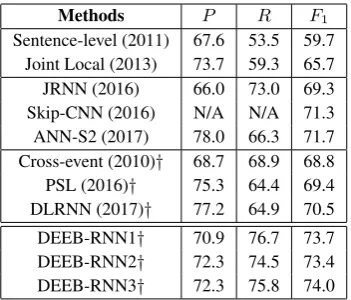
Table 2: Comparison between different methods.
†indicates that the corresponding ED method uses information at both sentence and document levels.
tence levels (λ= 1andµ= 1).
Table 1 compares these methods, where we can observe that the methods with document em-beddings (i.e., the last four) significantly outper-form the pure Bi-GRU method, which suggests that document-level information is very benefi-cial for ED. An interesting phenomenon is that, as compared to DEEB-RNN, DEEB-RNN2 changes the precision-recall balance. This is because of the following reasons. On one hand, as com-pared to DEEB-RNN, DEEB-RNN2 uses the gold sentence-level attention signal, indicating that it pays special attention to the sentences containing events with event triggers. In this way, the Bi-RNN model for learning document embeddings will filter out the sentences containing events but without explicit event triggers. That means the events detected by DEEB-RNN2 are basically the ones with explicit event triggers. Therefore, as compared to RNN, the precision of DEEB-RNN2 is improved; On the other hand, the above strategy may result in less learning of words, which are event triggers but do not appear in the training dataset. Therefore, those sentences with such event triggers cannot be detected. The recall of DEEB-RNN2 is thus lowered, as compared to DEEB-RNN. Moreover, DEEB-RNN3 shows the best performance, indicating that the gold atten-tion signals at both word and sentence levels are useful for ED.
3.4 Performance Comparison
Table 2 presents the overall performance of all methods on ACE-2005. We can see that dif-ferent versions of DEEB-RNN consistently
out-perform the existing state-of-the-art methods in terms of both recall and F1-measure, while their precision is comparable to that of others. The better performance of DEEB-RNN can be ex-plained by the following reasons: (1) Compared with feature-based methods, including Sentence-level,Joint Local, and representation-based meth-ods, including JRNN, Skip-CNN and ANN-S2, our method exploits document-level information (i.e., the ED oriented document embeddings) from both word and sentence levels in a document by the supervised attention mechanism, which en-hance the ability of identifying trigger words; (2) Compared with feature-based methods using document-level information, such asCross-event, PSL, our method can automatically capture event types in documents via a end-to-end Bi-RNN based model without manually designed rules; (3) Compared with representation-based methods us-ing document-level information, such asDLRNN, our method can learn event detection oriented em-beddings of documents through the hierarchical and supervised attention based Bi-RNN network.
4 Conclusions and Future Work
In this study, we proposed a hierarchical and su-pervised attention based and document embedding enhanced Bi-RNN method, called DEEB-RNN, for event detection. We explored different strate-gies to construct gold word- and sentence-level at-tentions to focus on event information. Experi-ments on the ACE-2005 dataset demonstrate that DEEB-RNN achieves better performance as com-pared to the state-of-the-art methods in terms of both recall and F1-measure. In this paper, we can strike a balance between sentence and document embeddings by adjusting their dimensions. In the future, we may improve the DEEB-RNN model to automatically determine the weights of sentence and document embeddings.
Acknowledgments
References
Yubo Chen, Shulin Liu, Xiang Zhang, Kang Liu, and Jun Zhao. 2017. Automatically labeled data genera-tion for large scale event extracgenera-tion. InAssociation for Computational Linguistics, pages 409–419.
Yubo Chen, Liheng Xu, Kang Liu, daojian zeng, and jun zhao. 2015. Event extraction via dynamic multi-pooling convolutional neural networks. In Associa-tion for ComputaAssocia-tional Linguistics, pages 167–176.
Shaoyang Duan, Ruifang He, and Wenli Zhao. 2017. Exploiting document level information to improve event detection via recurrent neural networks. In Proceedings of the Eighth International Joint Con-ference on Natural Language Processing - Volume 1), pages 352–361.
Reza Ghaeini, Xiaoli Fern, Liang Huang, and Prasad Tadepalli. 2016. Event nugget detection with forward-backward recurrent neural networks. In As-sociation for Computational Linguistics, pages 369– 373.
Yanchao Hao, Yuanzhe Zhang, Kang Liu, Shizhu He, Zhanyi Liu, Hua Wu, and Jun Zhao. 2017. An end-to-end model for question answering over knowl-edge base with cross-attention combining global knowledge. InAssociation for Computational Lin-guistics, pages 221–231.
Yu Hong, Jianfeng Zhang, Bin Ma, Jianmin Yao, Guodong Zhou, and Qiaoming Zhu. 2011. Using cross-entity inference to improve event extraction. InAssociation for Computational Linguistics, pages 1127–1136.
Ruihong Huang and Ellen Riloff. 2012. Modeling tex-tual cohesion for event extraction. InAAAI, pages 1664–1670.
Heng Ji and Ralph Grishman. 2008. Refining event extraction through cross-document inference. In As-sociation for Computational Linguistics, pages 254– 262.
Alex Krizhevsky, Ilya Sutskever, and Geoffrey E. Hin-ton. 2012. Imagenet classification with deep con-volutional neural networks. InProceedings of the 25th International Conference on Neural Informa-tion Processing Systems - Volume 1, pages 1097– 1105.
Qi Li, Heng Ji, Yu Hong, and Sujian Li. 2014. Con-structing information networks using one single model. InEmpirical Methods in Natural Language Processing, pages 1846–1851.
Qi Li, Heng Ji, and Liang Huang. 2013. Joint event extraction via structured prediction with global fea-tures. InAssociation for Computational Linguistics, pages 73–82.
Shasha Liao and Ralph Grishman. 2010. Using doc-ument level cross-event inference to improve event
extraction. In Association for Computational Lin-guistics, pages 789–797.
Shulin Liu, Yubo Chen, Shizhu He, Kang Liu, and Jun Zhao. 2016a. Leveraging framenet to improve auto-matic event detection. InAssociation for Computa-tional Linguistics, pages 2134–2143.
Shulin Liu, Yubo Chen, Kang Liu, and Jun Zhao. 2017. Exploiting argument information to improve event detection via supervised attention mechanisms. In Association for Computational Linguistics, pages 1789–1798.
Shulin Liu, Kang Liu, Shizhu He, and Jun Zhao. 2016b. A probabilistic soft logic based approach to exploit-ing latent and global information in event classifica-tion. InProceedings of the Thirtieth AAAI Confer-ence on Artificial IntelligConfer-ence, pages 2993–2999.
David McClosky, Mihai Surdeanu, and Christopher D. Manning. 2011. Event extraction as dependency parsing for bionlp 2011. In Association for Com-putational Linguistics, pages 41–45.
Tomas Mikolov, Ilya Sutskever, Kai Chen, Greg Cor-rado, and Jeffrey Dean. 2013. Distributed represen-tations of words and phrases and their composition-ality. InProceedings of the 26th International Conference on Neural Information Processing Systems -Volume 2, pages 3111–3119.
Thien Nguyen, Kyunghyun Cho, and Ralph Grishman. 2016. Joint event extraction via recurrent neural net-works. InNAACL, pages 300–309.
Thien Nguyen and Ralph Grishman. 2015. Event de-tection and domain adaptation with convolutional neural networks. InIJCNLP, pages 365–371.
Thien Nguyen and Ralph Grishman. 2016. Modeling skip-grams for event detection with convolutional neural networks. InEmpirical Methods in Natural Language Processing, pages 886–891.
M. Schuster and K.K. Paliwal. 2002. Bidirectional re-current neural networks. IEEE Transactions on Sig-nal Processing, 45:2673–2681.
Jiwei Tan, Xiaojun Wan, and Jianguo Xiao. 2017. Abstractive document summarization with a graph-based attentional neural model. InAssociation for Computational Linguistics, pages 1171–1181.
Zichao Yang, Diyi Yang, Chris Dyer, Xiaodong He, Alex Smola, and Eduard Hovy. 2016. Hierarchical attention networks for document classification. In NAACL, pages 1480–1489.