Proceedings of the 55th Annual Meeting of the Association for Computational Linguistics (Short Papers), pages 148–154 Vancouver, Canada, July 30 - August 4, 2017. c2017 Association for Computational Linguistics
Proceedings of the 55th Annual Meeting of the Association for Computational Linguistics (Short Papers), pages 148–154 Vancouver, Canada, July 30 - August 4, 2017. c2017 Association for Computational Linguistics
Lifelong Learning CRF for Supervised Aspect Extraction
Lei Shu, Hu Xu, Bing Liu
Department of Computer Science, University of Illinois at Chicago, USA
{lshu3, hxu48, liub}@uic.edu
Abstract
This paper makes a focused contribution to supervised aspect extraction. It shows that if the system has performed aspect ex-traction from many past domains and re-tained their results as knowledge, Condi-tional Random Fields (CRF) can leverage this knowledge in a lifelong learning man-ner to extract in a new domain markedly better than the traditional CRF without us-ing this prior knowledge. The key inno-vation is that even after CRF training, the model can still improve its extraction with experiences in its applications.
1 Introduction
Aspect extraction is a key task of opinion min-ing (Liu, 2012). It extracts opinion targets from opinion text. For example, from the sentence “The screen is great”, it aims to extract “screen”, which is a product feature, also called anaspect.
Aspect extraction is commonly done using a su-pervised or an unsusu-pervised approach. The unsu-pervised approach includes methods such as fre-quent pattern mining (Hu and Liu,2004;Popescu and Etzioni, 2005; Zhu et al., 2009), syntactic rules-based extraction (Zhuang et al.,2006;Wang and Wang, 2008; Wu et al., 2009; Zhang et al., 2010;Qiu et al., 2011;Poria et al., 2014), topic modeling (Mei et al.,2007;Titov and McDonald, 2008;Li et al., 2010;Brody and Elhadad, 2010; Wang et al.,2010;Moghaddam and Ester, 2011; Mukherjee and Liu,2012;Lin and He,2009;Zhao et al., 2010;Jo and Oh, 2011;Fang and Huang, 2012; Wang et al., 2016), word alignment (Liu et al.,2013), label propagation (Zhou et al.,2013; Shu et al.,2016), and others (Zhao et al.,2015).
This paper focuses on the supervised approach (Jakob and Gurevych, 2010; Choi and Cardie,
2010; Mitchell et al., 2013) using Conditional Random Fields (CRF) (Lafferty et al., 2001). It shows that the results of CRF can be significantly improved by leveraging some prior knowledge au-tomatically mined from the extraction results of previous domains, including domains without la-beled data. The improvement is possible because although every product (domain) is different, there is a fair amount of aspects sharing across do-mains (Chen and Liu,2014). For example, every review domain has the aspect price and reviews of many products have the aspect battery life or
screen. Those shared aspects may not appear in the training data but appear in unlabeled data and the test data. We can exploit such sharing to help CRF perform much better.
Due to leveraging the knowledge gained from the past to help the new domain extraction, we are using the idea of lifelong machine learning
(LML) (Chen and Liu, 2016; Thrun, 1998; Sil-ver et al., 2013), which is a continuous learning paradigm that retains the knowledge learned in the past and uses it to help future learning and prob-lem solving with possible adaptations.
The setting of the proposed approach L-CRF (Lifelong CRF) is as follows: A CRF model M has been trained with a labeled training review dataset. At a particular point in time, M has ex-tracted aspects from data in n previous domains D1, . . . , Dn (which are unlabeled) and the
ex-tracted sets of aspects areA1, . . . , An. Now, the
system is faced with a new domain data Dn+1. M can leverage somereliable prior knowledgein A1, . . . , Anto make a better extraction fromDn+1 than without leveraging this prior knowledge.
The key innovation of L-CRF is that even after supervised training, the model can still improve its extraction in testing or its applications with expe-riences. Note that L-CRF is different from semi-supervised learning (Zhu,2005) as thenprevious
(unlabeled) domain data used in extraction are not used or not available during model training.
There are prior LML works for aspect extrac-tion (Chen et al., 2014; Liu et al., 2016), but they were all unsupervised methods. Supervised LML methods exist (Chen et al.,2015;Ruvolo and Eaton,2013), but they are for classification rather than for sequence learning or labeling like CRF. A semi-supervised LML method is used in NELL (Mitchell et al.,2015), but it is heuristic pattern-based. It doesn’t use sequence learning and is not for aspect extraction. LML is related to transfer learning and multi-task learning (Pan and Yang, 2010), but they are also quite different (see (Chen and Liu,2016) for details).
To the best of our knowledge, this is the first pa-per that uses LML to help a supa-pervised extraction method to markedly improve its results.
2 Conditional Random Fields
CRF learns from an observation sequencexto
es-timate a label sequencey: p(y|x;θ), whereθ is a set of weights. Letlbe the l-th position in the sequence. The core parts of CRF are a set of feature functionsF = {fh(yl, yl−1,xl)}Hh=1 and
their corresponding weightsθ={θh}Hh=1.
Feature Functions: We use two types of feature functions (FF). One isLabel-Label (LL)FF:
fijLL(yl, yl−1) =1{yl=i}1{yl−1=j},∀i, j∈ Y, (1)
whereY is the set of labels, and1{·}an indicator function. The other isLabel-Word (LW)FF:
fivLW(yl,xl) =1{yl=i}1{xl=v},∀i∈ Y,∀v∈ V, (2)
whereVis the vocabulary. This FF returns1when
thel-th word isvand thel-th label isv’s specific labeli; otherwise0. xl is the current word, and
is represented as a multi-dimensional vector. Each dimension in the vector is a feature ofxl.
Following the previous work in (Jakob and Gurevych,2010), we use the feature set{W, -1W,
+1W, P, -1P, +1P, G}, where W is the word and P is its POS-tag, -1W is the previous word, -1P is its tag, +1W is the next word, +1P is its POS-tag, and G is the generalized dependency feature.
Under the Label-Word FF type, we have two sub-types of FF:Label-dimensionFF andLabel-G
FF. Label-dimension FF is for the first 6 features, and Label-G is for the G feature.
TheLabel-dimension (Ld)FF is defined as
fLdd(yl,xl) =1{yl=i}1{xdl=vd},∀i∈ Y,∀vd∈ Vd, (3)
whereVdis the set of observed values in feature
d∈ {W,−1W,+1W, P,−1P,+1P}and we call
Vdfeatured’s feature values. Eq. (3) is a FF that returns1whenxl’s featuredequals to the feature
value vd and the variable yl (lth label) equals to
the label valuei; otherwise 0.
We describe G and its feature function next, which also holds the key to the proposed L-CRF.
3 General Dependency Feature (G)
Feature G uses generalized dependency relations. What is interesting about this feature is that it en-ables L-CRF to use past knowledge in its sequence prediction at the test time in order to perform much better. This will become clear shortly. This feature takes adependency pattern as its value, which is generalized from dependency relations.
The general dependency feature (G) of the vari-ablexltakes a set of feature valuesVG. Each
fea-ture valuevGis a dependency pattern. The Label-G (LLabel-G)FF is defined as:
fivLGG(yl,xl) =1{yl=i}1{xGl =vG},∀i∈ Y,∀vG∈ VG. (4)
Such a FF returns1when the dependency feature
of the variablexl equals to a dependency pattern
vGand the variableylequals to the label valuei.
3.1 Dependency Relation
Dependency relations have been shown useful in many sentiment analysis applications (Johansson and Moschitti,2010;Jakob and Gurevych,2010). A dependency relation 1 is a quintuple-tuple: (type, gov, govpos, dep, deppos),wheretypeis the type of the dependency relation,govis the gover-nor word, govposis the POS tag of the governor word, dep is the dependent word, and deppos is the POS tag of the dependent word. Thel-th word can either be the governor word or the dependent word in a dependency relation.
3.2 Dependency Pattern
We generalize dependency relations into depen-dency patternsusing the following steps:
1. For each dependency relation, replace the current word (governor word or dependent word) and its POS tag with a wildcard since we already have the word (W) and the POS tag (P) features.
Index Word Dependency Relations
1 The {(det, battery, 2, NN , The, 1, DT)}
2 battery {(nsubj, great, 7, JJ , battery, 2, NN), (det, battery, 2, NN , The, 1, DT), (nmod, battery, 2, NN, camera, 5, NN)}
3 of {(case, camera, 5, NN, of, 3, IN)}
4 this {(det, camera, 5, NN, this, 4, DT)}
5 camera {(case, camera, 5, NN, of, 3, IN), (det, camera, 5, NN, this, 4, DT), (nmod, battery, 2, NN, camera, 5, NN)}
6 is {(cop, great, 7, JJ , is, 6, VBZ)}
7 great {(root, ROOT, 0, VBZ, great, 7, JJ), (nsubj, great, 7, JJ , battery, 2, NN), (cop, great, 7, JJ , is, 6, VBZ)}
Table 1: Dependency relations parsed from “The battery of this camera is great” 2. Replace the context word (the word other
than the l-th word) in each dependency re-lation with a knowledge label to form a more general dependency pattern. Let the set of as-pects annotated in the training data beKt. If
the context word in the dependency relation appears in Kt, we replace it with a knowl-edge label ‘A’ (aspect); otherwise ‘O’ (other).
For example, we work on the sentence “The bat-tery of this camera is great.” The dependency re-lations are given in Table 1. Assume the current word is “battery,” and “camera” is annotated as an aspect. The original dependency relation between “camera” and “battery” produced by a parser is (nmod, battery, NN, camera, NN). Note that we do not use the word positions in the relations in Table 1. Since the current word’s information (the word itself and its POS-tag) in the dependency relation is redundant, we replace it with a wild-card. The relation becomes (nmod, *, camera, NN). Sec-ondly, since “camera” is inKt, we replace “cam-era” with a general label ‘A’. The final dependency pattern becomes (nmod,*, A, NN).
We now explain why dependency patterns can enable a CRF model to leverage the past knowl-edge. The key is the knowledge label ‘A’ above, which indicates a likely aspect. Recall that our problem setting is that when we need to extract from the new domainDn+1 using a trained CRF model M, we have already extracted from many previous domains D1, . . . , Dn and retained their
extracted sets of aspects A1, . . . , An. Then, we
can mine reliable aspects from A1, . . . , An and
add them in Kt, which enables many
knowl-edge labels in the dependency patterns of the new data An+1 due to sharing of aspects across do-mains. This enriches the dependency pattern fea-tures, which consequently allows more aspects to be extracted from the new domainDn+1.
4 The Proposed L-CRF Algorithm
We now present the L-CRF algorithm. As the de-pendency patterns for the general dede-pendency
fea-Algorithm 1Lifelong Extraction of L-CRF 1: Kp← ∅
2: loop
3: F ←FeatureGeneration(Dn+1, K)
4: An+1 ←Apply-CRF-Model(M, F)
5: S ←S∪ {An+1}
6: Kn+1←Frequent-Aspects-Mining(S, λ)
7: ifKp =Kn+1then
8: break
9: else
10: K ←Kt∪Kn+1
11: Kp ←Kn+1
12: S ←S− {An+1}
13: end if 14: end loop
ture do not use any actual words and they can also use the prior knowledge, they are quite powerful for cross-domain extraction (the test domain is not used in training).
LetK be a set ofreliable aspectsmined from the aspects extracted in past domain datasets using the CRF modelM. Note that we assume that M has already been trained using some labeled train-ing dataDt. Initially,K isKt(the set of all an-notated aspects in the training dataDt). The more domainsMhas worked on, the more aspects it ex-tracts, and the larger the setK gets. When faced with a new domain Dn+1, K allows the general dependency feature to generate more dependency patterns related to aspects due to more knowledge labels ‘A’ as we explained in the previous section. Consequently, CRF has more informed features to produce better extraction results.
L-CRF works in two phases: training phase
andlifelong extraction phase. The training phase trains a CRF modelM using the training dataDt,
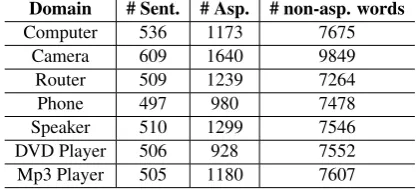
Domain # Sent. # Asp. # non-asp. words
Computer 536 1173 7675
Camera 609 1640 9849
Router 509 1239 7264
Phone 497 980 7478
Speaker 510 1299 7546
DVD Player 506 928 7552
[image:4.595.76.285.64.159.2]Mp3 Player 505 1180 7607
Table 2: Annotation details of the datasets
a particular time, it is assumed M has been ap-plied to n past domains, and is now faced with the n+ 1 domain. L-CRF uses M and reliable aspects (denoted Kn+1) mined from S and Kt (K = Kt∪K
n+1) to extract from Dn+1. Note that aspectsKtfrom the training data are
consid-ered always reliable as they are manually labeled, thus a subset ofK. We cannot use all extracted as-pects from past domains as reliable asas-pects due to many extraction errors. But those aspects that ap-pear in multiple past domains are more likely to be correct. ThusKcontains those frequent aspects in S. The lifelong extraction phase is in Algorithm1.
Lifelong Extraction Phase: Algorithm 1 per-forms extraction onDn+1iteratively.
1. It generates features (F) on the data Dn+1 (line3), and applies the CRF modelM onF to produce a set of aspectsAn+1(line4).
2. An+1 is added to S, the past aspect store. From S, we mine a set of frequent aspects Kn+1. The frequency threshold isλ.
3. If Kn+1 is the same asKp from the
previ-ous iteration, the algorithm exits as no new aspects can be found. We use an iterative process because each extraction gives new re-sults, which may increase the size ofK, the reliable past aspects or past knowledge. The increasedK may produce more dependency patterns, which can enable more extractions.
4. Else: some additional reliable aspects are found. M may extract additional aspects in the next iteration. Lines10and11update the two sets for the next iteration.
5 Experiments
We now evaluate the proposed L-CRF method and compare with baselines.
5.1 Evaluation Datasets
We use two types of data for our experiments. The first type consists of seven (7) annotated bench-mark review datasets from 7 domains (types of products). Since they are annotated, they are used in training and testing. The first 4 datasets are from (Hu and Liu, 2004), which actually has 5 datasets from 4 domains. Since we are mainly interested in results at the domain level, we did not use one of the domain-repeated datasets. The last 3 datasets of three domains (products) are from (Liu et al., 2016). These datasets are used to make up our CRF training dataDtand test data Dn+1. The annotation details are given in Table2. The second type has 50 unlabeled review datasets from 50 domains or types of prod-ucts (Chen and Liu,2014). Each dataset has 1000 reviews. They are used as the past domain data, i.e.,D1, . . . , Dn(n = 50). Since they are not
la-beled, they cannot be used for training or testing.
5.2 Baseline Methods
We compare L-CRF with CRF. We will not com-pare with unsupervised methods, which have been shown improvable by lifelong learning (Chen et al., 2014; Liu et al., 2016). The frequency thresholdλin Algorithm 1 used in our experiment to judge which extracted aspects are considered re-liable is empirically set to2.
CRF: We use the linear chain CRF from2. Note
that CRF uses all features including dependency features as the proposed L-CRF but does not em-ploy the 50 domains unlabeled data used for life-long learning
CRF+R: It treats the reliable aspect set K as a dictionary. It adds those reliable aspects in K that are not extracted by CRF but are in the test data to the final results. We want to see whether incorporatingK into the CRF extraction through dependency patterns in L-CRF is actually needed. We do not compare with domain adaptation or transfer learning because domain adaption basi-cally uses the source domain labeled data to help learning in the target domain with few or no la-beled data. Our 50 domains used in lifelong learn-ing have no labels. So they cannot help in transfer learning. Although in transfer learning, the target domain usually has a large quantity of unlabeled data, but the 50 domains are not used as the target domains in our experiments.
Cross-Domain
Training Testing CRF CRF+R L-CRF
P R F1 P R F1 P R F1
−Computer Computer 86.6 51.4 64.5 23.2 90.4 37.0 82.2 62.7 71.1
−Camera Camera 84.3 48.3 61.4 21.8 86.8 34.9 81.9 60.6 69.6
−Router Router 86.3 48.3 61.9 24.8 92.6 39.2 82.8 60.8 70.1
−Phone Phone 72.5 50.6 59.6 20.8 81.2 33.1 70.1 59.5 64.4
−Speaker Speaker 87.3 60.6 71.6 22.4 91.2 35.9 84.5 71.5 77.4
−DVDplayer DVDplayer 72.7 63.2 67.6 16.4 90.7 27.7 69.7 71.5 70.6
−Mp3player Mp3player 87.5 49.4 63.2 20.6 91.9 33.7 84.1 60.7 70.5
Average 82.5 53.1 64.3 21.4 89.3 34.5 79.3 63.9 70.5
In-Domain
−Computer −Computer 84.0 71.4 77.2 23.2 93.9 37.3 81.6 75.8 78.6
−Camera −Camera 83.7 70.3 76.4 20.8 93.7 34.1 80.7 75.4 77.9
−Router −Router 85.3 71.8 78.0 22.8 93.9 36.8 82.6 76.2 79.3
−Phone −Phone 85.0 71.1 77.5 25.1 93.7 39.6 82.9 74.7 78.6
−Speaker −Speaker 83.8 70.3 76.5 20.1 94.3 33.2 80.1 75.8 77.9
−DVDplayer −DVDplayer 85.0 72.2 78.1 20.9 94.2 34.3 81.6 76.7 79.1
−Mp3player −Mp3player 83.2 72.6 77.5 20.4 94.5 33.5 79.8 77.7 78.7
[image:5.595.97.502.60.331.2]Average 84.3 71.4 77.3 21.9 94.0 35.5 81.3 76.0 78.6
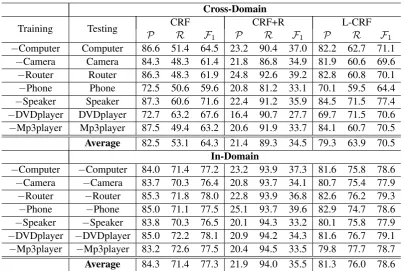
Table 3: Aspect extraction results in precision, recall and F1score: Cross-Domain and In-Domain (−X means all except domain X)
5.3 Experiment Setting
To compare the systems using the same training and test data, for each dataset we use 200 sen-tences for training and 200 sensen-tences for testing to avoid bias towards any dataset or domain because we will combine multiple domain datasets for CRF training. We conducted both cross-domain and in-domain tests. Our problem setting is cross-domain. In-domain is used for completeness. In both cases, we assume that extraction has been done for the 50 domains.
Cross-domain experiments: We combine 6 labeled domain datasets for training (1200 sen-tences) and test on the 7th domain (not used in training). This gives us 7 cross-domain results. This set of tests is particularly interesting as it is desirable to have the trained model used in cross-domain situations to save manual labeling effort.
In-domain experiments: We train and test on the same 6 domains (1200 sentences for training and 1200 sentences for testing). This also gives us 7in-domainresults.
Evaluating Measures: We use the popular pre-cisionP, recallR, andF1-score.
5.4 Results and Analysis
All the experiment results are given in Table3.
Cross-domain: Each −X in column 1 means that domain X is not used in training. X in
col-umn 2 means that domain X is used in testing. We can see that L-CRF is markedly better than CRF and CRF+R in F1. CRF+R is very poor due to poor precisions, which shows treating the reliable aspects setKas a dictionary isn’t a good idea.
In-domain: −X in training and test columns means that the other 6 domains are used in both training and testing (thus in-domain). We again see that L-CRF is consistently better than CRF and CRF+R inF1. The amount of gain is smaller. This is expected because most aspects appeared in training probably also appear in the test data as they are reviews from the same 6 products.
6 Conclusion
This paper proposed a lifelong learning method to enable CRF to leverage the knowledge gained from extraction results of previous domains (unla-beled) to improve its extraction. Experimental re-sults showed the effectiveness of L-CRF. The cur-rent approach does not change the CRF model it-self. In our future work, we plan to modify CRF so that it can consider previous extraction results as well as the knowledge in previous CRF models.
Acknowledgments
References
Samuel Brody and Noemie Elhadad. 2010. An unsu-pervised aspect-sentiment model for online reviews. InNAACL ’10. pages 804–812.
Zhiyuan Chen and Bing Liu. 2014. Topic modeling using topics from many domains, lifelong learning and big data. InICML ’14. pages 703–711.
Zhiyuan Chen and Bing Liu. 2016. Lifelong Machine Learning. Morgan & Claypool Publishers.
Zhiyuan Chen, Nianzu Ma, and Bing Liu. 2015. Life-long learning for sentiment classification. Volume 2: Short Paperspage 750.
Zhiyuan Chen, Arjun Mukherjee, and Bing Liu. 2014. Aspect extraction with automated prior knowledge learning. InACL ’14. pages 347–358.
Yejin Choi and Claire Cardie. 2010. Hierarchical se-quential learning for extracting opinions and their attributes. InACL ’10. pages 269–274.
Lei Fang and Minlie Huang. 2012. Fine granular aspect analysis using latent structural models. InACL ’12. pages 333–337.
Minqing Hu and Bing Liu. 2004. Mining and summa-rizing customer reviews. InKDD ’04. pages 168– 177.
Niklas Jakob and Iryna Gurevych. 2010. Extracting opinion targets in a single- and cross-domain set-ting with conditional random fields. InEMNLP ’10. pages 1035–1045.
Yohan Jo and Alice H. Oh. 2011. Aspect and senti-ment unification model for online review analysis. InWSDM ’11. pages 815–824.
Richard Johansson and Alessandro Moschitti. 2010. Syntactic and semantic structure for opinion ex-pression detection. In Proceedings of the Four-teenth Conference on Computational Natural Lan-guage Learning. pages 67–76.
John Lafferty, Andrew McCallum, and Fernando CN Pereira. 2001. Conditional random fields: Prob-abilistic models for segmenting and labeling se-quence data. InICML ’01. pages 282–289.
Fangtao Li, Minlie Huang, and Xiaoyan Zhu. 2010. Sentiment analysis with global topics and local de-pendency. InAAAI ’10. pages 1371–1376.
Chenghua Lin and Yulan He. 2009. Joint senti-ment/topic model for sentiment analysis. InCIKM ’09. pages 375–384.
Bing Liu. 2012. Sentiment Analysis and Opinion Min-ing. Morgan & Claypool Publishers.
Kang Liu, Liheng Xu, Yang Liu, and Jun Zhao. 2013. Opinion target extraction using partially-supervised word alignment model. InIJCAI ’13. pages 2134– 2140.
Qian Liu, Bing Liu, Yuanlin Zhang, Doo Soon Kim, and Zhiqiang Gao. 2016. Improving opinion aspect extraction using semantic similarity and aspect asso-ciations. InThirtieth AAAI Conference on Artificial Intelligence.
Qiaozhu Mei, Xu Ling, Matthew Wondra, Hang Su, and ChengXiang Zhai. 2007. Topic sentiment mix-ture: Modeling facets and opinions in weblogs. In WWW ’07. pages 171–180.
Margaret Mitchell, Jacqui Aguilar, Theresa Wilson, and Benjamin Van Durme. 2013. Open domain tar-geted sentiment. InACL ’13. pages 1643–1654.
T Mitchell, W Cohen, E Hruschka, P Talukdar, J Bet-teridge, A Carlson, B Dalvi, M Gardner, B Kisiel, J Krishnamurthy, N Lao, K Mazaitis, T Mohamed, N Nakashole, E Platanios, A Ritter, M Samadi, B Settles, R Wang, D Wijaya, A Gupta, X Chen, A Saparov, M Greaves, and J Welling. 2015. Never-ending learning. InAAAI’2015.
Samaneh Moghaddam and Martin Ester. 2011. ILDA: interdependent lda model for learning latent aspects and their ratings from online product reviews. In SIGIR ’11. pages 665–674.
Arjun Mukherjee and Bing Liu. 2012. Aspect extrac-tion through semi-supervised modeling. InACL ’12. volume 1, pages 339–348.
Sinno Jialin Pan and Qiang Yang. 2010. A survey on transfer learning. IEEE Transactions on knowledge and data engineering22(10):1345–1359.
Ana-Maria Popescu and Oren Etzioni. 2005. Extract-ing product features and opinions from reviews. In HLT-EMNLP ’05. pages 339–346.
Soujanya Poria, Erik Cambria, Lun-Wei Ku, Chen Gui, and Alexander Gelbukh. 2014. A rule-based ap-proach to aspect extraction from product reviews. In Proceedings of the second workshop on natural language processing for social media (SocialNLP). pages 28–37.
Guang Qiu, Bing Liu, Jiajun Bu, and Chun Chen. 2011. Opinion word expansion and target extraction through double propagation. Computational Lin-guistics37(1):9–27.
Paul Ruvolo and Eric Eaton. 2013. Ella: An efficient lifelong learning algorithm.ICML (1)28:507–515.
Lei Shu, Bing Liu, Hu Xu, and Annice Kim. 2016. Lifelong-rl: Lifelong relaxation labeling for sepa-rating entities and aspects in opinion targets. In Pro-ceedings of the Conference on Empirical Methods in Natural Language Processing (EMNLP).
Sebastian Thrun. 1998. Lifelong learning algorithms. InLearning to learn, Springer, pages 181–209.
Ivan Titov and Ryan McDonald. 2008. A joint model of text and aspect ratings for sentiment summariza-tion. InACL ’08: HLT. pages 308–316.
Bo Wang and Houfeng Wang. 2008. Bootstrapping both product features and opinion words from chi-nese customer reviews with cross-inducing. In IJC-NLP ’08. pages 289–295.
Hongning Wang, Yue Lu, and Chengxiang Zhai. 2010. Latent aspect rating analysis on review text data: A rating regression approach. InKDD ’10. pages 783– 792.
Shuai Wang, Zhiyuan Chen, and Bing Liu. 2016. Min-ing aspect-specic opinion usMin-ing a holistic lifelong topic model. InWWW ’16.
Yuanbin Wu, Qi Zhang, Xuanjing Huang, and Lide Wu. 2009. Phrase dependency parsing for opinion min-ing. InEMNLP ’09. pages 1533–1541.
Lei Zhang, Bing Liu, Suk Hwan Lim, and Eamonn O’Brien-Strain. 2010. Extracting and ranking prod-uct features in opinion documents. InCOLING ’10: Posters. pages 1462–1470.
Wayne Xin Zhao, Jing Jiang, Hongfei Yan, and Xiaom-ing Li. 2010. Jointly modelXiaom-ing aspects and opinions with a maxent-lda hybrid. InEMNLP ’10. pages 56– 65.
Yanyan Zhao, Bing Qin, and Ting Liu. 2015. Creating a fine-grained corpus for chinese sentiment analysis. IEEE Intelligent Systems30(1):36–43.
Xinjie Zhou, Xiaojun Wan, and Jianguo Xiao. 2013. Collective opinion target extraction in Chinese mi-croblogs. InEMNLP ’13. pages 1840–1850.
Jingbo Zhu, Huizhen Wang, Benjamin K. Tsou, and Muhua Zhu. 2009. Multi-aspect opinion polling from textual reviews. In CIKM ’09. pages 1799– 1802.
Xiaojin Zhu. 2005. Semi-supervised learning literature survey .