J. Range Manage.
55: 426-438 September 2002
Valuing grazing use on public land
E. TOM BARTLETT, L. ALLEN TORELL, NEIL R. RIMBEY, LARRY W. VAN TASSELL, AND DANIEL W.
MCCOLLUM
Authors are Professor, Department of Rangeland Ecosystem Science, Colorado State University, Fort Collins, Colo. 80523; Professor, Department of Agricultural Economics and Agricultural Business, New Mexico State University, Las Cruces, N.M. 88003; Professor, Department of Agricultural Economics and Rural Sociology, University of Idaho, Caldwell, Ida. 83605; Professor and Head, Department of Agricultural Economics and Rural Sociology, University of Idaho, Moscow, Ida., 83844; and Economist, U.S. Forest Service, Rocky Mountain Research Station, Fort Collins, Colo.
Abstract
The value of public land forage has been of key interest since grazing fees were first established on federal lands. Additionally, knowing the value of rangeland forage is important for assessing the economics of range improvements, grazing systems, and alternative land uses. It is important for resource value compar- isons and impact assessments when public land forage is allocat- ed to other uses. In this synthesis paper, we review the various methods that have been used to value public land forage and dis- cuss the advantages and limitations of each. We highlight that past valuation efforts have concentrated on the value of public land forage for livestock production and, consequently, underes- timated total forage value and rancher willingness to pay for for- age and grazing permits. These research efforts failed to recog- nize that amenity and lifestyle attributes from ranch ownership and forage leasing play important roles in the use and pricing of rangeland forage. We review the numerous studies conducted to estimate public land forage value and suggest modifications to improve future value estimates. Because lifestyle attributes of ranch ownership have so strongly influenced ranch values and what ranchers are willing to pay for grazing use on public lands, we find the market value of federal grazing permits and a modi- fication of the standard contingent valuation method for valuing non-market goods to hold the greatest promise for valuing public land grazing.
Key Words: Forage value, grazing fees, grazing leases, hedonic models, contingent valuation, public land grazing
Knowing the value of forage is a necessary component in many economic studies. Forage value estimates are needed for assess- ing the economics of range improvements, grazing systems, and alternative land uses. Rural appraisers use estimates of forage value in ranch income appraisals. The economic impact of chang- ing forage use and availability starts with an estimate of the eco- nomic value of the grazing capacity potentially eliminated or redirected. These assessments and valuations are often controver- sial, especially when public land grazing is considered.
Much of the prior work to value rangeland forage has dealt with the appropriate grazing fee for public land grazing; the key issue being the level of economic benefits received by grazing users of public lands (Gee 1981, Torell et al. 1993, USDA/USDI
Research was funded in part by U.S. Forest Service Research Joint Venture No.
00-JV-11221617-221.
Manuscript accepted 26 Dec. 2001.
Resumen
El valor del forraje de tierras publicas ha sido de interes cave desde que los pagos por pastoreo fueron establecidos en tierras federales. Adicionalmente, el saber el valor del forraje de los pas- tizales es importante para tasar la economca de las mejoras al rancho, de los sistemas de pastoreo, y de los usos alternativos del suelo. Es importante para comparaciones del valor de los recur- sos y evaluaciones de impacto cuando la tierra publica es desti- nada a otros usos. En esta sintesis revisamos los diferentes meto- dos que han sido utilizados para valuar el forraje de tierras publicas y se discuten las ventajas y limitaciones de cada uno.
Enfatizamos que los esfuerzos de valuacion utilizados en el pasa- do se han concentrado en el valor del forraje de tierras publicas utilizado en la produccion de ganado, y consecuentemente han subestimado el valor total del forraje y la disposicion del ranchero de pagar por el forraje y por los permisos de pastoreo.
Los esfuerzos de esta investigacion fallaron en reconocer que los atributos amenidad y estilo de vida de poseer un rancho y arren- dar pastizales juegan roles importantes en el use y precio del for- raje. Revisamos los numerosos estudios que condujeron a esti- mar el valor del forraje en tierras publicas y sugerimos modifica- ciones para mejorar estimaciones del valor futuro. Dado que los atributos del estilo de vida de poseer un rancho han influenciado
fuertemente el valor de los ranchos, asi como to que los rancheros estan dispuestos a pagar por el use de pastizales en tierras publicas, encontramos que el valor de mercado de los permisos federales de pastoreo y una modificacion al metodo estandar de valuacion contingente para valuar productos fuera del mercado, como una de las grandes promesas para valuar pastoreo en tierras publicas.
1986). Comparison to private rangeland lease rates has been the primary method to value public forage. Yet, average private lease rates may or may not reflect the total benefit received from the use of range forage on federal lands. Hence, the focus of this paper goes beyond the grazing fee issue and reviews numerous ways forage can be valued on public rangelands. We approach forage valuation from the basis of total value to resource users and consider resource values for livestock production and other values associated with rangelands and ranching that we call quali- ty-of-life (QOL) factors. These amenity and lifestyle attributes from ranch ownership and forage leasing have been shown to play important roles in the use and pricing of rangeland forage.
"Forage value" in our application is thus expanded beyond its value for livestock production to include other attributes such as
426 JOURNAL OF RANGE MANAGEMENT 55(5) September 2002
exclusive access to permits, the desirable ranching and rural lifestyle, open spaces, and the solitude and tranquil experiences realized or perceived to exist when using public lands for grazing.
In this synthesis paper, we first review the theoretical basis for valuing rangeland forage, both for its value in livestock pro- duction and for the value realized from recreation, cultural experiences, open spaces, and scenic views associated with the rural ranching lifestyle. We review the numerous methods that can be used to value forage and discuss the advantages, disadvantages, and limitations of each. We evaluate whether there are regional differ- ences in forage values and relate these dif- ferences to the question of whether public land grazing fees should be different for different areas of the West. We recognize there are many values associated with rangelands (USDA 1998). Limiting the scope of this paper to rangeland forage and its use requires a rethinking of the benefits obtained from grazing use of pub- lic rangeland.
Over the history of administered grazing on public lands, updates of forage value have varied from periodic appraisals based upon comparable private lands (Rachford 1924, Tittman and Brownell 1984) to indexing values based on private lease rates, livestock prices, and prices paid on a national basis (Dutton 1953, Brokken and McCarl 1987). Updating forage values as markets and grazing conditions change is a critical factor for grazing fee policy.
Thus, we discuss different ways public land forage values might be updated through time and how appropriate fee esti- mates could be established using each of the alternative valuation procedures.
Theoretical Basis for Valuing Public Land Forage
Valuing Forage for Livestock Production
The theoretical justification for various forage valuation procedures has historical- ly been based on the premise that ranchers maximize profit. Forage has a derived demand in the production of livestock, and the forces of supply and demand operate to establish prices within a competitive market (Jensen and Thomas 1967).
Establishing the value of public land for- age based on its value for livestock pro- duction has a long history with strong ties
to the standard production economic
model of a profit-maximizing firm. These production principles were first highlight- ed in an economic model developed as part of grazing fee research conducted in Utah (Roberts 1963). This model formed the traditional basis for valuing forage on public lands.
As shown by Roberts (1963), Nielsen and Wennergren (1970), and Brokken and McCarl (1987), the Utah forage value model implies the standard condition for profit maximization. Profit-maximizing firms use inputs to the point where the value of the marginal product of factor i (VMPi) is equal to the marginal factor cost of input i (MFCi). VMPi is the product of 1) marginal physical product (MPPi), which is the added productivity (output) of input factor i when used to produce live- stock and 2) the marginal revenue from selling the product, which is the price of the product under perfect competition.
Under this construct, grazing resources are valued for their MPP and the value of the livestock product to be sold.
By adjusting stocking rates to the level where VMP is equal to MFC, a profit- maximizing level of forage use and output is determined. However, the profit-maxi- mizing level of range forage use might dif- fer from use limits imposed by land man- agement agencies. Roberts (1963) demon- strated that, if the profit-maximizing rancher must set forage harvest where VMP exceeds MFC, an excess value accrues to the permittee. With a long-term lease, this excess value would be capital- ized into a permit value, or the value of the base property of the ranch. Thus arises the traditional theory of why public land grazing permits have market value, and the widespread belief that the existence of permit value suggests public land forage is
under-priced.
The standard economic model of pro- duction and optimal input use implies cer- tain behavioral postulates and requires cer- tain conditions for validity. Observation has shown shortcomings in using the "the- ory of the firm" to explain the behavior of livestock producers in leasing forage.
Most notably, the value of private and public grazing land use does not appear to arise strictly from livestock production (Martin and Jeffries 1966). Ranchers have motives beyond profit that influence their willingness to pay for forage, buy ranches, and remain in business when other invest- ments would provide a higher rate of investment return (Torell and Bailey 2000, Torell et al. 2001).
Valuing Forage for Quality-of-Life Reasons
Buying ranches or leasing forage to obtain the associated lifestyle, as well as the revenue that accrues from agricultural production, suggests a household produc- tion framework. Based on work by Becker (1965) and Lancaster (1966a, 1996b), households are said to combine goods and services with time and human capital to produce an output. In this case, ranchers are thought to realize satisfaction and utili- ty from cultural experiences, open spaces, recreation, and scenic views associated with the ranching lifestyle. They maxi- mize utility, of which profit is 1 compo- nent, subject to a budget constraint.
Ranching as a way-of-life is a good that provides utility and satisfaction to the ranch owner and family.
There are at least 3 indicators that most ranchers are not motivated primarily by profit from livestock production. First, returns to both private and public land ranches are low by any standard measure of investment performance. Depending on ranch size, nominal rates of return from livestock production have typically been reported to range from negative amounts to about 3%, averaging no more than 2%
(McGrann 2000, Torell et al. 2001, Smathers et al. 1998b, Workman 1986).
By comparison, an American Agricultural Economics Association report on com- modity cost and return (CAR) estimation (AAEA 1998) found the nominal opportu- nity rate that agricultural investors could have made over the 1964-1996 period by investing their money in non-agricultural investments with similar risk was from 5%
to 9%.
A second indicator that ranchers do not adhere to a strong profit motive is the rela- tively small part of land value explained by livestock production value. Trends in ranchland values seem to be impervious to the price of beef and net livestock returns.
Adkins and Graeber (1978) found that the productive value of ranches in the Hill Country of Texas accounted for about
10% of ranchland market value, but in the High Plains, the productive value account- ed for nearly 50% of market value.
Similarly, Pope (1985) found population density, aesthetic differences, quality of deer hunting, and proximity to major met- ropolitan centers explained most differ- ences in Texas land values. Torell and Bailey (2000) found no statistical relation- ship between variation in net annual live- stock returns or variation in beef prices
JOURNAL OF RANGE MANAGEMENT 55(5) September 427
and recent trends in New Mexico ranch values. As noted by Barkema and Novack (2000) in an assessment of farm and ranch values in the various Federal Reserve Districts, "During 1999-2000 the value of ranches in the mountain states climbed the most, influenced more by nonfarm investors' demand for scenic mountain views than by ranchers' demand for addi- tional grazing land" (p. 39). It is widely recognized that western ranches are over- priced relative to what the cows will buy and pay for (Torell et al. 2001, Martin and Jeffries 1966).
The third indicator that profit is not the primary motive is that western ranchers list quality of life as a primary reason for ranching. Numerous authors have reviewed the motives of farmers and ranchers (Martin 1966, Martin and Jeffries 1966, Smith and Martin 1972, Harper and Eastman 1980, Biswas et al. 1984, Sullivan and Libbin 1987, Bartlett et al.
1989, Young and Shumway 1991, Gentner 1999, Liffman et al. 2000, Rowe et al.
2001, Torell et al. 2001, Tanaka and Gentner 2001). These studies show, for most agricultural producers, the desirable quality-of-life (QOL) attributes associated with rural living are more important goals than profit maximization.
To help define social and economic characteristics of western public land ranchers, Gentner (1999) conducted a mail survey of Bureau of Land Management (BLM) and U.S. Forest Service (USFS) grazing permittees. The goals and objec- tives of public land ranchers varied from a high ranking for QOL factors to a strong emphasis on profit maximization for ranchers more dependent on ranching for income. Gentner (1999) found all types of public land ranchers ranked QOL factors above profit maximization as reasons for ranching. This suggests "all ranchers are economic satisficers with varying degrees of importance placed on earning potential from the ranch" (Gentner 1999, p. 49). All ranch groups listed the complementary relationship between land ownership and family tradition, culture, and values as a primary reason for owning the ranch.
Significant policy implications arise when the primary reason for ranch owner- ship and livestock production is not profit.
As noted by Torell et al. (2001), when ranch market values are driven by non- profit factors, disparities will exist between the livestock production value and market value of forage. Traditional economic models used to evaluate land-
use policies will be inadequate and alter- native valuation procedures, such as con- tingent valuation, willingness-to-pay stud- ies, and hedonic models, must be used to consider QOL factors in the forage valua- tion process.
Methods of Valuing Grazing Use There are a number of methods that have been used to estimate forage value.
These methods have included lease-price observation in the private forage market, comparing total costs (fee and non-fee) of grazing public and private lands, using the value of public land grazing permits to imply the value of forage, economic
analysis of factors associated with public land livestock production, competitive bidding processes, and contingent valua- tion of public land forage. This section summarizes past work on each of these valuation procedures, detailing strengths and weaknesses of each method.
Procedures that could be used to update forage values using each method are also discussed.
Market Price Comparison
Leasehold value and comparison to the private forage market is the primary way farms and ranches are valued in income appraisals. Competition for leased forage will supposedly drive lease prices to the value of the marginal product of forage in the production of livestock, and average lease rates indicate earning potential from land ownership. Observed market prices have traditionally been used to calculate expected annual earnings from a ranch property and the capitalized value of the expected future income stream (ASFM- RA/AI 2000).
Comparison to the private forage market is based on the alternative cost doctrine, whereby a profit maximizing lessee of for- age will not pay in excess of the amount that must be paid for the next best alterna- tive. Thus, if private and public forage are perfect substitutes, economically motivat- ed ranchers should be willing to pay equal amounts for the 2 sources of forage.
Because of policies governing the issuance and regulation of public grazing permits, there is no competition to determine pub- lic forage value. Consequently, it has been generally accepted that the fair market value of public lands would have to be estimated indirectly by comparing to the
private forage market (USDI/USDA 1977).
Nearly all valuations of public land for- age have used the private forage market to imply value. These comparisons date back to 1916 when the U.S. Forest Service used the rental value of some 900 tracts of pri- vate land to determine the apparent market value of Forest Service forage (Dutton 1953). Federal grazing fee studies have continued to rely on private forage market price comparisons as one of the primary indi- cators of market value (Rachford 1924;
USDA/USDI 1986, 1992, USDI/USDA 1977, 1993, 1994).
When tracts of land have comparable characteristics, it is widely believed that comparison to the private forage market is
valid. However, adjustments must be made for any observed differences in leasehold arrangements, and it is often dif- ficult to find comparable rental informa- tion on ranch properties. Further, the validity of the comparison depends on the assumption of perfect competition. Kearl (1989) questioned this assumption, given the observation that, in many areas of the West, there are relatively few sellers of forage. He felt the forage market was characterized by monopolistic competition with price discrimination, citing the lack of private grazing resources in geographic proximity to public lands as support for his market characterization.
Private landowners often provide rights and services to grazing tenants that are not provided on public lands. These rights and services have value to the lessee that is incorporated into the private land lease rate. Many comparisons to the private for- age market have failed to adequately adjust for lessor-provided services and to recognize other lease and land-tract differ- ences. Some of the earliest grazing fee studies did adjust for lease differences.
The Rachford (1924) appraisal and lease rate comparison compared 1,675 private land tracts (6.56 million ha) to some 10,000 USFS allotments that had been rated for compatibility based on forage availability, distance to water, topography, and accessibility. When the appraisal results and comparison were presented at public meetings, there was widespread agreement as to the fairness of the com- parison method. But, as a business propo- sition, public land ranchers were unani- mous in opposing the fee increases pro- posed at the time (Dutton 1953). By com- parison, the 1986 grazing fee report and mass appraisal of forage (USDA/USDI
428 JOURNAL OF RANGE MANAGEMENT 55(5) September 2002
1986) was severely criticized by western university economists and others for the minimal adjustments (5% for conditions of use and 10% for lease prepayment) that were made between private and public lands and the mass appraisal procedures used (Dudley and Rostvold 1992, Kearl
1989, USDA/USDI 1992).
Attempts have been made to statistically determine how private land lease rates vary when selected services are provided with forage leases. These studies have generally used regression procedures on a cross-section of private land leases to esti- mate service and forage values (Gray et al.
1983, Fowler et al. 1985, Torell et al.
1988, Torell and Bledsoe 1990, Rimbey et al. 1992, 1994). Because lessor services tend to be provided in blocks, these
regression studies had problems with mul- ticollinearity. Consequently, principal components regression was used to esti- mate service values in Fowler et al.
(1985), and more broadly grouped cate- gories of services were used in the other studies. These studies considered the value of landlord-provided services for daily care of livestock, watering livestock, maintenance of fences and facilities, and grazing access to the leased property.
They did not value the hunting, fishing, and timber-harvest rights, exclusion of access to outside parties, and differences in stewardship requirements.
Results of 6 New Mexico lease rate studies, conducted primarily to evaluate the market value of New Mexico State Trust Lands, consistently found the value of landlord services to comprise about 30% of the average lease price (Torell and Fowler 1992). Rimbey et al. (1992) found a slightly higher percentage in Idaho, but this included an adjustment for lease pre- payment that was not considered in the New Mexico studies. The Idaho study found the value of services to average 36% or 39% of the average lease price, depending on whether the National Agricultural Statistics Service (NASS) survey lease rate or a University of Idaho survey rate was used.
Using the 30% average service valua- tion in their calculations, LaFrance and Watts (1995) estimated the average com- posite real rate of return on private grazing lands was 3.37%. They noted that this value was nearly identical to the 3.35%
rate estimated from New Mexico ranch sales by Torell and Doll (1991), and con- cluded that the 30% average service valua- tion was appropriate across all 11 western
states. The implied forage valuation proce- dure was to multiply average private land lease rates reported by USDA-NASS (2001), or other sources, by 70% to esti- mate net forage value.
Comparison of public forage use to the private forage market have historically assumed the market lease rate reflects the value of forage for livestock production.
Yet, the market price comparison method does not necessarily give the value of for- age for livestock production alone.
Theoretically, ranchers base their willing- ness to pay for forage on livestock earning potential, but the actual price paid can result for a combination of reasons. Martin and Jeffries (1966, p. 239) noted private and public land forage lessors pay too much relative to livestock earnings poten- tial and concluded, "Evidently private lands are not rented merely for the purpose of profits from beef production either."
Recent cost-and-return studies confirm that the willingness to pay more for pri- vate leased forage than justified by live- stock production has continued (Torell et al. 2000, Smathers et al. 1998a). Leasing private lands provides those who cannot afford to buy ranches the opportunity for livestock income and Quality of Life (QOL) experiences.
Forage values implied from comparison to private grazing markets can be estimat- ed annually. This comparison is currently made each year to update the Public Rangelands Improvement Act (PRIA) fee formula'. Because lease rate surveys are conducted and published annually, no updating mechanism is necessary.
Perhaps the major limitation of the lease price comparison method is finding pri- vate leases that are comparable to public lands and making appropriate adjustments for lease differences that exist. Various lease rate comparison studies support adjusting published NASS private lease rates downward in each state by a factor of about 30% to account for services provid- ed to lessors of private forage that are not provided on public lands, but this percent- age is variable and broadly applied.
Further, comparison to private land lease rates does not recognize the higher non- fee grazing costs shown to exist on public
'The PRIA fee formual is calculated as Feet =
$1.23 x (FVIt_i- + BCPIt_1-PPIt-,)1100, where FVI is the Forage Value Index, BCPI is the Beef Cattle Price Index, and PPI is the Prices Paid Index. The PRIA formula with modification by Executive Order in 1986 is stil used to set public land grazing fees.
lands (USDI/USDA 1977, Bartlett et al.
1993).
Total Cost Approach
The total cost approach is another form of market price comparison that has been used to value public land forage. This val- uation approach is based on the belief that
"the fair market value of public range for- age used for grazing is equal to the lease rate for private forage adjusted by the amount that the cost of grazing on private lands is less than the cost of grazing on public lands" (USDI/USDA 1977, p.
2-19). Comparisons of total fee and non- fee grazing costs on private and public lands are used to estimate the forage value on public lands that would make total grazing costs between the 2 land types equal. The total cost approach explicitly recognizes differences in non-fee grazing costs between private and public lands.
Many of the differences in terrain, dis- tance, and facilities are also implicitly considered in the cost comparison.
The total cost approach was used to derive the $1.23 AUM ' (Animal Unit Month) base rate used in the PRIA grazing fee formula (USDI/USDA 1977). Total fee and non-fee costs of grazing private and public rangelands were compared using data collected in a 1966 Western Livestock Grazing Survey (Little 1967, 1968; Houseman 1968). The $1.23 AUM' difference in total grazing costs was con- sidered to be the value of public land for- age (USDI/USDA 1977). A major point of controversy was excluding interest on the permit investment as a cost item in cal- culating the base value.
The 1992 Incentive-Based Grazing Fee Study (Bartlett et al. 1993) also used the total cost approach as a forage valuation method. They started with the perception that the total cost approach would give an appropriate valuation of public land for- age. The conclusion was that for total grazing costs to be equal on private and public lands, the public land grazing fee would have to be reduced from the 1992 level of $1.92 AUM' to $0.13 AUM'.
Cost differences were found between USFS and BLM permits and between cat- tle and sheep producers. The forage value for cattle grazing on BLM lands was $3.63 AUM'', but the value for cattle grazing USFS lands was -$2.86 AUM'. The esti- mated forage value for sheep grazing was negative on both BLM and USFS lands.
These values suggest, even without a graz-
JOURNAL OF RANGE MANAGEMENT 55(5) September 429
ing fee, sheep producers on both BLM and USFS lands, and cattle producers on USFS lands were paying more than those with private leases because of higher non-fee grazing costs.
These results are not consistent with the traditional profit-maximizing model that suggests livestock producers would not pay more to graze public lands than private land alternatives. Further, public land graz- ing permits will supposedly have grazing value only if total grazing costs on public lands are less than on private land. Yet, the observation is that public land grazing per- mits do have market value (Torell and Doll 1991, Rowan and Workman 1992, Sunderman and Spahr 1994, Spahr and Sunderman 1995, Tore!! and Kincaid 1996). Results imply that permit values currently occur without a cost advantage for grazing public lands. This may have changed over time. The traditional eco- nomic model explaining permit value apparently held reasonably well in the the 1960s when major grazing fee studies were done to establish the PRIA grazing fee for- mula. Nielson and Wennergren (1970) found that capitalizing the average differ- ence between total public and private graz- ing costs from the 1966 Western Livestock Grazing Survey, using an approximate 4%
capitalization rate, equaled the average permit value. They concluded that compe- tition and a free market existed for public land grazing permits. Average forage value estimates from their study supported the traditional belief at that time that permit values arise because of a capitalized cost advantage from public land grazing.
Private forage comparison methods fail to meet the profit-maximizing assumption about competitive markets and the derived demand for forage. The complementary value of public and private resources and the personal utility from ranching as a way of life are obvious examples of why ranch- ers pay more for public forage than live- stock earning potential would justify
(Bartlett et al. 1993).
Because the total cost approach has yielded inconsistent results through time and because repeating intensive studies to estimate non-fee grazing costs is expen- sive, additional grazing cost studies are not warranted. Grazing costs could be updated using an index of prices paid, similar to the Prices Paid Index used to update PRIA, but this indexing would not capture differences in the rate of change in grazing costs between private and public lands. Updating forage values could be
done with an index similar to the Forage Value Index (USDA-NASS 2001), but this would ignore the inconsistencies found with the valuation procedure. Estimating livestock grazing cost differences between private and public lands does not recognize the Quality of Life (QOL) reasons for why ranchers are willing to pay as much as they do for both private and public forage.
Permit Value Approach
It is widely believed that the market value of grazing permits arises because grazing fees have been less than forage value. As noted by Roberts (1963), if for- age markets are efficient, competition should equalize production costs by inflat- ing ranch values by the capitalized value of any resource underpricing. Past under- pricing and the capitalization of permit values have been described as the dilem- ma we now face in changing grazing fees (Workman 1988, Quigley and Thomas 1989, Torell and Fowler 1992). Past poli- cies have not enabled the federal govern- ment to capture all of the benefits of pub- lic land grazing.
The underpricing of public land forage when given as the reason for grazing per- mits having value is largely justified on theoretical grounds, relating closely to the economic models formulated in Utah (Roberts 1963, Nielsen and Wennergren 1970). Empirical evidence, however, on the correlation between permit value and grazing fees is lacking. As noted by USDA/USDI (1992, p. 51), "There is no information on the correlation between the change in permit value and change in grazing fees." This is generally true, but 2
studies (using the same dataset) have found a correlation between ranch values and grazing fees. Torell and Doll (1991) used ranch sales data from New Mexico over the 1979-1988 period to estimate grazing permit values. Hedonic regression models were used to estimate how select- ed factors affected ranch values, including the apparent cost advantage for grazing on public lands. They estimated that, for every $1 AUM ' that public forage is priced below its apparent market value, the value of the ranch increased by $29.81 AUM ', which implies a 3.35% (1 29.81) capitalization rate.
Using the Torell and Doll (1991) dataset, Xu et al. (1994) demonstrated how to correct a model misspecification by truncating allowable dependent vari- able estimates (land prices) at zero. With
this adjustment, each $1 AUM'' of cost advantage on public lands increased ranch value by $40.45 AUM 1, implying a 2.47%
capitalization rate. In both the Torell and Doll (1991) and Xu et al. (1994) studies, the cost advantage variable was statistical- ly significant at the
a
= 0.05 level. Other authors have relied on the 3.35% capital-ization rate to estimate forage value (Torell et al. 1993, Sunderman and Spahr 1994, LaFrance and Watts 1995), but the adjustment suggested by Xu et al. (1994) means a capitalization rate of about 2.5%
would be more appropriate. This lower rate of return is similar to the long-term average rate of return western ranchers have made from livestock production (Workman 1986).
The existence of permit value is well documented. Stern (1998) summarized 20 different studies that estimated permit value using various methods. These stud- ies included capitalization of income (Gardner 1962, Lambent 1987); survey and professional opinion of ranchers, appraisers, and real estate brokers (Fowler and Gray 1980, Torell and Fowler 1985);
appraisal of ranch sales that were nearly all federal land or where the permit was valued separately (Gardner 1962, Bartlett et al. 1993, USDA/USDI 1992, Salvo and Kerr 2001); and hedonic regression mod- els (Rowan and Workman 1992, Spahr and Sunderman 1995, Torell and Kincaid 1996, Xu et a1.1994).
Permit value estimates range from nega- tive amounts to $300 AUM' (Stern 1998, USDA/USDI 1992, Sunderman and Spahr
1994). Permit values occur without an apparent grazing cost advantage on public lands (Bartlett et al. 1993), and a major pant of this value appears to occur for rea- sons unrelated to livestock production and profit potential. Permit value estimates have been used to assign forage value for a combination of profit from livestock production and utility satisficing behavior (Bartlett et al. 1993). Implying that permit value is solely a capitalized value of excess livestock earning potential, as has
traditionally been stated (Martin and Jeffries 1966, Torell and Doll 1991, Bartlett et al. 1993, Sunderman and Spahr
1994), is not appropriate.
The purchase of the grazing permit reflects an amount willingly paid in the competitive ranch real estate market. This value is in addition to the annual grazing fee. It implicitly considers purchaser expectations about future grazing fees, non-fee grazing costs, and land-use poli-
430 JOURNAL OF RANGE MANAGEMENT 55(5) September 2002
cies, and gives an estimate of value irre- spective of the multiple reasons for permit purchase. It captures the rancher's total willingness to pay for public land grazing.
A drawback to using permit value to imply forage value is the need to select a subjec- tive discount rate to convert capitalized permit value to annual forage value.
Further, estimating hedonic ranch regres- sion models requires detailed data defining ranch characteristics and terms of sale.
Past studies in the western states have relied almost exclusively on data provided by Farm Credit Services appraisers. These data are limited or non-existent in some western states.
Estimating forage value using permit value is straightforward after recognizing that both livestock earnings potential and Quality of Life (QOL) values contribute to the value of the permit. Grazing permit value is the capitalized value of annual benefits from holding the lease. Thus, the annual value (A) can be estimated as A = i x permit value, where i is the discount rate. This annualized value is added to the current grazing fee to estimate the annual value of public land forage (Roberts 1963).
Because grazing permits rarely sell independently of the base ranch, hedonic2 ranch value regression models have shown the greatest potential for estimating graz- ing permit values on a state or regional basis. The level of dependency on public lands varies widely, and federal and state grazing permits are transferable when ranches sell. Thus, an evaluation of ranch sales using hedonic regression models pro- vides a way to estimate permit value regardless of the level of public land dependency. A more detailed description and discussion about hedonic ranch value model use to estimate grazing use values can be found in Bartlett et al. (2002).
Pope (1985) developed an hedonic land value model to evaluate factors that influ- enced rural land values in Texas. Pope used 1981 data from the Texas State Property Tax Board to estimate per acre expected annual returns for each land par- cel studied. Quality of life (QOL) vari- ables considered in the hedonic model included the number of white-tailed deer
2Economists and real estate analysts describe regres- sions of the price of a parcel of real estate as related to the characteristics of the real estate using the term
"hedonic." Hedonic pricing models are built on the premise that goods traded in the market place have different bundles of attributes and characteristics that influence market value.
harvested per square mile, county popula- tion density, acres devoted to agriculture per square mile, highway mileage to vari- ous large Texas cities, and dummy vari- ables defining regions of aesthetic appeal.
As indicated by R2 values, Pope (1985) found only 14.7% of the per acre variation in rural Texas land values was explained by variation in annual returns, but the R2 value increased to 85.8% when QOL vari- ables were included.
Hedonic models used to estimate the value of western ranches have varied from simple specifications to complex equa- tions with numerous variables capturing differences in income-earning potential, location, time of sale, and Quality of Life (QOL) differences. Workman and King (1982) developed a very simple regression model where ranch price ($ cow unit-`) was related to ranch size (number of cows), distance to markets, time of sale, the value of ranch improvements, and an adjustment for whether the sale included cattle. At the other extreme, Spahr and Sunderman (1995) and Torell and Bailey (2000) included over 20 variables in their hedonic regression models.
In estimating the value of western ranches, hedonic price models have been applied primarily in 2 western
states-
Wyoming and New Mexico. Sunderman and Spahr (1994) and Spahr and Sunderman (1995, 1998) used Wyoming ranch sales data provided by Farm Credit Services (FCS) to estimate the market value of public land grazing permits and to study property tax inequities caused by the large disparity between livestock produc- tive value and market value of Wyoming ranches. McLeod et al. (1999) used hedo- nic price models to study the market value of environmental amenities present on Wyoming ranches. Geographical
Information System (GIS) data were used to visualize the scenic view at the centroid of a parcel of land and to quantify the abundance and quality of wildlife and fish habitat, as well as accessibility. Alter- natively, Spahr and Sunderman (1995, 1998), Sunderman and Spahr (1994), and Rowan and Workman (1992) used a sub- jective assessment of scenic and recreation potential for each ranch and included this assessment as a dummy variable.
In New Mexico, Torell and various coauthors (Torell and Fowler 1986, Torell and Doll 1991, Xu et al. 1994, Torell and Kincaid 1996, Torell and Bailey 2000) have used hedonic price models to evalu- ate the determinants of ranch value. These
hedonic models have consistently included percent of grazing capacity coming from public lands, time of sale, ranch size, rangeland productivity, house and building values, and cultivated acreage as explana- tory variables. Torell and Bailey (2000) expanded the models to include aesthetic values by defining ranching area dummy variables where aesthetic values were expected to be higher because of moun- tainous terrain and desirable Quality of Life (QOL) characteristics. Other QOL variables have included distance to town (Pope 1985, Torell and Bailey 2000, Rowan and Workman 1992) and county population density (Pope 1985, Torell and Bailey 2000).
Hedonic models for estimating permit value appear to work well in the southwest where yearlong grazing is practiced.
Similar research undertaken on seasonal ranges in Wyoming (Sunderman and Spahr 1994, Spahr and Sunderman 1995, 1998), resulted in inconsistent permit value estimates, with different permit val- ues generated over time and between stud- ies. Northern-state ranch value models do not seem to statistically fit the data as well as the yearlong grazing models appropri- ate for the southwest. Perhaps QOL values are more important and account for a larg- er share of ranch value in these northern states. If so, additional detail about the scenic and recreational characteristics and potential of each ranch studied, similar to the efforts of McLeod et al. (1999), will be needed to adequately explain the wide variation observed in ranch value and per- mit value for seasonally grazed ranches.
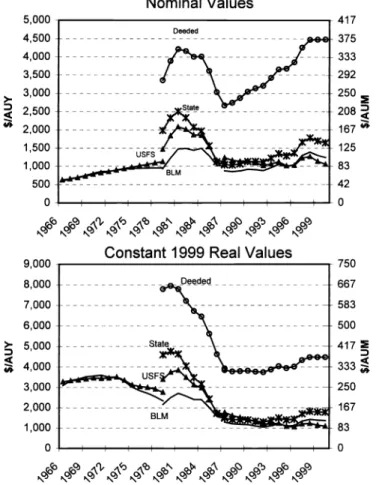
Using hedonic models developed for New Mexico, and survey data by Fowler and Gray (1980), the estimated nominal and real value of BLM, USFS, and New Mexico State Trust Land grazing permits in New Mexico from 1966 to 2000 are shown in Figure 1. The average value of deeded land is shown for comparison in those years when hedonic model estimates were available. Since about 1985, the average real market value (inflation adjusted) of USFS and BLM permits in New Mexico have remained relatively constant at about $100 AUM'.
Multiplying this value estimate by a 2.5 to 3.5% capitalization rate and adding the recent $1.35 AUM' federal grazing fee suggests a nearly constant annual grazing value in the last 15 years of between $4 and $5 AUM'. If 7% is considered to be the opportunity rate of return that ranchers forego by investing in grazing permits
JOURNAL OF RANGE MANAGEMENT 55(5) September 431
5,000
4-I
Deeded
4,500 4,500
4,000
---
;3,500
---
2,500 --
2,000 --
1,500 --
1,000 - - 500 ~
411 375 333 292 250 --- 208
---
167 125---42
83 09,000 8,000 7,000 6,000 5,000 4,000 3,000 2,000 1, 000 0
Constant 1999 Real Values
0
---State---
---
417Nominal Values
USE
BLM
250 167 83
0
USFS, BLM, and State permit value estimates are not continuous because estimates were from different studies (Fowler and Gray 1980, Torell and Kincaid 1996, and
Torell and Bailey 2000).
Fig. 1. Average nominal and real grazing permit values, and deeded land ranch values in New Mexico, 1966-1999 (From Torell et al. 2001).
(AAEA 1998), and used as the capitaliza- tion rate, the implied value of grazing is over $8 AUM'. As a regional comparison, recent estimates of average permit value in northern states, where seasonal grazing is common, have generally been between
$35 and $75 AUM' (USDA/USDI 1992, Stern 1998), implying a lower forage value.
If a system is devised to use periodic permit value estimates to imply forage value across broadly defined areas (similar to that used by Bartlett et al. 1993), index- ing could be used to provide annual updates until additional studies evaluate changes in permit value. Instead of the Forage Value Index (FVI), an index that tracks changes in asset values (e.g. land and buildings) over time could be devel- oped to provide annual updates.
Additional research would be needed to identify a preferred index and the compo- nents and weighting of the land value index. As demonstrated by the different trends in permit and deeded land values
shown in Figure 1, an index of private agricultural land values may not be ade- quate, since public land policy and uncer- tainty about the future of grazing on public lands are additional factors affecting the value of public land grazing permits.
There is no reason to believe the value of grazing permits will necessarily follow the trend of deeded land values, especially if grazing fees are significantly increased and grazing use continues to become more regulated and restrictive.
Production
Analysis andLinear
ProgrammingVarious production analyses and budget- ing techniques can be used to estimate the value of public land forage (Bartlett 1983).
These procedures are linked to profit maxi- mization, derived demand, and the value of forage for livestock production.
Using enterprise budgeting, the total gross value of ranch output is calculated and all costs except range forage are
c,- 333
deducted. The remaining value is the resid- ual return to the grazing resource. Dividing the residual return by the amount of forage yields the apparent per unit value of the unpriced forage input (Bartlett 1983).
Linear programming (LP) has been used to estimate forage value (Gee 1983, Kehmeier et al. 1987, Hahn et al. 1989) and to estimate economic impacts from changes in federal land policies (Peryman and Olson 1975, Bartlett et al. 1979, Torell et al. 1981, Gee 1981, Rowe and Bartlett 2001). The dual solution of an LP model provides an estimate of imputed prices for scarce resources, and this shad- ow price can be used as an indication of marginal value for rangeland forage and
other scarce resources. As noted by Brokken and McCarl (1987), a resource shadow price is conceptually similar to Value Marginal Product (VMP) and factor demand. It is different in a strict theoreti- cal sense because the optimal use of other inputs in the production process may change in the LP analysis, but are held constant when constructing VMP curves.
The shadow price is affected by product prices, marginal productivity of inputs, and the prices of all inputs.
As an application to forage valuation, Gee (1981) and Hahn et al. (1989) used LP and resource shadow prices to estimate forage value on USFS and BLM lands.
Shadow price estimates of forage value in 1981 were estimated to be $10.86 AUM' for BLM and $11.58 AUM' for USFS (Gee 1981). Hahn et al. (1989) updated Gee's work and reported shadow prices for each of 9 USFS regions and a national average. Values ranged from $9.22 AUM' in Region 3 (New Mexico and Arizona) to
$15.11 AUM' in Region 5 (California).
Problems have been noted in using shadow prices for resource valuation.
Most notably, different shadow prices can be obtained by including different formu- lations of the constraint set. What costs and where they are included in the objec- tive function also have an impact on shad- ow price levels. The shadow price esti- mates of value reported by Gee (1981) measured the return above cash costs per AUM. When depreciation costs and the value of family labor were considered, for- age value estimates decreased to $6.61
AUM' and $7.05 AUM' for BLM and USFS, respectively. Hahn et al. (1989) performed additional analyses in which fixed costs and opportunity costs were subtracted from the objective function to estimate long-run shadow prices. These
432 JOURNAL OF RANGE MANAGEMENT 55(5) September 2002