Proceedings of the 55th Annual Meeting of the Association for Computational Linguistics-System Demonstrations, pages 109–114 Vancouver, Canada, July 30 - August 4, 2017. c2017 Association for Computational Linguistics
Proceedings of the 55th Annual Meeting of the Association for Computational Linguistics-System Demonstrations, pages 109–114 Vancouver, Canada, July 30 - August 4, 2017. c2017 Association for Computational Linguistics
UCCAApp: Web-application for Syntactic and Semantic
Phrase-based Annotation
Omri Abend, Shai Yerushlami, Ari Rappoport
Department of Computer Science, The Hebrew University of Jerusalem
{oabend|shaiy|arir}@cs.huji.ac.il
Abstract
We present UCCAApp, an open-source, flexible web-application for syntactic and semantic phrase-based annotation in gen-eral, and for UCCA annotation in par-ticular. UCCAApp supports a variety of formal properties that have proven use-ful for syntactic and semantic representa-tion, such as discontiguous phrases, mul-tiple parents and empty elements, mak-ing it useful to a variety of other anno-tation schemes with similar formal prop-erties. UCCAApp’s user interface is in-tuitive and user friendly, so as to support annotation by users with no background in linguistics or formal representation. In-deed, a pilot version of the application has been successfully used in the compilation of the UCCA Wikipedia treebank by anno-tators with no previous linguistic training. The application and all accompanying re-sources are released as open source under the GNU public license, and are available online along with a live demo.1
1 Introduction
We present UCCAApp, a web-application for semantic and general phrase strucutre annotation, which has been developed for annotation using the UCCA scheme (Abend and Rappoport,2013), but can support the annotation of most phrase-structure annotation schemes, including support for discontiguous units, multiple categories for a phrase, and reentrancy (multiple parents for a phrase, resulting in DAG structures). Despite the
1https://github.com/omriabnd/UCCA-App
recent interest in web-based annotation applica-tions, very few open source applications support phrase-structure annotation (see Section5), a gap we address in this work.
UCCA (Universal Conceptual Cognitive Anno-tation) is a cross-linguistically applicable seman-tic representation scheme, building on the Basic Linguistic Theory typological framework (Dixon,
2010a,b, 2012), and Cognitive Linguistics litera-ture (Croft and Cruse,2004). It has demonstrated applicability to multiple languages, including En-glish, French, German and Czech, support for rapid annotation, accessibility to non-expert anno-tators and stability under translation (Sulem et al.,
2015). The scheme has recently proven useful for machine translation evaluation (Birch et al.,2016). UCCA emphasizes accessibility and intuitive distinctions in the definition of its categories. UC-CAApp complements this effort by offering an in-tuitive user interface (see Figure1and Section4), which does not require background in formal rep-resentation and linguistics, as attested by the steep learning curve of annotators with no background in these fields that used UCCAApp in the annota-tion of the UCCA Wikipedia corpus (Abend and Rappoport,2013).2
Aside from the annotation interface, the appli-cation includes modules for defining annotation schemes (layers), and for project management. Importantly, the system supports a multi-layered architecture, where the same text passage may be annotated by multiple layers. See Section3.
In order to facilitate the adoption of UCCAApp by other research groups, we built UCCAApp us-ing recent, standard web technology. The server is based on Django, accompanied with a
Post-2UCCA’s resources are freely available throughhttp: //www.cs.huji.ac.il/˜oabend/ucca.html.
greSQL database. The API follows the apigee
style guide,3and the client is based on AngularJS.
2 The UCCA Framework
UCCA graphs are edge-labeled, directed acyclic graphs (DAGs), whose leaves correspond to the tokens of the text. A node (orunit) corre-sponds to a terminal or to several sub-units (not necessarily contiguous) viewed as a single entity according to semantic or cognitive considerations. Edges bear a category, indicating the role of the sub-unit in the parent relation. Figure2 presents a few examples. One incoming edge for each non-root node is marked as primary, and the rest (mostly used for implicit relations and arguments) as remote edges, a distinction made by the an-notator (see Section 4). The primary edges thus form a tree structure, whereas the remote edges en-able reentrancy, forming a DAG. The primary tree structure can be equivalently viewed as a node-labeled tree, where each node is node-labeled with the category of the edge leading to its primary parent. We adopt this view in our user interface.
UCCA is a multi-layered framework, where each layer corresponds to a “module” of seman-tic distinctions. UCCA’sfoundational layer, with which existing UCCA corpora are annotated, cov-ers predicate-argument relations for predicates of all grammatical categories (verbal, nominal, ad-jectival and others), their inter-relations, and other major linguistic phenomena such as coordination and multi-word expressions. The layer’s basic no-tion is the scene, describing a movement, action or state. Each scene contains one main relation (marked as either a Process or a State), as well as one or more Participants. For example, the sentence “After graduation, John moved to Paris” (Figure 2a) contains two scenes, whose main re-lations are “graduation” and “moved”. “John” is a Participant in both scenes, while “Paris” only in the latter. Further categories account for inter-scene relations and the internal structure of com-plex arguments and relations .
3 System Architecture
The system is built as two completely sepa-rate modules: a RESTful web API for monitor-ing and manipulatmonitor-ing the system’s resources, and a client which interfaces with the system’s resources through http requests to the API. This modular ar-chitecture allows to create, read, update and delete
3https://apigee.com/
the system’s resources without using the client, which is useful for the integration of external re-sources, such as parsers and analysis tools.
The system’s resources can largely be cat-egorized into resources that define annotation schemes (layers and categories), and resources for managing the annotation projects and tasks. Defining Annotation Schemes.The atomic units of annotation schemes are thecategories. Alayer
is a set of categories, paired with a set of restric-tions over the joint occurrence of these categories (see Section 4). The grouping of categories into layers and the definition of restrictions are fully configurable either through chart-based admin in-terface or through the web API.
UCCAApp supports a multi-layered architec-ture, which is implemented using three types of inter-layer relations. The first is REFINEMENT,
where one layer defines sub-categories for the par-ent layer (e.g., a Participant category may be re-fined to Agent and Patient categories). The second is COARSENING, where one layer defines
super-categories for sub-sets of super-categories in the other layer (i.e., the inverse of REFINEMENT). The third
is EXTENSION, where two disjoint sets of
cate-gories, that may inform the annotation of one an-other, are annotated one on top of the other (e.g., information structural categories and phrase struc-ture annotation).
Passages and Users.UCCAApp includes stan-dard management tools for text passages and users. There are four types of roles in the sys-tem. ADMIN users are super-users who
adminis-trate the system, and have complete access to its resources. PROJECT MANAGERS oversee one or
more projects, and may create new layers and cate-gories, invite new users and assign annotators with tasks. ANNOTATORS carry out tasks assigned to
them, while GUESTS can view all the layers and
categories defined in the system, as well as try out the annotation interface, in order to get an impres-sion of the system’s capabilities.
Passages are the source texts that the annota-tion procedure targets. The system allows insert-ing passages either through a web interface, or by uploading a delimited text file.
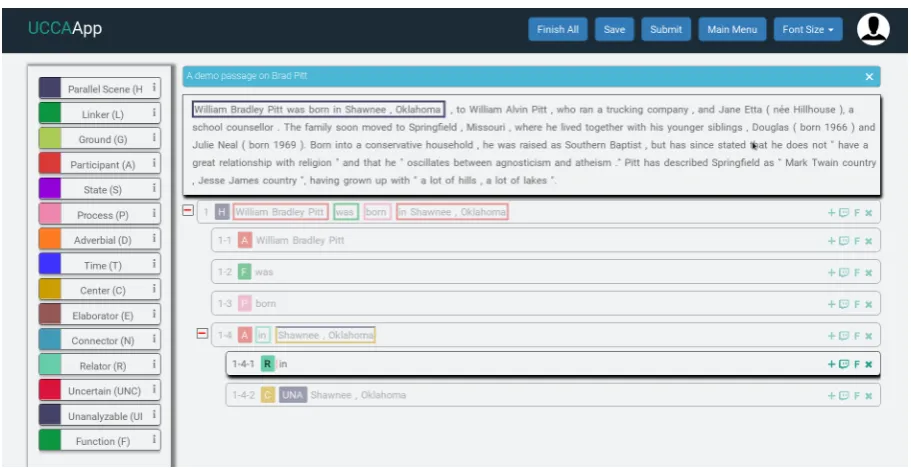
Figure 1: The layout of UCCAApp’s annotation interface. See Section4.
(a) After
L
graduation P
H , U
John A
moved P
to R
Paris C A H
A
(b) John
A
gave C
everything up C P
A PA participantprocess
H linked scene C center R relator N connector L scene linker U punctuation F function unit
Figure 2: UCCA structures demonstrating two structural properties exhibited by the scheme. (a) includes a remote edge (dashed), resulting in “John” having two parents. (b) includes a discontinuous unit (“gave ... up”). Pre-terminal nodes are omitted for brevity. Right: legend of edge labels.
allows annotators to do.
• Tokenization tasks, whose input is a passage of text and whose output is a sequence of to-kens. Tokenization tasks are carried out by hand-correcting the output of an automatic to-kenizer.
• Annotation task, whose input is a set of tokens, and whose output is a DAG structure, whose leaves are the tokens. The task proceeds by iter-atively grouping tokens into units.
• Review task, which is similar to an annotation task, but whose input is a full annotation of a given passage, and not only its set of tokens.
Annotation tasks in a project that uses a de-rived layer (i.e., a layer which is either a REFINE -MENT, an EXTENSION or a COARSENING of a
parent layer), start where a full annotation of a pas-sage using the parent layer is in place. Such tasks are thus created by selecting a completed task that uses the parent layer as a parent task.
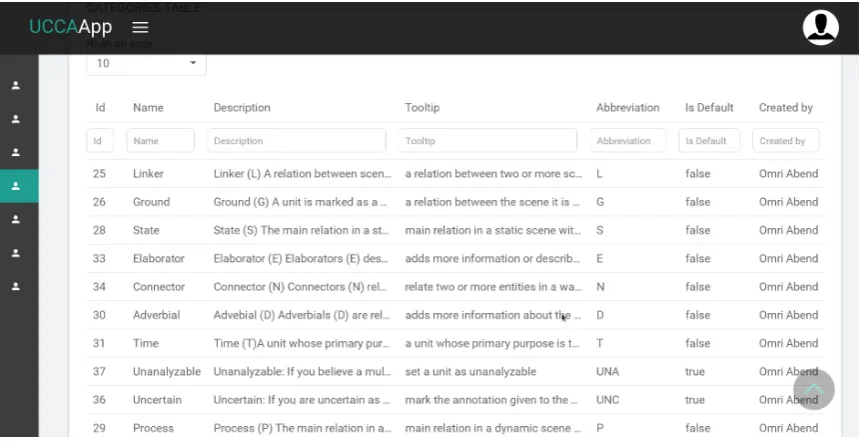
A complete documentation of the API is in-cluded in the project’s repository. Figure 3
presents a screenshot of the admin screens used for managing the different resources. The admin interface is designed to scale to tens of thousands of tasks and passages, and supports advanced pag-ination, search and filtering capabilities.
4 Annotation Interface
The system’s core is its annotation interface. Annotation is carried out over passages, rather than individual sentences. The application thus supports the annotation of inter-sentence relations, which feature in many annotation schemes, in-cluding the Penn Discourse Treebank (Miltsakaki et al.,2004), the Groningen Meaning Bank (Basile et al., 2012), and UCCA. UCCAApp fully sup-ports both mouse functionality, for novice anno-tators, and keyboard functionality, which we have found to be faster, and more suitable for experi-enced annotators.
Figure 3: An example admin screen, for accessing and manipulating the system’s resources.
menu; (2) a left sidebar that includes buttons for creating new categories, and assigning and remov-ing categories from existremov-ing units, and (3) the an-notation panel on which the anan-notation is carried out, and which takes up most of the screen.
Within the annotation panel, the passage box is presented at the top of the annotation panel, and corresponds to the root of the DAG. Upon the cre-ation of a unit, a unit box is created, indented be-low its parent. Each unit thus appears twice in the annotation panel: as a nested unit box, and as a bordered span in the unit box of its parent. The cursor is always found within one of the unit boxes, which is highlighted (henceforth, thefocus unit).
Creating and Deleting Units.Annotation is car-ried out by iteratively grouping tokens and units into larger units. Units are created by marking spans of text (not necessarily contiguous), declar-ing them as units, and assigndeclar-ing them any number of categories.
Preliminary user studies conducted with a pilot version of the application have shown that most annotators find it most intuitive and efficient to perform the annotation top-down, starting off by creating larger units (e.g., sentences), and itera-tively analyzing their sub-parts, until the resulting unit cannot be further decomposed.
We consequently designed the interface to op-timally support top-down annotation flow. Once an annotation unit has been created, the focus im-mediately shifts to the newly formed unit,
allow-ing the user to internally analyze it. Once the an-notation of a unit has been completed, the user may mark it as “finished”. The system then val-idates the annotation of the unit and its sub-tree (according to the layer’s restrictions), collapses its sub-unit tree and shifts the focus to the parent unit. Such a procedure minimizes the number of keystrokes required for a user who is annotating bottom-up. Still, the user is free to override this action order, and annotate the passage in any or-der she pleases.
Remote Sub-Units.In order to support the an-notation of remote sub-units, we note that most schemes that allow DAG structures, including UCCA, use multiple parents to express shared ar-gumenthood, namely a single argument participat-ing in multiple relations (see Figure2a). However, supporting such structures does not require gen-eral DAG annotation functionality, but only sup-port for drawing additional edges between units that otherwise form a tree. For instance, UCCA annotation does not require a functionality for forming partially overlapping sub-units, such as having bothw1, w2 andw2, w3 be sub-units of a
unit whose span isw1, w2, w3.
annotating “John” as a sub-unit of “John moved to Paris” and a remote sub-unit of “graduation”.4
Remote sub-units may not have any children and are displayed in a different color in the unit hierarchy. For example:
Implicit Sub-Units.Many annotation schemes encode units that do not correspond to any span of text. Examples include traces, such as in the Penn Treebank (Marcus et al.,1993), and implicit argu-ments (Gerber and Chai, 2010). UCCAApp sup-ports this functionality by allowing units to have remote sub-units that do not correspond to any span of text. Implicit sub-units may receive cat-egories just like any other unit.
Restrictions Module.UCCAApp supports the in-troduction of restrictions over the joint occurrence of different categories within a layer. Restrictions may either forbid a category from having any chil-dren, require that two categories appear together as siblings or children of one another, or forbid them from doing so. Restrictions are validated when a unit is declared finished, or when the passage is submitted. If the validation fails, an error message pops up, indicating what the user should fix. Multi-layered Annotation.In order to keep the user interface user friendly, annotation tasks that use derived layers, i.e., layers that were derived from another layer through extension, refinement or coarsening, are built upon a complete tation according to the parent layer. The anno-tation task in a derived layer thus only includes adding units and categories to an existing annota-tion, which in itself is not editable.
For instance, assume L is a refinement layer
of Lparent. Then an annotation task t by L
be-gins with the submitted annotation of a parent task
tparent, annotated withLparent. Completingt
re-quires traversing the units created in tparent, and
for each of the units that is annotated with a cat-egoryc ∈ Lparent, selecting which of the refined
categories inLapplies to it.
4There is some arbitrariness in selecting which unit “John” is a remote sub-unit of. Both assigning “John” to be a remote sub-unit of “graduation” and of “moved to Paris” are valid options, although annotators tend to prefer selecting contiguous units wherever possible.
5 Previous Work
While there are a number of open-source web-applications for corpus annotation, very few of them support phrase-based annotation in general, and the formal properties required by UCCA in particular. Annotald5 is a web application for
phrase structure annotation, originally developed for Icelandic. It is however difficult to use in a web-based setting, as it requires all annotators to be logged in to the same system, which of-ten leads to security issues. Folia FLAT6 is an
open-source web-application with support for dis-tributed collaborative annotation in a variety of annotation formats, including phrase-structure an-notation. However, as it is mostly geared to-wards flat annotations, phrase structure annotation with FLAT is somewhat difficult. SynTree7 also
supports phrase-structure annotation, focusing on Chinese. Its applicability, however, has so far been limited due to its documentation being formulated only in Chinese. To the best of our knowledge, none of these applications support DAG annota-tion, or full keyboard functionality.
The AMR editor8(Banarescu et al.,2013)
sup-ports annotation through an interface based on the linearization of the AMR DAGs using the PEN-MAN notation. The application has a number of dedicated functionalities both for facilitating the annotation process (e.g., nodes and edges can be added either by directly inputting their textual rep-resentations, or through more elaborate modals), and for validating that the resulting annotation is indeed well-formed. The editor is also well in-tegrated with the AMR category set, facilitating the navigation through its rich ontology. UC-CAApp supports many of the properties required for AMR annotation, including reentrancy, and of-fers a graphical user interface that does not require annotators to be versed in formal notation. While not all functionalities required for AMR annota-tion are currently supported in UCCAApp (im-portantly, the application does not support repre-sentations that are not anchored in the words and phrases of the text), future work will address the adaptation of UCCAApp to AMR annotation.
A number of recent annotation web applications support dependency annotation, and provide
fective tools for collaborative annotation by ge-ographically dispersed parties. The brat appli-cation (Stenetorp et al., 2012) is a popular web-based annotation tool that supports a wide variety of annotation types, including dependency analy-sis, chunking and named entity recognition. How-ever, annotation in brat is carried out through di-alogue boxes, which slows down the annotation process. WebAnno (Eckart de Castilho et al.,
2016) is a generic and flexible annotation tool for collaborative annotation, which supports the joint annotation of semantic and syntactic dependen-cies. One of its major design principles is multi-layered analysis and the effective browsing of rich category sets, which it supports using a sugges-tion engine, and both manually-configurable and automatically-induced constraints on the joint ap-pearance of categories. It also improves upon brat’s (and earlier versions of WebAnno) user in-terface, allowing improved keyboard functionali-ties and visualization. Arborator (Gerdes, 2013) is a lightweight, web-based annotation application which focuses on dependency structures. The tool is easily configurable, and has a mouse-based in-terface for creating annotations. None of these recently proposed tools support phrase-structure grammar annotation.
6 Conclusion
We presented UCCAApp, an open-source web application for phrase-based and UCCA annota-tion, with an intuitive and accessible design. An earlier version of UCCAApp was developed as part of the compilation of the English UCCA cor-pus, and was successfully employed by annotators with no background in linguistics or formal repre-sentation.
UCCAApp supports annotation with a vari-ety of formal properties, including discontiguous units, inter-sentence annotation, reentrancy and multi-layered annotation, making it suitable for other syntactic and semantic annotation schemes that use these properties. Future extensions of UC-CAApp will include further analysis capabilities, such as inter-annotator agreement tools, as well as support for AMR annotation.
Given the scarcity of freely available annota-tion web applicaannota-tions for phrase structures, UC-CAApp’s modular and extensible design, and its intuitive user interface, we believe UCCAApp will make a substantial contribution to the field of lin-guistic annotation.
References
Omri Abend and Ari Rappoport. 2013. Universal Con-ceptual Cognitive Annotation (UCCA). InProc. of ACL. pages 228–238.
Laura Banarescu, Claire Bonial, Shu Cai, Madalina Georgescu, Kira Griffitt, Ulf Hermjakob, Kevin Knight, Philipp Koehn, Martha Palmer, and Nathan Schneider. 2013. Abstract meaning representation for sembanking. InProc. of LAW. pages 178–186. Valerio Basile, Johan Bos, Kilian Evang, and Noortje
Venhuizen. 2012. Developing a large semantically annotated corpus. In Proc. of LREC. pages 3196– 3200.
Alexandra Birch, Omri Abend, Ondˇrej Bojar, and Barry Haddow. 2016. HUME: Human UCCA-based evaluation of machine translation. In Proc. of EMNLP. pages 1264–1274.
William Croft and Alan Cruse. 2004. Cognitive lin-guistics. Cambridge University Press.
R.M.W. Dixon. 2010a. Basic Linguistic Theory: Grammatical Topics, Vol. 2. Oxford University Press.
R.M.W. Dixon. 2010b. Basic Linguistic Theory: Methodology, Vol. 1. Oxford University Press. R.M.W. Dixon. 2012. Basic Linguistic Theory:
Fur-ther Grammatical Topics, Vol. 3. Oxford University Press.
Richard Eckart de Castilho, Eva Mujdricza-Maydt, Seid Muhie Yimam, Hartmann Silvana, Iryna Gurevych, Annette Frank, and Chris Biemann. 2016. A web-based tool for the integrated annotation of semantic and syntactic structures. In Proc. of the LT4DH workshop. pages 76–84.
Matthew Gerber and Joyce Chai. 2010. Beyond Nom-Bank: A study of implicit arguments for nominal predicates. InProc. of ACL. pages 1583–1592. Kim Gerdes. 2013. Collaborative dependency
annota-tion. InProc. of DepLing. pages 88–97.
Mitch Marcus, Beatrice Santorini, and Mary Ann Marcinkiewicz. 1993. Building a large annotated corpus of English: The Penn Treebank. Computa-tional Linguistics19:313–330.
Eleni Miltsakaki, Rashmi Prasad, Aravind Joshi, and Bonnie Webber. 2004. The penn discourse treebank. InLREC. pages 2237–2240.
Pontus Stenetorp, Sampo Pyysalo, Goran Topi´c, Tomoko Ohta, Sophia Ananiadou, and Jun’ichi Tsu-jii. 2012. Brat: a web-based tool for nlp-assisted text annotation. InProc. of EACL. pages 102–107. Elior Sulem, Omri Abend, and Ari Rappoport. 2015.