.I. Range Manage.
50:47stal
Viewpoint:
Implications of participatory democracy for public land planning
MARGARET A. MOOTE AND MITCHEL P. MCCLARAN
Authors are research specialist, Water Resources Research Center, University of Arizona, Tucson, Ark 85721; and associate professor of Range Management, University of Arizona. Tucson, Ark 85721. Please send correspondence to Mitchel P. McClaran at the University of Arizona, 325 Bio Science East, Tucson. Ariz. 85721.
Abstract
Non-traditional, collaborative public participation approaches such as coordinated resource management have been proposed to improve the public participation process used in public land planning on rangelands. Either implicitly or explicitly, most advocates of such non-traditional approaches to public participa- tion seem to embrace a participatory democracy model of gover- nance. Whether or not thii model for decision-making can prac- ticably be implemented, given our current institutional and legal frameworks for public lands management, has not been closely examined. Criticisms of the traditional public participation process are categorized into 5 main issues: efficacy; representa- tion and access; information exchange and learning; continuity of participation; and decision-making authority. We use these categories to evaluate the feasibility of implementing participato- ry democracy-based decision-making in public lands planning.
Although there is some statutory and regulatory authority for participatory democracy in public land planning, there are a number of logistical, legal, and even philosophical challenges to its application that warrant further consideration.
legal authority underlying collaborative processes should be examined carefully. For example, what changes to the traditional public participation process are required, what logistical prob- lems will be encountered, and what legal authority is available for a collaborative planning process? To shed some light on these questions, we review the evolution of public land planning and the traditional approach to public participation. We then present criticisms of the traditional approach, organized into 5 issues:
efficacy; representation and access; information exchange and learning; continuity of participation; and decision-making author- ity. Either implicity or explicitly, many of these criticisms and recommendations for change are based in participatory democra- cy theory. We use these categories as the framework to examine participatory democracy approaches to public participation, par- ticularly their authority in statute and regulation and their logisti- cal demands. We intend for this analysis to illustrate some of the ramifications of decisions based in participatory democracy theo- ry and instigate further discussion and debate over the applicabili- ty and appropriateness of participatory democracy in public land planning.
Key Words: accountability, collaborative planning, coordinated resource management, decision-making, public participation, representation
Non-traditional, collaborative public participation processes such as coordinated resource management have been proposed to improve the public participation process in public land planning on rangelands (Cleary and Phillippi 1993, Floyd 1988, Krueger 1992, Swanson 1994, Tore11 1993). Coordinated resource man- agement, for example, utilizes teams of agency representatives, landowners, interest group representatives, and members of the general public to collectively determine acceptable management practices (Memorandum of Understanding 1987). Although these collaborative approaches have, for the most part, been favorably received and their application advocated (Anderson and Baum 1987, Swanson 1994), some have encountered legal and philo- sophical barriers (Southern Utah Wilderness Alliance 1994, Amy 1990, Meidinger 1997). We suggest that the political theory and
Manuscript accepted 12 Nav. 1996.
JOURNAL OF RANGE MANAGEMENT 50(5), September 1997
Administrative Authority for Public Participation in Public Land Planning
Beginning with the Administrative Procedure Act of 1946 (APA), Congress has placed increasingly demanding statutory requirements for public participation in federal agency decision- making. By enacting APA, Congress essentially limited federal agency discretion by providing for specific procedures for public input to and oversight of administrative decision-making process- es. Yet APA limited the public role in administrative decision- making to an adversarial one: the primary opportunities provided for public input were the appeals and adjudication processes (Bryner 1987).
Increased public participation in governance was stimulated in the 1960s by a general dissatisfaction with the expansion and centralization of government and widespread mistrust of the sci- entific bases of administrative decisions (Achterman and Fairfax 1979, Reich 1985, Wengert 1976). Amendments made to APA in the 1960s and early 1970s reflect these sentiments: Congress passed the Government in the Sunshine Act, the Freedom of
473
Information Act, and the Federal Advisory Committee Act to makes its final decisions, and publishes the final plan. Once the encourage open public meetings with balanced public representa- final plan has been published, citizens can influence it only tion and public disclosure of federal agency records. through formal appeals and adjudication.
In the 1970s new approaches to agency planning and adminis- tration shifted participation methods away from adversarial processes and toward involvement in agency planning (Daneke
1983). The National Environmental Policy Act of 1969 @EPA), National Forest Management Act of 1976 (NFMA), and Federal Land Planning and Management Act of 1976 (FLPMA) provided for public participation at specific points in the administrative planning process. This moved public participation in public land planning beyond access to appeals and litigation to a more proac- tive involvement in agency planning and decision-making.
Beyond the specific requirements for hearings and document review periods, however, these statutes permit considerable dis- cretion in the approach to public participation agencies choose to adopt (Achterman and Fairfax 1979, Daneke 1983).
Agencies are free to utilize other forums of public participation, such as field trips, workshops, and advisory councils. In practice, however, the public participation methods utilized by the public land management agencies are typically limited to the public hearings and formal comment periods required in the regulations (Blahna and Yonts-Shepard 1989, Feller 1991, Wondolleck 1985, 1988).
Criticisms of the Traditional Process and Participatory Democracy Alternatives
Criticisms of the traditional public participation process in fed- eral land planning center on the observation that agencies have chosen to stress rational planning and technical discretion over more open and sustained public participation. Most critics of the traditional public participation process believe “the criteria for evaluating policy in a democratic process are the accessibility to the process and/or the responsiveness of the policy to those who are affected by it, rather than efficiency or rationality of the deci- sion” (Kweit and Kweit 1987).
These critics generally espouse alternatives based in participa- tory democracy, a political theory in the republican tradition ini- tially advocated by Rousseau (1987) which has regained promi- nence in recent years. The central premise of participatory democracy is that active participation by all citizens is required to foster the collective governance required for democracy (Bachrach and Botwinick 1992, Held 1987, Pateman 1970).
Hierarchical forms of government are rejected because they impede public discourse (Meidinger 1997, Tipple and Wellman 1989). This is in contrast with representative democracy, the pre- dominant democratic theory in the 20th century, which is exem- plified in the “one person, one vote” electoral process (Bachrach and Botwinick 1992, Pateman 1970, Stanley 1990).
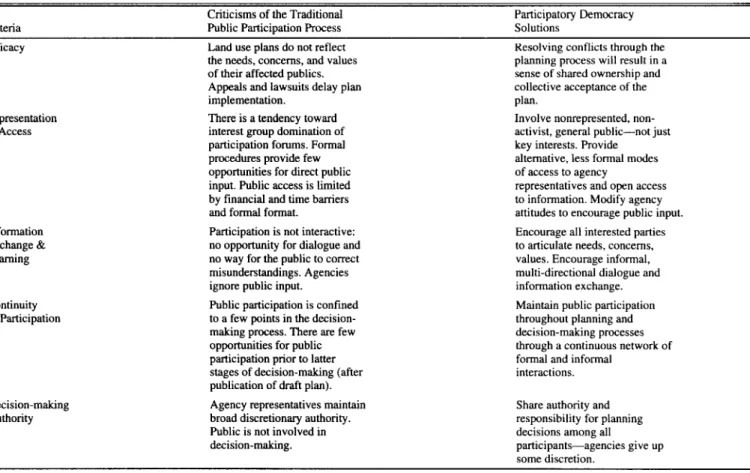
We organize criticisms of the traditional public participation process into 5 issues, and present the participatory democracy response to each. The first issue-efficacy-relates to the desired results of public participation. The other 4-representation and access, information exchange and learning, continuity of partici- pation, and decision-making authority-relate to the means of achieving those results (Table 1).
The Traditional Public Participation Process
Public administration in the 20th century has been character- ized by its adherence to the rational model of bureaucratic plan- ning and decision-making, in which efficiency, not representa- tion, is the goal (Kweit and Kweit 1980, Reich 1990a,1990b, Shannon 1990a, 1992a, Wondolleck 1987). In the rational model, planning and decision-making are the exclusive domain of tech- nical experts, who develop decision-making criteria and consis- tently apply them to a range of alternatives in order to select the best decision (Cubbage et al. 1993). Agency adherence to this planning model is evident in the Bureau of Land Management (BLM) regulations, which state that:
The objective of resource management planning by the Bureau of Land Management is to maximize resource values for the public through a rational, consistently applied set of regulations and proce- dures which promote the concept of multiple use management and ensure participation by the public, state, and local governments, Indian tribes, and appropriate federal agencies (43 C.F.R. 1601.0-2 (1994)).
However, also evident in this statement of objectives is a tension between the rational expectation of technical competency and efficiency and more recent demands for broadened public partici- pation in the land management planning process (Fortenbery and Harris 1983). The federal land management agencies have responded to this tension by adapting the broad congressional directives for public participation to lit specific steps in the ratio- nal planning models developed in the 197Os, resulting in what we term the “traditional” public participation process.
The traditional public participation process is outlined in the implementing regulations for NEPA, FLPMA, and NFMA (40 C.F.R. 1500 (1994); 43 C.F.R. 1600 (1994); 36 C.F.R. 219 (1994)). Public participation is initiated at the start of the plan- ning process, during scoping, when the public is contacted through mailings and/or public hearings to help identify issues of concern. After scoping, public participation is virtually nonexis- tent during plan development, which includes selection of plan- ning criteria, baseline environmental studies, development of alternatives, and selection of a preferred alternative. After publi- cation of the draft plan, public input is again solicited during the formal 90-day comment period, when the draft plan is displayed in public places and mailed to all who request it. Typically, pub- lic hearings are also held on the draft plan. After the 90-day pub- lic comment period, the agency considers the comments received,
Effkacy
The efficacy of a public land management planning process is reflected in public acceptance of the resultant plan. Critics of the traditional public participation process in public land planning and decision-making point to the public’s extensive use of appeals and lawsuits as evidence that the rational planning approach fails to produce decisions that address the concerns of all affected interests (Wondolleck 1985). In a study of the Forest Service (FS) planning and decision-making process, for instance, Wondolleck (1985) found that “when the process used was one relying on professional expertise to assess values and make the inevitable judgmental tradeoffs, the outcome was mistrust and dissatisfaction on the part of affected interest groups, leading to administrative appeals and lawsuits.” The vast number of appeals and lawsuits has delayed plan implementation to the extent that
Criteria Efficacy
Representation
& Access
Information Exchange &
Learning
Continuity of Participation
Table 1. Criticisms of the Traditional Public Participation Process and Participatory Democracy Solutions
Criticisms of tbe Traditional Public Participation Process Laud use plans do not reflect
the needs, concerns, and values
of their affected publics.
Appeals and lawsuits delay plan implementation.
There is a tendency toward
interest group domination of participation forums. Formal procedures provide few opportunities for direct public input. Public access is limited by financial and time barriers and format format.
Participation is not interactive:
no opportunity for dialogue and no way for tbe public to correct misunderstandings. Agencies ignore public input.
Public participation is confined to a few points in tbe decision- making process. There are. few opportunities for public participation prior to latter stages of decision-making (after publication of draft plan).
Participatory Democracy Solutions
Resolving conflicts through the
planning process will result in a sense of shared ownership and collective acceptance of the plan.
Involve nonrepresented, non- activist, general public-not just key interests. Provide
alternative, less formal modes of access to agency
representatives and open access to information. Modify agency attitudes to encourage public input.
Encourage all interested parties to articulate needs, concerns, values. Encourage informal, multi-directional dialogue and information exchange.
Maintain public participation
throughout planning and
decision-making processes through a continuous network of formal and informal
interactions.
Decision-making Authority
Agency representatives maintain broad discretionary authority.
Public is not involved in decision-making.
Share authority and responsibility for planning decisions among all
participants-agencies give up some discretion.
the efficacy of the entire planning process has heen questioned (Behan 1990).
A participatory democracy approach, on the other hand, involves all citizens in a process of social discourse over the plan- ning issues, not just experts and representatives of key interests (Kemmis 1990, Shannon 1992a). These characteristics of partici- patory democracy are said to improve plan implementation by resolving conflicts during the planning process, rather than delay-
ing implementation of completed plans while decisions are reviewed through appeals and adjudication (Blackburn 1988, Pateman 1970, Susskind and Cruikshank 1987).
Representation and Access
A primary goal of public participation in public land planning is to ensure that plans accurately reflect the knowledge and con- cerns of the public. In other words, public participation should elicit participation from as representative a sample of the citizen- ry as possible (Shannon 1992b). Furthermore, citizens want access to the decision-making process to ensure that their inter- ests are represented, whether or not government actions are con- sidered to be ‘in the public good’ (Amstein 1969, Achtennan and Fairfax 1979, ACIR 1979).
Critics of the traditional public participation process contend, however, that agency procedures tend to limit participation by the general public. Facaros (1989) criticized the Forest Service (FS) for focusing its public involvement process on disseminating information to “target groups,” essentially eliminating others
from participation. By purposely including organized interest groups, an agency may inadvertently exclude other interests (Shannon 1990b). Yet 1 comparative survey found the general public to be more moderate than either a natural resource agency or interest groups (Knopp and Caldbeck 1990). In another survey, Lyden et al. (1990) found that participants in FS planning who did not identify with specific interest groups had more moderate views and a more realistic impression of agency biases than those who did.
One reason why the traditional public participation process is perceived as unrepresentative is lack of public access to agency decision-making. The formal public participation procedures uti- lized by the FS and Bureau of Land Management (BLM) have been criticized repeatedly for limiting public access to agency planning processes. Formal statements at public hearings and written comments on draft plans, 2 established methods of elicit- ing public comment, exclude people uncomfortable about public speaking or formal letter-writing. The financial and time require- ments of public participation are frequently cited as barriers, as well. Interest groups and individual citizens are at a disadvantage if they must take time off from work and pay for their own trans- portation to meetings and hearings, while agency and industry employees are often compensated, as participation in these forums is considered part of their jobs (Carpenter and Kennedy
1988).
A primary tenet of participatory democracy is broad involve- ment by the general, non-activist public in public participation procedures. Blahna and Yonts-Shepard (1989) stress that “‘repre-
JOURNAL OF RANGE MANAGEMENT 50(5), September 1997 475
sentative’ public involvement means ‘working closely with lead- ers of key interests’, while ‘participatory’ public involvement requires the involvement of nonrepresented members of the pub- lic.” Furthermore, participatory democracy theory explains that what appears to be public apathy toward administrative gover- nance is actually citizens’ rational evaluation of the costs and ben- efits of participating in traditional planning processes (Kathlene and Martin 1991, Pateman 1970). Specifically, the citizens find attempts at meaningful participation in public land planning to be hampered by the class bias and technical bias typical of agency officials, and the traditional public hearings dominated by unrep- resentative interest groups (Kathlene and Martin 1991).
Therefore, they advocate both alternative forums for public access and a revision of professional attitudes to encourage public access. The primary role of the administrator under participatory democracy is to facilitate learning and public deliberation (Shannon 1990b, 1992a, Reich 1990).
Information Exchange and Learning
Information exchange and learning are critical to informed pub- lic land planning. This aspect of public participation is important both to inform the public regarding the agency’s planning process, and to inform the agency regarding the public’s needs, concerns, and knowledge.
Yet a number of studies of the Forest Service (FS) planning process have found that the most frequently used public participa- tion techniques are ‘one-way’ communications, such as formal statements at hearings and written correspondence (Blahna and Yonts-Shepard 1989, Cheng et al. 1993, Wondolleck 1985, 1988). Such techniques preclude dialogue and support the impression that administrators consider learning to be something that the public needs, and that the agency has to offer.
Wondolleck (1985) found “there is seldom opportunity for affect- ed groups and individuals . . to clarify or expand their concerns, or to correct inappropriate responses to the issues they raised.”
Other studies corroborate this finding, and indicate that citizens who do become involved in administrative planning are frequent- ly frustrated by the lack of evidence that their opinions have been heard (Lyden et al. 1990, Shannon 1990b, Blahna and Yonts- Shepard 1989). One study found that “both Utilization-oriented and Preservation-oriented respondents failed to understand the positions taken by the [agency] on many of the policy issues.
This may explain why the public respondents were dissatisfied with their participation” (Lyden et al. 1990).
From a participatory democracy perspective, “full and free interchange between the people and their elected representatives, as well as between the people and appointed administrators, clearly is essential to responsible and well informed public deci- sion-making and to responsive government” (ACIR 1979).
Active dialogue that encourages the needs and concerns of each interested group and individual, including the agency, to be artic- ulated and addressed in the planning process allows the various participants to gain an understanding of each other’s values, inter- ests, and concerns, as well as legal constraints on agency deci- sion-making (Wondolleck 1985, 1988). In addition to improving the information base upon which decisions are made, such infor- mation exchange is said to aid participants in the revision and refinement of their values and interests (Bachrach and Botwinick
1992, Reich 1985).
Continuity of Participation
Planning involves constant re-evalution and analysis as new information becomes available. During this process, alternatives may be added or eliminated, and tradeoffs are made. Therefore, continuity of public participation during the planning process is considered critical to ensure that the decisions made are represen- tative of and acceptable to the public.
In the traditional public participation process, however, public participation often occurs exclusively at scoping meetings and during review periods for draft planning documents. Studies of the Forest Service (FS) planning process have found that public
involvement in the identification of issues, development of alter- natives, and evaluation of alternatives is extremely limited (Shannon 1990b, Blahna and Yonts-Shepard 1989). Furthermore, implementation, monitoring, and evaluation of plans are not included in the formal public participation process (Facaros 1989).
In practice, therefore, public participation is generally limited to a few points in the planning and decision-making processes.
Under a participatory democracy model, however, public par- ticipation is “not a one-shot affair but a continuing network of interaction with others” (Bachrach and Botwinick 1992).
Continuous feedback from participants ensures that their evolving interests are adequately reflected in policy decisions (Bachrach and Botwinick 1992, Pateman 1970). To ensure that the evolving needs and concerns of the public are addressed in the planning process, participation should therefore be initiated at the begin- ning of the process and maintained throughout, including during the development of and selection among alternatives and during plan implementation, and “especially when key decisions are being made” (Blahna and Yonts-Shepard 1989). Thus, “public involvement becomes a continuous process, no longer a series of discrete events” (Behan 1988).
Decision-making Authority
Public access to decision-making is a basic goal of public par- ticipation, intended to ensure that the public interest is being met.
The traditional public participation process, however, keeps pub- lic input well removed from administrative decision-making, thereby protecting the agencies’ administrative discretion. This is in keeping with the rational, progressive ideal of neutral public administration and positive science (Reich 1985). In this ideal,
“public policies are generally perceived as being best pursued through broad discretionary authority to implement policies in the most efficient and effective manner possible,” particularly where the decisions to be made involve technical or scientific analyses (Bryner 1987). This is one reason why public participation is gen- erally not found in some of the most discretionary steps in the planning process, such as criteria selection, development of and selection among alternatives, and plan evaluation. Yet critics of traditional public administration contend that public policy deci- sions are ultimately social value choices, which the government cannot effectively make without significant public participation (Paelke 1987, Shannon 1992b, Wondolleck 1987).
Critics of the traditional approach maintain that the public should actually participate in the making of the final decision, not just be given the opportunity to comment on proposed decisions (Amstein 1969, Kweit and Kweit 1987, Selin and Chavez 1995, Shannon 1990a). A participatory democracy approach therefore requires that administrators give up some discretion, and agree to share decision-making authority with other participants (Hoover and Shannon 1995, Kweit and Kweit 1987).
Administrative Authority for Participatory Democracy
A comparison between the tenets of participatory democracy theory and administrative law indicates that while the law may support some aspects of participatory democracy, it limits others (Table 2). The Administrative Procedures Act (APA) and its amendments both support and hinder participatory democracy in public land planning. The legal directives for public participation found in NEPA, FLPMA, NFMA, and the FS, BLM, and Council on Environmental Quality (CEQ) implementing regulations gen- erally support the participatory democracy approach to represen- tation and access and continuity of participation. Legislative sup- port for open information exchange and learning and shared deci- sion-making authority is less clear. There is no legal directive explicitly relating to efficacy, the desired product of public par- ticipation.
Table 2. Administrative Authority for Application of the Participatory Democracy Model
Criteria Administrative Authority
Efficacy Representation
& Access
None.
“Tbe public” includes all affected or interested individ- uals, organizations, business entities, and other special interest groups as well as government officials.
Provide for public input to rule making,and make agency decisions and policy statements available for public inspection. Provide the public with opportunity to meaningfully participate in planning and comment on draft plans. Provide public access to the agency decision-making processes.
Information Exchange &
Learning
Broaden the information base for planning. Ensure that the agency understands the needs, concerns, and values of the public. Ensure thal the public is informed of and understands proposed and final agency plans. Provide for public participation in formulation of standards and criteria for plans. Make planning information available to the public. Consider and respond to public com- ments. Make sure all meetings comply with the open meeting and public disclosure requirements of the Federal Advisory Committee Act.
Continuity of Participation
Decision-making Authority
Encourage public participation throughout the plan- ning process and in plan implementation.
Agency officer is responsible for approving the plan.
Each citizen has a responsibility to contribute to the preservation and enhancement of the environment.
Representation and Access
Neither the CEQ’s NEPA implementing regulations nor the FS regulations define the public(s) that are to be involved in plan- ning, although the CEQ regulations do state that
as part of the scoping process the lead agency shall invite the partici- pation of affected Federal, State, and local agencies, any affected tribe, the proponent of the action, and other interested persons (including those who might not be in accord with the action on envi- ronmental grounds) (40 C.F.R. 1501.7(a)(l) (1994)).
The BLM regulations, on the other hand, define the public quite broadly as
affected or interested individuals, including consumer organizations, public land resource users, corporations, and other business entities, environmental organizations and other special interest groups and
officials of State, local, and Indian tribal governments (43 C.F.R.
1601.5(h) (1994)).
Thus, no regulatory guidance discourages broad representation, and the CEQ and BLM regulations would seem to support it.
The APA provides basic public access to agency decision-mak- ing by giving all citizens the “opportunity to participate in . . . rule making through submission of written data, views, or argu- ments” (5 U.S.C. 553(c) (1994)), and requiring that all agency opinions, policy statements, and manuals be available for public inspection (5 U.S.C. 552 (1994)). FLMPA, NFMA, and their implementing regulations further direct that for the public land management agencies, access is to be provided to a broad range of planning and management activities. In perhaps the strongest statutory directive on public access to agency decision-making, FLPMA requires the BLM “to give . . the public adequate notice and opportunity” to participate in a broad range of planning, deci- sion-making, and management activities (43 U.S.C. 1739(e)) (1994)). The BLM’s FLPMA implementing regulations reiterate,
“The public shall be provided opportunities to meaningfully par- ticipate in and comment on the preparation of plans, amendments, and related guidance and be given early notice of planning activi- ties” (43 C.F.R. 1612.2(a) (1994)). Similarly, the NFMA directs the FS to “provide opportunity for public involvement” in devel- oping forest plans (16 U.S.C. 1601 (c) (1994)), and the FS regula- tions specify that “early and frequent public participation” is 1 of 14 “principles” upon which “forest planning will be based” (36 C.F.R. 219.6(a) (1994)). Under the NEPA implementing regula- tions, “all federal agencies shall to the fullest extent possible encourage and facilitate public involvement”; they are to do this by providing access to their environmental decision-making processes (40 C.F.R. 1500.2(d) (1994)).
Information Exchange and Learning
The public land management agencies are directed by law to include the public in the planning process in a substantive man- ner. The FS regulations state that
the intent of public participation is t-broaden the information base upon which land and resource management planning decisions are made; ensure that the Forest Service understands the needs, con- cerns, and values of the public; inform the public of Forest Service land and resource planning activities; and provide the public with an understanding of Forest Service programs and proposed actions (36 C.F.R. 219.6(a) (1994)).
The BLM is directed to involve the public in “the formulation of standards and criteria for . . the preparation and execution of plans and programs for . . the public lands” (43 U.S.C. 1739(e) (1994)). In addition, BLM’s advisory councils are to “furnish advice to the [agency] with respect to the land use planning, clas- sification, retention, management, and disposal of the public lands” (43 U.S.C. 1739(a),(d) (1994)). NEPA is less explicit with regard to information exchange, but it does require agencies to
“make available to States, counties, municipalities, institutions, and individuals, advice and information useful in restoring, main- taining, and enhancing the quality of the environment” (42 U.S.C.
4332(2)(G) (1994)), implying that these parties, and not just the agencies, require such information for environmental planning.
Similarly, the NEPA implementing regulations require that agen- cies make environmental information available to the public before decisions are made (40 C.F.R. 1500. I(b) (1994)) and con-
JOURNAL OF RANGE MANAGEMENT 50(5), September 1997 477
sider and respond to all comments received from the public (40 C.F.R. 1503.4(a) (1994)).
On the other hand, recent interpretations of the Federal Advisory Committee Act (FACA) (5 USC. App. p. 1371-1380 (1994), a 1972 amendment to the APA, have caused federal agen- cies to withdraw from participatory planning efforts out of fear that they will be sued for being involved in or taking advice from a group that does not meet the strictures of APA (Northwest Forest Resource Council v. Espy, 846 F.Supp. 1009, 1994, Meidinger 1997). FACA has been interpreted to require that all planning and decision-making groups in which federal agencies take part follow the open meeting and public disclosure require- ments of advisory committees under the act. Among other things, FACA requires that federal advisory committees be chartered, publish meeting times in the Federal Register, keep detailed min- utes of each meeting, and be fairly balanced in the viewpoints of their members. Similarly, federal antitrust laws discourage partic- ipation by some private entities in cooperative planning and con- flict resolution groups, since cooperation could be. considered col- lusion under the law (22 USC. l-7 (1994)). In other words, the law gives mixed messages regarding the extent to which the pub- lic may advise agency planning and decision-making.
Continuity of Participation
According to the FS regulations, “the public is encouraged to participate throughout the planning process” (36 C.F.R. 219.6(a) (1994)). An argument can be made that the directive in FLMPA
“to give . . . the public adequate notice and opportunity . . . to par- ticipate in the preparation and execution of plans and programs for, and the management of, the public lands” (43 U.S.C. 1739(e) (1994)) similarly requires continuity of participation throughout planning. In fact, Achterman and Fairfax (1979) make just such a claim when relating the legislative history of FLPMA:
the Department of the Interior objected to the reference to public participation in the management of public lands, contending that actual management should be left up to the BLM. Nevertheless, the reference to participation in public land management was retained.
The rejection of the Department’s views suggests that Congress had a radical objective; it wanted procedures to be established that would involve the public actively in formulating plans and implementing them through on-going management decisions.
The APA, NEPA, and the CEQ’s NEPA implementing regula- tions do not call for continuous participation in agency planning.
Decision-making Authority
Nothing in the APA, NFMA, or FLPMA implies that the public or interest groups should share decision-making authority with a public land management agency. Furthermore, the FS regulations make it clear that the agency retains decision-making authority when they state that “the interdisciplinary team shall identify and evaluate public issues” and “the Forest Supervisor shall deter- mine the major public issues . . . to be addressed in the planning process” (43 C.F.R. 219.12(b)(1994)). Similarly, the federal courts have generally interpreted NEPA and the CEQ regulations as simply requiring agencies “to consider every significant aspect of the environmental impact of a proposed action [and to] inform the public that it has indeed considered environmental concerns in its decision-making process” (Baltimore Gas & Electric v.
Natural Resources Defense Council, Inc., 462 U.S. 87, 97-98, 1983).
Some reviewers, however, claim that NEPA, which states that
“each person has a responsibility to contribute to the preservation and enhancement of the environment” (42 U.S.C. 4331(c) (1992)), indicates a substantive requirement for shared public ownership in agency decision-making (Facaros 1989, Shannon 1990b). Facaros (1989) states,
The CEQ policy does not call on agencies to maximize information sharing; it requires agencies to maximize public involvement in their decisions. The difference is not subtle, for if involvement means par- ticipation, members of the public, along with [agency] officials, are to wear the mantle of decision-maker.
Applying Participatory Democracy in Public Land PlaMing
The participatory democracy approach to public participation in public land planning has been applied, to some extent, in coordi- nated resource management processes and consensus groups.
While these attempts have been lauded for successfully resolving conflicts and improving planning (Sample et al. 1995, Cleary 1984, Anderson and Baum 1987), they also have illustrated some of the potential pitfalls to applying participatory democracy theory to public land planning (Moote 1995). These pitfalls are presented in relation to the 5 issue categories outlined above (Table 3).
Table 3. Barriers to the Application of the Participatory Democracy Model
Criteria Barriers
Efficacy
Representation
& Access
Information Exchange &
Learning
Continuity of
Participation
Greater public involvement in land use planning and decision&king processes does not necessarily result in a plan or decision that all will accept and support.
Some affected interests may choose not to participate.
Lack of time and financial resources restrict access, especially for non-affiliated citizens.
If differences are rooted in fundamental conflicts of interest or values, improved communication will not help resolve them. Fear of FACA lawsuits causes agencies to avoid collaborative planning processes.
Transfer of agency personnel reduces continuity and time requirements engender participant burn- out. Agency mandates, including schedules and budget targets may require them to make a decision before the public participants arc ready to do so.
Decision-making Authority
Law does not provide for shared decision-making authority. No way to determine who is ultimately accountable for a collective decision.
Efficacy
Participatory approaches to public participation have been criti- cized for the same basic failure that is applied to traditional approaches: it has been found in some cases that while alternative methods of participation gave participants a valuable educational experience, they did not result in greater public influence on administrative decisions (Culhane 1981, Landre and Knuth
1993). As a result, while participants may feel more involved, their interests may not actually be represented in ongoing plan- ning or in administrative decisions (Amy 1987, Crowfoot and Wondolleck 1990). The end result of participatory planning
processes may therefore be no different from the common result of the traditional planning process-appeals and lawsuits.
Representation and Access
While representation may be improved in more participatory planning processes, case studies have shown that getting all inter- ests to participate can be extremely difftcult (Sample et al. 1995, Moote 1995, Moote et al. in press). Furthermore, public access is inevitably limited by time and money commitments. Shannon and Anderson (1994) note that
while inviting all affected parties to the table is a substantial step, if certain parties have consistently disproportionate resources at their disposal-information, the financial capacity to expend staff time and effort in negotiations, communication skills-other parties will be at a disadvantage.
Agency representatives cite a lack of time, personnel, and money to provide broader access to the general public (Sample et al.
1995).
Information Exchange and Learning
Most significantly, the Federal Advisory Committee Act and federal anti-trust laws apparently limit federal and corporate par- ticipation in many collaborative planning efforts (Sample et al.
1995). Revision of both law and policy may be required to encourage agencies and some private entities to shift their focus from competition to cooperation.
A potentially greater hurdle relates to the premise that improved communication will result in conflict resolution and improved decisions. Amy (1990) asserts that “environmental dis- putes have little to do with miscommunication, but instead are rooted in fundamental conflicts of interest, values, and princi- ples.” Attempts to resolve basic value conflicts through improved communication are liable to lead only to circular discussions (Moote 1995). Other barriers to collaborative planning include a history of antagonism among participants and a desire for consti- tutional changes or legal precedents (Selin and Chavez 1995).
Animosity among polarized interest groups and general distrust of government are added problems that are not easily overcome (Sample et al. 1995).
Continuity of Participation
Agency policies of transferring personnel every few years reduces the likelihood that agency personnel will follow through on verbal agreements (Sample et al. 1995). The transitory nature of most citizen groups similarly hinders continuity of participa- tion. Although participation in all phases of planning is desirable, it is also extremely demanding and therefore engenders partici- pant bum-out (Moote 1995). Participatory forms of planning fre- quently drag on for several years without reaching resolution, fur- ther frustrating participants (Southern Utah Wilderness Alliance 1994). Furthermore, participatory democracy theory fails to con- sider other management and planning mandates affecting agen- cies, such as schedules and targets for commodity production and the federal budgeting process. Annual budgets provide no assur- ance of funding continuance from one year to the next, and agency budget targets stress achieving outputs, not building link- ages (Cortner 1994). Conflicts among mandates can result in
instances where participants in collaborative planning processes get mired down in debates and discussions, while agencies move ahead to meet planning deadlines, making and implementing decisions independent of the group (Southern Utah Wilderness Alliance 1994; Moote 1995).
Decision-making Authority
Finally, theoretical treatises on participatory democracy fail to consider questions of legal authority and accountability. The con- cept of shared decision-making authority is in direct conflict with federal officers’ responsibilities to Congress. Congressional statutes grant authority to the Secretaries of Agriculture and Interior and their officers to manage public lands in a manner that will meet a variety of congressional goals, and these and other statutes hold the officers accountable for meeting these goals.
These questions of authority and accountability were a major component of judicial denial of the widespread application of cooperative management agreements by the BLM to manage livestock grazing (Natural Resources Defense Council, Inc. et al.
v. Hodel, E.D. Cal, 1985). Under the rejected BLM policy, per- mittees with cooperative management agreements were given decision-making authority regarding livestock grazing. The Court found the permittees could not be held accountable to meeting the goals of FLPMA, and the Secretary of the Interior and officers had no authority to relinquish their authority to permittees in this manner. It is important to recognize that the Court did not base its denial on the fact that permittees would eventually be policing themselves. Rather, the court denial was based on the general behavior of relinquishing authority. It is likely that a similar denial would be rendered if any public participation group was granted decision-making authority by the Administration without congressional directive, no matter what its composition.
Conclusion
Participatory democracy concepts are the basis for many alter- native models of public participation in public land planning and decision-making on rangelands. Theoretically, a participatory approach would provide more acceptable decisions through broad representation of all affected interests, better access to agency decision-makers and decision-making materials, open forums for information exchange and learning, continuous involvement of affected interests in the planning and decision-making processes, and shared ownership in decisions. In addition, a participatory approach would theoretically result in a decision that reflects the interests and concerns of all affected and interested groups and individuals, and therefore precludes appeals and lawsuits. Such approaches are extremely attractive in these days of federal gov- ernment decentralization and ubiquitous appeals of FS and BLM plans.
To some degree, participatory approaches to public participa- tion in public land planning can take place under the existing legal authorities of the BLM and the FS, yet attempts to imple- ment more participatory processes indicate that these approaches will have to be further developed to address logistical and legal barriers to participatory public land planning and decision-mak- ing. Participatory approaches to public participation are based in a political theory that differs from the concepts of representative governance and competition that are basic to our political and
JOURNAL OF RANGE MANAGEMENT 50(5), September 1997 479