Proceedings of the First Workshop on Multilingual Surface Realisation, pages 49–53 49
Generating High-Quality Surface Realizations Using Data Augmentation
and Factored Sequence Models
Henry Elder
ADAPT Centre,
Dublin City University, Ireland [email protected]
Chris Hokamp
Aylien Ltd. Dublin, Ireland [email protected]
Abstract
This work presents state of the art re-sults in reconstruction of surface realiza-tions from obfuscated text. We identify the lack of sufficient training data as the major obstacle to training high-performing models, and solve this issue by gener-ating large amounts of synthetic training data. We also propose preprocessing tech-niques which make the structure contained in the input features more accessible to se-quence models. Our models were ranked first on all evaluation metrics in the En-glish portion of the 2018 Surface Realiza-tion shared task.
1 Introduction
Contextualized Natural Language Generation (NLG) is a long-standing goal of Natural Lan-guage Processing (NLP) research. The task of generating text, conditioned on knowledge about the world, is applicable to almost any domain. However, despite recent advances on some tasks, NLG models still produce relatively low quality outputs in many settings. Representing the context in a consistent manner is still a challenge: how can we condition output on a stateful structure such as a graph or a tree?
Several shared tasks have recently explored NLG from inputs with graph-like structures; RDF triples (Colin et al., 2016), dialogue act-based meaning representations (Novikova et al., 2017) and abstract meaning representations (May and Priyadarshi, 2017). In each of these challenges, the input has structure beyond simple linear se-quences; however, to date, the top results in these tasks have consistently been achieved using rela-tively standard sequence-to-sequence models.
Thesurface realizationtask (Mille et al.,2018) is a conceptually simple challenge: given shuffled input, where tokens are represented by their lem-mas, parts of speech, and dependency features, can we train a model to reconstruct the original text? A model that performs well at this task is likely to be a good starting point for solving more com-plex tasks, such as NLG from Resource Descrip-tion Framework (RDF) graphs or Abstract Mean-ing Representation (AMR) structures. In addition, training data for the surface realization task can also be generated in a fully-automated manner.
In this work, we show that training dataset size may be the major obstacle preventing current sequence-to-sequence models from doing well at NLG from structured inputs. Although inputting the structures themselves is theoretically appeal-ing (Tai et al., 2015), for some tasks it may be enough to use sequential inputs by flattening struc-tures, and providing structural information via in-put factors, as long as the training dataset is suffi-ciently large. By augmenting training data using a large corpus of unannotated data, we obtain a new state of the art in the surface realization task using off-the-shelf sequence to sequence models.
In addition, we show that information about the output word order, implicitly available in the universal dependency fields, provides essential in-formation about the word order of correct output sequences, confirming that structural information cannot be discarded without a large drop in perfor-mance.
The main contributions of this work are:
1. We show how training datasets can be aug-mented with synthetic data
3. We evaluate copy attention models for the surface realization task
2 The Surface Realization Shared Task
In theshallowtrack of the 2018 surface realization (SR) shared task, inputs consist of tokens from a universal dependency (UD) tree provided in the form of lemmas. The original order of the se-quence is obfuscated by random shuffling1.
Models are evaluated on their ability to recon-struct the original, unshuffled input which gener-ated the features. In order to do this, models must make use of structural information in order to re-order the tokens correctly as well as part-of-speech and/or dependency parse labels in order to restore the correct surface realization of lemmas. Note that we focus upon the English sub-task, where word order is critical because of the typologically analytic nature of English, however, for other lan-guages, restoring word order may be less impor-tant, while deriving surface realizations from lem-mas may be much more challenging.
3 Datasets
3.1 Augmenting Training with Synthetic Datasets
To augment the SR training data, we used sen-tences from the WikiText corpus (Merity et al.,
2016). Each of these sentences was parsed us-ing UDPipe (Straka and Straková, 2017) to ob-tain the same features provided by the SR organiz-ers. We then filtered this data, keeping only sen-tences with at least 95% vocabulary overlap with the domain SR training data. Note that the in-put vocabulary for this task is word lemmas, so at least 95% of the tokens in each instance in our ad-ditional training data are lemmas which are also found in the in-domain data. The order of tokens in each instance of this additional dataset is then randomly shuffled to simulate the random input order in the SR data.
We thus obtain 642,960 additional training in-stances, which are added to the 12,375 instances supplied by the SR shared task organizers.
1The task organizers also introduced adeeptask, but since ours was the only submission to the deep task, we save our discussion of this task for future work.
4 Features
4.1 Leveraging Structured Features
Because we have the dependency parse features for each input, some (noisy) information about word order is implicitly available from the parse information; however, discovering the structural relationship between the dependency parse fea-tures and the order of words in the output se-quence is likely to be challenging for our sese-quence to sequence model. Therefore, we re-construct the original parse tree from the dependency fea-tures, and perform a depth-first search to sort and reorder the lemmas. This is similar to the lin-earization step performed byKonstas et al.(2017), the main difference being we randomly choose between child nodes instead of using a predeter-mined order based on edge types.
In order to further augment the available con-text, we experiment with adding potential delem-matized forms for each input lemma. The possible forms for each lemma were found by creating a map from (lemma,xpos) → form, using the WikiText dataset. For each input lemma and xpos, we then check for the pair in the map – if it ex-ists, the corresponding form is appended to the se-quence. This makes forms available to the model for copying.
For some(lemma,xpos)pairs there are mul-tiple potential forms. When this occurs we add all potential forms to the input sequence. The map-ping was found to cover 98.9% of cases in the de-velopment set.
4.2 Factored Inputs
Factored models were introduced by Alexan-drescu et al. (2006) as a means of including ad-ditional features beyond word tokens into neural language models. The key idea is to create a sep-arate embedding representation for each feature type, and to concatenate the embeddings for each input token to create its dense representation. Sen-nrich et al. (2016) showed that this technique is quite effective for neural machine translation, and some recent work, such as Hokamp (2017) has successfully applied this technique to related se-quence generation tasks.
FEATURE DESCRIPTION VOCABULARY
SIZE
EMBEDDING
SIZE
lemma the lemma of the surface word 30004 300
XPOS the English part-of-speech label 53 16
position the position in the sequence 103 25
UPOS the universal part-of-speech label 20 8
head position the position of the head word according to the dependency parser
100 25
deprel the dependency relation label according to the dependency parser
[image:3.595.79.517.263.410.2]51 15
Table 1: The features used in the factored models, along with the number of possible values the feature may take, and the respective embedding size.
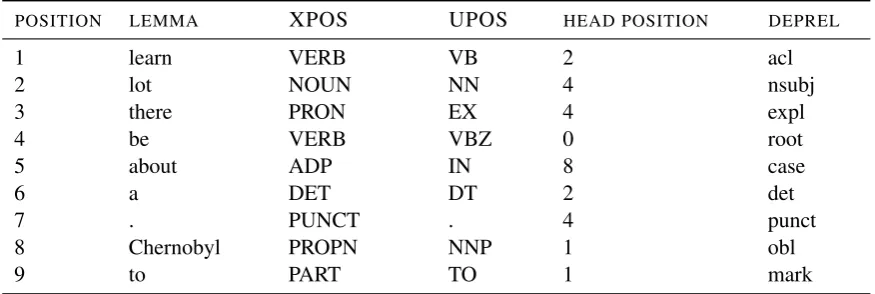
POSITION LEMMA XPOS UPOS HEAD POSITION DEPREL
1 learn VERB VB 2 acl
2 lot NOUN NN 4 nsubj
3 there PRON EX 4 expl
4 be VERB VBZ 0 root
5 about ADP IN 8 case
6 a DET DT 2 det
7 . PUNCT . 4 punct
8 Chernobyl PROPN NNP 1 obl
9 to PART TO 1 mark
Table 2: An example from the training data, containing all features we use as input factors.
factorsF is created as in Eq.1:
ej =
|F| n
k=1
Ekxjk (1)
wherefindicates vector concatenation,Ekis the
embedding matrix of factor k, and xjk is a one hot vector for the k-th input factor. Table1 lists each of the factors used in our models, along with its corresponding embedding size. The embedding size of 300 for the lemma is set in configuration, while the embedding sizes of the other features are set heuristically by OpenNMT-py, using the heuristic |embeddingk| = |Vk|0.7, where |V
k|is
the vocabulary size of featurek. Table2gives an example from the training data with actual instan-tiations of each of the features.
5 Model
Models were trained using the OpenNMT-py toolkit (Klein et al., 2017). The model archi-tecture is a 1 layer bidirectional recurrent neu-ral network (RNN) with long short-term memory
(LSTM) cells (Hochreiter and Urgen Schmidhu-ber,1997) and attention (Luong et al.,2015). The model has 450 hidden units in the encoder and de-coder layers, and 300 hidden units in the word embeddings which are learned jointly across the whole model. Dropout of 0.3 is applied between the LSTM stacks. We use a coverage attention layer (Tu et al.,2016) with lambda value of 1.
The models are trained using stochastic gradi-ent descgradi-ent with learning rate 1. A learning rate decay of 0.5 is applied at each epoch once perplex-ity does not decrease on the validation set. Models were trained for 20 epochs. Output was decoded using beam search with beam size 5. Unknown to-kens were replaced with the input token that had the highest attention value at that time step. The approach of copying input tokens using attention is commonly known as a pointer network (Vinyals et al., 2015). Output from the epoch checkpoint which performed best on the development set was chosen for test set submission.
optimization platform SigOpt2.
6 Experiments
We experiment with many different combinations of input features and training data, in order to understand which elements of the representation have the largest impact upon performance.
We limit vocabulary size during training to en-able the network to generalize to unknown tokens at test time. When using just the SR training data we train word embeddings for the 15,000 most frequent tokens from a possible 23,650 unique to-kens. When using the combined SR training data and filtered WikiText dataset we use the 30,000 most frequent tokens from a possible 106,367 unique tokens.
We trained on a single Tesla K40 GPU. Training time was approximately 1 minute per epoch for the SR data and 1 hour per epoch for the combined SR data and filtered WikiText.
7 Results
We report results using automated evaluation met-ric BLEU (Papineni et al., 2002). On the test set we additionally report the NIST (Przybocki et al.,2009) score and the normalized edit distance (DIST).
SYSTEM BLEU
SR Baseline 21.27
SR + delemma suggestions 23.75 SR + delemma suggestions +
linearization
43.11
SR + delemma suggestions + linearization + additional data
68.86
Table 3: Ablation study with BLEU scores for dif-ferent configurations on the shallow task develop-ment set
Table3presents the results of the surface real-ization experiments. We observe three main com-ponents that drastically improve performance over the baseline model:
1. augmenting the training set with more data
2. reordering the input using the dependency parse features
2https://sigopt.com/
3. providing potential forms via the delemmati-zation map
Table4gives the official SR 2018 results from task organizers. Our system, which corresponds to the best configuration from Table3was ranked first across all metrics.
TEAMID BLEU DIST NIST
1 (Ours) 69.14 80.42 12.02
2 28.09 70.01 9.51
3 8.04 47.63 7.71
4 66.33 70.22 12.02
5 50.74 77.56 10.62
6 55.29 79.29 10.86
7 23.2 51.87 8.86
8 29.6 65.9 9.58
AVG 41.3 67.86 10.15
Table 4: Official results of the surface realization shared task using BLEU, DIST and NIST as eval-uation metrics.
8 Related Work
The surface realization task bears the closest re-semblance to the SemEval 2017 shared task AMR-to-text (May and Priyadarshi, 2017). Our ap-proach to data augmentation and preprocessing uses many insights from Neural AMR (Konstas et al.,2017). Traditional data-to-text systems use a rule based approach (Reiter and Dale,2000).
9 Conclusion
[image:4.595.320.502.163.317.2]in-formation such as parse features. However, recon-structing the original sequence from unprocessed, flattened parse information alone is unrealistic us-ing standard encoder-decoder models.
In future work, we plan to explore more chal-lenging variants of this task, while also experi-menting with models that do not require feature-specific preprocessing to make use of rich struc-tural information in the input.
References
Andrei Alexandrescu and Katrin Kirchhoff. 2006.
Factored neural language models. InProceedings of the Human Language Technology Conference of the NAACL, Companion Volume: Short Papers. Association for Computational Linguistics, Strouds-burg, PA, USA, NAACL-Short ’06, pages 1–4.
http://dl.acm.org/citation.cfm?id=1614049.1614050.
Emilie Colin, Claire Gardent, M Yassine, and Shashi Narayan. 2016. The WebNLG Challenge :
Generat-ing Text from DBPedia Data. The 9th International
Conference on Natural Language Generation.
Sepp Hochreiter and J Urgen
Schmidhu-ber. 1997. Long Short-Term
Mem-ory. Neural Computation 9(8):1735–1780.
https://doi.org/10.1162/neco.1997.9.8.1735.
Chris Hokamp. 2017. Ensembling factored neural
ma-chine translation models for automatic post-editing and quality estimation. InProceedings of the Sec-ond Conference on Machine Translation. Associa-tion for ComputaAssocia-tional Linguistics, pages 647–654.
http://aclweb.org/anthology/W17-4775.
Guillaume Klein, Yoon Kim, Yuntian Deng,
Josep Crego, Jean Senellart, and Alexander M.
Rush. 2017. OpenNMT: Open-source Toolkit
for Neural Machine Translation pages 67–72.
https://doi.org/10.18653/v1/P17-4012.
Ioannis Konstas, Srinivasan Iyer, Mark Yatskar, Yejin
Choi, and Luke Zettlemoyer. 2017. Neural AMR:
Sequence-to-Sequence Models for Parsing and Gen-eration https://doi.org/10.1145/nnnnnnn.nnnnnnn.
Minh-Thang Luong, Hieu Pham, and
Christo-pher D. Manning. 2015. Effective Approaches
to Attention-based Neural Machine Translation https://doi.org/10.18653/v1/D15-1166.
Jonathan May and Jay Priyadarshi. 2017.
SemEval-2017 Task 9: Abstract Meaning Representa-tion Parsing and GeneraRepresenta-tion. SemEval pages
536–545.
http://nlp.arizona.edu/SemEval-2017/pdf/SemEval090.pdf.
Stephen Merity, Caiming Xiong, James Bradbury, and
Richard Socher. 2016. Pointer Sentinel Mixture
Models http://arxiv.org/abs/1609.07843.
Simon Mille, Anja Belz, Bernd Bohnet, Yvette
Gra-ham, Emily Pitler, and Leo Wanner. 2018. The
First Multilingual Surface Realisation Shared Task
(SR’18): Overview and Evaluation Results. In
Pro-ceedings of the 1st Workshop on Multilingual Sur-face Realisation (MSR), 56th Annual Meeting of the Association for Computational Linguistics ({ACL}). Melbourne, Australia, pages 1–10.
Jekaterina Novikova, OndÅ ´Zej Dušek, and Verena
Rieser. 2017. The E2E Dataset: New
Chal-lenges For End-to-End Generation (August):201– 206. http://arxiv.org/abs/1706.09254.
Kishore Papineni, Salim Roukos, Todd Ward, and
Wei-Jing Zhu. 2002. BLEU: A Method for
Au-tomatic Evaluation of Machine Translation. In Proceedings of the 40th Annual Meeting on As-sociation for Computational Linguistics. Asso-ciation for Computational Linguistics,
Strouds-burg, PA, USA, ACL ’02, pages 311–318.
https://doi.org/10.3115/1073083.1073135.
Mark Przybocki, Kay Peterson, SÃl’bastien
Bronsart, and Gregory Sanders. 2009. The
NIST 2008 Metrics for machine translation challenge—overview, methodology, metrics, and results. Machine Translation 23(2):71–103.
https://doi.org/10.1007/s10590-009-9065-6.
Ehud Reiter and Robert Dale. 2000. Building Natural
Language Generation Systems. Cambridge Univer-sity Press, New York, NY, USA.
Rico Sennrich and Barry Haddow. 2016.
Linguis-tic input features improve neural machine transla-tion. In Proceedings of the First Conference on Machine Translation, WMT 2016, colocated with ACL 2016, August 11-12, Berlin, Germany. pages
83–91.
http://aclweb.org/anthology/W/W16/W16-2209.pdf.
Milan Straka and Jana Straková. 2017. Tokenizing,
POS Tagging, Lemmatizing and Parsing UD 2.0 with UDPipe. InProceedings of the CoNLL 2017 Shared Task: Multilingual Parsing from Raw Text to Universal Dependencies. Association for Compu-tational Linguistics, Vancouver, Canada, pages 88– 99. http://www.aclweb.org/anthology/K/K17/K17-3009.pdf.
Kai Sheng Tai, Richard Socher, and
Christo-pher D. Manning. 2015. Improved
Seman-tic Representations From Tree-Structured Long Short-Term Memory Networks pages 1556–1566.
https://doi.org/10.1515/popets-2015-0023.
Zhaopeng Tu, Zhengdong Lu, Yang Liu,
Xi-aohua Liu, and Hang Li. 2016.
Model-ing Coverage for Neural Machine Translation https://doi.org/10.1145/2856767.2856776.
Oriol Vinyals, Meire Fortunato, and
Navdeep Jaitly. 2015. Pointer Networks