Proceedings of the 55th Annual Meeting of the Association for Computational Linguistics, pages 1481–1491 Vancouver, Canada, July 30 - August 4, 2017. c2017 Association for Computational Linguistics Proceedings of the 55th Annual Meeting of the Association for Computational Linguistics, pages 1481–1491
Vancouver, Canada, July 30 - August 4, 2017. c2017 Association for Computational Linguistics
Context Sensitive Lemmatization Using Two Successive Bidirectional
Gated Recurrent Networks
Abhisek Chakrabarty Onkar Arun Pandit
Computer Vision and Pattern Recognition Unit Indian Statistical Institute
203 B.T. Road, Kolkata-700108, India
[email protected], [email protected], [email protected] Utpal Garain
Abstract
We introduce a composite deep neural network architecture for supervised and language independent context sensitive lemmatization. The proposed method con-siders the task as to identify the correct edit tree representing the transformation between a word-lemma pair. To find the lemma of a surface word, we exploit two successive bidirectional gated recur-rent structures - the first one is used to ex-tract the character level dependencies and the next one captures the contextual infor-mation of the given word. The key ad-vantages of our model compared to the state-of-the-art lemmatizers such as Lem-ming and Morfette are -(i)it is
indepen-dent of human decided features(ii)except
the gold lemma, no other expensive mor-phological attribute is required for joint learning. We evaluate the lemmatizer on nine languages - Bengali, Catalan, Dutch, Hindi, Hungarian, Italian, Latin, Roma-nian and Spanish. It is found that ex-cept Bengali, the proposed method outper-forms Lemming and Morfette on the other languages. To train the model on Ben-gali, we develop a gold lemma annotated dataset1 (having 1,702 sentences with a total of20,257word tokens), which is an
additional contribution of this work.
1 Introduction
Lemmatization is the process to determine the root/dictionary form of a surface word. Morpho-logically rich languages suffer due to the existence
1The dataset and the code of model architecture are
re-leased with the paper. They are also available in http: //www.isical.ac.in/˜utpal/resources.php
of various inflectional and derivational variations of a root depending on several linguistic proper-ties such as honorificity, parts of speech (POS), person, tense etc. Lemmas map the related word forms to lexical resources thus identifying them as the members of the same group and providing their semantic and syntactic information. Stem-ming is a way similar to lemmatization producing the common portion of variants but it has several limitations -(i)there is no guarantee of a stem to
be a legitimate word form(ii) words are
consid-ered in isolation. Hence, for context sensitive lan-guages i.e. where same inflected word form may come from different sources and can only be dis-ambiguated by considering its neighbouring infor-mation, there lemmatization defines the foremost task to handle diverse text processing problems (e.g. sense disambiguation, parsing, translation).
The key contributions of this work are as fol-lows. We address context sensitive lemmatiza-tion introducing a two-stage bidireclemmatiza-tional gated recurrent neural network (BGRNN) architecture. Our model is a supervised one that needs lemma tagged continuous text to learn. Its two most important advantages compared to the state-of-the-art supervised models (Chrupala et al., 2008;
Toutanova and Cherry, 2009; Gesmundo and Samardzic,2012;M¨uller et al.,2015) are -(i)we
do not need to define hand-crafted features such as the word form, presence of special characters, character alignments, surrounding words etc. (ii)
parts of speech and other morphological attributes of the surface words are not required for joint learning. Additionally, unknown word forms are also taken care of as the transformation between word-lemma pair is learnt, not the lemma itself. We exploit two steps learning in our method. At first, characters in the words are passed sequen-tially through a BGRNN to get a syntactic em-bedding of each word and then the outputs are
combined with the corresponding semantic em-beddings. Finally, mapping between the combined embeddings to word-lemma transformations are learnt using another BGRNN.
For the present work, we assess our model on nine languages having diverse morphological vari-ations. Out of them, two (Bengali and Hindi) be-long to the Indic languages family and the rests (Catalan, Dutch, Hungarian, Italian, Latin, Roma-nian and Spanish) are taken from the European languages. To evaluate the proposed model on Bengali, a lemma annotated continuous text has been developed. As so far there is no such stan-dard large dataset for supervised lemmatization in Bengali, the prepared one would surely contribute to the respective NLP research community. For the remaining languages, standard datasets are used for experimentation. Experimental results reveal that our method outperforms Lemming (M¨uller et al.,2015) and Morfette (Chrupala et al.,2008) on all the languages except Bengali.
1.1 Related Works
Efforts on developing lemmatizers can be divided into two principle categories (i) rule/heuristics
based approaches (Koskenniemi, 1984; Plisson et al., 2004) which are usually not portable to different languages and(ii) learning based
meth-ods (Chrupala et al.,2008;Toutanova and Cherry,
2009; Gesmundo and Samardzic, 2012; M¨uller et al., 2015; Nicolai and Kondrak, 2016) requir-ing prior trainrequir-ing dataset to learn the morphologi-cal patterns. Again, the later methods can be fur-ther classified depending on whefur-ther context of the current word is considered or not. Lemmatiza-tion without context (Cotterell et al.,2016; Nico-lai and Kondrak,2016) is closer to stemming and not the focus of the present work. It is notewor-thy here that the supervised lemmatization meth-ods do not try to classify the lemma of a given word form as it is infeasible due to having a large number of lemmas in a language. Rather, learn-ing the transformation between word-lemma pair is more generalized and it can handle the unknown word forms too. Several representations of word-lemma transformation have been introduced so far such as shortest edit script (SES), label set, edit tree by Chrupala et al. (2008), Gesmundo and Samardzic(2012) andM¨uller et al.(2015) respec-tively. Following M¨uller et al. (2015), we con-sider lemmatization as the edit tree classification
problem. Toutanova and Cherry (2009); M¨uller et al. (2015) also showed that joint learning of lemmas with other morphological attributes is mu-tually beneficial but obtaining the gold annotated datasets is very expensive. In contrast, our model needs only lemma annotated continuous text (not POS and other tags) to learn the word morphology. Since our experiments include the Indic lan-guages also, it would not be an overstatement to say that there have been little efforts on lemmati-zation so far (Faridee et al., 2009;Loponen and J¨arvelin, 2010; Paul et al., 2013; Bhattacharyya et al.,2014). The works byFaridee et al.(2009);
Paul et al.(2013) are language specific rule based for Bengali and Hindi respectively. (Loponen and J¨arvelin,2010)’s primary objective was to improve the retrieval performance. Bhattacharyya et al.
(2014) proposed a heuristics based lemmatizer us-ing WordNet but they did not consider context of the target word which is an important basis to lem-matize Indic languages. Chakrabarty and Garain
(2016) developed an unsupervised language in-dependent lemmatizer and evaluated it on Ben-gali. They consider the contextual information but the major disadvantage of their method is depen-dency on dictionary as well as POS information. Very recently, a supervised neural lemmatization model has been introduced by Chakrabarty et al.
(2016). They treat the problem as lemma trans-duction rather than classification. The particular root in the dictionary is chosen as the lemma with which the transduced vector possesses maximum cosine similarity. Hence, their approach fails when the correct lemma of a word is not present in the dictionary. Besides, the lemmatization accuracy obtained by the respective method is not very sig-nificant. Apart from the mentioned works, there is no such commendable effort so far.
Rest of this paper is organized as follows. In section2, we describe the proposed lemmatization method. Experimental setup and the results are presented in section 3. Finally, in section 4 we conclude the paper.
2 The Proposed Method
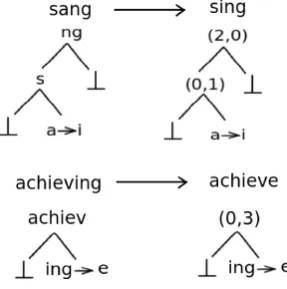
Figure 1: Edit trees for the word-lemma pairs ‘sang-sing’ and ‘achieving-achieve’.
process. Figure1 depicts two edit trees that map the inflected English words‘sang’and‘achieving’ to their respective lemmas ‘sing’ and ‘achieve’. For generalization, edit trees encode only the sub-stitutions and the length of prefixes and suffixes of the longest common substrings. Initially, all unique edit trees are extracted from the associated surface word-lemma pairs present in the training set. The extracted trees refer to the class labels in our model. So, for a test word, the goal is to classify the correct edit tree which, applied on the word, returns the lemma.
Next, we will describe the architecture of the proposed neural lemmatization model. It is evi-dent that for morphologically rich languages, both syntactic and semantic knowledge help in lemma-tizing a surface word. Now a days, it is a com-mon practice to embed the functional properties of words into vector representations. Despite the word vectors prove very effectual in semantic pro-cessing tasks, they are modelled using the distribu-tional similarity obtained from a raw corpus. Mor-phological regularities, local and non-local depen-dencies in character sequences that play deciding roles to find the lemmas, are not taken into account where each word has its own vector interpreta-tion. We address this issue by incorporating two different embeddings into our model. Semantic embedding is achieved using word2vec (Mikolov et al.,2013a,b), which has been empirically found highly successful. To devise the syntactic embed-ding of a word, we follow the work ofLing et al.
[image:3.595.97.241.63.208.2](2015) that uses compositional character to word model using bidirectional long-short term memory (BLSTM) network. In our experiments, different
Figure 2: Syntactic vector composition for a word.
gated recurrent cells such as LSTM (Graves,2013) and GRU (Cho et al., 2014), are explored. The next subsection describes the module to construct the syntactic vectors by feeding the character se-quences into BGRNN architecture.
2.1 Forming Syntactic Embeddings
Our goal is to build syntactic embeddings of words that capture the similarities in morpholog-ical level. Given an input word w, the target is to obtain addimensional vector representing the syntactic structure of w. The procedure is illus-trated in Figure2. At first, an alphabet of char-acters is defined as C. We represent w as a se-quence of characters c1, . . . , cm where m is the word length and each characterci is defined as a one hot encoded vector1ci, having one at the
in-dex ofci in the alphabetC. An embedding layer is defined asEc∈Rdc×|C|, that projects each one hot encoded character vector to adcdimensional embedded vector. For a characterci, its projected vector eci is obtained from the embedding layer
Ec, using this relationeci = Ec·1ci where ‘·’ is
the matrix multiplication operation.
Given a sequence of vectors x1, . . . ,xm as in-put, a LSTM cell computes the state sequence
h1, . . . ,hmusing the following equations:
ft=σ(Wfxt+Ufht−1+Vfct−1+bf)
it=σ(Wixt+Uiht−1+Vict−1+bi)
ct=ft⊙ct−1
+it⊙tanh(Wcxt+Ucht−1+bc)
ot=σ(Woxt+Uoht−1+Voct+bo)
Whereas, the updation rules for GRU are as fol-lows
zt=σ(Wzxt+Uzht−1+bz)
rt=σ(Wrxt+Urht−1+br)
ht= (1−zt)⊙ht−1
+zt⊙tanh(Whxt+Uh(rt⊙ht−1) +bh), σ denotes the sigmoid function and ⊙stands for the element-wise (Hadamard) product. Unlike the simple recurrent unit, LSTM uses an extra mem-ory cell ct that is controlled by three gates - in-put (it), forget (ft) and output (ot). itcontrols the amount of new memory content added to the mem-ory cell,ftregulates the degree to which the exist-ing memory is forgotten andotfinally adjusts the memory content exposure. W,U,V(weight ma-trices),b(bias) are the parameters.
Without having a memory cell like LSTM, a GRU uses two gates namely update (zt) and re-set (rt). The gate, zt decides the amount of up-date needed for activation andrtis used to ignore the previous hidden states (when close to0, it
for-gets the earlier computation). So, for a sequence of projected characters ec1, . . . ,ecm, the forward
and the backward networks produce the state se-quenceshf
1, . . . ,hfm andhbm, . . . ,hb1 respectively.
Finally, we obtain the syntactic embedding ofw, denoted asesyn
w , by concatenating the final states of these two sequences.
esyn
w = [hb1,hfm]
2.2 Model
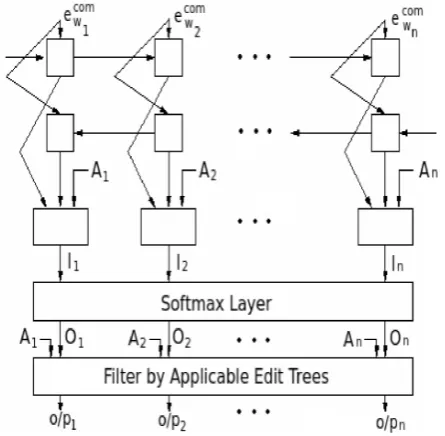
We present the sketch of the final integrated model in Figure3. For a wordw, letesemw denotes its se-mantic embedding obtained using word2vec. Both the vectors, esyn
w and esemw are concatenated to-gether to shape the composite representationecom
w which carries the morphological and distributional information within it. Firstly, for all the words present in the training set, their composite vec-tors are generated. Next, they are fed sentence-wise into the next level of BGRNN to train the model for the edit tree classification task. This second level bidirectional network accounts the local context in both forward and backward di-rections, which is essential for lemmatization in context sensitive languages. Let, ecom
w1 , . . . ,e
com wn
be the input sequence of composite vectors to the BGRNN model, representing a sentence havingn wordsw1, . . . , wn. For theithvectorecomwi ,h
[image:4.595.312.535.62.280.2]f i and
Figure 3: Second level BGRNN model for edit tree classification.
hb
i denote the forward and backward states respec-tively carrying the informations ofw1, . . . , wiand wi, . . . , wn.
2.2.1 Incorporating Applicable Edit Trees Information
One aspect that we did not look into so far, is that for a word all unique edit trees extracted from the training set are not applicable as this would lead to incompatible substitutions. For example, the edit tree for the word-lemma pair ‘sang-sing’ depicted in Figure1, cannot be applied on the word ‘achiev-ing’. This information is prior before training the model i.e. for any arbitrary word, we can sort out the subset of unique edit trees from the training samples in advance, which are applicable on it. In general, if all the unique edit trees in the train-ing data are set as the class labels, the model will learn to distribute the probability mass over all the classes which is a clear-cut bottleneck. In order to alleviate this problem, we take a novel strategy so that for individual words in the input sequence, the model will learn, to which classes, the output probability should be apportioned.
LetT ={t1, . . . , tk}be the set of distinct edit trees found in the training set. For the word wi in the input sequence w1, . . . , wn, we define its
upon, while processing the wordwi. We combine
Aitogether withhfi andhbi for the final classifica-tion task as following,
li =sof tplus(Lfhfi +Lbhbi+LaAi+bl),
where ‘softplus’ denotes the activation function f(x) = ln(1 +ex)andLf,Lb,La andb
l are the parameters trained by the network. At the end,liis passed through the softmax layer to get the output labels forwi.
To pick the correct edit tree from the output of the softmax layer, we exploit the prior informa-tion Ai. Instead of choosing the class that gets the maximum probability, we select the maximum over the classes corresponding to the applicable edit trees. The idea is expressed as follows. Let
Oi = (o1i, . . . , oki) be the output of the softmax layer. Instead of opting for the maximum over o1i, . . . , oki as the class label, the highest probable class out of those corresponding to the applicable edit trees, is picked up. That is, the particular edit treetj ∈Tis considered as the right candidate for wi, where
j= argmax
j′∈{1,...,k} ∧aji′=1o
j′ i
In this way, we cancel out the non-applicable classes and focus only on the plausible candidates.
3 Experimentation
Out of the nine reference languages, initially we choose four of them (Bengali, Hindi, Latin and Spanish) for in-depth analysis. We conduct an ex-haustive set of experiments - such as determin-ing the direct lemmatization accuracy, accuracy obtained without using applicable edit trees in training, measuring the model’s performance on the unseen words etc. on these four languages. Later we consider five more languages (Catalan, Dutch, Hungarian, Italian and Romanian) mostly for testing the generalization ability of the pro-posed method. For these additional languages, we present only the lemmatization accuracy in sec-tion3.2.
Datasets: As Bengali is a low-resourced lan-guage, a relatively large lemma annotated dataset is prepared for the present work using Tagore’s short stories collection2 and randomly selected news articles from miscellaneous domains. One
2www.rabindra-rachanabali.nltr.org
[image:5.595.334.499.62.114.2]# Sentences # Word Tokens Bengali 1,702 20,257 Hindi 36,143 819,264 Latin 15,002 165,634 Spanish 15,984 477,810
Table 1: Dataset statistics of the4languages.
linguist took around2months to complete the
an-notation which was checked by another person and differences were sorted out. Out of the 91
short stories of Tagore, we calculate the value of (# tokens / # distinct tokens) for each story. Based on this value (lower is better), top 11
sto-ries are selected. The news articles3 are crafted from the following domains: animal, archaeology, business, country, education, food, health, poli-tics, psychology, science and travelogue. In Hindi, we combine the COLING’12shared task data for
dependency parsing and Hindi WSD health and tourism corpora4 (Khapra et al.,2010) together5. For Latin, the data is taken from the PROIEL tree-bank (Haug and Jøhndal, 2008) and for Spanish, we merge the training and development datasets of CoNLL’09 (Hajiˇc et al., 2009) shared task on
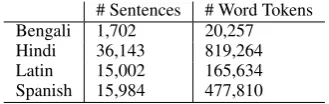
syntactic and semantic dependencies. The dataset statistics are given in Table 1. We assess the lemmatization performance by measuring the di-rect accuracy which is the ratio of the number of correctly lemmatized words to the total number of input words. The experiments are performed using
4fold cross validation technique i.e. the datasets
are equi-partitioned into4 parts at sentence level
and then each part is tested exactly once using the model trained on the remaining 3 parts. Finally,
we report the average accuracy over4fold.
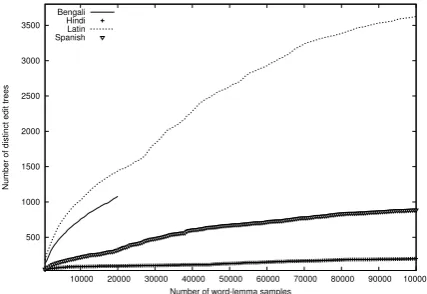
Induction of Edit Tree Set: Initially, distinct edit trees are induced from the word-lemma pairs present in the training set. Next, the words in the training data are annotated with their correspond-ing edit trees. Traincorrespond-ing is accomplished on this edit tree tagged text. Figure4plots the growth of the edit tree set against the number of word-lemma samples in the four languages. With the increase of samples, the size of edit tree set gradually con-verges revealing the fact that most of the frequent transformation patterns (both regular and irregu-lar) are covered by the induction process. From
3http://www.anandabazar.com/ 4http://www.cfilt.iitb.ac.in/wsd/
annotated_corpus/
5We also release the Hindi dataset with this paper as it is
500 1000 1500 2000 2500 3000 3500
10000 20000 30000 40000 50000 60000 70000 80000 90000 100000
Number of distinct edit trees
Number of word-lemma samples Bengali
[image:6.595.73.287.61.208.2]Hindi Latin Spanish
Figure 4: Increase of the edit tree set size with the number of word-lemma samples.
Figure4, morphological richness can be compared across the languages. When convergence hap-pens quickly i.e. at relatively less number of sam-ples, it evidences that the language is less com-plex. Among the four reference languages, Latin stands out as the most intricate, followed by Ben-gali, Spanish and Hindi.
Semantic Embeddings: We obtain the distri-butional word vectors for Bengali and Hindi by training the word2vec model on FIRE Bengali and Hindi news corpora6. Following the work by Mikolov et al. (2013a), continuous-bag-of-words architecture with negative sampling is used to get 200 dimensional word vectors. For Latin
and Spanish, we use the embeddings released by Bamman and Smith (2012)7 and Cardellino (2016)8respectively.
Syntactic Representation: We acquire the statistics of word length versus frequency from the datasets and find out that irrespective of the lan-guages, longer words (have more than20-25 char-acters) are few in numbers. Based on this finding, each word is limited to a sequence of 25
charac-ters. Smaller words are padded null characters at the end and for the longer words, excess characters are truncated out. So, each word is represented as a25length array of one hot encoded vectors which is given input to the embedding layer that works as a look up table producing an equal length ar-ray of embedded vectors. Initialization of the em-bedding layer is done randomly and the embedded vector dimension is set to10. Eventually, the
out-put of the embedding layer is passed to the first
6http://fire.irsi.res.in/fire
7http://www.cs.cmu.edu/˜dbamman/latin.
html
8http://crscardellino.me/SBWCE/
level BGRNN for learning the syntactic represen-tation.
Hyper Parameters: There are several hyper parameters in our model such as the number of neurons in the hidden layer (ht) of both first and second level BGRNN, learning mode, number of epochs to train the models, optimization algo-rithm, dropout rate etc. We experiment with differ-ent settings of these parameters and report where optimum results are achieved. For both the bidi-rectional networks, number of hidden layer neu-rons is set to 64. Online learning is applied for
updation of the weights. Number of epochs varies across languages to converge the training. It is maximum for Bengali (around 80 epochs), fol-lowed by Latin, Spanish and Hindi taking around
50,35and15respectively. Throughout the
exper-iments, we set the dropout rate as 0.2 to prevent
over-fitting. Different optimization algorithms like AdaDelta (Zeiler,2012), Adam (Kingma and Ba, 2014), RMSProp (Dauphin et al., 2015) are explored. Out of them, Adam yields the best re-sult. We use the categorical cross-entropy as the loss function in our model.
Baselines: We compare our method with Lem-ming9 and Morfette10. Both the model jointly learns lemma and other morphological tags in con-text. Lemming uses a2nd-order linear-chain CRF
to predict the lemmas whereas, the current ver-sion of Morfette is based on structured perceptron learning. As POS information is a compulsory re-quirement of these two models, the Bengali data is manually POS annotated. For the other lan-guages, the tags were already available. Although this comparison is partially biased as the proposed method does not need POS information, but the experimental results show the effectiveness of our model. There is an option in Lemming and Mor-fette to provide an exhaustive set of root words which is used to exploit the dictionary features i.e. to verify if a candidate lemma is a valid form or not. To make the comparisons consistent, we do not exploit any external dictionary in our experi-ments.
3.1 Results
The lemmatization results are presented in Table2. We explore our proposed model with two types of gated recurrent cells - LSTM and GRU. As there
Bengali Hindi Latin Spanish BLSTM-BLSTM 90.84/91.14 94.89/94.90 89.35/89.52 97.85/97.91 BGRU-BGRU 90.63/90.84 94.44/94.50 89.40/89.59 98.07/98.11
Lemming 91.69 91.64 88.50 93.12
[image:7.595.155.443.62.116.2]Morfette 90.69 90.57 87.10 92.90
Table 2: Lemmatization accuracy (in %) without/with restricting output classes.
Bengali Hindi Latin Spanish
BLSTM-BLSTM 86.46/89.52 94.34/94.52 85.70/87.35 97.39/97.62 BGRU-BGRU 86.39/88.90 93.84/94.04 85.49/86.87 97.51/97.73
Table 3: Lemmatization accuracy (in %) without using applicable edit trees in training.
are two successive bidirectional networks - the first one for building the syntactic embedding and the next one for the edit tree classification, so basi-cally we deal with two different models BLSTM-BLSTM and BGRU-BGRU. Table 2 shows the comparison results of these models with Lemming and Morfette. In all cases, the average accuracy over4 fold cross validation on the datasets is
re-ported. For an entry ‘x/y’ in Table2, x denotes the accuracy without output classes restriction, i.e. taking the maximum over all edit tree classes present in the training set, whereasyrefers to the accuracy when output is restricted in only the ap-plicable edit tree classes of the input word. Except for Bengali, the proposed models outperform the baselines for the other three languages. In Hindi, BLSTM-BLSTM gives the best result (94.90%).
For Latin and Spanish, the highest accuracy is achieved by BGRU-BGRU (89.59%and98.11%
respectively). In the Bengali dataset, Lemming produces the optimum result (91.69%) beating its
closest performer BLSTM-BLSTM by0.55%. It
is to note that the training set size in Bengali is smallest compared to the other languages (on av-erage,16,712tokens in each of the4folds).
Over-all, BLSTM-BLSTM and BGRU-BGRU perform equally good. For Bengali and Hindi, the for-mer model is better and for Latin and Spanish, the later yields more accuracy. Throughout the ex-periments, restricting the output over applicable classes improves the performance significantly. The maximum improvements we get are: 0.30%
in Bengali using BLSTM-BLSTM (from90.84%
to91.14%),0.06% in Hindi using BGRU-BGRU (from 94.44% to 94.50%), 0.19% in Latin
us-ing BGRU-BGRU (from89.40% to89.59%) and 0.06% in Spanish using BLSTM-BLSTM (from
97.85%to97.91%). To compare between the two
baselines, Lemming consistently performs better
Bengali Hindi Latin Spanish 27.17 5.25 15.74 7.54
Table 4: Proportion of unknown word forms (in %) present in the test sets.
than Morfette (the maximum difference between their accuracies is1.40%in Latin).
Effect of Training without Applicable Edit Trees: We also explore the impact of applicable edit trees in training. To see the effect, we train our model without giving the applicable edit trees in-formation as input. In the model design, the equa-tion for the final classificaequa-tion task is changed as follows,
li=sof tplus(Lfhfi +Lbhbi +bl),
The results are presented in Table3. Except for Spanish, BLSTM-BLSTM outperforms BGRU-BGRU in all the other languages. As compared with the results in Table 2, for every model, training without applicable edit trees degrades the lemmatization performance. In all cases, BGRU-BGRU model gets more affected than BLSTM-BLSTM. Language-wise, the drops in its accuracy are: 1.94%in Bengali (from 90.84%to88.90%), 0.46%in Hindi (from94.50%to94.04%),2.72%
in Latin (from 89.59%to86.87%) and0.38% in Spanish (from98.11%to97.73%).
One important finding to note in Table3is that irrespective of any particular language and model used, the amount of increase in accuracy due to the output restriction on the applicable classes is much more than that observed in Table2. For instance, in Table2the accuracy improvement for Bengali using BLSTM-BLSTM is0.30%(from90.84%to 91.14%), whereas in Table 3 the corresponding
value is3.06%(from86.46%to89.52%). These
ap-Bengali Hindi Latin Spanish BLSTM-BLSTM 71.06/72.10 87.80/88.18 60.85/61.63 88.06/88.79 BGRU-BGRU 70.44/71.22 88.34/88.40 60.65/61.52 91.48/92.25
Lemming 74.10 90.35 57.19 58.89
[image:8.595.156.444.62.116.2]Morfette 70.27 88.59 47.41 57.61
Table 5: Lemmatization accuracy (in %) on unseen words.
Bengali Hindi Latin Spanish
[image:8.595.320.511.227.281.2]BLSTM-BLSTM 56.16/66.26 87.42/88.41 49.80/56.05 86.22/87.97 BGRU-BGRU 59.45/66.84 87.19/88.26 50.24/55.35 86.74/88.49
Table 6: Lemmatization accuracy (in %) on unseen words without using applicable edit trees in training.
plicable edit trees already learns to dispense the output probability to the legitimate classes over which, output restriction cannot yield much en-hancement.
Results for Unseen Word Forms: Next, we discuss about the lemmatization performance on those words which were absent in the training set. Table 4 shows the proportion of unseen forms averaged over 4 folds on the datasets. In Table 5, we present the accuracy obtained by our models and the baselines. For Bengali and Hindi, Lemming produces the best results (74.10% and 90.35%). For Latin and Spanish,
BLSTM-BLSTM and BGRU-BGRU obtain the highest accuracy (61.63% and 92.25%) respec-tively. In Spanish, our model gets the maximum improvement over the baselines. BGRU-BGRU beats Lemming with 33.36% margin (on
aver-age, out of 9,011 unseen forms, 3,005more
to-kens are correctly lemmatized). Similar to the re-sults in Table 2, the results in Table 5 evidences that restricting the output in applicable classes en-hances the lemmatization performance. The max-imum accuracy improvements due to the output restriction are: 1.04% in Bengali (from 71.06%
to 72.10%), 0.38% in Hindi (from 87.80% to 88.18%) using BLSTM-BLSTM and 0.87% in
Latin (from60.65%to61.52%),0.77%in Spanish
(from91.48%to92.25%) using BGRU-BGRU.
Further, we investigate the performance of our models trained without the applicable edit trees in-formation, on the unseen word forms. The results are given in Table6. As expected, for every model, the accuracy drops compared to the results shown in Table 5. The only exception that we find out is in the entry for Hindi with BLSTM-BLSTM. Though without restricting the output, the accu-racy in Table5(87.80%) is higher than the
corre-sponding value in Table6(87.42%), but after
out-Sem. Embedding Syn. Embedding Bengali 90.76/91.02 86.61/86.82 Hindi 94.86/94.86 91.24/91.25 Latin 88.90/89.09 85.31/85.49 Spanish 97.95/98 96.07/96.10
Table 7: Results (in %) obtained using semantic and syntactic embeddings separately.
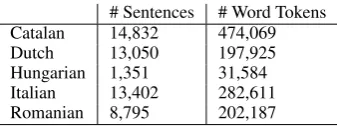
# Sentences # Word Tokens Catalan 14,832 474,069 Dutch 13,050 197,925 Hungarian 1,351 31,584 Italian 13,402 282,611 Romanian 8,795 202,187
Table 8: Dataset statistics of the5additional
lan-guages.
put restriction, the performance changes (88.18%
in Table5,88.41%in Table6) which reveals that
only selecting the maximum probable class over the applicable ones would be a better option for the unseen word forms in Hindi.
[image:8.595.332.501.331.394.2]vec-Catalan Dutch Hungarian Italian Romanian BLSTM-BLSTM 97.93/97.95 93.20/93.44 91.03/91.46 96.06/96.09 94.25/94.32
Lemming 89.80 86.95 87.95 92.51 93.34
[image:9.595.125.474.62.106.2]Morfette 89.46 86.62 86.52 92.02 94.13
Table 9: Lemmatization accuracy (in %) for the5languages.
tor proves to be more effective than the charac-ter level embedding. However, to capture the dis-tributional properties of words efficiently, a huge corpus is needed which may not be available for low resourced languages. In that case, making use of syntactic embedding is a good alternative. Nonetheless, use of both types of embedding to-gether improves the result.
3.2 Experimental Results for Another Five Languages
As mentioned earlier, five additional languages (Catalan, Dutch, Hungarian, Italian and Roma-nian) are considered to test the generalization abil-ity of the method. The datasets are taken from the UD Treebanks11(Nivre et al.,2017). For each language, we merge the training and development data together and perform4 fold cross validation
on it to measure the average accuracy. The dataset statistics are shown in Table 8. For experimen-tation, we use the pre-trained semantic embed-dings released by (Bojanowski et al.,2016). Only BLSTM-BLSTM model is explored and it is com-pared with Lemming and Morfette. The hyper pa-rameters are kept same as described previously ex-cept for the number of epochs needed for training across the languages. We present the results in Ta-ble9. For all the languages, BLSTM-BLSTM out-performs Lemming and Morfette. The maximum improvement over the baselines we get is for Cata-lan (beats Lemming and Morfette by 8.15% and 8.49%respectively). Similar to the results in
Ta-ble2, restricting the output over applicable classes yields consistent performance improvement.
4 Conclusion
This article presents a neural network based con-text sensitive lemmatization method which is lan-guage independent and supervised in nature. The proposed model learns the transformation patterns between word-lemma pairs and hence, can handle the unknown word forms too. Additionally, it does not rely on human defined features and various
11http://universaldependencies.org/
morphological tags except the gold lemma anno-tated continuous text. We explore different vari-ations of the model architecture by changing the type of recurrent units. For evaluation, nine lan-guages are taken as the references. Except Ben-gali, the proposed method outperforms the state-of-the-art models (Lemming and Morfette) on all the other languages. For Bengali, it produces the second best performance (91.14%using
BLSTM-BLSTM). We measure the accuracy on the partial data (keeping the data size comparable to the Ben-gali dataset) for Hindi, Latin and Spanish to check the effect of the data amount on the performance. For Hindi, the change in accuracy is insignifi-cant but for Latin and Spanish, accuracy drops by
3.50%and6%respectively. The time requirement
of the proposed method is also analyzed. Train-ing time depends on several parameters such as size of the data, number of epochs required for convergence, configuration of the system used etc. In our work, we use the ‘keras’ software keeping ‘theano’ as backend. The codes were run on a sin-gle GPU (Nvidia GeForce GTX960, 2GB
mem-ory). Once trained, the model takes negligible time to predict the appropriate edit trees for test words (e.g. 844and 930words/second for
gali and Hindi respectively). We develop a Ben-gali lemmatization dataset which is definitely a no-table contribution to the language resources. From the present study, one important finding comes out that for the unseen words, the lemmatization ac-curacy drops by a large margin in Bengali and Spanish, which may be the area of further research work. Apart from it, we intend to propose a neural architecture that accomplishes the joint learning of lemmas with other morphological attributes.
References
David Bamman and David Smith. 2012.
Extract-ing two thousand years of latin from a million book library. J. Comput. Cult. Herit.5(1):2:1–2:13. https://doi.org/10.1145/2160165.2160167.
Pushpak Bhattacharyya, Ankit Bahuguna, Lavita
Talukdar, and Bornali Phukan. 2014. Facilitating
lemmatizer. In Heili Orav, Christiane Fellbaum,
and Piek Vossen, editors,Proceedings of the Seventh
Global Wordnet Conference. Tartu, Estonia, pages
224–231.
http://www.aclweb.org/anthology/W14-0130.
Piotr Bojanowski, Edouard Grave, Armand Joulin,
and Tomas Mikolov. 2016. Enriching word
vec-tors with subword information. arXiv preprint arXiv:1607.04606https://arxiv.org/abs/1607.04606.
Cristian Cardellino. 2016. Spanish
Bil-lion Words Corpus and Embeddings.
http://crscardellino.me/SBWCE/.
Abhisek Chakrabarty, Akshay Chaturvedi, and
Utpal Garain. 2016. A neural lemmatizer for
bengali. In Proceedings of the Tenth Inter-national Conference on Language Resources and Evaluation (LREC 2016). European Lan-guage Resources Association (ELRA), Paris,
France, pages 2558–2561.
http://www.lrec-conf.org/proceedings/lrec2016/pdf/955Paper.pdf.
Abhisek Chakrabarty and Utpal Garain. 2016.
Ben-lem (a bengali Ben-lemmatizer) and its role in wsd. ACM Trans. Asian Low-Resour. Lang. Inf. Process.
15(3):12:1–12:18. https://doi.org/10.1145/2835494.
Kyunghyun Cho, Bart Van Merri¨enboer, Dzmitry
Bah-danau, and Yoshua Bengio. 2014. On the
proper-ties of neural machine translation: Encoder-decoder approaches. arXiv preprint arXiv:1409.1259 https://arxiv.org/abs/1409.1259.
Grzegorz Chrupała. 2008. Towards a
machine-learning architecture for lexical functional gram-mar parsing. Ph.D. thesis, Dublin City University. http://doras.dcu.ie/550/.
Grzegorz Chrupala, Georgiana Dinu, and
Josef van Genabith. 2008. Learning
mor-phology with morfette. In Proceedings of
the Sixth International Conference on Lan-guage Resources and Evaluation (LREC’08).
European Language Resources Association
(ELRA), Marrakech, Morocco.
http://www.lrec-conf.org/proceedings/lrec2008/pdf/594paper.pdf.
Ryan Cotterell, Christo Kirov, John Sylak-Glassman, David Yarowsky, Jason Eisner, and Mans Hulden.
2016. The sigmorphon 2016 shared task—
morphological reinflection. In Proceedings of the 2016 Meeting of SIGMORPHON. Association for Computational Linguistics, Berlin, Germany. http://aclweb.org/anthology/sigmorphon.html.
Yann N. Dauphin, Harm de Vries, and Yoshua
Ben-gio. 2015. Equilibrated adaptive learning rates
for non-convex optimization. In Proceedings of the 28th International Conference on Neural Information Processing Systems. MIT Press, Cam-bridge, MA, USA, NIPS’15, pages 1504–1512. http://dl.acm.org/citation.cfm?id=2969239.2969407.
Abu Zaher Md Faridee, Francis M Tyers, et al. 2009. Development of a morphological analyser for ben-gali. InProceedings of the First International Work-shop on Free/Open-Source Rule-Based Machine Translation. Universidad de Alicante. Departamento de Lenguajes y Sistemas Inform´aticos, pages 43– 50. http://www.mt-archive.info/FreeRBMT-2009-Faridee.pdf.
Andrea Gesmundo and Tanja Samardzic. 2012.
Lem-matisation as a tagging task. In Proceed-ings of the 50th Annual Meeting of the As-sociation for Computational Linguistics (Volume 2: Short Papers). Association for Computational Linguistics, Jeju Island, Korea, pages 368–372. http://www.aclweb.org/anthology/P12-2072.
Alex Graves. 2013. Generating sequences with
recurrent neural networks. arXiv preprint arXiv:1308.0850https://arxiv.org/abs/1308.0850.
Jan Hajiˇc, Massimiliano Ciaramita, Richard Johans-son, Daisuke Kawahara, Maria Ant`onia Mart´ı, Llu´ıs M`arquez, Adam Meyers, Joakim Nivre, Se-bastian Pad´o, Jan ˇStˇep´anek, Pavel Straˇn´ak, Mi-hai Surdeanu, Nianwen Xue, and Yi Zhang. 2009. The conll-2009 shared task: Syntactic and seman-tic dependencies in multiple languages. In Pro-ceedings of the Thirteenth Conference on Com-putational Natural Language Learning (CoNLL 2009): Shared Task. Association for Computa-tional Linguistics, Boulder, Colorado, pages 1–18. http://www.aclweb.org/anthology/W09-1201.
Dag TT Haug and Marius Jøhndal. 2008. Creating a parallel treebank of the old indo-european bible
translations. In Proceedings of the Second
Work-shop on Language Technology for Cultural Heritage Data (LaTeCH 2008). pages 27–34.
Mitesh Khapra, Anup Kulkarni, Saurabh Sohoney, and
Pushpak Bhattacharyya. 2010. All words domain
adapted wsd: Finding a middle ground between su-pervision and unsusu-pervision. InProceedings of the 48th Annual Meeting of the Association for Compu-tational Linguistics. Association for Computational Linguistics, Uppsala, Sweden, pages 1532–1541. http://www.aclweb.org/anthology/P10-1155.
Diederik Kingma and Jimmy Ba. 2014. Adam: A
method for stochastic optimization. arXiv preprint arXiv:1412.6980https://arxiv.org/abs/1412.6980.
Kimmo Koskenniemi. 1984. A general computational
model for word-form recognition and production. In Proceedings of the 10th International Confer-ence on Computational Linguistics and 22nd An-nual Meeting of the Association for Computational Linguistics. Association for Computational Linguis-tics, Stanford, California, USA, pages 178–181. https://doi.org/10.3115/980491.980529.
Wang Ling, Chris Dyer, Alan W Black, Isabel Tran-coso, Ramon Fermandez, Silvio Amir, Luis Marujo,
Compositional character models for open vocabu-lary word representation. In Proceedings of the 2015 Conference on Empirical Methods in Natu-ral Language Processing. Association for Compu-tational Linguistics, Lisbon, Portugal, pages 1520–
1530.http://aclweb.org/anthology/D15-1176.
Aki Loponen and Kalervo J¨arvelin. 2010. A
dic-tionary and corpus independent statistical lemma-tizer for information retrieval in low resource lan-guages. In Multilingual and Multimodal Infor-mation Access Evaluation, Springer, pages 3–14. https://doi.org/10.1007/978-3-642-15998-53.
Tomas Mikolov, Ilya Sutskever, Kai Chen, Greg
Corrado, and Jeffrey Dean. 2013a.
Dis-tributed representations of words and phrases and their compositionality. In Proceedings of the 26th International Conference on Neural Information Processing Systems. Curran As-sociates Inc., USA, NIPS’13, pages 3111–3119. http://dl.acm.org/citation.cfm?id=2999792.2999959.
Tomas Mikolov, Wen-tau Yih, and Geoffrey Zweig.
2013b. Linguistic regularities in continuous space
word representations. In Proceedings of the 2013 Conference of the North American Chapter of the Association for Computational Linguistics: Human Language Technologies. Association for Computa-tional Linguistics, Atlanta, Georgia, pages 746–751. http://www.aclweb.org/anthology/N13-1090.
Thomas M¨uller, Ryan Cotterell, Alexander Fraser, and
Hinrich Sch¨utze. 2015. Joint lemmatization and
morphological tagging with lemming. In Proceed-ings of the 2015 Conference on Empirical Methods in Natural Language Processing. Association for Computational Linguistics, Lisbon, Portugal, pages
2268–2274. http://aclweb.org/anthology/D15-1272.
Garrett Nicolai and Grzegorz Kondrak. 2016.
Lever-aging inflection tables for stemming and lemmati-zation. In Proceedings of the 54th Annual Meet-ing of the Association for Computational LMeet-inguistics (Volume 1: Long Papers). Association for Compu-tational Linguistics, Berlin, Germany, pages 1138–
1147.http://www.aclweb.org/anthology/P16-1108.
Joakim Nivre, ˇZeljko Agi´c, Lars Ahrenberg, Maria Je-sus Aranzabe, Masayuki Asahara, Aitziber Atutxa, Miguel Ballesteros, John Bauer, Kepa Ben-goetxea, Riyaz Ahmad Bhat, Eckhard Bick, Cristina Bosco, Gosse Bouma, Sam Bowman, Marie Candito, G¨uls¸en Cebirolu Eryiit, Giuseppe G. A. Celano, Fabricio Chalub, Jinho Choi, C¸ar C¸¨oltekin, Miriam Connor, Elizabeth Davidson, Marie-Catherine de Marneffe, Valeria de Paiva, Arantza Diaz de Ilarraza, Kaja Dobrovoljc, Tim-othy Dozat, Kira Droganova, Puneet Dwivedi, Marhaba Eli, Tomaˇz Erjavec, Rich´ard Farkas, Jen-nifer Foster, Cl´audia Freitas, Katar´ına Gajdoˇsov´a, Daniel Galbraith, Marcos Garcia, Filip Ginter, Iakes Goenaga, Koldo Gojenola, Memduh G¨okrmak, Yoav Goldberg, Xavier G´omez Guinovart, Berta Gonz´ales Saavedra, Matias Grioni, Normunds
Gr¯uz¯itis, Bruno Guillaume, Nizar Habash, Jan Hajiˇc, Linh H`a M, Dag Haug, Barbora Hladk´a, Petter Hohle, Radu Ion, Elena Irimia, Anders Jo-hannsen, Fredrik Jørgensen, H¨uner Kas¸kara, Hiroshi Kanayama, Jenna Kanerva, Natalia Kotsyba, Simon Krek, Veronika Laippala, Phng Lˆe Hng, Alessan-dro Lenci, Nikola Ljubeˇsi´c, Olga Lyashevskaya, Teresa Lynn, Aibek Makazhanov, Christopher Man-ning, C˘at˘alina M˘ar˘anduc, David Mareˇcek, H´ector Mart´ınez Alonso, Andr´e Martins, Jan Maˇsek, Yuji Matsumoto, Ryan McDonald, Anna Mis-sil¨a, Verginica Mititelu, Yusuke Miyao, Simon-etta Montemagni, Amir More, Shunsuke Mori, Bo-hdan Moskalevskyi, Kadri Muischnek, Nina Musta-fina, Kaili M¨u¨urisep, Lng Nguyn Th, Huyn Nguyn Th Minh, Vitaly Nikolaev, Hanna Nurmi, Stina Ojala, Petya Osenova, Lilja Øvrelid, Elena Pascual, Marco Passarotti, Cenel-Augusto Perez, Guy Per-rier, Slav Petrov, Jussi Piitulainen, Barbara Plank, Martin Popel, Lauma Pretkalnia, Prokopis Proko-pidis, Tiina Puolakainen, Sampo Pyysalo, Alexan-dre Rademaker, Loganathan Ramasamy, Livy Real, Laura Rituma, Rudolf Rosa, Shadi Saleh, Manuela Sanguinetti, Baiba Saul¯ite, Sebastian Schuster, Djam´e Seddah, Wolfgang Seeker, Mojgan Seraji, Lena Shakurova, Mo Shen, Dmitry Sichinava, Na-talia Silveira, Maria Simi, Radu Simionescu, Katalin Simk´o, M´aria ˇSimkov´a, Kiril Simov, Aaron Smith, Alane Suhr, Umut Sulubacak, Zsolt Sz´ant´o, Dima Taji, Takaaki Tanaka, Reut Tsarfaty, Francis Tyers, Sumire Uematsu, Larraitz Uria, Gertjan van No-ord, Viktor Varga, Veronika Vincze, Jonathan North Washington, Zdenˇek ˇZabokrtsk´y, Amir Zeldes,
Daniel Zeman, and Hanzhi Zhu. 2017. Universal
dependencies 2.0. LINDAT/CLARIN digital library at the Institute of Formal and Applied Linguistics,
Charles University.
http://hdl.handle.net/11234/1-1983.
Snigdha Paul, Nisheeth Joshi, and Iti Mathur.
2013. Development of a hindi lemmatizer.
In-ternational Journal of Computational Linguistics and Natural Language Processing 2(5):380–384. https://arxiv.org/abs/1305.6211.
Jo¨el Plisson, Nada Lavrac, Dunja Mladenic, et al. 2004.
A rule based approach to word lemmatization.
Pro-ceedings of IS-2004pages 83–86.
Kristina Toutanova and Colin Cherry. 2009. A
global model for joint lemmatization and part-of-speech prediction. In Proceedings of the Joint Conference of the 47th Annual Meeting of the ACL and the 4th International Joint Con-ference on Natural Language Processing of the AFNLP. Association for Computational Lin-guistics, Suntec, Singapore, pages 486–494. http://aclweb.org/anthology/P/P09/P09-1055.pdf.
Matthew D Zeiler. 2012. Adadelta: an adaptive