34
APE at Scale and its Implications on MT Evaluation Biases
Markus Freitag, Isaac Caswell, Scott Roy Google Research
{freitag,icaswell,hsr}@google.com
Abstract
In this work, we train an Automatic Post-Editing (APE) model and use it to reveal bi-ases in standard Machine Translation (MT) evaluation procedures. The goal of our APE model is to correct typical errors introduced by the translation process, and convert the “translationese” output into natural text. Our APE model is trained entirely on monolin-gual data that has been round-trip translated through English, to mimic errors that are similar to the ones introduced by NMT. We apply our model to the output of existing NMT systems, and demonstrate that, while the human-judged quality improves in all cases, BLEUscores drop with forward-translated test sets. We verify these results for the WMT18 English→German, WMT15 English→French, and WMT16 English→Romanian tasks. Fur-thermore, we selectively apply our APE model on the output of the top submissions of the most recent WMT evaluation campaigns. We see quality improvements on all tasks of up to 2.5 BLEU points.
1 Introduction
Neural Machine Translation (NMT) (Bahdanau et al., 2015;Gehring et al., 2017;Vaswani et al.,
2017) is currently the most popular approach in Machine Translation leading to state-of-the-art performance for many tasks. NMT relies mainly on parallel training data, which can be an expen-sive and scarce resource. There are several ap-proaches to leverage monolingual data for NMT: Language model fusion for both phrase-based (Brants et al., 2007) and neural MT (G¨ulc¸ehre et al., 2015, 2017), back-translation (Sennrich et al.,2016b), unsupervised NMT (Lample et al.,
2018a;Artetxe et al.,2018a), dual learning (Cheng et al.,2016;He et al.,2016;Xia et al.,2017), and multi-task learning (Domhan and Hieber,2017).
In this paper, we present a different approach to leverage monolingual data, which can be used as a post-processor for any existing translation. The idea is to train an Automatic Post-Editing (APE) system that is only trained on a large amount of synthetic data, to fix typical errors introduced by the translation process. During training, our model uses a noisy version of each sentence as input and learns how to reconstruct the origi-nal sentence. In this work, we model the noise with round-trip translations (RTT) through En-glish, translating a sentence in the target language into English, then translating the result back into the original language. We train our APE model with a standard transformer model on the WMT18 English→German, WMT15 English→French and WMT16 English→Romanian monolingual News Crawl data and apply this model on the output of NMT models that are either trained on all avail-able bitext or trained on a combination of bitext and back-translated monolingual data. Further-more, we show that our APE model can be used as a post-processor for the best output of the recent WMT evaluation campaigns, where it improves even the output of these well engineered transla-tion systems.
In addition to measuring quality in terms of BLEU scores on the standard WMT test sets,
we split each test set into two subsets based on whether the source or target is the origi-nal sentence (each sentence is either origiorigi-nally written in the source or target language and human-translated into the other). We call these the source-language-original and target-language-original halves, respectively. We find that evaluat-ing our post-edited output on the source-language-original half actually decreases the BLEUscores,
that the mere fact of being translated plays a cru-cial role in the makeup of a translated text, mak-ing the actual (human) translation a less natural example of the target language. We hypothesize that, given these findings, the consistent decreases in BLEUscores on test sets whose source side are natural text does not mean that the actual output is of lower quality. To verify this hypothesis, we run human evaluations for different outputs with and without APE. The human ratings demonstrate that the output of the APE model is both consis-tently more accurate and consisconsis-tently more fluent, regardless of whether the source or the target lan-guage is the original lanlan-guage, contradicting the corresponding BLEUscores.
To summarize the contributions of the paper:
• We introduce an APE model trained only on synthetic data generated with RTT for fixing typical translation errors from NMT output and investigate its scalability. To the best of our knowledge, this paper is the first to study the effect of an APE system trained at scale and only on synthetic data.
• We improve the BLEUof top submissions of the recent WMT evaluation campaigns.
• We show that the BLEU scores of the APE output only correlate well with human ratings when they are calculated with target-original references.
• We propose separately reporting scores on test sets whose source sentences are lated and whose target sentences are trans-lated, and call for higher-quality test sets.
2 APE with RTT
2.1 Definition and Training
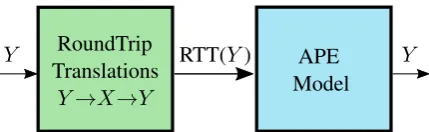
We formalize our APE model as a translation model from synthetic “translationese” ( Geller-stam, 1986) text in one language to natural text in the same language. For a language pair (X,Y) and a monolingual corpusMY in languageY, the
training procedure is as follows:
1. Train two translation models on bitext for
X→Y andY→X
2. Use these models to generate round-trip translations for every target-language sen-tence y in MY, resulting in the synthetic
dataset RTT(MY).
3. Train a translation model on pairs of
(RTT(y), y), that translates from the round-tripped version of a sentence to its original form.
This procedure is illustrated in Figure1.
RoundTrip Translations
Y→X→Y
APE Model
[image:2.595.309.524.147.213.2]Y RTT(Y) Y
Figure 1: Training procedure of our APE model with RTT in languageY.
2.2 Application
Given a trained translation model and a trained APE model, the procedure is simply to a) trans-late any source text from languageXto language
Y with the translation model, and b) post-edit the output of the translation by passing it through the APE model. In this sense, the APE model may also be viewed as a paraphrasing model to produce “naturalized” text. This procedure is illustrated in Figure2.
NMT
X→Y
APE Model
X Y Y
Figure 2: Automatic Post-Editing (APE) as post-processor of NMT.
3 Experimental Setup
3.1 Architecture
For the translation models, we use the trans-former implementation in lingvo (Shen et al.,
2019), using the transformer-base model size for Romanian→English and transformer-big model size (Vaswani et al., 2017) for German→English and French→English. The reverse mod-els, English→Romanian, English→German and English→French, are all transformer-big. All use a vocabulary of 32k subword units, and exponen-tially moving averaging of checkpoints (EMA de-cay) with the weight decrease parameter set to
α= 0.999(Buduma and Locascio,2017).
with lingvo. For the German and the French APE models, we use the transformer-big size, whereas for the Romanian APE model, we use the smaller transformer-base setup as we have less monolin-gual data.
3.2 Evaluation
We report BLEU(Papineni et al.,2002) and human evaluations. All BLEUscores are calculated with sacreBLEU (Post,2018)1.
Since 2014, the organizers of the WMT evalua-tion campaign (Bojar et al.,2017) have created test sets with the following method: first, they crawled monolingual data in both English and the target language from news stories from online sources. Thereafter they took about 1500 English sentences and translated them into the target language, and an additional 1500 sentences from the target lan-guage and translated them into English. This re-sults in test sets of about 3000 sentences for each English-X language pair. The sgm files of each WMT test set include the original language for each sentence.
Therefore, in addition to reporting overall BLEUscores on the different test sets, we also
re-port results on the two subsets (based on the orig-inal language) of each newstest20XX, which we call the{German,French,Romanian}-original and English-original halves of the test set. This is mo-tivated byKoppel and Ordan(2011), who demon-strated that they can train a simple classifier to distinguish human-translated text from natural text with high accuracy. These text categorization ex-periments suggest that both the source language and the mere fact of being translated play a cru-cial role in the makeup of a translated text. One of the major goals of our APE model is to rephrase the NMT output in a more natural way, aiming to remove undesirable translation artifacts that have been introduced.
To collect human rankings, we present each out-put to crowd-workers, who were asked to score each sentence on a 5-point scale for:
• fluency: How do you judge the overall natu-ralness of the utterance in terms of its gram-matical correctness and fluency?
Further, we included the source sentence and asked the raters to evaluate each sentence on a 2-point scale (binary decision) for:
1sacreBLEU signatures: BLEU+case.mixed+lang.en-LANG+numrefs.1+smooth.exp+SET+tok.intl+version.1.2.20
• accuracy: Does the statement factually con-tradict anything in the reference information?
Each task was given to three different raters. Consequently, each output has a separate score for each question that is the average of 3 different rat-ings.
3.3 Data
For the round-trip experiments we use the mono-lingual News Crawl data from the WMT evalua-tion campaign. We remove duplicates and apply a max-length filter on the source sentences and the round-trip translations, filtering to the minimum of 500 characters or 70 tokens. For German, we con-catenate all News Crawl data from 2007 to 2017, comprising 216.5M sentences after filtering and removing duplicates. For Romanian, we use News Crawl ’16, comprising 2.2M sentences after filter-ing and deduplication. For French, we concatenate News Crawl data from 2007 to 2014, comprising 34M sentences after filtering.
Our translation models are trained on WMT18 (∼5M sentences for German after filtering), WMT16 (∼0.5M sentences for Romanian after fil-tering) and WMT15 (∼41M sentences for French) bitext. For Romanian and German we filter sen-tence pairs that have empty source or target, that have source or target longer than 250 tokens, or the ratio of whose length is greater than 2.0. For English→German and English→French, we also build a system based on noised back-translation, as inEdunov et al.(2018). We use the same mono-lingual sentences that we used for the APE model to generate the noisy back-translation data.
4 Experiments
4.1 English→German
The results of our English→German experiments are shown in Table 1. We trained the APE model on RTT produced by English→German and German→English NMT models that are only trained on bitext. Applying the APE model on the output of our NMT model also trained on only bi-text improves the BLEUscores by up to 1.5 BLEU
points for newstest2014 and 0.7 BLEU points for
newstest2014 newstest2015 newstest2016 newstest2017 average
Vaswani et al.(2017) 28.4 - -
-Shaw et al.(2018) 29.2 - -
-our bitext 29.2 31.4 35.0 29.4 31.2
+ RTT APE 30.7 31.2 33.6 30.1 31.4
+ RTT APE de-orig only 31.7 32.9 37.2 31.9 33.4
our NBT 33.5 34.4 38.3 32.5 34.7
+ RTT APE 32.5 32.7 35.2 31.3 32.9
[image:4.595.83.517.62.192.2]+ RTT APE de-orig only 34.0 34.5 38.7 33.2 35.1
Table 1: BLEUscores for WMT18 English→German. We apply the same APE model (trained on RTT with bitext
models) for both an NMT system based on pure bitext and an NMT system that uses noised back-translation (NBT) in addition to bitext.
newstest2014 newstest2015 newstest2016 newstest2017 average
orig-de orig-en orig-de orig-en orig-de orig-en orig-de orig-en orig-de orig-en our bitext 28.4 29.4 26.5 33.3 29.9 38.2 25.9 31.6 27.7 33.1
+ RTT APE 34.1 27.6 31.3 30.9 35.7 32.2 32.1 28.5 33.3 29.8 our NBT 35.6 31.3 32.6 34.7 37.6 38.7 31.7 32.6 34.4 34.3 + RTT APE 36.9 28.8 33.5 32.0 38.5 32.9 33.8 29.2 35.7 30.7
Table 2: BLEU scores for WMT18 English→German. Test sets are divided by their original source language
(either German or English).
newstest2016 newstest2017
fluency accuracy fluency accuracy orig-de orig-en orig-de orig-en orig-de orig-en orig-de orig-en baseline bitext 4.65 4.49 95.6% 94.4% 4.74 4.52 97.2% 94.6% + RTT APE 4.77 4.59 98.4% 95.0% 4.84 4.58 98.0% 94.8% our NBT 4.79 4.64 98.2% 95.8% 4.79 4.65 98.2% 95.4% + RTT APE 4.82 4.63 98.0% 96.2% 4.86 4.68 98.0% 96.4% reference 4.85 4.67 98.6% 98.6% 4.83 4.70 98.0% 99.2%
Table 3: English→German human evaluation results split by original language of the test set.
on the English-original half. Consequentially, we applied our APE model only on the sentences with original language in German (+RTT APE de-orig onlyin Table1) and see consistent improvements over all test sets with an average BLEU
improve-ment of 2.2 points.
To verify that the drop in BLEU score is
be-cause of the unnatural reference translations, we run a human evaluation (see Section 3.2) for both fluency/grammatical correctness and accu-racy. Based on the human ratings (Table 3), our APE model also improves on the English-original half of the test set (which is a more realistic use case).
the reference sentences and found that the scores for both fluency and accuracy are only minimally higher than for our APE NBT output.
Comparing only the BLEUscores from our bi-text and NBT models in Table2reveals that aug-menting the parallel data with back-translated data also mostly improves the BLEU scores on the
German-original half of the test set. This is in line with the results of our APE model and opens the question of how much of the original bitext data is natural on the target side.
As our APE model seems agnostic to the model which produced the RTT, we applied it to the best submissions of the recent WMT18 evalua-tion campaign, applying to German-original half of the test set only. Table 4 shows the results for the 2 top submissions of Microsoft ( Junczys-Dowmunt,2018) and Cambridge (Stahlberg et al.,
2018). Both systems improved by up to 0.8 points in BLEU.
Microsoft Cambridge WMT18 submission 48.7 47.2
[image:5.595.310.526.66.196.2]+ APE only de-orig 49.5 47.7
Table 4: BLEUscores for WMT18 English→German
newstest2018. We apply our APE model only on the German-original half of the test set. BLEUscores are calculated on the full newstest2018 set and the English-original half is just copied from the submission.
Finally, we train our APE model on different random subsets of the available 216.5M monolin-gual data (see Figure3). The average BLEUscores on newstest2014-newstest2017 show that we can achieve similar performance by using 24 million training examples only, and that large improve-ments are seen using as few as 4M training ex-amples.
4.2 English→Romanian
Experimental results for the WMT16 English→Romanian task are summarized in Table 5. By applying our APE model on top of a baseline that is only trained on bitext, we see improvements of 3.0 BLEU (dev) and 0.3 BLEU
(test) over our baseline system when we automat-ically post edit only to the Romanian-original half of the test set. Similar to English→German, we apply our APE model on the top 2 submissions of the WMT16 evaluation campaign (Table6). Both the QT21 submission (Peter et al., 2016), which is a system combination of several NMT systems,
27.7
31.8 32.4
33.4 33.4 33.3 33.1
29.0 29.3 29.5
30.0 29.8
Training data size
26.0 28.0 30.0 32.0 34.0 36.0
Bitext 4M 8M 24M 64M 216.5M orig-de avg orig-en avg
Figure 3: English→German - Average BLEUscores for newstest2014-newstest2017: Our APE model is trained on different subsets of the monolingual data.
and the ensemble of the University of Edinburgh (Sennrich et al., 2016a) improve, by 0.3 BLEU
and 0.2 BLEUon test, respectively.
dev test
Sennrich et al.(2016a) - 28.8
our bitext 27.0 28.9 + RTT APE 27.3 29.0 + RTT APE only ro-orig 30.0 29.2
Table 5: BLEU scores for our models on WMT16 English→Romanian.
QT21 Edinburgh WMT16 submission 29.4 28.8
+ RTT APE only ro-orig 29.7 29.0
Table 6: BLEUscores for WMT16 English→Romanian
test set. Our APE model was applied on top of the best WMT16 submissions.
4.3 English→French
Experimental results for English→French are summarized in Table 7. We see the same ten-dency as we saw for German and Romanian. When applying our APE system on the output of the bitext baseline, we get a small improve-ment of 0.1 BLEU. By only post-editing the
[image:5.595.330.502.322.393.2] [image:5.595.310.525.462.507.2]newstest2014
our bitext 43.2
+ RTT APE 43.3
+ RTT APE only fr-orig 44.2
our NBT 45.3
+ RTT APE 44.6
[image:6.595.89.277.61.164.2]+ RTT APE only fr-orig 46.1
Table 7: BLEUscores for WMT15 English→French.
5 Example Output
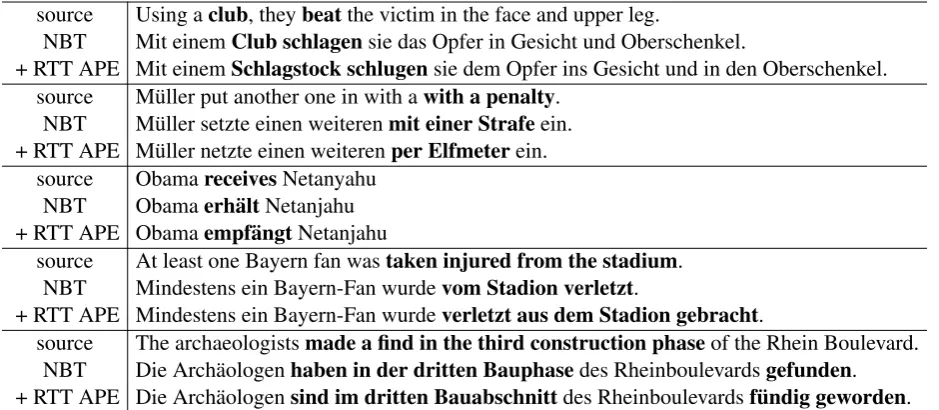
We would like to highlight a few short exam-ples where our APE model improves the NMT translation in German. Although our APE model is also quite helpful for long sentences, we will focus on short examples for the sake of sim-plicity. In Table 8 there are examples from the English→German noised back-translated (NBT) setup (see Table 1), with and without automatic post editing. In the first example, NMT translates
club(i.e. cudgel) incorrectly intoClub(i.e. orga-nization). Based on the context of the sentence, our APE model learned thatclubhas to be trans-lated intoSchlagstock (i.e. cudgel). The next two examples are very similar as our APE model im-proves the word choice of the translations by tak-ing the context of the sentence into account. The NMT translations of the last two examples make little sense and our APE model rephrases the out-put into a fluent, meaningful sentence.
6 Discussion
In this section, we focus on the results on target-language-original test sets, like the English-original subset of newstest2016 (Table2 and Ta-ble3), where the APE model lowered the score by 6 BLEU, yet improved human evaluations. A na¨ıve take-away from this result would be that evalua-tion sets whose target side is natural text are inher-ently superior. However, translatingfrom transla-tionese also has its own problems, including 1) it does not represent any real-world translation task, and 2) translationese sources may be much easier to translate “correctly”, and reward MT biases like word-for-word translation. The take-away, there-fore, must be to report scores both on the source-language-original and the target-source-language-original test sets, rather than lumping two test-sets together into one as has heretofore been done. This gives a higher-precision glimpse into the strengths and
weaknesses of different modeling techniques, and may prevent some effects (like improvements in naturalness of output) from being hidden.
Going forward, our results should also be seen as a call for higher-quality test sets. Multi refer-ence BLEU is one option and less likely to suffer
these biases as acutely, and has previously been used in the NIST projects. Another option could be to align sentence pairs from monolingual data sets in two languages and run human evaluation to exclude bad sentence pairs.
7 Related Work
Automatic Post-Editing
Probably most similar to our work, Junczys-Dowmunt and Grundkiewicz (2016, 2018) uses RTT as additional training data for the automatic post-editing (APE) task of the WMT evaluation campaign (Chatterjee et al.,2018). They claimed that the provided post-editing data is orders of magnitude too small to train neural models, and combined the training data with artificial training data generated with RTT. They found that the addi-tional artificial data helps against early overfitting and makes it possible to overcome the problem of too little training data. In contrast to our work, they do not report results for models only trained on the artificial RTT data. Further, their RTT data is much smaller (10M sentences) compared to ours (up to 200M sentences) and they only report re-sults for the APE subtask.
There have been several earlier approaches us-ing RTT for APE.Hermet and Alain(2009) used RTT to improve a standard preposition error de-tection system. Although their evaluation corpus was limited to 133 prepositions, the hybrid system outperformed their standard method by roughly 13%. Madnani et al. (2012) combined RTT ob-tained from Google Translate via 8 different pivot languages into a lattice for grammatical error cor-rection. Similar to system combination, their final output is extracted by the shortest path scored by different features. They claimed that their prelim-inary experiments yield fairly satisfactory results but leave significant room for improvement.
Back-translation
Specif-source Using aclub, theybeatthe victim in the face and upper leg.
NBT Mit einemClub schlagensie das Opfer in Gesicht und Oberschenkel.
+ RTT APE Mit einemSchlagstock schlugensie dem Opfer ins Gesicht und in den Oberschenkel. source M¨uller put another one in with awith a penalty.
NBT M¨uller setzte einen weiterenmit einer Strafeein. + RTT APE M¨uller netzte einen weiterenper Elfmeterein.
source ObamareceivesNetanyahu NBT Obamaerh¨altNetanjahu + RTT APE Obamaempf¨angtNetanjahu
source At least one Bayern fan wastaken injured from the stadium. NBT Mindestens ein Bayern-Fan wurdevom Stadion verletzt.
+ RTT APE Mindestens ein Bayern-Fan wurdeverletzt aus dem Stadion gebracht.
[image:7.595.71.541.62.267.2]source The archaeologistsmade a find in the third construction phaseof the Rhein Boulevard. NBT Die Arch¨aologenhaben in der dritten Bauphasedes Rheinboulevardsgefunden. + RTT APE Die Arch¨aologensind im dritten Bauabschnittdes Rheinboulevardsf ¨undig geworden.
Table 8: Example output for English→German.
ically, given a set of sentences in the target lan-guage, a pre-constructed T2S translation system is used to generate translations to the source lan-guage. These synthetic sentence pairs are com-bined with the original bilingual data when train-ing the S2T NMT model.
Iterative Back-translation
Iterative back-translation (Zhang et al.,2018; Cot-terell and Kreutzer, 2018;Hoang et al., 2018) is a joint training algorithm to enhance the effect of monolingual source and target data by iteratively boosting the source-to-target and target-to-source translation models. The joint training method uses the monolingual data and updates NMT models through several iterations. A variety of flavors of iterative back-translation have been proposed, in-cludingNiu et al.(2018), who simultaneously per-form iterative S2T and T2S back-translation in a multilingual model, andHe et al.(2016);Xia et al.
(2017), who combine dual learning with phases of back- and forward-translation.
Artetxe et al. (2018a,b) and Lample et al.
(2018a,b) used iterative back-translation to train two unsupervised translation systems in both di-rections (X→Y andY→X) in parallel. Further, they used back-translation to generate a synthetic source to construct a dev set for tuning the parame-ters of their unsupervised statistical machine trans-lation system. In a similar formutrans-lation, Cheng et al.(2016) jointly learn a translation system with a round-trip autoencoder.
Round-tripping and Paraphrasing
Round-trip translation has seen success as a
method to generate paraphrases. Bannard and Callison-Burch (2005) extracted paraphrases by using alternative phase translations from bilingual phrase tables from Statistical Machine Transla-tion.Mallinson et al.(2017) presented PARANET, a neural paraphrasing model based on round-trip translations with NMT. They showed that their paraphrase model outperforms all traditional para-phrase models.
Wu et al. (2018) train a paraphrasing model on (X,RTT(X)) pairs, translating from natural text into a simplified version. They apply this sentence-simplifier on the source sentences of the training data and report quality gains for IWSLT.
Translationese and Artifacts from NMT
ex-tent to which the translation appears to be a natu-ral sentence in the target language) (Warner,2018;
Schleiermacher, 1816; Dryden, 1685). To frame our hypotheses in these terms, the present work hypothesizes that outputs from NMT systems of-ten err on the side of disfluent fidelity, or word-by-word translation.
There are a few papers that discuss the effect of translationese on MT models. Lembersky et al.
(2012); Stymne (2017) explored how the trans-lation direction for statistical machine transtrans-lation affects the translation result. They found that using training and tuning data translated in the same direction as the translation systems tends to give the best results. Holmqvist et al. (2009) noted that the original language of the test sen-tences influences the BLEU score of translations. They showed that the BLEU scores for target-original sentences are on average higher than sen-tences that have their original source in a differ-ent language.Popel(2018) split the WMT Czech-English test set based on the original language. They found that when training on synthetic data, the model performs much better on the Czech-original half than on the non Czech-Czech-original half. When trained on authentic data, it is the other way round.Fomicheva et al.(2017) found that both the average score and Pearson correlation with human judgments is substantially higher when both the MT output and human translation were generated from the same source language.
8 Ablation
8.1 Iterative APE
We can apply our APE model in an iterative fash-ion several times on the same output. In Table9, we applied our APE model on the already post-edited output to see if we can further naturalize the sentences. As a result, 75% of the sentences did not change. The remaining sentences lowered the BLEUscores on average by 0.1 points for German-original half and by 0.7 points for the English-original half of the test sets.
8.2 Reverse APE
Instead of training an APE model on(RTT(y), y)
sentence pairs (see Section 2), we train in this section areverse APEmodel that flips source and target and is trained on(y,RTT(y))sentence pairs. Experimental results can be seen in Ta-ble 10. Overall, the performance decreases on
average
orig-de orig-en our bitext 27.7 33.1
+ APE 33.3 29.8 + 2xAPE 33.2 29.1
Table 9: Average BLEU scores for WMT18 English→German newstest2014-2017. We run our APE model a second time on the output of the already post-editied output.
both the German-original half and the English-original half. Interestingly, the BLEUscores of the reverse APE model on the English-original half are higher than those of the normal APE model. This demonstrates again that sentences evaluated on the English-original half prefer output that is biased by the translation process.
average
orig-de orig-en our bitext 27.7 33.1
+ RTT APE 33.3 29.8 + Reverse APE 25.1 30.6 our NBT 34.4 34.3 + RTT APE 35.7 30.7 + Reverse APE 27.0 31.3
Table 10: Average BLEU scores for WMT18 English→German newstest2014-2017.
8.3 Inside the black box of RTT
In this subsection we are interested in how much RTT changes translation outputs. We calculate the BLEUscores of all English→German test sets (11,175 sentences in total) by taking the original German sentences as references and their RTT as hypotheses. Although the RTT hypotheses are a less clean (paraphrased) version of the references, having been forward-translated from an already noisy back-translated source, the BLEU score is 40.9, with unigram precision of 72.3%, bigram precision of 48.9%, trigram precision of 35.6% and 4gram precision of 26.6%.
on bitext) of the same test sets has a vocabulary size of 30,540, but after running our APE on the same test sets the vocabulary size increases to 31,471. The NMT output from the NBT model has a vocabulary size of 32,170 and its post-edited version increases the number of unique words to 32,283. Overall, we see that both the RTT and the NMT output have a smaller vocabulary size than the original or post-edited versions, and that BLEUscore grows directly with increased number
of unique tokens in the target side.
9 Conclusion
We propose an APE model that is only trained on RTT and increases the quality of NMT transla-tions, measured both by BLEUand human evalu-ation. We see improvements both when automati-cally post editing our model translations and when automatically post editing outputs from the win-ning submissions to the WMT competition. Our APE has the advantage that it is agnostic to the model which produced the translations, and so can be used on top of any new advance in the field, without need for re-training. Further, we demon-strate that we need only a subset of 24M training examples to train our APE model. We further-more use this model as a tool to reveal system-atic problems with reference translations, and pro-pose finer-grained BLEUreporting on both source-language-original test sets and target-language-original test sets, as well as calling for higher-quality and multi-reference test sets.
References
Mikel Artetxe, Gorka Labaka, and Eneko Agirre. 2018a. Unsupervised Statistical Machine Transla-tion. InProceedings of the 2018 Conference on
Em-pirical Methods in Natural Language Processing,
pages 3632–3642.
Mikel Artetxe, Gorka Labaka, Eneko Agirre, and Kyunghyun Cho. 2018b. Unsupervised Neural Ma-chine Translation. InInternational Conference on Learning Representations.
Dzmitry Bahdanau, Kyunghyun Cho, and Yoshua Ben-gio. 2015. Neural Machine Translation by Jointly Learning to Align and Translate. In 3rd Inter-national Conference on Learning Representations,
ICLR 2015.
Mona Baker. 1993. Corpus Linguistics and Transla-tion Studies: ImplicaTransla-tions and ApplicaTransla-tions. Text
and technology: in honour of John Sinclair, pages
233–252.
Colin Bannard and Chris Callison-Burch. 2005. Para-phrasing with Bilingual Parallel Corpora. In Pro-ceedings of the 43rd Annual Meeting on Association for Computational Linguistics, pages 597–604.
Ondˇrej Bojar, Rajen Chatterjee, Christian Federmann, Yvette Graham, Barry Haddow, Shujian Huang, Matthias Huck, Philipp Koehn, Qun Liu, Varvara Logacheva, et al. 2017. Findings of the 2017 Conference on Machine Translation (WMT17). In
Proceedings of the Second Conference on Machine Translation, pages 169–214.
Thorsten Brants, Ashok C Popat, Peng Xu, Franz J Och, and Jeffrey Dean. 2007.Large Language Mod-els in Machine Translation. In Proceedings of the 2007 Joint Conference on Empirical Methods in Natural Language Processing and Computational
Natural Language Learning (EMNLP-CoNLL).
Nikhil Buduma and Nicholas Locascio. 2017.
Fundamentals of Deep Learning: Designing
Next-Generation Machine Intelligence Algorithms. “O’Reilly Media, Inc.”.
Rajen Chatterjee, Matteo Negri, Raphael Rubino, and Marco Turchi. 2018. Findings of the WMT 2018 Shared Task on Automatic Post-Editing. In Pro-ceedings of the Third Conference on Machine Trans-lation: Shared Task Papers, pages 710–725.
Yong Cheng, Wei Xu, Zhongjun He, Wei He, Hua Wu, Maosong Sun, and Yang Liu. 2016. Semi-Supervised Learning for Neural Machine Transla-tion. InProceedings of the 54th Annual Meeting of the Association for Computational Linguistics, vol-ume 1, pages 1965–1974.
Ryan Cotterell and Julia Kreutzer. 2018. Explain-ing and GeneralizExplain-ing Back-Translation through Wakesleep. arXiv preprint arXiv:1806.04402.
Tobias Domhan and Felix Hieber. 2017.Using Target-side Monolingual Data for Neural Machine Transla-tion through Multi-task Learning. InProceedings of the 2017 Conference on Empirical Methods in
Nat-ural Language Processing, pages 1500–1505.
John Dryden. 1685. Sylvae [Translator’s preface]. A Scolar Press facsimile. Scolar Press.
Sergey Edunov, Myle Ott, Michael Auli, and David Grangier. 2018. Understanding Back-Translation at Scale. InProceedings of the 2018 Conference on Empirical Methods in Natural Language Processing
(EMNLP), pages 489–500.
Marina Fomicheva et al. 2017.The Role of Human Ref-erence Translation in Machine Translation Evalua-tion. Ph.D. thesis, Universitat Pompeu Fabra.
Jonas Gehring, Michael Auli, David Grangier, Denis Yarats, and Yann N. Dauphin. 2017. Convolutional Sequence to Sequence Learning. In Proceedings of the 34th International Conference on Machine
Martin Gellerstam. 1986. Translationese in Swedish novels translated from English. Translation Studies in Scandinavia, pages 88–95.
C¸ a˘glar G¨ulc¸ehre, Orhan Firat, Kelvin Xu, Kyunghyun Cho, Loic Barrault, Huei-Chi Lin, Fethi Bougares, Holger Schwenk, and Yoshua Bengio. 2015. On us-ing Monolus-ingual Corpora in Neural Machine Trans-lation. arXiv preprint arXiv:1503.03535.
C¸ a˘glar G¨ulc¸ehre, Orhan Firat, Kelvin Xu, Kyunghyun Cho, and Yoshua Bengio. 2017. On Integrating a Language Model into Neural Machine Translation.
Comput. Speech Lang., pages 137–148.
Di He, Yingce Xia, Tao Qin, Liwei Wang, Nenghai Yu, Tieyan Liu, and Wei-Ying Ma. 2016. Dual Learn-ing for Machine Translation. InConference on Ad-vances in Neural Information Processing Systems (NeurIPS).
Matthieu Hermet and D´esilets Alain. 2009.Using First and Second Language Models to Correct Preposition Errors in Second Language Authoring. In Proceed-ings of the Fourth Workshop on Innovative Use of
NLP for Building Educational Applications, pages
64–72.
Vu Cong Duy Hoang, Philipp Koehn, Gholamreza Haf-fari, and Trevor Cohn. 2018. Iterative Backtransla-tion for Neural Machine TranslaBacktransla-tion. In Proceed-ings of the 2nd Workshop on Neural Machine Trans-lation and Generation, volume 1, pages 18–24.
Maria Holmqvist, Sara Stymne, Jody Foo, and Lars Ahrenberg. 2009. Improving Alignment for SMT by Reordering and Augmenting the Training Cor-pus. InProceedings of the Fourth Workshop on Sta-tistical Machine Translation, pages 120–124. Asso-ciation for Computational Linguistics.
Marcin Junczys-Dowmunt. 2018.Microsoft’s Submis-sion to the WMT2018 News Translation Task: How I Learned to Stop Worrying and Love the Data. In
Proceedings of the Third Conference on Machine
Translation, Volume 2: Shared Task Papers, pages
429–434. Association for Computational Linguis-tics.
Marcin Junczys-Dowmunt and Roman Grundkiewicz. 2016. Log-linear Combinations of Monolingual and Bilingual Neural Machine Translation Models for Automatic Post-Editing. InProceedings of the First Conference on Machine Translation: Volume 2, Shared Task Papers, pages 751–758.
Marcin Junczys-Dowmunt and Roman Grundkiewicz. 2018. MS-UEdin Submission to the WMT2018 APE Shared Task: Dual-Source Transformer for Au-tomatic Post-Editing. In Proceedings of the Third Conference on Machine Translation: Shared Task Papers, pages 822–826.
Moshe Koppel and Noam Ordan. 2011. Translationese and Its Dialects. InProceedings of the 49th Annual
Meeting of the Association for Computational Lin-guistics: Human Language Technologies - Volume 1, pages 1318–1326.
Guillaume Lample, Alexis Conneau, Ludovic Denoyer, and Marc’Aurelio Ranzato. 2018a. Unsupervised Machine Translation Using Monolingual Corpora Only. InInternational Conference on Learning Rep-resentations.
Guillaume Lample, Myle Ott, Alexis Conneau, Lu-dovic Denoyer, and Marc’Aurelio Ranzato. 2018b. Phrase-Based & Neural Unsupervised Machine Translation. InProceedings of the 2018 Conference on Empirical Methods in Natural Language
Pro-cessing (EMNLP).
Gennadi Lembersky, Noam Ordan, and Shuly Wintner. 2012. Language Models for Machine Translation: Original vs. Translated Texts. Computational Lin-guistics, 38(4).
Nitin Madnani, Joel Tetreault, and Martin Chodorow. 2012. Exploring grammatical error correction with not-so-crummy machine translation. InProceedings of the Seventh Workshop on Building Educational
Applications Using NLP, pages 44–53. Association
for Computational Linguistics.
Jonathan Mallinson, Rico Sennrich, and Mirella Lap-ata. 2017. Paraphrasing Revisited with Neural Ma-chine Translation. InProceedings of the 15th Con-ference of the European Chapter of the Association for Computational Linguistics: Volume 1, Long Pa-pers, volume 1, pages 881–893.
Xing Niu, Michael Denkowski, and Marine Carpuat. 2018. Bi-Directional Neural Machine Translation with Synthetic Parallel Data. InProceedings of the 2nd Workshop on Neural Machine Translation and Generation, pages 84–91.
Kishore Papineni, Salim Roukos, Todd Ward, and Wei-Jing Zhu. 2002. BLEU: a Method for Automatic Evaluation of Machine Translation. InProceedings of the 40th annual meeting on association for com-putational linguistics, pages 311–318. Association for Computational Linguistics.
Jan-Thorsten Peter, Tamer Alkhouli, Hermann Ney, Matthias Huck, Fabienne Braune, Alexander Fraser, Aleˇs Tamchyna, Ondˇrej Bojar, Barry Haddow, Rico Sennrich, Fr´ed´eric Blain, Lucia Specia, Jan Niehues, Alex Waibel, Alexandre Allauzen, Lauri-ane Aufrant, Franck Burlot, elena knyazeva, Thomas Lavergne, Franc¸ois Yvon, M¯arcis Pinnis, and Stella Frank. 2016. The QT21/HimL Combined Ma-chine Translation System. In Proceedings of the
First Conference on Machine Translation (WMT16),
pages 344–355.
21st Annual Conference of the European Associa-tion for Machine TranslaAssocia-tion, pages 249–258.
Martin Popel. 2018. CUNI Transformer Neural MT System for WMT18. InProceedings of the Third Conference on Machine Translation: Shared Task Papers, pages 482–487.
Matt Post. 2018. A Call for Clarity in Reporting Bleu Scores. InProceedings of the Third Conference on
Machine Translation: Research Papers, pages 186–
191.
Friedrich Schleiermacher. 1816. Uber die verschiede-¨ nen Methoden des ¨Ubersetzens. Abhandlungen der K¨oniglichen Akademie der Wissenschaften in Berlin. Walter de Gruyter GmbH.
Larry Selinker. 1972. Interlanguage. International Re-view of Applied Linguistics, pages 209–241.
Rico Sennrich, Barry Haddow, and Alexandra Birch. 2016a. Edinburgh Neural Machine Translation Sys-tems for WMT 16. InProceedings of the First
Con-ference on Machine Translation, pages 371–376.
Rico Sennrich, Barry Haddow, and Alexandra Birch. 2016b. Improving Neural Machine Translation Models with Monolingual Data. InProceedings of the 54th Annual Meeting of the Association for
Com-putational Linguistics (Volume 1: Long Papers),
pages 86–96.
Peter Shaw, Jakob Uszkoreit, and Ashish Vaswani. 2018. Self-Attention with Relative Position Repre-sentations. InProceedings of the 2018 Conference of the North American Chapter of the Association for Computational Linguistics: Human Language Technologies, pages 464–468.
Jonathan Shen, Patrick Nguyen, Yonghui Wu, Zhifeng Chen, Mia X. Chen, Ye Jia, Anjuli Kannan, Tara N. Sainath, and Yuan Cao et al. 2019. Lingvo: a Modular and Scalable Framework for Sequence-to-Sequence Modeling. CoRR, abs/1902.08295.
Felix Stahlberg, Adri de Gispert, and Bill Byrne. 2018. The University of Cambridge’s Machine Transla-tion Systems for WMT18. In Proceedings of the Third Conference on Machine Translation, Volume
2: Shared Task Papers, pages 508–516.
Sara Stymne. 2017. The Effect of Translationese on Tuning for Statistical Machine Translation. InThe 21st Nordic Conference on Computational Linguis-tics, pages 241–246.
Gideon Toury. 1995. Descriptive Translation Studies and Beyond. Benjamins translation library. John Benjamins Publishing Company.
Ashish Vaswani, Noam Shazeer, Niki Parmar, Jakob Uszkoreit, Llion Jones, Aidan N Gomez, Łukasz Kaiser, and Illia Polosukhin. 2017. Attention Is All You Need. InAdvances in Neural Information Pro-cessing Systems, pages 5998–6008.
Marina Warner. 2018. The Politics of Translation.
London Review of Books, 40 no. 19:22.
Tian Wu, Zhongjun He, Enhong Chen, and Haifeng Wang. 2018. Improving Neural Machine Transla-tion with Neural Sentence Rewriting. In2018 Inter-national Conference on Asian Language Processing (IALP).
Yingce Xia, Tao Qin, Wei Chen, Jiang Bian, Nenghai Yu, and Tie-Yan Liu. 2017. Dual Supervised Learn-ing. InInternational Conference on Machine Learn-ing (ICML).
Zhirui Zhang, Shujie Liu, Mu Li, Ming Zhou, and En-hong Chen. 2018. Joint Training for Neural Ma-chine Translation Models with Monolingual Data.
InThirty-Second AAAI Conference on Artificial