145
UdS Submission for the WMT 19 Automatic Post-Editing Task
Hongfei Xu Saarland University
DFKI
Qiuhui Liu
China Mobile Online Services
Josef van Genabith Saarland University
DFKI
josef.van [email protected]
Abstract
In this paper, we describe our submission to the English-German APE shared task at WMT 2019. We utilize and adapt an NMT architec-ture originally developed for exploiting con-text information to APE, implement this in our own transformer model and explore joint train-ing of the APE task with a de-noistrain-ing encoder.
1 Introduction
The Automatic Post-Editing (APE) task is to au-tomatically correct errors in machine translation outputs. This paper describes our submission to the English-German APE shared task at WMT 2019. Based on recent research on the APE task (Junczys-Dowmunt and Grundkiewicz,2018) and an architecture for the utilization of document-level context information in neural machine trans-lation (Zhang et al., 2018b), we re-implement a multi-source transformer model for the task. In-spired by Cheng et al. (2018), we try to train a more robust model by introducing a multi-task learning approach which jointly trains APE with a de-noising encoder.
We made use of the artificial eScape data set (Negri et al., 2018) provided for the task, since the multi-source transformer model contains a large number of parameters and training with large amounts of supplementary synthetic data can help regularize its parameters and make the model more general. We then tested the BLEU scores be-tween machine translation results and correspond-ing gold standard post-editcorrespond-ing results on the orig-inal development set, the training set and the syn-thetic data as shown in Table1.
dev train eScape 77.15 77.42 37.68
Table 1: BLEU Scores of Data Sets
Table1shows that there is a significant gap be-tween the synthetic eScape data set (Negri et al., 2018) and the real-life data sets (the develop-ment set and the original training set from post-editors), potentially because Negri et al. (2018) generated the data set in a different way compared to Junczys-Dowmunt and Grundkiewicz (2016) and very few post-editing actions are normally re-quired due to the good translation quality of neu-ral machine translation (Bahdanau et al., 2014; Gehring et al.,2017;Vaswani et al.,2017) which significantly reduces errors in machine translation results and makes the post-editing results quite similar to raw machine translation outputs.
2 Our Approach
We simplify and employ a multi-source trans-former model (Zhang et al., 2018b) for the APE task, and try to train a more robust model through multi-task learning.
2.1 Our Model
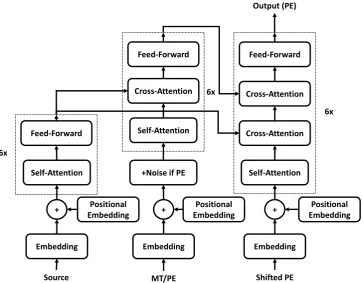
The transformer-based model proposed byZhang et al.(2018b) for utilizing document-level context information in neural machine translation has two source inputs which can also be a source sentence along with the corresponding machine translation output and therefore caters for the requirements of APE. Since both source sentence and machine translation outputs are important for the APE task (Pal et al.,2016;Vu and Haffari,2018), we remove the context gate used to restrict the information flow from the first input to the final output in their architecture, and obtain the model we used for our submission shown in Figure1.
Positional Embedding 6x
6x
Embedding Self-Attention Feed-Forward
6x
Cross-Attention Cross-Attention
Embedding + Self-Attention Feed-Forward
Cross-Attention
Embedding
+ +
Self-Attention Feed-Forward
Positional Embedding Positional
Embedding
+Noise if PE
Source MT/PE Shifted PE
[image:2.595.118.482.62.345.2]Output (PE)
Figure 1: Our Transformer-Based Multi-Source Model for the APE Task
layer), attending to the source sentence (with a cross-attention layer) and processing the collected information (with a feed-forward neural network). Finally, the decoder attends to representations of the source sentence and the machine translation result and generates the post-editing result.
Compared to the multi-source transformer model used by Junczys-Dowmunt and Grund-kiewicz (2018), this architecture has one more cross-attention module in the encoder for machine translation outputs to attend to the source input which makes the parameter sharing of layers be-tween two encoders impossible, but we think this cross-attention module can help the de-noising task. The embedding of source, machine transla-tion outputs and post-editing results is still shared as Junczys-Dowmunt and Grundkiewicz (2018) advised.
2.2 Joint Training with De-noising Encoder
Table1 shows a considerable difference between the synthetic data set (Negri et al.,2018) and the real data set. To enable the model to handle more kinds of errors, we simulate new “machine trans-lation outputs” through adding noise to the cor-responding post-editing results. FollowingCheng et al.(2018), we add noise directly to the look-up embedding of post-editing results instead of
ma-nipulating post-editing sequences.
Since the transformer (Vaswani et al., 2017) does not apply any weight regularization, we as-sume that the model can easily learn to reduce noise by enlarging weights, and propose to add adaptive noise to the embedding:
embout=emb+strength∗abs(emb)∗N (1)
whereembis the embedding matrix,strength is a number between [0.0,+∞) to control the strength of noise, N is the noise matrix of the same shape as emb. We explore both standard Gaussian distribution and uniform distribution of
[−1.0,−1.0] as N. In this way the noise will automatically grow with the growing embedding weights.
Given that the transformer translation model (Vaswani et al.,2017) incorporates word order in-formation through adding positional embedding to word embedding, we add noise to the combined embedding. In this case, the noise can both affect the word embedding (replacing words with their synonyms) and positional embedding (swapping word orders).
while those for the de-noising encoder task are
{source, pe+noise, pe}where “source”, “mt” and “pe” stand for the source sentence, the correspond-ing output from the machine translation system and the correct post-editing result. The final loss for joint training is:
loss=λ∗lossape+ (1−λ)∗lossde−noising (2)
i.e. the loss between the APE task and the de-noising encoder task are balanced byλin this way.
3 Experiments
We implemented our approaches based on the Neutron implementation (Xu and Liu, 2019) for transformer-based neural machine translation.
3.1 Data and Settings
We only participated in the English to German task, and we used both the training set provided by WMT and the synthetic eSCAPE corpus ( Ne-gri et al., 2018). We first re-tokenized1 and true-cased both data sets with tools provided by Moses (Koehn et al., 2007), then cleaned the data sets with scripts ported from the Neutron implementa-tion, and the original training set was up-sampled
20 times as in (Junczys-Dowmunt and Grund-kiewicz, 2018). We applied joint Byte-Pair En-coding (Sennrich et al.,2016) with40kmerge op-erations and50as the vocabulary threshold for the BPE. We only kept sentences with a max of 256
sub-word tokens for training, and obtained a train-ing set of about 6.5M triples with a shared vo-cabulary of42476. We did not apply any domain adaptation approach for our submission consid-ering that (Junczys-Dowmunt and Grundkiewicz, 2018) shows few improvements, but advanced do-main adaption (Wang et al.,2017) or fine-tuning (Luong and Manning, 2015) methods may still bring some improvements. The training set was shuffled for each training epoch.
Like Junczys-Dowmunt and Grundkiewicz (2018), all embedding matrices were bound with the weight of the classifier. But for tokens which in fact do never appear in post-editing outputs in the shared vocabulary, we additionally remove their weights in the label smoothing loss and set corre-sponding biases in the decoder classifier to−1032. Unlike Zhang et al. (2018b), the source en-coder, the machine translation encoder and the de-coder had6 layers. The hidden dimension of the
1using arguments: -a -no-escape
position-wise feed-forward neural network was
2048, the embedding dimension and the multi-head attention dimension were 512. We used a dropout probability of 0.1, and employed label smoothing (Szegedy et al.,2016) value of 0.1. We used the Adam optimizer (Kingma and Ba,2015) with0.9,0.98and10−9asβ1,β2and. The learn-ing rate schedule fromVaswani et al.(2017) with
8,000 as the number of warm-up steps2 was ap-plied. We trained our models for only 8 epochs with at least 25k post-editing tokens in a batch, since we observed over-fitting afterwards. For the other hyper parameters, we used the same as the transformer base model (Vaswani et al.,2017).
During training, we kept the last20checkpoints saved with an interval of 1,500 training steps (Vaswani et al., 2017; Zhang et al., 2018a), and obtained4models for each run through averaging every5adjacent checkpoints.
For joint training, we simply used 0.2 as the strength of noise (strength), and0.5asλfor joint training. Other values may provide better perfor-mance, but we did not have sufficient time to try this for our submission.
During decoding, we used a beam size of 4
without any length penalty.
3.2 Results
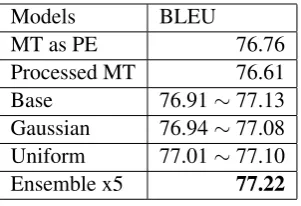
We first evaluated case-sensitive BLEU scores3 on the development set, and results of all our ap-proaches and baselines are shown in Table2.
“MT as PE” is the do-nothing baseline which takes the machine translation outputs directly as post-editing results. “Processed MT” is the machine translation outputs through pre-processing (re-tokenizing and truecasing) and post-processing (de-truecasing and re-tokenizing without “-a” argument4) but without APE. “Base”, “Gaussian” and “Uniform” stand for our model trained only for the APE task, jointly trained with Gaussian noise and uniform noise, respec-tively. We reported the minimum and the maxi-mum BLEU scores of the 4 averaged models for
2
https://github.com/tensorflow/
tensor2tensor/blob/master/tensor2tensor/ models/transformer.py#L1623.
3https://github.com/moses-smt/
mosesdecoder/blob/master/scripts/ generic/multi-bleu.perl.
4“-a” indicates tokenizing in the aggressive mode, which
each experiment. “Ensemble x5” is the ensemble of 5 models from joint training, 4 of which were averaged models with highest BLEU scores on the development set, another one was the model saved for each training epoch with lowest validation per-plexity.
Models BLEU
MT as PE 76.76
Processed MT 76.61 Base 76.91∼77.13 Gaussian 76.94∼77.08 Uniform 77.01∼77.10 Ensemble x5 77.22
Table 2: BLEU Scores on the Development Set
Table2shows that the performance got slightly hurt (comparing “Processed MT” with “MT as PE”) with pre-processing and post-processing pro-cedures which are normally applied in training seq2seq models for reducing vocabulary size. The multi-source transformer (Base) model achieved the highest single model BLEU score without joint training with the de-noising encoder task. We think this is perhaps because there is a gap be-tween the generated machine translation outputs with noise and the real world machine translation outputs, which biased the training.
Even with the ensembled model, our APE approach does not significantly improve ma-chine translation outputs measured in BLEU (+0.46). We think human post-editing results may contain valuable information to guide neu-ral machine translation models in some way like Reinforcement-Learning, but unfortunately, due to the high quality of the original neural machine translation output, only a small part of the real training data in the APE task are actually correc-tions from post editors, and most data are gener-ated from the neural machine translation system, which makes it like adversarial training of neural machine translation (Yang et al., 2018) or multi-pass decoding (Geng et al.,2018).
All our submissions were made by jointly trained models because the performance gap be-tween the best and the worst model of jointly trained models is smaller, which means that jointly trained models may have smaller variance.
Results on the test set from the APE shared task organizers are shown in Table3. Even the ensem-ble of 5 models did not result in significant
differ-ences especially in BLEU scores.
[image:4.595.343.491.86.160.2]Models TER BLEU MT as PE 16.84 74.73 Gaussian 16.79 75.03 Uniform 16.80 75.03 Ensemble x5 16.77 75.03
Table 3: Results on the Test Set
4 Related Work
Pal et al.(2016) applied a multi-source sequence-to-sequence neural model for APE, and Vu and Haffari(2018) jointly trained machine translation with the post editing sequence prediction task ( Be-rard et al.,2017). Though all previous approaches get significant improvements over Statistical Ma-chine Translation outputs, benefits with APE on top of Neural Machine Translation outputs are not very significant (Chatterjee et al.,2018).
On the other hand, advanced neural machine translation approaches may also improve the APE task, such as: combining advances of the recurrent decoder (Chen et al., 2018), the Evolved Trans-former architecture (So et al., 2019), Layer Ag-gregation (Dou et al.,2018) and Dynamic Convo-lution structures (Wu et al.,2019).
5 Conclusion
In this paper, we described details of our ap-proaches for our submission to the WMT 19 APE task. We borrowed a multi-source transformer model from the context-dependent machine trans-lation task and applied joint training with a de-noising encoder task for our submission.
Acknowledgments
Hongfei Xu is supported by a doctoral grant from China Scholarship Council ([2018]3101, 201807040056). This work is supported by the German Federal Ministry of Education and Research (BMBF) under the funding code 01IW17001 (Deeplee). We thank the anonymous reviewers for their instructive comments.
References
[image:4.595.107.258.155.258.2]Alexandre Berard, Laurent Besacier, and Olivier Pietquin. 2017. LIG-CRIStAL submission for the wmt 2017 automatic post-editing task. In Proceed-ings of the Second Conference on Machine Trans-lation, Volume 2: Shared Task Papers, pages 623– 629, Copenhagen, Denmark. Association for Com-putational Linguistics.
Rajen Chatterjee, Matteo Negri, Raphael Rubino, and Marco Turchi. 2018. Findings of the WMT 2018 shared task on automatic post-editing. In Proceed-ings of the Third Conference on Machine Transla-tion, Volume 2: Shared Task Papers, pages 723–738, Belgium, Brussels. Association for Computational Linguistics.
Mia Xu Chen, Orhan Firat, Ankur Bapna, Melvin Johnson, Wolfgang Macherey, George Foster, Llion Jones, Mike Schuster, Noam Shazeer, Niki Parmar, Ashish Vaswani, Jakob Uszkoreit, Lukasz Kaiser, Zhifeng Chen, Yonghui Wu, and Macduff Hughes. 2018. The best of both worlds: Combining recent advances in neural machine translation. In Proceed-ings of the 56th Annual Meeting of the Association for Computational Linguistics (Volume 1: Long Pa-pers), pages 76–86, Melbourne, Australia. Associa-tion for ComputaAssocia-tional Linguistics.
Yong Cheng, Zhaopeng Tu, Fandong Meng, Junjie Zhai, and Yang Liu. 2018. Towards robust neural machine translation. InProceedings of the 56th An-nual Meeting of the Association for Computational Linguistics (Volume 1: Long Papers), pages 1756– 1766, Melbourne, Australia. Association for Com-putational Linguistics.
Zi-Yi Dou, Zhaopeng Tu, Xing Wang, Shuming Shi, and Tong Zhang. 2018. Exploiting deep represen-tations for neural machine translation. In Proceed-ings of the 2018 Conference on Empirical Methods in Natural Language Processing, pages 4253–4262. Association for Computational Linguistics.
Jonas Gehring, Michael Auli, David Grangier, Denis Yarats, and Yann N. Dauphin. 2017. Convolutional sequence to sequence learning. In Proceedings of the 34th International Conference on Machine Learning, volume 70 of Proceedings of Machine Learning Research, pages 1243–1252, International Convention Centre, Sydney, Australia. PMLR.
Xinwei Geng, Xiaocheng Feng, Bing Qin, and Ting Liu. 2018. Adaptive multi-pass decoder for neu-ral machine translation. InProceedings of the 2018 Conference on Empirical Methods in Natural Lan-guage Processing, pages 523–532, Brussels, Bel-gium. Association for Computational Linguistics.
Marcin Junczys-Dowmunt and Roman Grundkiewicz. 2016. Log-linear combinations of monolingual and bilingual neural machine translation models for au-tomatic post-editing. In Proceedings of the First Conference on Machine Translation, pages 751– 758, Berlin, Germany. Association for Computa-tional Linguistics.
Marcin Junczys-Dowmunt and Roman Grundkiewicz. 2018. MS-UEdin submission to the wmt2018 ape shared task: Dual-source transformer for automatic post-editing. InProceedings of the Third Confer-ence on Machine Translation, Volume 2: Shared Task Papers, pages 835–839, Belgium, Brussels. As-sociation for Computational Linguistics.
Diederik P. Kingma and Jimmy Ba. 2015. Adam: A method for stochastic optimization. In 3rd Inter-national Conference on Learning Representations, ICLR 2015, San Diego, CA, USA, May 7-9, 2015, Conference Track Proceedings.
Philipp Koehn, Hieu Hoang, Alexandra Birch, Chris Callison-Burch, Marcello Federico, Nicola Bertoldi, Brooke Cowan, Wade Shen, Christine Moran, Richard Zens, Chris Dyer, Ondrej Bojar, Alexandra Constantin, and Evan Herbst. 2007. Moses: Open source toolkit for statistical machine translation. In Proceedings of the 45th Annual Meeting of the As-sociation for Computational Linguistics Companion Volume Proceedings of the Demo and Poster Ses-sions, pages 177–180, Prague, Czech Republic. As-sociation for Computational Linguistics.
Minh-Thang Luong and Christopher D. Manning. 2015. Stanford neural machine translation systems for spoken language domain. InInternational Work-shop on Spoken Language Translation, Da Nang, Vietnam.
Matteo Negri, Marco Turchi, Rajen Chatterjee, and Nicola Bertoldi. 2018. ESCAPE: a Large-scale Synthetic Corpus for Automatic Post-Editing. In Proceedings of the Eleventh International Confer-ence on Language Resources and Evaluation (LREC 2018), Miyazaki, Japan. European Language Re-sources Association (ELRA).
Santanu Pal, Sudip Kumar Naskar, Mihaela Vela, and Josef van Genabith. 2016. A neural network based approach to automatic post-editing. In Proceed-ings of the 54th Annual Meeting of the Association for Computational Linguistics (Volume 2: Short Pa-pers), pages 281–286, Berlin, Germany. Association for Computational Linguistics.
Rico Sennrich, Barry Haddow, and Alexandra Birch. 2016. Neural machine translation of rare words with subword units. InProceedings of the 54th An-nual Meeting of the Association for Computational Linguistics (Volume 1: Long Papers), pages 1715– 1725. Association for Computational Linguistics.
David R. So, Chen Liang, and Quoc V. Le. 2019. The evolved transformer.CoRR, abs/1901.11117.
Ashish Vaswani, Noam Shazeer, Niki Parmar, Jakob Uszkoreit, Llion Jones, Aidan N Gomez, Ł ukasz Kaiser, and Illia Polosukhin. 2017. Attention is all you need. In I. Guyon, U. V. Luxburg, S. Bengio, H. Wallach, R. Fergus, S. Vishwanathan, and R. Gar-nett, editors, Advances in Neural Information Pro-cessing Systems 30, pages 5998–6008. Curran As-sociates, Inc.
Thuy-Trang Vu and Gholamreza Haffari. 2018. Au-tomatic post-editing of machine translation: A neu-ral programmer-interpreter approach. In Proceed-ings of the 2018 Conference on Empirical Methods in Natural Language Processing, pages 3048–3053, Brussels, Belgium. Association for Computational Linguistics.
Rui Wang, Andrew Finch, Masao Utiyama, and Ei-ichiro Sumita. 2017. Sentence embedding for neural machine translation domain adaptation. In Proceed-ings of the 55th Annual Meeting of the Association for Computational Linguistics (Volume 2: Short Pa-pers), pages 560–566, Vancouver, Canada. Associa-tion for ComputaAssocia-tional Linguistics.
Felix Wu, Angela Fan, Alexei Baevski, Yann Dauphin, and Michael Auli. 2019. Pay less attention with lightweight and dynamic convolutions. In Interna-tional Conference on Learning Representations.
Hongfei Xu and Qiuhui Liu. 2019. Neutron: An Im-plementation of the Transformer Translation Model and its Variants.arXiv preprint arXiv:1903.07402.
Zhen Yang, Wei Chen, Feng Wang, and Bo Xu. 2018. Improving neural machine translation with condi-tional sequence generative adversarial nets. In Proceedings of the 2018 Conference of the North American Chapter of the Association for Computa-tional Linguistics: Human Language Technologies, Volume 1 (Long Papers), pages 1346–1355, New Orleans, Louisiana. Association for Computational Linguistics.
Biao Zhang, Deyi Xiong, and jinsong su jinsong. 2018a. Accelerating neural transformer via an av-erage attention network. InProceedings of the 56th Annual Meeting of the Association for Computa-tional Linguistics (Volume 1: Long Papers), pages 1789–1798. Association for Computational Linguis-tics.