Munich Personal RePEc Archive
Energy efficiency programs in the
context of increasing block tariffs: The
case of residential electricity in Mexico
Hancevic, Pedro and Lopez-Aguilar, Javier
Centro de Investigacion y Docencia Economicas
July 2017
Energy efficiency programs in the context of
increasing block tariffs: The case of residential
electricity in Mexico
Pedro Ignacio Hancevic
∗Javier Alejandro Lopez-Aguilar
†June 30, 2017
Abstract
Increasing block pricing schemes represent difficulties for applied researchers who try to recover demand parameters, in particular, price and income elasticities. The Mexican residential electricity tariff structure is amongst the most intricate around the globe. In this paper, we estimate the residential electricity demand and use the corresponding structural parameter estimates to simulate an energy efficiency improvement scenario, as suggested by the Energy Transition Law of December 2015. The simulated program consists of a massive replacement of electric appliances (air conditioners, fans, refrigerators, washing machines, and light-bulbs) for more energy-efficient units. The main empirical findings are the following: overall residential electricity consumption decreases 8.9% and the asso-ciated expenditure falls 11.1%. Additionally, the electricity subsidy decreases 360 million of USD per year and there is an annual cut in CO2emissions of 3.5 million of tons.
Keywords: increasing block pricing, energy efficiency, residential electricity users, elec-tric appliances, energy subsidies, air pollution
JEL classification:D12, L50, L94, Q40, Q53
∗Centro de Investigaci´on y Docencia Econ´omicas, Mexico. E-mail:[email protected]
†Centro de Investigaci´on y Docencia Econ´omicas, Mexico. E-mail:[email protected]
The Energy Transition Law was enacted in December 2015 (ETL-2015). It mandates the
Mexican Ministry of Energy to undertake technical analysis to evaluate the potential effects
that various energy efficiency measures would have on: (1) electricity subsidy reduction, (2)
household welfare (due to the expected lower electricity bills), and (3) the environment –i.e.,
air pollution and water resources.1 Although some hesitant, non-conclusive, engineering based
reports have been written, there is no economic study that evaluates the potential performance
of the proposed energy efficiency measures.
A very reduced number of papers study energy efficiency in Mexican households (Davis
et al., 2014; Guti´errez-Mendieta, 2016; J. Rosas-Flores, D. Rosas-Flores and D.
Morill´on-G´alvez,2011). In particular,Davis et al. (2014) put under scrutiny and evaluate a large-scale
appliance replacement program in Mexico during the 2009–2012 period.2 Our paper goes
beyond that historical point, and analyzes a set of potential future policy scenarios, which
are expected to happen once the prospective regulations derived from the ETL-2015 become
effective.
With the above objective in mind, we first specify and estimate a structural electricity
de-mand model for residential users in Mexico. We use the corresponding estimates of price and
income elasticities and the coefficients associated to electric appliances as well as other relevant
variables in the demand function, to simulate different energy efficiency scenarios (programs)
that go in line with the ETL-2015 requirements. Concretely, we follow the report by the
Mex-ican Energy Ministry (SENER, 2017b) to assume realistic improved energy efficiency levels
for a selected group of sensible electric appliances: air conditioners, fans, refrigerators,
wash-1The ETL-2015 also requires the conduction of research to evaluate the potential impact of distributed
photo-voltaic generation on the same objective variables –i.e., electricity subsidy, household welfare, and pollution reduction. SeeHancevic et al.(2017) for a complete analysis on this topic.
2Davis et al.(2014) find evidence that refrigerator replacement reduce electricity consumption by 8 percent
ing machines, and light-bulbs. We then estimate the counterfactual electricity consumption
levels, assuming each household re-optimizes its choice after the simulated energy efficiency
measures are applied. Finally, using the results of the empirical exercise just described, we
calculate the effects that improved energy efficiency would have on government savings and
air pollution.
The residential electricity tariff structure in Mexico is very intricate.3 There are seven
differenttariff classesacross the country and eigth tariff regions, which are linked to average
temperatures in a subsidized scheme –i.e. high temperature zones afford lower marginal prices
and have larger consumption blocks. Each tariff class consists of increasing block prices (IBP),
which clearly invalidate any simple estimation strategy that relies on OLS or even traditional
IV methods. In the presence of IBP, consumers face a piecewise-linear budget constraint.
These pricing schemes present a serious simultaneity problem: prices and quantities consumed
are endogenously and simultaneously determined (see, for example,Reiss and White (2005),
Olmstead et al.(2007), or Olmstead (2009)). When the joint decision of marginal price and
quantity is ignored in the demand estimation, price effects are likely to be positively biased.4
Our structural model solves this endogeneity problem and allows us to identify the behavior
of residential users. By the same token, we are able to simulate counterfactual scenarios for
relevant energy efficiency programs.
The main results of this study are the following: on average, the residential electricity
con-sumption and the associated expenditure fall 8.9% and 11.1%, respectively. There is, however,
significant heterogeneity with regards of the final effect across households. The reasons are
threefold: the tariff structure differs across the country (i.e., distinct marginal prices and
differ-ent consumption blocks), the electric appliances under study have uneven penetration levels,
and their potential savings are dissimilar. AC units and refrigerators offer the best
opportuni-3Mexico has one of the most complex tariff and subsidy structures in the world, see for exampleKomives et al.
(2009) andLopez-Calva and Rosell´on(2002).
ties in terms of policy outcomes: they provide the largest consumption savings, 13% and 5%,
respectively. Finally, the electricity subsidy burden is reduced in about 360 million USD/year,
and there is an annual cut in CO2emissions of approximately 3.5 million of metric tons.
The rest of this paper is organized as follows. Section 1 develops the structural demand
model to be estimated later. Section2illustrates the Mexican residential electricity sector and
presents a description of the data used in the empirical analysis. Section3 presents the
esti-mation results. Section4describes the counterfactual scenario and then presents the estimated
impact that improved energy efficiency would have on household electricity consumption, the
residential electricity subsidy, and the environment. Finally, section5concludes the paper.
1
Structural model
In this section we present the structural model of electricity demand. The key feature of the
model is the underlying piecewise linear budget constraint that emerges in the context of IBP.
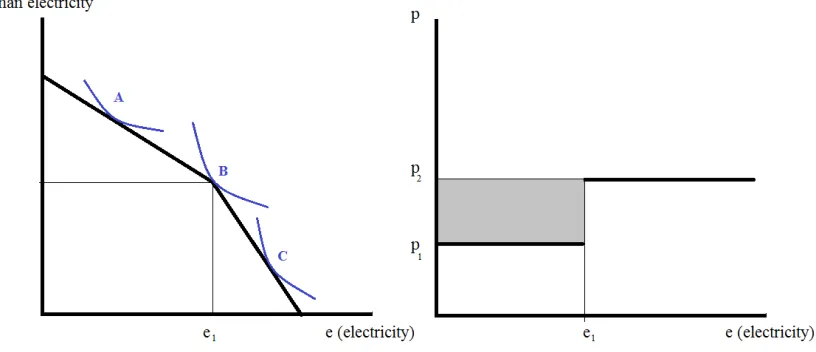
Figure1illustrates this point for a two-block tariff scheme. A consumer can choose a quantity
of electricity in the first block (point A in the left panel of Figure1), where the marginal price
is p1 (right panel). Another possibility is the consumer chooses a quantity in the second
con-sumption block (point C in the left panel) and pays a higher marginal price p2(right panel). A
third possibility is that the consumer choosese1, which is exactly the kink point. The
underly-ing idea is that consumers behaveas if they where making a discrete–continuous choice. They
first select the consumption block, and then, conditional on being in the the selected block,
they choose the quantity of electricity. A maintained assumption in our paper is therefore that
consumers respond to marginal prices.
FIGURE1ABOUT HERE
behave rationally and respond to marginal prices in the context of IBP schemes. In particular,
Borenstein (2009) suggests consumers respond to expected marginal prices, and Ito (2014)
finds evidence that consumers respond to average prices rather than marginal or expected
marginal prices. Both studies use billing panel data for a relatively small geographical area
in Southern California. Although we acknowledge their findings, especially the clean
em-pirical strategy followed by Ito (2014), we are unable to apply his methodology due to data
limitations and cannot formally test the implicit rationality assumption made in our structural
model of consumer choice. On the other hand, Nataraj and Hanemann(2011) find evidence
that water consumers who face IBP do respond to changes in marginal prices. The
discrep-ancy between the results obtained for water and electricity consumption could be, in principle,
due to fundamental differences between the two services (water and electricity cover and
sat-isfy different needs) and/or differences between the price structures under investigation. In any
case, and not just as a simple justification, the above-mentioned piece of evidence for a reduced
area in Southern California (Borenstein,2009;Ito,2014) cannot be directly extrapolated to all
settings and countries. Also, given the data limitations we face, the empirical strategy followed
in this study is still superior than common approaches that use average prices in the context of
OLS regressions or IV specifications (usually based on weak instruments), which ignore the
multi-block structure.
As pointed out in Olmstead (2009), there are two main advantages of structural models
of the sort described above over the traditional reduced-form approaches –either OLS or IV
models. First, structural models (potentially) produce unbiased and consistent estimates of
parameters such as price and income elasticities. Second, they are consistent with a
utility-maximizing behavior and allow the researcher to perform meaningful counterfactual analysis,
such as measurement of welfare changes due to price adjustments or other policy changes.
The structural discrete/continuous choice (DCC) model was originally proposed by
income taxation. In the more specific context of consumer choice, the model was developed
by Hanemann (1984). The typical electricity demand function estimated in most empirical
applications has the following log-log form:
lnejt =α lnpjt+γ lnyjt+Xjt β+vjt (1)
where ejt is the quantity of electricity consumed by the household j in period t, pjt is the
marginal (or sometimes, the average) price of electricity, yjt is the household income, and
Xjt is a vector of variables that includes household characteristics, dwelling characteristics,
weather variables, and several other control variables. Our model closely follows the model
proposed by Hewitt and Hanemann (1995) for water demand, later extended by Olmstead
et al. (2007). It incorporates a compounded error term vjt =ωj+εjt. The first part of the
error, ωj, includes unobserved (to the econometrician) household preferences for electricity
consumption, whereas εjt includes both optimization errors and the traditional measurement
error. We assume thatωj∼N(0,σ2ω)and thatεjt ∼N(0,σ2ε). We also assume that both error
terms are independently distributed. Hence, the compounded errorvjt ∼N 0,σ2ω+σ2ε
.
In the environment of IBP, one must distinguish between conditional and unconditional
demand functions. The former is defined as the quantity the household consumes conditional
on being in themth price block. This is reflected in equation (1) evaluated at the price pmand
thevirtual incomeyˆm=y+δm, whereδm=0 ifm=1, andδm=∑mi=−11(pi+1−pi)eiifm>1.
The termeirefers to the the upper limit of the block (kink point)i. 5
Each household has separate conditional demand functions, one for each block. On the
other hand, there is only one unconditional demand function that characterizes the overall
con-sumption choice. Omitting household and time subscripts, defineeas the observed
consump-5Notice that the shaded area in Figure1representsδ
mevaluated atm=2. This term constitutes the implicit
tion, e∗mas the optimal consumption on blockm, andemas the consumption at the kink point
m. We estimate the unconditional demand function using a Maximum Likelihood approach.
The log-likelihood function is as follows
lnL=
∑
ln M
∑
m=1
"
1
p
2πσ2
v
∗exp −(lne−lne
∗
m)
2
2σ2
v
!#
∗Pr(blockm)
+ M−1
∑
m=1
"
1
p
2πσ2ε ∗exp
−(lne−lnem)2
2σ2ε
!#
∗Pr(kinkm) (2) where
Pr(blockm) =Φ
lnem−lne∗m σω −ρ
lne−lne∗ m σv
p
1−ρ2
!
−Φ
lnem−1−lne∗m σω −ρ
lne−lne∗ m σv
p
1−ρ2
!
and
Pr(kinkm) =Φ
ln
em−lne∗m+1
σω
−Φ
lnem−lne∗m
σω
Φ(.) is the normal CDF and ρ=corr(v,ω). Notice that each observation in the likelihood
function has positive probability of having occurred in any segment and any kink point of the
budget constraint. We use the estimated parameters to calculate the expected unconditional
demand, as well as price and income elasticities.
2
Data and context
Our main source of data is the National Survey of Household Income and Expenditure (ENIGH),
which is collected every two years by the National Institute of Statistics and Geography
(IN-EGI). Specifically, we make use of the surveys 2010, 2012 and 2014. The data collected in
these surveys provide us with certain household and dwelling characteristics –including some
information on the stock of electric appliances–, as well as monthly household expenditures.
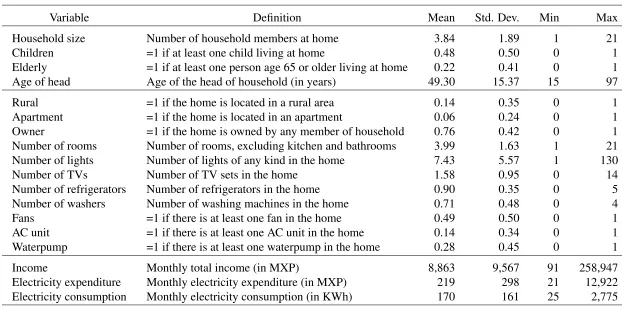
Table1we provide the summary statistics for the relevant variables used in this research.
TABLE1ABOUT HERE
Aside socio-demographic and economic characteristics at the household level, the ENIGH
data include each household electricity expenditure which corresponds to a single billing
pe-riod. This fact allows us to avoid the problems resulting from aggregating consumption data
across billing periods, typically an entire year (see Dubin and McFadden (1984) and Reiss
and White(2005)). Based on household geographic location, we match each household in the
ENIGH with the actual electric rate schedule the household faces. For that purpose, we use
tar-iff data provided by the national electricity company that is in charge of electricity distribution
all across the country (Comisi´on Federal de Electricidad, CFE). We therefore invert the
corre-sponding tariff formula and retrieve the electricity consumption (in kWh) from the electricity
expenditure data provided in the ENIGH.
There are seven different tariff classes (i.e., categories): 1, 1A, 1B, 1C, 1D, 1E and 1F,
which are set by the CFE based on average temperature during summer months at the
munici-pality level. Each tariff class consists of three or four consumption blocks. The corresponding
block lengths and marginal prices differ considerably across tariff classes for both summer
and winter seasons. We use the month of payment reported by household to classify users
between summer and winter tariff structures.6 Another source of price heterogeneity comes
from the fact that we use three different cross sections: 2010, 2012, and 2014, and the CFE
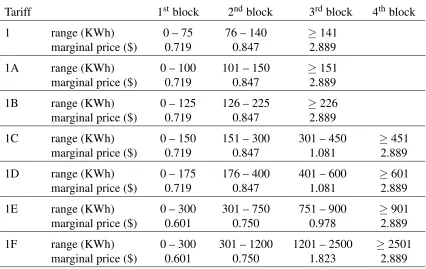
adjusted block marginal prices in each of those years. Table2provides an example for the rate
schedules during Summer 2014.
TABLE2ABOUT HERE
6Billing data reported in the ENIGH correspond to the preceding two months. November to January are the
In addition, each of the seven IBP tariff classes has an associated annual maximum
con-sumption threshold. When the threshold is crossed, the corresponding household is
automati-cally classified as a High-Consumption User (DAC). Analogously, when the sum of
consump-tion in the last 12 months falls below the threshold, a DAC user returns to its original tariff
class. The DAC users afford a two-part tariff that is composed of a fixed charge and a uniform
marginal price, which is applicable to any consumption level and substantially more expensive
than the regular IBP tariffs mentioned before. The consumption limit to become a DAC user
differs across tariff classes and the associated marginal price differs over CFE tariff regions.
Since the ENIGH data do not identify the exact tariff class each household belongs to, we need
to make some additional assumptions in order to establish which households are considered
as DAC users in our sample.7 Concretely, we retrieve monthly consumption for each
house-hold using the corresponding DAC tariff structure and then compare it to an imputed monthly
consumption limit (based on the actual annual limit). All households exceeding this limit are
considered to afford a DAC tariff and consequently, for these households we use this retrieved
consumption instead of the one computed based on the original tariff.
The three cross sections used in this paper add up to 52,580 household observations. Our
final sample comprises 41,779 observations. First, we discarded households that either were
not connected to the electricity grid (3,661) or did not have electricity meter (1,468). Second,
we dropped 2,359 households for which it was impossible to identify their actual one-period
electric bill.8 For other 3,166 cases, it was troublesome to retrieve electricity consumption
because they reported to have non-standard billing periods, paid their last bill long time ago or
reported an expenditure in electricity bellow the minimum possible outlay charged by CFE.9
7Recall we recover electricity consumption from expenditure data.
8This problem typically emerges in the case of multiple-family households. In those cases, it is not clear
whether each family reports the share of the bill they actually pay or the total bill amount. Additionally, some households report paying electric bills for more than one family, or even they report paying more than one bill (several months at once).
9Our final sample comprises only those observations that reported to pay electricity on a bimonthly basis, and
Finally, we dropped 147 observations due to missing values in other sensible variables used in
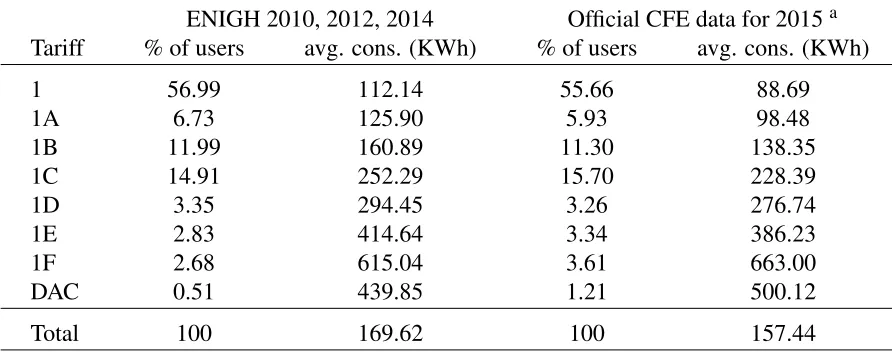
our estimations. Table3shows the final distribution of users and the average consumption by
tariff classes, comparing the estimated values from the ENIGH data with the the corresponding
figures from the CFE official report for the year 2015. The two set of numbers do not differ
substantially, validating our empirical exercise presented later in this paper.
TABLE3ABOUT HERE
3
Electricity demand estimation
As described in section 2, our database provide us with detailed household-level electricity
demand data. We exploit the substantial cross-sectional and time-series variation in prices that
residential users face in order to estimate the structural DCC model of Equation (2). As a
pure academic concern, we have to mention that the price schedule itself could be endogenous:
the schedule changes over time and varies across tariff classes. While these price variation is
very useful for identifying the price coefficient, using the structural model does not solve the
potential endogeneity issue per se. The schedule changes could be correlated with unobserved
demand shocks not captured in our model. There is however a clear fact in the case of Mexico
that supports our exogeneity assumption: in a context of highly subsidized electricity prices,
authorities design tariff schedules from a (partial) cost recovery perspective –i.e., a supply
side decision. Additionally, the inclusion of state fixed effects and year fixed effects helps
mitigate this (unlikely) endogeneity issue since they reduce, to some extent, the unobserved
heterogeneity.
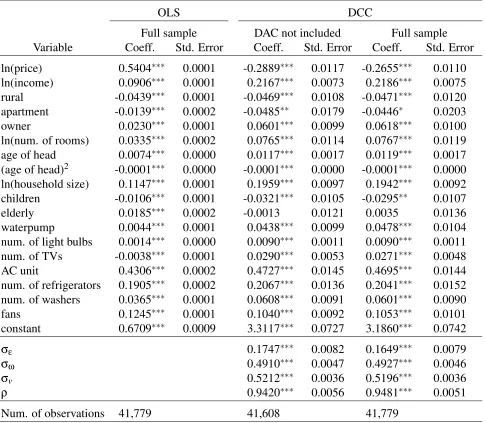
Table4presents the electricity demand models estimates. The first column corresponds to
the simple OLS specification, where the price variable represents the marginal price paid by
that there is a substantial simultaneity (endogeneity) problem, as it was previously explained.
We present two specifications for the DCC model. One excludes the DAC users and the other
makes use of the full sample. As can be seen, the estimates are relatively similar in both DDC
model specifications, validating the exercise we performed to retrieve consumption of DAC
users (see section2). As a result, we will concentrate in the DDC full sample model for the
rest of the paper, which is our baseline specification.
TABLE4ABOUT HERE
Clearly, in the baseline specification all the estimated coefficients are statistically
signifi-cant and have the expected sign, with the only exception being the dummy variable elderly,
which is not significant at any conventional level. The variables that represent electric
appli-ance holdings (i.e., water-pump, AC unit, fans, number of light bulbs, TV sets, refrigerators,
and washers) have a positive impact on household electricity consumption. In particular,
re-frigerators and AC units have sizable effects.
Table5presents the simulated unconditional price and income elasticities for the two DCC
models described before. We depart from Olmstead et al.(2007) and calculate demand
elas-ticities in the following manner: we first simulate an 1% increment in all marginal prices and
re-calculate household virtual income, ˆym, at each block in order to compute a new predicted
consumption. We then compare the counterfactual predicted consumption with the original
predicted consumption. The bootstrapped average difference across households is the reported
price elasticity. We perform a similar routine to calculate the unconditional simulated income
elasticity. This way, in the baseline model the estimated unconditional elasticities are
approxi-mately -.23 and .19 for price and income, respectively.10
10Other short-run estimates of price elasticities in the Mexican residential sector are -0.14 for the State of
TABLE5ABOUT HERE
4
Simulated energy efficiency scenario
In this section we simulate a massive energy efficiency program that is in line with the Energy
Transition Law of December 2015. For that purpose, we select a group of energy-intensive
appliances that are present in a significant number of Mexican households. Following the report
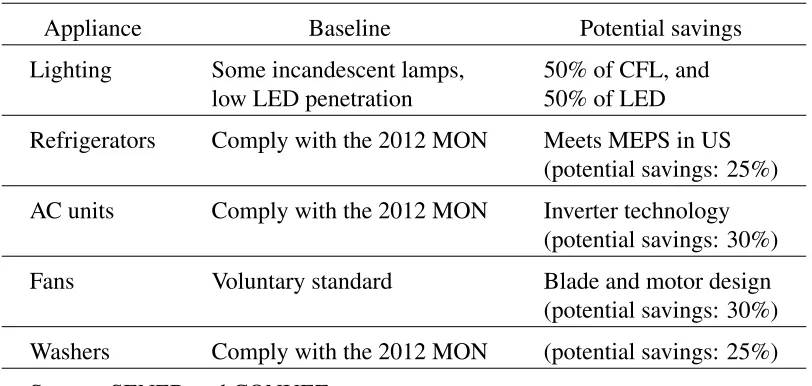
by SENER (2017b), for each appliance we assumepotential savingsin electricity consumption
by comparing known values from the Mexican Official Norms of Energy Efficiency (MON) –or
estimated baselines– with minimum values of energy consumption from international standards
or new technologies. In a majority of cases, the most efficient equipment is already available in
Mexico, although sometimes at a higher cost and with a substantially lower market penetration
than the equipment considered at the baseline. Table 6presents the assumptions of improved
energy consumption for the set of selected electric appliances.
TABLE6ABOUT HERE
For the simulations, we only use the ENIGH 2014 and take advantage of two facts. First,
this cross section distinguish between incandescent (inefficient) and low-consumption lamps
held by the households. Second, data from ENIGH 2014 are more comparable to the 2015
CFE numbers we use to calculate savings in the electricity subsidy and air pollution emissions.
The simulation exercise consists of the following steps:
1. Compute the predicted electricity consumption for each household using the conditional
demand coefficients of the DCC full-sample model (Table4)
2. Recover the compounded error term, ˜vjt, as the difference between the observed
con-sumption and the predicted concon-sumption from step 1
3. For each electric appliance considered separately (except for light-bulbs), modify the
corresponding demand coefficient by imputing the associated energy efficiency factor
(Table6) and then obtain the new predicted consumption
4. Add the estimated error term from step 2 to the new predicted consumption of step 3
5. Compare the original (observed) consumption with the predicted consumption of step 4.
It is worth noting that the predicted consumption derived from the DCC baseline model
(step 1 above) is, in fact, the expected unconditional consumption. As a result, the calculation
of the predicted consumption involves a process of re-estimating the probabilities associated to
each consumption block and each kink point, and that is the case for each household regardless
of the original (observed) consumption level.
In the case of light-bulbs, we simulate a massive adoption scenario of compact fluorescent
lamps (CFL). We assume households replace the incandescent lights with CFL up to the point
of reaching at least 50% CFL penetration, as well as an improvement in energy consumption of
75% of CFL with respect to the old incandescent lamps.11 We then compute the counterfactual
consumption.
There is a number of implicit assumptions (limitations) in the simulation exercise of this
section. First, we do not allow for changes in appliance penetration rates. Hence, all
improve-ments in technology has no effect on adoption.12 Second, we consider the energy efficiency
im-provement in a given appliance affects uniformly all households holding the appliance. Third,
11For instance, this is equivalent to assuming a household replace a 60-watt incandescent lamp with a new
15-watt CFL.
12More specific data on the characteristics of household electric appliances would make possible to estimate
since we do not have information on the brand and model of electric appliance held by the
household, we do not know the ex-ante unit energy consumption (UEC). As a result, the
im-puted energy efficiency improvement factors are simply averaged measures based on technical
reports from CONUEE and SENER.13 In that sense, having detailed data on household
appli-ance holding would substantially improve the quality of this research. Unfortunately, we do
not have such information.14 Nevertheless, our simulation exercise represents a valuable effort
to measure the potential impacts of the ETL-2015.
4.1
Impact on household consumption and expenditure
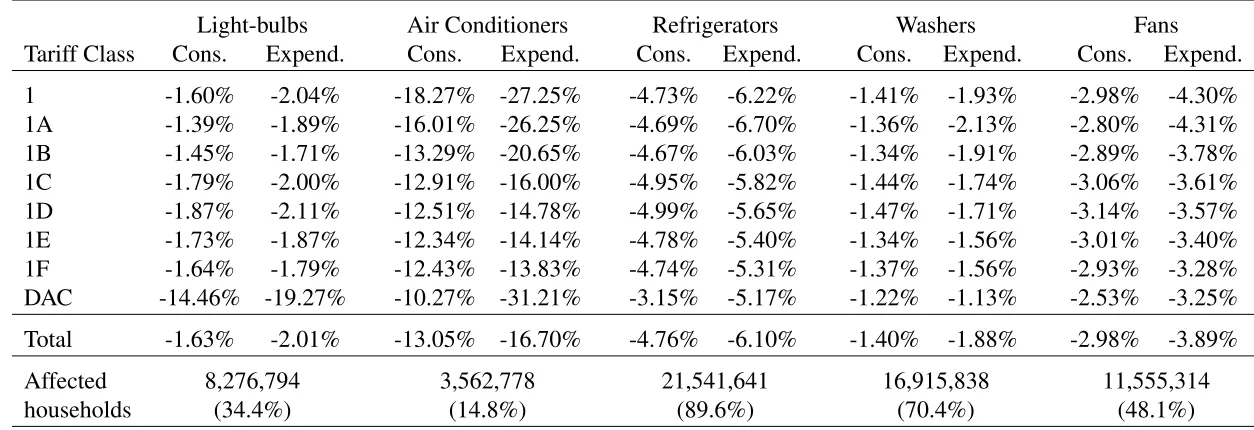
Table 7 presents the impact of the simulated energy efficiency scenario for each appliance
individually considered –i.e., assuming energy efficiency is improved for one appliance at a
time. The table shows the average savings per month in terms of electricity consumption and
expenditure for affected households only –i.e., households that have at least one unit of the
appliance under analysis.15 AC units has the lowest penetration rate (14.8%) but the highest
impact on electricity consumption and expenditure (13% and 16.7% savings, respectively).
Refrigerators, in turn, have the largest penetration rate (89.6%) and the second highest savings
(4.8% and 6.1%).
TABLE7ABOUT HERE
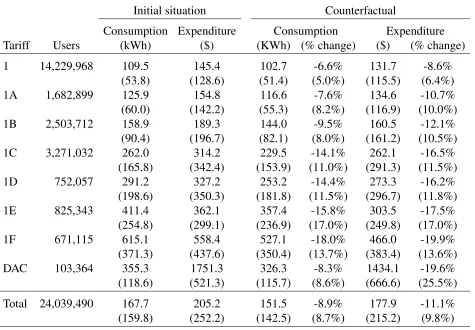
Table 8displays the average savings in terms of consumption and expenditure when
im-provements in energy efficiency occur in all selected appliances simultaneously. In this case,
the results are computed considering the full 2014 sample. In that context, the final impact
13SeeSENER(2017b),LBNL and IIE(2011a) andLBNL and IIE(2011b)
14A great deal of relevant literature on residential energy efficiency is about interventions through frame field
experiments. See for exampleGandhi et al.(2016) orHahn and Metcalfe(2016) for a review on this topic. We recognize the advantages of such an approach, however field experiments are beyond the scope of this research and the comparisons are, to some extent, meaningless given the totally different contexts.
15Recall that we do not consider alternative adoption scenarios, that is to say the current level of appliance
on each household savings will depend on the corresponding stock of appliances. The overall
average consumption savings amount to 16.6 kWh per month, which in monetary terms
repre-sents a reduction of $27.3 in the electricity bill. As can be seen, the savings differ substantially
among the different tariff classes, being 1F users the most benefited. At the other end of the
spectrum, tariff 1 users have, on average, the lowest savings.
TABLE8ABOUT HERE
Notice that savings in expenditure are systematically larger than savings in consumption,
as shown in Tables7and8. In fact, that is a direct consequence of the re-estimation of
proba-bilities associated to different consumption blocks.16 Once the improvements in efficiency take
place, in a significant number of cases households not only consume less but also consume in
a lower block –i.e., they pay a lower marginal price. Table9presents the percentage of
house-holds switching to a lower block once improvements in efficiency occur. It also shows the
cases where DAC users reduce consumption sufficiently to return to the original tariff class.
This constitute a significant advantage of our structural model, which provide us with more
flexibility (and realism).
TABLE9ABOUT HERE
4.2
Impact on government savings
The federal government collects the value-added tax (VAT) which has a 16% rate on electricity
sales. Additionally, most local governments collect a street lighting tax with rates ranging from
5% to 10%. However, the government fiscal outcome derived from the residential electricity
sector operation is a large deficit. Household electricity consumption is heavily subsidized:
16That is a necessary step to recover the expected unconditional consumption levels, a point previously
more than 98% of households receive the electricity subsidy and pay, on average, only 45%
of the overall electricity cost. As a result, the fiscal burden associated to residential electricity
consumption has consistently increased during the last decade and currently represents more
than 0.5% of the Mexican GDP.
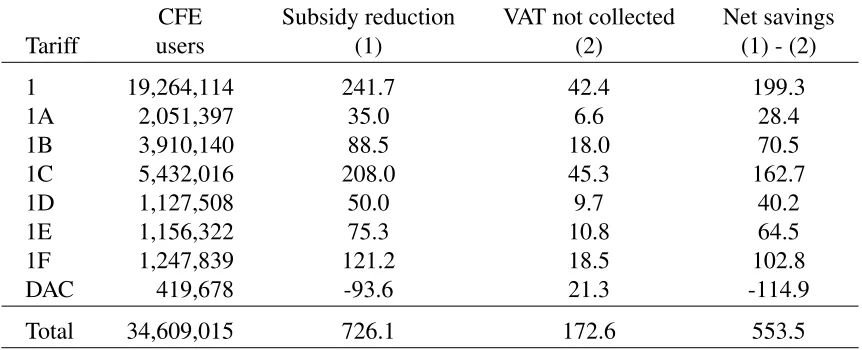
Table 10 displays the effect that the main energy efficiency scenario (i.e., improvements
in energy efficiency occur in all selected appliances simultaneously) would have on federal
government savings. We assume that local governments continue affording the street lighting
costs. The results in the table are calibrated using the actual number of users in each tariff
class according to the CFE official report for the year 2015. The total monthly reduction in the
net subsidy account amounts to 553.5 million of Mexican Pesos (MXP). Although electricity
consumption differs during summer and winter months, a simple (arbitrary and imperfect)
extrapolation of this result would imply annual savings of approximately 6.6 billion of MXP
–i.e., 360 million of USD at the current exchange rate.
TABLE10ABOUT HERE
By decomposing the fiscal outcome into the distinct tariff classes, it is apparent that the bulk
of savings come from the more numerous classes (1 and 1C). On the other hand, the changes
in both consumption and composition of DAC users have a negative impact on the subsidy
account. The reason is simple: DAC users pay for electricity approximately 50% above the
real supply cost, and therefore cross-subsidize users in other tariff classes.
4.3
Impact on air pollution
Electricity generation in Mexico is heavily based on fossil fuels (approximately 80% of the
accounts for 25% of total electricity consumed in the country.17 In this section we calculate
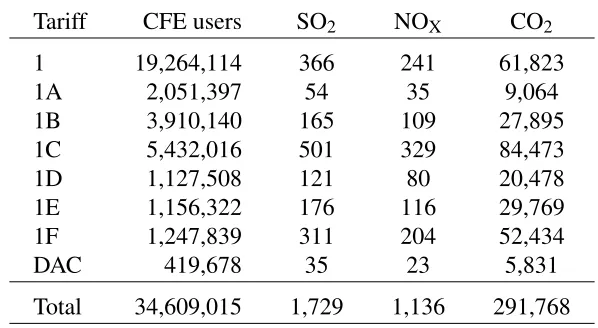
the environmental impact of the simulated energy efficiency scenario. Our analysis relies on
the emission factors recently published by SENER(2017a), which were calculated assuming
the typical operation of an average thermal generator.18 Table 11 presents the environmental
outcomes of the massive energy efficiency scenario.
TABLE11ABOUT HERE
The technologies used for electricity generation are: coal, combined cycle, internal
com-bustion, turbo-gas and conventional steam (fuel-oil and gas). It is important to note that, since
2015, the higher availability of natural gas made it possible to reduce the consumption of more
expensive and polluting fuels, such as fuel-oil and diesel. Hence, the avoided emissions of
local pollutants such as SO2 and NOX are important but not extremely significant since the
country relies more on natural gas, which in this case could be considered a “cleaner” fuel.
With regards of carbon dioxide emissions, it is interesting to put these numbers in context. In
so doing, we transform the results obtained for summer months (shown in table11) to annual
values.19 The estimated annual cut in CO2 emissions is approximately 3.5 million of metric
tons. That figure represents 2.7% of the 2020-2030 emission reduction target for the electricity
generation sector that was committed after COP-21 held in Paris (December 2015).
To provide a monetary metric, we make an additional effort and measure emission savings.
Unfortunately, a market for emissions in Mexico does not exist. There is not a single price for
each of these air pollutants, and no global agreement has been reached. In the case of Mexico,
however, the government sets a tax of approximately 3 USD per ton of carbon emitted. In some
developed countries such as Sweden, the corresponding price could be as high as 130 USD per
17Mexico is the 13th largest GHG emitter in the world and the second in Latin America –behind Brazil. It
contributes with 1.4% of the global GHG emissions (Damassa et al.,2015).
18Concretely, the emission factors used in our analysis are: 0.00283 kg/kWh for SO
2, 0.00186 kg/kWh for
NOX, and 0.47753 kg/kWh for CO2.
19Here the same disclaimers of section4.2apply: this is an imperfect and, to some extent, arbitrary exercise.
ton (Ward et al., 2015). Here we assume an intermediate value of 60 MXP/ton. As a result,
the environmental savings due to CO2emissions reduction amounts to 210 million of MXP per
year.
5
Conclusion
In this paper we propose and estimate a structural model of residential electricity demand to
simulate the effects that a massive energy efficiency program in Mexico would have on
house-hold consumption and expenditure, government subsidies, and air pollution. The
character-istics of the tariff structure all across the country make it difficult to rely on simple reduced
form models. In that sense, our structural model, which builds on the model proposed by
Olm-stead et al.(2007) for water demand, allows us to recover sensible parameters of the electricity
demand function to simulate a meaningful counterfactual energy efficiency scenario. The
sim-ulated situation consists of massive replacements of electric appliances in Mexican households
(AC units, refrigerators, fans, washing machines, and lights). It is based on the suggestions of
a previous report bySENER(2017b), which follows the requirements of the Energy Transition
Law of December 2015.
The main results of this study are the following: residential electricity consumption falls
8.9% and the associated expenditure decreases 11.1%, on average. The outcomes, however,
vary significantly across consumers because the tariff structure differs substantially depending
on the geographical location of households. There are different marginal prices and different
consumption blocks at the municipality level, which are linked to the average summer
tem-peratures. Also, the electric appliances under study have very uneven penetration levels and
different potential savings. As a result, electricity consumption and expenditure once the
en-ergy efficiency improvements take place have a variety of responses. Users under 1F tariff are
tariff class (1) save 8.6% in their electricity bill. In terms of electric appliances, AC units and
refrigerators are probably the best candidates for future policy targets: they proportion, on
aver-age, consumption savings of approximately 13% and 5% on affected users, respectively. With
regards of the residential electricity subsidy, the fiscal burden could be reduced in 360 million
USD per year. Finally, there would be an annual cut in CO2 emissions of approximately 3.5
million of tons, which represents about 2.7% of the 2020-2030 emissions reduction goal for
the electricity generation sector as it was committed in the COP-21 held in Paris.
There are some limitations in our simulation exercise that provide incentives for further
research on this topic. The consumer decisions regarding the replacement of old appliances
and/or the adoption of new technologies were not considered in our model –we assume all
households holding the selected appliance simply replace it for a more efficient unit. Also,
more flexibility in terms of consumer behavior would be welcome: our empirical exercise
as-sumes a uniform effect for all households holding the appliances under consideration.20
There-fore, all the heterogeneity we obtain in our results comes from the differential tariff structure,
the household stock of appliances, and the imputed energy efficiency improvement factors for
each appliance. Finally, detailed information on the actual household stock of appliances (e.g.,
price, operation and maintenance costs, UEC, etc.) and on conservation practices followed by
users would be a plus.
The above discussion points in the direction of suggesting a concrete piece of advice for
in-terested researchers and policymakers: the collection of more detailed consumers data, which
ideally should be combined with interventions through field experiments to evaluate concrete
measures of energy-efficiency policy. In this line of thoughts, engineering-type studies
consti-tute a first (and necessary) step to evaluate the current situation (of buildings materials,
facil-ities, equipment and appliances) and the potential new technologies that could be introduced.
20An assumption difficult to support given the evidence from previous studies. See, for example,Davis et al.
Structural economic studies that used observational micro-data are an intermediate step. Our
contribution to the literature, and more specifically, to the Mexican case, clearly belongs to this
second step. The final step is the gold standard in the energy efficiency literature: field
ex-periments. They should be performed to evaluate the complex interactions between economic
agents, information problems, market failures, and behavioral biases. As a result, different
policy options can be properly implemented depending on the specific context.
References
S. Borenstein. To what electricity price do consumers respond? residential demand elasticity
under increasing-block pricing. Unpublished manuscript, 2009.
G. Burtless and J. Hausman. The effect of taxation on labor supply: Evaluating the gary
negative income tax experiment. Journal of Political Economy, 86(6):1103–1130, 1978.
K. Caballero-G¨uendolain and L. Galindo-Paliza. El consumo de energ´ıa en M´exico y sus
efectos en el producto y los precios. Problemas del Desarrollo, 38(148):127–151, 2007.
T. Damassa, T. Fransen, B. Haya, M. Ge, K. Pjeczka, and K. Ross. Interpreting indcs:
Assessing transparency of post-2020 greenhouse gas emissions targets for 8 top-emitting
economies. Technical report, WRI Working Paper, 2015.
L. Davis, A. Fuchs, and P. Gertler. Cash for coolers: Evaluating a large-scale appliance
replace-ment program in Mexico. American Economic Journal: Economic Policy, 6(4):207–38,
November 2014.
J. Dubin and D. McFadden. An econometric analysis of residential electric appliance holdings
R. Gandhi, C. Knittel, P. Pedro, and C. Wolfram. Running randomized field experiments for
energy efficiency programs: A practitioner’s guide. Economics of Energy & Environmental
Policy, 5(2), 2016.
A. Guti´errez-Mendieta. Determinantes de consumo eficiente de energ´ıa el´ectrica en el sector
residencial en M´exico: un enfoque de regresi´on cuant´ılica. Mimeo, 2016.
R. Hahn and R. Metcalfe. The impact of behavioral science experiments on energy policy.
Economics of Energy & Environmental Policy, 5(2), 2016.
P. Hancevic, H. Nu˜nez, and J. Rosellon. Distributed Photovoltaic Power Generation:
Possi-bilities, Benefits, and Challenges for a Widespread Application in the Mexican Residential
Sector. DIW Berlin Discussion Paper, (1663), 2017.
W. Hanemann. Discrete/continuous models of consumer demand. Econometrica, 52(3):541–
561, 1984.
J. Hausman. Taxes and labor supply. Working Paper 1102, National Bureau of Economic
Research, March 1983.
J. Hewitt and W. Hanemann. A discrete/continuous choice approach to residential water
de-mand under block rate pricing. Land Economics, pages 173–192, 1995.
K. Ito. Do consumers respond to marginal or average price? evidence from nonlinear electricity
pricing. American Economic Review, 104(2):537–63, February 2014.
J. Rosas-Flores, D. Rosas-Flores and D. Morill´on-G´alvez. Saturation, energy consumption,
CO2 emission and energy efficiency from urban and rural households appliances in Mexico.
Energy and Buildings, 43(1):10–18, 2011.
K. Komives, T. Johnson, J. Halpern, J. Aburto, and J. Scott. Residential Electricity Subsidies
LBNL and IIE. Normas de desempe˜no energ´etico m´ınimo para acondicionadores de aire de
tipo ventana en m´exico. Technical report, CONUEE, July 2011a.
LBNL and IIE. Normas de desempe˜no energ´etico m´ınimo para refrigeradores en m´exico.
Technical report, CONUEE, July 2011b.
L. Lopez-Calva and J. Rosell´on. On the potential distributive impact of electricity reform in
Mexico. 2002.
D. Morales-Ram´ırez, J Luyando-Cuevas, and D. Flores-Curiel. Determinantes del consumo
de energ´ıa el´ectrica residencial de la Zona Metropolitana de Monterrey, Nuevo Le´on, en
m´exico. Universidad & Empresa, 22:79–98, 2012.
S. Nataraj and W. Hanemann. Does marginal price matter? a regression discontinuity approach
to estimating water demand. Journal of Environmental Economics and Management, 61(2):
198–212, 2011.
S. Olmstead. Reduced-form versus structural models of water demand under nonlinear prices.
Journal of Business & Economic Statistics, 27(1):84–94, 2009.
S. Olmstead, W. Hanemann, and R. Stavins. Water demand under alternative price structures.
Journal of Environmental Economics and Management, 54(2):181–198, 2007.
J. Ort´ız-Vel´azquez, G. Bueno, and J Arana-Coronado. An´alisis de la demanda residencial de
electricidad en el Estado de M´exico. Econom´ıa, Sociedad y Territorio, 17(53):199–223,
2017.
D. Rapson. Durable goods and long-run electricity demand: Evidence from air conditioner
purchase behavior. Journal of Environmental Economics and Management, 68(1):141–160,
P. Reiss and M. White. Household electricity demand, revisited. Review of Economic Studies,
72(3):853–883, 2005.
SENER. Primer an´alisis sobre los beneficios de la generaci´on limpia distribuida y la eficiencia
energ´etica en m´exico. Technical report, Secretaria de Energia, 2017a.
SENER. Primer analisis sobre los beneficios de la generacion limpia distribuida y la eficiencia
energetica en mexico. 2017b.
John Ward, Paul Sammon, Guy Dundas, Grzegorz Peszko, Pauline Maree Kennedy, Sebastian
Wienges, and Nicolai Prytz. Carbon leakage: theory, evidence, and policy design.
part-nership for market readiness technical note; no. 11. Technical report, World Bank Group,
Figures and Tables
Table 1:
Variable definitions and summary statistics
Variable Definition Mean Std. Dev. Min Max
Household size Number of household members at home 3.84 1.89 1 21 Children =1 if at least one child living at home 0.48 0.50 0 1 Elderly =1 if at least one person age 65 or older living at home 0.22 0.41 0 1 Age of head Age of the head of household (in years) 49.30 15.37 15 97
Rural =1 if the home is located in a rural area 0.14 0.35 0 1 Apartment =1 if the home is located in an apartment 0.06 0.24 0 1 Owner =1 if the home is owned by any member of household 0.76 0.42 0 1 Number of rooms Number of rooms, excluding kitchen and bathrooms 3.99 1.63 1 21 Number of lights Number of lights of any kind in the home 7.43 5.57 1 130
Number of TVs Number of TV sets in the home 1.58 0.95 0 14
Number of refrigerators Number of refrigerators in the home 0.90 0.35 0 5 Number of washers Number of washing machines in the home 0.71 0.48 0 4 Fans =1 if there is at least one fan in the home 0.49 0.50 0 1 AC unit =1 if there is at least one AC unit in the home 0.14 0.34 0 1 Waterpump =1 if there is at least one waterpump in the home 0.28 0.45 0 1
Income Monthly total income (in MXP) 8,863 9,567 91 258,947
Electricity expenditure Monthly electricity expenditure (in MXP) 219 298 21 12,922 Electricity consumption Monthly electricity consumption (in KWh) 170 161 25 2,775
Source: Own elaboration, based on ENIGH 2010, 2012 and 2014.
Number of observations: 20,604 in year 2010; 6,649 in year 2012; and 14,526 in year 2014.
Table 2:
Residential tariff schedules for Summer 2014
Tariff 1stblock 2nd block 3rdblock 4th block
1 range (KWh) 0 – 75 76 – 140 ≥141 marginal price ($) 0.719 0.847 2.889
1A range (KWh) 0 – 100 101 – 150 ≥151 marginal price ($) 0.719 0.847 2.889
1B range (KWh) 0 – 125 126 – 225 ≥226 marginal price ($) 0.719 0.847 2.889
1C range (KWh) 0 – 150 151 – 300 301 – 450 ≥451 marginal price ($) 0.719 0.847 1.081 2.889
1D range (KWh) 0 – 175 176 – 400 401 – 600 ≥601 marginal price ($) 0.719 0.847 1.081 2.889
1E range (KWh) 0 – 300 301 – 750 751 – 900 ≥901 marginal price ($) 0.601 0.750 0.978 2.889
1F range (KWh) 0 – 300 301 – 1200 1201 – 2500 ≥2501 marginal price ($) 0.601 0.750 1.823 2.889
Table 3:
Percentage of users and average monthly consumption by tariff
class: own calculation based on ENIGH data versus CFE users in 2015
ENIGH 2010, 2012, 2014 Official CFE data for 2015a Tariff % of users avg. cons. (KWh) % of users avg. cons. (KWh)
1 56.99 112.14 55.66 88.69
1A 6.73 125.90 5.93 98.48
1B 11.99 160.89 11.30 138.35
1C 14.91 252.29 15.70 228.39
1D 3.35 294.45 3.26 276.74
1E 2.83 414.64 3.34 386.23
1F 2.68 615.04 3.61 663.00
DAC 0.51 439.85 1.21 500.12
Total 100 169.62 100 157.44
Source: Own elaboration based on ENIGH 2010, 2012 and 2014, and CFE tariffs.
Table 4:
Residential electricity demand model estimates
OLS DCC
Full sample DAC not included Full sample Variable Coeff. Std. Error Coeff. Std. Error Coeff. Std. Error
ln(price) 0.5404∗∗∗ 0.0001 -0.2889∗∗∗ 0.0117 -0.2655∗∗∗ 0.0110
ln(income) 0.0906∗∗∗ 0.0001 0.2167∗∗∗ 0.0073 0.2186∗∗∗ 0.0075
rural -0.0439∗∗∗ 0.0001 -0.0469∗∗∗ 0.0108 -0.0471∗∗∗ 0.0120
apartment -0.0139∗∗∗ 0.0002 -0.0485∗∗ 0.0179 -0.0446∗ 0.0203
owner 0.0230∗∗∗ 0.0001 0.0601∗∗∗ 0.0099 0.0618∗∗∗ 0.0100
ln(num. of rooms) 0.0335∗∗∗ 0.0002 0.0765∗∗∗ 0.0114 0.0767∗∗∗ 0.0119
age of head 0.0074∗∗∗ 0.0000 0.0117∗∗∗ 0.0017 0.0119∗∗∗ 0.0017
(age of head)2 -0.0001∗∗∗ 0.0000 -0.0001∗∗∗ 0.0000 -0.0001∗∗∗ 0.0000
ln(household size) 0.1147∗∗∗ 0.0001 0.1959∗∗∗ 0.0097 0.1942∗∗∗ 0.0092
children -0.0106∗∗∗ 0.0001 -0.0321∗∗∗ 0.0105 -0.0295∗∗ 0.0107
elderly 0.0185∗∗∗ 0.0002 -0.0013 0.0121 0.0035 0.0136
waterpump 0.0044∗∗∗ 0.0001 0.0438∗∗∗ 0.0099 0.0478∗∗∗ 0.0104
num. of light bulbs 0.0014∗∗∗ 0.0000 0.0090∗∗∗ 0.0011 0.0090∗∗∗ 0.0011
num. of TVs -0.0038∗∗∗ 0.0001 0.0290∗∗∗ 0.0053 0.0271∗∗∗ 0.0048
AC unit 0.4306∗∗∗ 0.0002 0.4727∗∗∗ 0.0145 0.4695∗∗∗ 0.0144
num. of refrigerators 0.1905∗∗∗ 0.0002 0.2067∗∗∗ 0.0136 0.2041∗∗∗ 0.0152
num. of washers 0.0365∗∗∗ 0.0001 0.0608∗∗∗ 0.0091 0.0601∗∗∗ 0.0090
fans 0.1245∗∗∗ 0.0001 0.1040∗∗∗ 0.0092 0.1053∗∗∗ 0.0101
constant 0.6709∗∗∗ 0.0009 3.3117∗∗∗ 0.0727 3.1860∗∗∗ 0.0742
σε 0.1747∗∗∗ 0.0082 0.1649∗∗∗ 0.0079
σω 0.4910∗∗∗ 0.0047 0.4927∗∗∗ 0.0046
σv 0.5212∗∗∗ 0.0036 0.5196∗∗∗ 0.0036
ρ 0.9420∗∗∗ 0.0056 0.9481∗∗∗ 0.0051
Num. of observations 41,779 41,608 41,779
Notes: ∗∗∗significant atα=0.01. ∗∗significant atα=0.05. ∗∗∗significant atα=0.10. Dependent
Table 5:
Unconditional simulated price and income elasticities
Elasticity DAC not included Full sample
Price -0.2439∗∗∗ (0.0088) -0.2263∗∗∗ (0.0084)
Income 0.1819∗∗∗ (0.0061) 0.1857∗∗∗ (0.0063)
Bootstrapped standard errors in parentheses (200 replications).
Table 6:
Energy efficiency assumptions for main electric appliances in the
Mexican residential sector
Appliance Baseline Potential savings
Lighting Some incandescent lamps, 50% of CFL, and low LED penetration 50% of LED
Refrigerators Comply with the 2012 MON Meets MEPS in US (potential savings: 25%)
AC units Comply with the 2012 MON Inverter technology (potential savings: 30%)
Fans Voluntary standard Blade and motor design (potential savings: 30%)
Washers Comply with the 2012 MON (potential savings: 25%)
[image:30.612.113.519.267.460.2]Table 7:
Impact of improved energy efficiency by electric appliance:
% change on consumption and expenditure per month (affected households only)
Light-bulbs Air Conditioners Refrigerators Washers Fans Tariff Class Cons. Expend. Cons. Expend. Cons. Expend. Cons. Expend. Cons. Expend.
1 -1.60% -2.04% -18.27% -27.25% -4.73% -6.22% -1.41% -1.93% -2.98% -4.30% 1A -1.39% -1.89% -16.01% -26.25% -4.69% -6.70% -1.36% -2.13% -2.80% -4.31% 1B -1.45% -1.71% -13.29% -20.65% -4.67% -6.03% -1.34% -1.91% -2.89% -3.78% 1C -1.79% -2.00% -12.91% -16.00% -4.95% -5.82% -1.44% -1.74% -3.06% -3.61% 1D -1.87% -2.11% -12.51% -14.78% -4.99% -5.65% -1.47% -1.71% -3.14% -3.57% 1E -1.73% -1.87% -12.34% -14.14% -4.78% -5.40% -1.34% -1.56% -3.01% -3.40% 1F -1.64% -1.79% -12.43% -13.83% -4.74% -5.31% -1.37% -1.56% -2.93% -3.28% DAC -14.46% -19.27% -10.27% -31.21% -3.15% -5.17% -1.22% -1.13% -2.53% -3.25%
Total -1.63% -2.01% -13.05% -16.70% -4.76% -6.10% -1.40% -1.88% -2.98% -3.89%
Affected 8,276,794 3,562,778 21,541,641 16,915,838 11,555,314
households (34.4%) (14.8%) (89.6%) (70.4%) (48.1%)
Source: own calculations based on data from ENIGH-2014 and CFE.
Table 8:
Estimated average effect of improved energy efficiency on household
consumption and expenditure per month: all appliances involved (all sample)
Initial situation Counterfactual
Consumption Expenditure Consumption Expenditure Tariff Users (kWh) ($) (KWh) (% change) ($) (% change)
1 14,229,968 109.5 145.4 102.7 -6.6% 131.7 -8.6% (53.8) (128.6) (51.4) (5.0%) (115.5) (6.4%) 1A 1,682,899 125.9 154.8 116.6 -7.6% 134.6 -10.7% (60.0) (142.2) (55.3) (8.2%) (116.9) (10.0%) 1B 2,503,712 158.9 189.3 144.0 -9.5% 160.5 -12.1%
(90.4) (196.7) (82.1) (8.0%) (161.2) (10.5%) 1C 3,271,032 262.0 314.2 229.5 -14.1% 262.1 -16.5%
(165.8) (342.4) (153.9) (11.0%) (291.3) (11.5%) 1D 752,057 291.2 327.2 253.2 -14.4% 273.3 -16.2%
(198.6) (350.3) (181.8) (11.5%) (296.7) (11.8%) 1E 825,343 411.4 362.1 357.4 -15.8% 303.5 -17.5%
(254.8) (299.1) (236.9) (17.0%) (249.8) (17.0%) 1F 671,115 615.1 558.4 527.1 -18.0% 466.0 -19.9%
(371.3) (437.6) (350.4) (13.7%) (383.4) (13.6%) DAC 103,364 355.3 1751.3 326.3 -8.3% 1434.1 -19.6%
(118.6) (521.3) (115.7) (8.6%) (666.6) (25.5%)
Total 24,039,490 167.7 205.2 151.5 -8.9% 177.9 -11.1% (159.8) (252.2) (142.5) (8.7%) (215.2) (9.8%)
Table 9:
Household re-optimization process: block changes within regular
tariffs and DAC re-categorization (percentage of users by tariff class)
Block changes within tariff class
Tariff from 2 to 1 from 3 to 2 from 4 to 3 Total changes
1 3.8% 4.8% 8.6%
1A 4.8% 9.8% 14.6%
1B 6.3% 7.5% 13.8%
1C 10.4% 8.2% 3.6% 18.7%
1D 7.4% 9.5% 3.8% 16.9%
1E 7.7% 2.7% 4.7% 10.4%
1F 7.9% 3.4% 0.0% 11.3%
DAC – – – 23.5%
Table 10:
Government savings in the proposed energy efficiency scenario
(millions of MXP)
CFE Subsidy reduction VAT not collected Net savings
Tariff users (1) (2) (1) - (2)
1 19,264,114 241.7 42.4 199.3
1A 2,051,397 35.0 6.6 28.4
1B 3,910,140 88.5 18.0 70.5
1C 5,432,016 208.0 45.3 162.7
1D 1,127,508 50.0 9.7 40.2
1E 1,156,322 75.3 10.8 64.5
1F 1,247,839 121.2 18.5 102.8
DAC 419,678 -93.6 21.3 -114.9
Total 34,609,015 726.1 172.6 553.5
[image:33.612.100.531.472.647.2]Table 11:
Emissions reduction in the proposed energy efficiency scenario
(metric tons per month)
Tariff CFE users SO2 NOX CO2
1 19,264,114 366 241 61,823
1A 2,051,397 54 35 9,064
1B 3,910,140 165 109 27,895 1C 5,432,016 501 329 84,473 1D 1,127,508 121 80 20,478 1E 1,156,322 176 116 29,769 1F 1,247,839 311 204 52,434
DAC 419,678 35 23 5,831