Proceedings of the 57th Annual Meeting of the Association for Computational Linguistics, pages 1738–1750 1738
Multilingual Factor Analysis
Francisco Vargas, Kamen Brestnichki, Alex Papadopoulos-Korfiatis and Nils Hammerla Babylon Health
{firstname.lastname, alex.papadopoulos}@babylonhealth.com
Abstract
In this work we approach the task of learn-ing multillearn-ingual word representations in an of-fline manner by fitting a generative latent vari-able model to a multilingual dictionary. We model equivalent words in different languages as different views of the same word gener-ated by a common latent variable representing their latent lexical meaning. We explore the task of alignment by querying the fitted model for multilingual embeddings achieving com-petitive results across a variety of tasks. The proposed model is robust to noise in the em-bedding space making it a suitable method for distributed representations learned from noisy corpora.
1 Introduction
Popular approaches for multilingual alignment of word embeddings base themselves on the
obser-vation in (Mikolov et al., 2013a), which noticed
that continuous word embedding spaces (Mikolov et al.,2013b;Pennington et al.,2014;Bojanowski et al., 2017; Joulin et al., 2017) exhibit similar structures across languages. This observation has led to multiple successful methods in which a di-rect linear mapping between the two spaces is learned through a least squares based objective
(Mikolov et al., 2013a; Smith et al., 2017; Xing
et al.,2015) using a paired bilingual dictionary. An alternate set of approaches based on
Canon-ical Correlation Analysis (CCA) (Knapp, 1978)
seek to project monolingual embeddings into a shared multilingual space (Faruqui and Dyer, 2014b;Lu et al.,2015). Both these methods aim to exploit the correlations between the monolingual vector spaces when projecting into the aligned multilingual space. The multilingual embeddings
from (Faruqui and Dyer, 2014b;Lu et al., 2015)
are shown to improve on word level semantic
tasks, which sustains the authors’ claim that mul-tilingual information enhances semantic spaces.
In this paper we present a new non-iterative method based on variants of factor analysis
(Browne,1979;McDonald,1970;Browne,1980)
for aligning monolingual representations into a multilingual space. Our generative modelling as-sumes that a single word translation pair is gen-erated by an embedding representing the lexical meaning of the underlying concept. We achieve competitive results across a wide range of tasks compared to state-of-the-art methods, and we con-jecture that our multilingual latent variable model has sound generative properties that match those of psycholinguistic theories of the bilingual mind
(Weinreich, 1953). Furthermore, we show how
our model extends to more than two languages within the generative framework which is some-thing that previous alignment models are not nat-urally suited to, instead resorting to combining bilingual models with a pivot as in (Ammar et al., 2016).
Additionally the general benefit of the proba-bilistic setup as discussed in (Tipping and Bishop, 1999) is that it offers the potential to extend the scope of conventional alignment methods to model and exploit linguistic structure more accu-rately. An example of such a benefit could be mod-elling how corresponding word translations can be generated by more than just a single latent con-cept. This assumption can be encoded by a
mix-ture of Factor Analysers (Ghahramani et al.,1996)
to model word polysemy in a similar fashion to
(Athiwaratkun and Wilson,2017), where mixtures
of Gaussians are used to reflect the different mean-ings of a word.
y x
z
[image:2.595.382.482.60.153.2]N
Figure 1: Graphical model for alignment. Latent space zrepresents the aligned shared space between the two vector spacesxandy.
tasks. We put the model through a battery of tests, showing it aligns embeddings across languages well, while retaining performance on monolingual word-level and sentence-level tasks. Finally, we apply a natural extension of this model to more languages in order to align three languages into a single common space.
2 Background
Previous work on the topic of embedding align-ment has assumed that alignalign-ment is a directed pro-cedure — i.e. we want to align French to English embeddings. However, another approach would be to align both to a common latent space that is not necessarily the same as either of the original spaces. This motivates applying a well-studied la-tent variable model to this problem.
2.1 Factor Analysis
Factor analysis (Spearman, 1904; Thurstone,
1931) is a technique originally developed in psy-chology to study the correlation of latent factors
z ∈Rkon observed measurementsx∈
Rd.
For-mally:
p(z) =N(z;0,I),
p(x|z) =N(x;W z+µ,Ψ).
In order to learn the parameters W,Ψ of the
model we maximise the marginal likelihood
p(x|W,Ψ) with respect to W,Ψ. The
max-imum likelihood estimates of these procedures can be used to obtain latent representations for
a given observation Ep(z|x)[z]. Such projections
have been found to be generalisations of principal
component analysis (Pearson,1901) as studied in
(Tipping and Bishop,1999).
2.2 Inter-Battery Factor Analysis
Inter-Battery Factor Analysis (IBFA) (Tucker, 1958; Browne, 1979) is an extension of factor
xv
xj
x1 z
... ...
[image:2.595.161.233.60.149.2]N .
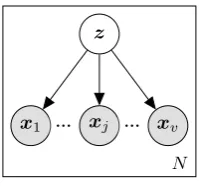
Figure 2: Graphical model for MBFA. Latent spacez represents the aligned shared space between the multi-ple vector spaces{xj}vj=1.
analysis that adapts it to two sets of variables
x ∈ Rd,y ∈
Rd
0
(i.e. embeddings of two lan-guages). In this setting it is assumed that pairs of observations are generated by a shared latent
vari-ablez
p(z) =N(z;0,I),
p(x|z) =N(x;Wxz+µx,Ψx),
p(y|z) =N(y;Wyz+µy,Ψy). (1)
As in traditional factor analysis, we seek to esti-mate the parameters that maximise the marginal likelihood
arg max
{Ψi,Wi}
Y
k
p(x(k),y(k)|{Ψi,Wi}i),
subject toΨi 0, (Wi>Wi)<0, (2)
where the joint marginalp(xk,yk|{Ψi,Wi}i)is a
Gaussian with the form
N
x y
;
µx µy
,
ΣxxΣxy
ΣyxΣyy
,
Σij =WiWj>+δijΨi,
andΨ0meansΨis positive definite.
Maximising the likelihood as in Equation2will
find the optimal parameters for the generative
pro-cess described in Figure1where one latentzis
re-sponsible for generating a pairx,y. This makes it
a suitable objective for aligning the vector spaces
ofx, yin the latent space. In contrast to the
dis-criminative directed methods in (Mikolov et al., 2013a;Smith et al.,2017;Xing et al.,2015), IBFA has the capacity to model noise.
(as shown in AppendixD) as
X
k
logp(x(k),y(k)|θ) =C+X k
(Lyk|x+Lx k), (3)
Lyk|x=−1
2||y˜
(k)−W
yEp(z|x(k))[z]||2Σ
y|x,
Lx k=−
1 2||x˜
(k)−W
xEp(z|x(k))[z]||2Ψ
xΣ−x1Ψx,
C=−N
2(log|2πΣy|x|+ log|2πΣx|).
The exact expression for Σy|x is given in the
same appendix. This interpretation shows that for each pair of points, the objective is to minimise
the reconstruction errors ofxandy, given a
pro-jection into the latent spaceEp(z|xk)[z]. By
utilis-ing the symmetry of Equation2, we can show the
converse is true as well — maximising the joint probability also minimises the reconstruction loss given the latent projectionsEp(z|yk)[z]. Thus, this
forces the latent embeddings ofxk and yk to be
close in the latent space. This provides intuition as to why embedding into this common latent space is a good alignment procedure.
In (Browne,1979;Bach and Jordan,2005) it is
shown that the maximum likelihood estimates for
{Ψi,Wi}can be attained in closed form
ˆ
Wi=SiiUiP1/2, ˆ
Ψi=Sii−WˆiWˆi>, ˆ
µx= ¯x, µˆy = ¯y,
where
Sxx= 1 m m X i=1 ˜
x(i)x˜(i)>,
Syy = 1 m m X i=1 ˜
y(i)y˜(i)>,
Ui=Sii−1/2Vi,
VxP Vy>=SVD(S
−1/2
xx SxySyy−1/2).
The projections into the latent space fromxare
given by (as proved in AppendixB)
Ep(z|x)[z] = (I+Wx>Ψ
−1
x Wx)
−1
Wx>Ψ−1x x˜, ˜
x=x−µx. (4)
Evaluated at the MLE, (Bach and Jordan,2005)
show that Equation4can be reduced to
Ep(z|x)[z] =P1/2Ux>(x−µx).
2.2.1 Multiple-Battery Factor Analysis
Multiple-Battery Factor Analysis (MBFA) (Mc-Donald, 1970;Browne, 1980) is a natural exten-sion of IBFA that models more than two views of observables (i.e. multiple languages), as shown in
Figure2.
Formally, for a set of views{x1, ...,xv}, we can
write the model as
p(z) =N(z;0,I),
p(xi|z) =N(xi;Wiz+µi,Ψi).
Similar to IBFA the projections to the latent space
are given by Equation4, and the marginal yields a
very similar form
N x1 .. . xv ; µ1 .. . µv ,
W1W1>+Ψ1. . . W1Wv> ..
. . .. ...
WvW1> . . .WvWv>+Ψv
.
Unlike IBFA, a closed form solution for maximis-ing the marginal likelihood of MBFA is unknown. Because of this, we have to resort to iterative
ap-proaches as in (Browne,1980) such as the natural
extension of the EM algorithm proposed by (Bach and Jordan,2005). Defining
Mt=
I+Wt>Ψ−1t Wt
−1
,
Bt=MtWt>Ψ−1t ,
e
Ψt+1=S−SΨ−1t WtMt>Wt>+1,
the EM updates are given by
Wt+1 =SBt>
Mt+BtSB>t
−1
,
Ψt+1=Bdiag
(Ψet+1)11, . . . ,(Ψet+1)vv
,
where S is the sample covariance matrix of the
concatenated views (derivation provided in
Ap-pendixE). (Browne,1980) shows that, under
suit-able conditions, the MLE of the parameters of MBFA is uniquely identifiable (up to a rotation that does not affect the method’s performance). We observed this in an empirical study — the so-lutions we converge to are always a rotation away from each other, irrespective of the parameters’ initialisation. This heavily suggests that any opti-mum is a global optiopti-mum and thus we restrict our-selves to only reporting results we observed when fitting from a single initialisation. The chosen ini-tialisation point is provided as Equation (3.25) of
`book`=`kniga`
[image:4.595.123.241.67.137.2]/buk/ /kn'iga/
Figure 3: Weinrich’s compound model for lexical as-sociation between English and Russian. Image from (Neuser,2017).
3 Multilingual Factor Analysis
We coin the term Multilingual Factor Analysis for the application of methods based on IBFA and MBFA to model the generation of multilingual tuples from a shared latent space. We motivate our generative process with the compound model for language association presented by (Weinreich, 1953). In this model a lexical meaning entity (a concept) is responsible for associating the corre-sponding words in the two different languages.
We note that the structure in Figure 3 is very
similar to our graphical model for IBFA specified
in Figure1. We can interpret our latent variable as
the latent lexical concept responsible for associ-ating (generassoci-ating) the multilingual language pairs. Most theories that explain the interconnections be-tween languages in the bilingual mind assume that “while phonological and morphosyntactic forms differ across languages, meanings and/or concepts are largely, if not completely, shared” (Pavlenko, 2009). This shows that our generative modelling is supported by established models of language in-terconnectedness in the bilingual mind.
Intuitively, our approach can be summarised as transforming monolingual representations by mapping them to a concept space in which lexical meaning across languages is aligned and then per-forming retrieval, translation and similarity-based tasks in that aligned concept space.
3.1 Comparison to Direct Methods
Methods that learn a direct linear transformation
from x to y, such as (Mikolov et al., 2013a;
Artetxe et al., 2016; Smith et al., 2017; Lample et al.,2018) could also be interpreted as maximis-ing the conditional likelihood
Y
k
p(y(k)|x(k)) =Y k
N(y(k);W x(k)+µ,Ψ).
As shown in AppendixF, the maximum
likeli-hood estimate forW does not depend on the noise
termΨ. In addition, even if one were to fitΨ, it
is not clear how to utilise it to make predictions as the conditional expectation
Ep(y|x(k))[y] =W x(k)+µ,
does not depend on the noise parameters. As this method is therefore not robust to noise, previous work has used extensive regularisation (i.e. by
makingW orthogonal) to avoid overfitting.
3.2 Relation to CCA
CCA is a popular method used for multilingual alignment which is very closely related to IBFA,
as detailed in (Bach and Jordan, 2005). (Barber,
2012) shows that CCA can be recovered as a lim-iting case of IBFA with constrained diagonal co-varianceΨx = σx2I, Ψy = σy2I, asσx2, σy2 → 0. CCA assumes that the emissions from the latent spaces to the observables are deterministic. This is a strong and unrealistic assumption given that word embeddings are learned from noisy corpora and stochastic learning algorithms.
4 Experiments
In this section, we empirically demonstrate the ef-fectiveness of our generative approach on several benchmarks, and compare it with state-of-the-art
methods. We first present cross-lingual
(word-translation) evaluation tasks to evaluate the qual-ity of our multi-lingual word embeddings. As a follow-up to the word retrieval task we also run experiments on cross-lingual sentence retrieval tasks. We further demonstrate the quality of our multi-lingual word embeddings on monolingual word- and sentence-level similarity tasks from
(Faruqui and Dyer,2014b), which we believe
pro-vides empirical evidence that the aligned embed-dings preserve and even potentially enhance their monolingual quality.
4.1 Word Translation
This task is concerned with the problem of retriev-ing the translation of a given set of source words. We reproduce results in the same environment as
(Lample et al., 2018)1 for a fair comparison. We
perform an ablation study to assess the effective-ness of our method in the Italian to English (it-en)
setting in (Smith et al., 2017; Dinu et al., 2014).
1github.com/Babylonpartners/MultilingualFactorAnalysis,
Method en-es es-en en-fr fr-en en-de de-en en-ru ru-en en-zh zh-en
Supervised
SVD 77.4 77.3 74.9 76.1 68.4 67.7 47.0 58.2 27.3* 09.3*
IBFA 79.5 81.5 77.3 79.5 70.7 72.1 46.7 61.3 42.9 36.9
SVD+CSLS 81.4 82.9 81.1 82.4 73.5 72.4 51.7 63.7 32.5* 25.1*
IBFA+CSLS 81.7 84.1 81.9 83.4 74.1 75.7 50.5 66.3 48.4 41.7
Semi-supervised
SVD 65.9 74.1 71.0 72.7 60.3 65.3 11.4 37.7 06.8 00.8
IBFA 76.1 80.1 77.1 78.9 66.8 71.8 23.1 39.9 17.1 24.0
AdvR 79.1 78.1 78.1 78.2 71.3 69.6 37.3 54.3 30.9 21.9
SVD+CSLS 73.0 80.7 75.7 79.6 65.3 70.8 20.9 41.5 10.5 01.7
IBFA+CSLS 76.5 83.7 78.6 82.3 68.7 73.7 25.3 46.3 22.1 27.2
AdvR+CSLS 81.7 83.3 82.3 82.1 74.0 72.2 44.0 59.1 32.5 31.4
Table 1: Precision @1 for crosslingual word similarity tasks. Rows labelled AdvR are copies of Adversarial -Refine rows in (Lample et al.,2018). Results marked with a * differ from the ones shown in (Lample et al.,2018) due to pre-processing done on their part. SVD and IBFA in the semi-supervised setting use the pseudo-dictionary, while AdvR uses frequency information. CSLS is the post-processing technique proposed in (Lample et al.,2018).
In these experiments we are interested in study-ing the effectiveness of our method compared to that of the Procrustes-based fitting used in (Smith et al.,2017) without any post-processing steps to
address the hubness problem (Dinu et al., 2014).
In Table1we observe how our model is
compet-itive to the results in (Lample et al., 2018) and
outperforms them in most cases. We notice that given an expert dictionary, our method performs the best out of all compared methods on all tasks, except in English to Russian (en-ru) translation where it remains competitive. What is surpris-ing is that, in the semi-supervised settsurpris-ing, IBFA bridges the gap between the method proposed in
(Lample et al.,2018) on languages where the
dic-tionary of identical tokens across languages (i.e.
the pseudo-dictionary from (Smith et al., 2017))
is richer. However, even though it significantly outperforms SVD using the pseudo-dictionary, it cannot match the performance of the adversarial approach for more distant languages like English and Chinese (en-zh).
4.1.1 Detailed Comparison to Basic SVD
We present a more detailed comparison to the
SVD method described in (Smith et al., 2017).
We focus on methods in their base form, that is
without post-processing techniques, i.e.
cross-domain similarity local scaling (CSLS) (Lample et al., 2018) or inverted softmax (ISF) (Smith
et al., 2017). Note that (Smith et al., 2017) used
the scikit-learn 2 implementation of CCA, which
uses an iterative estimation of partial least squares. This does not give the same results as the
stan-dard CCA procedure. In Table2we reproduce the
results from (Smith et al.,2017) using the
dictio-naries and embeddings provided by (Dinu et al., 2014)3 and we compare our method (IBFA) us-ing both the expert dictionaries from (Dinu et al., 2014) and the pseudo-dictionaries as constructed
in (Smith et al., 2017). We significantly
outper-form both SVD and CCA, especially when using the pseudo-dictionaries.
4.2 Word Similarity Tasks
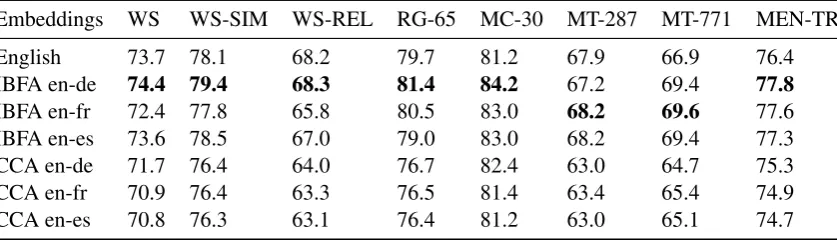
This task assesses the monolingual quality of word embeddings. In this experiment, we fit both con-sidered methods (CCA and IBFA) on the entire available dictionary of around 100k word pairs. We compare to CCA as used in (Faruqui and Dyer, 2014b) and standard monolingual word embed-dings on the available tasks from (Faruqui and Dyer,2014b). We evaluate our multilingual
em-beddings on the following tasks: WS353
(Finkel-stein et al., 2002); WS-SIM, WS-REL (Agirre et al.,2009);RG65(Rubenstein and Goodenough, 1965); MC-30 (Miller and Charles, 1991);
MT-2
A commonly used Python library for scientific comput-ing, found at (Pedregosa et al.,2011).
English to Italian Italian to English English to Italian Italian to English
@1 @5 @10 @1 @5 @10 @1 @5 @10 @1 @5 @10
Mikolov et. al. 33.8 48.3 53.9 24.9 41.0 47.4 1.0 2.8 3.9 2.5 6.4 9.1
CCA (Sklearn) 36.1 52.7 58.1 31.0 49.9 57.0 29.1 46.4 53.0 27.0 47.0 52.3
CCA 30.9 48.1 52.7 27.7 45.5 51.0 26.5 42.5 48.1 22.8 40.1 45.5
SVD 36.9 52.7 57.9 32.2 49.6 55.7 27.1 43.4 49.3 26.2 42.1 49.0
[image:6.595.90.509.229.349.2]IBFA (Ours) 39.3 55.3 60.1 34.7 53.5 59.4 34.7 52.6 58.3 33.7 53.3 59.2
Table 2: Comparisons without post-processing of methods. Results reproduced from (Smith et al.,2017) for fair comparison. Left: Comparisons using the same expert dictionary as (Smith et al.,2017). Right: Comparisons using the pseudo-dictionary from (Smith et al.,2017).
Embeddings WS WS-SIM WS-REL RG-65 MC-30 MT-287 MT-771 MEN-TR
English 73.7 78.1 68.2 79.7 81.2 67.9 66.9 76.4
IBFA en-de 74.4 79.4 68.3 81.4 84.2 67.2 69.4 77.8
IBFA en-fr 72.4 77.8 65.8 80.5 83.0 68.2 69.6 77.6
IBFA en-es 73.6 78.5 67.0 79.0 83.0 68.2 69.4 77.3
CCA en-de 71.7 76.4 64.0 76.7 82.4 63.0 64.7 75.3
CCA en-fr 70.9 76.4 63.3 76.5 81.4 63.4 65.4 74.9
CCA en-es 70.8 76.3 63.1 76.4 81.2 63.0 65.1 74.7
Table 3: Spearman correlation for English word similarity tasks. First row represents monolingual fasttext vectors (Joulin et al.,2017) in English, the rest are bilingual embeddings.
287; (Radinsky et al., 2011); MT-771 (Halawi
et al., 2012), and MEN-TR (Bruni et al., 2012). These tasks consist of English word pairs that have been assigned ground truth similarity scores
by humans. We use the test-suite provided by
(Faruqui and Dyer,2014a)4 to evaluate our
mul-tilingual embeddings on these datasets. This test-suite calculates similarity of words through cosine similarity in their representation spaces and then reports Spearman correlation with the ground truth similarity scores provided by humans.
As shown in Table3, we observe a performance
gain over CCA and monolingual word embed-dings suggesting that we not only preserve the monolingual quality of the embeddings but also enhance it.
4.3 Monolingual Sentence Similarity Tasks
Semantic Textual Similarity (STS) is a standard benchmark used to assess sentence similarity
met-rics (Agirre et al.,2012,2013,2014,2015,2016).
In this work, we use it to show that our alignment procedure does not degrade the quality of the em-beddings at the sentence level. For both IBFA and CCA, we align English and one other language
4https://github.com/mfaruqui/eval-word-vectors
(from French, Spanish, German) using the entire dictionaries (of about 100k word pairs each)
pro-vided by (Lample et al., 2018). We then use the
procedure defined in (Arora et al., 2016) to
cre-ate sentence embeddings and use cosine similarity to output sentence similarity using those embed-dings. The method’s performance on each set of embeddings is assessed using Spearman correla-tion to human-produced expert similarity scores.
As evidenced by the results shown in Table 4,
IBFA remains competitive using any of the three languages considered, while CCA shows a perfor-mance decrease.
4.4 Crosslingual Sentence Similarity Tasks
Europarl (Koehn,2005) is a parallel corpus of
Embeddings STS12 STS13* STS14 STS15 STS16
English 58.1 69.2 66.7 72.6 70.6
IBFA en-de 58.1 70.2 66.8 73.0 71.6
IBFA en-fr 58.0 70.0 66.7 72.8 71.4
IBFA en-es 57.9 69.7 66.6 72.9 71.7
CCA en-de 56.7 67.5 65.7 73.1 70.5
CCA en-fr 56.7 67.9 65.9 72.8 70.8
CCA en-es 56.6 67.8 65.9 72.9 70.8
Table 4: Spearman correlation for Semantic Textual Similarity (STS) tasks in English. All results use the sentence embeddings described in (Arora et al.,2016). First row represents monolingual FastText vectors (Joulin et al., 2017) in English, the rest are bilingual embeddings. *STS13 excludes the proprietary SMT dataset.
English to Italian Italian to English
@1 @5 @10 @1 @5 @10
Mikolov et. al.X 10.5 18.7 22.8 12.0 22.1 26.7
Dinu et al.X 45.3 72.4 80.7 48.9 71.3 78.3
Smith et al.X 54.6 72.7 78.2 42.9 62.2 69.2
SVD 40.5 52.6 56.9 51.2 63.7 67.9
IBFA (Ours) 62.7 74.2 77.9 64.1 75.2 79.5
SVD + CSLS 64.0 75.8 78.5 67.9 79.4 82.8
AdvR + CSLS 66.2 80.4 83.4 58.7 76.5 80.9
IBFA + CSLS 68.8 80.7 83.5 70.2 80.8 84.8
Table 5: Sentence translation precisions @1, @5, @10 on 2,000 English-Italian pairs samples from a set of 200k sentences from Europarl (Koehn, 2005) on Dinu embeddings. AdvR is copied from Adversarial - Refined in (Lample et al.,2018). Rows withXcopied from (Smith et al.,2017).
target sentences for each language pair. Note that this is a different set up to the one presented in
(Smith et al., 2017), in which an unweighted
av-erage is used. The results are reported in Table5.
As we can see, IBFA outperforms all prior meth-ods both using nearest neighbour retrieval, where it has a gain of 20 percent absolute on SVD, as well as using the CSLS retrieval metric.
4.5 Alignment of three languages
In an ideal scenario, when we have v languages,
we wouldn’t want to train a transformation be-tween each pair, as that would involve storing
O(v2) matrices. One way to overcome this
prob-lem is by aligning all embeddings to a common space. In this exploratory experiment, we con-strain ourselves to aligning three languages at the same time, but the same methodology could be ap-plied to an arbitrary number of languages. MBFA,
the extension of IBFA described in Section 2.2.1
naturally lends itself to this task. What is needed for training this method is a dictionary of word triples across the three languages considered. We
construct such a dictionary by taking the intersec-tion of all 6 pairs of bilingual dicintersec-tionaries for the
three languages provided by (Lample et al.,2018).
We then train MBFA for 20,000 iterations of EM (a brief analysis of convergence is provided in
Ap-pendixG). Alternatively, with direct methods like
(Smith et al.,2017;Lample et al.,2018) one could
align all languages to English and treat that as the common space.
We compare both approaches and present their
results in Table6. As we can see, both methods
ex-perience a decrease in overall performance when compared to models fitted on just a pair of lan-guages, however MBFA performs better overall. That is, the direct approaches preserve their per-formance on translation to and from English, but translation from French to Italian decreases signif-icantly. Meanwhile, MBFA suffers a decrease in each pair of languages, however it retains compet-itive performance to the direct methods on English translation. It is worth noting that as the number of
Method en-it it-en en-fr fr-en it-fr fr-it
SVD 71.0 72.4 74.9 76.1 78.3 72.9
MBFA 71.9 73.4 76.7 78.1 82.6 77.5
SVD+CSLS 76.2 77.9 81.1 82.4 84.5 79.8
[image:8.595.175.425.64.147.2]MBFA+CSLS 77.4 77.7 81.9 82.1 86.8 81.9
Table 6: Precision @1 when aligning English, French and Italian embeddings to a common space. For SVD, this common space is English, while for MBFA it is the latent space.
of languages, one of which is English, andO(v2)
pairs in which English does not participate. This suggests that MBFA may generalise past three si-multaneously aligned languages better than the di-rect methods.
4.6 Generating Random Word Pairs
We explore the generative process of IBFA by syn-thesising word pairs from noise, using a trained English-Spanish IBFA model. We follow the
gen-erative process specified in Equation 1 to
gener-ate 2,000 word vector pairs and then we find the nearest neighbour vector in each vocabulary and display the corresponding words. We then rank these 2,000 pairs according to their joint probabil-ity under the model and present the top 28
sam-ples in Table7. Note that whilst the sampled pairs
are not exact translations, they have closely re-lated meanings. The examples we found interest-ing are dreadful and despair; frighteninterest-ing and bru-tality; crazed and merry; unrealistic and question-ing; misguided and conceal; reactionary and con-servatism.
5 Conclusion
We have introduced a cross-lingual embedding alignment procedure based on a probabilistic la-tent variable model, that increases performance across various tasks compared to previous meth-ods using both nearest neighbour retrieval, as well as the CSLS criterion. We have shown that the re-sulting embeddings in this aligned space preserve their quality by presenting results on tasks that as-sess word and sentence-level monolingual similar-ity correlation with human scores. The resulting embeddings also significantly increase the preci-sion of sentence retrieval in multilingual settings. Finally, the preliminary results we have shown on aligning more than two languages at the same time provide an exciting path for future research.
en es es→en
particular efectivamente effectively
correspondingly esto this
silly ir´onicamente ironic
frightening brutalidad brutality
manipulations intencionadamente intentionally
ignore contraproducente
counter-productive
fundamentally entendido understood
embarrassed enojado angry
terrified casualidad coincidence
hypocritical obviamente obviously
wondered inc´omodo
uncomfort-able
oftentimes apostar betting
unwittingly traicionar betray
mishap ir´onicamente ironically
veritable empero however
overpowered deshacerse fall apart
crazed divertidos merry
frightening iron´ıa irony
dreadful desesperaci´on despair
instituting restablecimiento recover
unrealistic cuestionamiento questioning
regrettable err´oneos mistaken
irresponsible preocupaciones concerns
obsession irremediablemente hopelessly
embodied voluntad will
misguided esconder conceal
perspective contestaci´on answer
reactionary conservadurismo conservatism
[image:8.595.306.525.214.690.2]References
Eneko Agirre, Enrique Alfonseca, Keith Hall, Jana Kravalova, Marius Pas¸ca, and Aitor Soroa. 2009. A study on similarity and relatedness using distribu-tional and wordnet-based approaches. In Proceed-ings of Human Language Technologies: The 2009 Annual Conference of the North American Chap-ter of the Association for Computational Linguistics, pages 19–27. Association for Computational Lin-guistics.
Eneko Agirre, Carmen Banea, Claire Cardie, Daniel Cer, Mona Diab, Aitor Gonzalez-Agirre, Weiwei Guo, Inigo Lopez-Gazpio, Montse Maritxalar, Rada Mihalcea, et al. 2015. Semeval-2015 task 2: Se-mantic textual similarity, english, spanish and pilot on interpretability. InProceedings of the 9th inter-national workshop on semantic evaluation (SemEval 2015), pages 252–263.
Eneko Agirre, Carmen Banea, Claire Cardie, Daniel Cer, Mona Diab, Aitor Gonzalez-Agirre, Weiwei Guo, Rada Mihalcea, German Rigau, and Janyce Wiebe. 2014. Semeval-2014 task 10: Multilingual semantic textual similarity. In Proceedings of the 8th international workshop on semantic evaluation (SemEval 2014), pages 81–91.
Eneko Agirre, Carmen Banea, Daniel Cer, Mona Diab, Aitor Gonzalez-Agirre, Rada Mihalcea, German Rigau, and Janyce Wiebe. 2016. Semeval-2016 task 1: Semantic textual similarity, monolingual and cross-lingual evaluation. InProceedings of the 10th International Workshop on Semantic Evalua-tion (SemEval-2016), pages 497–511.
Eneko Agirre, Daniel Cer, Mona Diab, Aitor Gonzalez-Agirre, and Weiwei Guo. 2013. * sem 2013 shared task: Semantic textual similarity. In Second Joint Conference on Lexical and Computational Seman-tics (* SEM), Volume 1: Proceedings of the Main Conference and the Shared Task: Semantic Textual Similarity, volume 1, pages 32–43.
Eneko Agirre, Mona Diab, Daniel Cer, and Aitor Gonzalez-Agirre. 2012. Semeval-2012 task 6: A pi-lot on semantic textual similarity. InProceedings of the First Joint Conference on Lexical and Computa-tional Semantics-Volume 1: Proceedings of the main conference and the shared task, and Volume 2: Pro-ceedings of the Sixth International Workshop on Se-mantic Evaluation, pages 385–393. Association for Computational Linguistics.
Waleed Ammar, George Mulcaire, Yulia Tsvetkov, Guillaume Lample, Chris Dyer, and Noah A Smith. 2016. Massively multilingual word embeddings. arXiv preprint arXiv:1602.01925.
Sanjeev Arora, Yingyu Liang, and Tengyu Ma. 2016. A simple but tough-to-beat baseline for sentence em-beddings. International Conference on Learning Representations, 2017.
Mikel Artetxe, Gorka Labaka, and Eneko Agirre. 2016. Learning principled bilingual mappings of word em-beddings while preserving monolingual invariance. In Proceedings of the 2016 Conference on Empiri-cal Methods in Natural Language Processing, pages 2289–2294.
Ben Athiwaratkun and Andrew Gordon Wilson. 2017. Multimodal word distributions. Proceedings of the 15th Conference of the European Chapter of the As-sociation for Computational Linguistics: Volume 2, pages 427–431,Valencia, Spain, April 3-7.
Francis R Bach and Michael I Jordan. 2005. A proba-bilistic interpretation of canonical correlation analy-sis. Computer Science Division, University of Cali-fornia Berkeley.
David Barber. 2012. Bayesian reasoning and ma-chine learning, pages 474–475. Cambridge Univer-sity Press.
Piotr Bojanowski, Edouard Grave, Armand Joulin, and Tomas Mikolov. 2017. Enriching word vectors with subword information. Transactions of the Associa-tion for ComputaAssocia-tional Linguistics, 5:135–146.
Michael W Browne. 1979. The maximum-likelihood solution in inter-battery factor analysis. British Journal of Mathematical and Statistical Psychology, 32(1):75–86.
Michael W Browne. 1980. Factor analysis of mul-tiple batteries by maximum likelihood. British Journal of Mathematical and Statistical Psychology, 33(2):184–199.
Elia Bruni, Gemma Boleda, Marco Baroni, and Nam-Khanh Tran. 2012. Distributional semantics in tech-nicolor. In Proceedings of the 50th Annual Meet-ing of the Association for Computational LMeet-inguis- Linguis-tics: Long Papers-Volume 1, pages 136–145. Asso-ciation for Computational Linguistics.
Georgiana Dinu, Angeliki Lazaridou, and Marco Ba-roni. 2014. Improving zero-shot learning by mitigating the hubness problem. arXiv preprint arXiv:1412.6568.
Manaal Faruqui and Chris Dyer. 2014a. Community evaluation and exchange of word vectors at word-vectors.org. InProceedings of ACL: System Demon-strations.
Manaal Faruqui and Chris Dyer. 2014b. Improving vector space word representations using multilingual correlation. InProceedings of the 14th Conference of the European Chapter of the Association for Com-putational Linguistics, pages 462–471.
Zoubin Ghahramani, Geoffrey E Hinton, et al. 1996. The em algorithm for mixtures of factor analyzers. Technical report, Technical Report CRG-TR-96-1, University of Toronto.
Guy Halawi, Gideon Dror, Evgeniy Gabrilovich, and Yehuda Koren. 2012. Large-scale learning of word relatedness with constraints. In Proceedings of the 18th ACM SIGKDD international conference on Knowledge discovery and data mining, pages 1406– 1414. ACM.
Armand Joulin, Edouard Grave, Piotr Bojanowski, and Tomas Mikolov. 2017. Bag of tricks for efficient text classification. Proceedings of the 15th Con-ference of the European Chapter of the Associa-tion for ComputaAssocia-tional Linguistics: Volume 2, pages 427–431,Valencia, Spain, April 3-7, 2017, Volume 2.
Thomas R Knapp. 1978. Canonical correlation anal-ysis: A general parametric significance-testing sys-tem. Psychological Bulletin, 85(2):410.
Philipp Koehn. 2005. Europarl: A parallel corpus for statistical machine translation. InMT summit, vol-ume 5, pages 79–86.
Guillaume Lample, Alexis Conneau, Marc’Aurelio Ranzato, Ludovic Denoyer, and Herv´e J´egou. 2018. Word translation without parallel data. In Proceed-ings of the 6th International Conference on Learning Representations.
Ang Lu, Weiran Wang, Mohit Bansal, Kevin Gimpel, and Karen Livescu. 2015. Deep multilingual cor-relation for improved word embeddings. In Pro-ceedings of the 2015 Conference of the North Amer-ican Chapter of the Association for Computational Linguistics: Human Language Technologies, pages 250–256.
Roderick P McDonald. 1970. Three common fac-tor models for groups of variables. Psychometrika, 35(1):111–128.
Tomas Mikolov, Quoc V Le, and Ilya Sutskever. 2013a. Exploiting similarities among languages for ma-chine translation. arXiv preprint arXiv:1309.4168.
Tomas Mikolov, Ilya Sutskever, Kai Chen, Greg S Cor-rado, and Jeff Dean. 2013b. Distributed representa-tions of words and phrases and their compositional-ity. InAdvances in neural information processing systems, pages 3111–3119.
George A Miller and Walter G Charles. 1991. Contex-tual correlates of semantic similarity. Language and cognitive processes, 6(1):1–28.
Hannah Neuser. 2017. Source Language of Lexical Transfer in Multilingual Learners: A Mixed Meth-ods Approach. Ph.D. thesis, Department of English, Stockholm University.
Aneta Pavlenko. 2009. Conceptual representation in the bilingual lexicon and second language vocabu-lary learning. The bilingual mental lexicon: Inter-disciplinary approaches, pages 125–160.
Karl Pearson. 1901. Liii. on lines and planes of clos-est fit to systems of points in space. The London, Edinburgh, and Dublin Philosophical Magazine and Journal of Science, 2(11):559–572.
F. Pedregosa, G. Varoquaux, A. Gramfort, V. Michel, B. Thirion, O. Grisel, M. Blondel, P. Pretten-hofer, R. Weiss, V. Dubourg, J. Vanderplas, A. Pas-sos, D. Cournapeau, M. Brucher, M. Perrot, and E. Duchesnay. 2011. Scikit-learn: Machine learning in Python. Journal of Machine Learning Research, 12:2825–2830.
Jeffrey Pennington, Richard Socher, and Christopher Manning. 2014. Glove: Global vectors for word representation. InProceedings of the 2014 confer-ence on empirical methods in natural language pro-cessing (EMNLP), pages 1532–1543.
Kaare Brandt Petersen, Michael Syskind Pedersen, et al. 2008. The matrix cookbook. Technical Uni-versity of Denmark, 7(15):510.
Kira Radinsky, Eugene Agichtein, Evgeniy Gabrilovich, and Shaul Markovitch. 2011. A word at a time: computing word relatedness using temporal semantic analysis. In Proceedings of the 20th international conference on World wide web, pages 337–346. ACM.
Herbert Rubenstein and John B Goodenough. 1965. Contextual correlates of synonymy. Communica-tions of the ACM, 8(10):627–633.
Samuel L Smith, David HP Turban, Steven Hamblin, and Nils Y Hammerla. 2017. Offline bilingual word vectors, orthogonal transformations and the inverted softmax. Proceedings of the 5th International Con-ference on Learning Representations.
Charles Spearman. 1904. ” general intelligence,” ob-jectively determined and measured. The American Journal of Psychology, 15(2):201–292.
Louis L Thurstone. 1931. Multiple factor analysis. Psychological Review, 38(5):406.
Michael E Tipping and Christopher M Bishop. 1999. Probabilistic principal component analysis. Journal of the Royal Statistical Society: Series B (Statistical Methodology), 61(3):611–622.
Ledyard R Tucker. 1958. An inter-battery method of factor analysis. Psychometrika, 23(2):111–136.
Chao Xing, Dong Wang, Chao Liu, and Yiye Lin. 2015. Normalized word embedding and orthogonal trans-form for bilingual word translation. In Proceed-ings of the 2015 Conference of the North Ameri-can Chapter of the Association for Computational Linguistics: Human Language Technologies, pages 1006–1011.
A Joint Distribution
We show the form of the joint distribution for 2 views. Concatenating our data and parameters as below, we can use Equation (3) of (Ghahramani et al.,1996) to write
m=
"
x y
#
,W =
" Wx Wy # Ψ= "
Ψx 0
0 Ψy
#
,µ=
"
µx
µy
#
p(m,z|θ) =N " m z # ; " µ 0 #
,Σm,z
!
(5)
Σm,z=
"
W W>+ Ψ W W> I
#
It is clear that this generalises to any number of views of any dimension, as the concatenation op-eration does not make any assumptions.
B Projections to Latent SpaceEp(z|x)[z]
We can query the joint Gaussian in5 using rules
from (Petersen et al.,2008) Sections (8.1.2, 8.1.3)
and we get
p(z|x) =N z;Wx>Σ−1x x˜,I−Wx>Σ
−1
x Wx
E[z|x] =Wx>Σ−1x x˜
C Derivation for the Marginal Likelihood
We want to compute p(x,y|θ) so that we can
then learn the parameters θ = {θx,θy}, θi =
{µi,Wi,Ψi,} by maximising the marginal
like-lihood as is done in Factor Analysis.
From the joint p(m,z|θ), again using rules
from (Petersen et al.,2008) Sections (8.1.2) we get
p(m|θ) =p(x,y|θ)
=N " x y # ; " µx µy #
,W WT +Ψ
!
For the case of two views, the joint probability can be factored as
p(x,y|θ) =p(x|θx)p(y|x,θ) p(x|θx) =N (x;µx,Σx)
p(y|x,θ) =N y;WyWx>Σ−1x x˜+µy,Σy|x
=N y;WyE[z|x] +µy,Σy|x
,
where
Σx =WxWx>+Ψx
Σy|x =Σy−WyWx>Σ−1x WxWy>
D Scaled Reconstruction Errors
logp(x,y|θ) = logp∗(x|θx) + logp∗(y|x,θ)
−1
2(log|2πΣy|x|+ log|2πΣx|)
logp∗(y|x,θ) =−1
2||y˜−WyE[z|x]||
2
Σy|x
logp∗(x|θx) =−1
2||x−µx||
2
Σx
=−1
2||Σ
−1 2
x x˜||2
Setting A = ΨxΣ−1x Ψx, we can re-parametrise
as
logp∗(x|θx) =−1
2||ΨxΣ
−1
x x˜||2A
=−1
2||(Σx−WxW
>
x )Σ−1x x˜||2A
=−1
2||x˜−WxW
>
x Σ−1x x˜||2A
=−1
2||x˜−WxE[z|x]||
2
A
E Expectation Maximisation for MBFA
Define ˜ x=
x1−µ1
.. .
xv−µ1
,W =
W1 .. . Wv Ψ=
Ψ1 0
. ..
0 Ψv
=Bdiag(Ψ1, . . . ,Ψv)
Hence
Method EN-IT IT-EN EN-FR FR-EN IT-FR FR-IT
MBFA-1K 71.9 73.3 76.7 78.2 82.4 77.5
MBFA-20K 71.9 73.4 76.7 78.1 82.6 77.5
MBFA-1K+CSLS 77.5 77.6 81.9 82.0 86.8 82.1
[image:12.595.273.518.534.779.2]MBFA-20K+CSLS 77.4 77.7 81.9 82.1 86.8 81.9
Table 8: Precision @1 between MBFA fitted for 1K iterations and MBFA fitted for 20K iterations.
This follows the same form as regular factor analysis, but with a block-diagonal constraint on
Ψ. Thus by Equations (5) and (6) of (Ghahramani
et al.,1996), we apply EM as follows.
E-Step:ComputeE[z|x]andE[zz>|x]given the
parametersθt={Wt,Ψt}.
E[z(i)|x˜(i)] =Btx˜(i)
E[z(i)z(i)
>
|x˜(i)] =I−BtWt+Btx˜(i)x˜(i)>B>t =Mt+Btx˜(i)x˜(i)>Bt> (6)
where
Mt=
I+Wt>Ψ−1t Wt
−1
Bt=Wt>(Ψt+WtWt>)−1
=MtWt>Ψ−1t . (7)
Equation6is obtained by applying the Woodbury
identity, and Equation 7 by applying the closely
related push-through identity, as found in Section
3.2 of (Petersen et al.,2008).
M-Step:Update parametersθt+1={Wt+1,Ψt+1}.
Define
S = 1 m
m
X
i=1
˜
x(i)x˜(i)>
By first observing
1 m
m
X
i=1
˜
x(i)E[z(i)|x˜(i)]>=SB>t
1 m
m
X
j=1
E[z(j)z(j)
>
|x˜(j)] =Mt+BtSBt>,
update the parameters as follows.
Wt+1=SB>t
I−BtWt+BtSBt>
−1
=SB>tMt+BtSBt>
−1
e
Ψt+1=
1 m
m
X
i=1
˜
x(i)x˜(i)>−Wt+1E[z(i)|x˜(i)] ˜x(i)>
=S− 1
m m
X
i=1
Wt+1Btx˜(i)x˜(i)>
=S−Wt+1BtS =S−SBt>Wt>+1
Imposing the block diagonal constraint,
Ψt+1 =Bdiag
(Ψet+1)11, . . . ,(Ψet+1)vv
where( ˜Ψ)ii=Ψi.
F Independence to Noise in Direct Methods
We are maximising the following quantity with
re-spect toθ ={W,µ,Ψ}
p(Y|X,θ) =Y i
p(y(i)|x(i),θ)
=Y
i
N(y(i);W x(i)+µ,Ψ)
logp(Y|X,θ) =−1
2
X
i
||y(i)−W x(i)||2Ψ−C
!
Then the partial derivativeQ = ∂logp∂(WY|X,θ) is
proportional to
Q ∝ X
i
Ψ−1(y(i)−W x(i))x(i)>
!
∝Ψ−1X
i
y(i)x(i)>−WX
i
x(i)x(i)>
0 1000 2000 3000 4000 5000
Iterations
3040000 3030000 3020000 3010000 3000000
NLL
0 1000 2000 3000 4000 5000
Iterations
3044250 3044000 3043750 3043500 3043250 3043000 3042750
[image:13.595.125.479.63.188.2]NLL
Figure 4: Training curve of EM algorithm over the first 5,000 iterations. It is clear that the procedure quickly finds a good approximation to the optimal parameters and then slowly converges to the real optimum. Left picture shows the entire training curve, while the right picture starts from iteration 100.
The maximum likelihood is achieved when
∂logp(Y|X,θ)
∂W =0,
and since Ψ−1 has an inverse (namely Ψ), this
means that
WX
i
x(i)x(i)>=X i
y(i)x(i)>
It is clear from here that the MLE ofWdoes not
depend onΨ, thus we can conclude that adding a
noise parameter to this directed linear model has no effect on its predictions.
G Learning curve of EM
Figure4shows the negative log-likelihood of the
three language model over the first 5,000 itera-tions. The precision of the learned model is very close when evaluated at iteration 1,000 and at
iter-ation 20,000 as seen in Table8. This suggests that