2714
Explore, Propose, and Assemble:
An Interpretable Model for Multi-Hop Reading Comprehension
Yichen Jiang∗ Nitish Joshi∗ Yen-Chun Chen Mohit Bansal
UNC Chapel Hill
{yichenj, nitish, yenchun, mbansal}@cs.unc.edu
Abstract
Multi-hop reading comprehension requires the model to explore and connect relevant infor-mation from multiple sentences/documents in order to answer the question about the con-text. To achieve this, we propose an in-terpretable 3-module system called Explore-Propose-Assemble reader (EPAr). First, the Document Explorer iteratively selects relevant documents and represents divergent reasoning chains in a tree structure so as to allow assim-ilating information from all chains. The An-swer Proposer then proposes an anAn-swer from every root-to-leaf path in the reasoning tree. Finally, the Evidence Assembler extracts a key sentence containing the proposed answer from every path and combines them to pre-dict the final answer. Intuitively, EPAr ap-proximates the coarse-to-fine-grained compre-hension behavior of human readers when fac-ing multiple long documents. We jointly op-timize our 3 modules by minimizing the sum of losses from each stage conditioned on the previous stage’s output. On two multi-hop reading comprehension datasets WikiHop and MedHop, our EPAr model achieves significant improvements over the baseline and compet-itive results compared to the state-of-the-art model. We also present multiple reasoning-chain-recovery tests and ablation studies to demonstrate our system’s ability to perform in-terpretable and accurate reasoning.1
1 Introduction
The task of machine reading comprehension and question answering (MRC-QA) requires the model to answer a natural language question by finding relevant information and knowledge in a given natural language context. Most MRC
∗
equal contribution; part of this work was done during the second author’s internship at UNC (from IIT Bombay).
1Our code is publicly available at:
https://github.com/jiangycTarheel/EPAr
datasets require single-hop reasoning only, which means that the evidence necessary to answer the question is concentrated in a single sentence or lo-cated closely in a single paragraph. Such datasets emphasize the role of locating, matching, and aligning information between the question and the context. However, some recent multi-document, multi-hop reading comprehension datasets, such as WikiHop and MedHop (Welbl et al., 2017), have been proposed to further assess MRC sys-tems’ ability to perform multi-hop reasoning, where the required evidence is scattered in a set of supporting documents.
These multi-hop tasks are much more chal-lenging than previous single-hop MRC tasks ( Ra-jpurkar et al., 2016, 2018;Hermann et al., 2015;
Nguyen et al., 2016;Yang et al., 2015) for three primary reasons. First, the given context contains a large number of documents (e.g., 14 on aver-age, 64 maximum for WikiHop). Most existing QA models cannot scale to the context of such length, and it is challenging to retrieve a reason-ing chain of documents with complete informa-tion required to connect the quesinforma-tion to the an-swer in a logical way. Second, given a reason-ing chain of documents, it is still necessary for the model to consider evidence loosely distributed in all these documents in order to predict the final an-swer. Third, there could be more than one logical way to connect the scattered evidence (i.e., more than one possible reasoning chain) and hence this requires models to assemble and weigh informa-tion collected from every reasoning chain before making a unified prediction.
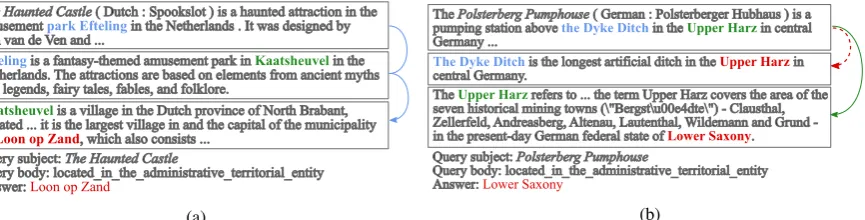
To overcome the three difficulties elaborated above, we develop our interpretable 3-module sys-tem based on examining how a human reader would approach a question, as shown in Fig. 1a
sequen-The Haunted Castle ( Dutch : Spookslot ) is a haunted attraction in the amusement park Efteling in the Netherlands . It was designed by Ton van de Ven and ...
Efteling is a fantasy-themed amusement park in Kaatsheuvel in the Netherlands. The attractions are based on elements from ancient myths and legends, fairy tales, fables, and folklore.
Kaatsheuvel is a village in the Dutch province of North Brabant, situated ... it is the largest village in and the capital of the municipality of Loon op Zand, which also consists ...
Query subject: The Haunted Castle
Query body: located_in_the_administrative_territorial_entity Answer: Loon op Zand
The Polsterberg Pumphouse ( German : Polsterberger Hubhaus ) is a pumping station above the Dyke Ditch in the Upper Harz in central Germany ...
The Dyke Ditch is the longest artificial ditch in the Upper Harz in central Germany.
The Upper Harz refers to ... the term Upper Harz covers the area of the seven historical mining towns (\"Bergst\u00e4dte\") - Clausthal, Zellerfeld, Andreasberg, Altenau, Lautenthal, Wildemann and Grund - in the present-day German federal state of Lower Saxony. Query subject: Polsterberg Pumphouse
Query body: located_in_the_administrative_territorial_entity Answer: Lower Saxony
(a)
The Haunted Castle ( Dutch : Spookslot ) is a haunted attraction in the amusement park Efteling in the Netherlands . It was designed by Ton van de Ven and ...
Efteling is a fantasy-themed amusement park in Kaatsheuvel in the Netherlands. The attractions are based on elements from ancient myths and legends, fairy tales, fables, and folklore.
Kaatsheuvel is a village in the Dutch province of North Brabant, situated ... it is the largest village in and the capital of the municipality of Loon op Zand, which also consists ...
Query subject: The Haunted Castle
Query body: located_in_the_administrative_territorial_entity Answer: Loon op Zand
The Polsterberg Pumphouse ( German : Polsterberger Hubhaus ) is a pumping station above the Dyke Ditch in the Upper Harz in central Germany ...
The Dyke Ditch is the longest artificial ditch in the Upper Harz in central Germany.
The Upper Harz refers to ... the term Upper Harz covers the area of the seven historical mining towns (\"Bergst\u00e4dte\") - Clausthal, Zellerfeld, Andreasberg, Altenau, Lautenthal, Wildemann and Grund - in the present-day German federal state of Lower Saxony. Query subject: Polsterberg Pumphouse
Query body: located_in_the_administrative_territorial_entity Answer: Lower Saxony
[image:2.595.87.520.63.173.2](b)
Figure 1: Two examples from the QAngaroo WikiHop dataset where it is necessary to combine information spread across multiple documents to infer the correct answer. (a): The hidden reasoning chain of 3 out of a total of 37 documents for a single query.(b): Two possible reasoning chains that lead to different answers: “Upper Harz” and “Lower Saxony”, while the latter (green solid arrow) fits better with query body “administrative territorial entity”.
tially, she would start from the document that is directly related to the query subject (e.g., “The Haunted Castle”). She could then read the second and third document by following the connecting entities “park Efteling” and “Kaatsheuvel”, and uncover the answer “Loon op Zand” by comparing phrases in the final document to the query. In this way, the reader accumulates knowledge about the query subject by exploring inter-connected docu-ments, and eventually uncovers the entire reason-ing chain that leads to the answer. Drawreason-ing inspi-ration from this coarse (document-level) plus fine-grained (word-level) comprehension behavior, we first construct aT-hop Document Explorer model, a hierarchical memory network, which at each re-current hop, selects one document to read, updates the memory cell, and iteratively selects the next related document, overall constructing a reason-ing chain of the most relevant documents. We next introduce an Answer Proposer that performs query-context reasoning at the word-level on the retrieved chain and predicts an answer. Specifi-cally, it encodes the leaf document of the reason-ing chain while attendreason-ing to its ancestral docu-ments, and outputs ancestor-aware word represen-tations for this leaf document, which are compared to the query to propose a candidate answer.
However, these two components above cannot handle questions that allow multiple possible rea-soning chains that lead to different answers, as shown in Fig. 1b. After the Document Explorer selects the 1st document, it finds that both the 2nd and 3rd documents are connected to the 1st doc-ument via entities “the Dyke Ditch” and “Upper Harz” respectively. This is a situation where a sin-gle reasoning chain diverges into multiple paths, and it is impossible to tell which path will lead to the correct answer before finishing exploring
all possible reasoning chains/paths. Hence, to be able to weigh and combine information from mul-tiple reasoning branches, the Document Explorer is rolled out multiple times to represent all the divergent reasoning chains in a ‘reasoning tree’ structure, so as to allow our third component, the Evidence Assembler, to assimilate important ev-idence identified in every reasoning chain of the tree to make one final, unified prediction. To do so, the Assembler selects key sentences from each root-to-leaf document path in the ‘reasoning tree’ and forms a new condensed, salient context which is then bidirectionally-matched with the query rep-resentation to output the final prediction. Via this procedure, evidence that was originally scattered widely across several documents is now collected concentratedly, hence transforming the task to a scenario where previous standard phrase-matching style QA models (Seo et al., 2017; Xiong et al.,
2017;Dhingra et al.,2017) can be effective. Overall, our 3-module, multi-hop, reasoning-tree based EPAr (Explore-Propose-Assemble reader) closely mimics the coarse-to-fine-grained reading and reasoning behavior of human readers. We jointly optimize this 3-module system by having the following component working on the outputs from the previous component and minimizing the sum of the losses from all 3 modules. The Answer Proposer and Evidence Assembler are trained with maximum likelihood using ground-truth answers as labels, while the Document Explorer is weakly supervised by heuristic reasoning chains constructed via TF-IDF and documents with the ground-truth answer.
On WikiHop, our system achieves the highest-reported dev set result of 67.2%, outperforming all published models2 on this task, and 69.1%
Query Subject
...
( aware)
proposed candidate 0 proposed candidate 1
proposed candidate 4 A sentence in containing candidate 0
A sentence in containing candidate 1
A sentence in containing candidate 4 synthesized context
Final prediction
A
ttent
ion
DE
AP
AP
AP
AP
BiDAF EA
Values:
softmax
Keys:
sampling
I
Hiearchical, Key-value Memory Network:
DE ...
{ , , ... , }
( aware) ( aware)
A sentence in containing query subject
Query Body
document-reasoning tree
...
... ...
...
[image:3.595.79.520.62.216.2]...
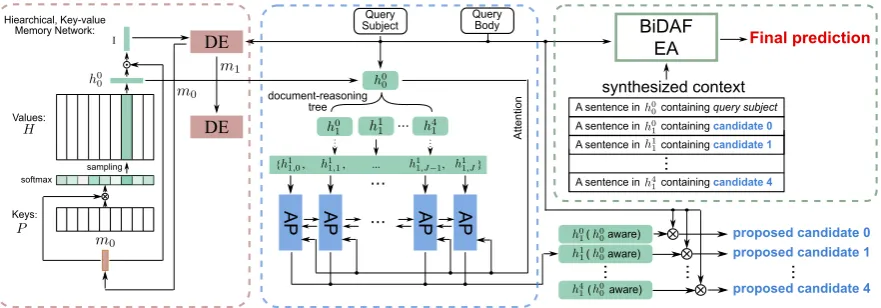
Figure 2: The full architecture of our 3-module system EPAr, with the Document Explorer (DE, left), Answer Proposer (AP, middle), and Evidence Assembler (EA, right).
accuracy on the hidden test set, which is com-petitive with the current leaderboard state-of-the-art. On MedHop, our system outperforms all pre-vious models, achieving the new state-of-the-art test leaderboard accuracy. It also obtains statis-tically significant (p < 0.01) improvement over our strong baseline on the two datasets. Further, we show that our Document Explorer combined with 2-hop TF-IDF retrieval is substantially better than two TF-IDF-based retrieval baselines in mul-tiple reasoning-chain recovery tests including on human-annotated golden reasoning chains. Next, we conduct ablations to prove the effectiveness of the Answer Proposer and Evidence Assembler in comparison with several baseline counterparts, and illustrate output examples of our 3-module system’s reasoning tree.
2 Model
In this section, we describe our 3-module sys-tem that constructs the ‘reasoning tree’ of docu-ments and predicts the answer for the query. For-mally, given a query q and a corresponding set of supporting documentsD = {di}Ni=1, our sys-tem tries to find a reasoning chain of documents
d01, . . . , d0T, d0i ∈D.3 The information from these selected documents is then combined to predict the answer among the given answer candidates. In the WikiHop and MedHop datasets, a query consists of a subject qsub (e.g., “The Haunted Castle” in
Fig.1a) and a bodyqbod (e.g., “located in the
ad-ministrative territorial entity”). There is one single correct answera(e.g., “Loon op Zand”) in the set of candidate answersA = {cl}Ll=1 such that the relationqbodholds true betweenqsubanda.
3In WikiHop dataset,T ≤3.
2.1 Retrieval and Encoding
In this section, we describe the pre-processing document retrieval and encoding steps before in-troducing our three modules of EPAr. We adopt a 2-hop document retrieval procedure to reduce the number of supporting documents that are fed to our system. We first select one document with the shortest TF-IDF distance to the query. We then rank the remaining documents according to their TF-IDF distances to the first selected document and add the topN0−1documents to form the con-text with a total of N0 documents for this query. Adding this preprocessing step is not only helpful in reducing GPU memory consumption but also helps bootstrap the training by reducing the search space of the Document Explorer (Sec.2.2).
We then use a Highway Network (Srivastava et al., 2015) of dimension d, which merges the character embedding and GloVe word embed-ding (Pennington et al., 2014), to get the word representations for the supporting documents and query4. This gives three matrices:X∈RN0×K×d, Qsub ∈ RJs×d and Qbod ∈ RJb×d, K, Js, Jb
are the lengths of supporting documents, query body, and query subject respectively. We then ap-ply a bi-directional LSTM-RNN (Hochreiter and Schmidhuber, 1997) of v hidden units to get the contextual word representations for the documents
H = {h1,· · · , hN0} s.t. hi ∈ RK×2v and the
query Usub ∈ RJs×2v, Ubod ∈ RJb×2v. Other than the word-level encoding, we also collect com-pact representations of all the supporting
docu-4
Unlike previous works (Welbl et al.,2017;Dhingra et al.,
2018;De Cao et al.,2018;Song et al.,2018a) that
ments, denoted asP ={p1,· · · , pN0}, by
apply-ing the self-attention mechanism in Zhong et al.
(2019) (see details in appendix). We obtain em-beddings for each candidate ci ∈ {c1, c2, .., cL}
using the average-over-word embeddings of the first mention5of the candidate inH.
2.2 Document Explorer
Our Document Explorer (DE, shown in the left part of Fig. 2) is a hierarchical memory net-work (Chandar et al.,2016). It utilizes the reduced document representationsP= {p1, p2,· · · , pN0}
and their corresponding word-level representa-tions H = {h1, h2,· · ·, hN0} as the key-value
knowledge base and maintains a memorymusing a Gated Recurrent Unit (GRU) (Cho et al.,2014). At every step, the DE selects a document which is related to the current memory state and updates the internal memory. This iterative procedure thus constructs a reasoning chain of documents.
Read Unit At each hopt, the model computes a
document-selection distributionP over every doc-ument based on the bilinear-similarity between the memory statemand document representationsP
using the following equations6:
xn=pTnWrmt χ= softmax(x) P(di) =χi
The read unit looks at all document (representa-tion) P and selects (samples) a document di ∼ P. The write operation updates the internal state (memory) using this sampled document.
Write Unit After the model selects di ∈ D,
the model then computes a distribution over ev-ery word in document di based on the similarity
between the memory state mand its word repre-sentationshi ∈ H. This distribution is then used
to compute the weighted average of all word rep-resentations in document di. We then feed this
weighted averageh˜ as the input to the GRU cell and update its memory state m (subscript i is omitted for simplicity):
wk=hTkWwm
ω = softmax(w)
˜
h=XK
k=1hkωk
mt+1=GRU(˜h, mt) (1)
Combining the ‘read’ and ‘write’ operations de-scribed above, we define a recurrent function:
5We tried different approaches to make use of all mentions of every candidate, but observe no gain in final performance. 6We initialize the memory state with the last state of the query subjectUsubto make first selected document directly conditioned on the query subject.
(ˆht+1, mt+1) = fDE(mt) such that ˆht+1 ∈ H and ˆht 6= ˆht+1. Therefore, unrolling the Docu-ment Explorer for T hops results in a sequence ofnon-repeating documents Hˆ = {hˆ1,· · · ,ˆhT}
such that each documentˆhi is selected iteratively
based on the current memory state building up one reasoning chain of documents. In practice, we roll out DE multiple times to obtain a document-search ‘reasoning tree’, where each root-to-leaf path cor-responds to a query-to-answer reasoning chain.
2.3 Answer Proposer
The Answer Proposer (AP, shown in the middle part of Fig.2) takes as input a single chain of doc-uments {ˆh1,· · ·,hˆT} from one of the chains in
the ‘reasoning tree‘ created by the DE, and tries to predict a candidate answer from the last doc-ument ˆhT in that reasoning chain. Specifically,
we adopt an LSTM-RNN with an attention mech-anism (Bahdanau et al.,2015) to encode theˆhT to
ancestor-aware representations y by attending to [ˆh1,...,T−1]. The model then computes a distribu-tion over wordsˆhiT ∈ˆhT based on the similarity
betweenyand the query representation. This dis-tribution is then used to compute the weighted av-erage of word representations{h1T, h2T,· · · , hKT}. Finally, AP proposes an answer among all candi-dates{c1,· · · , cL} that has the largest similarity
score with this weighted average˜hT.
eki =vTtanh(Whhˆicct+Wssk+b)
ak = softmax(ek); ck =X ia
k ihicct
yk =LSTM(ˆhTk−1, sk−1, ck−1)
wk =α(yk, us) +α(yk, ub); = softmax(w)
a=XK
k=1
ˆ
hkTk; Scorel=β(cl, a) (2)
where ˆhcct = [ˆh1,...,T−1]is the concatenation of documents in the word dimension;us andub are
the final states of Usub and Ubod respectively,
andskis the LSTM’s hidden states at the kth step. The Answer Proposer proposes the candidate with the highest score among{c1,· · ·, cL}. All
com-putations in Eqn.2that involve trainable parame-ters are marked in bold.7 This procedure produces ancestor-aware word representations that encode the interactions between the leaf document and ancestral document, and hence models the multi-hop, cross-document reasoning behavior.
7See appendix for the definition of the similarity functions
2.4 Evidence Assembler
As shown in Fig.1b, it is possible that a reasoning path could diverge into multiple branches, where each branch represents a unique, logical way of re-trieving inter-connected documents. Intuitively, it is very difficult for the model to predict which path to take without looking ahead. To solve this, our system first explores multiple reasoning chains by rolling out the Document Explorer multiple times to construct a ‘reasoning tree’ of documents, and then aggregates information from multiple rea-soning chains using a Evidence Assembler (EA, shown in the right part of Fig. 2), to predict the final answer. For each reasoning chain, the As-sembler first selects one sentence that contains the candidate answer proposed by the Answer Pro-poser and concatenates all these sentences into a new documenth0. This constructs a highly infor-mative and condensed context, at which point pre-vious phrase-matching style QA models can work effectively. Our EA uses a bidirectional attention flow model (Seo et al.,2017) to get a distribution over every word inh0 and compute the weighted average of word representations{h01,· · · , h0K}as ˜
h0. Finally, the EA selects the candidate answer of the highest similarity score w.r.t.˜h0.
2.5 Joint Optimization
Finally, we jointly optimize the entire model us-ing the cross-entropy losses from our Document Explorer, Answer Proposer, and Evidence Assem-bler. Since the Document Explorer samples doc-uments from a distribution, we use weak supervi-sion at the first and the final hops to account for the otherwise non-differentiabilty in the case of end-to-end training. Specifically, we use the doc-ument having the shortest TF-IDF distance w.r.t. the query subject to supervise the first hop and the documents which contain at least one mention of the answer to supervise the last hop. This allows the Document Explorer to learn the chain of docu-ments leading to the document containing the an-swer from the document most relevant to the query subject. Since there can be multiple documents containing the answer, we randomly sample a doc-ument as the label at the last hop. For the Answer Proposer and Evidence Assembler, we use cross-entropy loss from the answer selection process.
3 Experiments and Results
3.1 Datasets and Metrics
We evaluate our 3-module system on the WikiHop and the smaller MedHop multi-hop datasets from QAngaroo (Welbl et al.,2017). For the WikiHop dev set, each instance is also annotated as “fol-lows” or “not fol“fol-lows”, i.e., whether the answer can be inferred from the given set of supporting documents, and “single” or “multiple”, indicating whether the complete reasoning chain comprises of single or multiple documents. This allows us to evaluate our system on less noisy data and to in-vestigate its strength in queries requiring different levels of multi-hop reasoning. Please see appendix for dataset and metric details.
3.2 Implementation Details
For WikiHop experiments, we use 300-d GloVe word embeddings (Pennington et al., 2014) for our main full-size ‘EPAr’ model and 100-d GloVE word embeddings for our smaller ‘EPAr’ model which we use throughout the Analysis section for time and memory feasibility. We also use the last hidden state of the encoding LSTM-RNN to get the compact representation for all supporting documents in case of smaller model, in contrast to self-attention (Sec. B in Appendix) as in the full-size ‘EPAr’ model. The encoding LSTM-RNN (Hochreiter and Schmidhuber, 1997) has 100-d hidden size for our ‘EPAr’ model whereas the smaller version has 20-d hidden size. The em-bedded GRU (Cho et al.,2014) and the LSTM in our Evidence Assembler have the hidden dimen-sion of 80. In practice, we only apply TF-IDF based retrieval procedure to our Document Ex-plorer and Answer Proposer during inference, and during training time we use the full set of support-ing documents as the input. This is because we ob-served that the Document Explorer overfits faster in the reduced document-search space. For the Ev-idence Assembler, we employ both the TF-IDF re-trieval and Document Explorer to get the ‘reason-ing tree’ of documents, at both train‘reason-ing and test‘reason-ing time. We refer to the Sec.Ein the appendix for the implementation details of our MedHop models.
3.3 Results
We first evaluate our system on the Wiki-Hop dataset. For a fair comparison to recent works (De Cao et al., 2018; Song et al., 2018a;
Dev Test
BiDAF (Welbl et al.,2017)? - 42.9 Coref-GRU (Dhingra et al.,2018) 56.0 59.3 WEAVER (Raison et al.,2018) 64.1 65.3 MHQA-GRN (Song et al.,2018a) 62.8 65.4 Entity-GCN (De Cao et al.,2018) 64.8 67.6 BAG (Cao et al.,2019) 66.5 69.0 CFC (Zhong et al.,2019) 66.4 70.6
[image:6.595.313.517.59.242.2]EPAr (Ours) 67.2 69.1
Table 1: Dev set and Test set accuracy on WIKIHOP
dataset. The model marked with? does not use can-didates and directly predict the answer span. EPAr is our system with TF-IDF retrieval, Document Explorer, Answer Proposer and Evidence Assembler.
follow follow full + multiple + single
BiDAF Baseline 62.8 63.1 58.4
DE+AP+EA? 65.2 66.9 61.1
AP+EA 68.7 67.0 62.8
DE+AP+EA 69.4 70.6 64.7
DE+AP+EA† 71.8 73.8 66.9
DE+AP+EA†+SelfAttn 73.5 72.9 67.2
Table 2: Ablation accuracy on WIKIHOPdev set. The model marked with ? does not use the TFIDF-based
document retrieval procedure. The models marked with†are our full EPAr systems with 300-d word em-beddings and 100-d LSTM-RNN hidden size (same as the last row of Table1), while the 4th row represents the smaller EPAr system.
300-d embeddings and 100-d hidden size of the encoding LSTM-RNN. As shown in Table1, EPAr achieves 67.2% accuracy on the dev set, outper-forming all published models, and achieves 69.1% accuracy on the hidden test set, which is competi-tive with the current state-of-the-art result.8
Next, in Table2, we further evaluate our EPAr system (and its smaller-sized and ablated versions) on the “follows + multiple”, “follows + single”, and the full development set. First, note that on the full development set, our smaller system (“DE+AP+EA”) achieves statistically significant (p-value< 0.01)9 improvements over the BiDAF
baseline and is also comparable toDe Cao et al.
(2018) on the development set (64.7 vs. 64.8).10
8
Note that there also exists a recent anonymous unpub-lished entry on the leaderboard with 70.9% accuracy, which is concurrent to our work. Also note that our system achieves these strong accuracies even without using pretrained lan-guage model representations like ELMo (Peters et al.,2018) or BERT (Devlin et al., 2018), which have been known to give significant improvements in machine comprehension and QA tasks. We leave these gains for future work.
9
All stat. signif. is based on bootstrapped randomization test with 100K samples (Efron and Tibshirani,1994).
10For time and memory feasibility, we use this smaller
Query subject: Sulphur Spring,
Query body: located in the administrative territorial entity
Hayden Valley is a large, sub-alpine valley in Yellowstone National Park straddling the Yellowstone River ... 1
Sulphur Spring (also known as Crater Hills Geyser), is a
geyser in the Hayden Valley region of
Yellowstone National Park in the United States . ... 0
The Yellowstone River is a tributary of the Missouri River ...
Yellowstone Falls consist of two major waterfalls on the
Yellowstone River, within Wyoming, United States. ...
Yellowstone National Park is a national park located in the
U.S. states of Wyoming, Montana and Idaho. ...
2
3
4
Missouri Wyoming Wyoming? Montana? Idaho?
0
1 2 3 4
[image:6.595.83.279.62.171.2]Yellowstone
Figure 3: A ‘reasoning tree’ with 4 leaves that lead to different answers (marked in bold). The ground-truth answer is marked in red additionally.
Moreover, we see that EPAr is able to achieve high accuracy in both the examples that require multi-hop reasoning (“follows + multiple”), and other cases where a single document suffices for correctly answering the question (“follows + sin-gle”), suggesting that our system is able to ad-just to examples of different reasoning require-ments. The evaluation results further demonstrate that our Document Explorer combined with TF-IDF-based retrieval (row ‘DE+AP+EA’) consis-tently outperforms TF-IDF alone (row ‘AP+EA’) or the Document Explorer without TF-IDF (row ‘DE+AP+EA?’ in Table 2), showing that our 2-hop TF-IDF document retrieval procedure is able to broadly identify relevant documents and further aid our Document Explorer by reducing its search space. Finally, comparing the last two rows in Ta-ble2shows that using self-attention (Zhong et al.,
2019) to compute the document representation can further improve the full-sized system. We show an example of the ‘reasoning tree’ constructed by the Document Explorer and the correct answer pre-dicted by the Evidence Assembler in Fig.3.
We report our system’s accuracy on the Med-Hop dataset in Table3. Our best system achieves 60.3 on the hidden test set11, outperforming all current models on the leaderboard. However, as reported byWelbl et al.(2017), the original Med-Hop dataset suffers from a candidate frequency imbalance issue that can be exploited by certain
strong model with 100-d word embeddings and 20-d LSTM-RNN hidden size (similar to baselines inWelbl et al.(2017)) in all our analysis/ablation results (including Sec.4).
[image:6.595.74.287.244.338.2]Test
Test (Masked)
FastQA?(Weissenborn et al.,2017) 23.1 31.3 BiDAF?(Seo et al.,2017) 33.7 47.8
CoAttention - 58.1
Most Frequent Candidate? 10.4 58.4
[image:7.595.307.524.64.134.2]EPAr (Ours) 41.6 60.3
Table 3: Test set accuracy on MEDHOPdataset. The re-sults marked with?are reported in (Welbl et al.,2017).
R@1 R@2 R@3 R@4 R@5
Random 11.2 17.3 27.6 40.8 50.0
1-hop TFIDF 32.7 48.0 56.1 63.3 70.4 2-hop TFIDF 42.9 56.1 70.4 78.6 82.7
DE 38.8 50.0 65.3 73.5 83.7
TFIDF+DE 44.9 64.3 77.6 82.7 90.8
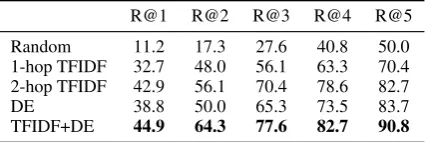
Table 4: Recall-k score is the % of examples where one of the human-annotated reasoning chains is recovered in the top-k root-to-leaf paths in the ‘reasoning tree’. ‘TFIDF+DE’ is the combination of the 2-hop TF-IDF retrieval procedure and our Document Explorer.
heuristics like the ‘Most Frequent Candidate’ in Table3. To eliminate this bias and to test our sys-tem’s ability to conduct multi-hop reasoning us-ing the context, we additionally evaluate our sys-tem on the masked version of MedHop, where ev-ery candidate expression is replaced randomly us-ing 100 unique placeholder tokens so that models can only rely on the context to comprehend every candidate. Our model achieves 41.6% accuracy in this “masked” setting, outperforming all previ-ously published works by a large margin.
4 Analysis
In this section, we present a series of new analyses and comparisons in order to understand the contri-bution from each of our three modules and demon-strate their advantages over other corresponding baselines and heuristics.
4.1 Reasoning Chain Recovery Tests
We compare our Document Explorer with two TF-IDF-based document selectors for their ability to recover the reasoning chain of documents. The 1-hop TF-IDF selector selects the topk+ 1 doc-uments with the highest TF-IDF score w.r.t. the query subject. The 2-hop TF-IDF selector, as in Sec.2.1, first selects the top-1 TF-IDF document w.r.t. the query subject and then selects the topk
remaining documents based on the TF-IDF score with respect to the first selected document. Fi-nally, we also compare to our final combination
R@1 R@2 R@3 R@4 R@5
Random 39.9 51.4 60.2 67.8 73.5
1-hop TFIDF 38.4 48.5 58.6 67.4 73.7 2-hop TFIDF 38.4 58.7 70.2 77.2 81.6
DE 52.5 70.2 80.3 85.8 89.0
TFIDF+DE 52.2 69.0 77.8 82.2 85.2
Table 5: Recall-k score is the percentage of examples where the ground-truth answer is present in the top-k root-to-leaf path in the ‘reasoning tree’. ‘TFIDF+DE’ is the combination of the 2-hop TFIDF retrieval proce-dure and our Document Explorer.
of 2-hop TF-IDF and Document Explorer.
Human Evaluation: We collect human-annotated reasoning chains for 100 documents from the “follows + multiple” dev set, and com-pare these to the ‘reasoning tree’ constructed by our Document Explorer to assess its ability to dis-cover the hidden reasoning chain from the entire pool of supporting documents. For each example, human annotators (external, English-speaking) select two of the smallest set of documents, from which they can reason to find the correct answer from the question. As shown in Table 4, our Document Explorer combined with 2-hop TF-IDF (row ‘TFIDF+DE’) obtains higher golden-chain recall scores compared to the two TFIDF-based document retrieval heuristics (row ‘1-hop TFIDF’ and ‘2-hop TFIDF’) alone or the Document Explorer without TF-IDF (row ‘DE’).
Answer Span Test: We also test our Document Explorer’s ability to find the document with men-tions of the ground-truth answer. Logically, the fact that the answer appears in one of the docu-ments in the ‘reasoning tree’ signals higher prob-ability that our modules at the following stages could predict the correct answer. As shown in Table5, our Document Explorer receives signifi-cantly higher answer-span recall scores compared to the two TF-IDF-based document selectors.12
4.2 Answer Proposer Comparisons
We compare our Answer Proposer with two rule-based sentence extraction heuristics for the ability to extract salient information from every reason-ing chain. For most documents in the WikiHop dataset, the first sentence is comprised of the most salient information from that document. Hence,
[image:7.595.74.287.184.255.2]full follows follows + multiple + single
Full-doc 63.1 68.4 69.0
Lead-1 63.6 68.7 70.2
AP w.o. attn 63.3 68.3 69.6
[image:8.595.91.269.64.135.2]AP 64.7 69.4 70.6
Table 6: Answer Proposer comparison study. “Follows + multiple” and “follows + single” are the subsets of dev set as described in Sec.3.1.
full follows follows + multiple + single
Single-chain 59.9 64.3 63.8
Avg-vote 54.6 56.3 55.6
Max-vote 51.5 53.9 53.3
w. Reranker 60.6 65.1 65.5 w. Assembler 64.7 69.4 70.6
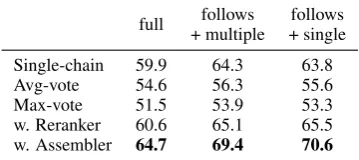
Table 7: Evidence Assembler comparison study: Reranker (described in the appendix) rescores the doc-uments selected by the Document Explorer.
we construct one baseline that concatenates the first sentence from each selected document as the input to the Evidence Assembler. We also show results of combining all the full documents as the synthesized context instead of selecting one sen-tence from every document. We further present a lighter neural-model baseline that directly pro-poses the answer from the leaf document without first creating its ancestor-aware representation. As shown in Table6, the system using sentences se-lected by our Answer Proposer outperforms both rule-based heuristics (row 1 and 2) and the simple neural baseline (row 3).
4.3 Assembler Ablations
In order to justify our choice of building an As-sembler, we build a 2-module system without the Evidence-Assembler stage by applying the An-swer Proposer to only the top-1 reasoning chain in the tree. We also present two voting heuristics that selects the final answer by taking the aver-age/maximum prediction probability from the An-swer Proposer on all document chains. Further-more, we compare our Evidence Assembler with an alternative model that, instead of assembling information from all reasoning chains, reranks all chains and their proposed answers to select the top-1 answer prediction. As shown in Table 7, the full system with the Assembler achieves sig-nificant improvements over the 2-module system. This demonstrates the importance of the Assem-bler in enabling information aggregation over
mul-tiple reasoning chains. The results further show that our Assembler is better than the reranking al-ternative.
4.4 Multi-hop Reasoning Example
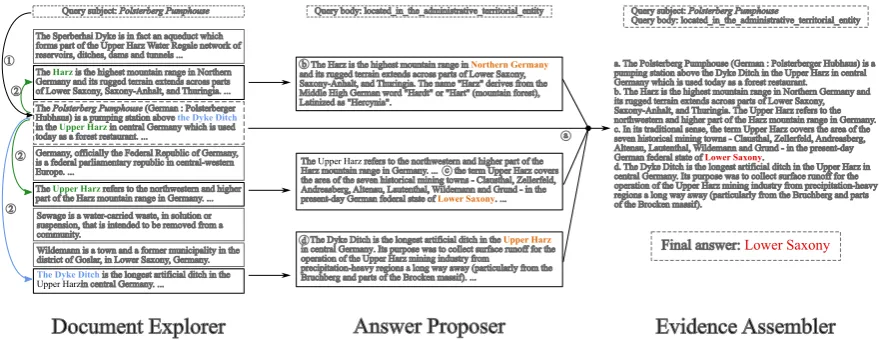
We visualize the 3-stage reasoning procedure of our EPAr system in Fig.4. As shown in the left of Fig.4, the Document Explorer first locates the root document (“The Polsterberg Pumphouse ...”) based on the query subject. It then finds three more documents that are related to the root document, constructing three document chains. The An-swer Proposer proposes a candidate anAn-swer from each of the three chains selected by the Docu-ment Explorer. Finally, the Evidence Assembler selects key sentences from all documents in the constructed document chains and makes the final prediction (“Lower Saxony”).
5 Related Works
The last few years have witnessed significant progress on text-based machine reading compre-hension and question answering (MRC-QA) in-cluding cloze-style blank-filling tasks (Hermann et al.,2015), open-domain QA (Yang et al.,2015), answer span prediction (Rajpurkar et al., 2016,
2018), and generative QA (Nguyen et al., 2016). However, all of the above datasets are confined to a single-document context per question setup.
Joshi et al.(2017) extended the task to the multi-document regime, with some examples requir-ing cross-sentence inference. Earlier attempts in multi-hop MRC focused on reasoning about the relations in a knowledge base (Jain, 2016; Zhou et al.,2018;Lin et al.,2018) or tables (Yin et al.,
2015). QAngaroo WikiHop and MedHop (Welbl et al.,2017), on the other hand, are created as nat-ural language MRC tasks. They are designed in a way such that the evidence required to answer a query could be spread across multiple documents. Thus, finding some evidence requires building a reasoning chain from the query with intermediate inference steps, which poses extra difficulty for MRC-QA systems. HotpotQA (Yang et al.,2018) is another recent multi-hop dataset which focuses on four different reasoning paradigms.
[image:8.595.91.271.189.269.2]metic-a The Sperberhai Dyke is in fact an aqueduct which
forms part of the Upper Harz Water Regale network of reservoirs, ditches, dams and tunnels ...
The Polsterberg Pumphouse (German : Polsterberger Hubhaus) is a pumping station above the Dyke Ditch
in the Upper Harz in central Germany which is used today as a forest restaurant. ...
The Harz is the highest mountain range in Northern Germany and its rugged terrain extends across parts of Lower Saxony, Saxony-Anhalt, and Thuringia. ...
The Dyke Ditch is the longest artificial ditch in the Upper Harzin central Germany. ...
The Upper Harz refers to the northwestern and higher part of the Harz mountain range in Germany. ... Germany, officially the Federal Republic of Germany, is a federal parliamentary republic in central-western Europe. ...
Query subject: Polsterberg Pumphouse
Sewage is a water-carried waste, in solution or suspension, that is intended to be removed from a community.
Wildemann is a town and a former municipality in the district of Goslar, in Lower Saxony, Germany. 1
2
2
2
Document Explorer
Query body: located_in_the_administrative_territorial_entity
b
d
c
The Dyke Ditch is the longest artificial ditch in the Upper Harz
in central Germany. Its purpose was to collect surface runoff for the operation of the Upper Harz mining industry from
precipitation-heavy regions a long way away (particularly from the Bruchberg and parts of the Brocken massif). ...
The Upper Harz refers to the northwestern and higher part of the Harz mountain range in Germany. ... the term Upper Harz covers the area of the seven historical mining towns - Clausthal, Zellerfeld, Andreasberg, Altenau, Lautenthal, Wildemann and Grund - in the present-day German federal state of Lower Saxony. ... The Harz is the highest mountain range in Northern Germany
and its rugged terrain extends across parts of Lower Saxony, Saxony-Anhalt, and Thuringia. The name "Harz" derives from the Middle High German word "Hardt" or "Hart" (mountain forest), Latinized as "Hercynia".
Answer Proposer
Query subject: Polsterberg Pumphouse
Query body: located_in_the_administrative_territorial_entity
a. The Polsterberg Pumphouse (German : Polsterberger Hubhaus) is a pumping station above the Dyke Ditch in the Upper Harz in central Germany which is used today as a forest restaurant. b. The Harz is the highest mountain range in Northern Germany and its rugged terrain extends across parts of Lower Saxony, Saxony-Anhalt, and Thuringia. The Upper Harz refers to the northwestern and higher part of the Harz mountain range in Germany. c. In its traditional sense, the term Upper Harz covers the area of the seven historical mining towns - Clausthal, Zellerfeld, Andreasberg, Altenau, Lautenthal, Wildemann and Grund - in the present-day German federal state of Lower Saxony.
d. The Dyke Ditch is the longest artificial ditch in the Upper Harz in central Germany. Its purpose was to collect surface runoff for the operation of the Upper Harz mining industry from precipitation-heavy regions a long way away (particularly from the Bruchberg and parts of the Brocken massif).
Final answer: Lower Saxony
[image:9.595.79.520.62.234.2]Evidence Assembler
Figure 4: An example of our 3-stage EPAr system exploring relevant documents, proposing candidate answers, and then assembling extracted evidence to make the final prediction.
ulously designed to solve single-document MRC tasks. Clark and Gardner(2018) andChen et al.
(2017) used a simple TF-IDF based document-selection procedure to find the context that is most relevant to the query for multi-document QA. However, this 1-hop, similarity-based se-lection process would fail on multi-hop reading-comprehension datasets like WikiHop because the query subject and the answer could appear in dif-ferent documents. On the other hand, our Doc-ument Explorer can discover the docDoc-ument with the answer “Loon op Zand” (in Fig.1a) by itera-tively selecting relevant documents and encoding the hinge words “Efteling” and “Kaatsheuvel” in its memory.
Recently,Dhingra et al.(2018) leveraged coref-erence annotations from an external system to con-nect the entities. Song et al. (2018a) andDe Cao et al. (2018) utilized Graph Convolutional Net-works (Kipf and Welling,2017) and Graph Recur-rent Networks (Song et al., 2018b; Zhang et al.,
2018) to model the relations between entities. Re-cently,Cao et al.(2019) extended the Graph Con-volutional Network inDe Cao et al.(2018) by in-troducing bi-directional attention between the en-tity graph and query. By connecting the entities, these models learn the inference paths for multi-hop reasoning. Our work differs in that our sys-tem learns the relation implicitly without the need of any human-annotated relation. Recently,Zhong et al. (2019) used hierarchies of co-attention and self-attention to combine evidence from multiple scattered documents. Our novel 3-module archi-tecture is inspired by previous 2-module selection architectures for MRC (Choi et al., 2017).
Sim-ilarly, Wang et al. (2018) first selected relevant content by ranking documents and then extracted the answer span. Min et al.(2018) selected rele-vant sentences from long documents in a single-document setup and achieved faster speed and ro-bustness against adversarial corruption. However, none of these models are built for multi-hop MRC where our EPAr system shows great effectiveness.
6 Conclusion
We presented an interpretable 3-module, multi-hop, reading-comprehension system ‘EPAr’ which constructs a ‘reasoning tree’, proposes an answer candidate for every root-to-leaf chain, and merges key information from all reasoning chains to make the final prediction. On WikiHop, our system out-performs all published models on the dev set, and achieves results competitive with the current state-of-the-art on the test set. On MedHop, our system outperforms all previously published models on the leaderboard test set. We also presented multi-ple reasoning-chain recovery tests for the explain-ability of our system’s reasoning capabilities.
7 Acknowledgement
References
D. Bahdanau, K. Cho, and Y. Bengio. 2015. Neural Machine Translation by Jointly Learning to Align and Translate. InThird International Conference on Learning Representations.
Yu Cao, Meng Fang, and Dacheng Tao. 2019. BAG: bi-directional attention entity graph convolutional net-work for multi-hop reasoning question answering. InNAACL-HLT.
Sarath Chandar, Sungjin Ahn, Hugo Larochelle, Pascal Vincent, Gerald Tesauro, and Yoshua Bengio. 2016. Hierarchical memory networks. arXiv preprint arXiv:1605.07427.
Danqi Chen, Adam Fisch, Jason Weston, and Antoine Bordes. 2017. Reading Wikipedia to answer open-domain questions. InACL.
Kyunghyun Cho, Bart van Merrienboer, C¸ aglar G¨ulc¸ehre, Fethi Bougares, Holger Schwenk, and Yoshua Bengio. 2014. Learning phrase representa-tions using RNN encoder-decoder for statistical ma-chine translation. InEMNLP.
Eunsol Choi, Daniel Hewlett, Jakob Uszkoreit, Illia Polosukhin, Alexandre Lacoste, and Jonathan Be-rant. 2017. Coarse-to-fine question answering for long documents. InACL.
Christopher Clark and Matt Gardner. 2018. Simple and effective multi-paragraph reading comprehen-sion. In Proceedings of the 56th Annual Meeting of the Association for Computational Linguistics.
Nicola De Cao, Wilker Aziz, and Ivan Titov. 2018. Question answering by reasoning across documents with graph convolutional networks. arXiv preprint arXiv:1808.09920.
Jacob Devlin, Ming-Wei Chang, Kenton Lee, and Kristina Toutanova. 2018. Bert: Pre-training of deep bidirectional transformers for language understand-ing.
Bhuwan Dhingra, Qiao Jin, Zhilin Yang, William W Cohen, and Ruslan Salakhutdinov. 2018. Neural models for reasoning over multiple mentions using coreference. In Proceedings of the 16th Annual Conference of the North American Chapter of the Association for Computational Linguistics: Human Language Technologies.
Bhuwan Dhingra, Hanxiao Liu, Zhilin Yang, William Cohen, and Ruslan Salakhutdinov. 2017. Gated-attention readers for text comprehension. In Pro-ceedings of the 55th Annual Meeting of the Associa-tion for ComputaAssocia-tional Linguistics (Volume 1: Long Papers), pages 1832–1846, Vancouver, Canada. As-sociation for Computational Linguistics.
Bradley Efron and Robert J Tibshirani. 1994. An intro-duction to the bootstrap. CRC press.
Karl Moritz Hermann, Tomas Kocisky, Edward Grefenstette, Lasse Espeholt, Will Kay, Mustafa Su-leyman, and Phil Blunsom. 2015. Teaching ma-chines to read and comprehend. InAdvances in Neu-ral Information Processing Systems, pages 1693– 1701.
Sepp Hochreiter and J¨urgen Schmidhuber. 1997. Long short-term memory. Neural computation, 9(8):1735–1780.
Sarthak Jain. 2016. Question answering over knowl-edge base using factual memory networks. In Pro-ceedings of the NAACL Student Research Workshop. Association for Computational Linguistics.
Mandar Joshi, Eunsol Choi, Daniel S Weld, and Luke Zettlemoyer. 2017. Triviaqa: A large scale distantly supervised challenge dataset for reading comprehen-sion.arXiv preprint arXiv:1705.03551.
Diederik P. Kingma and Jimmy Ba. 2014. Adam: A method for stochastic optimization.CoRR.
Thomas N. Kipf and Max Welling. 2017. Semi-supervised classification with graph convolutional networks. InICLR.
Xi Victoria Lin, Richard Socher, and Caiming Xiong. 2018. Multi-hop knowledge graph reasoning with reward shaping. InEMNLP.
Sewon Min, Victor Zhong, Richard Socher, and Caim-ing Xiong. 2018. Efficient and robust question an-swering from minimal context over documents. In
Proceedings of the 56th Annual Meeting of the As-sociation for Computational Linguistics (Volume 1: Long Papers), pages 1725–1735. Association for Computational Linguistics.
Tri Nguyen, Mir Rosenberg, Xia Song, Jianfeng Gao, Saurabh Tiwary, Rangan Majumder, and Li Deng. 2016. Ms marco: A human generated machine reading comprehension dataset. arXiv preprint arXiv:1611.09268.
Jeffrey Pennington, Richard Socher, and Christopher D Manning. 2014. Glove: Global vectors for word representation. In Conference on Empirical Meth-ods in Natural Language Processing (EMNLP).
Matthew E. Peters, Mark Neumann, Mohit Iyyer, Matt Gardner, Christopher Clark, Kenton Lee, and Luke S. Zettlemoyer. 2018. Deep contextualized word representations. InNAACL-HLT.
Martin Raison, Pierre-Emmanuel Mazar´e, Rajarshi Das, and Antoine Bordes. 2018. Weaver: Deep co-encoding of questions and documents for machine reading.arXiv preprint arXiv:1804.10490.
Pranav Rajpurkar, Jian Zhang, Konstantin Lopyrev, and Percy Liang. 2016. Squad: 100,000+ questions for machine comprehension of text. InConference on Empirical Methods in Natural Language Processing (EMNLP).
Minjoon Seo, Aniruddha Kembhavi, Ali Farhadi, and Hannaneh Hajishirzi. 2017. Bidirectional attention flow for machine comprehension. In International Conference on Learning Representations (ICLR).
Linfeng Song, Zhiguo Wang, Mo Yu, Yue Zhang, Radu Florian, and Daniel Gildea. 2018a. Exploring graph-structured passage representation for multi-hop reading comprehension with graph neural net-works. arXiv preprint arXiv:1809.02040.
Linfeng Song, Yue Zhang, Zhiguo Wang, and Daniel Gildea. 2018b. A graph-to-sequence model for amr-to-text generation. In Proceedings of the 56th An-nual Meeting of the Association for Computational Linguistics (Volume 1: Long Papers), pages 1616– 1626. Association for Computational Linguistics.
Rupesh Kumar Srivastava, Klaus Greff, and J¨urgen Schmidhuber. 2015. Highway networks. In Inter-national Conference on Machine Learning (ICML).
Shuohang Wang, Mo Yu, Xiaoxiao Guo, Zhiguo Wang, Tim Klinger, Wei Zhang, Shiyu Chang, Gerald Tesauro, Bowen Zhou, and Jing Jiang. 2018. R3: Reinforced ranker-reader for open-domain question answering. InAAAI.
Dirk Weissenborn, Georg Wiese, and Laura Seiffe. 2017. Making neural qa as simple as possible but not simpler. InCoNLL.
Johannes Welbl, Pontus Stenetorp, and Sebastian Riedel. 2017. Constructing datasets for multi-hop reading comprehension across documents. InTACL.
Caiming Xiong, Victor Zhong, and Richard Socher. 2017. Dynamic coattention networks for question answering. InICLR.
Yi Yang, Wen-tau Yih, and Christopher Meek. 2015. Wikiqa: A challenge dataset for open-domain ques-tion answering. In Proceedings of the 2015 Con-ference on Empirical Methods in Natural Language Processing, pages 2013–2018.
Zhilin Yang, Peng Qi, Saizheng Zhang, Yoshua Ben-gio, William W Cohen, Ruslan Salakhutdinov, and Christopher D Manning. 2018. Hotpotqa: A dataset for diverse, explainable multi-hop question answer-ing. InConference on Empirical Methods in Natural Language Processing (EMNLP).
Pengcheng Yin, Zhengdong Lu, Hang Li, and Ben Kao. 2015. Neural enquirer: Learning to query tables.
arXiv preprint.
Yue Zhang, Qi Liu, and Linfeng Song. 2018. Sentence-state lstm for text representation. InProceedings of the 56th Annual Meeting of the Association for Com-putational Linguistics (ACL).
Victor Zhong, Caiming Xiong, Nitish Shirish Keskar, and Richard Socher. 2019. Coarse-grain fine-grain coattention network for multi-evidence question an-swering. InICLR.
Mantong Zhou, Minlie Huang, and Xiaoyan Zhu. 2018. An interpretable reasoning network for multi-relation question answering. In Proceedings of the 27th International Conference on Computational Linguistics.
Appendix
A Reranker
We explore an alternative to Evidence Assem-bler (EA), where instead of selecting key sen-tences from every root-to-leaf path in the rea-soning tree, we use a reranker to rescore the se-lected documents. Specifically, given a document reasoning-tree oftwreasoning chains, we use
bidi-rectional attention (Seo et al., 2017) between the last documents in each chain and all the docu-ments from the previous hops in that chain to ob-tain {ˆh1,· · ·,hˆtw} which are the refined repre-sentations of the leaf documents. We then ob-tain a fixed length document representation as the weighted average of word representations for each of the tw documents using similarity with query
subject and query body as the weights using func-tionα. We obtain the scores for each of the doc-uments by computing similarity with the answer which that reasoning chain proposes usingβ. (See Sec.Cbelow for details of the similarity functions
αandβ.)
B Self-Attention
We use self-attention from Zhong et al. (2019) to get the compact representation for all support-ing documents. Given contextual word repre-sentations for the supporting documents H = {h1, h2,· · ·, hN0}such thathi ∈ RK×2v, we
de-fineSelfattn(hi)→pi ∈R2vas:
aik= tanh(W2tanh(W1hki +b1) +b2)
ˆ
ai= softmax(ai)
pi= K
X
k=1
ˆ
aikhki
(3)
such thatpi provides the summary of theith
C Similarity Functions
When constructing our 3-module system, we use similarity functions α and β. The functionβ is defined as:
β(h, c) =Wβ1relu(Wβ2[h;u;h◦u]+bβ2)+bβ1
(4) where relu(x) = max(0, x), and ◦ represents element-wise multiplication. And the functionα
is defined as:
α(h, u) =Wα2
T((W
α1h+bα1)◦u) (5)
where all trainable weights are marked in bold.
D Datasets and Metrics
We evaluate our 3-module system on QAngaroo (Welbl et al.,2017), which is a set of two multi-hop reading comprehension datasets: WikiHop and MedHop. WikiHop contains 51K instances, including 44K for training, 5K for development and 2.5K for held out testing. MedHop is a smaller dataset based on the domain of molecular biology. It consists of 1.6K instances for training, 342 for development, and 546 for held out testing. Each instance consists of a query (which can be sep-arated as a query subject and a query body), a set of supporting documents and a list of candi-date answers. For the WikiHop development set, each instance is also annotated as “follows” or “not follows”, which signifies whether the answer can be inferred from the given set of supporting documents, and “multiple” or “single”, which tells whether the complete reasoning chain comprises of multiple documents or just a single one. We measure our system’s performance on these sub-sets of the development set that are annotated as “follows and multiple” and “follows and single”. This allows us to evaluate our systems on a less noisy version of development set and to investigate their strength in queries requiring different levels of multi-hop reasoning behavior.
E Implementation Details
For Medhop, considering the small size of the dataset, we use 20-d hidden size of the encod-ing LSTM-RNN and the last hidden state of the encoding LSTM-RNN to get compact representa-tion of the documents. We also use a hidden size of 20 for the embedded GRU cell and LSTM in our Evidence Assembler. In addition to that, since