2872
Multi-Level Matching and Aggregation Network
for Few-Shot Relation Classification
Zhi-Xiu Ye, Zhen-Hua Ling∗
National Engineering Laboratory for Speech and Language Information Processing, University of Science and Technology of China
[email protected],[email protected]
Abstract
This paper presents a multi-level matching and aggregation network (MLMAN) for few-shot relation classification. Previous studies on this topic adopt prototypical networks, which cal-culate the embedding vector of a query in-stance and the prototype vector of each sup-port set independently. In contrast, our pro-posed MLMAN model encodes the query in-stance and each support set in an interactive way by considering their matching informa-tion at both local and instance levels. The fi-nal class prototype for each support set is ob-tained by attentive aggregation over the rep-resentations of its support instances, where the weights are calculated using the query in-stance. Experimental results demonstrate the effectiveness of our proposed methods, which achieve a new state-of-the-art performance on the FewRel dataset1.
1 Introduction
Relation classification (RC) is a fundamental task in natural language processing (NLP), which aims to identify the semantic relation between two enti-ties in text. For example, the instance “[London]e1 is the capital of [the UK]e2” expresses the relation capital of between the two entities London and
the UK.
Some conventional relation classification meth-ods (Bethard and Martin, 2007; Zelenko et al., 2002) adopted supervised training and suffered from the lack of large-scale manually labeled data. To address this issue, the distant supervision method (Mintz et al.,2009) was proposed which annotated training data by heuristically aligning knowledge bases (KBs) and texts. However, the long-tail problem in KBs (Xiong et al.,2018;Han
∗
Corresponding author: Zhen-Hua Ling.
1The code is available at https://github.com/
ZhixiuYe/MLMAN.
Support Set
class A:mother
instance #1 The Queen Consort [Jetsun Pema]e2 gave
birth to a son on 5 February 2016 , [Jigme Namgyel Wangchuck]e1.
instance #2 He married the American actress [Cindy Robbins]e2 and was stepfather to her daughter ,
[Kim-berly Beck]e1.
instance #3 Edgar married actress [Moyna Macgill]e2
and became the father of [Angela Lansbury]e1.
instance #4 In 1845 , [Cemile Sultan]e1’s mother ,
Em-press [Dzdidil Kadn]e2, died.
instance #5 Bo ’s wife [Gu Kailai]e2traveled with their
son [Bo Guagua]e1to Britain.
class B:member of... class C:father... class D:sport... class E:voice type...
Query Instance
He was married to [Eva Funck]e2 and they have a son
[Gustav]e1.
Table 1: A data example of 5-way-5-shot relation clas-sification in FewRel development set. The correct re-lation class for the query instance is class A:mother. The instances for other relation classes are omitted for saving space.
et al.,2018) still exists and makes it hard to clas-sify the relations with very few training samples.
This paper focuses on the few-shot relation clas-sification task, which was designed to address the long-tail problem. In this task, only few (e.g., 1 or 5) support instances are given for each relation, as shown by an example in Table1.
gen-eralize to new concepts (e.g., test set). Some other methods use metric learning based networks (Koch et al., 2015; Vinyals et al., 2016; Snell et al.,2017), which learn the distance distributions among classes. A simple and effective metric-based few-shot learning method is prototypical network (Snell et al., 2017). In a prototype net-work, query and support instances are encoded into an embedding space independently. Then, a prototype vector for each class candidate is de-rived as the mean of its support instances in the embedding space. Finally, classification is per-formed by calculating the distances between the embedding vector of the query and all class pro-totypes. This prototype network method has also been applied to few-shot relation classification re-cently (Han et al.,2018).
This paper proposes a multi-level matching and aggregation network (MLMAN) for few-shot re-lation classification. Different from prototypi-cal networks, which represent support sets with-out dependency on query instances, our proposed MLMAN model encodes each query instance and each support set in an interactive way by consid-ering their matching information at both local and instance levels. At local level, the local context representations of a query instance and a support set are softly matched toward each other follow-ing the sentence matchfollow-ing framework (Chen et al., 2017). Then, the matched local representations are aggregated into an embedding vector for each query and each support instance using max and av-erage pooling. At instance level, the matching de-gree between the query instance and each of the support instances is calculated via a multi-layer perceptron (MLP). Taking the matching degrees as weights, the instances in a support set are aggre-gated to form the class prototype for final classifi-cation. All these matching and aggregation layers in the MLMAN model are estimated jointly us-ing trainus-ing data. Since the representations of the support instances in each class are expected to be close with each other, an auxiliary loss function is further designed to measure the inconsistency among all support representations in each class.
In summary, our contributions in this paper are three-fold. First, a multi-level matching and ag-gregation network is proposed to encode query in-stances and class prototypes in an interactive fash-ion. Second, an auxiliary loss function measur-ing the consistency among support instances is
de-signed. Third, our method achieves a new state-of-the-art performance on FewRel, a public few-shot relation classification dataset.
2 Related Work
2.1 Relation Classification
Relation classification is to identify the semantic relation between two entities in one sentence. In recently years, neural networks have been widely applied to deal with this task. Zeng et al. (2014) employed position features and convolutional neu-ral networks (CNNs) to capture the structure and contextual information respectively. Then, a max pooling operation was adopted to determine the most useful features. Wang et al. (2016) pro-posed multi-level attention CNNs, which captured both entity-specific attention and relation-specific pooling attention in order to better discern pat-terns in heterogeneous contexts.Zhou et al.(2016) proposed attention-based bidirectional long short-term memory networks (AttBLSTMs) to capture the most important semantic information in a sen-tence. All of these methods require a large amount of training data and can’t quickly adapt to a new class that has never been seen.
2.2 Metric Based Few-Shot Learning
In few-shot learning paradigm, a classifier is re-quired to generalize to new classes with only a small number of training samples. The metric based approach aims to learn a set of projec-tion funcprojec-tions that take support and query sam-ples from the target problem and classify them in a feed forward manner. This approach has lower complexity and is easier for implementa-tion than meta-learner based approach (Ravi and Larochelle,2016;Finn et al.,2017;Santoro et al., 2016;Munkhdalai and Yu,2017).
based on a principle that test and training condi-tions must match and has been adopted by many following studies. Snell et al. (2017) proposed prototypical networks that learn a metric space in which classification can be performed by comput-ing distances to prototype representations of all classes, and the prototype representation of each class was the mean of all its support samples. Gar-cia and Bruna(2017) defined a graph neural net-work architecture to assimilate generic message-passing inference algorithms, which generalized above three models.
Regarding with few-shot relation classification, Han et al.(2018) adopted prototypical networks to build baseline models on the FewRel dataset.Gao et al.(2019) proposed hybrid attention-based pro-totypical networks to handle noisy training sam-ples in few-shot learning. In this paper, we im-prove the conventional prototypical networks for few-shot relation classification by encoding the query instance and class prototype interactively through multi-level matching and aggregation.
2.3 Sentence Matching
Sentence matching is essential for many NLP tasks, such as natural language inference (NLI) (Bowman et al., 2015) and response selection (Lowe et al., 2015). Some sentence match-ing methods mainly rely on sentence encodmatch-ing (Mueller and Thyagarajan,2016;Conneau et al., 2017;Chen et al.,2018), which encode a pair sen-tences independently and then transmit their em-beddings into a classifier, such as a neural net-work, to decide the relationship between them. Some other methods are based on joint models (Chen et al.,2017;Gong et al., 2017;Kim et al., 2018), which use cross-features to represent the local (i.e., word-level and phrase-level) alignments for better performance. In this paper, we follow the joint models to achieve the local matching be-tween a query instance and the support set for a class. The difference between our task and the other sentence matching tasks mentioned above is that, our goal is to match a sentence to a set of sen-tences, instead of to another sentence (Bowman et al.,2015) or to a sequence of sentences (Lowe et al.,2015).
3 Task Definition
In few-shot relation classification, we are given two datasets, Dmeta−train andDmeta−test. Each
dataset consists of a set of samples(x, p, r), where
x is a sentence composed of T words and the t -th word is wt, p = (p1, p2) indicate the posi-tions of two entities, and r is the relation label of the instance (x, p). These two datasets have their own relation label spaces that are disjoint with each other. Under few-shot configuration, Dmeta−testis splited into two parts,Dtest−support
andDtest−query. IfDtest−support containsK
la-beled samples for each ofN relation classes, this target few-shot problem is namedN-way-K-shot. Dtest−query contains test samples, each labeled
with one of theN classes. Assuming that we only haveDtest−supportandDtest−query, we can train a
model usingDtest−supportand evaluate its
perfor-mance onDtest−query. But limited by the number
of support samples (i.e,.,N×K), it is hard to train a good model from scratch.
AlthoughDmeta−trainandDmeta−testhave
dis-joint relation label spaces, Dmeta−train can also
been utilized to help the few-shot relation clas-sification on Dmeta−test. One approach is the
paradigm proposed byVinyals et al.(2016), which obey an important machine learning principle that test and train conditions must match. That’s to say, we also split Dmeta−train into two parts,
Dtrain−support and Dtrain−query, and mimic the
few-shot learning settings at training stage. In each training iteration, N classes are randomly selected from Dtrain−support, and K support
in-stances are randomly selected from each class. In this way, we construct the train-support set
S = {sik;i = 1, ..., N, k = 1, ..., K}, where sik
is the k-th instance in classi. And also, we ran-domly selectR samples from the remaining sam-ples of those N classes and construct the train-query set Q = {(qj, lj);j = 1, ..., R}, where lj ∈ {1, ..., N}is the label of instanceqj.
Just like conventional prototypical networks, we expect to minimize the following objective function at training time
Jmatch =−
1
R X
(q,l)∈Q
P(l|S, q), (1)
andP(l|S, q)is defined as
P(l|S, q) = exp(f({s
l
k}Kk=1, q))
PN
i=1exp(f({sik}Kk=1, q))
. (2)
The function f({sik}K
𝑠1 Encoder
𝑠𝐾 Encoder
... ... ... 𝐶
𝑞 Encoder 𝑄
Local Matching and Aggregation
𝑠 1
...
𝑠 𝐾
... Class
Matching 𝛾 𝑠2 Encoder
𝑆1
𝑆2
𝑆𝐾 𝑞
[image:4.595.80.509.63.176.2]Instance Matching and Aggregation 𝑠
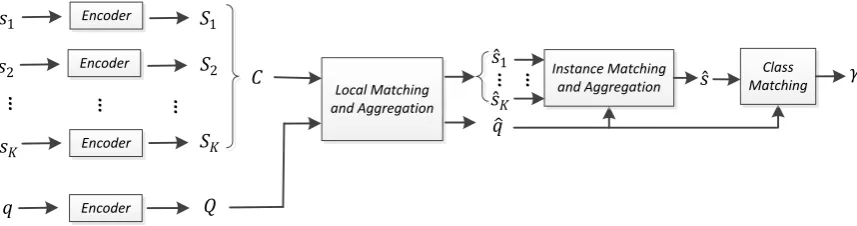
Figure 1: The framework of our proposed MLMAN model.
the set of support instances{sik}K
k=1. How to de-sign this function is the focus of this paper.
4 Methodology
In this section, we will introduce our proposed multi-level matching and aggregation network (MLMAN) for modelingf({sik}K
k=1, q). For sim-plicity, we will discard the superscriptiofsikfrom Section 4.1 to Section 4.4. The framework of our proposed MLMAN model is shown in Fig. 1, which has four main modules.
• Context Encoder. Given a sentence and the positions of two entities within this sentence, CNNs (Zeng et al.,2014) are adopted to de-rive the local context representations of each word in the sentence.
• Local Matching and Aggregation. Similar to (Chen et al.,2017), given the local repre-sentation of a query instance and the local representations of K support instances, the attention method is employed to collect local matching information between them. Then, the matched local representations are aggre-gated to represent each instance as an embed-ding vector.
• Instance Matching and Aggregation. The matching information between a query in-stance and each of the K support instances are calculated using an MLP. Then, we take the matching degrees as weights to sum the representations of support instances in order to get the class prototype.
• Class Matching. An MLP is built to cal-culate the matching score between the repre-sentations of the query instance and the class prototype.
More details of these four modules will be in-troduced in the following subsections.
4.1 Context Encoder
For a query or support instance, each word
wt in the sentence x is first mapped into a dw-dimensional word embedding et (Pennington
et al.,2014). In order to describe the position in-formation of the two entities in this instance, the position features (PFs) proposed by Zeng et al. (2014) are also adopted in our work. Here, PFs de-scribe the relative distances between current word and the two entities, and are further mapped into two vectors p1t and p2t of dp dimensions.
Fi-nally, these three vectors are concatenated to get the word representation wt = [et;p1t;p2t] of dw+2dpdimensions, and the instance can be
writ-ten asW∈RT×(dw+2dp).
The most popular models for local context en-coding are recurrent neural networks (RNNs) with long short-term memories (LSTMs) (Hochreiter and Schmidhuber,1997) and convolutional neural networks (CNNs) (Kim,2014). In this paper, we employ CNNs to build the context encoder. For an input instanceW∈RT×(dw+2dp), we input it into a CNN withdcfilters. The output from the CNN
is a matrix withT ×dcdimensions. In this way,
the context representations of the query instance Q ∈ RTq×dc and the context representations of
support instances {Sk ∈ RTk×dc;k = 1, ..., K} are obtained, where Tq and Tk are the sentence
lengths of the query sentence and thek-th support sentence respectively.
4.2 Local Matching and Aggregation
In order to get the matching information between Qand{Sk;k= 1, ..., K}, we first concatenate the Ksupport instance representations into one matrix as follow
C= concat({Sk}Kk=1), (3)
whereC ∈ RTs×dc withT
s = PKk=1Tk. Then,
andCand calculate their matched representations
e
QandSeas follows
αmn=q>mcn, (4)
e
qm=
Ts X
n=1
exp(αmn) PTs
n0=1exp(αmn0)
cn, (5)
e
cn=
Tq X
m=1
exp(αmn) PTq
m0=1exp(αm0n)
qm, (6)
wherem ∈ {1, ..., Tq}in Eq. (5),n∈ {1, ..., Ts}
in Eq. (6),qmandeqmare them-th rows ofQand
e
Qrespectively, andcnandecnare then-th rows of CandCe respectively.
Next, the original representations and the matched representations are fused utilizing a ReLU layer as follows,
¯
Q= ReLU([Q;Qe;|Q−Qe|;QQe]W1), (7)
¯
C= ReLU([C;Ce;|C−Ce|;CCe]W1), (8)
where is the element-wise product andW1 ∈ R4dc×dh is the weight matrix at this layer for
re-ducing dimensionality. C¯ is further split into K
representations {S¯k}Kk=1 corresponding to theK support instances where S¯k ∈ RTk×dh. All S¯
k
and Q¯ are fed into a single-layer Bi-directional LSTM (BLSTM) withdhhidden units along each
direction to obtain the final local matching results
b
Sk ∈RTk×2dhandQb ∈RTq×2dh.
Local aggregation aims to convert the results of local matching into a single vector for each query and each support instance. In this paper, we em-ploy a max pooling together with an average pool-ing, and concatenate their results into one vectorbsk
orbq. The calculations are as follows,
bsk=[max(Sbk); ave(Sbk)],∀k∈ {1, ..., K}, (9)
b
q=[max(Qb); ave(Qb)], (10)
where{bsk,bq} ∈R
4dh.
4.3 Instance Matching and Aggregation
Similar to conventional prototypical networks (Snell et al., 2017), our proposed method calcu-lates class prototypebsvia the representations of all
support instances in this class, i.e.,{bsk}Kk=1. How-ever, instead of using a naive mean operation, we aggregate instance-level representations via atten-tion over{bsk}Kk=1, where each weight is derived
from the instance matching score betweenbsk and
b
q. The matching function is as follow,
βk=v>(ReLU(W2[bsk;bq])), (11)
whereW2∈Rdh×8dhandv∈Rdh.β
kdescribes
the instance-level matching degree between the query instance q and the support instance sk.
Then, all{bsk}Kk=1are aggregated into one vectorbs
as
bs= K X
k=1
exp(βk) PK
k0=1exp(βk0)
bsk, (12)
andbsis the class prototype.
4.4 Class Matching
After the class prototypebsand the embedding
vec-tor of the query instancebqhave been determined, the class-level matching functionf({sk}Kk=1, q)in Eq. (2) is defined as
f({sk}Kk=1, q) =v
>(ReLU(W
2[bs;qb])). (13)
Eq. (11) and (13) have the same form. In our experiments, sharing the weights W2 and v in these two equations, i.e., employing the exactly same function for both instance-level and class-level matching in each training iteration, lead to better performance.
4.5 Joint Training with Inconsistency Measurement
If the representations of all support instances in a class are far away from each other, it could become difficult for the derived class prototype to cap-ture the common characteristics of all support in-stances. Therefore, a function which measures the inconsistency among the set of support instances is designed. In order to avoid the high complexity of directly comparing every two support instances in a class, we calculate the inconsistency measure-ment as the average Euclidean distance between the support instances and the class prototype as
Jincon =
1
N K N X
i=1
K X
k=1
||bsik−bsi||22, (14)
whereiis the class index and|| · ||2 calculates the 2-norm of a vector.
By combining Eqs. (1) and (14), the final ob-jective function for training the whole model is de-fined as
J = Jmatch+λJincon, (15)
Model 5 Way 1 Shot 5 Way 5 Shot 10 Way 1 Shot 10 Way 5 Shot
Meta Network (Han et al.,2018) 64.46±0.54 80.57±0.48 53.96±0.56 69.23±0.52
GNN (Han et al.,2018) 66.23±0.75 81.28±0.62 46.27±0.80 64.02±0.77
SNAIL (Han et al.,2018) 67.29±0.26 79.40±0.22 53.28±0.27 68.33±0.25
Prototypical Network (Han et al.,2018) 69.20±0.20 84.79±0.16 56.44±0.22 75.55±0.19
Proto-HATT (Gao et al.,2019) - - 90.12±0.04 - - 83.05±0.05
[image:6.595.309.525.199.333.2]MLMAN 82.98±0.20 92.66±0.09 75.59±0.27 87.29±0.15
Table 2: Accuracies (%) of different models on FewRel test set.
5 Experiments
5.1 Dataset and Evaluation Metrics
The few-shot relation classification dataset FewRel2 was adopted in our experiments. This dataset was first generated by distant supervision and then filtered by crowdsourcing to remove noisy annotations. The final FewRel dataset consists of 100 relations, each has 700 instances. The average number of tokens in each sentence is 24.99, and there are 124,577 unique tokens in total. The 100 relations are split into 64, 16 and 20 for training, validation and test respectively.
Our experiments investigated four few-shot learning configurations, 5 way 1 shot, 5 way 5 shot, 10 way 1 shot, and 10 way 5 shot, which were the same asHan et al.(2018). According to the official evaluation scripts3, all results given by our experiments were the mean and standard de-viation values of 10 training repetitions, and were tested using 20,000 independent samples.
5.2 Training Details and Hyperparameters
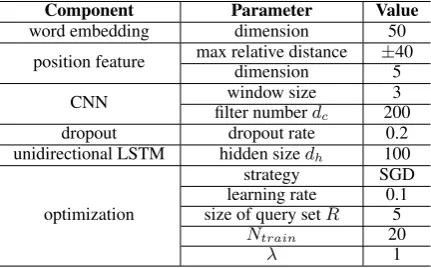
All of the hyperparameters used in our experi-ments are listed in Table 3. The 50-dimensional Glove word embeddings released by Pennington et al.(2014)4were adopted in the context encoder and were fixed during training. For the unknown words, we just replaced them with an unique spe-cial token <UNK> and fixed its embedding as a zero vector. Previous study (Munkhdalai and Yu,2017) found that the models trained on harder tasks may achieve better performances than using the same configurations at both training and test stages. Therefore, we set N = 20 to construct the train-support sets for 5-way and 10-way tasks. In our experiments, grid searches among dc ∈
{100,150,200,250}, dh ∈ {100,150,200,250}
2https://thunlp.github.io/fewrel.html
.
3
https://thunlp.github.io/fewrel.html.
4https://nlp.stanford.edu/projects/
glove/.
Component Parameter Value
word embedding dimension 50
position feature max relative distance ±40
dimension 5
CNN window size 3
filter numberdc 200
dropout dropout rate 0.2
unidirectional LSTM hidden sizedh 100
optimization
strategy SGD
learning rate 0.1 size of query setR 5
Ntrain 20
λ 1
Table 3: Hyper-parameters of the models built in our experiments.
and R ∈ {5,10,15} were conducted to deter-mine their optimal values. For optimization, we employed mini-batch stochastic gradient descent (SGD) with the initial learning rate of 0.1. The learning rate was decayed to one tenth every 20,000 steps. And also, dropout layers (Hinton et al.,2012) were inserted before CNN and LSTM layers and the drop rate was set as 0.2.
5.3 Comparison with Previous Work
Model No. 5 Way 1 Shot 5 Way 5 Shot 10 Way 1 Shot 10 Way 5 Shot
MLMAN 1 79.01±0.20 88.86±0.20 67.37±0.19 80.07±0.18
-Jincon 2 79.01±0.20 88.33±0.15 67.37±0.19 79.38±0.22
IM(shared→untied) 3 79.01±0.20 86.77±0.19 67.37±0.19 77.66±0.09
IA(att.→max.) 4 79.01±0.20 87.84±0.13 67.37±0.19 78.86±0.15
IA(att.→ave.) 5 79.01±0.20 87.48±0.17 67.37±0.19 78.58±0.23
-Jincon 6 79.01±0.20 86.23±0.22 67.37±0.19 77.36±0.26
LM(-concatenation) 7 79.01±0.20 85.48±0.28 67.37±0.19 74.56±0.36
CM(MLP→ED) 8 76.52±0.23 81.91±0.13 62.89±0.13 69.41±0.15
-LM 9 74.13±0.16 82.73±0.16 59.71±0.22 70.23±0.23
[image:7.595.95.505.62.191.2]CM(MLP→ED) 10 75.42±0.23 82.36±0.07 62.54±0.26 70.45±0.11
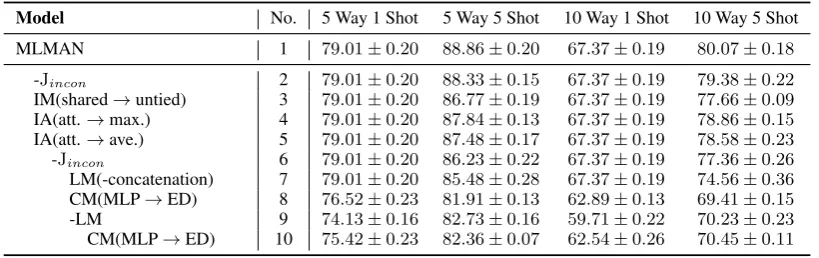
Table 4: Accuracies (%) of different models on FewRel development set. Here, IM stands for instance matching, IA stands for instance aggregation, LM stands for the local matching, CM stands for the class matching, MLP stands for multi-layer perceptrons and ED stands for Euclidean distance.
interactions between query instance and support set at multiple levels.
5.4 Ablation Study
In order to evaluate the contributions of individ-ual model components, ablation studies were con-ducted. Table 4 shows the performance of our model and its ablations on the development set of FewRel. Considering that the first 6 ablations only affected the few-shot learning tasks withN > 1, model 2 to model 7 achieved exactly the same per-formance as the complete model (i.e., model 1) un-der 5 way 1 shot and 10 way 1 shot configurations.
5.4.1 Instance Matching and Aggregation
First, the attention-based instance aggregation in-troduced in Section 4.3 was replaced with a max pooling (model 4) or an average pooling (model 5). We can see that the model with instance-level attentive aggregation (model 1) outperformed the ones using a max pooling (model 4) or an aver-age pooling (model 5) on 5-shot tasks. Their dif-ference were significantly at 1% significance level in t-test. The advantage of attentive pooling is that the weights of integrating all support instances can be determined dynamically according to the query. For example, when conducting instance matching and aggregation between the query in-stance and the support set in Table1, the weights of the 5 instances in class A were 0.03, 0.46, 0.25, 0.08 and 0.18 respectively. Instance #2 achieved the highest weight because it had the best similar-ity with the query instance and was considered as the most helpful one when matching the query in-stance with class A.
Then, the effectiveness of sharing the weight parameters in Eqs. (11) and (13) was evaluated
by untying them (model 3). The performance of model 3 was much worse than the complete model (model 1) as shown in Table 4, which demon-strates the need of sharing the weights for calcu-lating matching scores at both instance and class levels.
5.4.2 Inconsistency Measurement
As introduced in Section 4.5,Jinconis designed to
measure the inconsistency among the representa-tions of all support instances in a class. After re-movingJincon, model 2 was optimized only using
the objective functionJmatch. We can see that it
performed much worse than the complete model. Furthermore, we calculated the mean of the Eu-clidean distances between every support instance pair(bsi
k,bs i
k0)in the same class using model 1 and
model 2 respectively. For each support set, the cal-culation can be written as
D= 2
N K(K−1)
N X
i=1
K X
k=1
K X
k0=k+1
||bsik−bsik0||22.
(16) We sampled 20,000 support sets under the 5-way 5-shot configuration and calculated the mean of them. The results were 0.0199 and 0.0346 for model 1 and model 2 respectively, which means thatJinconwas effective at forcing the
representa-tions of the support instances in the same class to be close with each other.
Jincon was further removed from model 5 and
model 6 was obtained. It can be found that the ac-curacy degradation from model 5 to model 6 was larger than the one from model 1 to model 2. This implies that theJinconobjective function also
[image:7.595.101.502.63.190.2]5.4.3 Local Matching
First, the concatenation operation in local match-ing was removed from model 6 in this ablation study. That’s to say, instead of concatenating the representations of all support instances {Sk}Kk=1 into one single matrix as Eq. (3), local match-ing was conducted between the query instance and each support instance separately to get their vector representations {(bsk,bqk);k = 1, ..., K} (model
7). It should be noticed that this led toK differ-ent represdiffer-entations of a query instance according to each support class. Then, the mean overkfor
bsk and bqk were calculated to get the
representa-tions of the support setbs and the query instance
b
q. Comparing model 6 and model 7, we can see that the concatenation operation plays an impor-tant role in our model. One possible reason is that the concatenation operation can help local match-ing to restrain the support instances with low sim-ilarity to the query.
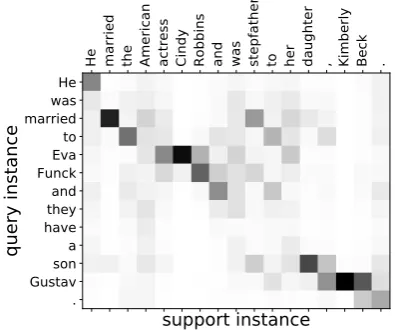
Second, the whole local matching module to-gether with the concatenation and attentive ag-gregation operation were removed from model 6, which led to model 9. Model 9 is similar to the one proposed by Snell et al. (2017) that encoded the support and query instances independently. The difference was that model 9 was equipped with more components, including an LSTM layer, two pooling operations, and a learnable class matching function. Comparing the performance of model 6 and model 9 in Table4, we can see that the local matching operation significantly improves the per-formance in few-shot relation classification. Fig. 2shows the attention weight matrix calculated be-tween the query instance and the support instance #2 of class A in Table 1. From this figure, we can see that the attention-based local matching is able to capture some matching relations of local contexts, such as the head entitiesEva Funckand
Cindy Robbins, the tail entitiesGustav and Kim-berly Beck, the key phrasessonanddaughter, the same keyword “married”, and so on.
5.4.4 Class Matching
In this experiment, we compared two class match-ing functions, (1) Euclidean distance (ED) (Snell et al.,2017) and (2) a learnable MLP function as shown by Eq. (13). In order to ignore the influence of the instance-level attentive aggregation, these two matching functions were compared based on model 6 and model 9. After converting the MLP function in model 6 and model 9 to Euclidean
dis-He married the American actress Cindy Robbins and was stepfather to her daughter , Kimberly Beck .
support instance
Hewas married to Eva Funck and they have a son Gustav .
[image:8.595.317.515.67.232.2]query instance
Figure 2: The attention weight matrix calculated be-tween the query instance and the support instance #2 of class A in Table1. The darker units have larger value. The summation of one column in the matrix is one.
tance, model 8 and model 10 were obtained. Com-paring the performance of these models in Table 4, we have two findings. (1) When local matching was adopted, the learnable MLP for class match-ing (model 6) outperformed the ED metric (model 8) by a large margin. (2) After removing local matching, the learnable MLP for class matching (model 9) performed not as good as the ED met-ric (model 10). One possible reason is that the local matching process enhances the interaction between a query instance and a support set when calculatingbs andqb. Thus, simple Euclidean dis-tance between them may not be able to describe the complex correlation and dependency between them. On the other hand, MLP mapping is more powerful than calculating Euclidean distance, and can be more appropriate for class matching when local matching is also adopted.
6 Conclusions
rep-resentations of all support instances in a class. Ex-periments have demonstrated the effectiveness of our proposed model, which achieves state-of-the-art performance on the FewRel dataset. Studying few-shot relation classification with data gener-ated by distant supervision and extending our ML-MAN model to zero-shot learning will be the tasks of our future work.
Acknowledgments
We thank the anonymous reviewers for their valu-able comments. This work was partially funded by the National Nature Science Foundation of China (Grant No. U1636201, 61871358).
References
Steven Bethard and James H. Martin. 2007. Cu-tmp: Temporal relation classification using syntac-tic and semansyntac-tic features. In Proceedings of the Fourth International Workshop on Semantic Evalu-ations (SemEval-2007), pages 129–132. Association for Computational Linguistics.
Samuel R. Bowman, Gabor Angeli, Christopher Potts, and Christopher D. Manning. 2015. A large anno-tated corpus for learning natural language inference. In Proceedings of the 2015 Conference on Empiri-cal Methods in Natural Language Processing, pages 632–642. Association for Computational Linguis-tics.
Qian Chen, Zhen-Hua Ling, and Xiaodan Zhu. 2018.
Enhancing sentence embedding with generalized pooling. InProceedings of the 27th International Conference on Computational Linguistics, pages 1815–1826. Association for Computational Linguis-tics.
Qian Chen, Xiaodan Zhu, Zhen-Hua Ling, Si Wei, Hui Jiang, and Diana Inkpen. 2017. Enhanced lstm for natural language inference. InProceedings of the 55th Annual Meeting of the Association for Compu-tational Linguistics (Volume 1: Long Papers), pages 1657–1668. Association for Computational Linguis-tics.
Alexis Conneau, Douwe Kiela, Holger Schwenk, Lo¨ıc Barrault, and Antoine Bordes. 2017. Supervised learning of universal sentence representations from natural language inference data. InProceedings of the 2017 Conference on Empirical Methods in Nat-ural Language Processing, pages 670–680. Associ-ation for ComputAssoci-ational Linguistics.
Chelsea Finn, Pieter Abbeel, and Sergey Levine. 2017. Model-agnostic meta-learning for fast adaptation of deep networks. arXiv preprint arXiv:1703.03400.
Tianyu Gao, Xu Han, Zhiyuan Liu, and Maosong Sun. 2019. Hybrid attention-based prototypical networks for noisy few-shot relation classification.
Victor Garcia and Joan Bruna. 2017. Few-shot learn-ing with graph neural networks. arXiv preprint arXiv:1711.04043.
Yichen Gong, Heng Luo, and Jian Zhang. 2017. Natu-ral language inference over interaction space. arXiv preprint arXiv:1709.04348.
Xu Han, Hao Zhu, Pengfei Yu, Ziyun Wang, Yuan Yao, Zhiyuan Liu, and Maosong Sun. 2018. Fewrel: A large-scale supervised few-shot relation classifica-tion dataset with state-of-the-art evaluaclassifica-tion. In Pro-ceedings of the 2018 Conference on Empirical Meth-ods in Natural Language Processing, pages 4803– 4809. Association for Computational Linguistics.
Geoffrey E Hinton, Nitish Srivastava, Alex Krizhevsky, Ilya Sutskever, and Ruslan R Salakhutdinov. 2012. Improving neural networks by preventing co-adaptation of feature detectors. arXiv preprint arXiv:1207.0580.
S Hochreiter and J Schmidhuber. 1997. Long short-term memory. Neural Computation, 9(8):1735– 1780.
Seonhoon Kim, Jin-Hyuk Hong, Inho Kang, and No-jun Kwak. 2018. Semantic sentence matching with densely-connected recurrent and co-attentive infor-mation. arXiv preprint arXiv:1805.11360.
Yoon Kim. 2014. Convolutional neural networks for sentence classification. Eprint Arxiv.
Gregory Koch, Richard Zemel, and Ruslan Salakhut-dinov. 2015. Siamese neural networks for one-shot image recognition. InICML Deep Learning Work-shop, volume 2.
Ryan Lowe, Nissan Pow, Iulian Serban, and Joelle Pineau. 2015. The ubuntu dialogue corpus: A large dataset for research in unstructured multi-turn dia-logue systems. InProceedings of the 16th Annual Meeting of the Special Interest Group on Discourse and Dialogue, pages 285–294. Association for Com-putational Linguistics.
Mike Mintz, Steven Bills, Rion Snow, and Dan Juraf-sky. 2009. Distant supervision for relation extrac-tion without labeled data. In Proceedings of the Joint Conference of the 47th Annual Meeting of the ACL and the 4th International Joint Conference on Natural Language Processing of the AFNLP: Vol-ume 2-VolVol-ume 2, pages 1003–1011. Association for Computational Linguistics.
Nikhil Mishra, Mostafa Rohaninejad, Xi Chen, and Pieter Abbeel. 2018. A simple neural attentive meta-learner.
Tsendsuren Munkhdalai and Hong Yu. 2017. Meta net-works. arXiv preprint arXiv:1703.00837.
Jeffrey Pennington, Richard Socher, and Christopher Manning. 2014. Glove: Global vectors for word representation. In Proceedings of the 2014 Con-ference on Empirical Methods in Natural Language Processing (EMNLP), pages 1532–1543. Associa-tion for ComputaAssocia-tional Linguistics.
Sachin Ravi and Hugo Larochelle. 2016. Optimization as a model for few-shot learning.
Adam Santoro, Sergey Bartunov, Matthew Botvinick, Daan Wierstra, and Timothy Lillicrap. 2016. Meta-learning with memory-augmented neural networks. In International conference on machine learning, pages 1842–1850.
Jake Snell, Kevin Swersky, and Richard Zemel. 2017. Prototypical networks for few-shot learning. In Ad-vances in Neural Information Processing Systems, pages 4077–4087.
Oriol Vinyals, Charles Blundell, Timothy Lillicrap, Daan Wierstra, et al. 2016. Matching networks for one shot learning. InAdvances in neural informa-tion processing systems, pages 3630–3638.
Linlin Wang, Zhu Cao, Gerard de Melo, and Zhiyuan Liu. 2016. Relation classification via multi-level attention cnns. In Proceedings of the 54th An-nual Meeting of the Association for Computational Linguistics (Volume 1: Long Papers), pages 1298– 1307. Association for Computational Linguistics.
Wenhan Xiong, Mo Yu, Shiyu Chang, Xiaoxiao Guo, and William Yang Wang. 2018. One-shot relational learning for knowledge graphs. InProceedings of the 2018 Conference on Empirical Methods in Nat-ural Language Processing, pages 1980–1990. Asso-ciation for Computational Linguistics.
Dmitry Zelenko, Chinatsu Aone, and Anthony Richardella. 2002. Kernel methods for relation ex-traction. InProceedings of the 2002 Conference on Empirical Methods in Natural Language Processing (EMNLP 2002).
Daojian Zeng, Kang Liu, Siwei Lai, Guangyou Zhou, and Jun Zhao. 2014. Relation classification via con-volutional deep neural network. InProceedings of COLING 2014, the 25th International Conference on Computational Linguistics: Technical Papers, pages 2335–2344. Dublin City University and As-sociation for Computational Linguistics.