Context-aware Learning for Sentence-level Sentiment Analysis
with Posterior Regularization
Bishan Yang
Department of Computer Science Cornell University
Claire Cardie
Department of Computer Science Cornell University
Abstract
This paper proposes a novel context-aware method for analyzing sentiment at the level of individual sentences. Most ex-isting machine learning approaches suf-fer from limitations in the modeling of complex linguistic structures across sen-tences and often fail to capture non-local contextual cues that are important for sentiment interpretation. In contrast, our approach allows structured modeling of sentiment while taking into account both local and global contextual infor-mation. Specifically, we encode intu-itive lexical and discourse knowledge as expressive constraints and integrate them into the learning of conditional random field models via posterior regularization. The context-aware constraints provide ad-ditional power to the CRF model and can guide semi-supervised learning when la-beled data is limited. Experiments on standard product review datasets show that our method outperforms the state-of-the-art methods in both the supervised and semi-supervised settings.
1 Introduction
The ability to extract sentiment from text is cru-cial for many opinion-mining applications such as opinion summarization, opinion question answer-ing and opinion retrieval. Accordanswer-ingly, extract-ing sentiment at the fine-grained level (e.g. at the sentence- or phrase-level) has received increasing attention recently due to its challenging nature and its importance in supporting these opinion analysis tasks (Pang and Lee, 2008).
In this paper, we focus on the task of sentence-level sentiment classification in online reviews. Typical approaches to the task employ supervised
machine learning algorithms with rich features and take into account the interactions between words to handle compositional effects such as po-larity reversal (e.g. (Nakagawa et al., 2010; Socher et al., 2013)). Still, their methods can en-counter difficulty when the sentence on its own does not contain strong enough sentiment signals (due to the lack of statistical evidence or the re-quirement for background knowledge). Consider the following review for example,
1. Hearing the music in real stereo is a true reve-lation. 2. You can feel that the music is no longer constrained by the mono recording. 3. In fact, it is more like the players are performing on a stage in front of you ...
Existing feature-based classifiers may be effective in identifying the positive sentiment of the first sentence due to the use of the word revelation, but they could be less effective in the last two sen-tences due to the lack of explicit sentiment signals. However, if we examine these sentences within the discourse context, we can see that: the second sen-tence expresses sentiment towards the same aspect – the music– as the first sentence; the third sen-tence expands the second sensen-tence with the dis-course connective In fact. These discourse-level relations help indicate that sentence 2 and 3 are likely to have positive sentiment as well.
The importance of discourse for sentiment anal-ysis has become increasingly recognized. Most existing work considers discourse relations be-tween adjacent sentences or clauses and incor-porates them as constraints (Kanayama and Na-sukawa, 2006; Zhou et al., 2011) or features in classifiers Trivedi and Eisenstein (2013; Lazari-dou et al. (2013). Very little work has explored long-distance discourse relations for sentiment analysis. Somasundaran et al. (2008) defines coreference relations on opinion targets and ap-plies them to constrain the polarity of sentences.
However, the discourse relations were obtained from fine-grained annotations and implemented as hard constraints on polarity.
Obtaining sentiment labels at the fine-grained level is costly. Semi-supervised techniques have been proposed for sentence-level sentiment classi-fication (T¨ackstr¨om and McDonald, 2011a; Qu et al., 2012). However, they rely on a large amount of document-level sentiment labels that may not be naturally available in many domains.
In this paper, we propose a sentence-level senti-ment classification method that can (1) incorporate rich discourse information at both local and global levels; (2) encode discourse knowledge as soft constraints during learning; (3) make use of un-labeled data to enhance learning. Specifically, we use the Conditional Random Field (CRF) model as the learner for sentence-level sentiment classi-fication, and incorporate rich discourse and lexi-cal knowledge as soft constraints into the learn-ing of CRF parameters via Posterior Regulariza-tion (PR) (Ganchev et al., 2010). As a framework for structured learning with constraints, PR has been successfully applied to many structural NLP tasks (Ganchev et al., 2009; Ganchev et al., 2010; Ganchev and Das, 2013). Our work is the first to explore PR for sentiment analysis. Unlike most previous work, we explore a rich set of structural constraints that cannot be naturally encoded in the feature-label form, and show that such constraints can improve the performance of the CRF model.
We evaluate our approach on the sentence-level sentiment classification task using two stan-dard product review datasets. Experimental re-sults show that our model outperforms state-of-the-art methods in both the supervised and semi-supervised settings. We also show that dis-course knowledge is highly useful for improving sentence-level sentiment classification.
2 Related Work
There has been a large amount of work on sen-timent analysis at various levels of granular-ity (Pang and Lee, 2008). In this paper, we focus on the study of sentence-level sentiment classifi-cation. Existing machine learning approaches for the task can be classified based on the use of two ideas. The first idea is to exploit sentiment sig-nals at the sentence level by learning the relevance of sentiment and words while taking into account the context in which they occur: Nakagawa et
al. (2010) uses tree-CRF to model word interac-tions based on dependency tree structures; Choi and Cardie (2008) applies compositional inference rules to handle polarity reversal; Socher et al. (2011) and Socher et al. (2013) compute composi-tional vector representations for words and phrases and use them as features in a classifier.
The second idea is to exploit sentiment signals at the inter-sentential level. Polanyi and Zaenen (2006) argue that discourse structure is important in polarity classification. Various attempts have been made to incorporate discourse relations into sentiment analysis: Pang and Lee (2004) explored the consistency of subjectivity between neighbor-ing sentences; Mao and Lebanon (2007),McDon-ald et al. (2007), and T¨ackstr¨om and McDon(2007),McDon-ald (2011a) developed structured learning models to capture sentiment dependencies between adjacent sentences; Kanayama and Nasukawa (2006) and Zhou et al. (2011) use discourse relations to con-strain two text segments to have either the same polarity or opposite polarities; Trivedi and Eisen-stein (2013) and Lazaridou et al. (2013) encode the discourse connectors as model features in su-pervised classifiers. Very little work has explored long-distance discourse relations. Somasundaran et al. (2008) define opinion target relations and ap-ply them to constrain the polarity of text segments annotated with target relations. Recently, Zhang et al. (2013) explored the use of explanatory dis-course relations as soft constraints in a Markov Logic Network framework for extracting subjec-tive text segments.
Leveraging both ideas, our approach exploits sentiment signals from both intra-sentential and inter-sentential context. It has the advantages of utilizing rich discourse knowledge at different lev-els of context and encoding it as soft constraints during learning.
Our approach is also semi-supervised. Com-pared to the existing work on semi-supervised learning for sentence-level sentiment classification (T¨ackstr¨om and McDonald, 2011a; T¨ackstr¨om and McDonald, 2011b; Qu et al., 2012), our work does not rely on a large amount of coarse-grained (document-level) labeled data, instead, distant supervision mainly comes from linguistically-motivated constraints.
tasks such as dependency parsing, information ex-traction and cross-lingual learning tasks (Ganchev et al., 2009; Bellare et al., 2009; Ganchev et al., 2010; Ganchev and Das, 2013). Most previous work using PR mainly experiments with feature-label constraints. In contrast, we explore a rich set of linguistically-motivated constraints which cannot be naturally formulated in the feature-label form. We also show that constraints derived from the discourse context can be highly useful for dis-ambiguating sentence-level sentiment.
3 Approach
In this section, we present the details of our pro-posed approach. We formulate the sentence-level sentiment classification task as a sequence label-ing problem. The inputs to the model are segmented documents annotated with sentence-level sentiment labels (positive, negative or neu-tral) along with a set of unlabeled documents. During prediction, the model outputs sentiment la-bels for a sequence of sentences in the test docu-ment. We utilize conditional random fields and use Posterior Regularization (PR) to learn their param-eters with a rich set of context-aware constraints.
In what follows, we first briefly describe the framework of Posterior Regularization. Then we introduce the context-aware constraints derived based on intuitive discourse and lexical knowl-edge. Finally we describe how to perform learning and inference with these constraints.
3.1 Posterior Regularization
PR is a framework for structured learning with constraints (Ganchev et al., 2010). In this work, we apply PR in the context of CRFs for sentence-level sentiment classification.
Denote xas a sequence of sentences within a document and y as a vector of sentiment labels associated withx. The CRF model the following conditional probabilities:
pθ(y|x) = exp(θZ·f(x,y)) θ(x)
where f(x,y) are the model features, θ are the model parameters, and Zθ(x) = Pyexp(θ · f(x,y))is a normalization constant. The objec-tive function for a standard CRF is to maximize the log-likelihood over a collection of labeled
doc-uments plus a regularization term:
max
θ L(θ) = maxθ X
(x,y)
logpθ(y|x)−||θ|| 2 2
2δ2
PR makes the assumption that the labeled data we have is not enough for learning good model parameters, but we have a set of constraints on the posterior distribution of the labels. We can define the set of desirable posterior distrbutions as
Q={q(Y) :Eq[φ(X,Y)] =b} (1) whereφis a constraint function, b is a vector of desired values of the expectations of the constraint functions under the distributionq1. Note that the distribution q is defined over a collection of un-labeled documents where the constraint functions apply, and we assume independence between doc-uments.
The PR objective can be written as the origi-nal model objective peorigi-nalized with a regulariza-tion term, which minimizes the KL-divergence be-tween the desired model posteriors and the learned model posteriors with an L2 penalty2for the con-straint violations.
max
θ L(θ)−minq∈Q{KL(q(Y)||pθ(Y|X))
+β||Eq[φ(X,Y)]−b||22}
(2)
The objective can be optimized by an EM-like scheme that iteratively solves the minimization problem and the maximization problem. Solving the minimization problem is equivalent to solving its dual since the objective is convex. The dual problem is
arg max
λ λ·b−logZλ(X)−
1
4β||λ||22 (3)
We optimize the objective function 2 using stochastic projected gradient, and compute the learning rate using AdaGrad (Duchi et al., 2010).
3.2 Context-aware Posterior Constraints
We develop a rich set of context-aware poste-rior constraints for sentence-level sentiment anal-ysis by exploiting lexical and discourse knowl-edge. Specifically, we construct the lexical con-straints by extracting sentiment-bearing patterns
1In general, inequality constraints can also be used. We
focus on the equality constraints since we found them to ex-press the sentiment-relevant constraints well.
2Other convex functions can be used for the penalty. We
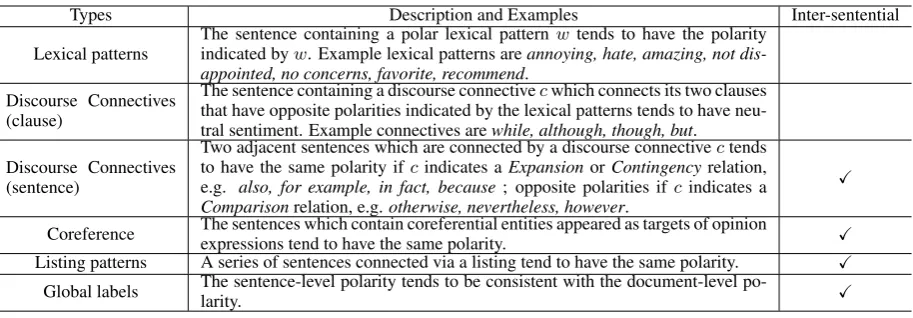
within sentences and construct the discourse-level constraints by extracting discourse relations that indicate sentiment coherence or sentiment changes both within and across sentences. Each constraint can be formulated as equality between the expec-tation of a constraint function value and a desired value set by prior knowledge. The equality is not strictly enforced (due to the regularization in the PR objective 2). Therefore all the constraints are applied as soft constraints. Table 1 provides in-tuitive description and examples for all the con-straints used in our model.
Lexical Patterns The existence of a polarity-carrying word alone may not correctly indicate the polarity of the sentence, as the polarity can be re-versed by other polarity-reversing words. We ex-tract lexical patterns that consist of polar words and negators3, and apply the heuristics based on compositional semantics (Choi and Cardie, 2008) to assign a sentiment value to each pattern.
We encode the extracted lexical patterns along with their sentiment values as feature-label con-straints. The constraint function can be written as
φw(x, y) = X
i
fw(xi, yi)
where fw(xi, yi) is a feature function which has value1when sentencexicontains the lexical pat-ternwand its sentiment labelyi equals to the ex-pected sentiment value and has value0otherwise. The constraint expectation value is set to be the prior probability of associating w with its ment value. Note that sentences with neutral senti-ment can also contain such lexical patterns. There-fore we allow the lexical patterns to be assigned a neutral sentiment with a prior probability r0 (we compute this value as the empirical probability of neutral sentiment in the training documents). Us-ing the polarity indicated by lexical patterns to constrain the sentiment of sentences is quite ag-gressive. Therefore we only consider lexical pat-terns that are strongly discriminative (many opin-ion words in the lexicon only indicate sentiment with weak strength). The selected lexical patterns include a handful of seed patterns (such as “pros” and “cons”) and the lexical patterns that have high precision (larger then 0.9) of predicting sentiment in the training data.
3The polar words are identified using the MPQA lexicon
and the negators are identified using a handful of seed words extended by the General Inquirer dictionary and WordNet as described in (Choi and Cardie, 2008).
Discourse Connectives. Lexical patterns can be limited in capturing contextual information since they only look at interactions between words within an expression. To capture context at the clause or sentence level, we consider discourse connectives, which are cue phrases or words that indicate discourse relations between adjacent sen-tences or clauses. To identify discourse connec-tives, we apply a discourse tagger trained on the Penn Discourse Treebank (Prasad et al., 2008) 4 to our data. Discourse connectives are tagged with four senses: Expansion, Contingency, Compari-son, Temporal.
Discourse connectives can operate at both intra-sentential and inter-intra-sentential level. For example, the word “although” is often used to connect two polar clauses within a sentence, while the word “however” is often used to at the beginning of the sentence to connect two polar sentences. It is important to distinguish these two types of dis-course connectives. We consider a disdis-course con-nective to be intra-sentential if it has the Com-parisonsense and connects two polar clauses with opposite polarities (determined by the lexical pat-terns). We construct a feature-label constraint for each intra-sentential discourse connective and set its expected sentiment value to be neutral.
Unlike the intra-sentential discourse connec-tives, the inter-sentential discourse connectives can indicate sentiment transitions between sen-tences. Intuitively, discourse connectives with the senses of Expansion(e.g. also, for example, furthermore) and Contingency (e.g. as a result, hence, because) are likely to indicate sentiment coherence; discourse connectives with the sense ofComparison (e.g. but, however, nevertheless) are likely to indicate sentiment changes. This in-tuition is reasonable but it assumes the two sen-tences connected by the discourse connective are both polar sentences. In general, discourse con-nectives can also be used to connect non-polar (neutral) sentences. Thus it is hard to directly constrain the posterior expectation for each type of sentiment transitions using inter-sentential dis-course connectives.
Instead, we impose constraints on the model posteriors by reducing constraint violations. We
4http://www.cis.upenn.edu/˜epitler/
Types Description and Examples Inter-sentential Lexical patterns The sentence containing a polar lexical patternindicated byw. Example lexical patterns areannoying, hate, amazing, not dis-wtends to have the polarity
appointed, no concerns, favorite, recommend. Discourse Connectives
(clause)
The sentence containing a discourse connectivecwhich connects its two clauses that have opposite polarities indicated by the lexical patterns tends to have neu-tral sentiment. Example connectives arewhile, although, though, but.
Discourse Connectives (sentence)
Two adjacent sentences which are connected by a discourse connectivectends to have the same polarity ifcindicates aExpansionorContingencyrelation, e.g. also, for example, in fact, because; opposite polarities ifcindicates a Comparisonrelation, e.g.otherwise, nevertheless, however.
X
Coreference The sentences which contain coreferential entities appeared as targets of opinionexpressions tend to have the same polarity. X
Listing patterns A series of sentences connected via a listing tend to have the same polarity. X
[image:5.595.75.532.61.220.2]Global labels The sentence-level polarity tends to be consistent with the document-level po-larity. X
Table 1: Summarization of Posterior Constraints for Sentence-level Sentiment Classification
define the following constraint function:
φc,s(x, y) = X
i
fc,s(xi, yi, yi−1)
where c denotes a discourse connective, s indi-cates its sense, andfc,s is a penalty function that takes value1.0whenyiandyi−1form a contradic-tory sentiment transition, that is,yi 6=polar yi−1if
s∈ {Expansion,Contingency}, oryi =polar yi−1 ifs=Comparison. The desired value for the con-straint expectation is set to0so that the model is encouraged to have less constraint violations.
Opinion CoreferenceSentences in a discourse can be linked by many types of coherence rela-tions (Jurafsky et al., 2000). Coreference is one of the commonly used relations in written text. In this work, we explore coreference in the text of sentence-level sentiment analysis. We con-sider a set of polar sentences to be linked by the opinion coreference relation if they contain core-ferring opinion-related entities. For example, the following sentences express opinions towards “the speaker phone”, “The speaker phone” and “it” re-spectively. As these opinion targets are corefer-ential (referring to the same entity “the speaker phone”), they are linked by the opinion corefer-encerelation5.
My favorite features are the speaker phone and the radio. The speaker phone is very functional. I use it in the car, very audible even with freeway noise.
5In general, the opinion-related entities include both the
opinion targets and the opinion holders. In this work, we only consider the targets since we experiment with single-author product reviews. The opinion holders can be included in a similar way as the opinion targets.
Our coreference relations indicated by opinion targets overlap with thesame targetrelation intro-duced in (Somasundaran et al., 2009). The dif-ferences are: (1) we encode the coreference re-lations as soft constraints during learning instead of applying them as hard constraints during infer-ence time; (2) our constraints can apply to both polar and non-polar sentences; (3) our identifica-tion of coreference relaidentifica-tions is automatic without any fine-grained annotations for opinion targets.
To extract coreferential opinion targets, we ap-ply Stanford’s coreference system (Lee et al., 2013) to extract coreferential mentions in the doc-ument, and then apply a set of syntactic rules to identify opinion targets from the extracted men-tions. The syntactic rules correspond to the shortest dependency paths between an opinion word and an extracted mention. We consider the 10 most frequent dependency paths in the training data. Example dependency paths include nsubj(opinion, mention), nobj(opinion, mention), andamod(mention, opinion).
For sentences connected by the opinion coref-erence relation, we expect their sentiment to be consistent. To encode this intuition, we define the following constraint function:
φcoref(x, y) =
X
i,ant(i)=j,j≥0
fcoref(xi, xj, yi, yj)
where ant(i) denotes the index of the sentence which contains an antecedent target of the target mentioned in sentencei(the antecedent relations over pairs of opinion targets can be constructed using the coreference resolver), and fcoref is a penalty function which takes value 1.0 when the expected sentiment coherency is violated, that is,
dis-course connectives, modeling opinion coreference via constraint violations allows the model to han-dle neutral sentiment. The expected value of the constraint functions is set to0.
Listing PatternsAnother type of coherence re-lations we observe in online reviews is listing, where a reviewer expresses his/her opinions by listing a series of statements followed by a se-quence of numbers. For example, “1. It’s smaller than the ipod mini .... 2. It has a removable battery ....”. We expect sentences connected by a listing to have consistent sentiment. We implement this constraint in the same form as the coreference con-straint (the antecedent assignments are constructed from the numberings).
Global Sentiment Previous studies have demonstrated the value of document-level sen-timent in guiding the semi-supervised learning of sentence-level sentiment (T¨ackstr¨om and McDonald, 2011b; Qu et al., 2012). In this work, we also take into account this information and encode it as posterior constraints. Note that these constraints are not necessary for our model and can be applied when the document-level sentiment labels are naturally available.
Based on an analysis of the Amazon review data, we observe that sentence-level sentiment usually doesn’t conflict with the document-level sentiment in terms of polarity. For example, the proportion of negative sentences in the positive documents is very small compared to the propor-tion of positive sentences. To encode this intuipropor-tion, we define the following constraint function:
φg(x, y) = n X
i
δ(yi6=polarg)/n
whereg ∈ {positive, negative}denotes the sen-timent value of a polar document, n is the total number of sentences in x, and δ is an indicator function. We hope the expectation of the con-straint function takes a small value. In our experi-ments, we set the expected value to be the empiri-cal estimate of the probability of “conflicting” sen-timent in polar documents using the training data.
3.3 Training and Inference
During training, we need to compute the constraint expectations and the feature expectations under the auxiliary distribution q at each gradient step.
We can deriveqby solving the dual problem in 3:
q(y|x) = exp(θ·f(x,y) +λ·φ(x,y))
Zλ,θ(X) (4) whereZλ,θ(X)is a normalization constant. Most of our constraints can be factorized in the same way as factorizing the model features in the first-order CRF model, and we can compute the expec-tations underqvery efficiently using the forward-backward algorithm. However, some of our dis-course constraints (opinion coreference and list-ing) can break the tractable structure of the model. For constraints with higher-order structures, we use Gibbs Sampling (Geman and Geman, 1984) to approximate the expectations. Given a sequence x, we sample a labelyiat each positioniby com-puting the unnormalized conditional probabilities
p(yi = l|y−i) ∝exp(θ·f(x,yi =l,y−i) +λ·
φ(x,yi =l,y−i))and renormalizing them. Since the possible label assignments only differ at posi-tion i, we can make the computation efficient by maintaining the structure of the coreference clus-ters and precomputing the constraint function for different types of violations.
During inference, we find the best label assign-ment by computing arg maxyq(y|x). For
doc-uments where the higher-order constraints apply, we use the same Gibbs sampler as described above to infer the most likely label assignment, other-wise, we use the Viterbi algorithm.
4 Experiments
We experimented with two product review datasets for sentence-level sentiment classifica-tion: the Customer Review (CR) data (Hu and Liu, 2004)6 which contains 638 reviews of 14 prod-ucts such as cameras and cell phones, and the Multi-domain Amazon (MD) data from the test set of T¨ackstr¨om and McDonald (2011a) which con-tains 294 reivews from 5 different domains. As in Qu et al. (2012), we chose the books, electronics and music domains for evaluation. Each domain also comes with 33,000 extra reviews with only document-level sentiment labels.
We evaluated our method in two settings: su-pervised and semi-susu-pervised. In the susu-pervised setting, we treated the test data as unlabeled data and performed transductive learning. In the semi-supervised setting, our unlabeled data consists of
6Available at http://www.cs.uic.edu/˜liub/
both the available unlabeled data and the test data. For each domain in the MD dataset, we made use of no more than 100 unlabeled documents in which our posterior constraints apply. We adopted the evaluation schemes used in previous work: 10-fold cross validation for the CR dataset and 3-10-fold cross validation for the MD dataset. We also report both two-way classification (positive vs. negative) and three-way classification results (positive, neg-ative or neutral). We use accuracy as the per-formance measure. In our tables, boldface num-bers are statistically significant by paired t-test for
p < 0.05 against the best baseline developed in this paper7.
We trained our model using a CRF incorpo-rated with the proposed posterior constraints. For the CRF features, we include the tokens, the part-of-speech tags, the prior polarities of lexical pat-terns indicated by the opinion lexicon and the negator lexicon, the number of positive and neg-ative tokens and the output of the vote-flip algo-rithm (Choi and Cardie, 2009). In addition, we in-clude the discourse connectives as local or transi-tion features and the document-level sentiment la-bels as features (only available in the MD dataset). We set the CRF regularization parameterσ = 1
and set the posterior regularization parameter β
andγ (a trade-off parameter we introduce to bal-ance the supervised objective and the posterior regularizer in 2) by using grid search 8. For approximation inference with higher-order con-straints, we perform 2000 Gibbs sampling itera-tions where the first 1000 iteraitera-tions are burn-in it-erations. To make the results more stable, we con-struct three Markov chains that run in parallel, and select the sample with the largest objective value.
All posterior constraints were developed using the training data on each training fold. For the MD dataset, we also used the dvd domain as additional labeled data for developing the constraints.
Baselines. We compared our method to a num-ber of baselines: (1) CRF: CRF with the same set of model features as in our method. (2) CRF-INF: CRF augmented with inference constraints. We can incorporate the proposed constraints (con-straints derived from lexical patterns and discourse connectives) as hard constraints into CRF during
7Significance test was not conducted over the previous
methods as we do not have their results for each fold.
8We conducted 10-fold cross-validation on each training
fold with the parameter space: β: [0.01,0.05,0.1,0.5,1.0]
andγ: [0.1,0.5,1.0,5.0,10.0].
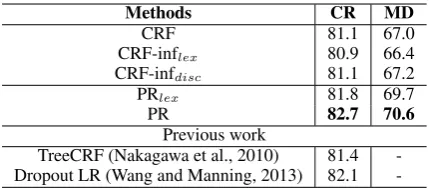
Methods CR MD
CRF 81.1 67.0
CRF-inflex 80.9 66.4
CRF-infdisc 81.1 67.2
PRlex 81.8 69.7
PR 82.7 70.6
Previous work
TreeCRF (Nakagawa et al., 2010) 81.4 -Dropout LR (Wang and Manning, 2013) 82.1
-Table 2: Accuracy results (%) for supervised sen-timent classification (two-way)
Books Electronics Music Avg
VoteFlip 44.6 45.0 47.8 45.8
DocOracle 53.6 50.5 63.0 55.7
CRF 57.4 57.5 61.8 58.9
CRF-inflex 56.7 56.4 60.4 57.8 CRF-infdisc 57.2 57.6 62.1 59.0
PRlex 60.3 59.9 63.2 61.1
PR 61.6 61.0 64.4 62.3
Previous work
HCRF 55.9 61.0 58.7 58.5
[image:7.595.309.524.61.156.2]MEM 59.7 59.6 63.8 61.0
Table 3: Accuracy results (%) for semi-supervised sentiment classification (three-way) on the MD dataset
inference by manually settingλin equation 4 to a large value,9. Whenλis large enough, it is equiva-lent to adding hard constraints to the viterbi infer-ence. To better understand the different effects of lexical and discourse constraints, we report results for applying only the lexical constraints (CRF-INFlex) as well as results for applying only the discourse constraints (CRF-INFdisc). (3) PRlex: a variant of our PR model which only applies the lexical constraints. For the three-way classifica-tion task on the MD dataset, we also implemented the following baselines: (4) VOTEFLIP: a rule-based algorithm that leverages the positive, tive and neutral cues along with the effect of nega-tion to determine the sentence sentiment (Choi and Cardie, 2009). (5) DOCORACLE: assigns each sentence the label of its corresponding doc-ument.
4.1 Results
We first report results on a binary (positive or neg-ative) sentence-level sentiment classification task. For this task, we used the supervised setting and performed transductive learning for our model. Table 2 shows the accuracy results. We can see
9We setλto 1000 for the lexical constraints and -1000 to
[image:7.595.309.521.207.323.2]Books Electronics Music
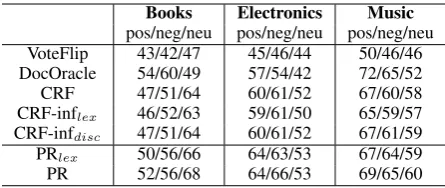
pos/neg/neu pos/neg/neu pos/neg/neu VoteFlip 43/42/47 45/46/44 50/46/46 DocOracle 54/60/49 57/54/42 72/65/52 CRF 47/51/64 60/61/52 67/60/58 CRF-inflex 46/52/63 59/61/50 65/59/57 CRF-infdisc 47/51/64 60/61/52 67/61/59 PRlex 50/56/66 64/63/53 67/64/59 PR 52/56/68 64/66/53 69/65/60
Table 4: F1 scores for each sentiment cate-gory (positive, negative and neutral) for semi-supervised sentiment classification on the MD dataset
that PR significantly outperforms all other base-lines in both the CR dataset and the MD dataset (average accuracy across domains is reported). The poor performance of CRF-INFlex indicates that directly applying lexical constraints as hard constraints during inference could only hurt the performance. CRF-INFdisc slightly outperforms CRF but the improvement is not significant. In contrast, both PRlexand PR significantly outper-form CRF, which implies that incorporating lex-ical and discourse constraints as posterior con-straints is much more effective. The superior per-formance of PR over PRlex further suggests that the proper use of discourse information can signif-icantly improve accuracy for sentence-level senti-ment classification.
We also analyzed the model’s performance on a three-way sentiment classification task. By intro-ducing the “neutral” category, the sentiment clas-sification problem becomes harder. Table 4 shows the results in terms of accuracy for each domain in the MD dataset. We can see that both PR and PRlexsignificantly outperform all other baselines in all domains. The rule-based baseline VOTE -FLIPgave the weakest performance because it has no prediction power on sentences with no opinion words. DOCORACLEperforms much better than VOTEFLIP and performs especially well on the Musicdomain. This indicates that the document-level sentiment is a very strong indicator of the sentence-level sentiment label. For the CRF base-line and its invariants, we observe a similar per-formance trend as in the two-way classification task: there is nearly no performance improve-ment from applying the lexical and discourse-connective-based constraints during CRF infer-ence. In contrast, both PRlex and PR provide substantial improvements over CRF. This
con-firms that encoding lexical and discourse knowl-edge as posterior constraints allows the feature-based model to gain additional learning power for sentence-level sentiment prediction. In par-ticular, incorporating discourse constraints leads to consistent improvements to our model. This demonstrates that our modeling of discourse in-formation is effective and that taking into account the discourse context is important for improving sentence-level sentiment analysis. We also com-pare our results to the previously published results on the same dataset. HCRF (T¨ackstr¨om and Mc-Donald, 2011a) and MEM (Qu et al., 2012) are two state-of-the-art semi-supervised methods for sentence-level sentiment classification. We can see that our best model PR gives the best results in most categories.
Table 4 shows the results in terms of F1 scores for each sentiment category (positive, negative and neutral). We can see that the PR models are able to provide improvements over all the sentiment cate-gories compared to all the baselines in general. We observe that the DOCORACLE baseline provides very strong F1 scores on the positive and nega-tive categories especially in the Books and Mu-sic domains, but very poor F1 on the neutral cate-gory. This is because it over-predicts the polar sen-tences in the polar documents, and predicts no po-lar sentences in the neutral documents. In contrast, our PR models provide more balanced F1 scores among all the sentiment categories. Compared to the CRF baseline and its variants, we found that the PR models can greatly improve the precision of predicting positive and negative sentences, re-sulting in a significant improvement on the pos-itive/negative F1 scores. However, the improve-ment on the neutral category is modest. A plausi-ble explanation is that most of our constraints fo-cus on discriminating polar sentences. They can help reduce the errors of misclassifying polar sen-tences, but the model needs more constraints in order to distinguish neutral sentences from polar sentences. We plan to address this issue in future work.
4.2 Discussion
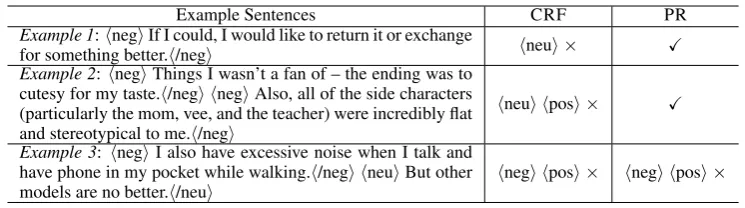
[image:8.595.71.294.62.156.2]Example Sentences CRF PR Example 1:hnegiIf I could, I would like to return it or exchange
for something better.h/negi hneui × X
Example 2:hnegiThings I wasn’t a fan of – the ending was to cutesy for my taste.h/negi hnegiAlso, all of the side characters (particularly the mom, vee, and the teacher) were incredibly flat and stereotypical to me.h/negi
hneui hposi × X
Example 3:hnegiI also have excessive noise when I talk and have phone in my pocket while walking.h/negi hneuiBut other
[image:9.595.112.485.60.164.2]models are no better.h/neui hnegi hposi × hnegi hposi ×
Table 5: Example sentences where PR succeeds and fails to correct the mistakes of CRF
The lexical features return and exchange may be good indicators of negative sentiment for the sentence. However, with limited labeled data, the CRF learner can only associate very weak senti-ment signals to these features. In contrast, the PR model is able to associate stronger sentiment sig-nals to these features by leveraging unlabeled data for indirect supervision. A simple lexicon-based constraint during inference time may also correct this case. However, hard-constraint baselines can hardly improve the performance in general be-cause the contributions of different constraints are not learned and their combination may not lead to better predictions. This is also demonstrated by the limited performance of CRF-INFin our exper-iments.
We also found that the discourse constraints play an important role in improving the sentiment prediction. The lexical constraints alone are of-ten not sufficient since their coverage is limited by the sentiment lexicon and they can only constrain sentiment locally. On the contrary, discourse con-straints are not dependent on sentiment lexicons, and more importantly, they can provide sentiment preferences on multiple sentences at the same time. When combining discourse constraints with features from different sentences, the PR model becomes more powerful in disambiguating senti-ment. The second example in Table 5 shows that the PR model learned with discourse constraints correctly predicts the sentiment of two sentences where no lexical constraints apply.
However, discourse constraints are not always helpful. One reason is that they do not constrain the neutral sentiment. As a result they could not help disambiguate neutral sentiment from polar sentiment, such as the third example in Table 5. This is also a problem for most of our lexical con-straints. In general, it is hard to learn reliable indi-cators for the neutral sentiment. In the MD dataset, a neutral label may be given because the sentence
contains mixed sentiment or no sentiment or it is off-topic. We plan to explore more refined con-straints that can deal with the neutral sentiment in future work. Another limitation of the discourse constraints is that they could be affected by the er-rors of the discourse parser and the coreference re-solver. A potential way to address this issue is to learn discourse constraints jointly with sentiment. We plan to study this in future research.
5 Conclusion
In this paper, we propose a context-aware ap-proach for learning sentence-level sentiment. Our approach incorporates intuitive lexical and dis-course knowledge as expressive constraints while training a conditional random field model via pos-terior regularization. We explore a rich set of context-aware constraints at both intra- and inter-sentential levels, and demonstrate their effective-ness in the analysis of sentence-level sentiment. While we focus on the sentence-level task, our ap-proach can be easily extended to handle sentiment analysis at finer levels of granularity. Our exper-iments show that our model achieves better accu-racy than existing supervised and semi-supervised models for the sentence-level sentiment classifica-tion task.
Acknowledgments
This work was supported in part by DARPA-BAA-12-47 DEFT grant #12475008 and NSF grant BCS-0904822. We thank Igor Labutov for help-ful discussion and suggestions; Oscar T¨ackstr¨om and Lizhen Qu for providing their Amazon review datasets; and the anonymous reviewers for helpful comments and suggestions.
References
with expectation constraints. InProceedings of the Twenty-Fifth Conference on Uncertainty in Artificial Intelligence, pages 43–50. AUAI Press.
Yejin Choi and Claire Cardie. 2008. Learning with compositional semantics as structural inference for subsentential sentiment analysis. InProceedings of the Conference on Empirical Methods in Natural Language Processing, pages 793–801. Association for Computational Linguistics.
Yejin Choi and Claire Cardie. 2009. Adapting a po-larity lexicon using integer linear programming for domain-specific sentiment classification. In Pro-ceedings of the 2009 Conference on Empirical Meth-ods in Natural Language Processing: Volume 2-Volume 2, pages 590–598. Association for Compu-tational Linguistics.
John Duchi, Elad Hazan, and Yoram Singer. 2010. Adaptive subgradient methods for online learning and stochastic optimization. Journal of Machine Learning Research, 12:2121–2159.
Kuzman Ganchev and Dipanjan Das. 2013. Cross-lingual discriminative learning of sequence models with posterior regularization.
Kuzman Ganchev, Jennifer Gillenwater, and Ben Taskar. 2009. Dependency grammar induction via bitext projection constraints. InProceedings of the ACL-IJCNLP, pages 369–377.
Kuzman Ganchev, Joao Grac¸a, Jennifer Gillenwater, and Ben Taskar. 2010. Posterior regularization for structured latent variable models. The Journal of Machine Learning Research, 99:2001–2049. Stuart Geman and Donald Geman. 1984.
Stochas-tic relaxation, gibbs distributions, and the bayesian restoration of images. Pattern Analysis and Machine Intelligence, IEEE Transactions on, (6):721–741. Minqing Hu and Bing Liu. 2004. Mining and
summa-rizing customer reviews. InProceedings of the tenth ACM SIGKDD international conference on Knowl-edge discovery and data mining, pages 168–177. ACM.
Dan Jurafsky, James H Martin, Andrew Kehler, Keith Vander Linden, and Nigel Ward. 2000. Speech and language processing: An introduction to natu-ral language processing, computational linguistics, and speech recognition, volume 2. MIT Press. Hiroshi Kanayama and Tetsuya Nasukawa. 2006.
Fully automatic lexicon expansion for domain-oriented sentiment analysis. InProceedings of the 2006 Conference on Empirical Methods in Natural Language Processing, pages 355–363. Association for Computational Linguistics.
Angeliki Lazaridou, Ivan Titov, and Caroline Sporleder. 2013. A bayesian model for joint unsupervised induction of sentiment, aspect and
discourse representations. InTo Appear in Proceed-ings of the 51th Annual Meeting of the Association for Computational Linguistics, Sofia, Bulgaria, August. Association for Computational Linguistics.
Heeyoung Lee, Angel Chang, Yves Peirsman, Nathanael Chambers, Mihai Surdeanu, and Dan Ju-rafsky. 2013. Deterministic coreference resolution based on entity-centric, precision-ranked rules.
Yi Mao and Guy Lebanon. 2007. Isotonic conditional random fields and local sentiment flow. Advances in neural information processing systems, 19:961.
Ryan McDonald, Kerry Hannan, Tyler Neylon, Mike Wells, and Jeff Reynar. 2007. Structured mod-els for fine-to-coarse sentiment analysis. In An-nual Meeting-Association For Computational Lin-guistics, volume 45, page 432.
Tetsuji Nakagawa, Kentaro Inui, and Sadao Kurohashi. 2010. Dependency tree-based sentiment classifica-tion using crfs with hidden variables. In Human Language Technologies: The 2010 Annual Confer-ence of the North American Chapter of the Associa-tion for ComputaAssocia-tional Linguistics, pages 786–794. Association for Computational Linguistics.
Bo Pang and Lillian Lee. 2004. A sentimental educa-tion: Sentiment analysis using subjectivity summa-rization based on minimum cuts. InProceedings of the 42nd annual meeting on Association for Compu-tational Linguistics, page 271. Association for Com-putational Linguistics.
Bo Pang and Lillian Lee. 2008. Opinion mining and sentiment analysis. Now Pub.
Livia Polanyi and Annie Zaenen. 2006. Contextual valence shifters. InComputing attitude and affect in text: Theory and applications, pages 1–10. Springer.
Rashmi Prasad, Nikhil Dinesh, Alan Lee, Eleni Milt-sakaki, Livio Robaldo, Aravind K Joshi, and Bon-nie L Webber. 2008. The penn discourse treebank 2.0. InLREC. Citeseer.
Lizhen Qu, Rainer Gemulla, and Gerhard Weikum. 2012. A weakly supervised model for sentence-level semantic orientation analysis with multiple experts. In Proceedings of the 2012 Joint Conference on Empirical Methods in Natural Language Process-ing and Computational Natural Language LearnProcess-ing, pages 149–159. Association for Computational Lin-guistics.
Richard Socher, Alex Perelygin, Jean Y Wu, Jason Chuang, Christopher D Manning, Andrew Y Ng, and Christopher Potts. 2013. Recursive deep mod-els for semantic compositionality over a sentiment treebank. InProceedings of EMNLP.
Swapna Somasundaran, Janyce Wiebe, and Josef Rup-penhofer. 2008. Discourse level opinion interpre-tation. In Proceedings of the 22nd International Conference on Computational Linguistics-Volume 1, pages 801–808. Association for Computational Lin-guistics.
Swapna Somasundaran, Galileo Namata, Janyce Wiebe, and Lise Getoor. 2009. Supervised and unsupervised methods in employing discourse rela-tions for improving opinion polarity classification. InProceedings of the 2009 Conference on Empirical Methods in Natural Language Processing: Volume 1-Volume 1, pages 170–179. Association for Com-putational Linguistics.
Oscar T¨ackstr¨om and Ryan McDonald. 2011a. Dis-covering fine-grained sentiment with latent variable structured prediction models. InAdvances in Infor-mation Retrieval, pages 368–374. Springer.
Oscar T¨ackstr¨om and Ryan McDonald. 2011b. Semi-supervised latent variable models for sentence-level sentiment analysis.
Rakshit Trivedi and Jacob Eisenstein. 2013. Discourse connectors for latent subjectivity in sentiment analy-sis. InProceedings of NAACL-HLT, pages 808–813. Sida Wang and Christopher Manning. 2013. Fast dropout training. InProceedings of the 30th Inter-national Conference on Machine Learning (ICML-13), pages 118–126.
Qi Zhang, Jin Qian, Huan Chen, Jihua Kang, and Xu-anjing Huang. 2013. Discourse level explanatory relation extraction from product reviews using first-order logic.