168
The CUED’s Grammatical Error Correction Systems for BEA-2019
Felix Stahlberg and Bill Byrne
Department of Engineering University of Cambridge
Trumpington St, Cambridge CB2 1PZ, UK
{fs439,wjb31}@cam.ac.uk
Abstract
We describe two entries from the Cambridge University Engineering Department to the BEA 2019 Shared Task on grammatical er-ror correction. Our submission to the low-resource track is based on prior work on us-ing finite state transducers together with strong neural language models. Our system for the restricted track is a purely neural system con-sisting of neural language models and neural machine translation models trained with back-translation and a combination of checkpoint averaging and fine-tuning – without the help of any additional tools like spell checkers. The latter system has been used inside a separate system combination entry in cooperation with the Cambridge University Computer Lab.
1 Introduction
The automatic correction of errors in text [In a such situaction → In such a situation] is receiv-ing more and more attention from the natural lan-guage processing community. A series of compe-titions has been devoted to grammatical error cor-rection (GEC): the CoNLL-2013 shared task (Ng et al., 2013), the CoNLL-2014 shared task (Ng et al., 2014), and finally the BEA 2019 shared task (Bryant et al.,2019). This paper presents the contributions from the Cambridge University En-gineering Department to the latest GEC competi-tion at the BEA 2019 workshop.
We submitted systems to two different tracks. The low-resource track did not permit the use of parallel training data except a small develop-ment set with around 4K sentence pairs. For our low-resource system we extended our prior work on finite state transducer based GEC (Stahlberg et al., 2019) to handle new error types such as punctuation errors as well as insertions and dele-tions of a small number of frequent words. For therestricted track, the organizers provided 1.2M
pairs (560K without identity mappings) of cor-rected and uncorcor-rected sentences. Our goal on the restricted track was to explore the potential of purely neural models for grammatical error cor-rection.1 We confirm the results ofKasewa et al.
(2018) and report substantial gains by applying back-translation (Sennrich et al., 2016b) to GEC – a data augmentation technique common in ma-chine translation. Furthermore, we noticed that large parts of the training data do not match the target domain. We mitigated the domain gap by over-sampling the in-domain training corpus, and by fine-tuning through continued training. Our final model is an ensemble of four neural ma-chine translation (NMT) models and two neural language models (LMs) with Transformer archi-tecture (Vaswani et al., 2017). Our purely neu-ral system was also part of the joint submission with the Cambridge University Computer Lab de-scribed byYuan et al.(2019).
2 Low-resource Track Submission
2.1 FST-based Grammatical Error Correction
Stahlberg et al.(2019) investigated the use of fi-nite state transducers (FSTs) for neural grammat-ical error correction. They proposed a cascade of FST compositions to construct a hypothesis space which is then rescored with a neural language model. We will outline this approach and explain our modifications in this section. For more details we refer to (Stahlberg et al.,2019).
In a first step, the source sentence is converted to an FSTI(Fig.1). This initial FST is augmented by composition (denoted with the◦-operator) with various other FSTs to cover different error types. Composition is a widely used standard operation
1Models will be published at http://ucam-smt.
Figure 1: Input FSTIrepresenting the source sentence ‘In a such situaction there is no other way.’. We follow standard convention and highlight the start state in bold and the final state with a double circle.
Figure 2: Deletion FSTDwhich can map any token in the listRfrom Tab. 1to. Theσ-label matches any symbol and maps it to itself.
Deletion Frequency Token (dev set)
164 the
78 ,
50 a
33 to
20 it
18 of
16 in
12 that
8 will
8 have
8 for
8 an
7 is
7
-6 they
6 ’s
6 and
5 had
Table 1: List of tokensR that can be deleted by the deletion transducerDin Fig.2.
on FSTs and supported efficiently by FST toolk-its such as OpenFST (Allauzen et al.,2007). We construct the hypothesis space as follows:2
1. We compose the input I with the deletion transducerDin Fig.2.Dallows to delete to-kens on the short list shown in Tab.1at a cost
λdel. We selectedRby looking up all tokens which have been deleted in the dev set more than five times and manually filtered that list slightly. We did not use the full list of dev set deletions to avoid under-estimatingλdelin tuning.
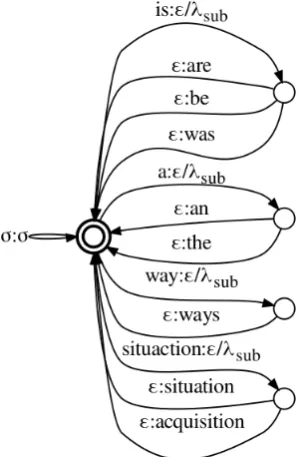
2. In a next step, we compose the transducer from step 1 with the edit transducer E in Fig. 3. This step addresses substitution er-rors such as spelling or morphology erer-rors.
2
Note that our description differs from (Stahlberg et al.,
[image:2.595.120.244.216.419.2]2019) in the following ways: First, we use additional FSTs to allow insertions and deletions. Second, we integrate penal-ties directly into the FSTs rather than using special tokens in combination with a penalization transducer.
Figure 3: Edit FSTEwhich allows substitutions with a cost ofλsub. Theσ-label matches any symbol and maps it to itself at no cost.
Figure 4: Insertion FSTAfor adding the symbols “,”, “-”, and “’s” at a cost ofλins. Theσ-label matches any symbol and maps it to itself at no cost.
LikeStahlberg et al.(2019), we use the con-fusion sets of Bryant and Briscoe (2018) based on CyHunspell for spell checking ( Ro-driguez and Seal,2014), the AGID morphol-ogy database for morpholmorphol-ogy errors ( Atkin-son,2011), and manually defined corrections for determiner and preposition errors to con-structE. Additionally, we extracted all sub-stitution errors from the BEA-2019 dev set which occurred more than five times, and added a small number of manually defined rules that fix tokenization around punctuation symbols.
Sub Del Ins LM Beam CoNLL-2014 BEA-2019 Dev P R M2 P R ERRANT
Best published:Stahlberg et al.(2019) 54.12 25.52 44.21 n/a
X 1x 8 58.59 24.14 45.58 42.44 14.68 30.79
X X 1x 8 59.01 26.07 47.11 41.21 16.47 31.69
X X X 1x 8 52.89 26.68 44.20 40.09 19.97 33.36
X X X 2x 8 54.05 26.71 44.87 40.70 20.01 33.73
X X X 2x 16 57.05 27.22 46.80 42.02 19.76 34.29
[image:3.595.118.483.63.154.2]X X X 2x 32 58.48 28.21 48.15 42.37 19.92 34.58
Table 2: Results on the low-resource track. Theλ-parameters are tuned on the BEA-2019 dev set.
less predictable words like proper names. We therefore restrict insertions to the three to-kens “,”, “-”, and “’s” and allow only one insertion per sentence. We achieve this by adding the transducerAin Fig.4to our com-position cascade.
4. Finally, we map the word-level FSTs to the subword-level by composition with a map-ping transducerT that applies byte pair en-coding (Sennrich et al., 2016c, BPE) to the full words. Word-to-BPE mapping transduc-ers have been used in prior work to combine word-level models with subword-level neu-ral sequence models (Stahlberg et al., 2019,
2017b,2018b,2017a).
In a more condensed form, we can describe the final transducer as:
I◦D◦E◦A◦T (1)
withDfor deletions,Efor substitutions,Afor in-sertions, and T for converting words to BPE to-kens. Path scores in the FST in Eq. 1 are the accumulated penalties λdel, λsub, and λins. The
λ-parameters are tuned on the dev set using a variant of Powell search (Powell, 1964). We apply standard FST operations like output pro-jection,-removal, determinization, minimization, and weight pushing (Mohri,1997;Mohri and Ri-ley,2001) to help downstream decoding. Follow-ingStahlberg et al.(2019) we then use the result-ing transducer to constrain a neural LM beam de-coder.
2.2 Experimental Setup
Our LMs are Transformer (Vaswani et al.,2017) decoders (transformer big) trained using the Tensor2Tensor library (Vaswani et al., 2018). We delay SGD updates (Stahlberg et al., 2018a;
Saunders et al., 2018) with factor 2 to simulate 500K training steps with 8 GPUs on 4 physi-cal GPUs. Training batches contain about 4K
source and target tokens. Our LM training set comprises the monolingual news2015-news2018 English training sets3 from the WMT evaluation campaigns (Bojar et al.,2018) after language de-tection (Nakatani, 2010) (138M sentences) and subword segmentation using byte pair encod-ing (Sennrich et al., 2016c) with 32K merge op-erations. For decoding, we use our SGNMT tool (Stahlberg et al., 2017b, 2018b) with Open-FST backend (Allauzen et al.,2007).
2.3 Results
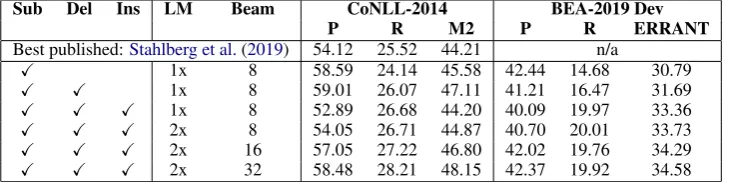
We report M2 (Dahlmeier and Ng, 2012) scores on the CoNLL-2014 test set (Ng et al.,2014) and span-based ERRANT scores (Bryant et al.,2017) on the BEA-2019 dev set (Bryant et al.,2019). On CoNLL-2014 we compare with the best published results with comparable amount of parallel train-ing data. We refer to (Bryant et al., 2019) for a full comparison of BEA-2019 systems. We tune our systems on BEA-2019 and only report the per-formance on CoNLL-2014 for comparison to prior work.
Tab. 2 summarizes our low-resource experi-ments. Our substitution-only system already out-performs the prior work ofStahlberg et al.(2019). Allowing for deletions and insertions improves the ERRANT score on BEA-2019 Dev by 2.57 points. We report further gains on both test sets by en-sembling two language models and increasing the beam size.
2.4 Differences Between CoNLL-2014 and BEA-2019 Dev
Our results in Tab. 2 differ significantly between the CoNLL-2014 test set and the BEA-2019 dev set. Allowing insertions is beneficial on BEA-2019 Dev but decreases the M2 score on CoNLL-2014. Increasing the beam size improves our sys-tem by 3.28 points on CoNLL-2014 while the
im-3http://www.statmt.org/wmt19/
Per Sentence Per Word CoNLL BEA CoNLL BEA
Missing 0.35 0.46 1.51% 2.30% Replacement 1.52 1.31 6.62% 6.57% Unnecessary 0.42 0.19 1.83% 0.98%
[image:4.595.307.526.61.134.2]Total 2.29 1.96 9.95% 9.86%
Table 3: Number of correction types in CoNLL-2014 and BEA-2019 Dev references.
pact on BEA-2019 Dev is smaller (+0.85 points). These differences can be partially explained by comparing the error type frequencies in the refer-ence annotations in both test sets (Tab.3). Samples in CoNLL-2014 generally need more corrections per sentence than in BEA-2019 Dev. More im-portantly, the CoNLL-2014 test set contains fewer missing words, but much more unnecessary words than BEA-2019 Dev. This mismatch tempers with tuning as we explicitly tune insertion and deletion penalties.
3 Restricted Track Submission
In contrast to our low-resource submission, our restricted system entirely relies on neural models and does not use any external NLP tools, spell checkers, or hand-crafted confusion sets. For sim-plicity, we also chose to use standard implemen-tations (Vaswani et al., 2018) of standard Trans-former (Vaswani et al., 2017) models with stan-dard hyper-parameters. This makes our final sys-tem easy to deploy as it is a simple ensemble of standard neural models with minimal prepro-cessing (subword segmentation). Our contribu-tions on this track focus on NMT training tech-niques such as over-sampling, back-translation, and fine-tuning. We show that over-sampling ef-fectively reduces domain mismatch. We found back-translation (Sennrich et al., 2016b) to be a very effective technique to utilize unannotated training data. However, while over-sampling is commonly used in machine translation to bal-ance the number of real and back-translated train-ing sentences, we report that ustrain-ing over-sampltrain-ing this way for GEC hurts performance. Finally, we propose a combination of checkpoint averag-ing (Junczys-Dowmunt et al.,2016) and continued training to adapt our NMT models to the target do-main.
3.1 Experimental Setup
We use neural LMs and neural machine transla-tion (NMT) models in our restricted track entry.
BASE BIG
T2T HParams set trans. base trans. big
# physical GPUs 4 4
Batch size 4,192 2,048
SGD delay factor 2 4
# training iterations 300K 400K
Beam size 4 8
Table 4: NMT setups BASEand BIGused in our exper-iments for the restricted track.
Number of Sentences With Identities W/o Identities
FCE 28K 18K
Lang-8 1,038K 498K
NUCLE 57K 21K
W&I+LOCNESS 34K 23K
[image:4.595.77.287.62.124.2]Total 1,157K 560K
Table 5: BEA-2019 parallel training data with and without removing pairs where source and target sen-tences are the same.
Our neural LM is as described in Sec. 2.2. Our LMs and NMT models share the same subword segmentation. We perform exploratory NMT ex-periments with the BASE setup, but switch to the BIG setup for our final models. Tab. 4 shows the differences between both setups. Tab. 5 lists some corpus statistics for the BEA-2019 training sets. In our experiments without fine-tuning we decode with the average of the 20 most recent checkpoints (Junczys-Dowmunt et al.,2016). We use the SGNMT decoder (Stahlberg et al.,2017b,
2018b) in all our experiments.
In-domain corpus over-sampling The BEA-2019 training corpora (Tab.5) differ significantly not only in size but also their closeness to the target domain. The W&I+LOCNESS corpus is most similar to the BEA-2019 dev and test sets in terms of domains and the distribution over En-glish language proficiency, but only consists of 34K sentence pairs. To increase the importance of in-domain training samples we over-sampled the W&I+LOCNESS corpus with different rates. Tab.6 shows that over-sampling by factor 4 (i.e. adding the W&I+LOCNESS corpus four times to the training set) improves the ERRAMTF0.5
-score by 2.2 points on the BEA-2019 dev set and does not lead to substantial losses on the CoNLL-2014 test set. We will over-sample the W&I+LOCNESS corpus by four in all subsequent experiments.
[image:4.595.308.524.178.253.2]W&I+LOCNESS Ratio CoNLL-2014 BEA-2019 Dev Over-sampling Rate P R M2 P R ERRANT
[image:5.595.133.464.61.115.2]1x 1:33 59.88 17.46 40.30 38.20 15.09 29.24 4x 1:8 59.16 17.20 39.76 40.40 16.67 31.44 8x 1:4 57.73 17.76 39.81 39.19 16.73 30.90
Table 6: Over-sampling the BEA-2019 in-domain corpus W&I+LOCNESS under BASE models. The second column contains the ratio of W&I+LOCNESS samples to training samples from the other corpora.
Identity CoNLL-2014 BEA-2019 Dev Removal P R M2 P R ERR.
[image:5.595.76.286.168.210.2]× 59.16 17.20 39.76 40.40 16.67 31.44 X 53.34 28.83 45.59 33.04 23.14 30.44
Table 7: Impact of identity removal on BASEmodels.
(i.e. source and target sentences are equal) from the training corpora (Stahlberg et al.,2019;Zhao et al.,2019;Grundkiewicz and Junczys-Dowmunt,
2018). We note that removing these identity map-pings can be seen as measure to control the bal-ance between precision and recall. As shown in Tab.7, removing identities encourages the model to make more corrections and thus leads to higher recall but lower precision. It depends on the test set whether this results in an improvement inF0.5
score. For the subsequent experiments we found that removing identities in the parallel training corpora but not in the back-translated synthetic data works well in practice.
Back-translation Back-translation (Sennrich et al., 2016b) has become the most widely used technique to use monolingual data in neural machine translation. Back-translation extends the existing parallel training set by additional training samples with real English target sentences but synthetic source sentences. Different methods have been proposed to synthesize the source sentence such as using dummy tokens (Sennrich et al.,2016b), copying the target sentence (Currey et al., 2017), or sampling from or decoding with a reverse sequence-to-sequence model (Sennrich et al.,2016b;Edunov et al.,2018;Kasewa et al.,
2018). The most popular approach is to generate the synthetic source sentences with a reverse model that is trained to transform target to source sentences using beam search. In GEC, this means that the reverse model learns to introduce errors into a correct English sentence. Back-translation has been applied successfully to GEC byKasewa et al. (2018). We confirm the effectiveness of back-translation in GEC and discuss some of the differences between applying this technique to grammatical error correction and machine translation.
Our experiments with back-translation are sum-marized in Tab.8. Adding 1M synthetic sentences to the training data already yields very substantial gains on both test sets. We achieve our best re-sults with 5M synthetic sentences (+8.44 on BEA-2019 Dev). In machine translation, it is important to maintain a balance between authentic and syn-thetic data (Sennrich et al.,2016b;Poncelas et al.,
2018;Sennrich et al.,2016a). Over-sampling the real data is a common practice to rectify that ratio if large amounts of synthetic data are available. In-terestingly, over-sampling real data in GEC hurts performance (row 3 vs. 5 in Tab.8), and it is possi-ble to mix real and synthetic sentences at a ratio of 1:7.9 (last three rows in Tab.8). We will proceed with the 5M setup for the remainder of this paper.
Fine-tuning As explained previously, we over-sample the W&I+LOCNESS corpus by factor 4 to mitigate the domain gap between the training set and the BEA-2019 dev and test sets. To further adapt our system to the target domain, we
fine-Over-sampling Rate Number of Ratio CoNLL-2014 BEA-2019 Dev (Real Data) Synthetic Sentences P R M2 P R ERRANT
1x 0 - 53.34 28.83 45.59 33.04 23.14 30.44
1x 1M 1:1.6 56.17 31.30 48.47 37.79 23.86 33.84
1x 3M 1:4.8 61.40 34.29 53.02 42.62 25.30 37.49
1x 5M 1:7.9 64.18 34.27 54.64 44.69 25.59 38.88
3x 3M 1:1.6 57.12 32.55 49.63 40.08 24.79 35.68
6x 5M 1:1.3 59.15 33.99 51.52 41.52 25.05 36.69
[image:5.595.86.510.647.729.2]Fine-tuning Checkpoint CoNLL-2014 BEA-2019 Dev (Continued Training) Averaging P R M2 P R ERRANT
63.61 33.39 53.86 44.16 25.01 38.29 X 64.18 34.27 54.64 44.69 25.59 38.88
X 64.98 33.05 54.46 48.62 27.19 42.00
[image:6.595.117.483.60.124.2]X X 66.03 34.17 55.65 48.99 26.87 42.06
Table 9: Fine-tuning through continued training on W&I+LOCNESS and checkpoint averaging with a BASEmodel with 5M back-translated sentences.
38.5 39.0 39.5 40.0 40.5 41.0 41.5 42.0
0 1000 2000 3000 4000 5000 F0.5
(in %)
Fine-tuning iterations With checkpoint averaging
[image:6.595.82.279.184.306.2]W/o checkpoint averaging
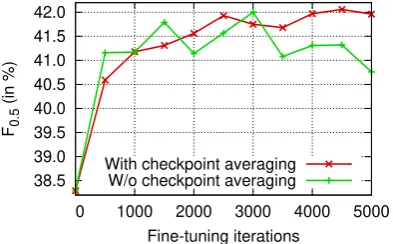
Figure 5: Span-based ERRANT F0.5 scores on the BEA-2019 dev set over the number of fine-tuning train-ing iterations (strain-ingle GPU, SGD delay factor (Saunders et al.,2018) of 16).
tune the NMT models on W&I+LOCNESS after convergence on the full training set. We do that by continuing training on W&I+LOCNESS from the last checkpoint of the first training pass. Fig.5
plots theF0.5 score on the BEA-2019 dev set for
two different setups. For the red curve, we average all checkpoints (Junczys-Dowmunt et al., 2016) (including the last unadapted checkpoint) up to a certain training iteration. Checkpoints are dumped every 500 steps. The green curve does not use any checkpoint averaging. Checkpoint averaging helps to smooth out fluctuations inF0.5score, and
also generalizes better to CoNLL-2014 (Tab.9).
Final system Tab. 10contains our experiments with the BIG configuration. In addition to W&I+LOCNESS over-sampling, back-translation with 5M sentences, and fine-tuning with check-point averaging, we report further gains by adding
the language models from our low-resource sys-tem (Sec. 2.2) and ensembling. Our best sys-tem (4 NMT models, 2 language models) achieves 58.9 M2 on CoNLL-2014, which is slightly (2.25 points) worse than the best published result on that test set (Zhao et al., 2019). However, we note that we have tailored our system towards the BEA-2019 dev set and not the 2013 or CoNLL-2014 test sets. As we argued in Sec.2.4, our re-sults throughout this work suggest strongly that the optimal system parameters for these test sets are very different from each other, and that our fi-nal system settings are not optimal for CoNLL-2014. We also note that unlike the system ofZhao et al. (2019), our system for the restricted track does not use spell checkers or other NLP tools but relies solely on neural sequence models.
4 Conclusion
We participated in the BEA 2019 Shared Task on grammatical error correction with submissions to the resource and the restricted track. Our low-resource system is an extension of prior work on FST-based GEC (Stahlberg et al.,2019) to allow insertions and deletions. Our restricted track sub-mission is a purely neural system based on stan-dard NMT and LM architectures. We pointed out the similarity between GEC and machine trans-lation, and demonstrated that several techniques which originate from MT research such as over-sampling, back-translation, and fine-tuning, are also useful for GEC. Our models have been used in a joint submission with the Cambridge Univer-sity Computer Lab (Yuan et al.,2019).
NMT Fine-tuning LM CoNLL-2014 BEA-2019 Dev P R M2 P R ERRANT
Best published:Zhao et al.(2019) 71.57 38.65 61.15 n/a
1x 64.04 35.74 55.28 45.86 26.46 40.00
1x X 66.57 35.21 56.50 51.57 27.49 43.88
1x X 2x 61.53 40.44 55.72 48.30 33.08 44.23
4x X 70.37 35.12 58.60 55.84 27.80 46.47
4x X 2x 66.89 39.85 58.90 53.17 32.89 47.34
[image:6.595.125.473.659.742.2]Acknowledgments
This work was supported by the U.K. Engineering and Physical Sciences Research Council (EPSRC) grant EP/L027623/1 and has been performed us-ing resources provided by the Cambridge Tier-2 system operated by the University of Cambridge Research Computing Service4 funded by EPSRC Tier-2 capital grant EP/P020259/1.
References
Cyril Allauzen, Michael Riley, Johan Schalkwyk, Wo-jciech Skut, and Mehryar Mohri. 2007. OpenFst: A general and efficient weighted finite-state transducer library. InImplementation and Application of Au-tomata, pages 11–23. Springer.
Kevin Atkinson. 2011. Automatically generated in-flection database (AGID). http://wordlist.
aspell.net/other/. [Online; accessed 24
April 2019].
Ondˇrej Bojar, Christian Federmann, Mark Fishel, Yvette Graham, Barry Haddow, Philipp Koehn, and Christof Monz. 2018. Findings of the 2018 con-ference on machine translation (WMT18). In Pro-ceedings of the Third Conference on Machine
Trans-lation: Shared Task Papers, pages 272–303,
Bel-gium, Brussels. Association for Computational Lin-guistics.
Christopher Bryant and Ted Briscoe. 2018. Language model based grammatical error correction without annotated training data. InProceedings of the Thir-teenth Workshop on Innovative Use of NLP for
Building Educational Applications, pages 247–253.
Association for Computational Linguistics.
Christopher Bryant, Mariano Felice, Øistein E. Ander-sen, and Ted Briscoe. 2019. The BEA-2019 shared task on grammatical error correction. In Proceed-ings of the 14th Workshop on Innovative Use of NLP for Building Educational Applications. Association for Computational Linguistics.
Christopher Bryant, Mariano Felice, and Ted Briscoe. 2017. Automatic annotation and evaluation of er-ror types for grammatical erer-ror correction. In Pro-ceedings of the 55th Annual Meeting of the Associa-tion for ComputaAssocia-tional Linguistics (Volume 1: Long
Papers), pages 793–805. Association for
Computa-tional Linguistics.
Anna Currey, Antonio Valerio Miceli Barone, and Ken-neth Heafield. 2017. Copied monolingual data im-proves low-resource neural machine translation. In Proceedings of the Second Conference on Machine
Translation, pages 148–156, Copenhagen,
Den-mark. Association for Computational Linguistics.
4http://www.hpc.cam.ac.uk
Daniel Dahlmeier and Hwee Tou Ng. 2012. Better evaluation for grammatical error correction. In Pro-ceedings of the 2012 Conference of the North Amer-ican Chapter of the Association for Computational
Linguistics: Human Language Technologies, pages
568–572. Association for Computational Linguis-tics.
Sergey Edunov, Myle Ott, Michael Auli, and David Grangier. 2018. Understanding back-translation at scale. In Proceedings of the 2018 Conference on Empirical Methods in Natural Language Process-ing, pages 489–500, Brussels, Belgium. Association for Computational Linguistics.
Roman Grundkiewicz and Marcin Junczys-Dowmunt. 2018. Near human-level performance in grammati-cal error correction with hybrid machine translation.
InProceedings of the 2018 Conference of the North
American Chapter of the Association for Computa-tional Linguistics: Human Language Technologies,
Volume 2 (Short Papers), pages 284–290.
Associa-tion for ComputaAssocia-tional Linguistics.
Marcin Junczys-Dowmunt, Tomasz Dwojak, and Hieu Hoang. 2016. Is neural machine translation ready for deployment? A case study on 30 translation di-rections. InInternational Workshop on Spoken
Lan-guage Translation IWSLT.
Sudhanshu Kasewa, Pontus Stenetorp, and Sebastian Riedel. 2018. Wronging a right: Generating bet-ter errors to improve grammatical error detection.
In Proceedings of the 2018 Conference on
Em-pirical Methods in Natural Language Processing,
pages 4977–4983, Brussels, Belgium. Association for Computational Linguistics.
Mehryar Mohri. 1997. Finite-state transducers in lan-guage and speech processing. Computational Lin-guistics, 23(2).
Mehryar Mohri and Michael Riley. 2001. A weight pushing algorithm for large vocabulary speech recognition. In Seventh European Conference on
Speech Communication and Technology.
Shuyo Nakatani. 2010. Language detection library for Java. [Online; accessed 24 April 2019].
Hwee Tou Ng, Siew Mei Wu, Ted Briscoe, Christian Hadiwinoto, Raymond Hendy Susanto, and Christo-pher Bryant. 2014. The CoNLL-2014 shared task on grammatical error correction. InProceedings of the Eighteenth Conference on Computational
Natu-ral Language Learning: Shared Task, pages 1–14.
Association for Computational Linguistics.
Hwee Tou Ng, Siew Mei Wu, Yuanbin Wu, Christian Hadiwinoto, and Joel Tetreault. 2013. The CoNLL-2013 shared task on grammatical error correction.
In Proceedings of the Seventeenth Conference on
Alberto Poncelas, Dimitar Shterionov, Andy Way, Gideon Maillette de Buy Wenniger, and Pey-man Passban. 2018. Investigating backtransla-tion in neural machine translabacktransla-tion. arXiv preprint
arXiv:1804.06189.
Michael JD Powell. 1964. An efficient method for find-ing the minimum of a function of several variables without calculating derivatives. The computer jour-nal, 7(2):155–162.
Tim Rodriguez and Matthew Seal. 2014. Cy-Hunspell. https://github.com/MSeal/ cython_hunspell. [Online; accessed 24 April 2019].
Danielle Saunders, Felix Stahlberg, Adri`a de Gispert, and Bill Byrne. 2018. Multi-representation en-sembles and delayed SGD updates improve syntax-based NMT. In Proceedings of the 56th Annual Meeting of the Association for Computational
Lin-guistics (Volume 2: Short Papers), pages 319–
325, Melbourne, Australia. Association for Compu-tational Linguistics.
Rico Sennrich, Barry Haddow, and Alexandra Birch. 2016a. Edinburgh neural machine translation sys-tems for WMT 16. In Proceedings of the First
Conference on Machine Translation, pages 371–
376, Berlin, Germany. Association for Computa-tional Linguistics.
Rico Sennrich, Barry Haddow, and Alexandra Birch. 2016b. Improving neural machine translation mod-els with monolingual data. In Proceedings of the 54th Annual Meeting of the Association for Compu-tational Linguistics (Volume 1: Long Papers), pages 86–96, Berlin, Germany. Association for Computa-tional Linguistics.
Rico Sennrich, Barry Haddow, and Alexandra Birch. 2016c. Neural machine translation of rare words with subword units. InProceedings of the 54th An-nual Meeting of the Association for Computational
Linguistics (Volume 1: Long Papers), pages 1715–
1725. Association for Computational Linguistics.
Felix Stahlberg, Christopher Bryant, and Bill Byrne. 2019. Neural grammatical error correction with fi-nite state transducers. InProceedings of the 2019 Conference of the North American Chapter of the Association for Computational Linguistics. Associ-ation for ComputAssoci-ational Linguistics.
Felix Stahlberg, Adri`a de Gispert, and Bill Byrne. 2018a. The University of Cambridge’s machine translation systems for WMT18. In Proceedings of the Third Conference on Machine Translation:
Shared Task Papers, pages 504–512, Belgium,
Brus-sels. Association for Computational Linguistics.
Felix Stahlberg, Adri`a de Gispert, Eva Hasler, and Bill Byrne. 2017a. Neural machine translation by minimising the Bayes-risk with respect to syntactic translation lattices. InProceedings of the 15th Con-ference of the European Chapter of the Association
for Computational Linguistics: Volume 2, Short Pa-pers, pages 362–368, Valencia, Spain. Association for Computational Linguistics.
Felix Stahlberg, Eva Hasler, Danielle Saunders, and Bill Byrne. 2017b. SGNMT – A flexible NMT de-coding platform for quick prototyping of new mod-els and search strategies. InProceedings of the 2017 Conference on Empirical Methods in Natural
Lan-guage Processing: System Demonstrations, pages
25–30. Association for Computational Linguistics.
Felix Stahlberg, Danielle Saunders, Gonzalo Iglesias, and Bill Byrne. 2018b. Why not be versatile? Ap-plications of the SGNMT decoder for machine trans-lation. InProceedings of the 13th Conference of the Association for Machine Translation in the
Ameri-cas (Volume 1: Research Papers), pages 208–216.
Association for Machine Translation in the Ameri-cas.
Ashish Vaswani, Samy Bengio, Eugene Brevdo, Fran-cois Chollet, Aidan Gomez, Stephan Gouws, Llion Jones, Łukasz Kaiser, Nal Kalchbrenner, Niki Par-mar, Ryan Sepassi, Noam Shazeer, and Jakob Uszkoreit. 2018. Tensor2tensor for neural machine translation. InProceedings of the 13th Conference of the Association for Machine Translation in the
Americas (Volume 1: Research Papers), pages 193–
199, Boston, MA. Association for Machine Transla-tion in the Americas.
Ashish Vaswani, Noam Shazeer, Niki Parmar, Jakob Uszkoreit, Llion Jones, Aidan N Gomez, Łukasz Kaiser, and Illia Polosukhin. 2017. Attention is all you need. InAdvances in Neural Information Pro-cessing Systems, pages 5998–6008.
Zheng Yuan, Felix Stahlberg, Marek Rei, Bill Byrne, and Helen Yannakoudakis. 2019. Neural and FST-based approaches to grammatical error correction.
InProceedings of the 14th workshop on innovative
use of NLP for building educational applications.
Association for Computational Linguistics.