Proceedings of the 13th Linguistic Annotation Workshop, pages 16–25 16
Crowdsourcing Discourse Relation Annotations
by a Two-Step Connective Insertion Task
Frances Yung†, Merel C.J. Scholman† and Vera Demberg†,‡ †Dept. of Language Science and Technology
‡Dept. of Mathematics and Computer Science, Saarland University
Saarland Informatic Campus, 66123 Saarbr¨ucken, Germany
[frances|m.c.j.scholman|vera]@coli.uni-saarland.de
Abstract
The perspective of being able to crowd-source coherence relations bears the promise of ac-quiring annotations for new texts quickly, which could then increase the size and vari-ety of discourse-annotated corpora. It would also open the avenue to answering new re-search questions: Collecting annotations from a larger number of individuals per instance would allow to investigate the distribution of inferred relations, and to study individual dif-ferences in coherence relation interpretation.
However, annotating coherence relations with untrained workers is not trivial. We here pro-pose a novel two-step annotation procedure, which extends an earlier method byScholman and Demberg(2017a). In our approach, coher-ence relation labels are inferred from connec-tives that workers insert into the text.
We show that the proposed method leads to replicable coherence annotations, and analyse the agreement between the obtained relation labels and annotations from PDTB and RST-DT on the same texts.
1 Introduction
Implicit coherence relations are connections be-tween text segments that are not overtly marked. Annotating implicit coherence relations using crowd-sourcing is methodologically challenging, because assigning coherence relation labels as used in popular discourse frameworks like the Penn Discourse Treebank style (PDTB, Prasad et al.,2008,2018) or the Rhetorical Structure The-ory (RST, Mann and Thompson, 1988; Carlson et al., 2003) requires linguistic knowledge and substantial training. It is thus not possible to ob-tain high quality annotations of coherence relation labels from untrained crowd workers (Kawahara et al.,2014;Kishimoto et al.,2018).
A more promising method for obtaining dis-course annotations through crowd-sourcing is to
ask workers to insert discourse connectives ( Ro-hde et al.,2016;Scholman and Demberg,2017a). However, this method so far has only been used in settings where it was sufficient to give workers a small set of connectives to choose from, and not in broad-coverage coherence relation annotation. For example,Rohde et al.(2016) focused on identify-ing cases where several coherence relations may hold between two segments. They provided par-ticipants with relations that were already marked with a discourse adverbial, and asked them to ad-ditionally insert a conjunction out of a list of six highly frequent connectives (and, but, so, because, before, or).
Highly frequent connectives are often ambigu-ous, for instance, the insertion ofbutdoes not al-low us to infer whether the relation is a contrast or a concession relation. When we want to do fine-grained relation annotation, providing only gen-eral connectives is thus not sufficient. Scholman and Demberg(2017a) addressed this problem by restricting the types of relations that could occur in their experiment. They selected six types of co-herence relations from the overlapping part of the PDTB2.0 and RST-DT corpora, and re-annotated them using crowd-sourced annotators. Workers in this study could choose from a list of connectives which distinguish unambiguously between the six relation types of interest. For example, instead of the connectivebut, they provided a choice between
neverthelessandby contrast.
connectives.
In this work, we therefore propose a new an-notation procedure which builds on the method of
Scholman and Demberg (2017a). Our contribu-tions in this paper consist of:
• a novel two-step procedure for eliciting discourse connective insertions from na¨ıve workers;
• a demonstration that the generalized method is comparable in reliability of annotations to the original more restricted crowd-sourcing method proposed by (Scholman and Dem-berg,2017a);
• a “connective bank” consisting of 800 entries including traditional connectives as well as variations of connectives and alternative lex-icalizations;
• an analysis comparing the obtained coher-ence labels to labels from professionally an-notated discourse treebanks. Our analysis shows that crowd-sourcing captures a mix-ture of characteristics from PDTB 3.0 and RST-DT annotations.
The data collected in this study, including the crowdsourced annotations of 447 implicit dis-course relations and aconnective bankof800 con-nective phrases, is freely available for the commu-nity.1
2 Background
Crowd-sourcing is an increasing popular alterna-tive to professional annotation of linguistic mate-rials because of time efficiency. However, classi-fication of discourse relations is not a trivial task. This is especially true for implicit relations, where explicit connectives are missing. Detailed guide-lines and extensive training are used in traditional annotation by experts.
Kawahara et al. (2014) presented a first at-tempt to crowd-source discourse relation annota-tion. The workers first decided whether text spans were connected by a relation, and then assigned one out of seven sense labels in case a relation was identified. The proposal is appealing in terms of time efficiency, but the quality is questionable be-cause evaluation was not carried out. Kishimoto
1https://git.sfb1102.uni-saarland.
de/francesyung/2-step-crowdsourced-discourse-annotation
et al.(2018) later annotated a portion of the re-lations by trained annotators, and found that the quality of the annotation from crowd-sourcing was not satisfactory. They argued that the na¨ıve work-ers did not completely undwork-erstand the definition of relation senses and the task was too demanding.
Following the success of analyzing multiple coherence interpretation based on connective in-sertions by crowd workers (Rohde et al., 2016),
Scholman and Demberg (2017a) proposed to use a connective insertion task as a more intuitive al-ternative to the annotation of coherence relation labels, when working with untrained annotators.
In their experiment, workers are asked to “drag-and-drop” one out of eight unambiguous connec-tives into the blank between two text spans to express the discourse relation holding between them.2
Scholman and Demberg (2017a) evaluated the annotation method by re-annotating a portion of the WSJ text for which professional coherence re-lation annotations (PDTB, RST-DT) are also avail-able. The majority of the crowd-sourced labels converged with the label of PDTB, showing that the method is reliable, at least in this simplified setting where the set of possible discourse rela-tions is limited and given.
Furthermore, replicability and robustness of the crowd-sourced annotation was demonstrated by replicating the crowd-sourced annotation on the same coherence relations without providing the participants with extra contexts. The resulting connective distributions of the two experiments closely agreed with each other, showing that the annotation is replicable even when contexts are ab-sent.
However, the method used by Scholman and Demberg (2017a) also presents some shortcom-ings: firstly, it doesn’t easily scale up to distin-guish between the full set of coherence relations that can occur in a text, and secondly, prompting workers to choose among a set of given connec-tives might affect their interpretation of the co-herence relation3. For example, workers might have refrained from inserting an unambiguous but rather heavy-handed connective like “as an illus-tration” if the text doesn’t sound “natural” after
2The connectives are because, as a result, in addition,
even though, nevertheless, by contrast, as an illustrationand more specifically.
3Although workers were also allowed to type other
inserting the connective.
We here propose a two-step design which al-lows the workers to mark each relation by a free insertion step followed by a customized disam-biguation step.
3 Method
3.1 Annotation task design
In the first step, workers are shown a short text passage containing a blank between two text seg-ments. They are asked to type in a connective that they think best expresses the relation between the textual arguments. They are also given the option to typenothingif they think no phrase possibly fits between the segments.
We expected that freely inserted connectives chosen by workers might often be ambiguous, such that we would not be able to infer a specific coherence relation label from these free insertions. We therefore include a second step, where partic-ipants are presented with a list of at most10 con-nectives that disambiguate the connective phrase they chose to insert in the first step. The selection of the connectives is determined dynamically from their choice in the first step. They are then asked to drag and drop the phrase that best expresses the relation holding between the text segments. They can choose thenone of theseoption if they think none of the given options fit.
For example, the worker had typedhowever in the first step, and this connective can markARG
1-AS-DENIER, ARG2-AS-DENIER, andCONTRAST,
the connectives even though, despite this andon the contrarywill be given as a choice to the worker in the second step. If the first free insertion is al-ready an unambiguous connective, the second step is skipped, and the worker proceeds to the next task.
In order to allow us to determine what connec-tives should be shown in the second step, we con-structed a connective bank containing a collection of connective phrases and their (multiple) senses. We also created a list of unambiguous connective phrases for each of the coherence relations that we distinguish.
In some cases, the insertion in the first step did not match any of the entries in our connective bank (see Section3.2). This might happen because of typos, insertions that are not actually connective phrases, or which are new connective phrases that are not yet contained in our connective bank. We
observed during the development of our method that this happens particularly frequently in cases where none of the frequent connectives seem to fit the text well. We therefore created a list of ten connectives that typically fit such cases well. This default list is presented to workers when we do not recognize their insertion from the first step, or if they typednothing. This list of default con-nectives includesaccordingly, actually, as you can see, essentially, evidently, in other words, in sum-mary, on top of that, specifically, and to provide some background information.
3.2 Connective bank
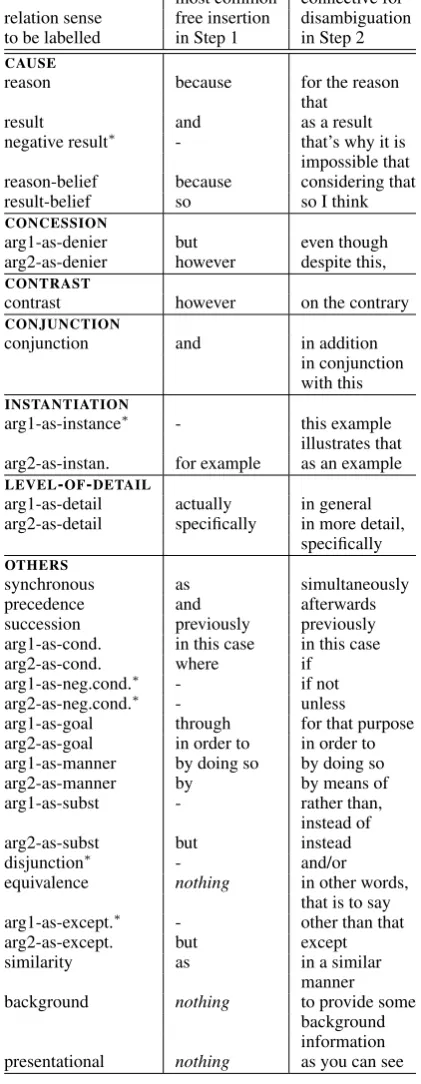
Based on existing discourse resources, we con-structed a bank of discourse connecting phrases and manually annotated the possible senses of each phrase. The set of labels is adapted from the sense hierarchy of PDTB3; it is shown in Table24. We tested the coverage of the connective bank in a number of pretests with a separate group of crowd workers, using materials from PDTB, as well as transcripts of TED talks, in order to cap-ture the possible connectives used by the na¨ıve workers. The free insertions collected from the pretests were manually classified as to whether they are connective phrases. The identified con-nectives are furthermore labelled with discourse senses and added to the connective bank.
The final version of our connective bank con-tains 800 entries, which include typical discourse connectives (e.g. because), variation of connec-tives (e.g. largely because), combination of con-nectives (e.g. and because) and ”alternative lexi-calization” (e.g.the reason is that).5The bank can be expanded with the new free insertions collected after each round of annotation.
The list given in Step 2 contains connectives that mark the relation senses that we want to dis-tinguish as unambiguously as possible. We deter-mined these connectives with the help of Knott
(1996)’s connective hierarchy. The complete list is shown in Table2.
4We cover each Level-3 sense in PDTB 3.0, except the 4
speech-act relations, because the speech-act relations are rare and cannot be distinguished with their non-speech-act ver-sions by means of the inserted connective. In addition, we included two extra relations: PRESENTATIONALandBACK
-GROUND
5We also find a lot of frequent typos among the
3.3 Aggregation of annotation
From each worker, we thus typically collect one freely inserted label and one forced choice label. In order to determine the coherence relation label, we retrieve the potential relation senses of both the freely inserted and the forced choice connectives from the connective bank, and calculate the inter-section of the relation senses they can mark. The exact algorithm is shown in the Appendix.
Each workerassigns either a single or multiple senses to a relation. If the intersection set con-tains one sense, the relation is resolved to a sin-gle unambiguous sense. If the worker chooses an ambiguous phrase in the first step and “none of these” in the second step, then the relation is an-notated with the multiple senses of the ambiguous phrase.6
It can however happen that participants type a phrase we do not know (and cannot interpret, e.g. because it is not a connective), or choose to insert nothing in the first step, and then choose
none of these in the second step. In these cases, which are rare (3%of the annotation), we remove the data from further analysis.
The multiple annotations collected from multi-ple workers for each item are aggregated to a sense distribution per item. If a worker assigned more than one sense to the item, the count is equally split among the multiple senses.
We conducted two annotation experiments to evaluate the methodology and reliability of the proposed method.
4 Experiment 1
The objective of this experiment is to confirm the proposed task design and compare it with the forced-choice design proposed byScholman and Demberg(2017a).
4.1 Materials
Experiment 1 used the same set of items as in
Scholman and Demberg (2017a). These are 234 items of six types of explicit and implicit relations chosen from the PDTB7, which are also annotated in RST-DT.
In the PDTB, each of these items consists of two consecutive text segments connected by a
dis-6Scholman and Demberg (2017a) allowed insertion of
multiple connectives, but they found that workers seldom do so, possibly due to increased workload.
7We used the same items but the updated sense labels
from PDTB3.
course connective, which is either present in the original text (explicit relation) or inserted by the PDTB annotators (implicit relation).
An example of each is shown below.
1. Some automotive programs have been de-layed, while they haven’t been canceled. [wsj 0628: explicit relation= ARG1-AS
-DENIER]
2. The explosions began when a seal blew out.
As a result,dozens of workers were injured. [wsj 1320: implicit relation=RESULT]
In the experiment, workers see the text segments and are asked to insert a connective phrase.
For the CAUSE, CONJUNCTION, CONCESSION
andCONTRASTrelations that are contained in this experiment, both PDTB and RST-DT annotations agreed with one another. TheINSTANTIATIONand
LEVEL-OF-DETAIL items were however selected such that RST-DT annotations do not always agree with PDTB annotations (seeScholman and Dem-berg (2017a) for more details). Therefore, these two types of relations are expected to be more am-biguous. The number of instances per relation is given in the subgraph titles in Figure2. The items are divided into 12 sense-balanced batches.
Following the experimental design in ( Schol-man and Demberg,2017a), we conducted two ver-sions of this experiment – one with context and the other without, where context is defined by the window of two sentences before and one sentence after the text spans linked by the coherence rela-tion.
4.2 Procedure
Each set of items was divided into 12 batches, and each batch of 17-20 questions was annotated by 12 workers.
In total, 380 workers were recruited and each of them completed one or more batches, but never the same batch in two conditions. Workers who inserted less than three different phrases in step one, or selected “none of these” in step two in more than 60% of their responses were screened and their annotations were examined and, if nec-essary, replaced by annotations of newly recruited workers.
The task was implemented by LingoTurk (Pusse et al., 2016) and the workers were recruited through Prolific.8 They were awarded with 2.2
British pounds on average for each batch of an-notation.
4.3 Results
We first analyzed the free and forced insertions collected in each step of the two-step approach, and then compared the annotations with those of
Scholman and Demberg(2017a).
The results showed that the proposed two-step free-choice annotation method successfully scaled the connective insertion task to a procedure for crowd-sourcing discourse annotation.
4.3.1 Connective insertion in Steps 1 and 2
First we tested whether the proposed method worked as it was intended. On one hand, if work-ers mostly inserted an unambiguous connective in the first step, the second step would not be nec-essary. On the other hand, if the workers often inserted ambiguous connectives in the first step but failed to choose any connectives in the second step, the 2-step operation failed in labeling the re-lation with a precise sense.
The experiment results demonstrated that the proposed method is flexible and useful. Table 1
shows the proportion of connectives inserted by the workers in each step of the experiment.
Step
1 free insertion
unamb. ambiguous unknown nothing
23% 64% 9% 4%
Step
2 skip customized default
unamb. unamb. amb. unamb. amb. none
[image:5.595.310.521.88.631.2]23% 58% 6% 6% 4% 3%
Table 1: Proportions of insertion normalized per step. The proportion of the unambiguous connective in Step 1 is carried over to Step 2.
In the first step, workers freely typed a connec-tives between the two text segments. Most (87%) of the connectives were identified in our connec-tive bank, and the majority (64%) of them were ambiguous.
Table 2 lists the most common connective phrases the workers typed in Step 1. Na¨ıve work-ers tended to insert common connectives that are usually ambiguous, such asand, as andbut. The unambiguous connecting phrases, such as simul-taneously, are uncommon expressions that people do not intuitively produce.
most common connective for relation sense free insertion disambiguation to be labelled in Step 1 in Step 2
CAUSE
reason because for the reason that
result and as a result
negative result∗ - that’s why it is impossible that reason-belief because considering that result-belief so so I think CONCESSION
arg1-as-denier but even though arg2-as-denier however despite this, CONTRAST
contrast however on the contrary CONJUNCTION
conjunction and in addition in conjunction with this INSTANTIATION
arg1-as-instance∗ - this example illustrates that arg2-as-instan. for example as an example LEVEL-OF-DETAIL
arg1-as-detail actually in general arg2-as-detail specifically in more detail,
specifically OTHERS
synchronous as simultaneously precedence and afterwards succession previously previously arg1-as-cond. in this case in this case arg2-as-cond. where if
arg1-as-neg.cond.∗ - if not arg2-as-neg.cond.∗ - unless
arg1-as-goal through for that purpose arg2-as-goal in order to in order to arg1-as-manner by doing so by doing so arg2-as-manner by by means of arg1-as-subst - rather than,
instead of arg2-as-subst but instead
disjunction∗ - and/or
equivalence nothing in other words, that is to say arg1-as-except.∗ - other than that arg2-as-except. but except similarity as in a similar
manner background nothing to provide some
background information presentational nothing as you can see
[image:5.595.72.302.446.532.2]However, people were still able to use these un-common expressions when they were prompted to do so in the second step. The majority of the ambiguous connectives in the first step were disambiguated to a single sense in the second step. For example, however was readily dis-tinguished between the ARG2-AS-DENIER and CONTRAST senses; and and was disambiguated between PRECEDENCE, RESULT and CONJUNC
-TION.
A manual check of the responses inserted as free text revealed that9%of the insertions in this first step were not actually connectives. This is not surprising, given that untrained workers may not know the concept of discourse connectives and could insert non-connective phrases depending on context, such asunfortunately, orthey think. Also, workers preferred not to insert any phrases in4%
of the instances. This is also expected because some discourse relations, e.g. CONJUNCTIONS, are often implicit.
Nonetheless, workers were able to choose a connective from the default options suggested to them for most of the unknown/nothing cases. This shows that our default list of connectives success-fully helped the untrained workers to express dis-course relations that were not obvious to them.
Overall, the two-step approach resolved the workers’ insertions to a single label in87%of the cases and27 types of sense labels were collected (See Table 2). This is encouraging because un-trained workers would not have been able to carry out such fine-grained classification in one step.
4.3.2 Comparison between forced and free insertions
Next, we compared the methodology of the pro-posed two-step free-choice task with the one-step forced-choice task ofScholman and Demberg
(2017a). We wanted to see if workers’ identifica-tion of the discourse relaidentifica-tion was biased to the set of options available to them and whether contexts were necessary for workers to infer the relations.
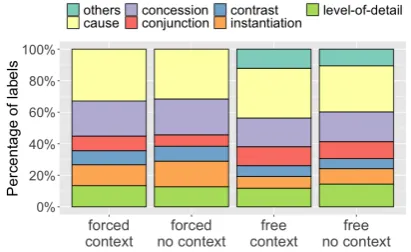
The overall distributions of the annotated senses under different annotation conditions are shown in Figure1.
It can be seen that the relative distribution of the senses was maintained across different ap-proaches, suggesting that the 2-step setup success-fully replicates the results obtained from the force-choice method. However, the distributions were statistically different across the two methods
[image:6.595.313.519.132.258.2]be-cause 12%of the annotated sense did not belong to the 6 original classes of relations. This is ex-pected because the workers were free to assign any relations instead of from a predefined list.
Figure 1: Label distribution per annotation condition of the S&D set
Another finding was that the distributions be-tween theno contextandcontextconditions were similar. Pearson’s χ2 tests showed a significant difference in the distribution of senses between the two conditions for the original CAUSE (p =
.0478) andLEVEL-OF-DETAIL(p= .0159) items but no significant difference for the other items (CONCESSION: p = .991, CONJUNCTION: p =
.258, CONTRAST: p = .975, INSTANTIATION:
p=.232).
This result partially replicates the finding in
Scholman and Demberg(2017a) that contexts of-fer limited help in this set of items.
4.3.3 Comparison with reference annotation
To assess the quality of the annotations collected by the proposed method, we compared the col-lected labels with the original expert label per item.
We selected the majority label of each item based on the aggregated distribution for compar-ison. If an item had more than one majority label, one of them was selected randomly.9
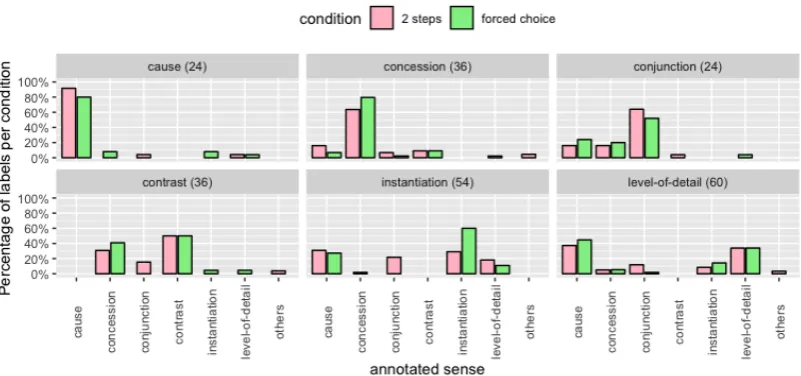
Figure 2 shows the distribution of the crowd-sourced labels, grouped by their original PDTB label. Only the results under the context condi-tions are shown because the results under the with-out context condition are similar. It can be seen that the distribution mostly replicated the distribu-tion obtained inScholman and Demberg(2017a),
9We also tried aggregation by an annotation model
Figure 2: (Experiment 1 results) Distribution of majority sense of the items annotated by the2 steps approach in comparison with theforced choiceapproach under thecontextcondition. Results are grouped by the original PDTB relation (titles of subgraphs). The item count of each group of relations are bracketed.
except for the INSTANTIATION items. For these
items, workers tended to choose CONJUNCTION
rather than INSTANTIATION in the two-step task comparing to the forced choice task.
It is known that INSTANTIATION relations
have an additive function and thus often coexist with CONJUNCTIONS (Scholman and Demberg,
2017b). However, the labelling ofCONJUNCTION
could have been suppressed in the forced choice setting, because the single connective that was provided forCONJUNCTIONSwasin addition, and this phrase may not fit in certain contexts.
Comparing with PDTB annotation, it can be observed that the distributions converged and di-verged following the manipulation on the agree-ment between PDTB and RSTDT.
For example, the crowd-sourced labels con-verged on the CAUSE sense for theCAUSE items, which were selected if they had high cross-framework agreement. On the other hand, the crowd-sourced labels diverged to a number of senses for the LEVEL-OF-DETAIL items, which were selected if they had low cross-framework agreement.
In addition, CONTRAST items were often
an-notated as CONCESSION, which is not surprising because the two types of relations are easily con-fused even for expert annotators. In fact, the over-all sense distribution ofCONTRASTandCONCES
-SIONreversed when the sense labels were updated from PDTB2 to PDTB3.
In sum, the results of Experiment 1 validated
the flexibility and potential of the two-step design and showed that it can be used to obtain similarly reliable annotation as in the oracle forced-choice setting. We conducted another experiment to eval-uate the performance of the approach in practical annotation.
5 Experiment 2
The items used in Experiment 1 were chosen such that RST-DT annotations for the same text spans were comparable to the PDTB annotations (for
CONTRAST, CONCESSION, CAUSE AND CON
-JUNCTION). This means that the items were not
entirely representative of a real-life annotation set-ting (i.e., the relations might have been easier to annotate). We therefore conducted another exper-iment using items that were selected without this constraint.
5.1 Materials
[image:7.595.99.500.68.256.2]Figure 3: (Experiment 2 results) Distribution of all sense labels (2 step all labels) and the majority sense (2 step majority) of the items annotated by the2 stepsapproach under thecontextcondition in comparison with annotation of RSTDT (RST). Results are grouped by the original PDTB relation (titles of subgraphs). The item count of each group of relations are bracketed.
(instead of being sense-balanced). This resembles a situation in which the proposed method is ap-plied to annotate new items. The rest of the exper-imental set up was the same as in Experiment 1.
5.2 Results
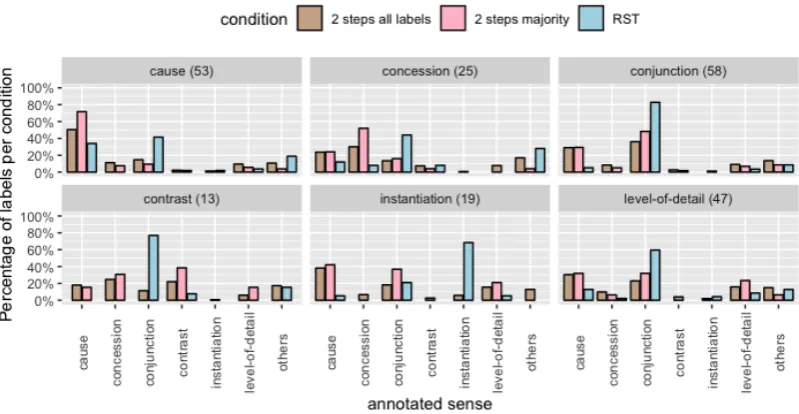
Figure3 shows the distribution of all the crowd-sourced labels as well as the majority labels col-lected for each group of relations as annotated in PDTB. Distribution of the RST-DT labels are also shown for comparison. The relation definitions of PDTB and RST-DT do not directly map with each other. In order to compare the annotations of both resources with the crowdsourced labels, we con-verted the RST labels to PDTB labels according to the Unifying Dimensions interlingua (Demberg et al.,2017).
The results showed that the distributions of the crowd-sourced labels overlapped with both PDTB and RST-DT annotations, except for INSTANTIA
-TIONS(see discussion). The annotations of PDTB and RST-DT largely differ for this more represen-tative selection.
Table 3 shows the agreement of the crowd-sourced labels with PDTB, compared with the agreement between the PDTB and RST-DT labels. It can be seen that the labels crowdsourced by the proposed method had higher overall agreement with PDTB comparing with RST-DT labels.
This experiment showed that expert annotation
[image:8.595.99.499.69.276.2]2 steps RST-DT PDTB3 Prec. Recall Prec. Recall cause .44 .71 .58 .34 concession .48 .52 .67 .06 conjunction .47 .47 .39 .83 contrast .63 .38 .33 .08 instantiation .0 .0 .56 .47 level-of-detail .46 .23 .44 .09 overall .44 .44 .40 .40
Table 3: Agreement of the majority crowd-sourced and RST-DT labels with the PDTB3 labels and the label distribution of the random set.
of discourse relations cannot be represented by a single label and the annotation crowdsourced by the two-step method captured the characteristics of both resources.
6 Discussion
[image:8.595.311.523.357.484.2]al-lowed. This is stronger evidence that the limited labels collected by traditional annotations might not be sufficient to reflect the multiple reading of discourse relations, while a distribution of labels collected by multiple annotation is more informa-tive.
However, we also identified potential problems: our na¨ıve workers seem to have under-labelled
INSTANTIATION relations, especially in Experi-ment 2. On top of the fact thatINSTANTIATIONS
are difficult in general, a closer look shows that these items mostly contain quotations, and it is difficult to distinguish whether the relation is be-tween the previous argument and the content of the quote, or the fact that someone said something. This could be the source of confusion for the crowd workers, which deserves to be addressed more specifically in future research.
Another challenge is the causal preference bias (Sanders, 2005). Although we expected that over-interpretation would be reduced in the free
insertion approach compared with forced selec-tion from an available list, we observed an over-interpretation of CAUSE relations. CAUSE rela-tions may be over-labelled because readers readily infer causality during text processing: Scholman
(2019) shows that readers infer causal relations readily when not processing the text very deeply. Since the materials we used came from outdated news journal texts from the US, they were likely to be hard to understand for the workers who mostly come from the UK, and the causality bias could hence be particularly prominent in our study. A future study on a different text type would be in-formative in this respect.
In terms of methodology, we also plan to ex-tend the method to make better use of the con-nectives provided during the free insertion step. For example, if a worker types and in the first step and chooses so in the second step, the cur-rent algorithm would simply combine the two in-sertions to a CAUSE relation by taking the inter-section of senses. However, there is a chance that the forced choice was prompted by the given op-tions, and that the inference of the relation was thus strengthened by the task. A more dynamic approach should take into account the pragmatic choice ofand over other alternatives, in order to determine whether the worker inferred a causal re-lation in the first place.
Lastly, the current method assumes that all
dis-course relations can be made explicit – in our ex-periments, we only used items where a connec-tive phrase originally existed or can possibly be in-serted. However, it is not always possible to insert a connective. For example, there are no explicit markers for ENTITY RELATIONS. Furthermore, there is also the possibility that the two consec-utive segments areunrelated. The current method has to be extended to identify these cases for prac-tical annotations.
7 Conclusion
We propose a two-step procedure to convert the challenging task of fine-grained implicit discourse relation annotation to an intuitive task that na¨ıve crowd workers can manage. The method can be directly applied to annotate coherence relations in other languages, and crowdsourcing is a time effi-cient alternative. On top of the discourse annota-tion, the methodology also allows creation of large connective banks in other languages.
The results from the current studies also in-dicate that the discourse relation annotations are more representative when they can be character-ized by sense distributions. Automatic discourse relation classification is a bottleneck task, and re-sources annotated with sense distributions allow more informative evaluation by ranking.
We plan to carry out large scale annotation us-ing the two-step approach to build discourse anno-tated resources in a variety of data.
Acknowledgments
This research was funded by the German Research Foundation (DFG) as part of SFB 1102 Informa-tion Density and Linguistic Encoding
References
Lynn Carlson, Daniel Marcu, and Mary Ellen Okurowski. 2003. Building a discourse-tagged cor-pus in the framework of Rhetorical Structure The-ory. InCurrent and new directions in discourse and dialogue, pages 85–112. Springer.
Alexander Philip Dawid and Allan M Skene. 1979. Maximum likelihood estimation of observer error-rates using the em algorithm. Journal of the Royal Statistical Society: Series C (Applied Statistics), 28(1):20–28.
RST-DT and PRST-DTB annotations. arXiv preprint arXiv:1704.08893.
Daisuke Kawahara, Yuichiro Machida, Tomohide Shi-bata, Sadao Kurohashi, Hayato Kobayashi, and Manabu Sassano. 2014. Rapid development of a corpus with discourse annotations using two-stage crowdsourcing. In Proceedings of the 25th Inter-national Conference on Computational Linguistics, pages 269–278.
Yudai Kishimoto, Shinnosuke Sawada, Yugo Mu-rawaki, Daisuke Kawahara, and Sadao Kurohashi. 2018. Improving crowdsourcing-based annotation of japanese discourse relations. InProceedings of the 11th Language Resources and Evaluation Con-ference.
Alastair Knott. 1996. A Data-Driven Methodology for Motivating a Set of Coherence Relations. Ph.D. the-sis, University of Edinburgh.
William C Mann and Sandra A Thompson. 1988. Rhetorical structure theory: Toward a functional the-ory of text organization. Text-Interdisciplinary Jour-nal for the Study of Discourse, 8(3):243–281.
Rebecca J Passonneau and Bob Carpenter. 2014. The benefits of a model of annotation. Transactions of the Association for Computational Linguistics, 2:311–326.
Rashmi Prasad, Nikhil Dinesh, Alan Lee, Eleni Milt-sakaki, Livio Robaldo, Aravind K Joshi, and Bon-nie L Webber. 2008. The Penn Discourse Treebank 2.0. InProceedings of the 6th Language Resources and Evaluation Conference.
Rashmi Prasad, Bonnie Webber, and Alan Lee. 2018. Discourse annotation in the PDTB: The next gen-eration. In Proceedings of the 14th Joint ACL-ISO Workshop on Interoperable Semantic Annota-tion, pages 87–97.
Florian Pusse, Asad Sayeed, and Vera Demberg. 2016. Lingoturk: managing crowdsourced tasks for psy-cholinguistics. InProceedings of the Conference of the North American Chapter of the Association for Computational Linguistics: Demonstrations, pages 57–61.
Hannah Rohde, Anna Dickinson, Nathan Schneider, Christopher NL Clark, Annie Louis, and Bonnie Webber. 2016. Filling in the blanks in understand-ing discourse adverbials: Consistency, conflict, and context-dependence in a crowdsourced elicitation task. In Proceedings of the 10th Linguistic Anno-tation Workshop, pages 49–58.
Ted Sanders. 2005. Coherence, causality and cogni-tive complexity in discourse. InProceedings of the First International Symposium on the exploration and modelling of meaning, pages 105–114. Univer-sity of Toulouse-le-Mirail Toulouse.
Merel C.J. Scholman. 2019. Coherence relations in discourse and cognition: comparing approaches, annotations and interpretations. Ph.D. thesis, Uni-versity of Saarland.
Merel C.J. Scholman and Vera Demberg. 2017a. Crowdsourcing discourse interpretations: On the in-fluence of context and the reliability of a connective insertion task. InProceedings of the 11th Linguistic Annotation Workshop, pages 24–33.
Merel C.J. Scholman and Vera Demberg. 2017b. Ex-amples and specifications that prove a point: Identi-fying elaborative and argumentative discourse rela-tions.Dialogue & Discourse, 8(2):56–83.
A Appendix: Algorithm for the
combination of inserted connectives
foreach insertion pairdo
iffree insertion∈connective bankthen
R1←sense(s) of free insertion
else
manual check
iffree insertion is connectivethen
added to connective bank manual sense annotation
R1←sense(s) of free insertion
else
R1← ∅
end if end if
ifforced insertion =none of thesethen
R2← ∅
else
R2←sense(s) of forced insertion
end if
S←R1∩R2