ccg2lambda: A Compositional Semantics System
Pascual Mart´ınez-G´omez4
[email protected] Koji Mineshima
1
Yusuke Miyao2
[email protected] Daisuke Bekki
1,2
1Ochanomizu University
Tokyo, Japan
2NII
Tokyo, Japan
4AIRC, AIST
Tokyo, Japan
Abstract
We demonstrate a simple and easy-to-use system to produce logical semantic rep-resentations of sentences. Our software operates by composing semantic formu-las bottom-up given a CCG parse tree. It uses flexible semantic templates to spec-ify semantic patterns. Templates for En-glish and Japanese accompany our soft-ware, and they are easy to understand, use and extend to cover other linguistic phe-nomena or languages. We also provide scripts to use our semantic representations in a textual entailment task, and a visu-alization tool to display semantically aug-mented CCG trees in HTML.
1 Introduction
We are motivated by NLP problems that bene-fit from any degree of computer language un-derstanding or semantic parsing. Two prominent examples are Textual Entailment and Question-Answering, where the most successful ap-proaches (Abzianidze, 2015; Berant et al., 2013) require symbolic representations of the semantics of sentences. We are inspired by the theoreti-cal developments in the formal semantics litera-ture, where higher-order logical (HOL) formulas are used to derive meaning representations (MR); despite what is typically believed in the NLP com-munity, Mineshima et al. (2015) demonstrated that HOL can be used effectively at a reasonable speed. In this paper, we describe ccg2lambda, our system to obtain MRs given derivations (trees) of a Combinatory Categorial Grammar (CCG) (Steed-man, 2000). In order to obtain the MRs, our sys-tem is guided by the combinatory characteristics of CCG derivations and a list of manually de-signed semantic templates. The linguistic
intu-itions behind the design of those semantic tem-plates and the evaluation of the MRs that they pro-duce is detailed in Mineshima et al. (2015), and is not repeated here. In that paper, we tackled a Textual Entailment task, where the meanings of premises and conclusions were represented sym-bolically, and their entailment relation was judged with a theorem prover of higher-order logics. With this system, we obtained a state-of-the-art perfor-mance on the FraCaS dataset (Cooper et al., 1994). ccg2lambdaand the accompanying semantic templates are open source1. Semantic templates
are already available for English and Japanese, and they are easily extensible to other linguistic phenomena and other languages for which CCG parsers are available. Here we describe how to use ccg2lambdaand how to specify semantic tem-plates for other researchers to extend our work.
2 Related Work
The most similar system to ours is Boxer (Bos et al., 2004), which outputs first order formulas given CCG trees. Our system can additionally produce higher-order formulas, which are more expressive and potentially accurate (Mineshima et al., 2015). There are three prominent textbook systems for computational semantics, that of Bird et al. (2009), Blackburn and Bos (2005) and van Ei-jck and Unger (2010). These three systems, to-gether with the Lambda Calculator2(Champollion
et al., 2007) are excellent educational resources that are very accessible to beginner linguists in general, and semanticists in particular. The devel-opment ofccg2lambdais inspired by these sys-tems, in that we aimed to produce a software that is easy to understand, use and extend with only basic knowledge of formal semantics and lambda
calcu-1https://github.com/mynlp/ccg2lambda 2http://lambdacalculator.com/
lus. However, these systems are mainly developed for educational purposes and are not connected to fully fledged parsers, hence not immediately us-able as a component of larger NLP systems.
We have developed ccg2lambda to process trees that are produced by wide-coverage CCG parsers (e.g. C&C and Jigg3). Other
seman-tic parsers such as those developed by Bos et al. (2004), Abzianidze (2015) and Lewis and Steed-man (2013) also connect to wide-coverage CCG parsers, but they do not emphasize easy accessi-bility or extensiaccessi-bility. NL2KR (Vo et al., 2015) is an interactive system with powerful generalization capabilities, but it does not allow fine-grained lexi-con specifications (only CCG categories) and does not output machine readable semantics. Instead, ccg2lambda produces XML machine-readable MRs, which make our system easy to integrate in larger logic or statistical NLP systems.
3 System Overview
Although our main system contribution is a se-mantic parser, we use the problem of textual en-tailment as an end-to-end task. Figure 1 schemati-cally shows the several components of our system. The first stage is to parse sentences into CCG trees (see Figure 2 for an example). Our system currently supports the C&C parser (Clark and Cur-ran, 2004) for English, and Jigg (Noji and Miyao, 2016) for Japanese.
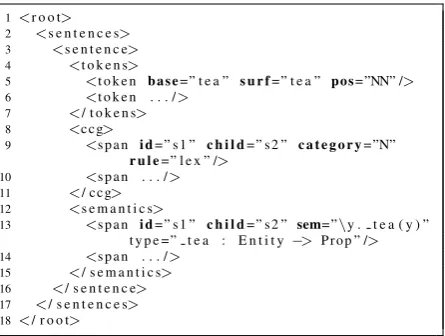
The second stage is the semantic composition, where MRs are constructed compositionally over CCG trees using lambda calculus, thus allowing higher-order logics if necessary. To this end, our system is guided by the compositional rules of the CCG tree and the semantic templates provided by the user. In Section 4 we describe in detail how these semantic templates are specified and how they control the semantic outputs. The output of this stage is a Stanford CoreNLP-style XML file (Manning et al., 2014) where each sentence has three XML nodes: <tokens>, <ccg> and <semantics>. Thus, sentence semantics can simply be read off the root node of the CCG tree.
In the case of recognizing textual entailment, the third stage is thetheorem construction, defini-tion of predicate types, and execudefini-tion with a logic prover. This stage is not essential to our system, but it is added to this paper to show the usefulness of our semantic representations in an NLP task.
3https://github.com/mynlp/jigg
4 Semantic Composition
ccg2lambda receives CCG trees and outputs (possibly higher-order) logic formulas. To that end, we use i) the combinatory characteristics of CCG trees to guide the semantic compositions, and ii) a list of semantic templates to assign a pre-cise meaning to CCG constituents.
See Figure 2 for an example of CCG deriva-tion for the sentence “Some woman ordered tea”, augmented with its semantics. Nodes have CCG syntactic categories (e.g. N orS\NP), which is what our system receives as input. On the same figure, we have added the logical semantic repre-sentations (e.g. λx.woman(x)) below the syntac-tic categories. Our system outputs these logical formulas. For clarity, leaves also display the to-ken base forms. The symbols<, >and lex stand for left and right function application rules, and the type-shift rule in C&C, respectively. These rules and the syntactic categories guide the seman-tic composition, provided with semanseman-tic templates that describe the specific semantics.
4.1 Semantic templates
Semantic templates are defined declaratively in a YAML4 file, typically by a formal semanticist
after an appropriate linguistic analysis. A tem-plate applies to a node of the CCG derivation tree if certain conditions are met. Each template has two required attributes:semanticsand (syn-tactic) category. The attribute semantics is a lambda term in NLTK semantics format (Garrette and Klein, 2009). In case a template applies on a CCG leaf (that is, a word), the lambda term in the template is applied on the base form of the word, and β-reduction is performed. For example, the semantic template
−semantics:\E.\x.E(x) category:N
applying on a leaf whose base word is “woman” and its syntactic category is N, would produce the expression (λE.λx.E(x))(woman) which is
β-reduced toλx.woman(x). Here, the base form “woman” substitutes all occurrences of the vari-ableEin thesemanticsexpression.
In case a template applies on a CCG inner node (a node with children), the lambda abstraction is applied on the semantics of the children, in order.
Figure 1: System pipeline for recognizing textual entailment. Syntactic structures of sentences are ob-tained with a CCG parser. Then, we perform the semantic composition using semantic templates. The resulting meaning representations are used to perform various logical inferences with a theorem prover.
Some
NP/N λF λG.∃x.(F x∧Gx)
woman
N λx.woman(x)
NP
λG.∃x(woman(x)∧G(x))
>
ordered (S\NP)/NP
λQ1λQ2.Q2(λx.Q1(λy.order(x, y)))
tea
N λy.tea(y)
NP
λF.∃y.(tea(y)∧F(y)) lex
S\NP
λQ2.Q2(λx.∃y.(tea(y)∧order(x, y)))
>
S
∃x.(woman(x)∧ ∃y.(tea(y)∧order(x, y)))
<
Figure 2: CCG derivation tree of the sentence “Some woman ordered tea”, with its semantics (simplified for illustrative purposes). The actual output ofccg2lambdawith our provided templates is in Figure 6.
For example, in Figure 2, the template −semantics:\E.\F.∃y.(E(y)∧F(y))
category: NP
rule: lex
produces a type-raise from N to NP, and when applied to the CCG node whose child’s semantics are λy.tea(y), it will produce, after β-reduction, the formula λF.∃y.(tea(y) ∧ F(y)). Here, the child’s semantics λy.tea(y) substitute all occur-rences of the variableE. The newly composed se-mantic representationλF.∃y.(tea(y)∧F(y))now expects another predicate (a verb) as an argument
F (i.e. “order”), which will be filled in the next step of the composition.
Thecategoryattribute of a semantic template may also specify conditions on the feature struc-tures of CCG nodes (which are provided by the CCG parser), in which case templates apply if the syntactic categorymatches and the feature struc-turesubsumesthat of the CCG node. For example, if the semantic template specifies a syntactic cat-egoryNP[dcl = true], it matches a CCG node with a category NP[dcl = true]or a category
NP[dcl=true,adj=true].
Other conditions for matching templates to CCG nodes can be specified by adding more at-tributes to the semantic template. In the exam-ple above, the attribute rule : lex is used to specify the combination rule of that inner CCG node. In practice, any XML attribute of a CCG
node can be used to specify matching conditions, which means that users ofccg2lambdacan en-rich CCG trees with arbitrary annotations such as Named Entities or Events and use them as match-ing conditions when definmatch-ing semantic templates without modifying the software. It is also possible to specify attributes of the children of the target CCG node. These conditions are always prefixed by the string child, followed by the branch in-dex0or1. For example, a semantic template with the attributechild1 child0 pos : NN matches a node whose right child’s (child1) left child’s (child0) POS tag is anNN. Moreover, paths to child nodes can be left unspecified, by using the keywordchild any X: Y; in this case,anychild whose attributeXhas valueYwill be matched by the template. If more than one template matches a CCG node, the first appearing template is selected.
4.2 System Usage and Output
The command for the semantic composition is:
# python semparse.py ccgtrees.xml templates.yaml semantics.xml
[image:3.595.73.525.208.290.2]1 <r o o t>
2 <s e n t e n c e s>
3 <s e n t e n c e>
4 <t o k e n s>
5 <t ok e n base=” t e a ” s u r f=” t e a ” pos=”NN” />
6 <t ok e n . . . />
7 </ t o k e n s>
8 <ccg>
9 <span id=” s1 ” c h i l d=” s2 ” category=”N”
r u l e=” l e x ” />
10 <span . . . />
11 </ ccg>
12 <s e m a n t i c s>
13 <span id=” s1 ” c h i l d=” s2 ” sem=”\y . t e a ( y ) ” t y p e =” t e a : E n t i t y−> Prop ” />
14 <span . . . />
15 </ s e m a n t i c s>
16 </ s e n t e n c e>
17 </ s e n t e n c e s>
[image:4.595.73.296.62.230.2]18</ r o o t>
Figure 3: XML output of the semantic composi-tion. Span nodes of the semantics tag contain log-ical semantic representations of that constituent.
element characteristics as XML node attributes. For example, the base and surface forms, and the POS tag of a token are all represented as XML attributes in a<token>tag.
Our semantic composition produces the <semantics>tag, which has as many children nodes (<span>) as the CCG tree, the same span identifiers and structure. However, semantic spans also have a “sem” attribute encoding the semantics (using NLTK’s semantics format) that have been composed for that constituent. An example of a resulting semantic logic formula in NLTK semantics format is:
\F.existsy.( tea(y) &F(y))
Note that predicates are prefixed with an under-score to avoid collisions with reserved predicates in NLTK semantics format or in a potential prover. Semantic spans also provide the type of single predicates (attribute “type”). For instance, the type of the predicate teais a function that receives an entity as an argument, and produces a proposition:
tea:Entity→Prop
Types are automatically inferred using NLTK se-mantics functionality. However, it is possible to force arbitrary types in a semantic template by adding the attribute “coq type”. For example, we can specify the type for a transitive verb as:
−semantics:. . .
category: (S\NP)/NP
coq type: Entity→Entity→Prop
We can activate these types with the flag --arbi-typesin the call tosemparse.py.
5 Textual Entailment
The logical formulas thatccg2lambda outputs can be used in a variety of applications. In this demonstration, we use them to recognize textual entailment, an NLP problem that often requires precise language understanding. We assume that the user inputs a file with one sentence per line. All sentences are assumed to be premises, except the last sentence, which is assumed to be the con-clusion. An entailment problem example is:
premise1: All women ordered coffee or tea. premise2: Some woman did not order coffee.
conclusion: Some woman ordered tea.
Contrarily to other textual entailment systems based on logics (Angeli and Manning, 2014; Mac-Cartney and Manning, 2007), we do not assume single-premise problems, which makes our system more general. The MRs of the problem above are:
p1:∀x.(woman(x)→ ∃y.((tea(y)∨coffee(y))∧order(x, y))) p2:∃x.(woman(x)∧ ¬∃y.(coffee(y)∧order(x, y))) c:∃x.(woman(x)∧ ∃y.(tea(y)∧order(x, y)))
We build a theorem by concatenating mean-ing representations of the premises {p1, . . . , pn} and the conclusion c with the implication opera-tor, which is a convenience in theorem proving:
Theorem :p1 →. . .→pn→c. (1)
And then, we define predicate types as: Parameter tea : Entity → Prop.
Parameter order : Entity → Entity → Prop.
Finally, we pipe the theorem and type definitions to Coq (Cast´eran and Bertot, 2004), an interactive higher-order prover that we run fully automated with the use of some tactics (including arithmetics and equational reasoning), as described in Mi-neshima et al. (2015). We return the labelyes (en-tailment) if the conclusion can be logically proved from the premises, no if the negated conclusion can be proved, andunknownotherwise.
The recognition of textual entailment can be performed with the following command:
# python prove.py semantics.xml
Figure 4: Visualization of the semantic output ofccg2lambda for the sentence “All women ordered coffee or tea.” where logical semantic representations appear below their respective CCG nodes.
Figure 5: Visualization of the semantic output ofccg2lambdafor the sentence “Some woman did not order coffee.” where logical semantic representations appear below their respective CCG nodes.
Figure 6: Visualization of the semantic output ofccg2lambdafor the sentence “Some woman ordered tea.” where logical semantic representations appear below their respective CCG nodes.
6 Visualization
For visualization purposes, we provide a separate script that can be called as:
# python visualize.py semantics.xml > semantics.html
which produces a file semantics.html with an HTML graphical representation of the CCG tree, augmented at every node with the seman-tics composed up to that node (see Figures 4, 5 and 6 for an excerpt). These semantic representa-tions are obtained with the semantic templates that accompany our software and that were developed and evaluated in Mineshima et al. (2015). The trivial propositions “TrueP” have no effect and ap-pear in the formulas in place of potential modifiers (such as adjectives or adverbs) of more complex sentences. The visualization can be configured to display the root on top, change colors and sizes of the syntactic categories, feature structures, logical formulas and base forms at the leaves.
7 Future Work and Conclusion
As an extension to ccg2lambda, it would be valuable to produce (possibly scored) N-best lists of logical formulas, instead of the current single 1-best. Moreover, our current semantic templates do not cover all syntactic categories that C&C or Jigg produce, and we need a good default combi-nation mechanism. Other minor enhancements are to produce logical formulas for each CCG deriva-tion in an N-best list, and to allow features other than the base form to become predicates.
[image:5.595.75.528.351.420.2]entailment. We believe that these easy-to-produce MRs can be useful to NLP tasks that require pre-cise language understanding or that benefit from using MRs as features in their statistical systems. Acknowledgments
This work was supported by CREST, JST.
References
Lasha Abzianidze. 2015. A tableau prover for natu-ral logic and language. InProceedings of the 2015 Conference on Empirical Methods in Natural Lan-guage Processing, pages 2492–2502, Lisbon, Portu-gal, September. Association for Computational Lin-guistics.
Gabor Angeli and Christopher D. Manning. 2014. NaturalLI: Natural logic inference for common sense reasoning. InProceedings of the 2014 Con-ference on Empirical Methods in Natural Language Processing (EMNLP), pages 534–545, Doha, Qatar, October. Association for Computational Linguistics. Jonathan Berant, Andrew Chou, Roy Frostig, and Percy Liang. 2013. Semantic parsing on Freebase from question-answer pairs. In Proceedings of the 2013 Conference on Empirical Methods in Natural Lan-guage Processing, pages 1533–1544, Seattle, Wash-ington, USA, October. Association for Computa-tional Linguistics.
Steven Bird, Ewan Klein, and Edward Loper. 2009. Natural Language Processing with Python. O’Reilly Media, Inc.
Patrick Blackburn and Johan Bos. 2005. Represen-tation and Inference for Natural Language: A First Course in Computational Semantics. CSLI. Johan Bos, Stephen Clark, Mark Steedman, James R
Curran, and Julia Hockenmaier. 2004. Wide-coverage semantic representations from a CCG parser. InProceedings of the 20th international con-ference on Computational Linguistics, pages 1240– 1246. Association for Computational Linguistics. Pierre Cast´eran and Yves Bertot. 2004.
Interac-tive Theorem Proving and Program Development. Coq’Art: The Calculus of Inductive Constructions.
Springer Verlag.
Lucas Champollion, Joshua Tauberer, and Maribel Romero. 2007. The Penn Lambda Calculator: Ped-agogical software for natural language semantics. In Tracy Holloway King, editor,Proceedings of the Grammar Engineering Across Frameworks (GEAF0 7) Workshop, pages 106–127, Stanford. CSLI Publi-cations.
Stephen Clark and James R Curran. 2004. Parsing the WSJ using CCG and log-linear models. In Proceed-ings of the 42nd Annual Meeting on Association for
Computational Linguistics, pages 104–111. Associ-ation for ComputAssoci-ational Linguistics.
Robin Cooper, Richard Crouch, Jan van Eijck, Chris Fox, Josef van Genabith, Jan Jaspers, Hans Kamp, Manfred Pinkal, Massimo Poesio, Stephen Pulman, et al. 1994. FraCaS–a framework for computational semantics.deliverable, D6.
Dan Garrette and Ewan Klein. 2009. An extensible toolkit for computational semantics. In Proceed-ings of the Eighth International Conference on Com-putational Semantics, IWCS-8 ’09, pages 116–127, Stroudsburg, PA, USA. Association for Computa-tional Linguistics.
Mike Lewis and Mark Steedman. 2013. Combin-ing distributional and logical semantics. Transac-tions of the Association for Computational Linguis-tics, 1:179–192.
Bill MacCartney and Christopher D Manning. 2007. Natural logic for textual inference. InProceedings of the ACL-PASCAL Workshop on Textual Entail-ment and Paraphrasing, pages 193–200. Associa-tion for ComputaAssocia-tional Linguistics.
Christopher Manning, Mihai Surdeanu, John Bauer, Jenny Finkel, Steven Bethard, and David McClosky. 2014. The Stanford CoreNLP natural language pro-cessing toolkit. In Proceedings of 52nd Annual Meeting of the Association for Computational Lin-guistics: System Demonstrations, pages 55–60, Bal-timore, Maryland, June. Association for Computa-tional Linguistics.
Koji Mineshima, Pascual Mart´ınez-G´omez, Yusuke Miyao, and Daisuke Bekki. 2015. Higher-order log-ical inference with compositional semantics. In Pro-ceedings of the 2015 Conference on Empirical Meth-ods in Natural Language Processing, pages 2055– 2061, Lisbon, Portugal, September. Association for Computational Linguistics.
Hiroshi Noji and Yusuke Miyao. 2016. Jigg: A framework for an easy natural language process-ing pipeline. InProceedings of ACL 2016 System Demonstrations, Berlin, Germany, August. Associa-tion for ComputaAssocia-tional Linguistics.
Mark Steedman. 2000. The Syntactic Process. MIT Press.
Jan van Eijck and Christina Unger. 2010. Compu-tational Semantics with Functional Programming. Cambridge University Press.