Single-Model Encoder-Decoder with Explicit Morphological
Representation for Reinflection
Katharina Kann and Hinrich Sch¨utze Center for Information & Language Processing
LMU Munich, Germany
Abstract
Morphological reinflection is the task of generating a target form given a source form, a source tag and a target tag. We propose a new way of modeling this task with neural encoder-decoder models. Our approach reduces the amount of re-quired training data for this architecture and achieves state-of-the-art results, mak-ing encoder-decoder models applicable to morphological reinflection even for low-resource languages. We further present a new automatic correction method for the outputs based on edit trees.
1 Introduction
Morphological analysis and generation of previ-ously unseen word forms is a fundamental prob-lem in many areas of natural language process-ing (NLP). Its accuracy is crucial for the success of downstream tasks like machine translation and question answering. Accordingly, learning mor-phological inflection patterns from labeled data is an important challenge.
The task of morphological reinflection (MRI) consists of producing an inflected form for a given source form, source tag and target tag. A spe-cial case is morphological inflection (MI), the task of finding an inflected form for a given lemma and target tag. An English example is “tree”+PLURAL→“trees”. Prior work on MI and MRI includes machine learning models and mod-els that exploit the paradigm structure of the lan-guage (Ahlberg et al., 2015; Dreyer, 2011; Nicolai et al., 2015).
In this work, we propose the neural encoder-decoder MED – Morphological Encoder-Decoder – a character-level sequence-to-sequence attention model that is a language-independent solution for
MRI. In contrast to prior work, we train asingle
model that is trained on all source to target map-pings of the language that are attested in the ing set. This radically reduces the amount of train-ing data needed for the encoder-decoder because most MRI patterns occur in many source-target tag pairs. In our model design, what is learned for one pair can be transferred to others.
The key enabler for this single-model approach is a novel representation we use for MRI. We en-code the input as a single sequence of (i) the phological tags of the source form, (ii) the mor-phological tags of the target form and (iii) the se-quence of letters of the source form. The output is the sequence of letters of the target form. As the decoder produces each letter, the attention mech-anism can focus on the input letter sequencefor parts of the output that simply copy the input. For other parts of the output, e.g., an inflectional end-ing that is predicted usend-ing the target tags, the at-tention mechanism can focus on the target mor-phological tags. In more complex cases, simulta-neous attention can be paid to subsequences of all three input types– source tags, target tags and in-put letter sequence. We can train a single generic encoder-decoder per language on this represen-tation that can handle all tag pairs, thus making it possible to make efficient use of the available training data. MED outperformed other systems on the SIGMORPHON16 shared task1 for all ten languages that were covered (Kann and Sch¨utze, 2016; Cotterell et al., 2016).
We also present POET – Prefer Observed Edit Trees – a new generic method for correcting the output of an MRI system. The combination of MED and POET is state-of-the-art or close to it on a CELEX-based evaluation of MRI even though this evaluation makes it difficult to exploit
gener-1ryancotterell.github.io/
sigmorphon2016/
alizations across tag pairs. 2 Model Description
Neural network model. Our model is based on
the network architecture proposed by Bahdanau et al. (2014) for machine translation.2 They de-scribe the model in detail; unless we explicitly say so in the description of our model below, we use the same network configuration as Bahdanau et al. (2014).
Bahdanau et al. (2014)’s model is an extension of the recurrent neural network (RNN) encoder-decoder developed by Cho et al. (2014) and Sutskever et al. (2014). The encoder of the latter consists of an RNN that reads an input sequence of vectorsxand encodes it into a fixed-length context vectorc, computing hidden stateshtandcby
ht=f(xt, ht−1), c=q(h1, ..., hTx) (1)
with nonlinear functionsf andq. The decoder is trained to predict each output yt dependent onc
and previous predictionsy1, ...,yt−1:
p(y) = Ty
Y
t=1
p(yt|{y1, ..., yt−1}, c) (2)
withy = (y1, ..., yTy)and each conditional
prob-ability being modeled with an RNN as
p(yt|{y1, ..., yt−1}, c) =g(yt−1, st, c) (3)
wheregis a nonlinear function andstis the hidden
state of the RNN.
Bahdanau et al. (2014) proposed an attention-based extension of this model that allows different vectors ct for each step by automatic learning of
an alignment model. Additionally, they made the encoder bidirectional: each hidden statehjat time
stepjdoes not only depend on the preceding, but also on the following input:
hj =
−→
hT j;
←−
hT j
T
(4)
The formula forp(y)changes as follows:
p(y) = Ty
Y
t=1
p(yt|{y1, ..., yt−1}, x) (5)
= Ty
Y
t=1
g(yt−1, st, ct) (6)
2Our implementation of MED is based on
github.com/mila-udem/blocks-examples/
tree/master/machine_translation.
with st being an RNN hidden state for time t
and ct being the weighted sum of the
annota-tions(h1, ..., hTx)produced by the encoder, using
the attention weights. Further descriptions can be found in (Bahdanau et al., 2014).
The final model is a multilayer network with a single maxout (Goodfellow et al., 2013) hidden layer that computes the conditional probability of each element in the output sequence (a letter in our case, (Pascanu et al., 2014)). As MRI is less complex than machine translation, we reduce the number of hidden units and embedding size. Af-ter initial experiments, we fixed the hyperparame-ters of our system and did not further adapt them to a specific task or language. Encoder and de-coder RNNs have 100 hidden units each. For train-ing, we use stochastic gradient descent, Adadelta (Zeiler, 2012) and a minibatch size of 20. We ini-tialize all weights in the encoder, decoder and the embeddings except for the GRU weights in the de-coder with the identity matrix as well as all biases with zero (Le et al., 2015). We train all models for 20,000 iterations. We settled on this number in early experimentation because training usually converged before that limit.
MED is an ensemble of five RNN encoder-decoders. The final decision is made by majority voting. In case of a tie, the answer is chosen ran-domly among the most frequent predictions.
Input and output format. We define the
al-phabet Σlang as the set of characters used in the
application language. As each morphological tag consists of one or more subtags, e.g. “number“ or “case“, we further define Σsrc andΣtrg as the set
of morphological subtags seen during training as part of the source tag and target tag, respectively. LetSstartandSendbe predefined start and end
sym-bols. Then each input of our system is of the for-matSstartΣsrc+Σtrg+Σlang+Send. In the same way,
we define the output format asSstartΣlang+Send.
A sample input for German is
<w> IN=pos=ADJ IN=case=GEN IN=num=PL OUT=pos=ADJ OUT=case=ACC OUT=num=PL i s o l i e r t e r </w>. The system should produce the corresponding output
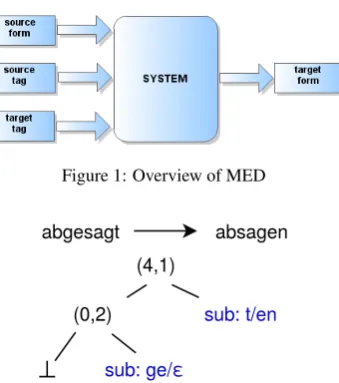
<w> i s o l i e r t e </w>. The high-level structure of MED can be seen in Figure 1.
POET. We now describe POET (Prefer
Figure 1: Overview of MED
Figure 2: Edit tree for the inflected formabgesagt“canceled” and its lemmaabsagen“to cancel”. The highest node con-tains the length of the parts before and after the LCS. The left node in the second row contains the length of the parts before and after the LCS ofabgeandab. The prefixsubindicates that the node is a substitution operation.
principle be applied to any MRI system.
An edit tree e(σ, τ) specifies a transforma-tion from a source string σ to a target string τ
(Chrupała, 2008). To compute e(σ, τ), we first determine the longest common substring (LCS) (Gusfield, 1997) betweenσ andτ and then recur-sively model the prefix and suffix pairs of the LCS. If the length of LCS is zero for(σ, τ), thene(σ, τ)
is simply the substitution operation that replacesσ
withτ. Figure 2 shows an example.
LetX be a training set for MRI. For each pair
(s, t)of tags, we define:
Es,t={e0|∃x∈X:e0=e(x), s=S(x), t=T(x)}
where S(x) andT(x) are source and target tags ofx and e(x) is e(σ(x), τ(x)), the edit tree that transforms the source form into the target form.
Let ρ be a target form predicted by the MRI system for the source form σ and let sand t be source and target tags. POET does not changeρif
e(σ, ρ)∈Es,t. Otherwise it replacesρwithτ:
τ :=
τ0 if e(σ, τ0)∈Es,t,|ρ, τ0|= 1
ρ else
where|ρ, τ0|is the Levenshtein distance. If there are several formsτ0with edit distance 1, we select the one with the most frequent edit tree. Ties are broken randomly.
We observed that MED sometimes makes er-rors that are close to the target, but differ by one
edit operation. Those errors are often not covered by edit trees that are observed in the training data whereas the correct form is. Thus, substituting a form not supported by an observed edit tree with a close one that is supported promises to reduce the error rate.
The effectiveness of POET depends on a train-ing set that is large enough to cover the possible edit trees that can occur in reinflection in a lan-guage. Thus, if the training set is not large enough in this respect, then POET will not be beneficial.
3 Experiments
We compare MED with the three models of Dreyer et al. (2008) as well as with two recently pro-posed models: (i) discriminative string transduc-tion (Durrett and DeNero, 2013; Nicolai et al., 2015), the SIGMORPHON16 baseline, and (ii) Faruqui et al. (2015)’s encoder-decoder model.3 We call the latter MODEL*TAG as it requires training as many models as there are target tags.
We evaluate MED on two MRI tasks: CELEX and SIGMORPHON16.
CELEX.This task is based on complete
inflec-tion tables for German extracted from CELEX. For this experiment we follow Dreyer et al. (2008). We use four pairs of morphological tags and corre-sponding word forms from the German part of the CELEX morphological database. The 4 different transduction tasks are: 13SIA→13SKE, 2PIE→ 13PKE, 2PKE → z and rP → pA.4 An example for this task would be to produce the output ges-teuert(target tagpA) for the sourcesteuert(source tagrP). To do so, the system has to learn that the prefix ge-, which is used for many participles in German, has to be added to the beginning of the original word form.
We use the same data splits as Dreyer et al. (2008), dividing the original 2500 samples for each tag into five folds, each consisting of 500
training and1000development and1000test sam-ples. We train a separate model for each fold and report exact match accuracy, averaged over the five folds, as our final result.
3For our experiments we ran the code available at
github.com/mfaruqui/morph-trans. We used the
enc-dec-attn model as overall results for the CELEX task were better than with thesep-morphmodel.
413SIA=1st/3rd sg. ind. past; 13SKE=1st/3rd sg.
model 13SIA 2PIE 2PKE rP
Dre
yer backofflat-class 82.8 88.7 74.7 69.984.8 93.6 75.7 81.8
lat-region 87.5 93.4 87.4 84.9
[image:4.595.72.292.63.190.2]baseline 77.6 95.1 82.5 69.6 MODEL*TAG 76.4 92.1 83.4 81.8 MED 82.3 94.4 86.8 83.9 MED+POET 83.9 95.0 87.6 84.0
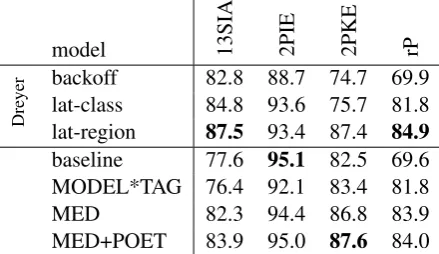
Table 1: Exact match accuracy of MRI on CELEX. Re-sults of (Dreyer et al., 2008)’s model are from their pa-per; backoff: ngrams+xmodel; lat-class: ngrams+x+latent classmodel; lat-region: ngrams+x+latent class+latent re-gionmodel; baseline: SIGMORPHON16 baseline.
SIGMORPHON16.This task covers eight
lan-guages and does not provide complete paradigms, but only a set of quadruples, each consisting of word form, source tag, target tag and target form. The main difference to CELEX is that the number of tag pairs is large, resulting in much less training data per tag pair. The number of tag pairs varies by language with Georgian being an extreme case; it has 28 tag pairs in dev that appear less than 10 times in train. For each language, we have around 12,800 training and 1600 development samples. We report exact match accuracy on the develop-ment set, as the final test data of the shared task is not publically available yet.
4 Results
Table 1 gives CELEX results. MED+POET is bet-ter than prior work on one task, close in perfor-mance on two and worse by a small amount on the third. Unlike Dreyer et al. (2008)’s models, MED does not use any hand-crafted features. MED’s re-sults are weakest on 13SIA. Typical errors on this task include epenthesis (e.g.,zirklevs.zirkele) and irregular verbs (e.g.,abhingvs.abh¨angte).
For SIGMORPHON16, Table 2 shows that MED outperforms the baseline for all eight lan-guages. Absolute performance and variance is probably influenced by type of morphology (e.g., templatic vs. agglutinative), regularity of the lan-guage, number of different tag pairs and other fac-tors. MED performs well even for complex and diverse languages like Arabic, Finnish, Navajo and Turkish, suggesting that the type of attention-based encoder-decoder we use – single-model, us-ing an explicit morphological representation – is a good choice for MRI.
MED
baseline average ensemble Arabic 58.8 83.1 (0.4) 88.8
Finnish 64.6 92.5 (0.8) 95.6
Georgian 91.5 95.7 (0.3) 97.3
German 87.7 92.1 (0.5) 95.1
Navajo 60.9 85.0 (1.1) 91.1
Russian 85.6 84.2 (0.3) 88.4
Spanish 95.6 96.3 (0.3) 97.5
Turkish 54.9 94.7 (1.3) 97.6
Table 2: Exact match accuracy of MRI on SIG-MORPHON16; baseline: SIGMORPHON16 baseline; MED/average: average of five MED models (standard devia-tion in parentheses); MED/ensemble: majority voting of five MED models.
We do not compare to MODEL*TAG here be-cause it requires training a large number of indi-vidual networks. This is a disadvantage compared to MED both in terms of the number of models that need to be trained and in terms of the effec-tive use of the small number of training examples that are available per tag pair.
POETimproves the results for all tag pairs for CELEX. However, initial experiments indicated that it is not effective for SIGMORPHON16 be-cause its training sets are not large enough.
5 Analysis
The main innovation of our work is that MED learns a single model of all MRI patterns of a lan-guage and thus can transfer what it has learned from one tag pair to another tag pair. Using CELEX, we now analyze how much our design contributes to better performance by conducting two experiments in which we gradually decrease the training set in two different ways. (i) Large general training set. We only reduce the number of training examples available for a tag pair(s, t)
and retain all other training examples. (ii) Small training set. We reduce the number of training ex-amples available for all tag pairs, not just for one.
A typical example of the large general training set scenario is that familiar second person forms are rare in genres like encyclopedia and news. So a training set derived from these genres will be large, but it will have very few tag pairs whose target tag is familiar second person.
0 0.2 0.4 0.6 0.8 1 0 20 40 60 80 100 A cc u ra cy
[image:5.595.104.254.63.157.2]% of training data MED MODEL*TAG
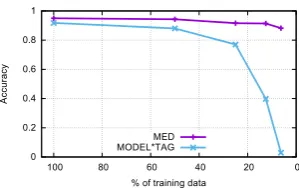
Figure 3: Results for the large general training set experi-ment: effect of reducing the training setfor only 2PIE →
13PKEon the accuracy for 2PIE →13PKE for MED and MODEL*TAG. 0 0.2 0.4 0.6 0.8 1 0 20 40 60 80 100 A cc u ra cy f o r 1 3 S IA
% of training data MED MODEL*TAG 0 0.2 0.4 0.6 0.8 1 0 20 40 60 80 100 A cc u ra cy f o r 2 P IE
% of training data MED MODEL*TAG 0 0.2 0.4 0.6 0.8 1 0 20 40 60 80 100 A cc u ra cy f o r 2 P K E
% of training data MED MODEL*TAG 0 0.2 0.4 0.6 0.8 1 0 20 40 60 80 100 A cc u ra cy f o r rP
% of training data MED MODEL*TAG
Figure 4: Results for the small training set experiment: effect of reducing the training setfor all tag pairson accuracy for MED and MODEL*TAG.
In the following two experiments, we only re-duce the training set and do not change the test set.
Large general training set. We iteratively
halve the training data for 2PIE → 13PKE until only6.25%or32samples are left. Figure 3 shows that MED performs well even if only6.25%of the training examples for the tag pair remain. In con-trast, MODEL*TAG struggles to generalize cor-rectly. This is due to the fact that we train one single model for all tags, so it can learn from other tags and transfer what it has learned to the tag pair that has a small training set.
Small training set. Figure 4 shows results
for reducing the training data equally for all tags. MED performs much better than the baseline for less than 50% of the training data. This can be ex-plained by the fact that MED learns from all given data at once and thus is able to learn common pat-terns that apply across different tag pairs.
6 Related Work
Earlier work on morphology includes morpholog-ical segmentation (Harris, 1955; Hafer and Weiss, 1974; D´ejean, 1998) and different approaches for MRI (Ahlberg et al., 2014; Durrett and DeNero,
2013; Eskander et al., 2013; Nicolai et al., 2015). Chrupała (2008) defined edit trees and Chrupała (2008) and M¨uller et al. (2015) use them for mor-phological tagging and lemmatization.
In the last years, RNN encoder-decoder models and RNNs in general were applied to several NLP tasks. For example, they proved to be useful for machine translation (Cho et al., 2014; Sutskever et al., 2014; Bahdanau et al., 2014), parsing (Vinyals et al., 2015) and speech recognition (Graves and Schmidhuber, 2005; Graves et al., 2013).
MED bears some resemblance to Faruqui et al. (2015)’s work. However, they train one network for every tag pair; this can negatively impact per-formance for low-resource languages and in gen-eral when training data are limited. In contrast, we train a single model for each language. This radi-cally reduces the amount of training data needed for the encoder-decoder because most MRI pat-terns occur in many tag pairs, so what is learned for one can be transferred to others. To be able to model all tag pairs of the language together, we introduce an explicit morphological represen-tation that enables the attention mechanism of the encoder-decoder to generalize MRI patterns across tag pairs.
7 Conclusion and Future Work
We have presented MED, a language independent neural sequence-to-sequence mapping approach, and POET, a method based on edit trees for cor-recting the output of an MRI system. MED ob-tains results comparable to state-of-the-art systems for CELEX and establishes the state-of-the-art for SIGMORPHON16. POET improves results fur-ther for large training sets. Our analysis showed that MED outperforms a neural encoder-decoder baseline system by a large margin, especially for small training sets.
In future work, we would like to make POET less dependent on the source tag and thus increase its accuracy for small training sets. Second, we will look into ways of taking advantage of ad-ditional information sources including unlabeled corpora.
Acknowledgments
[image:5.595.75.284.223.346.2]References
Malin Ahlberg, Markus Forsberg, and Mans Hulden. 2014. Semi-supervised learning of morphological paradigms and lexicons. InProc. of EACL.
Malin Ahlberg, Markus Forsberg, and Mans Hulden. 2015. Paradigm classification in supervised learning of morphology. InProc. of NAACL.
Dzmitry Bahdanau, Kyunghyun Cho, and Yoshua Ben-gio. 2014. Neural machine translation by jointly learning to align and translate. arXiv preprint arXiv:1409.0473.
Kyunghyun Cho, Bart van Merri¨enboer, Dzmitry Bah-danau, and Yoshua Bengio. 2014. On the properties of neural machine translation: Encoder-decoder ap-proaches. arXiv preprint arXiv:1409.1259.
Grzegorz Chrupała. 2008. Towards a machine-learning architecture for lexical functional grammar parsing. Ph.D. thesis, Dublin City University. Ryan Cotterell, Christo Kirov, John Sylak-Glassman,
David Yarowsky, Jason Eisner, and Mans Hulden. 2016. The SIGMORPHON 2016 shared task— morphological reinflection. In Proc. of the 2016 Meeting of SIGMORPHON.
Herv´e D´ejean. 1998. Morphemes as necessary concept for structures discovery from untagged corpora. In
Proc. of the Joint Conferences on New Methods in Language Processing and CoNLL.
Markus Dreyer, Jason R Smith, and Jason Eisner. 2008. Latent-variable modeling of string transduc-tions with finite-state methods. InProc. of EMNLP. Markus Dreyer. 2011. A non-parametric model for the discovery of inflectional paradigms from plain text using graphical models over strings. Ph.D. thesis, Johns Hopkins University, Baltimore, MD.
Greg Durrett and John DeNero. 2013. Supervised learning of complete morphological paradigms. In
Proc. of HLT-NAACL.
Ramy Eskander, Nizar Habash, and Owen Rambow. 2013. Automatic extraction of morphological lex-icons from morphologically annotated corpora. In
Proc. of EMNLP.
Manaal Faruqui, Yulia Tsvetkov, Graham Neubig, and Chris Dyer. 2015. Morphological inflection genera-tion using character sequence to sequence learning.
arXiv preprint arXiv:1512.06110.
Ian Goodfellow, David Warde-farley, Mehdi Mirza, Aaron Courville, and Yoshua Bengio. 2013. Max-out networks. InProc. of ICML.
Alex Graves and J¨urgen Schmidhuber. 2005. Frame-wise phoneme classification with bidirectional lstm and other neural network architectures. Neural Net-works, 18(5):602–610.
Alan Graves, Abdel-rahman Mohamed, and Geoffrey Hinton. 2013. Speech recognition with deep recur-rent neural networks. InProc of. ICASSP.
Dan Gusfield. 1997. Algorithms on strings, trees and sequences: computer science and computational bi-ology. Cambridge university press.
Margaret A Hafer and Stephen F Weiss. 1974. Word segmentation by letter successor varieties. Informa-tion storage and retrieval, 10(11):371–385.
Zellig S Harris. 1955. From phoneme to morpheme.
Language, 31(2):190–222.
Katharina Kann and Hinrich Sch¨utze. 2016. MED: The LMU system for the SIGMORPHON 2016 shared task on morphological reinflection. InProc. of the 2016 Meeting of SIGMORPHON.
Quoc V Le, Navdeep Jaitly, and Geoffrey E Hin-ton. 2015. A simple way to initialize recurrent networks of rectified linear units. arXiv preprint arXiv:1504.00941.
Thomas M¨uller, Ryan Cotterell, and Alexander Fraser. 2015. Joint lemmatization and morphological tag-ging with lemming. InProc. of EMNLP.
Garrett Nicolai, Colin Cherry, and Grzegorz Kondrak. 2015. Inflection generation as discriminative string transduction. InProc. of NAACL.
Razvan Pascanu, Caglar Gulcehre, Kyunghyun Cho, and Yoshua Bengio. 2014. How to construct deep recurrent neural networks. InProc. of ICLR. Ilya Sutskever, Oriol Vinyals, and Quoc V Le. 2014.
Sequence to sequence learning with neural net-works. InProc. of NIPS.
Oriol Vinyals, Łukasz Kaiser, Terry Koo, Slav Petrov, Ilya Sutskever, and Geoffrey Hinton. 2015. Gram-mar as a foreign language. InProc. of NIPS. Matthew D Zeiler. 2012. Adadelta: an adaptive