Matrix Factorization using Window Sampling and Negative Sampling
for Improved Word Representations
Alexandre Salle1 Marco Idiart2 Aline Villavicencio1
1Institute of Informatics 2Physics Department
Universidade Federal do Rio Grande do Sul Porto Alegre, Brazil
{atsalle,avillavicencio}@inf.ufrgs.br, [email protected]
Abstract
In this paper, we propose LexVec, a new method for generating distributed word representations that uses low-rank, weighted factorization of the Positive Point-wise Mutual Information matrix via stochastic gradient descent, employing a weighting scheme that assigns heav-ier penalties for errors on frequent co-occurrences while still accounting for neg-ative co-occurrence. Evaluation on word similarity and analogy tasks shows that LexVec matches and often outperforms state-of-the-art methods on many of these tasks.
1 Introduction
Distributed word representations, or word em-beddings, have been successfully used in many NLP applications (Turian et al., 2010; Collobert et al., 2011; Socher et al., 2013). Tradition-ally, word representations have been obtained us-ing count-based methods (Baroni et al., 2014), where the co-occurrence matrix is derived directly from corpus counts (Lin, 1998) or using associ-ation measures like Point-wise Mutual Informa-tion (PMI) (Church and Hanks, 1990) and Posi-tive PMI (PPMI) (Bullinaria and Levy, 2007; Levy et al., 2014).
Techniques for generating lower-rank represen-tations have also been employed, such as PPMI-SVD (Levy et al., 2015) and GloVe (Pennington et al., 2014), both achieving state-of-the-art per-formance on a variety of tasks.
Alternatively, vector-space models can be gen-erated with predictive methods, which gener-ally outperform the count-based methods (Baroni et al., 2014), the most notable of which is Skip-gram with Negative Sampling (SGNS, Mikolov
et al. (2013b)), which uses a neural network to generate embeddings. It implicitly factorizes a shifted PMI matrix, and its performance has been linked to the weighting of positive and negative co-occurrences (Levy and Goldberg, 2014).
In this paper, we present Lexical Vectors (LexVec), a method for factorizing PPMI matri-ces that combines characteristics of all these meth-ods. On the one hand, it uses SGNS window sampling, negative sampling, and stochastic gra-dient descent (SGD) to minimize a loss function that weights frequent co-occurrences heavily but also takes into account negative co-occurrence. However, since PPMI generally outperforms PMI on semantic similarity tasks (Bullinaria and Levy, 2007), rather than implicitly factorize a shifted PMI matrix (like SGNS), LexVec explicitly fac-torizes the PPMI matrix.
This paper is organized as follows: First, we de-scribe PPMI-SVD, GloVe, and SGNS (§2) before introducing the proposed method, LexVec (§3), and evaluating it on word similarity and analogy tasks (§4). We conclude with an analysis of results and discussion of future work.
We provide source code for the model at
https://github.com/alexandres/ lexvec.
2 Related Work
2.1 PPMI-SVD
Given a word wand a symmetric window ofwin
context words to the left andwinto the right, the co-occurrence matrix of elementsMwcis defined
as the number of times a target word w and the context word c co-occurred in the corpus within the window. The PMI matrix is defined as
P MIwc= logMMwc M∗∗
w∗M∗c (1)
where ’*’ represents the summation of the cor-responding index. As this matrix is unbounded in the inferior limit, in most applications it is replaced by its positive definite version, PPMI, where negative values are set to zero. The per-formance of the PPMI matrix on word similarity tasks can be further improved by using context-distribution smoothing(Levy et al., 2015) and sub-samplingthe corpus (Mikolov et al., 2013b). As word embeddings with lower dimensionality may improve efficiency and generalization (Levy et al., 2015), the improved PPMI∗ matrix can be
factor-ized as a product of two lower rank matrices.
P P MIwc∗ 'WwW˜c> (2)
whereWwandW˜care d-dimensional row vectors
corresponding to vector embeddings for the target and context words. Using the truncated SVD of sizedyields the factorizationUΣT>with the
low-est possibleL2error (Eckert and Young, 1936).
Levy et al. (2015) recommend using W =
UΣp as the word representations, as suggested
by Bullinaria and Levy (2012), who borrowed the idea of weighting singular values from the work of Caron (2001) on Latent Semantic Analysis. Although the optimal value of p is highly task-dependent ( ¨Osterlund et al., 2015), we setp= 0.5
as it has been shown to perform well on the word similarity and analogy tasks we use in our experi-ments (Levy et al., 2015).
2.2 GloVe
GloVe (Pennington et al., 2014) factors the loga-rithm of the co-occurrence matrixMˆ that consid-ers the position of the context words in the win-dow. The loss function for factorization is
LGloV ewc = 12f( ˆMwc)(WwW˜c>+bw+˜bc−log ˆMwc)2
(3) wherebwand˜bcare bias terms, andf is a
weight-ing function defined as
f(x) =
(
(x/xmax)β if x < xmax
1 otherwise (4)
W andW˜ are obtained by iterating over all non-zero (w, c)cells in the co-occurrence matrix and minimizing eq. (3) through SGD.
The weighting function (in eq. (3)) penalizes more heavily reconstruction error of frequent co-occurrences, improving on PPMI-SVD’s L2 loss,
which weights all reconstruction errors equally. However, as it does not penalize reconstruction er-rors for pairs with zero counts in the co-occurrence matrix, no effort is made to scatter the vectors for these pairs.
2.3 Skip-gram with Negative Sampling (SGNS)
SGNS (Mikolov et al., 2013b) trains a neural net-work to predict the probability of observing a con-text wordcgiven a target wordw, sliding a sym-metric window over a subsampled training corpus with the window size being sampled uniformly from the range[1, win]. Each observed(w, c)pair is combined withkrandomly sampled noise pairs
(w, wi)and used to calculate the loss function
LSGNSwc = logσ(WwW˜c>)+ k
X
i=1
Ewi∼Pn(w)logσ(−WwW˜w>i)
(5)
wherePn(w)is the distribution from which noise
words wi are sampled.1 We refer to this routine
which SGNS uses for selecting (w, c) pairs by sliding a context window over the corpus for loss calculation and SGD aswindow sampling.
SGNS is implicitly performing the weighted factorization of a shifted PMI matrix (Levy and Goldberg, 2014). Window sampling ensures the factorization weights frequent co-occurrences heavily, but also takes into account negative co-occurrences, thanks to negative sampling.
3 LexVec
LexVec is based on the idea of factorizing the PPMI matrix using a reconstruction loss func-tion that does not weight all errors equally, un-like SVD, but instead penalizes errors of frequent co-occurrences more heavily, while still treating negative co-occurrences, unlike GloVe. More-over, given that using PPMI results in better per-formance than PMI on semantic tasks, we pro-pose keeping the SGNS weighting scheme by us-ing window samplus-ing and negative samplus-ing, but explicitly factorizing the PPMI matrix rather than implicitly factorizing the shifted PMI matrix. The LexVec loss function has two terms
1Following Mikolov et al. (2013b) it is the unigram
LLexV ec
wc = 12(WwW˜c>−P P MIwc∗ )2 (6)
LLexV ec
w = 12
k
X
i=1
Ewi∼Pn(w)(WwW˜wi
>−P P MI∗ wwi)2
(7)
We minimize eqs. (6) and (7) using two alternative approaches:
Mini-Batch (MB):This variant executes gradient descent in exactly the same way as SGNS. Every time a pair(w, c)is observed by window sampling and pairs(w, w1...k)drawn by negative sampling, Ww,W˜c, andW˜w1...k are updated by gradient
de-scent on the sum of eq.(6) and eq.(7). The global loss for this approach is
LLexV ec= X
(w,c)
#(w, c) (LLexV ecwc +LLexV ecw )
(8) where#(w, c)is the number of times(w, c)is ob-served in the subsampled corpus.
Stochastic (St): Every context window is ex-tended with k negative samples w1...k. Iterative
gradient descent of eq. (6) is then run on pairs
(w, cj), for j = 1, ..,2∗win and (w, ci), j =
1, .., k for each window. The global loss for this approach is
LLexV ec0
= X
(w,c)
#(w, c)LLexV ec wc + X
w
#(w)LLexV ecw (9)
where#(w)is the number of timeswis observed in the subsampled corpus.
If a pair (w, c) co-occurs frequently, #(w, c)
will weigh heavily in both eqs. (8) and (9), giving the desired weighting for frequent co-occurrences. The noise term, on the other hand, has corrections proportional to #(w) and #(wi), for each pair
(w, wi). It produces corrections in pairs that due
to frequency should be in the corpus but are not observed, therefore accounting automatically for negative co-occurrences.
4 Materials
All models were trained on a dump of Wikipedia from June 2015, split into sentences, with punc-tuation removed, numbers converted to words, and lower-cased. Words with less than 100 counts were removed, resulting in a vocabulary of
302,203 words. All models generate embeddings of 300 dimensions.
The PPMI* matrix used by both PPMI-SVD and LexVec was constructed using smoothing of
α = 3/4 suggested in (Levy et al., 2015) and an unweighted window of size 2. A dirty sub-sampling of the corpus is adopted for PPMI* and SGNS with threshold oft= 10−5(Mikolov et al.,
2013b).2 Additionally, SGNS uses 5 negative
samples (Mikolov et al., 2013b), a window of size
10(Levy et al., 2015), for5iterations with initial learning rate set to the default0.025. GloVe is run with a window of size10,xmax = 100,β = 3/4,
for 50 iterations and initial learning rate of 0.05
(Pennington et al., 2014).
In LexVec two window sampling alternatives are compared: W SP P MI, which keeps the same
fixed sizewin= 2as used to create theP P MI∗
matrix; or W SSGNS, which adopts identical
SGNS settings (win = 10 with size randomiza-tion). We run LexVec for 5 iterations over the training corpus.
All methods generate both word and context matrices (W andW˜):W is used for SGNS, PPMI-SVD andW+ ˜W for GloVe (following Levy et al. (2015), andW andW + ˜W for LexVec.
For evaluation, we use standard word simi-larity and analogy tasks (Mikolov et al., 2013b; Levy et al., 2014; Pennington et al., 2014; Levy et al., 2015). We examine, in particular, if LexVec weighted PPMI∗ factorization outperforms SVD,
GloVe (weighted factorization of log ˆM) and Skip-gram (implicit factorization of the shifted PMI matrix), and compare the stochastic and mini-batch approaches.
Word similarity tasks are:3 WS-353
Similar-ity (WSim) and Relatedness (WRel) (Finkelstein et al., 2001), MEN (Bruni et al., 2012), MTurk (Radinsky et al., 2011), RW (Luong et al., 2013), SimLex-999 (Hill et al., 2015), MC (Miller and Charles, 1991), RG (Rubenstein and Goodenough, 1965), and SCWS (Huang et al., 2012), calculated using cosine. Word analogy tasks are: Google semantic (GSem) and syntactic (GSyn) (Mikolov et al., 2013a) and MSR syntactic analogy dataset (Mikolov et al., 2013c), using 3CosAdd and
3CosMul(Levy et al., 2014).
2Words with unigram relative frequencyf > tare
dis-carded from the training corpus with probabilitypw = 1−
p
t/f.
Method WSim WRel MEN MTurk RW SimLex-999 MC RG SCWS
PPMI-SVD .731 .617 .731 .627 .427 .303 .770 .756 .615
GloVe .719 .607 .736 .643 .400 .338 .725 .774 .573
SGNS .770 .670 .763 .675 .465 .339 .823 .793 .643
LexVec + MB +W SP P MI+(W+ ˜W) .770 .671 .755 .650 .455 .322 .824 .830 .623 LexVec + St. +W SP P MI+(W+ ˜W) .763 .671 .760 .655 .458 .336 .816 .827 .630 LexVec + MB +W SP P MI+W .748 .635 .741 .636 .456 .320 .827 .820 .632 LexVec + St. +W SP P MI+W .741 .622 .733 .628 .457 .338 .820 .808 .638 LexVec + MB +W SSGNS+(W+ ˜W) .768 .675 .755 .654 .448 .312 .824 .827 .626 LexVec + St. +W SSGNS+(W+ ˜W) .775 .673 .762 .654 .468 .339 .838 .848 .628
LexVec + MB +W SSGNS+W .745 .640 .734 .645 .447 .311 .814 .802 .624
[image:4.595.88.508.224.364.2]LexVec + St. +W SSGNS+W .740 .628 .728 .640 .459 .339 .821 .818 .638
Table 1: Spearman rank correlation on word similarity tasks.
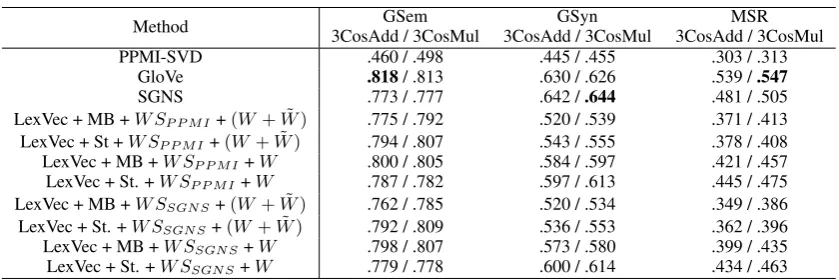
Method 3CosAdd / 3CosMulGSem 3CosAdd / 3CosMulGSyn 3CosAdd / 3CosMulMSR
PPMI-SVD .460 / .498 .445 / .455 .303 / .313
GloVe .818/ .813 .630 / .626 .539 /.547
SGNS .773 / .777 .642 /.644 .481 / .505
LexVec + MB +W SP P MI+(W+ ˜W) .775 / .792 .520 / .539 .371 / .413 LexVec + St +W SP P MI+(W+ ˜W) .794 / .807 .543 / .555 .378 / .408 LexVec + MB +W SP P MI+W .800 / .805 .584 / .597 .421 / .457 LexVec + St. +W SP P MI+W .787 / .782 .597 / .613 .445 / .475 LexVec + MB +W SSGNS+(W+ ˜W) .762 / .785 .520 / .534 .349 / .386 LexVec + St. +W SSGNS+(W+ ˜W) .792 / .809 .536 / .553 .362 / .396 LexVec + MB +W SSGNS+W .798 / .807 .573 / .580 .399 / .435 LexVec + St. +W SSGNS+W .779 / .778 .600 / .614 .434 / .463
Table 2: Results on word analogy tasks, given as percent accuracy.
5 Results
Results for word similarity and for the analogy tasks are in tables 1 and 2, respectively. Com-pared with PPMI-SVD, LexVec performs better in all tasks. As they factorize the same P P MI∗
matrix, it is the loss weighting from window sam-pling that is an improvement overL2 loss. As
ex-pected, due to PPMI, LexVec performs better than SGNS in several word similarity tasks, but in ad-dition it also does so on the semantic analogy task, nearly approaching GloVe. LexVec generally out-performs GloVe on word similarity tasks, possibly due to the factorization of the PPMI matrix and to window sampling’s weighting of negative co-occurrences.
We believe LexVec fares well on semantic analogies because its vector-space does a good job of preserving semantics, as evidenced by its per-formance on word similarity tasks. We believe the poor syntactic performance is a result of the PPMI measure. PPMI-SVD also struggled with syntac-tic analogies more than any other task. Levy et al. (2015) obtained similar results, and suggest that using positional contexts as done by Levy et al. (2014) might help in recovering syntactic analo-gies.
In terms of configurations, WSSGNSperformed
marginally better than WSP P MI. We
hypothe-size it is simply because of the additional com-putation. While W and (W + ˜W) are roughly equivalent on word similarity tasks, W is bet-ter for analogies. This is inline with results for PPMI-SVD and SGNS models (Levy et al., 2015). Both mini-batch and stochastic approaches result in similar scores for all tasks. For the same pa-rameterkof negative samples, the mini-batch ap-proach uses2∗winW SP P MI times more negative
samples than stochastic when using W SP P MI,
and winW SSGNS times more samples when
us-ingW SSGNS. Therefore, the stochastic approach
is more computationally efficient while delivering similar performance.
6 Conclusion and Future Work
co-occurrences. Finally, its PPMI factorization seems to better capture semantics when compared to the shifted PMI factorization of SGNS. As a result, it outperforms PPMI-SVD and SGNS in a variety of word similarity and semantic analogy tasks, and generally outperforms GloVe on similarity tasks.
Future work will examine the use of positional contexts for improving performance on syntactic analogy tasks. Moreover, we will explore further the hyper-parameter space to find globally optimal values for LexVec, and will experiment with the factorization of other matrices for developing al-ternative word representations.
Acknowledgments
This work has been partly funded by CAPES and by projects AIM-WEST (FAPERGS-INRIA 1706- 2551/13-7), CNPq 482520/2012-4, 312114/2015-0, “Simplificac¸˜ao Textual de Ex-press˜oes Complexas”, sponsored by Samsung Eletrˆonica da Amazˆonia Ltda. under the terms of Brazilian federal law No. 8.248/91.
References
Marco Baroni, Georgiana Dinu, and Germ´an Kruszewski. 2014. Don’t count, predict! a systematic comparison of context-counting vs. context-predicting semantic vectors. In Pro-ceedings of the 52nd Annual Meeting of the Association for Computational Linguistics. vol-ume 1, pages 238–247.
Elia Bruni, Gemma Boleda, Marco Baroni, and Nam-Khanh Tran. 2012. Distributional seman-tics in technicolor. InProceedings of the 50th Annual Meeting of the Association for Com-putational Linguistics: Long Papers-Volume 1. Association for Computational Linguistics, pages 136–145.
John A. Bullinaria and Joseph P. Levy. 2007. Ex-tracting semantic representations from word co-occurrence statistics: A computational study.
Behavior research methods39(3):510–526. John A Bullinaria and Joseph P Levy. 2012.
Ex-tracting semantic representations from word co-occurrence statistics: stop-lists, stemming, and svd. Behavior research methods 44(3):890– 907.
John Caron. 2001. Experiments with lsa scor-ing: Optimal rank and basis. InProceedings of
the SIAM Computational Information Retrieval Workshop. pages 157–169.
Kenneth W. Church and Patrick Hanks. 1990. Word association norms, mutual information, and lexicography. Computational Linguistics
16(1):22–29.
Ronan Collobert, Jason Weston, L´eon Bottou, Michael Karlen, Koray Kavukcuoglu, and Pavel Kuksa. 2011. Natural language processing (al-most) from scratch. The Journal of Machine Learning Research12:2493–2537.
C. Eckert and G. Young. 1936. The approximation of one matrix by another of lower rank. Psych.
1:211–218.
Lev Finkelstein, Evgeniy Gabrilovich, Yossi Ma-tias, Ehud Rivlin, Zach Solan, Gadi Wolfman, and Eytan Ruppin. 2001. Placing search in con-text: The concept revisited. In Proceedings of the 10th international conference on World Wide Web. ACM, pages 406–414.
Felix Hill, Roi Reichart, and Anna Korhonen. 2015. Simlex-999: Evaluating semantic models with (genuine) similarity estimation. Computa-tional Linguistics.
Eric H. Huang, Richard Socher, Christopher D. Manning, and Andrew Y. Ng. 2012. Improv-ing word representations via global context and multiple word prototypes. In Proceedings of the 50th Annual Meeting of the Association for Computational Linguistics: Long Papers-Volume 1. Association for Computational Lin-guistics, pages 873–882.
Omer Levy and Yoav Goldberg. 2014. Neural word embedding as implicit matrix factoriza-tion. In Advances in Neural Information Pro-cessing Systems. pages 2177–2185.
Omer Levy, Yoav Goldberg, and Ido Dagan. 2015. Improving distributional similarity with lessons learned from word embeddings.Transactions of the Association for Computational Linguistics
pages 211–225.
Omer Levy, Yoav Goldberg, and Israel Ramat-Gan. 2014. Linguistic regularities in sparse and explicit word representations.CoNLL-2014
page 171.
Minh-Thang Luong, Richard Socher, and Christo-pher D. Manning. 2013. Better word represen-tations with recursive neural networks for mor-phology. CoNLL-2013104.
Tomas Mikolov, Kai Chen, Greg Corrado, and Jef-frey Dean. 2013a. Efficient estimation of word representations in vector space. arXiv preprint arXiv:1301.3781.
Tomas Mikolov, Ilya Sutskever, Kai Chen, Greg S. Corrado, and Jeff Dean. 2013b. Distributed representations of words and phrases and their compositionality. InAdvances in Neural Infor-mation Processing Systems. pages 3111–3119. Tomas Mikolov, Wen-tau Yih, and Geoffrey
Zweig. 2013c. Linguistic regularities in con-tinuous space word representations. In HLT-NAACL. pages 746–751.
George A. Miller and Walter G. Charles. 1991. Contextual correlates of semantic similarity.
Language and cognitive processes6(1):1–28. Arvid ¨Osterlund, David ¨Odling, and Magnus
Sahlgren. 2015. Factorization of latent vari-ables in distributional semantic models. In Pro-ceedings of the 2015 Conference on Empiri-cal Methods in Natural Language Processing. Association for Computational Linguistics, Lis-bon, Portugal, pages 227–231.
Jeffrey Pennington, Richard Socher, and Christo-pher D. Manning. 2014. Glove: Global vectors for word representation.Proceedings of the Em-piricial Methods in Natural Language Process-ing (EMNLP 2014)12.
Kira Radinsky, Eugene Agichtein, Evgeniy Gabrilovich, and Shaul Markovitch. 2011. A word at a time: computing word relatedness us-ing temporal semantic analysis. InProceedings of the 20th international conference on World wide web. ACM, pages 337–346.
Herbert Rubenstein and John B. Goodenough. 1965. Contextual correlates of synonymy. Com-munications of the ACM8(10):627–633. Richard Socher, John Bauer, Christopher D
Man-ning, and Andrew Y Ng. 2013. Parsing with compositional vector grammars. In ACL (1). pages 455–465.
Joseph Turian, Lev Ratinov, and Yoshua Bengio. 2010. Word representations: a simple and gen-eral method for semi-supervised learning. In
Proceedings of the 48th annual meeting of the