Munich Personal RePEc Archive
Deadlines, Procrastination, and
Forgetting in Charitable Tasks: A Field
Experiment
Knowles, Stephen and Servátka, Maroš and Sullivan, Trudy
and Genç, Murat
University of Otago, MGSM Experimental Economics Laboratory,
Macquarie Graduate School of Management, University of Otago,
University of Otago
5 December 2017
Online at
https://mpra.ub.uni-muenchen.de/83242/
1
Deadlines, Procrastination, and Forgetting in Charitable Tasks:
A Field Experiment
Stephen Knowles1, Maroš Servátka2*, Trudy Sullivan3,and Murat Genc4
December 5, 2017
Abstract: We conduct a field experiment to test theoretical predictions regarding the effect of deadline length on task completion. We place our test in a charitable task setting in which participants are invited to complete an online survey, with a donation going to charity if they do so. Participants are given either one week, one month or no deadline by which to respond. Completions are lowest for the one month deadline and highest when no deadline is specified. Our results point out that a short deadline, and not specifying a deadline, signals urgency. By contrast, providing a longer (one month) deadline gives people permission to procrastinate, with people ultimately forgetting to complete the task.
Keywords: charitable tasks; charitable giving; deadline; procrastination; forgetting; field experiment
JEL Codes: C93; D64
1
Department of Economics, University of Otago, NEW ZEALAND
2*
Corresponding Author. MGSM Experimental Economics Laboratory, Macquarie Graduate School of Management, 99 Talavera Road, North Ryde NSW 2113, AUSTRALIA and University of Economics, Dolnozemská cesta 1, 852 35 Bratislava, SLOVAKIA. Tel: +61-2-9850 7813. E-mail: [email protected].
3
Department of Preventive and Social Medicine, University of Otago, NEW ZEALAND
4
2
1. Introduction
Deadlines often help us organize our lives by motivating us to perform tasks that we have
been procrastinating over (O’Donoghue and Rabin, 1999). Some tasks, like filing tax returns,
must be completed; otherwise the consequences or penalties can be severe. Other tasks, such as redeeming vouchers, are not compulsory, so we sometimes forget to complete them even though it would benefit us personally. For some non-compulsory tasks, such as donating money to charity or completing a survey, the benefits accrue to someone other than the person completing the task.1 While with personal benefit tasks, the people undertaking the task knows how important the task is, for charitable tasks people often lack information about the tasks importance or urgency. We conjecture that for such charitable tasks, deadline length might convey cues about the importance of the task, which would have an impact on the completion rate. For example, not specifying a deadline may signal urgency to complete the task, whereas specifying a long deadline may be interpreted as giving permission to delay, increasing the probability of both procrastination and forgetting to complete the task. If having no deadline creates enough urgency, it may even lead to a higher completion rate than a short deadline (which might both signal and create urgency).
Although longer deadlines increase the probability that there will be a period of time in which the transaction cost of completing the task is low enough the task will be completed, longer deadlines also increase the probability of both procrastination (Damgaard and Gravert, 2017) and forgetting due to imperfect memory (Ericson, 2017) or inattention Taubinsky (2014). These models (details of which are presented in Section 3) provide an intuition that if the effect of procrastination and forgetting are high enough, a shorter deadline will increase response rates relative to a longer deadline. Drawing on this intuition, and on our conjecture regarding deadlines conveying cues about the importance of the task, we hypothesize that response rates for charitable tasks will be higher for short deadlines than longer deadlines, but that the highest response rate will occur when no deadline is given at all.
To test these hypotheses, as well as other predictions of the above mentioned models, we conduct a field experiment in which we invite a nationally representative sample of 3,276 people to give up five minutes of their time to answer an online survey, and, in doing so, earn
1
We use the term “charitable tasks” to refer to such cases and the term “personal benefit tasks” to refer to tasks
3
$10 that will be donated to charity by the researchers.2 In the experiment we implement three different deadlines: a one week deadline (short deadline), a one month deadline (long
deadline), and no deadline at all (infinite deadline).
The current study is a part of our larger research program on the effects of deadlines on procrastination in charitable tasks. The current paper contributes to the literature in a number of ways. Apart from testing the empirical predictions of the models described above, we analyze the effect of having an infinite deadline (i.e., no deadline) in the context of a charitable task. While in our earlier work (Knowles and Servátka, 2015) we varied the deadline length (one hour, one day or one week) for a charitable donation in a laboratory experiment, the focus was on the interplay of transaction costs and the opportunity cost of time. This earlier work did not include a treatment with no deadline. In order to incorporate a no deadline treatment in the context of a charitable task we conduct a field experiment
instead of a laboratory experiment. A laboratory experiment arguably imposes an implicit deadline (e.g., end of the semester, academic year or one’s undergraduate studies) even if this
is not explicitly stated in the experimental instructions. ‘Stepping outside the lab’ allows for
having more control over participants expectations in a situation when no deadline is specified, a cornerstone of the current study.
To the best of our knowledge our current study is the first to find that deadline length significantly affects response rates in the context of a charitable task. In particular, we find responses are significantly higher for our short (one week) deadline compared to our long (one month) deadline. This result is in line with existing results in the literature for personal benefit tasks (Tversky and Shafir, 1992; Taubinsky 2014; Shu and Gneezy, 2010;
Janakiraman and Ordóñez, 2012). Interestingly, whereas having no deadline has been found to reduce response rates for personal benefit tasks (Tversky and Shafir, 1992), we find that having no deadline increases response rates, relative to both a short and a long deadline. Consistent with our conjecture that a longer deadline sends a signal that there is no urgency to respond, there are very few prompt responses in the One Month treatment, whereas a large number of responses in the No Deadline treatment came in early. Analyzing the patterns of completions, we provide support for the idea that the mechanism through which deadlines operate is signaling urgency or its lack thereof.
2
Hence, the task could be thought of as either completing a survey (benefitting those doing the research), or giving up a small amount of time to earn money for charity (benefitting the charity and those who are helped by
4
Our findings have important policy implications if our results are applied to the charitable giving context. Our experimental results suggest that while specifying a shorter deadline, thus creating some urgency, might mitigate procrastination and forgetting, a long deadline seems to remove this urgency and results in lower responses. However, the greatest urgency to respond, which in turn maximizes response rates, occurs when no deadline is specified. Therefore, applying our results to charitable giving, charities are best to, if possible, specify no deadline at all in order to maximize donations.
2. Relationship to the Literature
This section discusses the relevant details of previous studies on deadline length and
highlights the differences with respect to the focus and/or design from our field experiment. We begin by reviewing studies in the context of charitable giving, an obvious example of a charitable task. Damgaard and Gravert (2017) conduct a field experiment in which
solicitation emails and texts are sent out to people who have previously donated to a Danish charity to test the effect of deadlines on response rates. The recipients of these solicitations were told their donation would be matched if the donation was made by a specified deadline. The deadline length varied depending on whether the solicitation was by email or text. In the email treatment the short deadline was three days, the intermediate deadline 10 days and the long deadline 34 days. When the solicitation was by text, the short deadline was two days, the intermediate deadline three days and the long deadline 34 days. In contrast to our results, they find no evidence of deadline length affecting donations, but instead find what they term a
“now or never” effect; people either tend to donate promptly or not at all. Sending out a
reminder increased donations, but also increased the probability of someone being asked to be deleted from the charity’s database. Importantly, the context of this field experiment also differs from ours in that we ask participants to give up their time to answer a survey, and in doing so earn money for a charity, whereas Damgaard and Gravert ask people to donate their own money to charity.
5
of matching subsidies and the presence of a lead donor on charitable giving. Huck and Rasul implement treatments where subjects are told that if they make a donation within four weeks, the donation will be matched by an anonymous donor. In other treatments there was no deadline and no matching subsidy. They suggest that this four-week deadline likely did not affect donor behavior as 97% of those who donated did so within the four-week deadline, with the median donation time being within one week. Huck and Rasul also point out that they observed no differential effects on the time for donations to be received between the treatments specifying a four-week deadline, and those where no deadline was given. However, this comparison of treatments with and without a deadline is confounded by the fact that the treatments with a four-week deadline also include a matching subsidy, whereas the treatments with no deadline do not include a matching subsidy.
In Knowles and Servátka (2015) we also find no difference in charitable giving for deadline lengths of one hour, one day and one week in a laboratory experiment, suggesting that if deadlines are to have a behavioral effect, they need to be properly calibrated. The design of that study did not include a no deadline treatment, meaning the data could not be (and were not intended to be) used to test the hypotheses regarding the effects of a stated (long or short) deadline versus an infinite deadline. Unlike in a laboratory experiment, where from the perspective of student subjects there is always an implicit deadline (e.g., the end of the semester or academic year), a field experiment allows us to implement a treatment with a truly non-binding no deadline treatment.
Karlan et al (2011) focus mainly on the effect of matching subsidies on donations, but they also consider the effect of adding a message to the solicitation indicating urgency. The
wording was either “now is the time to give” or “now is the time to join the fight”. Including
6
In the context of personal benefit tasks, Tversky and Shafir (1992) offer students $5 to complete and return a lengthy questionnaire, with students being given either five days, three weeks or no deadline by which to complete the questionnaire. While the task employed in
Tversky and Shafir’s experiment is similar to ours, it is students who received the payment in
their context, rather than the funds going to a charity on the student’s behalf. The other two notable differences between Tversky and Shafir’s study and ours were slightly shorter
deadlines (if specified) and a different population of participants. Tversky and Shafir
observed rates of return of 60% with five days deadline, 42% with three weeks deadline, and 25% with no deadline, indicating the more time people were given to complete the task, the lower the response rate. This suggests that for personal benefit tasks, when the benefit to the individual is unambiguous, longer deadlines lead to more procrastination and possibly forgetting. Note that contrary to our conjecture that no deadline signals urgency for a charitable task, the importance of which might be unknown, response rates are lowest when no deadline is specified if completing the task directly benefits the individual.
7
3. Theoretical Framework
In this section we develop a number of hypotheses based on the models of Damgaard and Gravert (2017) and Ericson (2017), both of whom extend the framework of procrastination
developed by O’Donoghue and Rabin (1999), but in slightly different ways. We also discuss
Taubinsky’s (2014) model of inattention. We also provide more detail on our conjecture,
discussed in the introduction, that having no deadline may signal urgency.
Damgaard and Gravert (2017) present a model of charitable giving in which individuals derive utility from own consumption, the warm glow from their own donation and the public good from the sum of all donations. Each individual is also faced with a transaction cost of donating, which is identically and independently distributed across time and individuals. A time-consistent individual with perfect foresight will donate in the time period with the lowest anticipated transaction cost, if the benefits of donating (the warm glow and utility derived from the public good) exceed the costs of donating (the loss of utility from lost consumption3 and the transaction cost). This set-up leads to two predictions about donating behavior, assuming that there is no present-bias that could lead to procrastination. First, as transactions costs are independently distributed across individuals, donations will be equally distributed across time. Second, as a longer deadline increases the probability there will be a period in which the transaction cost is low enough to donate, a longer deadline will increase the probability of donating.
Damgaard and Gravert then extend the model by introducing the possibility of procrastination due to present-biased preferences and analyze the behavior of naïve donors, who do not realize they have a self-control problem. Such donors may not donate in the time period with the lowest transaction cost if there is a future period in which transaction costs are low enough their current selves believe their future selves would prefer to donate. Therefore, introducing procrastination, and assuming there are some naïve donors, changes the
predictions about both the effect of deadlines and the distribution of donations over time in the following ways. First, there will now be a spike in donations as the deadline approaches. This is because people will donate just ahead of the deadline, as long as the benefits of donating exceed the costs in this time period. Second, although it is still true that a longer deadline increases the probability there will be a time period when the transaction cost is low
3
8
enough to donate, the potential for procrastination is higher with a longer deadline. Therefore, shorter deadlines may reduce procrastination. If this second effect dominates, a shorter
deadline will increase responses.
Ericson (2017) does not consider the case of a charitable task, but the key insights of his model can still be applied to charitable tasks. Unlike Damgaard and Gravert, Ericson does not assume that the decision-maker has perfect foresight regarding the independently distributed costs, but that the draw is observed at the beginning of each period, akin to the optimal stopping theory (Chow, Robbins, and Siegmund, 1971; discussed also by Knowles and Servátka, 2015 in the context of charitable giving). Ericson extends the O’Donoghue and Rabin framework by incorporating imperfect memory, that is forgetting to complete a task, which is considered to be an absorbing state (i.e., once the decision-makers forget, there is zero chance they will remember in the future). Ericson also allows for the possibility that people may over-estimate their ability to remember to complete a task.
Time-consistent individuals always predict their behavior correctly, conditional on remembering. They will choose to respond when they expect their transaction costs to be lowest, but with the passage of time more will forget to respond. Naifs maximize their perceived expected utility given that they expect to behave in a time-consistent manner in the future and given their perceived memory. This leads to naifs mispredicting their behavior, conditional on remembering. Both time-consistent individuals as well as naifs may mispredict their probability of remembering. Increasing memory while holding beliefs about memory constant, raises the probability that the individual has not forgotten about the task in a given period, but does not affect the probability of completing an active (i.e., not forgotten) task in that period. Increasing beliefs about memory lowers the maximum (cut-off) cost at which time-consistent and present-biased individuals will act in a given period and thus lowers the probability of acting conditional on remembering. The threshold depends on the expected continuation value, which in turn depends on the distribution of costs, expected future strategies incorporating time-consistency or naiveté, perceived memory, and the period the individual is making the decision in.
9
current value function, present-biased naifs will respond right before the deadline (in both cases the individual acts if the cost realization is lower than or equal to the cut-off value). If memory is imperfect, shorter deadlines can raise the probability of task completion for both types. On the one hand, a shorter deadline increases the probability that someone who intends to respond will do so before having forgotten. On the other hand, a shorter deadline reduces the probability there will be a time period in which the benefits of responding exceed the costs. If the first effect dominates, a shorter deadline will increase responses; if the second effect dominates a shorter deadline will reduce responses.
People might be aware of their imperfect memory. If that is the case, time-consistent individuals with perceived low memory may act promptly, leading to a spike in responses early on, then a uniform decrease over time. For naifs, who with perfect memory respond immediately prior to the deadline, imperfect memory reduces the probability of acting at the deadline for two reasons. The first is that if perceived memory is low enough, naifs will act immediately, knowing that if they do not, they will forget. Secondly, naifs who have not acted promptly are likely to forget to act at the deadline. Finally, if people are unaware of imperfect memory, their response rates fall over time in a uniform manner.
Taubinsky (2014) derives a model of inattention. What Taubinsky defines as inattention is closely related to what Ericson (2017) terms imperfect memory, with the main difference being that with inattention there is a positive probability that the decision-makers will remember in each period, even if it slipped their mind in the previous one (i.e., forgetting is not an absorbing state). This subtle difference between imperfect memory and inattention has
important implications for the predictions made in Taubinsky’s model and in Ericson’s
model, but without procrastination. In both models, people who are aware of the possibility of future inattention (imperfect memory) will take steps to protect against this, including responding early (which would create a spike in donations early on), but also creating reminders. People who are not aware of their imperfect memory, on the other hand,
mistakenly assume that they will respond later and then forget to do so. When the probability of being attentive is bounded away from zero, for example due to mental recall or reminders, longer deadlines will not reduce the probability of responding in the Taubinsky model because as the deadline approaches infinity, people will eventually respond (contrary to
Ericson’s model where the task will not eventually be completed in infinite time, because the
10
time, response rates will be lowest for deadlines of intermediate length. Taubinsky’s model
gives two main predictions. The first is that a medium to long deadline will give a lower response rate than either a short deadline or a very long or infinite deadline. The second prediction is that a significant number of responses will come very late as natural reminders trigger memory.
The key predictions from the models discussed above can be summarized as follows.
In Damgaard and Gravert’s time consistent model (what they term their “standard model”):
(1) A longer deadline will increase the response rate. (2) There will be a uniform pattern of responses over time.
In Damgaard and Gravert’s present-bias model:
(1) If there is a sufficient proportion of naïve procrastinators, and if the effect of procrastination is strong enough, a longer deadline will reduce the response rate. (2) There will be a spike in responses at the deadline.
In Ericson’s model of imperfect memory:
(1) If there is a sufficient proportion of people who overestimate their ability to
remember, and if the effect of imperfect memory is strong enough, a longer deadline will reduce the response rate.
(2) There will be no spike in responses at the deadline.
(3) There may be a spike in donations early on as people who are aware of their imperfect memory respond early to overcome this.
In Taubinsky’s model of inattention:
(1) There will be a non-monotonic relationship between deadlines and response rates. Initially the response rate will fall as deadline length increases, but will eventually increase.
(2) There will be a significant number of (very) late responses, as people eventually remember to respond.
11
and a higher response rate in One Month would be consistent with Damgaard and Gravert’s time-consistent model whereas seeing a spike in donations at the end, and a higher response rate in One Week, would be consistent with their present-bias model. Seeing a spike in donations early on and a higher response rate for One Week would be consistent with
Ericson’s model.
Comparing One Week, One Month, and No Deadline, seeing lower responses in One Month
than in One Week or No Deadline, and with a significant number of responses coming in late, would be consistent with Taubinsky’s model.
The models discussed above do not include a role for the deadline conveying information about how urgent the task is. In Taubinsky’s (2014) framework, an infinite deadline would lead to a non-trivial number of very late donations coming in, as people remember to complete the task, assuming they had intended to complete it. Under this infinite deadline interpretation we would expect to see completed surveys continue to come in well after one month in the No Deadline treatment. However, we argue that rather than people interpreting the lack of a deadline as meaning the deadline is infinite (i.e., they have as long to complete the task as they like), they may interpret the lack of deadline as signaling urgency.4 We therefore, add a conjecture of our own: having no deadline at all may signal urgency in the context of a charitable task in a way that does not happen with a personal benefit task. Consider the example of a voucher: having a deadline of one month signals greater urgency to redeem the voucher than having no deadline, as voucher holders will interpret the lack of deadline to mean they can take as long as they like to redeem the voucher. In the case of a charitable task, however, it is quite possible a one month deadline (or perhaps even a deadline as short as one week) signals there is less urgency to complete the task than if no deadline is specified at all. In other words, we conjecture that specifying no deadline for a charitable task signals urgency in a similar way a very short deadline does, but that we would not expect this to happen for a personal benefit task. Evidence in favor of our signaling urgency hypothesis would be an early spike in responses in No Deadline. We note that such an early spike in
responses would also be consistent with Ericson’s model.
4
12
4. Experimental Design and Procedures
Our participants were randomly selected from the New Zealand electoral roll and invited to take part in an online survey on charitable giving, which would take approximately five minutes of their time. Participants were told that if they completed the survey the researchers would donate $10 to charity. This design feature allowed us to control the size of the donation rather than letting participants choose the size of the donation. This is important as it is
possible that there might be a non-trivial relationship between the time that has passed since receiving the letter and the size of the donation that the donor might consider to be
appropriate. For example, some participants may feel guilty about having delayed responding, and therefore make a larger donation than they would have done if they had donated
promptly. Our design controls for this.5
Participants were able to choose whether the donation was sent to World Vision or the Salvation Army.6 The letter (provided in the appendix) included a URL for the survey website, with a different URL given for each treatment. In addition, each letter contained a unique alphanumeric code. One of the questions in the survey asked for this code, and it was explained in the letter that this was to ensure that no one completed the survey more than once. The electoral roll contains information on people’s gender and age so we ensured an equal number of letters per treatment were sent out to males and females, and an equal number of letters were sent to those aged 18-35, 36-65 and 66 and over.7 Apart from
employing a solicitation method that would allow us to reach a sample representative of the entire country, we were interested in a solicitation that would involve a natural reminder (a visual cue of seeing a letter on the table in the to-do pile or attached to the fridge might remind participants who intended to complete the survey to do so) as a conservative test of procrastination leading to forgetting. If we are to observe deadlines affecting the response rates with a letter solicitation, one can expect that such effects would be more pronounced
5
While it might be interesting to study whether such a relationship exists, allowing participants to make a donation of an arbitrary size would create a potential confound in our design as the size of what one considers to
be an ‘appropriate’ donation might interact with whether the donation is actually made. Note also that such a design would require having participants donate their own money, rather than the donation being made by the researchers.
6
Both charities are well known in New Zealand. The key difference between the charities is that World Vision
works to assist families in need in the developing world, whereas the Salvation Army’s focus is on assisting
families in need in New Zealand. The Salvation Army was chosen by 72 percent of participants. Participants were given the opportunity to comment on the reason for their charity choice. We analyze these data in a separate paper (Knowles and Sullivan, 2017).
7
13
with solicitation via email where it is less likely that people would randomly come across the solicitation email in their inbox and read it, after it has already been read. Since all theories we test are environment-free, meaning they do not prescribe an environment in which they have to be tested, solicitation via letters provides for a valid test. We note, however, that different methods might have different reminder functions.
We initially sent out 300 letters per treatment, and then, to minimize the chances of any seasonality effects, followed up with another two mail-outs a few weeks apart with 390 and 402 letters per treatment in the second and third mail-outs respectively. In the One Week
treatment people were given 10 days from when the letters were sent to complete the survey; as the letters would take one to three days to be delivered, this gives seven to nine days to respond. The deadline in the One Month treatment was three weeks longer than in the One Week treatment, ensuring that the deadline was the same day of the week in each case. The
No Deadline treatment did not specify a deadline by which the survey had to be completed. All letters were sent out when no major holidays occurred that would interfere with returning the letters.
5. Results
In total, 1092 letters were sent out per treatment, across the three mail-outs. Some letters were returned because the person was no longer at that address. In addition, in four cases we were contacted by phone or email and informed that the person the letter was addressed to had died. We omit both groups of people, i.e., those whose letters were returned or where we were notified the person is deceased, (29 in One Week, 26 in One Month and 22 in No Deadline) from the denominator when calculating response rates. Two people completed the survey twice; in both cases the second survey was completed within a few minutes of the first so it is likely these people were unsure if they had correctly submitted the first time. We included the first response only in our data set for these people. There were three responses made after the deadline in One Week (these were one day late, two days late and eight days late), but none in One Month. As it is likely charities will accept late donations (and
14
either failed to enter their alpha-numeric code (three people, all in No Deadline) or entered an invalid code (one person, in One Month), or who did not choose a charity (three people; one from each treatment).
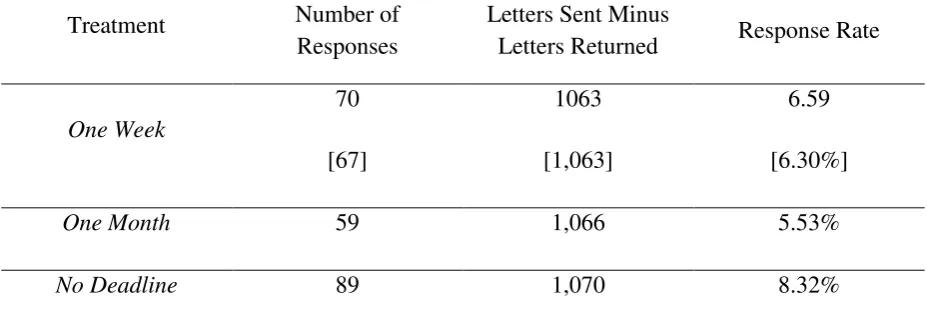
[image:15.595.66.530.344.507.2]The overall response rate is 6.82% if the three late responses are treated as valid and 6.72% if they are not. The response rates by treatment are presented in Table 1. We treat the three late responses in One Week as being valid, but report in square brackets what the response rate (and statistical significance tests) would be if these responses were treated as invalid. The response rate is highest when no deadline is specified (8.32%) and lowest with the deadline of one month (5.53%). The test statistics reported in Table 1 suggest that the observed differences in response rates are statistically significant on the basis of a joint test.
Table 1: Response Rates per Treatment
Treatment Number of Responses
Letters Sent Minus
Letters Returned Response Rate
One Week
70
[67]
1063
[1,063]
6.59
[6.30%]
One Month 59 1,066 5.53%
No Deadline 89 1,070 8.32%
Joint test of the hypothesis of equal response rates across treatments:
p-value for Fisher’s exact test: 0.038 [0.032]
Stone test of equal odds: λ2 = 6.65 [7.02] with p-value= 0.038 [0.0301]
Note: the numbers in square brackets are for when the three late responses in One Week are treated as non-responses.
15
Controlling for gender and age is complicated by that fact that of the 215 people who completed the survey, there were a small number of people who reported a different gender or age in the survey, than that associated with the person the letter was sent to, based on the electoral roll data. Two people entered a different gender. Both were in the One Month
treatment, and both letters were sent to males, but the people answering the survey stated that they were female. It is possible that the wrong answer was included in the survey in error, but another possibility is that the survey was filled in by someone other than the person it was sent to. There are also six people who entered a different age band in the survey than that associated with the person whom the letter was sent to. The information we obtained from the electoral roll did not include dates of birth, but grouped people into five-year age bands, based on their age when the details were supplied in May 2014. As there was a lag of a few months between when we obtained the electoral roll information and when people completed the survey, there could well be participants who were in an older age band by the time they completed the survey. There are five people who selected an older age band in the survey, than that associated with the person the letter was sent to based on the electoral roll,
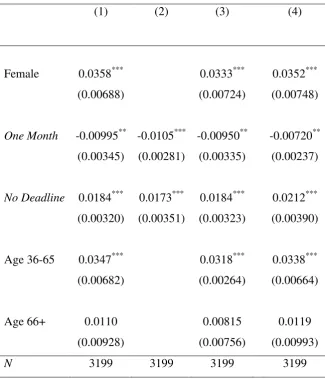
consistent with this explanation. However, there was one person who selected a younger age band; in this case it is likely that either the wrong age band was entered in error, or the survey was completed by a household member other than the one the letter was sent to. We record the age and gender of these eight people in the following way. In Column (1) of Table 2 the age and gender of participants is that recorded in the survey. In Column (2) we estimate the model without the age and gender variables and in Column (3) we re-estimate the Column (1) results but use the gender and age data from the electoral roll. The results are qualitatively similar across all three columns.
In Column (4) of Table 2 we explore how sensitive the results are to whether or not the three late observations in One Week are counted or not. In the first three columns these responses are treated as positive responses, whereas in Column (4) these are treated as non-responses. How these three observations are treated has little effect on the results. In the following discussions we focus on the Column (1) results.
16
reject the null hypothesis (the chi-square test statistic is 23.08 with a p-value of <0.0001). This confirms that participants were more likely to respond in No Deadline than in One Month.
[image:17.595.68.394.306.686.2]Giving a one-month deadline as opposed to a one-week deadline lowers the average probability of responding by 0.01. Having no deadline, on the other hand, increases the average probability of responding by 0.02 compared to having a one-week deadline. Considering that the average probability of responding is 0.067, the impact of having no deadline is quite significant. Also of interest, we find that females and participants in the age group 36 to 65 are more likely to respond.
Table 2: Marginal Effects on the Likelihood of Responding
(1) (2) (3) (4)
Female 0.0358*** 0.0333*** 0.0352*** (0.00688) (0.00724) (0.00748)
One Month -0.00995** -0.0105*** -0.00950** -0.00720** (0.00345) (0.00281) (0.00335) (0.00237)
No Deadline 0.0184*** 0.0173*** 0.0184*** 0.0212*** (0.00320) (0.00351) (0.00323) (0.00390)
Age 36-65 0.0347*** 0.0318*** 0.0338*** (0.00682) (0.00264) (0.00664)
Age 66+ 0.0110 0.00815 0.0119 (0.00928) (0.00756) (0.00993)
N 3199 3199 3199 3199
Standard errors (clustered by mail-out) in parentheses *
17
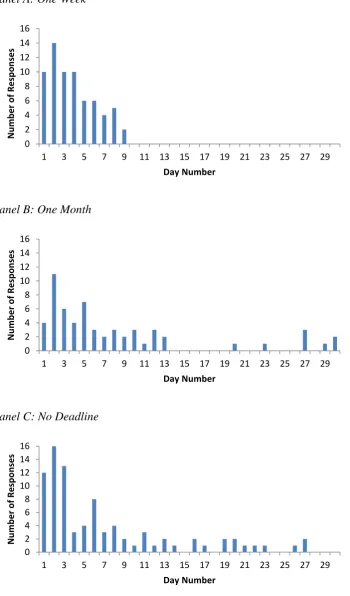
Figure 1: Timing of Responses for Each Treatment
Panel A: One Week
Panel B: One Month
Panel C: No Deadline
Panel A does not include the three late observations in One Week, which occurred on Days 10, 11 and 18. Panel C does not include the three observations occurring after one month, which occurred on Days 38, 52 and 145.
0 2 4 6 8 10 12 14 16
1 3 5 7 9 11 13 15 17 19 21 23 25 27 29
N u m b e r o f R e sp o n ses Day Number 0 2 4 6 8 10 12 14 16
1 3 5 7 9 11 13 15 17 19 21 23 25 27 29
N u m b e r o f R e sp o n ses Day Number 0 2 4 6 8 10 12 14 16
1 3 5 7 9 11 13 15 17 19 21 23 25 27 29
18
Figure 1 shows the response times in the One Week (Panel A), One Month (Panel B) and No Deadline (Panel C) treatments respectively. Panel C does not show the three latest responses in the No Deadline treatment, which occurred on days 38, 52 and 145 (and which are
consistent with Taubinsky’s intuition that there will be late responses as inattentive people
will eventually remember to respond). Panel A does not show the three late donations for One Week (these occurred on days 10, 11 and 18).
We now summarize how the results discussed above relate to the (binary) theoretical predictions presented in Section 3.
Result 1: Specifying a one-week deadline increases the probability of responding compared to a one-month deadline.
Our first key result that a short deadline results in higher response rate than a longer deadline is in line with Ericson’s model of imperfect memory and Taubinsky’s model of inattention as well as Damgaard and Gravert’s model of procrastination. The distributions of responses, presented in Figure 1, reject Damgaard and Gravert’s prediction that there will be a spike at
the deadline in favor of Ericson’s imperfect memory explanation. Also consistent with
Ericson’s intuition that people who are aware of their imperfect memory respond early to
overcome their handicap, we observe a spike early on. The predictions of Damgaard and
Gravert’s time consistent model that a longer deadline will increase the response rate and
these will be uniformly distributed over time is also rejected by our data.8
Result 2: Specifying no deadline at all increases the probability of responding compared to a one-month deadline.
Our second result thus supports Taubinsky’s prediction regarding the non-monotonicity between the deadline length and responses and is counter to the assumption made by both
8
19
Damgaard and Gravert (2017), and Huck and Rasul (2011) that a long deadline is effectively the same as having no deadline at all.
Result 3: Not specifying a deadline increases the probability of responding compared to a one-week deadline.
The third result is consistent with Taubinsky’s prediction that having an infinite deadline will not reduce the response rate compared to no deadline. It is also consistent with our conjecture that no deadline conveys urgency and will therefore result in a higher response rate than a short deadline.
We now turn our attention to how promptly responses were made across the three treatments to address the question of whether deadlines operate through signaling (a lack of) urgency. As shown in Figure 1, a feature of all three treatments is that the highest number of responses occurs on Day Two. However, not all letters will have been delivered on the same day; people outside the main centers may have received their letters on what we have labelled as Day Two, whereas for them it was really Day One. Day One is a Thursday (in all three mail-outs), so Days Three and Four correspond to the weekend. Only in One Week do responses fall off immediately after the first weekend. For all three treatments, the majority of responses
come in the first few days, but we do not find as strong a “now or never” effect as Damgaard
and Gravert (2017). In our One Month treatment only 63% of responses occur in the first seven days; the corresponding figure for the No Deadline treatment is 66%. In our No Deadline treatment 97% of those who responded did so in the first month, with a median response time of five days. The median response time in One Month is also five days.
20
significant (p-value = 0.014, two-sided Fisher exact test) between One Month and No Deadline, but not for One Week and No Deadline (p-value = 0.481).9
Relatedly, in the No Deadline treatment, a number of responses continued to come in some weeks after the letter was sent out, with three being received after a month, one of which was after several months. This is consistent with the notion that some participants at least
interpreted the deadline as being infinite, lending weight to Taubinsky’s prediction that responses will be highest in infinite time. However, as noted above, Figure 1 shows a significant number of prompt responses for No Deadline, consistent with the idea that many participants interpreted the lack of deadline as conveying urgency, similar to the short deadline.
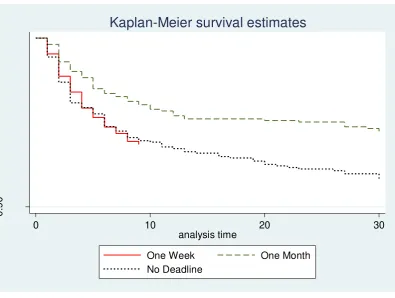
We next analyze the distribution of response times using Kaplan-Meier (KM) estimates of survival probabilities, which is the probability that a participant will not complete the task before a given day. We present the survival curves for all the treatments for the first 30 days in Figure 2. We observe that One Month has the highest survival probability for any one of the first 30 days across all the treatments. That is, the survival curve for No Deadline lies above the survival curves for the other treatments. This suggests that specifying a one-month deadline signals a lack of urgency compared to a short one-week deadline or no deadline at all. The survival probability for One Week is higher than the survival probability for No Deadline for the first three days, but lower thereafter. For example, the probability that a participant will not respond before Day 3 is 0.968 with a week deadline, 0.98 with a one-month deadline, and 0.962 with no deadline.
We use the log-rank test to evaluate whether or not the Kaplan-Meier survival curves for different treatments are statistically equivalent, that is, whether or not the differences in survival probabilities across the treatments are statistically significant. We start with the hypothesis that all three survival curves for the three treatments are the same. The value of the chi-square test statistic is 7.41 with a p-value of 0.0246, meaning that at least one of the survival curves is different.
9
21
Figure 2: Kaplan-Meier Survival Curves
No Deadline treatment censored on Day 30 for the figure (but not for the log-rank tests). Range = [0.90, 1.00].
We then perform the log-rank test to make pairwise comparisons between the treatments. We fail to reject the hypothesis that the survival curves for One Week and No Deadline are the same (p-value = 0.8241). The lack of difference in estimated survival functions can be visually seen in Figure 2 by the One Week curve overlapping the No Deadline curve over its 10 day duration. This means that participants take just as much time to complete the task before any given day, whether they are given no deadline at all or they are given a one-week deadline. This is consistent with the idea that many participants interpreted the lack of deadline as conveying urgency as opposed to providing evidence for Taubinsky’s prediction that responses will be highest in infinite time. Having said that, we did have three participants interpret the deadline as being infinite as their responses were received after a month, one of which was after several months.
Continuing with the survival analysis we reject the equality of the survival curves when we compare One Week with One Month (p-value = 0.0126) and One Month with No Deadline (p-value = 0.0204). Therefore, giving a one-month deadline as opposed to a one-week deadline
0
.9
0
0 10 20 30
analysis time
One Week One Month
No Deadline
22
or no deadline seems to make a difference in terms of how promptly participants complete the task. This supports our conjecture that a longer deadline conveys less urgency than a short deadline, or no deadline at all and thus gives people an excuse to procrastinate.
Result 4: Specifying a month deadline signals lack of urgency compared to a short one-week deadline or no deadline at all.
5. Conclusions
This paper presents a field experiment analyzing the effect of deadline length on charitable tasks. We conjecture that for such charitable tasks, the time available to perform them
influences whether they get completed or not as the deadline length might convey cues about the urgency of the task. There is evidence from previous research that increasing deadline length for personal benefit tasks reduces responses, with the response rate being the lowest when no deadline is specified. In contrast, for a charitable task we find that the response rate is the highest when no deadline is specified. In our treatment with a long (one-month)
deadline, there were fewer very prompt responses than when we specified a short deadline, or no deadline at all. We interpret this as evidence that specifying a longer deadline in contrast to a short deadline or no deadline at all, sends a signal that there is no urgency to act. People therefore put off undertaking the task, and since they are inattentive or forget, this results in lower response rates.
While we attempted to deal with participants’ potential beliefs that there might be an implicit
deadline by running a field rather than a laboratory experiment, it is possible that not
specifying a deadline in our No Deadline treatment might still have led participants to assume that there is an implicit deadline. Future research could address this issue in either measuring beliefs about implicit deadlines and/or by explicitly stating that there is no deadline (as opposed to not mentioning a deadline at all as we did in the current study). Furthermore, one could also explore in detail how no deadline could lead to different interpretations by
23
from the theoretical frameworks presented in Section 3. For example, sophisticated
individuals might also incur a psychological hassle cost of remembering (Haushofer, 2015). If there is an infinite deadline, these costs may approach infinity and thus the sophisticated individuals might opt to set reminders even if these are costly or respond immediately so they
would not forget (along the lines “I just want to get it done, so I would not have to remember
about it”).10It is also possible that people ‘conveniently forget’ as in Andreoni et al. (2015).
We leave these explorations for future research.
Our results have important policy implications both for maximizing completion rates for surveys and charitable giving. Researchers conducting surveys often specify a deadline by which the survey needs to be completed. Our results imply that survey response rates would be higher in the absence of a deadline. Charities typically do not specify deadlines by which donations need to be made and our results imply this is the optimal strategy, when there are few naturally occurring reminders. However, our results do not imply that deadlines will reduce charitable donations in contexts where there are strong naturally occurring reminders that a deadline is approaching. For example, if a charity asks people to donate before
Christmas (or for a particular event), there are constant reminders that Christmas is approaching, which may remind people about the opportunity to donate. Having said this, many charitable fundraisers do not have natural reminders and our results suggest that in these reminder-free cases charities should avoid setting deadlines, especially intermediate deadlines, by which donations have to be made. Such campaigns, however, might sometimes be limited in terms of their duration if the charity is using matching grants or if the campaign needs to close by a certain date and thus the no deadline option might not always be feasible.
Acknowledgements: Funding for this project was provided by the Department of Economics, Otago Business School, University of Otago. An earlier version of the paper was presented at the 2nd MERIT Conference of Field Experiments (Monash University, 2015), New Zealand Association of Economists conference (Wellington, 2015), Economic Science Association meetings (Sydney, 2015; Dallas, 2015, Jerusalem, 2016), and in the Economics Seminar Series at the University of Canterbury (Christchurch, 2015) and the University of Economics in Bratislava (2016). We are grateful to conference and seminar participants for the useful feedback. We are also grateful to Co-Editor David Reiley, Andrew Gray, Ella
10
24
Iosua, Lyla Zhang, and two anonymous referees for detailed comments that have helped us improve the quality of the paper and Matt Foster for research assistance.
References
Andreoni, J., M. Serra-Garcia and A-K. Koessler (2015) “Toward understanding the giving process: deciding to give versus giving,” mimeo.
Athey, S. and G. Imbens (2016) “The Econometrics of Randomized Experiments,” working paper (available online at https://arxiv.org/pdf/1607.00698.pdf).
Chow, Y.S., H. Robbins and D. Siegmund (1971) Great Expectations: The Theory of Optimal Stopping. Boston: Houghton Mifflin.
Damgaard, M.T. and C. Gravert (2017) “Now or never! The effect of deadlines on charitable
giving: evidence from two natural field experiments”, Journal of Behavioral and
Experimental Economics, 66:78-87.
Ericson, K.M. (2017) “On the interaction of memory and procrastination: implications for
reminders, deadlines, and empirical estimation”, Journal of the European Economic
Association, 15(3):692-719.
Haushofer, J. (2015) “The Costs of Keeping Track,” working paper (available online at
https://www.princeton.edu/~joha/publications/Haushofer_CostofKeepingTrack_2015.pdf)
Huck, S. and I. Rasul (2011) “Matched fundraising: evidence from a natural experiment”,
Journal of Public Economics, 95:351-362.
Janakiraman, N. and L. Ordóñez (2012) “Effect of effort and deadlines on consumer product
returns”, Journal of Consumer Psychology, 22:260-271.
Karlan, D., J.A. List and E. Shafir (2011) “Small matches and charitable giving: evidence
from a natural field experiment”, Journal of Public Economics, 95:344-350.
Knowles, S. and M. Servátka (2015) “Transaction costs, the opportunity cost of time and procrastination in charitable giving”, Journal of Public Economics, 125:54-63.
Knowles, S. and Sullivan, T. “Does charity begin at home or overseas”, Nonprofit and
Voluntary Sector Quarterly, forthcoming (available online at
http://journals.sagepub.com/eprint/q8Eh5fwrfxTq57gPEP6R/full).
O’Donoghue, T. andM. Rabin (1999) “Doing it now or later”, American Economic Review
25
Shu, S.B. and A. Gneezy (2010) “Procrastination of enjoyable experiences”, Journal of Marketing Research 47: 933-944.
Taubinsky, D. (2014) “From intentions to actions: a model and experimental evidence of
inattentive choice, mimeo (available online at
http://scholar.harvard.edu/files/taubinsk/files/inattentive_choice.pdf).
26
Appendix: Sample Letter Sent to Participants
Dear X
Are you interested in completing an online survey on charitable giving, and in doing so earning $10 for charity? If so, then read on.
Researchers at the [insert university names] are conducting a survey on charitable giving. Your name has been randomly chosen from the electoral roll to take part in this survey. Note, that in order to take part, you do not need to have made a donation to a charity before. We are interested in the responses both of people who do give money to charity, and those who do not. If you complete the survey by 8 August the researchers will donate $10 to charity on your behalf. You will get to choose whether this donation is forwarded to World Vision or the Salvation Army.
The survey is an online survey. To complete the survey please go to http://goo.gl/CPW1cr
We estimate that the survey will take approximately five minutes to complete.
At the bottom of this letter is a code, which you will need to enter when completing the survey, in order for us to forward $10 to the charity of your choice. Requiring you to enter the code is to ensure that no-one completes the survey more than once. Each person we have written to has been given a different code. Please be assured, however, that we have not kept a record of who has been given which code (we have just kept a list of all the codes used), so we will have no way of knowing who has given which answers to the survey; that is, your responses will be completely anonymous.
Please note that because of the steps we have taken to guarantee your anonymity, we cannot provide you with a receipt for the money donated on your behalf.
Enclosed is an information sheet with some more information about this research project. Remember, in order for us to make a $10 donation to the charity you chose, you need to complete the online survey by 8 August.
Your personal code is AWF001.