A Web-framework for ODIN Annotation
Ryan Georgi Michael Wayne Goodman Fei Xia
University of Washington Seattle, WA, USA
{rgeorgi,goodmami,fxia}@uw.edu
Abstract
The current release of the ODIN (On-line Database of Inter(On-linear Text) database contains over 150,000 linguistic examples, from nearly 1,500 languages, extracted from PDFs found on the web, representing a significant source of data for language research, particularly for low-resource lan-guages. Errors introduced during PDF-to-text conversion or poorly formatted exam-ples can make the task of automatically an-alyzing the data more difficult, so we aim to clean and normalize the examples in or-der to maximize accuracy during analysis. In this paper we describe a system that al-lows users to automatically and manually correct errors in the source data in order to get the best possible analysis of the data. We also describe a RESTful service for managing collections of linguistic exam-ples on the web. All software is distributed under an open-source license.
1 Introduction
The current release of the ODIN (Online Database of INterlinear Text) database contains over 150,000 linguistic examples in the form of inter-linear glossed text (IGT), an example of which is shown in Fig. 1. These IGT instances are extracted from PDFs found on the web, repre-senting a significant source of data for computa-tional typology, as well as providing information for resource-poor languages (RPLs). These in-stances are additionally useful for inducing anno-tation on RPLs, as demonstrated by Georgi et al. (2014, 2015), in which the relationships between words and glosses are identified and encoded for the purpose of enriching the data with annotations not present in the original examples. However,
keené Paksí dónq-ine-m
DEM.PLUR dog five-DEF-ACC ‘these five dogs’
Figure 1: An IGT instance of Aari [aiw], an Omotic language of Ethiopia. Extracted from Dryer (2007)
the PDF-to-text conversion process can introduce noise into the data, and some examples are not for-matted well in the original document. These and other issues can decrease the efficacy of the auto-matic structural analysis.
To address these issues, we have created a web interface that combines automatic cleaning and normalization procedures with a user-friendly browser-based GUI to enable human annotators to review and improve the data quality of the avail-able IGT instances. Additionally, as editing is meant as one of multiple capabilities of the final system, this browser interface is driven by a REST-ful (Fielding, 2000) backend system that will sup-port future interface extensions.
2 Related Work
The system we describe is not the first web-based editor of IGT, but none of the existing systems (for IGT or annotation in general) that we’re aware of fit our use case. TYPECRAFT1 (Beermann
and Mihaylov, 2014) is a wiki-based collabora-tive IGT editor. As it directly targets IGT, the editor is designed to support tabular annotations and is a useful tool for users creating new IGT. However, it limits the kinds of annotations (mor-phemes, POS tags, glosses, etc.) and it is not ob-vious how the ODIN model (see Section 3) would fit, nor how our automated transformation scripts (see Section 4) would be integrated. The brat
1http://typecraft.org
rapid annotation tool2 (BRAT; Stenetorp et al.,
2012), with its RESTful web API, is somewhat similar in implementation to our system, but does not seem to support tabular visualization of hierar-chical annotations. The current annotation task for our users is primarily correcting errors in text ex-tracted from PDFs, which is similar in some ways to howRECAPTCHA (Von Ahn et al., 2008) lets
users provide clean transcriptions of text in im-ages. But, unlike RECAPTCHA, our task
re-quires some knowledge of IGT structure.
3 ODIN Data
The data that we are seeking to annotate in this pa-per comes from the ODIN 2.1 data release,3which
provides the data in two formats: the plain text for-mat, and in Xigt, an extensible format for encod-ing IGT (Goodman et al., 2014).
3.1 Building ODIN
The ODIN database was constructed in several steps. First, documents were retrieved using a meta-crawling approach, where queries with IGT-like search terms such as {3SG, ACC} were di-rected to online search engines. The resulting doc-uments were converted to text format using an off-the-shelf PDF-to-text conversion tool. This text output was subsequently used to extract features to detect the IGT instances within the text, as well as build a language identification system. The full details of the construction of the ODIN database can be found in Lewis and Xia (2010).
3.2 Extracted Textual IGTs
The first format for representing IGT is intended to be human-readable while maintaining the appro-priate metadata for processing. An example of this format can be seen in Fig. 2. This format includes the textual content of the IGT, as well as whether a line belongs to the language line (L), gloss line (G) or translation line (T) of the instance, or whether it is metadata (M). In addition, secondary tags exist for more fine-grained categorization, such as for corrupted instances (CR), language name metadata (LN), etc. Furthermore, a doc_id is provided for reference to the original source document, as well as line numbers referring to the lines from the
pdftotext4output of the PDF document. 2http://brat.nlplab.org
3http://depts.washington.edu/uwcl/odin 4http://www.foolabs.com/xpdf
3.3 Xigt-encoded IGTs
The Xigt format (Goodman et al., 2014) encodes all of this information in a model that is better suited for computational work. The Xigt pack-age provides codes for either XML or JSON, and enables standoff annotation that is capable of pre-serving the original text format while adding mul-tiple annotation layers (Xia et al., 2016). This is the format used for storing additional annotation, including the syntactic enrichment found in Xia et al. (2016), as well as metadata such as annota-tor comments. This standoff annotation is imple-mented as XML elements we calltiersthat refer back to the elements they annotate.
4 Automatic Processing
The data in ODIN was assembled using an ap-proach that combined metacrawling for IGT-containing documents with a classifier trained to detect IGT-formatted instances (Lewis and Xia, 2010). The resulting data can look like that in Fig. 2; with a variety of corruption and non-linguistically relevant data. To speed up annota-tion, we run several automated cleaning and nor-malization steps before handing the instance off to human annotators.
4.1 Cleaning
cor-doc_id=1482 874 878 M+AC+LN L+CR L+SY+CR G T+DB language: Haitian (hat)
line=874 tag=M+AC+LN: (25) Haitian CF (Lefebvre 1998:165)
line=875 tag=L+CR : ak
line=876 tag=L+SY+CR: Jani pale lii/j line=877 tag=G : (John speak with he)
line=878 tag=T+DB : (a) ’John speaks with him’, (b) ’John speaks with himself’
Figure 2: A text-format ODIN IGT instance exhibiting line corruption, character corruption, and lan-guage names and parentheticals, extracted from Heine (2001).
rect the corrupted characters (including Unicode), and we make the original PDF available to the user for consultation, if it is necessary. We are also in-vestigating an alternative PDF extractor that more accurately extracts Unicode characters, diacritics, combined ligatures, etc.
4.2 Normalization
The second automated step we perform relates to information that is either non-linguistic or meta-linguistic in nature. In Fig. 2, such information in-cludes the instance numbering (25), the language name (Haitian), author citation (Lefebvre), and quotation marks (on line 878). In the instance in Fig. 2, these elements have been placed on a line above the language line, which the IGT detection algorithm has tagged as non-IGT data (tag=M). Other times, this data occurs on the language line and thus instance numbering on the language line are removed with regular expressions. Other in-formation, such as the language name or linguistic construction, are detected and placed on a sepa-rateMline. However, not all data can be reliably automatically extracted, such as the co-indexation variablesiandjin line 876 which could be inter-preted as being part of the word.
4.3 Enrichment
In addition to cleaning and normalizing, through the use of the INterlinear Text ENrichment Toolkit (INTENT) (Georgi, 2016; Xia et al., 2016), we automatically generate word alignments and part-of-speech tags for the different lines of IGT. Cur-rently, this is visualized in the editor, as seen in Fig. 5, and will be able to be corrected by the an-notators for subsequent tasks.
5 A RESTful IGT Server
While our immediate needs for the editor are fairly simple, we anticipate expansion for future tasks that may be required by the RiPLes(information
engineering andsynthesis for Resource-Poor Lan-guages) project (Xia et al., 2016). In order to
fa-cilitate such expansion, we created the backend for the editor as a general-purpose RESTful IGT server with the HTTP methods listed in Fig. 4.
The data is stored in a custom JSON-based filesystem database so that individual IGTs can be updated without having to reserialize an entire corpus, but the database abstraction layer makes it straightforward to later add support for other databases. Through theAcceptrequest header, a user may ask for either the XML or JSON serial-ization of the data. More information on this inter-face can be found at the project page at:
https://github.com/xigt/sleipnir 6 Online Editing Environment
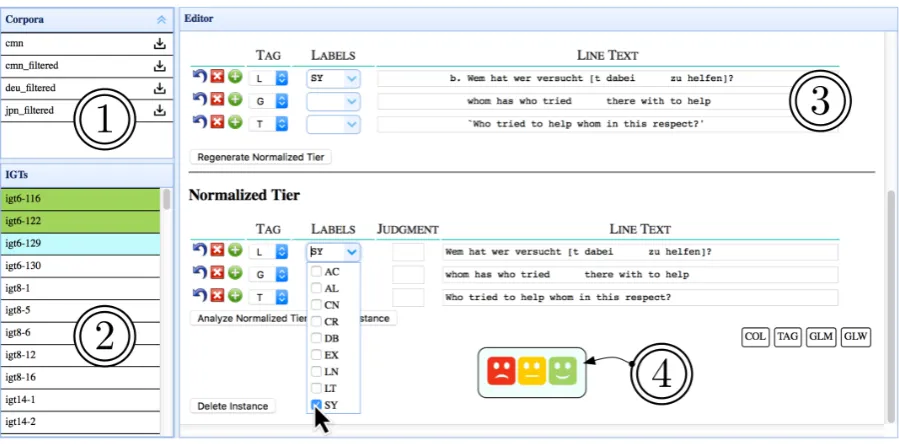
The main interface that end-users will experience at this point is the online editing environment, a screenshot of which is provided in Fig. 3. This browser-based interface allows us to invite an-notators around the world to participate without needing to install Python or any of the supporting packages required to work with the Xigt-formatted ODIN data.
The interface is contained in three main panes; in Fig. 3, labels (1) and (2) mark the corpus and instance browsers, respectively, while the rest of the window is dedicated to the instance editor.
Loading an Instance To start working on an
in-stance, an annotator first selects the corpus from the corpus browser (1) and then the particular in-stance from (2). Inin-stances that have been previ-ously annotated are highlighted with the color of their rating, while the currently displayed instance is highlighted in cyan.
Validating an Instance as IGT Once an
Figure 3: Screenshot of the browser-based editor being used to edit a sentence. (1) and (2) show the corpus and instance browsers, respectively, while (3) labels the instance editing area, and (4) shows the rating system.
GET /corpora
retrieve list of available corpora
GET /corpora/<CID>
retrieve a corpus by its identifier<CID> GET /corpora/<CID>/summary
retrieve a summary of the contents of corpus<CID> GET /corpora/<CID>/igts
retrieve the list of IGTs for corpus<CID>(parameters exist for filtering this list)
GET /corpora/<CID>/igts/<IID>
retrieve a single IGT by its identifier<IID>from cor-pus<CID>
POST /corpora
add a new corpus
POST /corpora/<CID>/igts
add a new IGT to corpus<CID> PUT /corpora/<CID>/igts/<IID>
assign or replace IGT<IID>in corpus<CID> DELETE /corpora/<CID>
delete corpus<CID>
DELETE /corpora/<CID>/igts/<IID>
delete IGT<IID>in corpus<CID>
Figure 4: HTTP methods for the IGT server, where <CID> refers to the corpus identifier and
<IID>the single IGT identifier.
the annotator may click the red “bad quality” rat-ing button to flag that instance. If the instance is IGT and of acceptable quality they may continue onto the next task.
Cleaning After the annotator has verified that
an instance is valid, they may click the Gener-ate Cleaned Tier button to trigger the automatic cleaning procedure described in Section 4.1. The annotator is then given an opportunity to manu-ally correct any errors made by the automatic cor-ruption removal. The cleaning stage only corrects errors introduced by the PDF-to-text conversion process, so for clean instances there is little to be done here. If the annotator has made a mistake or wishes to start over, they may restore the content of an item to the state after automatically clean-ing, or they may regenerate the clean tier entirely by re-invoking the cleaning procedure on the raw data. The raw tier cannot be edited, so the anno-tator can always get back to the original represen-tation. Once satisfied, the annotator may continue to the normalization step.
Normalization By clicking the Generate
Nor-malized Tier button, the annotator triggers the normalization procedure described in Section 4.2. In addition to placing non-IGT information onM
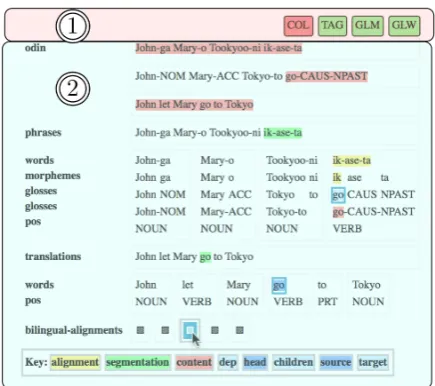
Figure 5: Normalized tier analysis, with the sec-tion labeled (1) showing the annotasec-tion indicator labels and (2) showing the enrichment and align-ment information. The colors highlighted in (2) are to indicate which elements of the IGT in-stance are referenced by another element. Here, the alignment between the English go and the Japaneseikasetas visualized. The titles on the left refer to the tier type represented in the Xigt repre-sentation.6
the annotator may restore the original normalized content of an item or regenerate the normalized tier entirely. At this point, if the annotator be-lieves they have satisfactorily met the normaliza-tion guidelines, they are done editing and continue to the analysis step to ensure the system is able to accurately infer the IGT structure.
Analysis When the annotator clicks theAnalyze
Normalized Tier button, the editor will present an analysis of the IGT such as the one shown in Fig. 5. This analysis includes both a series of in-dicators (1) to alert the annotator to the aforemen-tioned guidelines, and a visualization of the au-tomatic alignment and enrichment (2) performed by INTENT (see Section 4.3). The enrichment in-cludes both the automatic word, morpheme, and gloss segmentation (words,morphemes,glosses, respectively), as well as word alignment between gloss and translation and part-of-speech tags for each line (bilingual-alignments,pos). There are currently four indicators:
COL language and gloss tokens are aligned with whitespace into columns
TAG language, gloss, and translation lines all
ex-ist and have no extraneous metadata on them
GLM language and gloss lines have the same number of morphological units
GLW language and gloss lines have the same number of whitespace-separated tokens
When an indicator shows red, the annotator should go back to the normalization (or possibly, the cleaning) step and make more corrections, then reanalyze. Occasionally an indicator shows red when there is no error; e.g., a word in the language line might have a hyphen that is not a morpho-logical boundary and is thus glossed with a non-hyphenated token. The visualization of the auto-matically aligned and enriched IGT illustrates to the annotator how well the system was able to in-fer the structure of the IGT. Some problems that could not be detected with the indicators may be-come obvious by the presence of incorrect align-ments, and the annotator can use this information to adjust the textual representation until proper alignments are obtained. These two facets of the analysis—indicators and visualization—help the annotator see how usable the instance will be for further processing.
Rating and Saving the Instance Finally, if the
annotator has proceeded to the normalization or analysis steps, they may choose to rate the instance as bad (red), unclean (yellow) or clean (green), de-pending on the level of corruption of the instance. A field is provided to add further comments that will be saved into the IGT file.
User Management Currently, users are
identi-fied by a unique 8-character userid string, that also serves as the login. Annotator accounts are created and a backend corpus management script is used to initialize copies of corpus subsections that are as-signed to the annotators. Annotators’ ratings and comments are saved in these files along with their userid, so that inter-annotator agreement can be quickly and efficiently calculated across selected overlapping corpus segments.
Availability A fully functioning demonstration
of the interface containing Chinese, German, and Japanese instances may be accessed at:
http://editor.xigt.org/user/demo
The source code is released under the MIT license
and is available at:
https://github.com/xigt/yggdrasil
7 Conclusion and Future Improvements
The system we have presented here greatly streamlines the process of refining and display-ing IGT data. Such clean, electronically avail-able IGT data can be of great use to linguists searching for examples of particular phenomena, typologists looking to compare linguistic informa-tion over the thousands of languages for which IGT data is available, and computational linguists looking to build NLP tools for resource-poor lan-guages.
In the future, we hope to further expand the editing capabilities of the system to include giv-ing annotators the ability to edit word alignment and POS tag data. Such annotation would provide a high-quality set of data for typological research, as well as evaluation data for the automatic enrich-ment methods used.
Finally, while the current system is used only for display and editing, we hope to include the ability to search over IGT corpora in a subsequent version of the tool, replacing the current ODIN search capability7.
Acknowledgments
This work is supported by the National Science Foundation under Grant No. BCS-0748919. Any opinions, findings, and conclusions or recommen-dations expressed in this material are those of the authors and do not necessarily reflect the views of the NSF.
References
Dorothee Beermann and Pavel Mihaylov. 2014. TypeCraft collaborative databasing and re-source sharing for linguists. Language re-sources and evaluation48(2):203–225.
Bernard Comrie, Martin Haspelmath, and Balthasar Bickel. 2015. Leipzig glossing rules.
https://www.eva.mpg.de/lingua/ pdf/Glossing-Rules.pdf.
Matthew S Dryer. 2007. Noun phrase structure. In Timothy Shopen, editor,Language Typology and Syntactic Description, Language typology
7http://odin.linguistlist.org/
and syntactic description, Cambridge, United Kingdom, pages 151–205.
Roy Fielding. 2000. Architectural Styles and the Design of Network-based Software Archi-tecture. Ph.D. thesis, University of California, Irvine.
Ryan Georgi. 2016. the INterlinear Text ENrich-ment Toolkit. http://intent-project. info/.
Ryan Georgi, William D Lewis, and Fei Xia. 2014. Capturing divergence in dependency trees to improve syntactic projection. Language Re-sources and Evaluation48(4):709–739.
Ryan Georgi, Fei Xia, and William D Lewis. 2015. Enriching interlinear text using automatically constructed annotators. LaTeCH 2015page 58. Michael Wayne Goodman, Joshua Crowgey, Fei Xia, and Emily M Bender. 2014. Xigt: extensi-ble interlinear glossed text for natural language processing. Language Resources and Evalua-tion49(2):455–485.
Bernd Heine. 2001. Accounting for creole reflex-ive forms. Pidgins and Creoles Archive(8). William D Lewis and Fei Xia. 2010. Developing
ODIN: A Multilingual Repository of Annotated Language Data for Hundreds of the World’s Languages. Literary and Linguistic Computing
25(3):303–319.
Pontus Stenetorp, Sampo Pyysalo, Goran Topi´c, Tomoko Ohta, Sophia Ananiadou, and Jun’ichi Tsujii. 2012. BRAT: a web-based tool for NLP-assisted text annotation. InProceedings of the Demonstrations at the 13th Conference of the European Chapter of the Association for Com-putational Linguistics. Association for Compu-tational Linguistics, pages 102–107.
Luis Von Ahn, Benjamin Maurer, Colin McMillen, David Abraham, and Manuel Blum. 2008. recaptcha: Human-based char-acter recognition via web security measures.
Science321(5895):1465–1468.