Machine Comprehension using Rich Semantic Representations
Mrinmaya Sachan Eric P. Xing
School of Computer Science Carnegie Mellon University
{mrinmays, epxing}@cs.cmu.edu
Abstract
Machine comprehension tests the sys-tem’s ability to understand a piece of text through a reading comprehension task. For this task, we propose an approach us-ing the Abstract Meanus-ing Representation (AMR) formalism. We construct mean-ing representation graphs for the given text and for each question-answer pair by merging the AMRs of comprising sen-tences using cross-sentential phenomena such as coreference and rhetorical struc-tures. Then, we reduce machine compre-hension to a graph containment problem. We posit that there is a latent mapping of the question-answer meaning representa-tion graph onto the text meaning represen-tation graph that explains the answer. We present a unified max-margin framework that learns to find this mapping (given a corpus of texts and question-answer pairs), and uses what it learns to answer questions on novel texts. We show that this approach leads to state of the art results on the task.
1 Introduction
Learning to efficiently represent and reason with natural language is a fundamental yet long-standing goal in NLP. This has led to a series of efforts in broad-coverage semantic representation (or “sembanking”). Recently, AMR, a new seman-tic representation in standard neo-Davidsonian (Davidson, 1969; Parsons, 1990) framework has been proposed. AMRs are rooted, labeled graphs which incorporate PropBank style semantic roles, within-sentence coreference, named entities and the notion of types, modality, negation, quantifi-cation, etc. in one framework.
In this paper, we describe an approach to use
Elaboration
Text:
Snippet Graph:
Alignments:
Hypothesis Graph:
but
have Katie
arg0 dog
arg1
also
mod op1
like
-polarit y
Bows
arg1
op2
be name Sammy
domain
he
poss arg1
but
have Katie
arg0 dog
arg1
also
mod op1
like
-polarit y
Bows
arg1
op2
be name Sammy
domain arg1
be name Sammy
domain
dog poss Katie
prep-of arg1
arg0
arg0
poss
Text: ... Katie also has a dog, but he does not like Bows. ... His name is Sammy. ...
[image:1.595.309.546.232.425.2]Hypothesis: Sammy is the name of Katie’s dog. Question: What is the name of Katie’s dog. Answer: Sammy
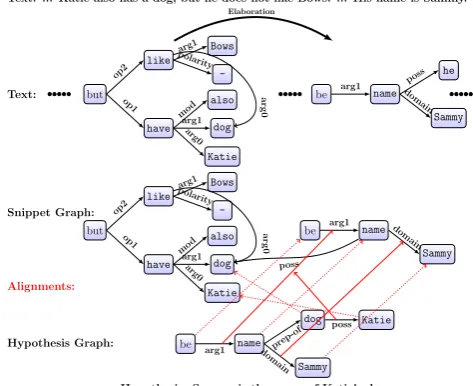
Figure 1: Example latentanswer-entailingstructure from the MCTest dataset. The question and answer candidate are combined to generate a hy-pothesis. This hypothesis is AMR parsed to construct a hypothesis meaning representation graph after some post-processing (§2.1). Similar processing is done for each sentence in the passage as well. Then, a subset (not neces-sarily contiguous) of these sentence meaning representation graphs is found. These representation subgraphs are further merged using coreference informa-tion, resulting into a structure called the relevant text snippet graph. Finally, the hypothesis meaning representation graph is aligned to the snippet graph. The dashed red lines show node alignments, solid red lines show edge alignments, and thick solid black arrow shows the rhetorical structure label (elaboration).
AMR for the task of machine comprehension. Ma-chine comprehension (Richardson et al., 2013) evaluates a machine’s understandingby posing a series of multiple choice reading comprehension tests. The tests are unique as the answer to each question can be found only in its associated texts, requiring us to go beyond simple lexical solutions. Our approach models machine comprehension as an extension to textual entailment, learning to out-put an answer that is best entailed by the pas-sage. It works in two stages. First, we construct a meaning representation graph for the entire pas-sage (§ 2.1) from the AMR graphs of compris-ing sentences. To do this, we account for cross-sentence linguistic phenomena such as entity and
be name
person namename op1 Sammy domain
dog poss person namename op1 Katy prep-of
[image:2.595.82.283.70.110.2]arg1
Figure 2:The AMR parse for the hypothesis in Figure 1. The person nodes are merged to achieve the hypothesis meaning representation graph.
event coreference, and rhetorical structures. A similar meaning representation graph is also con-structed for each question-answer pair. Once we have these graphs, the comprehension task hence-forth can be reduced to a graph containment prob-lem. We posit that there is a latent subgraph of the text meaning representation graph (called snip-pet graph) and a latent alignment of the question-answer graph onto this snippet graph that entails
the answer (see Figure 1 for an example). Then, we propose a unified max-margin approach (§2.2) that jointly learns the latent structure (subgraph selection and alignment) and the QA model. We evaluate our approach on the MCTest dataset and achieve competitive or better results than a number of previous proposals for this task.
2 The Approach
2.1 The Meaning Representation Graphs
We construct the meaning representation graph us-ing individual sentences AMR graphs and mergus-ing identical concepts (using entity and event corefer-ence). First, for each sentence AMR, we merge nodes corresponding to multi-word expressions and nodes headed by a date entity (“date-entity”), or a named entity (“name”) or a person entity (“person”). For example, the hypothesis meaning representation graph in Figure 1 was achieved by merging the AMR parse shown in Figure 2.
Next, we select the subset of sentence AMRs corresponding to sentences needed to answer the question. This step uses cross-sentential phe-nomena such as rhetorical structures1 and en-tities/event coreference. The coreferent enti-ties/event mentions are further merged into one node resulting in a graph called the relevant text snippet graph. A similar process is also
per-1Rhetorical structure theory (Mann and Thompson, 1988)
tells us that sentences with discourse relations are related to each other. Previous works in QA (Jansen et al., 2014) have shown that these relations can help us answer certain kinds of questions. As an example, the “cause” relation between sen-tences in the text can often give cues that can help us answer “why” or “how” questions. Hence, the passage meaning rep-resentation also remembers RST relations between sentences.
formed with the hypothesis sentences (generated by combining the question and answer candidate) as shown in Figure 1.
2.2 Max-Margin Solution
For each question qi ∈ Q, let ti be the corre-sponding passage text and Ai = {ai1, . . . , aim} be the set of candidate answers to the question. Our solution casts the machine comprehension task as a textual entailment task by converting each question-answer candidate pair(qi, aij)into a hypothesis statement hij. We use the question matching/rewriting rules described in Cucerzan and Agichtein (2005) to get the hypothesis state-ments. For each question qi, the machine com-prehension task reduces to picking the hypothe-sisˆhi that has the highest likelihood of being en-tailed by the text ti among the set of hypotheses hi = {hi1, . . . , him} generated for the question
qi. Let h∗
i ∈ hi be the hypothesis corresponding to the correct answer.
As described, we use subgraph matching to help us model the inference. We assume that the se-lection of sentences to generate the relevant text snippet graph and the mapping of the hypothe-sis meaning representation graph onto the passage meaning representation graph is latent and infer it jointly along with the answer. We treat it as a structured prediction problem of ranking the hy-pothesis sethisuch that the correct hypothesish∗i is at the top of this ranking. We learn a scoring functionSw(t, h,z) with parameter w such that
the score of the correct hypothesis h∗
i and corre-sponding best latent structurez∗
i is higher than the score of the other hypotheses and corresponding best latent structures. In a max-margin fashion, we want thatSw(ti, h∗i,z∗i)> S(ti, hij,zij) + 1−ξi for allhj ∈ h\h∗ for some slackξi. Writing the relaxed max margin formulation:
min
||w||
1
2||w||22+C X
i
max
zij,hij∈hi\h∗i
Sw(ti, hij,zij) + ∆(h∗i, hij)
−CX
i
Sw(ti, h∗i,z∗i) (1)
We use 0-1 cost, i.e. ∆(h∗
i, hij) = 1(h∗i 6=
ψ(t, h,z) is a feature map discussed later. The CCCP algorithm essentially alternates between solving for z∗
i, zij ∀j s.t. hij ∈ hi \h∗i and w to achieve a local minima. In the absence of in-formation regarding the latent structurezwe pick the structure that gives the best score for a given hypothesis i.e.arg maxzSw(t, h, z).
2.3 Scoring Function and Inference
Now, we define the scoring functionSw(t, h,z).
Let the hypothesis meaning representation graph be G0 = (V0, E0). Our latent structurez
decom-poses into the selection (zs) of relevant sentences that lead to the text snippet graphG, and the map-ping (zm) of every node and edge in G0 ontoG. We define the score such that it factorizes over the nodes and edges inG0. The weight vectorw
also has three componentsws,wv andwe corre-sponding to the relevant sentences selection, node matches and edge matches respectively. An edge in the graph is represented as a triple (v1, r, v2)
consisting of the enpoint vertices and relationr.
Sw(t, h,z) =wT
sf(G0, G,t, h,zs)
+ X
v0∈V0
wT
vf(v0, zm(v0)) + X e0∈E0
wT
ef(e0, zm(e0))
Here,tis the text corresponding to the hypoth-esish, andf are parts of the feature mapψto be described later. z(v0) maps a nodev0 ∈ V0 to a
node inV. Similarly,z(e0)maps an edgee0 ∈E0
to an edge inE.
Next, we describe the inference procedure i.e. how to select the structure that gives the best score for a given hypothesis. The inference is per-formed in two steps: The first step selects the relevant sentences from the text. This is done by simply maximizing the first part of the score: zs = arg maxzswTsf(G0, G,t, h,zs). Here, we only consider subsets of 1, 2 and 3 sentences as most questions can be answered by 3 sentences in the passage. The second step is formulated as an integer linear program by rewriting the scoring function. The ILP objective is:
X
v0∈V0 X
v∈V
zv0,vwTvf(v0, v) + X
e0∈E0 X
e∈E
ze0,ewTef(e0, e)
Here, with some abuse of notation, zv0,v and
ze0,e are binary integers such that zv0,v = 1iff z
mapsv0 ontovelsezv0,v = 0. Similarly,ze0,e = 1
iffz mapse0 ontoeelse z
e0,e = 0. Additionally,
we have the following constrains to our ILP:
• Each nodev0 ∈V0(or each edgee0 ∈E0) is
mapped to exactly one nodev ∈ V (or one edgee ∈ E). Hence: Pv∈V zv0,v = 1 ∀v0
andPe∈Eze0,e = 1 ∀e0
• If an edge e0 ∈ E0 is mapped to an edge
e ∈ E, then vertices (v1
e0, v2e0) that form the
end points ofe0 must also be aligned to
ver-tices (v1
e, v2e) that form the end points of e. Here, we note that AMR parses also have in-verse relations such as “arg0-of”. Hence, we resolve this with a slight modification. If nei-ther or both relations (corresponding to edges
e0ande) are inverse relations (case 1), we
en-force thatv1
e0 align withve1andv2e0align with
v2
e. If exactly one of the relations is an in-verse relation (case 2), we enforce that v1
e0
align withv2
e andv2e0 align withve1. Hence,
we introduce the following constraints:
ze0e≤zv1
e0v1e andze0e ≤zv2e0v2e ∀e
0.ein case 1
ze0e≤zv1
e0v2e andze0e ≤zv2e0v1e ∀e
0.ein case 2
2.4 Features
Our feature function ψ(t, h,z) decomposes into three parts, each corresponding to a part of the la-tent structure.
The first part corresponds to relevant sentence selection. Here, we include features for match-ing local neighborhoods in the sentence subset and the hypothesis: features for matching bigrams, tri-grams, dependencies, semantic roles, predicate-argument structure as well as the global syntac-tic structure: a graph kernel for matching AMR graphs of entire sentences (Srivastava and Hovy, 2013). Before computing the graph kernel, we re-verse all inre-verse relation edges in the AMR graph. Note that if a sentence subset contains the answer to the question, it should intuitively be similar to the question as well as to the answer. Hence, we add features that are the element-wise prod-uct of features for the subset-question match and subset-answer match. In addition to features for the exact word/phrase match of the snippet and the hypothesis, we also add features using two para-phrase databases: ParaPara (Chan et al., 2011) and DIRT (Lin and Pantel, 2001). These databases contain paraphrase rules of the form string1 →
string2. ParaPara rules were extracted through
have a substring in the text snippet that can be transformed into another using any of these two databases, we keep match features for the sub-string with a higher score (according to the cur-rent w) and ignore the other substring. Finally, we also have features corresponding to the RST (Mann and Thompson, 1988) links to enable infer-ence across sentinfer-ences. RST tells us that sentinfer-ences with discourse relations are related to each other and can help us answer certain kinds of questions (Jansen et al., 2014). For example, the “cause” relation between sentences in the text can often give cues that can help us answer “why” or “how” questions. Hence, we have additional features -conjunction of the rhetorical structure label from a RST parser and the question word as well.
The second part corresponds to node matches. Here, we have features for (a) Surface-form match (Edit-distance), and (b) Semantic word match (cosine similarity using SENNA word vectors (Collobert et al., 2011) and “Antonymy” ‘Class-Inclusion’ or ‘Is-A’ relations using Wordnet).
The third part corresponds to edge matches. Let the edges bee= (v1, r, v2)ande0 = (v01, r0, v02)
for notational convenience. Here, we introduce two features based on the relations - indicator that the two relations are the same or inverse of each other, indicator that the two relations are in the same relation category – categories as described in Banarescu et al. (2013). Then, we introduce a number of features based on distributional rep-resentation of the node pairs. We compute three vertex vector compositions (sum, difference and product) of the nodes for each edge proposed in recent representation learning literature in NLP (Mitchell and Lapata, 2008; Mikolov et al., 2013) i.e. v1 v2 and v01 v02 for = {+,−,×}.
Then, we compute the cosine similarities of the resulting compositions producing three features. Finally we introduce features based on the struc-tured distributional semantic representation (Erk and Pad´o, 2008; Baroni and Lenci, 2010; Goyal et al., 2013) which takes the relations into account while performing the composition. Here, we use a large text corpora (in our experiments, the English Wikipedia) and construct a representation matrix
M(r) ⊂ V × V for every relation r (V is the
vocabulary) where, theijthelementM(r)
ij has the value log(1+x) where x is the frequency for theith andjthvocabulary items being in relationrin the corpora. This allows us to compose the node and
relation representations and compare them. Here we compute the cosine similarity of the compo-sitions (v1)TM(r) and (v01)TM(r0)
, the compo-sitions M(r)v2 and M(r0)
v02 and their repective
sums (v1)TM(r) + M(r)v2 and (v01)TM(r0)
+ M(r0)
v02to get three more features.
2.5 Negation and Multi-task Learning
Next, we borrow two ideas from Sachan et al. (2015) namely, negation and multi-task learning, treating different question types in the machine comprehension setup as different tasks.
Handling negation is important for our model as facts align well with their negated versions. We use a simple heuristic. During training, if we detect negation (using a set of simple rules that test for presence of negation words (“not”, “n’t”, etc.)), we flip the corresponding constraint, now requiring that the correct hypothesis to be ranked below all the incorrect ones. During test phase if we detect negation, we predict the answer corre-sponding to the hypothesis with the lowest score.
QA systems often include a question classifica-tion component that divides the quesclassifica-tions into se-mantic categories based on the type of the ques-tion or answers expected. This allows the model to learn question type specific parameters when needed. We experiment with three task classifi-cations proposed by Sachan et al. (2015). First is QClassification, which classifies the question, based on the question word (what, why, what, etc.). Next is the QAClassification scheme, which classifies questions into different semantic classes based on the possible semantic types of the an-swers sought. The third scheme, TaskClassifica-tion classifies the quesTaskClassifica-tions into one of 20 subtasks for Machine Comprehension proposed in Weston et al. (2015). We point the reader to Sachan et al. (2015) for details on the multi-task model.
3 Experiments
Datasets: We use MCTest-500 dataset
it should not be possible to find the answer to the question with just one sentence of the passage. In a sense, ‘multiple’ questions are harder than ‘single’ questions as they require more complex inference. We will present the results breakdown for ‘single’ or ‘multiple’ category questions as well.
Baselines: We compare our approach to the
fol-lowing baselines: (1-3) The first three baselines are taken from Richardson et al. (2013). SW and
SW+Duse a sliding window and match a bag of words constructed from the question and the can-didate answer to the text. RTE uses textual en-tailment by selecting the hypothesis that has the highest likelihood of being entailed by the pas-sage. (4)LEX++, taken from Smith et al. (2015) is another lexical matching method that takes into account multiple context windows, question types and coreference. (5) JACANAuses an off the shelf aligner and aligns the hypothesis state-ment with the passage. (6-7)LSTM andQANTA, taken from Sachan et al. (2015), use neural net-works (LTSMs and Recursive NNs, respectively). (8) ATTENTION, taken from Yin et al. (2016), uses an attention-based convolutional neural net-work. (9) DISCOURSE, taken from Narasimhan and Barzilay (2015), proposes a discourse based model. (10-14) LSSVM, LSSVM+Negation,
LSSVM+Negation (MultiTask), taken from Sachan et al. (2015) are all discourse aware latent struc-tural svm models. LSSVM+Negation accounts for negation. LSSVM+Negation+MTL further in-coporates multi-task learning based on question types. Here, we have three variants of multitask learners based on the three question classification strategies. (15) Finally, SYN+FRM+SEM, taken from Wang et al. (2015) proposes a framework with features based on syntax, frame semantics, coreference and word embeddings.
Results:We compare our AMR subgraph
contain-ment approach2where we consider our modifica-tions for negation and multi-task learning as well in Table 1. We can observe that our models have a comparable performance to all the baselines in-cluding the neural network approaches and all pre-vious approaches proposed for this task. Further, when we incorporate multi-task learning, our proach achieves the state of the art. Also, our ap-proaches have a considerable improvement over the baselines for ‘multiple’ questions. This shows
2We tune the SVM parameterCon the dev set. We use
Stanford CoreNLP, HILDA parser (Feng and Hirst, 2014) and JAMR (Flanigan et al., 2014) for preprocessing.
Single Multiple All
AMR
Subgraph 67.28 65.24 66.16
Subgraph+Negation 69.48 66.46 67.83
+MTL
QClassification 70.59 67.99 69.17
QAClassification 71.32 68.29 69.67
TaskClassification 72.05 68.90 70.33
Baselines
SW 54.56 54.04 54.28
SW+D 62.99 58.00 60.26
RTE 69.85 42.71 55.01
LEX++ 69.12 63.34 65.96
JACANA Aligner 58.82 54.88 56.67
LSTM 62.13 58.84 60.33
QANTA 63.23 59.45 61.00
ATTENTION 54.20 51.70 52.90
DISCOURSE 68.38 59.90 63.75
LSSVM 61.12 66.67 64.15
LSSVM+Negation 63.24 66.15 64.83
+MTL
QClassification 64.34 66.46 65.50
QAClassification 66.18 67.37 66.83
TaskClassification 67.65 67.99 67.83
[image:5.595.308.538.62.277.2]SYN+FRM+SEM 72.05 67.94 69.94
Table 1:Comparison of variations of our method against several baselines on the 500 dataset. The table shows accuracy on the test set of MCTest-500. All differences between the baselines (exceptSYN+FRM+SEM) and our approaches, and the improvements due to negation and multi-task learning are significant (p <0.05) using the two-tailed paired T-test.
the benefit of our latent structure that allows us to combine evidence from multiple sentences. The negation heuristic helps significantly, especially for ‘single’ questions (majority of negation cases in the MCTest dataset are for the “single” ques-tions). The multi-task method which performs a classification based on the subtasks for machine comprehension defined in Weston et al. (2015) does better than QAClassification that learns the question answer classification. QAClassification in turn performs better than QClassification that learns the question classification only.
These results, together, provide validation for our approach of subgraph matching over mean-ing representation graphs, and the incorporation of negation and multi-task learning.
4 Conclusion
References
[Banarescu et al.2013] Laura Banarescu, Claire Bonial, Shu Cai, Madalina Georgescu, Kira Griffitt, Ulf Hermjakob, Kevin Knight, Philipp Koehn, Martha Palmer, and Nathan Schneider. 2013. Abstract meaning representation for sembanking. In Pro-ceedings of the 7th Linguistic Annotation Workshop and Interoperability with Discourse, pages 178–186, Sofia, Bulgaria, August. Association for Computa-tional Linguistics.
[Baroni and Lenci2010] Marco Baroni and Alessandro Lenci. 2010. Distributional memory: A general framework for corpus-based semantics. Computa-tional Linguistics, 36(4):673–721.
[Chan et al.2011] Tsz Ping Chan, Chris Callison-Burch, and Benjamin Van Durme. 2011. Rerank-ing bilRerank-ingually extracted paraphrases usRerank-ing mono-lingual distributional similarity. InProceedings of the GEMS 2011 Workshop on GEometrical Models of Natural Language Semantics, pages 33–42. [Collobert et al.2011] Ronan Collobert, Jason Weston,
L´eon Bottou, Michael Karlen, Koray Kavukcuoglu, and Pavel Kuksa. 2011. Natural language process-ing (almost) from scratch. The Journal of Machine Learning Research, 12:2493–2537.
[Cucerzan and Agichtein2005] S. Cucerzan and E. Agichtein. 2005. Factoid question answering over unstructured and structured content on the web. InProceedings of TREC 2005.
[Davidson1969] Donald Davidson. 1969. The individ-uation of events. Springer.
[Erk and Pad´o2008] Katrin Erk and Sebastian Pad´o. 2008. A structured vector space model for word meaning in context. In Proceedings of the Con-ference on Empirical Methods in Natural Language Processing, EMNLP ’08, pages 897–906, Strouds-burg, PA, USA. Association for Computational Lin-guistics.
[Feng and Hirst2014] Vanessa Wei Feng and Graeme Hirst. 2014. A linear-time bottom-up discourse parser with constraints and post-editing. In Proceed-ings of the 52nd Annual Meeting of the Association for Computational Linguistics (Volume 1: Long Pa-pers), pages 511–521.
[Flanigan et al.2014] Jeffrey Flanigan, Sam Thomson, Jaime G. Carbonell, Chris Dyer, and Noah A. Smith. 2014. A discriminative graph-based parser for the abstract meaning representation. In Proceedings of the 52nd Annual Meeting of the Association for Computational Linguistics, ACL 2014, June 22-27, 2014, Baltimore, MD, USA, Volume 1: Long Papers, pages 1426–1436.
[Goyal et al.2013] Kartik Goyal, Sujay Kumar Jauhar, Huiying Li, Mrinmaya Sachan, Shashank Srivas-tava, and Eduard H. Hovy. 2013. A structured dis-tributional semantic model for event co-reference.
InProceedings of the 51st Annual Meeting of the As-sociation for Computational Linguistics, ACL 2013, 4-9 August 2013, Sofia, Bulgaria, Volume 2: Short Papers, pages 467–473.
[Jansen et al.2014] Peter Jansen, Mihai Surdeanu, and Peter Clark. 2014. Discourse complements lexical semantics for non-factoid answer reranking. In Pro-ceedings of the 52nd Annual Meeting of the Associa-tion for ComputaAssocia-tional Linguistics (Volume 1: Long Papers), pages 977–986.
[Lin and Pantel2001] Dekang Lin and Patrick Pantel. 2001. Dirt@ sbt@ discovery of inference rules from text. In Proceedings of the seventh ACM SIGKDD international conference on Knowledge discovery and data mining, pages 323–328.
[Mann and Thompson1988] William C Mann and San-dra A Thompson. 1988. {Rhetorical Struc-ture Theory: Toward a functional theory of text organisation}.Text, 3(8):234–281.
[Mikolov et al.2013] Tomas Mikolov, Wen-tau Yih, and Geoffrey Zweig. 2013. Linguistic regularities in continuous space word representations. In Proceed-ings of the 2013 Conference of the North Ameri-can Chapter of the Association for Computational Linguistics: Human Language Technologies, pages 746–751, Atlanta, Georgia, June. Association for Computational Linguistics.
[Mitchell and Lapata2008] Jeff Mitchell and Mirella Lapata. 2008. Vector-based models of seman-tic composition. In ACL 2008, Proceedings of the 46th Annual Meeting of the Association for Compu-tational Linguistics, June 15-20, 2008, Columbus, Ohio, USA, pages 236–244.
[Narasimhan and Barzilay2015] Karthik Narasimhan and Regina Barzilay. 2015. Machine comprehen-sion with discourse relations. In Proceedings of the 53rd Annual Meeting of the Association for Computational Linguistics and the 7th International Joint Conference on Natural Language Processing of the Asian Federation of Natural Language Processing, ACL 2015, July 26-31, 2015, Beijing, China, Volume 1: Long Papers, pages 1253–1262. [Parsons1990] Terence Parsons. 1990. Events in the
Semantics of English, volume 5. In MIT Press. [Richardson et al.2013] Matthew Richardson,
Christo-pher JC Burges, and Erin Renshaw. 2013. Mctest: A challenge dataset for the open-domain machine comprehension of text. In Proceedings of Em-pirical Methods in Natural Language Processing (EMNLP).
[Smith et al.2015] Ellery Smith, Nicola Greco, Matko Bosnjak, and Andreas Vlachos. 2015. A strong lex-ical matching method for the machine comprehen-sion test. InProceedings of the 2015 Conference on Empirical Methods in Natural Language Process-ing, EMNLP 2015, Lisbon, Portugal, September 17-21, 2015, pages 1693–1698.
[Srivastava and Hovy2013] Shashank Srivastava and Dirk Hovy. 2013. A walk-based semantically en-riched tree kernel over distributed word representa-tions. InProceedings of Empirical Methods in Nat-ural Language Processing, pages 1411–1416. [Wang et al.2015] Hai Wang, Mohit Bansal, Kevin
Gimpel, and David A. McAllester. 2015. Machine comprehension with syntax, frames, and semantics. In Proceedings of the 53rd Annual Meeting of the Association for Computational Linguistics and the 7th International Joint Conference on Natural Lan-guage Processing of the Asian Federation of Natural Language Processing, ACL 2015, July 26-31, 2015, Beijing, China, Volume 2: Short Papers, pages 700– 706.
[Weston et al.2015] Jason Weston, Antoine Bordes, Sumit Chopra, and Tomas Mikolov. 2015. Towards ai-complete question answering: A set of prerequi-site toy tasks. arXiv preprint arXiv:1502.05698. [Yin et al.2016] Wenpeng Yin, Sebastian Ebert, and
Hinrich Schtze. 2016. Attention-based convolu-tional neural network for machine comprehension. arXiv preprint arXiv:1602.04341.