The Study of Method for Complex Processing Turgay
Sub-Standard Aluminum-Containing Raw Materials
G. Sarsenbay, L. A. Myltykbaeva, R. A. Abdulwalyev, S. B. Satylganova
Center of Earth Sciences, Metallurgy and Ore Beneficiation, JSC, Science and Education Ministry of the Republic of Kazakhstan Email: ао[email protected]
Received 2012
ABSTRACT
objects of the research are Kazakhstan’s Turgay clay, studied of method for alumina and potassium metasilicate obtaining from Tur-gay sub-standard aluminum raw materials. Concluded that optimal conditions for the process of TurTur-gay clay: reaction temperature 100°C, original solution K2O concentration to 300 g/dm
3
, reaction time 120 min, liquid-solid ratio of 3:1; optimized the conditions of digestion alumina concentrate: original Na2O solution concentration of 400 g/dm3, temperature 280°C, molar ratio CaO : SiO2 =
1. Recovery is 99.6% of alumina digestion under this condition; crystallized solid phase components as Na2O·Al2O3·6H2O sodium
hydroaluminate crystals. Extracted of alumina from solution of sodium hydroaluminate.
Keywords: Potassium Hydroxide Solution; Leaching; Clay; Alumina Concentrate; Sodium Aluminate Solution; Digestion; Desilication; Alumina
1. Introduction
With the reduction of bauxite resources, the application of low- grade aluminum-containing raw materials in aluminum produc-tion will be the key quesproduc-tion. Kazakhstan is rich of low grade bauxite mine (burnt ash, clay), which were the storage of Tur-gay clay long enough to provide raw materials for alumina production [1]. For low grade aluminum ore, chemical benefic-iation processing – alkali leaching to removal some silicon- containing to extraction silicate mineral, and alumina produc-tion by using concentrate can be comprehensive utilizaproduc-tion of raw materials, solve problems of production effectively. Study on alkaline leaching of high-silicon aluminum ore, treated by sodium hydroxide solution and extraction silicate widely visible [2,3], not seen on the potassium hydroxide reports. Potassium silicate as main ingredient for high-quality potassium fertilizer of chloride-free is widely used in agricultural production. For the purpose of this study to complex processing Turgay clay, potassium hydroxide solution used for the first time of low grade aluminum-containing raw materials dressing process, by planning central composite second order rotatable experiment and hydrochemical test, to find the best reaction condition of extraction from Turgay clay industrial alumina and chlorine- free potash fertilizer processing methods.
2. Experimental
2.1. Optimization Process of Clay ore Dressing
Potassium silicate solution and alumina concentrate can be obtained by baking clay leaching by potassium hydroxide solu-tion, using central composite second order rotatable test [4] to find the optimal leaching conditions.
Chemical composition of Turgay’s baking clay samples for experiments is: SiO2 37%; Al2O3 42.6%; Fe2O3 13.8 %; CaO
1.3%; Na2O 0.8%; other 1.5%; A/S=1.15. The experiments and
results: using of the central composite of second order rotata-ble to develop test, factors influencing the leaching effect of three is made for the variable: X1 as the concentration for K2O
in original solution, g/dm3; X2 for leaching time, min; X3 for liquid-solid ratio, percentage of SiO2 into solution (y) selected
[image:1.595.311.538.455.736.2]optimization parameter. Experiment conditions and results of Second order rotatable as shown in Table 1.
Table 1 Conditions and results of experiments.
Ν Conditions, g/dm
3
, min Solution components, g/dm3, %
X1 X2 X3 K2O Al2O3 SiO2 SiO2
1 100 60 2:1 61.1 1.38 98.0 48.21
2 300 60 2:1 211.5 2.46 243.5 79.00
3 100 180 2:1 56.4 1.63 99.5 48.94
4 300 180 2:1 253.8 2.89 228.5 78.40
5 100 60 4:1 61.1 1.13 70.5 69.32
6 300 60 4:1 282.0 2.64 105.0 79.44
7 100 180 4:1 61.1 1.63 72.5 71.29
8 300 180 4:1 282.0 3.13 97.5 82.84
9 31.8 120 3:1 30.25 2.64 26.5 20.93
10 336.4 120 3:1 235.0 1.13 162.5 80.86
11 200 19 3:1 188.0 1.13 95.0 65.02
12 200 221 3:1 188.0 2.64 112.0 76.66
13 200 120 1,31:1 188.0 2.64 208.0 62.26
14 200 120 4,68:1 188.0 0.12 74.0 79.06
15 200 120 3:1 164.5 1.63 114.3 78.23
16 200 120 3:1 188.0 1.13 114.5 78.37
17 200 120 3:1 164.5 1.13 114.0 78.03
18 200 120 3:1 164.5 1.13 115.0 78.71
19 200 120 3:1 164.5 1.63 113.5 77.69
According to the planning of matrix and experimental results the regression equation calculated, the equation is following:
У= 78.14 +13.38Х1 +1.84Х2 +5.61Х3 –8.36Х12 –1.30Х22 –1.36Х32 – 4.83Х13
Analysis equation can reach the following conclusion: the factors influencing the silica into solution of potassium hydroxide, the action of the concentration of alkali solution mostly strong. And compared to other factors, influence of reaction time on the translate silicon dioxide into solution is weak. Combined effects of three factors are more complex; factor values from 0
to 1, optimization parameters (у) grows, factor value is higher than the 1, у value decreases. Three factors affect the complex-ity can be interpreted as, dissolution and precipitation of silicon dioxide in the system are two processes occur simultaneously, the result of precipitation forming insoluble compounds - hydro aluminum silicate of potassium. When baking clay samples contact with potassium hydroxide solution, silicon dioxide
dis-solves faster than the hydrated aluminum silicate, β – cristoba-lite (Beta-SiO2) in quartz and silicon into solution, this solution
(potassium silicate) as the main ingredient for fertilizer produc-tion of potassium is chloride-free. At the same time mullite (3Al2O3.2SiO2) break down into solution, concentration of
alumina in solution at lower relative will exist of alumi-num-silicon complexes, where the proportion of aluminium in silicon atoms as a unit, as reaction continues, the complexes with alkali solution combining format insoluble hydrated alu-minum silicate of potassium. Experiments concluded that the optimal conditions for the process of Turgay clay: reaction temperature 100°C, original solution concentration K2O 300
g/dm3, reaction time 120 min, liquid-solid ratio of 3:1. 2.2. Optimization of Process of Digestion Alumina
Concentrate in Sodium Aluminum Solution
The process of extraction alumina products from alumina con-centrate carried out by hydrochemical methods [5]. Optimal preparation of alumina under leaching condition concentrate chemical composition as follows: SiO2 10.4%; CaO 0.2%; K2O
0.2%; Fe2O3 9.55%; Al2O3 62.8%; other 5.0%; A/S 6.04. Phase
compositions are mainly for Mullite and Hematite, with small amounts of hydrated aluminum silicate of potassium, amorph-ous SiO2 content low, shows many SiO2 in clay in the process
is dissolved of solution. Concentrate aluminum oxide digestion in sodium aluminate solution optimizated by hydrochemical process. Test conditions: temperature of 200~280˚C, time 60 min, original Na2O concentration of sodium aluminate solution
330~450 g/dm3, аk 30, CaO: SiO2 = 1.2~2. Affect of three
[image:2.595.310.535.509.611.2] [image:2.595.311.538.638.721.2]fac-tors of temperature, concentration and calcium oxide on the aluminum recovery shown in Figure 1-3.
Figure 1 test results view, increasing temperatures from 200˚C to 280˚C, percentage of Al2O3 into sodium aluminate
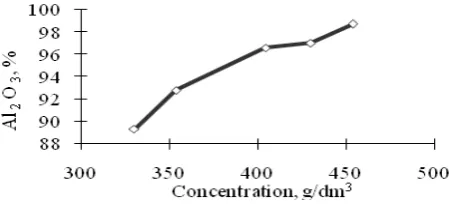
solution accordingly increased from 90.6 % to 97.63% . Figure 2 test results, when concentration gradually increased to 450 from 330 g/dm3, the alumina recovery into solution cor-responding increased from 89.3% to 98.56%.
As shown in Figure 3, when the calcium oxide content in-creased from molar ratio CaO: SiO2 = 1 to 2, alumina recovery
solution corresponding decreased from 99.6% to 94 %. Studied
tration of 400 g/dm3, temperature 280˚C, molar ratio CaO : SiO2 = 1. Recovery is 99.6% of alumina digestion under this
condition.
2.3. Optimization of Process for Desilication of Sodium Aluminate Solution
The chemical composition of sodium aluminate solution from processing alumina concentrate by hydro chemistry method as follows: Na2O 376.7 g/dm3; Al2O3 65.93 g/dm3; SiO2 4.22
g/dm3, α
k 9.4, αk high value of this solution, is not conducive
to decomposition out Al(OH)3 from aluminate solution,
there-fore, needed to be decrease values αk before processing of crys-tallization. This test uses the crystallization from solution of hydrated sodium aluminate, water soluble crystals method gets the αk ~1,6 of sodium aluminate solution. When crystallization,
small amounts of SiO2 will affect the crystallization in solution,
so before the sodium aluminate hydrate, pre-desilication process of sodium aluminate solution. Take into account the effects of concentration on silicon removal efficiency, Na2O
dilute solution concentration from 376.6 g/dm3 to 200 g/dm3, other components as Al2O3 35 g/dm3 accordingly, iO2 2.2
g/dm3.
Calcium oxide for desilication agent, add amount CaO : SiO2
to 1.5, 2 and 3 calculated, reaction time is 30 - 180 min, test conducted in the temperature range of 150-250°C, as shown in Table 2.
Figure 1. The effect of temperature on the aluminum recovery.
ery.
Test results showed highest conditions of sodium aluminate solution desilication rate: reaction temperature 200 °C, CaO added molar ratio CaO : SiO2 is 3, time for 120 min. Under this
condition, sodium aluminate solution desilication rate of 79.5%, solution composition for Na2O 191 g/dm3, Al2O3 34 g/dm3,
SiO2 0.594 g/dm 3, α
k 9,2.
2.4. Study on Formation of Alumina from Desilicated Sodium Aluminate Solution
1) Separating out sodium hydroaluminate crystals from de-
silicated sodium aluminate solution
Consists of sodium aluminate solution crystallization of so-dium hydroaluminate - Na2O·Al2O3·nH2O test: to evaporation
solution concentration of Na2O for 500-550 g/dm3, from which
separation crystals. Test results are shown in Table 3. After enrichment to concentrations of Na2O 548 g/dm3, removal of
sodium aluminate solution concentration to concentrations of Na2O after 548 g/dm3, crystallization temperature of 45°C,
[image:3.595.135.460.238.529.2]under the conditions to quality ratio of 0.05 to join seed crystal, constant stirring. Conditions and results of crystallization shown in Table 3.
Table 2. Experimental conditions and results of desilication of sodium aluminate solution.
N
Conditions Components, g/dm3
Des. rate, %
t,°C CaO:SiO2 min Na2O Al2O3 SiO2
1 100 3 120 182,4 33,7 1,93 13,4
2 150 3 120 188 33,3 0,6 76,8
3 200 3 120 190,5 34 0,594 79,5
4 250 3 120 196 20,1 0,65 75
5 200 1 120 196 30 0,747 66,7
6 200 1,5 120 190 32 1,00 55,6
7 200 2 120 192 33,5 0,56 75
8 200 3 120 191 34 0,47 79,5
9 200 3 30 196 34 0,725 67,6
10 200 3 60 189 33,3 0,6 77
11 200 3 120 191 34 0,594 79
12 200 3 180 188 34 0,67 69,2
Table 3. Experimental conditions and results of crystallization of sodium hydroaluminate.
T
°С T h
Test conditions, composition, g/dm3
Test results composition, g/dm3
Al2O3 Na2O αk Al2O3 Na2O ακ
45 10 91,89 561,1 10 76,67 550,6 11,8
45 20 91,89 561,1 10 71,44 538,5 12,4
45 30 91,89 561,1 10 31,2 527,3 27,8
[image:3.595.138.458.555.720.2]45 50 91,89 561,1 10 27,33 501,8 30,2
Crystallization rate test results in mixing continuously when 50 h reached the highest value. Chemical composition of sepa-rated sodium hydroaluminate crystals: AI2O3 25.5%; Na2O 24.1%;
other 34.2%, αк 1.58 solid phase components as Na2O·Al2O3·6H2O, sodium hydroaluminate crystal x-ray
dif-fraction curve as shown in Figure 4.
2) Extraction of aluminum hydroxide from solution of so-dium hydroaluminate
Separate sodium hydroaluminate crystal αkis 1.58, this wa-ter-soluble crystals available αk value breaks and crystal de-composition conditions of sodium aluminate solution, from which precipitation Al (OH) 3 crystal [6]. Test procedures are as
follows: dissolving sodium hydroaluminate crystal
Na2O·Al2O3·6H2O, get aqueous chemical composition for,
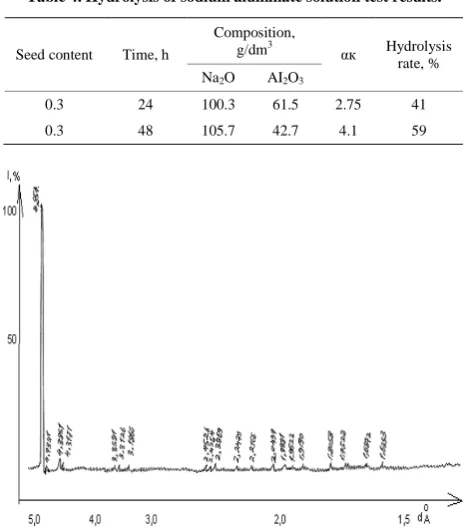
AI2O3 100.9 g/dm3; Na2O 98.1 g/dm3; αk is 1.58, according to the quality of the ratio of 0.3, to join seed – aluminum hydrox-ide in water solution, temperature of 62ºC - 44ºC conditions, to 70 p/min speed mixing hydrolysis of sodium aluminate solution to 48 h. According to table4 test findings, when 24 h reaction, hydrolysis rate of 41%, when 48 h reaction, hydrolysis rate Increased to 59%.(Table 4)
After the complete hydrolysis of sodium aluminate solution, the liquid-solid separation are obtained solid aluminum hy-droxide, chemical components for AI2O3 61.30%, Na2O 0.23%,
other 35.75%, X ray diffraction curve shows the solid formation is divided into size 20-50 µm of gibbsite, as shown in Figure 5.
3) preparation of alumina from aluminum hydroxide From solid aluminum hydroxide under the condition of tem-perature of 1050˚C, calcined 1h we are meeting the criteria of production alumina solid products. Analysis and identification of aluminum oxide crystals derived from chemical composition as: AI2O3 98.5%, Na2O 0.78%, SiO2 0.02%, Ti+V+Gr+Mn
0.01%, ZnO 0.01%, P2O5 0.002%, Fe2O3 0.026%, weight
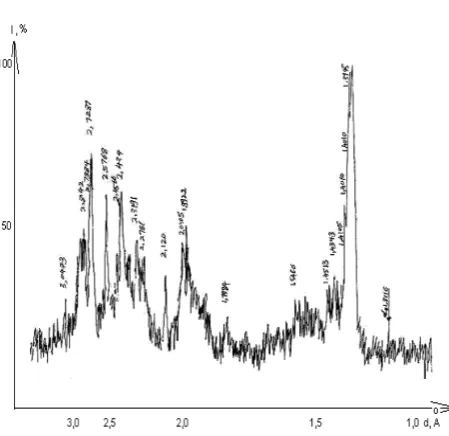
re-duction is 1.2%. X-ray diffraction analysis and its solid groups
are divided into: δ Al2O3, χ · Al2O3,Al2O3, θ Al2O3, κ Al2O3,
[image:4.595.306.540.366.632.2]beta-Al2O3, as shown in Figure 6.
Figure 4. Sodium hydroaluminate crystal x-ray diffraction curve. Table 4. Hydrolysis of sodium aluminate solution test results.
Seed content Time, h
Composition,
g/dm3 αк Hydrolysis
rate, % Na2O AI2O3
0.3 24 100.3 61.5 2.75 41
0.3 48 105.7 42.7 4.1 59
Figure 6 aluminum oxide crystal by x-ray diffraction curve.
3. Summary
By research: summary out KOH solution processing Turgay clay process and sodium aluminate solution digested out alu-mina concentrate process best reaction conditions; Optimization
conditions of dissolving sodium aluminate solution desilication; crystalline solid phase components as Na2O·Al2O3·6H2O
so-dium hydroaluminate crystals; preparation meeting the criteria of production alumina solid products; study for the first time out complex alkaline processing method of clay application of KOH solution.
REFERENCES
[1] Kirpal, G.R., (1970) Kaolin clay and allophone from Northern Kazakhstan / / Clay and mineralogy of their properties and prac-tical value. Moscow, pp.226-228.
[2] Suleyeva N.G., Sherban S.A., Tazhibayeva S.H., Romanov L.G., (1982) Study of solubility of ash components of Ekibastuz coal in alkaline ∥ comprehensive utilization of mineral raw mate-rials. № 3, pp. 62-66.
[3] Bukebayev E.T., Nurmagambetov H.N. Investigation of the process of kaolin clay desilication ∥ comprehensive utilization of mineral raw materials, 1982, № 8, pp.28-31.
[4] Nalimov V.V., Chernova N.A. (1965) Statistical methods of planning extreme experiments, Moscow, p. 330.