COMPARATIVE STUDY OF ANTI-OXIDANT ACTIVITY OF GREEN,
BLACK, WHITE AND OOLONG TEA
Dr. Harsimran Singh Bhalla1*, Dr. Jagdeep Kaur1, Anmol Arora1 and Nitish Kumar1
1
Department of Physiology and Pharmacology, Sri Sai College of Pharmacy, Badhani,
Pathankot, Punjab, India.
ABSTRACT
The present study was investigated to find out anti-oxidant activity of
different types of tea by using in vitro DPPH assay and to compare the
% inhibition and IC50 values of varieties of tea with standard ascorbic
acid. Moreover, phytochemical screening has also been carried out to
evaluate the presence and absence of flavonoids, alkaloids, phenols,
tannins, proteins and amino acids. The study clearly indicated that the
extract of different tea possesses excellent anti-oxidant potential.
Ranking of antioxidant properties of tea extracts were found to be
green tea > Oolong tea > black tea> white tea. For all four teas,
antioxidant property of green tea was significantly higher than extracts
of other tea on the basis of % inhibition and IC50 value. The IC50 of
green tea, ascorbic acid, oolong tea, black tea and white tea were found
to be 2.285, 3.447, 3.607, 4.177 and 7.046 respectively. Hence, it has
been proposed that higher polyphenolic content may be the key mechanism for higher
antioxidant property compared to other types of tea.
KEYWORDS: Tea, oxidative stress, green tea, reactive oxygen species, ascorbic acid.
INTRODUCTION
Tea is Produced from young leaves of Camellia sinensis, it is among one of the most popular
beverages.[1] It is consumed worldwide with 0.12 litre/year per capita and is grown in
approximately 30 countries. Green tea is prepared by preclude the green leaf poly-phenols
oxidation. During the production of black tea, oxidation of most of these substances is
promoted. Oolong tea is partially oxidised product. Green tea retains green colour and almost
all of original polyphenolic content because no fermentation occurs during the processing.
Volume 7, Issue 1, 514-523. Research Article ISSN 2277– 7105
*Corresponding Author
Dr. Harsimran Singh
Bhalla
Assistant Professor,
Department of Physiology
and Pharmacology, Sri Sai
College of Pharmacy,
Badhani, Pathankot, Punjab,
India.
Article Received on 06 November 2017,
Revised on 27 Nov. 2017, Accepted on 18 Dec. 2017
DOI: 10.20959/wjpr20181-10006
Oolong tea is semi fermented while black tea is fully fermented.[2] Tea is usually rich in
polyphenols, including catechins, thearubigins and theaflavins which are involved in the
various health benefits. Tea polyphenols act as antioxidants in vitro by scavenging reactive
oxygen species and nitrogen species and chelating redox-active transition metal ions. They
may also function indirectly as antioxidants through inhibition of the redox-sensitive
transcription factors, nuclear factor-ĸB and activator protein, inhibition of “pro-oxidant”
enzymes, such as inducible nitric oxide synthase (iNOS), lipoxygenases, and xanthine
oxidase; and induction of phase II and antioxidant enzymes, such as glutathione
S-transferases and superoxide dismutases.[3] It is an evergreen tree or shrub that attains a height
of 0.6 - 1.5m when cultivated and 10 - 15 m in the wild.[4]
The leaves are dark green, elliptical or lanceolate, blunt at apex, base is tapering margin
shortly serrate. Leaf blade was symmetric, longley oblong or oblong in shape, abaxially pale
green and glabrous or pubescent. Young leaves are hairy while young leaves are glabrous.[5]
Flowers are white fragrant, 2.5 - 4 cm in diameter, found in solitary or in clusters of two or
four. Flowers bear numerous stamens with yellow anther and produce brownish red capsules.
Fruit is a flattened, smooth, rounded trigons three celled capsule, seed solitary in each, size of
a small nut.[4] Herbal drugs are use of plants for medicinal purposes. About 80% of the
population depends on the herbal drugs because of their efficacy, safety and lesser side
effects. Herbal drugs have great demand in the developed countries. India has richest
medicinal traditional plants in the world. Various advantages of herbal drugs are cheap, easily
available, effective with chronic conditions and widespread availability.[6]
The chemical constituents present in tea are catechins, flavonol, aromatic acids, theaflavins,
thearubigins, pigments, alkaloids, sugar, amino acid, vitamins, cations, metals, lignans and
triterpenoid saponins. It also contains gallic acid caffeine and small amount of theobromine
and theophylline depending on the species and horticultural conditions.[7] The polyphenols in
tea mainly include the following six groups of compounds: flavanols, anthocyanins,
flavonols, hydroxyl-4-flavanols, flavones and phenolic acids. Tea polyphenols which are
important and therapeutic are the flavanols of which catechins (flavan-3-ols) are pre-
dominant and the major ones are:(-)-epicatechin (EC), (-)-epicatechin gallate (ECG), (-)-
epigallocatechin (EGC), (-)-epigallocatechin gallate(EGCG), catechin (C), and
(+)-gallocatechin (GC).[8] Theaflavins, bisflavanols and theaflavic are responsible for antioxidant
Oxidative stress is defined as an imbalance between free radical reactive oxygen species and
antioxidant defence mechanism of the body.[10] ROS are highly reactive molecules which can
damage cell structures such as nucleic acid, carbohydrates, proteins and alter their functions
and lead to cell death.[11] It can cause oxidative DNA damage and lipid peroxidation.[12]
Oxidative stress is involved in various pathological conditions such as hypertension,
ischemia, cancer, pulmonary fibrosis, diabetes, asthma, acute respiratory distress syndrome
and chronic obstructive pulmonary disease.[6] An antioxidant is a molecule that inhibits the
oxidation of other molecules and itself gets oxidized. Antioxidants inhibits cellular damage
through free radical scavenging property by hydrogen donation. Micronutrients antioxidants
are vitamin E, vitamin C and B-carotene.[18] The use of antioxidants in pharmacology is
intensively studied, particularly as treatments for stroke and neurodegenerative diseases.
Antioxidants are widely used in dietary supplements and have been investigated for the
prevention of diseases such as cancer, coronary heart disease and even altitude sickness.
Although initial studies suggested that antioxidant supplements might promote health, later
large clinical trials with a limited number of antioxidants detected no benefit and even
suggested that excess supplementation with certain putative antioxidants may be harmful. As
it has been proved that oxidative stress is main cause in the progression of many diseases and
polyphenols which have an anti-oxidant activity have shown to prevent neuron degeneration
and tumour cell division and other effects such as cardiac protection, hypoglycaemic effect,
anti-inflammatory effect and weight loss. Polyphenols are found more prominently in Tea or
Camellia sinensis herb along with caffeine, amino acids, carbohydrates, proteins, chlorophyll,
volatile compounds, fluoride, minerals and trace elements (Cr, Mn, Se, and Zn).
Polyphenolsare more concentrated in tea leaves.[19] The main objective of this study was to
evaluate the anti-oxidant potential of various types of tea and compared the efficacy with
standard ascorbic acid.
MATERIALS AND METHODS
Plant material
The preparation of white tea, green tea, oolong tea and black tea were purchased from Mann
tea estate, Dharmshala, Distt. Kangra, Himachal Pradesh.
Method of preparation of extract
Infusions were prepared by adding 200 mL of deionised boiling water to 2 g of tea or herbal
mixture was filtered through filter paper and aqueous extract obtained was used for
analysis.[13] Extract was then diluted with distilled water to prepare various dilutions of 10,
20, 40, 60, 80 and 100µg/ml.
Phytochemical screening
Aqueous extracts of teas were screened for the presence of various phytoconstituents such as
Alkaloids, saponins, glycosides, proteins, amino acids, carbohydrates, terpenoids, tannins,
flavonoids, phenolic compounds.[14]
Principle of DPPH Method
DPPH is characterized as stable free radical. The molecule does not dimerize because of
delocalisation of spare electron as a whole over the molecule. This delocalisation of electron
give rise to the deep violet colour characterized by absorbing band in ethanol solution at
about 517nM.[16] Its solution loss characteristic deep blue colour on accepting the hydrogen
from a corresponding donor.[15] Change in the optical density of DPPH is monitored in order
to evaluate the antioxidant potential through free radical scavenging by the test sample.[16]
Procedure for anti-oxidant activity
The working solutions (10, 20, 40, 60, 80, 100 μg/ml) of the extracts were prepared in
methanol. Ascorbic acid was used as standard in 1-100 μg/ml. 1 ml of DPPH solution (0.1
mM in methanol) was mixed with 3 ml of sample extracts and standard solutions separately.
The mixture was shaken thoroughly, wrapped with aluminium foil and kept aside for 30
minutes at room temperature. The decrease of solution absorbance due to proton donating
activity of components of extracts was determined at 517 nm using UV spectrophotometer
Higher free radical scavenging activity was indicated by lower absorbance of reaction
mixture. Vitamin C was used as reference standard. DPPH (3 ml of 0.1 mM) and methanol (1
ml) was used as blank. DPPH radical scavenging activity was calculated using the following
formula:
DPPH radical scavenging activity (% inhibition) = [(A0–A1/A0) × 100]
Where A0 is the absorbance of the blank and A1 is the absorbance of extract mixed with
DPPH. IC50 value (inhibitory concentration at which DPPH radicals where scavenged by
RESULTS
Phytochemical screening
Phytochemical screening of extracts of various types of tea revealed the presence of
[image:5.595.147.453.438.635.2]Alkaloids, saponins, phytosterols, phenols, tannins, flavonoids, proteins and amino acids
(Table 1).
Table 1: Phytochemical screening of test compounds and standard.
Tea
Types Alkaloids Saponins Phytosterols Phenols Tannins Flavonoids
Proteins and amino acids
Green +ve -ve +ve +ve +ve +ve +ve
White +ve -ve +ve +ve +ve +ve +ve
Oolong +ve -ve +ve +ve +ve +ve +ve
Black +ve -ve +ve +ve +ve +ve +ve
Antioxidant activity using DPPH free radical scavenging method
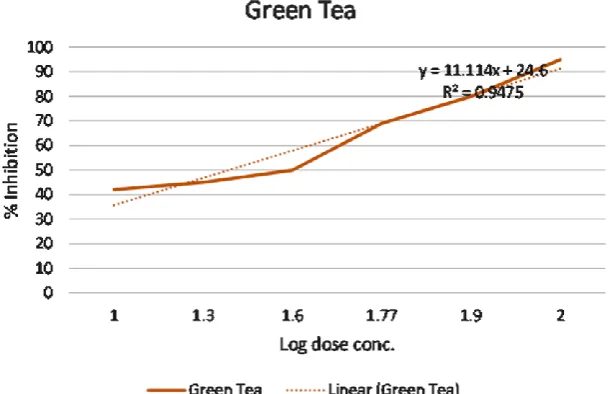
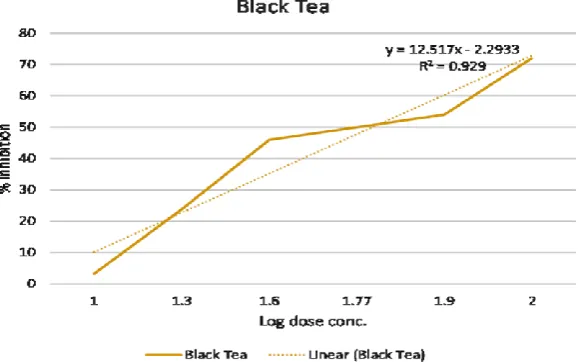
Antioxidant activity of various tea extracts were evaluated by DPPH free radical scavenging
activity with ascorbic acid as standard. The IC50 was calculated for test compound as well as
for standard by linear regression analysis of dose response curve plotting between %
inhibition and log concentration as per table-2 and figures 1-6.
Fig. 2: Effect of white tea as anti-oxidant.
Fig. 3: Effect of oolong tea as anti-oxidant.
[image:6.595.156.446.562.743.2]Fig. 5: Effect of ascorbic acid as anti-oxidant. 0 10 20 30 40 50 60 70 80 90 100
1 1.3 1.6 1.77 1.9 2
% In hi bi ti o n
Log dose conc.
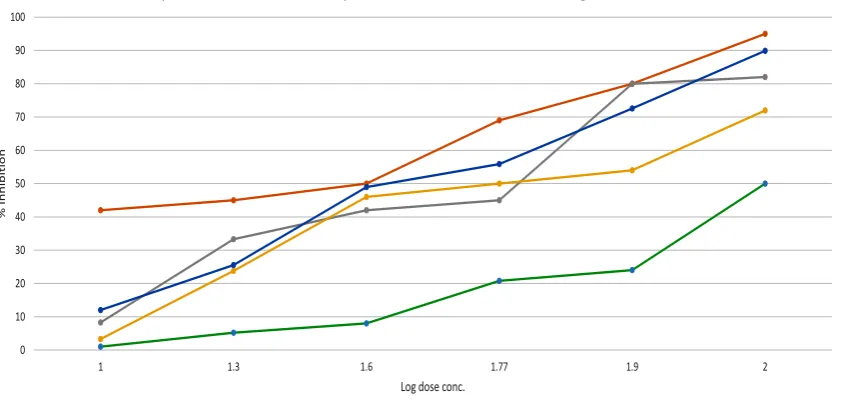
Comparison of anti-oxidant activity of various teas with the standard drug i.e. ascorbic acid
[image:7.595.148.453.83.271.2]White Tea Green Tea Oolong Tea Black Tea Ascorbic Acid
Fig. 6: Comparative anti-oxidant effect of various tea.
Table 2: DPPH free radical scavenging activity of test compounds and standard.
Conc. (μg/mL)
Log Conc.
% Inhibition of different tea samples % inhibition of ascorbic acid (AA) IC 50 values of tea samples IC 50 value of AA White (W) Green (G) Oolong (O) Black (B)
10 1 1 42 8.3 3.3 12
G = 2.285 O = 3.607 B = 4.177 W = 7.046
3.447
20 1.3 5.2 45 33.3 23.8 25.54
40 1.6 8 50 42 46 48.94
60 1.77 20.8 69 45 50 55.87
80 1.9 24 80 80 54 72.59
[image:7.595.91.512.333.535.2]The result showed that on increasing the concentration of the extract there were gradual
increase in the scavenging activity. The descending order of anti-oxidant activity has been
mentioned below:
Green tea > Ascorbic Acid > Oolong Tea > Black Tea > White Tea
IC 50 value of green tea, ascorbic acid, oolong tea, black tea and white tea have been found
to be 2.285, 3.447, 3.607, 4.177 and 7.046 respectively. IC 50 value of green tea was found to
be lower than that of standard ascorbic acid. IC 50 values revealed that Green tea has more
scavenging activity than other varieties of tea.
DISCUSSION
In our study green, black, white and oolong tea were used in various concentration of 10, 20,
40, 60, 80, 100µg/mL were used and these showed a potent antioxidant activity by
scavenging DPPH radicals. Oxidative stress, a causative agent for each and every diseased
conditions in humans. Oxidative stress is either due to increased release of reactive oxygen
species (ROS) or decreased anti-oxidant defence of body. Superoxide ions, hydroxyl ion,
hydrogen peroxide, nitrous oxide, are ROS causing oxidative stress in the body. Oxidative
stress can lead to neuron degeneration, tumour formation, diabetes, aging and others.
Moreover, it also is thought that small amount of OS is also necessary for the body, in order
to counter act the aging process i.e. repairing of damaged tissue or cell and induction of
immune responses in the body. It plays an important role in messenger modulation that
regulate cell membrane function.[11,12]
The preliminary phytochemical screening of green, black, white and oolong tea revealed that
aqueous extract showed the presence of carbohydrates, flavonoids, alkaloids, terpenoids and
phenols. The aqueous extract of Camellia sinensis shows anti-oxidant activity at different
concentration i.e., 10, 20, 40, 60, 80 and 100µg/mL. In our study, green tea revealed its
capacity to scavenge the free radicals by using DPPH method at high concentration followed
by oolong, black and white tea, may be due to the presence of alkaloids and polyphenol
content i.e., thymol and carvacrol. IC50 value of green tea (2.285) was found to be
comparatively lower than the IC50 of ascorbic acid (3.447). Anti-oxidants have great
potential in reducing the levels of ROS in the body. They act either by scavenging or by
neutralizing the ROS and hence reducing the levels of ROS in the body. Antioxidants are
widely used as dietary supplements. However, Clinical trials have also suggested that excess
CONCLUSION
The study revealed that all the varieties of the tea exhibits anti-oxidant potential. Effect
increases as the concentrations of the extracts were increased. Anti-oxidant activity of
different teas may be due to presence of polyphenols present in tea extracts. In addition,
extract of Green tea has shown maximum scavenging activity and hence antioxidant
behavior, which may be due to the presence of higher volume of polyphenolic content
compared to other varieties of tea. Therefore, further studies are warranted to elucidate the
mechanisms responsible for the anti-oxidant at molecular level.
ACKNOWLEDGEMENT
We are grateful to Honorable Chairman Er. S K Punj and Worthy MD Madam Mrs. Tripta
Punj, Director-Principal Prof. A.N. Kalia, Sri Sai College of Pharmacy, Badhani, Pathankot
for their praiseworthy inspiration and constant support for this study.
CONFLICT OF INTEREST
The Author(s) declare(s) that he has no conflicts of interest to disclose.
REFERENCES
1. Chan EW, Soh EY, Tie PP, Law YP. Antioxidant and antibacterial properties of green,
black, and herbal teas of Camellia sinensis. Pharmacogonosy res, 2011 Oct; 3(4): 266.
2. Graham HN. Green tea composition, consumption, and polyphenol chemistry. Prevent
med, 1992 May 1; 21(3): 334-50.
3. Frei B, Higdon JV. Antioxidant activity of tea polyphenols in vivo: evidence from animal
studies. J Nut, 2003 Oct 1; 133(10): 3275S-84S.
4. Mahmood T, Akhtar N, Khan BA. The morphology, characteristics and medicinal
properties of Camellia sinensis tea. J Med Plants Res, 2010 Oct 4; 4(19): 2028-33.
5. Piovan A, Filippini R, Dalla Vecchia F, Caniato R. Comparative Study of Leaf
Morphology, Phenolics and Methylxanthines in Camellia sinensis Teas from the Italian
Market. J Pharmacognosy Phytochem, 2014 Jan 1; 2(5).
6. Kour M, Singh H, Kaur J. In vitro anti-oxidant and anti-inflammatory activities of
hydroalcoholic extract of leaves of Valeriana Jatamansi. IAIM, 2014; 1(3): 18-26.
7. Yashin AY, Nemzer BV, Combet E, Yashin YI. Determination of the chemical
8. Du GJ, Zhang Z, Wen XD, Yu C, Calway T, Yuan CS, Wang CZ. Epigallocatechin
Gallate (EGCG) is the most effective cancer chemopreventive polyphenol in green tea.
Nutrients, 2012 Nov 8; 4(11): 1679-91.
9. Sharma VK, Bhattacharya A, Kumar A, Sharma HK. Health benefits of tea consumption.
Trop J Pharmaceutical Res, 2007; 6(3): 785-92.
10.Burton GJ, Jauniaux E. Oxidative stress. Best Practice & Research Clinical Obstetrics &
Gynaecol, 2011 Jun 30; 25(3): 287-99.
11.Birben E, Sahiner UM, Sackesen C, Erzurum S, Kalayci O. Oxidative stress and
antioxidant . World Aller Organiz J, 2012 Jan 13; 5(1): 9.
12.Yoshikawa T, Naito Y. What is oxidative stress? Japan Med Asso J., 2002; 45(7): 271-6.
13.Rusaczonek A, Swiderski F, Waszkiewicz-Robak B. Antioxidant properties of tea and
herbal infusions-a short report. Polish J Food Nut Sci, 2010; 60(1).
15.Tirzitis G, Bartosz G. Determination of antiradical and antioxidant activity: basic
principles and new insights. Acta biochimica polonica, 2010 Jan 1; 57(1): 139-42.
16.P Alam MN, Bristi NJ, Rafiquzzaman M. Review on in vivo and in vitro methods
evaluation of antioxidant activity. Saudi Pharmaceutical J, 2013 Apr 30; 21(2): 143-52.
17.Negi JS, Bisht VK, Bhandari AK, Sundriyal RC. Effects of extraction solvents on
concentration of valerenic acid and antioxidant property of Valeriana jatamansi jones. Int
J Pharma Bio Sci, 2012; 3(4): 28-35.
18.Lobo V, Patil A, Phatak A, Chandra N. Free radicals, antioxidants and functional foods:
Impact on human health. Pharmacognosy rev, 2010 Jul; 4(8): 118.
19.Rafieian-Kopaei M, Baradaran A, Rafieian M. Oxidative stress and the paradoxical