www.wjpr.net Vol 6, Issue 16, 2017. 1029
A COMPARATIVE STUDY ON THE
IN-VITRO
ANTIOXIDANT
POTENTIALS OF THE STEM BARK, ROOT, LEAF AND FRUIT PULP
OF
ANNONA MURICATA
L.
Renu G., Chittibabu C. V.* and Ranjithkumar A.
Department of Plant Biology and Plant Biotechnology, Presidency College (Autonomous), Chennai – 600 005, Tamil Nadu, India.
ABSTRACT
Annona muricata commonly called soursop, is an edible fruit bearing tree belonging to the Annonaceae family with a long history of traditional use. Various parts of the plant have been traditionally used in treating a plethora of human diseases including fever, malaria, parasitic infections, arthritis and insomnia. The objective of the present study was to assess and compare the antioxidant activities of the methanol extract of the stem bark, root, leaves and fruit pulp of A. muricata using in vitro models such as 1, 1-diphenyl-2-picrylhydrazyl (DPPH) radical, phosphomolybdenum, ferric reducing potential, nitric oxide scavenging, hydroxyl radical scavenging and 2,2'-azino-bis(3-ethylbenzothiazoline-6-sulphonic acid) (ABTS) scavenging assays. While comparing the antioxidant potential of the different parts, the root and stem bark displayed the highest DPPH scavenging activities with IC50 values of 17.04µg/ml and 20.21µg/ml. The maximum inhibition percentage for phosphomolybdenum assay at 100µg/ml was obtained for stem bark (89.23%) followed by fruit pulp (88.61%). The stem bark also showed maximum ferric reducing power, nitric oxide scavenging activity and ABTS antiradical property with IC50 values of 41.95 µg/ml, 16.12µg/ml and 14.19µg/ml respectively. The fruit pulp exhibited the strongest hydroxyl radical scavenging activity (52%) followed by leaf (48%) at 100µg/ml concentration. Values were comparable with standard ascorbic acid. These findings suggest that the extracts of A.muricata possess potent
in vitro antioxidant activity, capable of protection against free radical mediated damage and may have applications in preventing and curing various diseases.
Volume 6, Issue 16, 1029-1043. Research Article ISSN 2277–7105
Article Received on 14 October 2017,
Revised on 03 Nov. 2017, Accepted on 24 Nov. 2017
DOI: 10.20959/wjpr201716-10263
*Corresponding Author Dr. Chittibabu C. V.
Associate Professor &
Research Supervisor
Department of Plant Biology
and Plant Biotechnology,
Presidency College
(Autonomous) Chennai-600
www.wjpr.net Vol 6, Issue 16, 2017. 1030 KEYWORDS: Annona muricata, antioxidant activity, free radicals, IC50 values.
INTRODUCTION
Reactive oxygen species (ROS) and reactive nitrogen species (RNS) are generated in our body through normal cellular metabolism, exposure to different physiochemical conditions or pathophysiological states.[1,2] These free radicals have been implicated in more than one hundred disorders in humans including atherosclerosis, arthritis, ischemia and reperfusion injury of various tissues, central nervous system injury, gastritis, cancer and AIDS.[3] In the past decade, a number of studies have confirmed that increasing the antioxidant intake can prevent diseases and lower the health problems caused by free radicals.[4] Currently available synthetic antioxidants like butylated hydroxy anisole (BHA) and butylated hydroxyl toluene (BHT) have been suspected to be toxic and carcinogenic.[5] Hence, there is a trend to substitute them with naturally occurring antioxidants. Besides well-known antioxidants like tea, spices, fruits and vegetables which are commercially exploited, other medicinal plant species are also being investigated in the search for antioxidants.[6,7] Many plant-derived substances, collectively termed “phytonutrients,” or “phytochemicals,” are becoming increasingly known for their antioxidant activity.[8] Antioxidants from plants may act as reducing agents, hydrogen donors, free radical scavengers, singlet and triplet oxygen quenchers or peroxide decomposers and therefore play an important role in adsorbing and neutralizing free radicals.[9,10]
Annona muricata L. is a member of the Annonaceae family with a long history of traditional use. It is commonly called soursop, graviola, guanabana, corossol and is known as mullu seetha in tamil. It was one of the first trees to be carried from America to the old world tropics and has now become widely distributed throughout the tropical and subtropical parts of the world including India, Malaysia and Nigeria.[11] The tree is low-branching and slender reaching a maximum of 25 or 30 ft in height. The young branches are glabrous. The leaves are alternate, smooth, oblong, glossy and highly aromatic when crushed. The fruits are more or less heart-shaped or oval and range in diameter between 15-20 cms. The fruit is compound with white flesh and reddish brown seeds. The pulp is enclosed in an inedible, bitter skin covered with pliable spines.[12]
www.wjpr.net Vol 6, Issue 16, 2017. 1031
antibacterial activity against numerous pathogens and the bark has also found to have antifungal properties.[14,15,16] In vitro models, such as ABTS, nitric oxide and hydroxyl radicals have shown that the antioxidant activity of the leaves of A. muricata is stronger than other Annona species like A. squamosa and A. reticulata.[17] The seeds and leaves of the plant are reported to posses enzymatic antioxidants, including catalase and superoxide dismutase and non-enzymatic antioxidants including vitamin C and E. Also, several antioxidant compounds such as phenols (gallic acid and chlorogenic acid), flavanoids, anthocyanins, ascorbic acid, tocopherols, carotenoids and acetogenins have been found in soursop leaf, seed and pulp.[18,19]
Though A. muricata has been studied for its antioxidant property, there are few studies that comprehensively compare the in vitro antioxidant activity of different parts of the plant. The present study utilised the methanol extract from the leaves, stem bark, root and fruit pulp of
A. muricata, to find their antioxidant potential through various in vitro assays.
MATERIALS AND METHODS
Collection and identification of plant material
Fresh plant parts (stem bark, root and leaves) were collected during September 2015 from Nagercoil, Kanyakumari District, Tamil Nadu, India. Fresh fruits at commercial ripeness were purchased from local market in Marthandam region of Kanyakumari District. The taxonomic identity of the plant was confirmed by AnExcursion Flora of Central Tamil Nadu, India (Matthew KM, 1991).[20]
Preparation of plant extracts
www.wjpr.net Vol 6, Issue 16, 2017. 1032 Estimation of Radical Scavenging Activity using DPPH Assay
The antioxidant activity of the extracts was determined in terms of hydrogen donating or radical scavenging ability using the stable DPPH (1, 1-diphenyl-2-picrylhydrazyl) radical, according to the method of Chang et. al., (2008) with small modification.[22] Sample extract at various concentrations was taken and the volume was adjusted to 1ml with dimethyl sulphoxide (DMSO). 2ml of methanol solution of DPPH (0.1 mM) was added and shaken vigorously. The setup was left in dark at room temperature for 20 minutes. The absorbance of the sample was measured at 517nm. Ascorbic acid was used as standard. Radical scavenging activity was expressed as the inhibition percentage of free radical by the sample and was calculated using the formula.
%DPPH radical scavenging activity (%RSA) = (Abscontrol- Abssample /Abscontrol) × 100
Abs control is the absorbance of DPPH + DMSO; Abs sample is the absorbance of DPPH radical
+ plant extract. Measurements were performed in triplicates. Absorbance values were corrected for radical decay using blank solutions. The IC50 (Concentration providing 50%
inhibition) was calculated.
Phosphomolybdenum assay
The antioxidant capacity of the samples was evaluated by the formation of green phosphomolybdenum complex according to the method of Prieto et. al.(1999).[23] 10mg of plant extract was dissolved in 1ml of DMSO. An aliquot of 100µl sample solution was combined with 1ml of reagent solution (0.6M sulphuric acid, 28mM sodium phosphate and 4mM ammonium molybdate) in a 4ml vial. The vials were capped and incubated in a water bath at 95ºC for 90 min. After the samples had cooled to room temperature, the absorbance of the mixture was measured at 695 nm against a blank. Ascorbic acid (10mg/ml DMSO) was used as standard. The IC50 values of the different extracts at various concentrations were
calculated.
Ferric reducing antioxidant potential (FRAP) assay
www.wjpr.net Vol 6, Issue 16, 2017. 1033
(0.1%) was added to the mixture. The absorbance at 700nm was measured. The experiment was done in triplicate and the IC50 values were calculated.
Nitric oxide scavenging assay
The nitric oxide scavenging activity was estimated by the use of Griess Ilosvoy reaction (Green et. al 1982).[25] The compound Sodium nitroprusside is known to decompose in aqueous solution at physiological pH 7.2 producing NO. Under aerobic conditions, NO reacts with oxygen to produce stable compounds (nitrate and nitrite). The quantities of the stable compounds formed can be determined using Griess reagent. Scavengers of nitric oxide combine with oxygen leading to reduced production of nitrite ions. In this assay, 1ml of sodium nitroprusside (10mM) in phosphate buffered saline was mixed with different concentrations (20-100 µg/ml) of methanol extract of different parts were dissolved in methanol and made up to 1ml. This mixture was incubated at 30ºC for 180 min. The same reaction mixture without the extract served as the control. After the incubation period, 0.5ml of Griess reagent Solution A (1% sulphanilamide and 2% phosphoric acid) and Solution B (0.1% N-(1-naphthyl ethylenediamine dihydrochloride) was added. The absorbance was immediately read at 550nm. Inhibition of nitrite formation by the plant extracts and the standard antioxidant ascorbic acid were calculated relative to the control. IC50 which is the
inhibition concentration of the extract required to reduce 50% of nitric oxide radical formation was determined.
Hydroxyl radical scavenging assay
www.wjpr.net Vol 6, Issue 16, 2017. 1034
reagent blank. The percentage hydroxyl radical scavenging activity is calculated by the following formula.
%HRSA = [(A0-A1)/A0] × 100,
Where A0 is the absorbance of the control and A1 is the absorbance of the extract/standard.
ABTS radical scavenging assay
The ABTS (2,2'-azino-bis(3-ethylbenzothiazoline-6-sulphonic acid) scavenging assay was performed with slight modifications to the method described by Delgado-Andrade et al.[27] The ABTS+ cations were produced by the reaction between 7mM ABTS in distilled water and 2.45mM ammonium persulphate, stored in the dark at room temperature for 12-16 hours. Prior to use the solution was diluted with methanol to get an absorbance of 1.1±0.2 at 734 nm. Free radical scavenging activity was assessed by mixing 200µl of sample with 0.5ml of ABTS reagent. The solutions were incubated in dark for 2 hours. The decrease in absorbance was measured using a spectrophotometer. The percentage inhibition was calculated using the formula.
ABTS radical scavenging activity (%) = [(A0-A1)/A0] × 100
Where A0 is the absorbance of the control and A1 is the absorbance of the sample.
RESULTS AND DISCUSSION
Various concentrations ranging from 20-100 µg/ml of the methanol extract of the stem bark, root, leaves and fruit pulp were tested for their antioxidant activity using different in vitro
models. It was observed that free radicals were scavenged in a dose-dependent manner in all models. The results of the experiments are presented in Tables 1-4 as a comparative account of the various in vitro antioxidant models.
Table 1: Effect of stem bark methanol extract of A. muricata on different antioxidant
models.
Conc. (µg/ml)
DPPH assay
Phosphomolybdenum assay
Ferric reducing power assay
Nitric oxide scavenging
assay
Hydroxyl radical scavenging
assay
ABTS radical scavenging
assay
Inhibition (%)*
20 49.47 86.66 43.57 62 15.77 70.47 40 57.05 86.85 47.67 71.32 20.25 74.16 60 61.81 87.03 57.26 72.72 20.46 78.31 80 63.74 87.77 59.42 73.65 20.68 85.35 100 75.18 89.23 61.85 74.47 24.3 87.77 IC50
www.wjpr.net Vol 6, Issue 16, 2017. 1035
*-values are mean of 3 replicates
Table 2. Effect of root methanol extract of A. muricata on different antioxidant models
Conc. (µg/ml) DPPH assay Phosphomolybdenum assay Ferric reducing power assay Nitric oxide scavenging assay Hydroxyl radical scavenging assay ABTS radical scavenging assay Inhibition (%)*
20 58.67 73.30 39.32 44.40 19.46 55.16 40 60.84 76.29 40.52 51.9 21.53 56.09 60 64.36 77.36 42.13 56.17 22.17 58.53 80 68.70 79.50 45.70 59.20 24.94 60.51 100 76.15 80.56 52.18 64.91 27.07 66.78 IC50
[image:7.595.65.536.122.301.2](µg/ml) 17.04 13.64 95.82 38.53 184.70 18.12 *-values are mean of 3 replicates
Table 3: Effect of leaf methanol extract of A.muricata on different antioxidant models.
Conc. (µg/ml) DPPH assay Phosphomolybdenum assay Ferric reducing power assay Nitric oxide scavenging assay Hydroxyl radical scavenging assay ABTS radical scavenging assay Inhibition (%)*
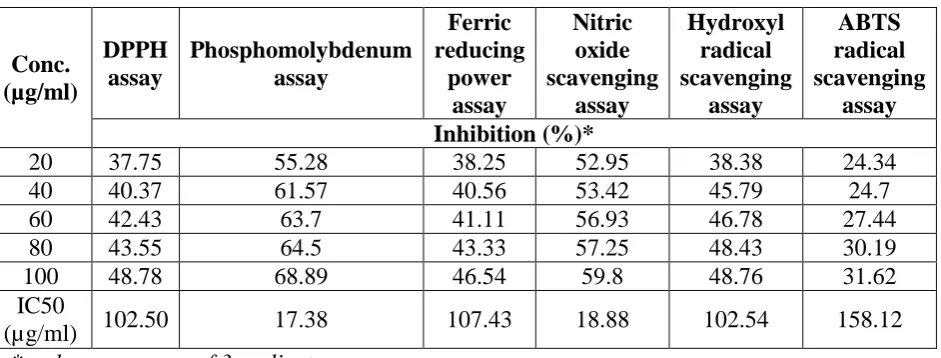
20 37.75 55.28 38.25 52.95 38.38 24.34 40 40.37 61.57 40.56 53.42 45.79 24.7 60 42.43 63.7 41.11 56.93 46.78 27.44 80 43.55 64.5 43.33 57.25 48.43 30.19 100 48.78 68.89 46.54 59.8 48.76 31.62 IC50
(µg/ml) 102.50 17.38 107.43 18.88 102.54 158.12 *-values are mean of 3 replicates
Table 4: Effect of fruit pulp methanol extract of A. muricata on different antioxidant
models. Conc. (µg/ml) DPPH assay Phosphomolybdenum assay Ferric reducing power assay Nitric oxide scavenging assay Hydroxyl radical scavenging assay ABTS radical scavenging assay Inhibition (%)*
20 34.6 70.63 46.93 44.97 36.4 20.46 40 37.45 75.33 48.23 51.67 43.82 23.04 60 39.54 82.87 48.79 52.47 48.1 23.27 80 43.34 85.31 49.56 61.56 46.62 25.02 100 49.08 88.61 50 67.3 52.05 29.23 IC50
[image:7.595.66.537.349.528.2]www.wjpr.net Vol 6, Issue 16, 2017. 1036
*-values are mean of 3 replicates.
DPPH Radical Scavenging activity
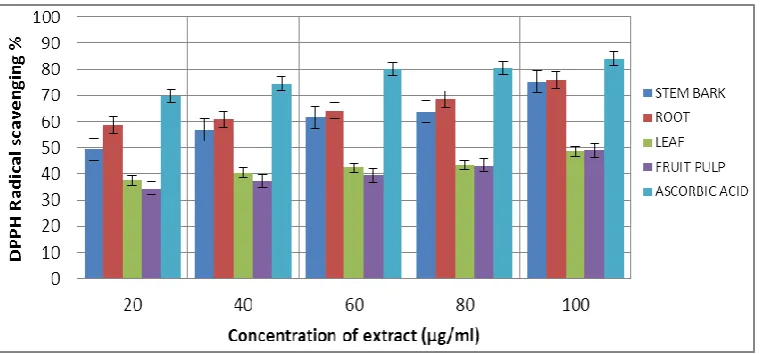
DPPH radical scavenging activity is widely used to evaluate the free radical scavenging capacity of antioxidants.[28] The antioxidant present in the sample react with 1, 1-diphenyl-2-picrylhydrazyl, which is a stable free radical, and convert it to 1,1-diphenyl-2-(2,4,6- trinitrophenyl) hydrazine. The degree of discolouration indicates the scavenging potentials of the antioxidant compounds which can be detected spectrophotometrically at 517nm. All the extracts showed significant free radical scavenging ability in a dosage dependant manner and the results are depicted with ascorbic acid as reference (Fig 1). Concentration of sample required to decrease initial concentration of DPPH to 50% (IC50) under experimental
conditions was also calculated. A lower IC50 value indicates a higher antioxidant activity. The
IC50 value of the stem bark, root, leaf and fruit pulp extract were found to be 20.21µg/ml,
17.04µg/ml, 102.50µg/ml and 101.87µg/ml respectively in comparison to the standard ascorbic acid, the IC50 value of which was determined to be 14.3 µg/ml. Previous studies on
[image:8.595.109.490.470.647.2]the ethanol leaf extract, ethanol extract of the seed, methanol and aqueous extracts of the seed and fruit pulp show that this plant exhibits significant antioxidant activity.[29 ,30] These results are consistent with earlier findings, in that the methanol extract of the leaf, stem bark, root and fruit pulp also showed a dose-dependent increase in antioxidant activity.
Fig 1: Comparative DPPH scavenging activity of stem bark, root, leaf and fruit pulp of
A.muricata with reference to ascorbic acid.
Phosphomolybdenum assay
www.wjpr.net Vol 6, Issue 16, 2017. 1037
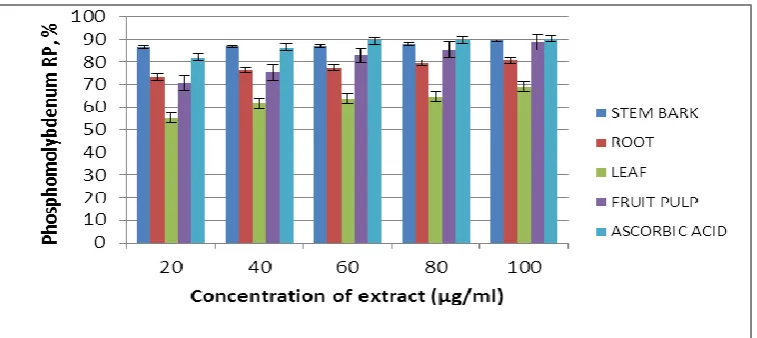
acid pH. The Phosphomolybdenum assay is routinely applied in the laboratory to evaluate the total antioxidant capacity of plant extracts.[31] This assay is a quantitative method to investigate the reduction reaction rate among antioxidant, oxidant and molybdenum ligand. It involves in thermally generating auto-oxidation during prolonged incubation period at higher temperature. It gives a direct estimation of reducing capacity of antioxidant.[32] The methanol extracts of the four different parts of the plant showed potent total antioxidant capacity. The total antioxidant effects of the different extracts are represented in Fig 2. The minimum IC50
value was obtained for stem bark (11.53µg/ml) and the maximum for fruit pulp (39.5 µg/ml). IC50 values of root and leaf samples were determined to be 13.64 µg/ml and 18.08 µg/ml
respectively.
Fig 2: Comparative phosphomolybdenum reduction potential of stem bark, root, leaf
and fruit pulp of A.muricata with reference to ascorbic acid.
Ferric ion reducing antioxidant power assay
The ferric reducing antioxidant power is widely used in the evaluation of the antioxidant component in dietary polyphenols.[33] The reducing power of the methanol extract of the different parts of A. muricata was significantly lower than that of the standard ascorbic acid. The IC50 value obtained for the stem bark (41.95 µg/ml) was followed by root (95.82 µg/ml),
[image:9.595.110.489.291.460.2]www.wjpr.net Vol 6, Issue 16, 2017. 1038 Fig 3: Comparative ferric reducing potential of stem bark, root, leaf and fruit pulp of
A.muricata with reference to ascorbic acid.
Nitric oxide scavenging assay
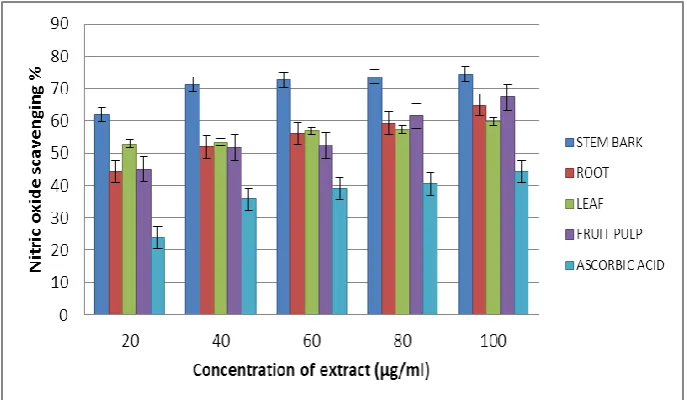
Nitric oxide is a potent pleiotropic inhibitor of physiological processes such as smooth muscle relaxation, neuronal signalling, inhibition of platelet aggregation and regulation of cell mediated toxicity. It is a diffusible free radical that plays many roles as an effector molecule in diverse biological systems including neuronal messenger, vasodilatation and antimicrobial and antitumour activities.[36] The scavenging of NO by the extract was increased in concentration dependent manner. Fig 4 illustrates a significant decrease in the NO radical due to the scavenging ability of the extracts and ascorbic acid. The stem bark showed the greatest radical scavenging ability with an IC50 value of 16.12 µg/ml followed by
leaf (18.89 µg/ml), root (38.53 µg/ml) and fruit pulp (38.70 µg/ml).
Fig 4: Comparative nitric oxide scavenging potential of stem bark, root, leaf and fruit
[image:10.595.123.477.71.240.2] [image:10.595.126.470.522.722.2]www.wjpr.net Vol 6, Issue 16, 2017. 1039 Hydroxyl radical scavenging assay
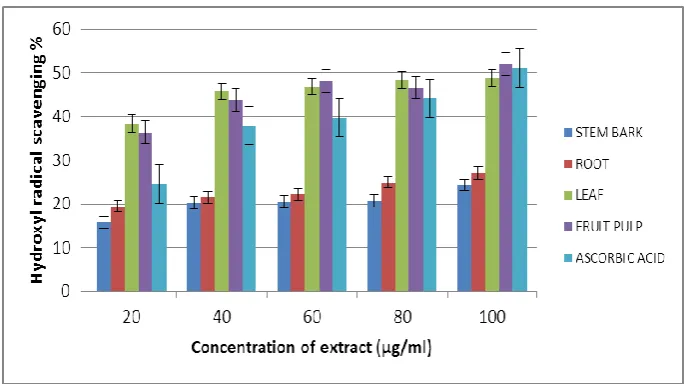
Hydroxyl radical is a form of reactive oxygen species (ROS) associated with arthritis and is cytotoxic, mutagenic and involved in disease pathogenesis.[37] These radicals are produced in the body through various biological reactions; one of the common reactions is the Iron (II) based Fenton reaction.[38] The scavenging capacity of the various methanol extracts of
[image:11.595.126.469.290.482.2]A.muricata is given in Fig 5. The fruit pulp exhibited the strongest hydroxyl radical scavenging activity(52%) followed by leaf (48%), while the root (27%) and stem bark (24%) at 100µg/ml concentration, were found to be weaker scavengers. The radical scavenging capacity may be attributed to phenolic compounds in the extract with the ability to accept electrons, which can combine with free radical competitively to decrease hydroxyl radical.[39]
Fig 5: Comparative hydroxyl scavenging potential of stem bark, root, leaf and fruit pulp
of A.muricata with reference to ascorbic acid.
ABTS radical scavenging assay
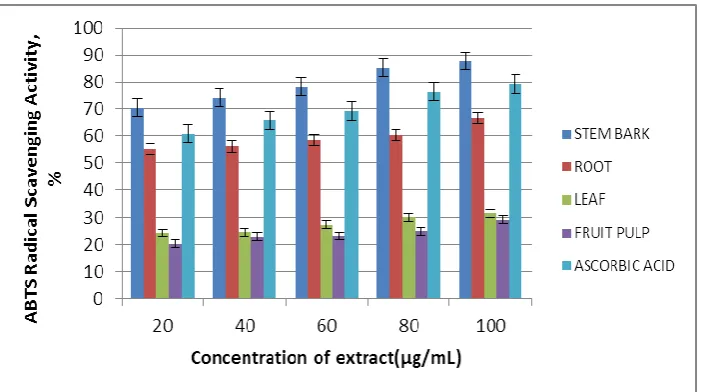
The scavenging capacities of various extracts for the ABTS radical were measured and compared (Fig 6). It was seen that the scavenging activity of all extracts increased with increasing concentration. As in the case of DPPH radical scavenging, the stem bark exhibited the highest ABTS antiradical property with IC50 value of 14.19µg/ml. In addition, the root
also showed strong ABTS scavenging activity with IC50 value of 18.12 µg/ml. The IC50
www.wjpr.net Vol 6, Issue 16, 2017. 1040 Fig 6: Comparative ABTS scavenging potential of stem bark, root, leaf and fruit pulp of
A.muricata with reference to ascorbic acid.
CONCLUSION
In the present investigation, the extracts of Annona muricata have exhibited outstanding scavenging effects on DPPH, nitric oxide, ABTS radicals and pronounced reducing powers. However, the extracts showed only moderate hydroxyl scavenging potential. Experimental results show that all the analysed parts (stem bark, root, leaves and fruit pulp) of A. muricata
have good antioxidant reserves and exhibits dose dependent antioxidant activity. Since, this investigation is a preliminary study, a detailed analysis of the antioxidant mechanisms of specific phytocomponents and in vivo antioxidant studies are necessary. Nevertheless, based on the above presented results, A. muricata can be considered for further investigation towards therapeutic application.
ACKNOWLEDGEMENT
The first author is grateful to Dr. P. Arumugam, Director, ARMATS Biotek, Maduvankarai, Chennai for providing the laboratory facilities to carry out the research work successfully.
REFERENCES
1. Valko M, Leibfritz D, Moncol J, Cronin MTD, Mazur M, Telser J. Free radicals and antioxidants in normal physiological functions and human disease. Int. J. Biochem. Cell Biol, 2007; 39: 44-84.
www.wjpr.net Vol 6, Issue 16, 2017. 1041
3. Bagchi D, Bagchi M, Sidney JS, Dipak KD, Sidhartha DR, Charles AK, Shantaram SJ and Harry GP. Free radicals and grape seed proanthocyanidin extract: importance in human health and disease prevention. Toxicology, 2000; 148: 187–197.
4. Hajhashemi V, Vaseghi G,Pourfarzam M, and Abdollahi A. Are antioxidants helpful for disease prevention? Res Pharm Sci, 2010; 5(1): 1–8.
5. Barlow SM, Toxicological aspects of antioxidants used as food additives. Food Antioxidants, Hudson BJF (ed.). Elsevier, London, 1990; 253-307.
6. Koleva II, van Beek TA, Linssen JP, de Groot A, Evstatieva LN. Screening of plant extracts for antioxidant activity: a comparative study on three testing methods. Phytochem Anal, 2002; 13(1): 8-17.
7. Oke JM, Hamburger MO. Screening of some Nigerian medicinal plants for antioxidant activity using 2, 2-diphenyl- picryl- hydrazyl radical. Afric J Biomed Res, 2002; 5: 77–79. 8. Percival M. Antioxidants. Clinical nutrition insights. Advanced Nutrition Publications,
Inc., Revised, 1998
9. Ashana E, Sathish Kumar M, Rebecca J, Sindhu S, Anbarasi P, Sagadevan E and Arumugam P. Evaluation of antiproliferative effect of Grewia hirsuta on HepG2 cell lines. Journal of Academia and Industrial Research, 2013; 2(1): 1-5.
10.Manach C, Morand C, Crespy V, Demigne C, Texier O, Regerat F and Remesy C. Quercetin is recovered in human plasma as conjugated derivatives which retain antioxidant properties. FEBS Lett, 1998; 426: 331-336.
11.Moghadamtousi SZ, Fadaeinasab M, Nikzad S, Mohan G, Ali HM and Kadir HA.
Annona muricata (Annonaceae): A review of its traditional uses, isolated acetogenins and biological activities. Int. J. Mol. Sci, 2015; 16: 15625-15658.
12.Morton JF. The Soursop or Guanabana (Annona muricata Linn.). Florida State Horticultural Society, 1966; 355-366.
13.Holdsworth DK. Traditional Medicinal Plants of Rarotonga, Cook Islands. Part I. Int. J. Crude Drug Res, 1990; 28(3): 209-218.
14.Misas C, Hernandez N and Abraham A. Contribution to the biological evaluation of Cuban plants. Rev Cubana Med Trop, 1979; 31: 29-35.
15.Sundarrao K. Preliminary screening of antibacterial and anti-tumor activities of Papua New Guinean active medicinal plants. J Int Pharmacol, 1993; 31: 3-6.
www.wjpr.net Vol 6, Issue 16, 2017. 1042
17.Baskar R, Rajeswari V and Sathish Kumar T. In vitro antioxidant studies in leaves of Annona species. Indian J Exp Biol, 2007; 45: 480-485.
18.Vijayameena C, Subhashini G, Loganayagi M and Ramesh B. Phytochemical screening and assessment of antibacterial activity for the bioactive compounds in Annona muricata.
Int. J. Curr. Microbiol. Appl. Sci, 2013; 2: 1-8.
19.Akomolafe SF and Ajayi OB. A comparative study on antioxidant properties, proximate and mineral compositions of the peel and pulp of ripe Annona muricata (L.) fruit. Int Food Res J, 2015; 22(6): 2381-2388.
20.Matthew KM. An excursion flora of Central Tamil Nadu, India. AA Balkema, Rotterdam, 1995.
21.Eloff JN. Which extractant should be used for the screening and isolation of antimicrobial components from plants? J. Ethnopharmacol, 1998; 60: 1-8.
22.Chua MT, Tung, YT and Chang ST. Antioxidant activities of ethanolic extracts from the twigs of Cinnamomum osmophloeum. Bioresour. Technol, 2008; 99: 1918–1925.
23.Prieto P, Pineda M, Aguilar M. Spectrophotometric Quantisation of Antioxidant Capacity through the Formation of a Phosphomolybdenum Complex: Specific Application to the Determination of Vitamin E. Anal Biochem, 1999; 269: 337-341.
24.Oyaizu M. Studies on product of browning reaction prepared from glucose amine. Jpn. J. Nut, 1986; 44: 307-315.
25.Green LC, Wagner DA, Glogowski J, Skipper PL, Wishnok JK, Tannenbaum SR. Analysis of nitrate, nitrite and 15N in biological fluids. Anal Biochem, 1982; 126: 131–136.
26.Klein SM, Cohen G, Cederbaum AI. Production of formaldehyde during metabolism of dimethyl sulphoxide by hydroxyl radical generating system. Biochem, 1981; 20: 6006–6012.
27.Delgado-Andrade C, Rufián-Henares JA, Morales FJ. Assessing the antioxidant activity of melanoidins from coffee brews by different antioxidant methods. J. Agric. Food Chem,
2005; 53: 7832–7836.
28.Zhenbao J, Fie T, Ling G, Guanjun T, Xiaolin D. Antioxidant properties of extracts from juemingzi (Cassia tora L.) evaluated in vitro. Food Sci Technol, 2007; 40(6): 1072- 107. 29.Moreno DML and Jorge N. Soursop (Annona muricata L.) and sugar apple (Annona
squamosaL.): Antioxidant activity, fatty acids profile and determination of tocopherols.
www.wjpr.net Vol 6, Issue 16, 2017. 1043
30.Raybaudi-Massilia R, Suarez AI, Sojo F, Mosqueda-Melgar J, Zambrano A and Calderon-Gabaldon MI. An analysis in-vitro of the cytotoxic, antioxidant and antimicrobial activity of aqueous and alcoholic extracts of Annona muricata L. seed and pulp. British Journal of applied science and technology, 2014; 5(4): 333-341.
31.Phatak RS and Hendre AS. Total antioxidant capacity (TAC) of fresh leaves of
Kalanchoe pinnata. Journal of Pharmacognosy and Phytochemistry, 2014; 2(5): 32-35. 32.Harini R, Sindhu S, Gurumoorthi P, Sagadevan E and Arumugam P. Characterisation of
in vitro antioxidant potential of Azadirachta indica and Abutilon indicum by different assay methods. J. Pharm. Res, 2012; 5: 3227-3231.
33.Luximon-Ramma A, Bahorun T, Soobrattee MA, Aruoma OI. Antioxidant activities ofphenolic, proanthocyanidin, and flavonoid components in extracts of Cassia fistula. J. Agric. Food Chem, 2002; 50(18): 5042-5047.
34.Pieme CA, Kumar SG, Dongmo MS, Moukette BM, Boyoum FF, Ngogang JY and Saxena AK. Antiproliferative activity and induction of apoptosis by Annona muricata(Annonaceae) extract on human cancer cells. BMC complementary and alternative medicine, 2014; 14: 516.
35.Oktay M, Gulcin I, Kufrevioglu OI. Determination of in vitro antioxidant activity of fennel (Foeniculum vulgare) seed extracts. Lebensm. Wiss. Technol, 2003; 36: 263-271. 36.Hagerman AE, Riedl KM, Jones GA, Sovik KN, Ritchard NT, Hartzfeld PW. High
molecular weight plant polyphenolics (tannins) as biological antioxidants. J Agric and Food Chem, 1998; 46: 1887-1892.
37.Naithani V, Singhal AK, Chaudhary M. Comparative evaluation of Metal Chelating, Antioxidant and Free Radical Scavenging activity of TROIS and six products commonly used to control pain and inflammation associated with Arthritis. Int. J. Drug Dev. & Res, 2011; 3(4): 308-314.
38.Thomas SS, Michael HG, Jennifer MA. Antioxidant properties of malt model systems. J. Agr. Food. Chem, 2005; 53: 4938-4945.
39.Loganayaki N, Siddhuraju P, and Manian S. Antioxidant activity and free radical scavenging capacity of phenolic extracts from Helicteres isora L. and Ceiba pentandra L.