ANALYTICAL STUDY OF EFFECTS OF VARIOUS CONTAINERS ON
GHRITA COMPOSITION AND PROPERTIES
Dr. Chavan Sunil*1 M.D., Prof. Dr. Nikam Vijay2 M.D., Dr. Sujata Vankudre3 M.D. and
Prof. Dr. Suryawanshi Shama4
1
Asst. Professor, Dept. of Agadtantra, Hon. Shri. Annasaheb Dange, Ayurved Medical
College, Ashta.
2
Professor, Dept. of Agadtantra, Hon. Shri. Annasaheb Dange, Ayurved Medical College,
Ashta.
3
P.G.Scholar Agad Tantra, CARC, Nigdi, Pune.
4
M.D. Dept.of Agadtantra, Govt.Ayurved College, Nagpur.
ABSTRACT
According to Sushrut Aacharya, when Ghrita placed in Bronze vessel
for ten days it becomes incompatible (karma Viruddha)1. A study was
conducted to see what changes exactly occur in Ghrita when placed in
Bronze vessel as well as in other containers. Laboratory findings
shows that after analysis of samples of Goghrita, there were gradually
increase in the levels of Copper (Cu) and Tin (Sn) as duration of
storage increases in respective containers.
KEYWORDS: Goghrita, Containers, Incompatibility (Karma
Virudha).
INTRODUCTION
According to Charakacharya and Sushrut Aacharya, articles of diet that are inimical to the
body elements tend to disagree with the system. This incompatibility is of several kinds,
some articles are mutually incompatible on account of their qualities. Some articles become
so when combined; some by the mode of preparation; and some by the conditioning factor of
place, time, dose etc. and some by vary nature.
Volume 7, Issue 1, 1531-1548. Research Article ISSN 2277–7105
*Corresponding Author
Dr. Chavan Sunil
Asst. Professor, Dept. of
Agadtantra, Hon. Shri.
Annasaheb Dange, Ayurved
Medical College, Ashta.
Article Received on 19 Nov. 2017,
Revised on 10 Dec. 2017, Accepted on 01 Jan. 2018,
AIMS AND OBJECTIVES
To find out changes occur when Ghrita placed in Bronze vessel as well as in other containers like
1) Copper.
2) Plastic.
3) Aluminium.
4) Stainless Steel.
5) Plastic.
MATERIALS AND METHODS
A)Collection of Goghrita
Sample of Goghrita required for study was collected from Govidnyan center, Nagpur.
B)Collection of Containers
For the storage of Goghrita containers of
1) Bronze (kansya)
2) Copper (Taamra)
3) Plastic (GMP approved of kissan company)
4) Aluminium and
5) Stainless steel
Was collected from market of Nagpur
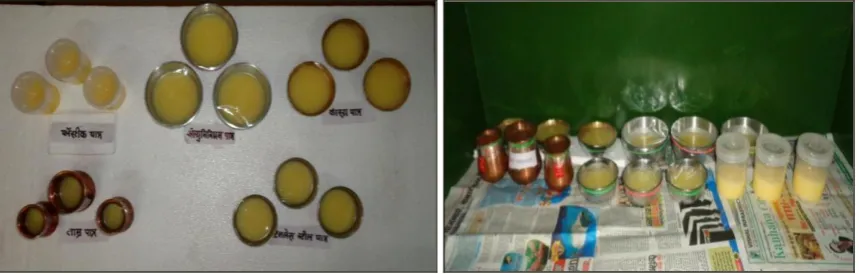
5 Different Containers for Storage of Goghrita.
METHODS
1) Sample of Goghrita collected was send to laboratory for authentification and chemical
2) After analysis primary readings recorded.
3) 100gm of Goghrita then placed in 3 containers of each.
a) Bronze.
b) Copper.
c) Plastic.
d) Aluminium and.
e) Stainless steel at the same time.
4) All 15 containers of five types filled with 100 gm Goghrita were air tightened with
transparent plastic paper.
5) All air tightened containers were placed in cup board of Agadtantra Evum Vidhivaidyaka
department at room temperature for study.
6) After 10 days one sample of each container was send to laboratory for testing and
observations recorded.
7) After 30 days second sample of each container was send to laboratory for testing and
observations recorded.
8) After 90 days last sample of each container was send to laboratory for testing and
observations recorded.
All laboratory findings were put together and statistically arranged in table and graphs then
results drawn.
Goghrita Kept in Taamra (Copper) Patra.
Goghrita Kept in Alluminium Container.
Goghrita Kept in Stainless Steel Container.
OBSERVATIONS
Sample of Ghrita collected from Govidnyan center, Nagpur was tested in laboratory having
[image:5.595.88.518.72.209.2]following observation.
Table. 1: Day 0-Table showing different values of sample Ghrita.
Test Standard Fssa Result Remarks
NLT NMT
Moisture
%w/w 0.5 0.26 Passes
FFA As OLEIC Acid
%w/w 3.0 0.26 Passes
Reichert Value
%w/w 26 26.28 Passes
Saponification Value
mgKOH/gm - - 262.21 -
Iodine Value
gI/100gm - - 29.82 -
NLT:-Not Less Than NMT:-Not More Than
The tested Sample of Ghrita had passed all the standard norms showing that collected sample
was of animal origin, i.e. Cow Ghee. Sample of Ghrita placed in containers and then air
tightened with transparent plastic paper.
[image:5.595.85.492.322.510.2]
After 10 days- observations
Table. 2: Day 10-Table showing values of Goghrita placed in different container.
No Test
RESULT DAY 10
bronze copper Aluminium steel plastic
Cu/Sn Cu Al Fe -
1 Moisture
%w/w 0.29 0.26 0.28 0.28 0.30
2 FFA As Oleic Acid
%w/w 0.27 0.28 0.28 0.25 0.26
%w/w
4 Iodine Value
gI/100gm 37.14 34.84 29.24 35.76 34.80
5 Saponification Value
mgKOH/gm 231.30 210.34 241.98 255.11 222.14
6 Metals
Ppm 1.8/1.6 2.2 BDL BDL -
BDL:- Below Detectable Limit i.e. less than 0.001ppm.
Slight change in physical state (liquid) of Ghrita placed in
Bronze (kansya), Copper (Taamra), Aluminium and
Stainless steel was observed, i.e. liquid state changes to semisolid state.
No change in liquid state of Ghrita placed in plastic container.
Slight change in pale yellow colour of Ghrita placed in
Bronze (kansya).
Copper (Taamra) container was observed, i.e.yellow coloured Ghrita becomes more pale
and whitish.
Analytical observations
A)Slight or non-significant change in the values of
1) Moisture
2) FFA
3) Recheirt
4) Saponification
B) Traces of metals Copper, Tin, Aluminium, Iron would be observed in sample of
Goghrita placed in following containers respectively as
Bronze (kansya)- Cu-1.8 ppm, Sn- 1.6 ppm.
Copper (Taamra) – Cu-2.2 ppm.
Aluminium – BDL (Below Detectable Limit).
Stainless steel – BDL (Below Detectable Limit).
After 30 days- observations
Table3: Day 30-Table showing values of Goghrita placed in different containers.
No TEST
RESULT DAY 30
Bronze Copper Aluminium steel plastic
Cu/Sn Cu Al Fe -
1 Moisture
%w/w 0.27 0.24 0.26 0.27 0.31
2 FFA As Oleic Acid
%w/w 0.16 0.11 0.14 0.22 0.29
3 Reichert Value
%w/w 30.07 25.13 26.90 25.74 28.86
4 Iodine Value
gI/100gm 39.48 29.85 38.72 31.68 36.15
5 Saponification Value
mgKOH/gm 198.28 176.97 209.79 223.43 187.19
6 METALS
ppm 2.3/1.8 5.5 BDL BDL -
BDL:- Below Detectable Limit i.e. less than 0.001ppm
Change in physical state (liquid) of Ghrita placed in
Bronze (kansya), Copper (Taamra), Aluminium and
Stainless steel was observed, i.e. liquid state changes to semisolid state.
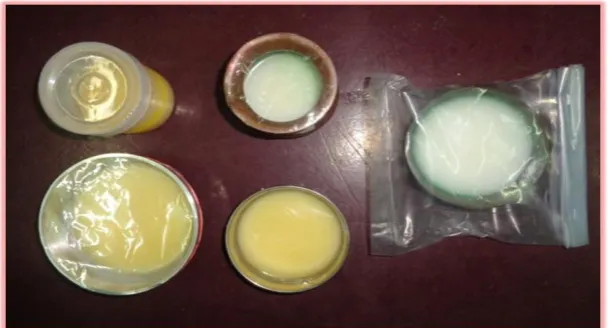
Goghrita Seen After 30 Days in 5 Different Containers
Change in pale yellow colour of Ghrita placed in
Bronze (kansya)
Copper (Taamra) container was observed, i.e. yellow coloured Ghrita becomes bluish and
greenish.
Analytical observations
A)Slight or non-significant change in the values of
o Moisture
o FFA As Oleic Acid
o Recheirt
o Saponification
o Iodine Values of Goghrita would be observed.
B)Traces of metals copper, tin, aluminium, iron would be observed in sample of
Goghrita placed in following containers respectively as
oBronze (kansya) - Cu-2.3 ppm, Sn- 1.8 ppm
oCopper (Taamra) – Cu-5.5 ppm
oAluminium (Al)– BDL (Below Detectable Limit)
After 90 days- observations
Table. 4: Day 90-Table showing values of Goghrita placed in different containers.
No Test
RESULT DAY 90
Bronze Copper Aluminium steel plastic
Cu/Sn Cu Al Fe -
1 Moisture
%w/w 0.28 0.24 0.29 0.27 0.31
2 FFA As Oleic Acid
%w/w 0.30 0.30 0.33 0.35 0.36
3 Reichert Value
%w/w 29.68 26.10 27.6 35.79 28.10
4 Iodine Value
gI/100gm 38.38 36.70 35.79 27.60 35.54
5 Saponification Value
mgKOH/gm 228.00 204.00 248.0 248.00 220.41
6 Metals
ppm 2.33/1.86 5.8 BDL BDL -
BDL:- Below Detectable Limit i.e. less than 0.001ppm.
Change in physical state (liquid) of Ghrita placed in
Bronze (kansya),
Copper (Taamra),
Aluminium and
Stainless steel was observed, i.e. liquid state changes to semisolid state.
No change in liquid state of Ghrita placed in plastic container.
Goghrita Seen After 90 Days In 5 Different Containers.
Change in pale yellow colour of Ghrita placed in
Copper (Taamra) container was observed, i.e. yellow coloured Ghrita becomes bluish and
greenish.
Analytical observations
Slight or non-significant change in the values of
a) Moisture
b) FFA
c) Recheirt
d) Saponification
e) Iodine Values of Goghrita Would Be Observed.
Traces of metals copper, tin, aluminium, iron would be observed in sample of Goghrita
placed in following containers respectively as
Bronze (kansya) - Cu-2.33 ppm, Sn- 1.86 ppm. Copper (Taamra) – Cu-5.8 ppm.
Aluminium – BDL (Below Detectable Limit).
Stainless steel – BDL (Below Detectable Limit) i.e. less than 0.001 ppm.
Taking all observations into consideration following tables would be drawn and accordingly
graphs prepared. Then results would be drawn.
[image:10.595.72.528.521.658.2]Bronze Container
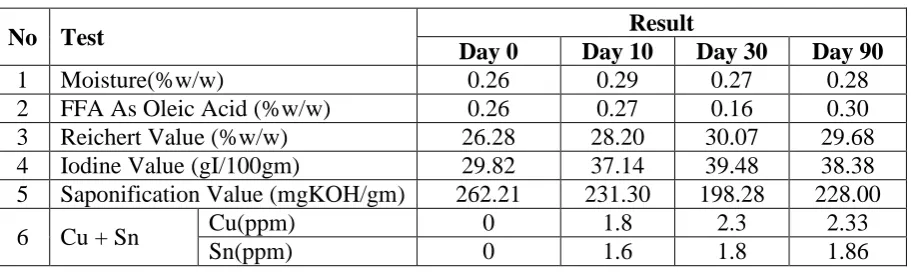
Table. 5: Table showing different values of Goghrita in Kansya (Bronze) Container.
No Test Result
Day 0 Day 10 Day 30 Day 90
1 Moisture(%w/w) 0.26 0.29 0.27 0.28
2 FFA As Oleic Acid (%w/w) 0.26 0.27 0.16 0.30
3 Reichert Value (%w/w) 26.28 28.20 30.07 29.68
4 Iodine Value (gI/100gm) 29.82 37.14 39.48 38.38
5 Saponification Value (mgKOH/gm) 262.21 231.30 198.28 228.00
6 Cu + Sn Cu(ppm) 0 1.8 2.3 2.33
Sn(ppm) 0 1.6 1.8 1.86
Copper Container
Table. 6: Table showing different values of Goghrita in Taamra(Copper) Container.
No Test Result
Day 0 Day 10 Day 30 Day 90
1 MOISTURE(%w/w) 0.26 0.26 0.24 0.24
3 REICHERT VALUE(%w/w) 26.28 26.83 25.13 26.10
4 IODINE VALUE (gI/100gm) 29.82 34.84 29.85 36.70
5 SAPONIFICATION VALUE(mgKOH/gm) 262.21 210.34 176.97 204.00
6 Cu(ppm) 0 2.2 5.5 5.8
AluminiumContainer
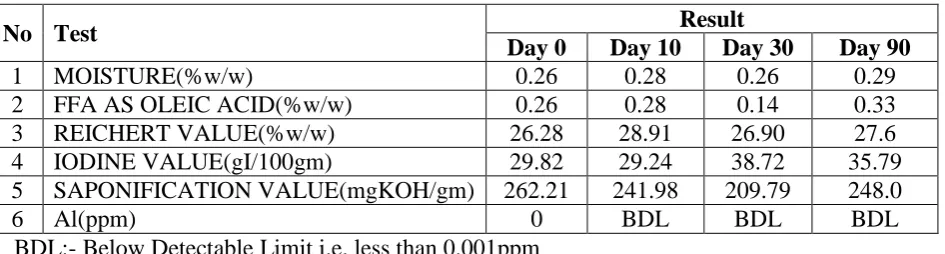
Table. 7: Table showing different values of Goghrita in Alluminium Container.
BDL:- Below Detectable Limit i.e. less than 0.001ppm
[image:11.595.65.538.187.314.2]StainlessSteelContainer
Table. 8: Table showing different values of Goghrita in Stainless Steel Container.
No Test Result
Day 0 Day 10 Day 30 Day 90
1 MOISTURE(%w/w) 0.26 0.28 0.27 0.27
2 FFA AS OLEIC ACID(%w/w) 0.26 0.25 0.22 0.35
3 REICHERT VALUE(%w/w) 26.28 27.12 25.74 35.79
4 IODINE VALUE (gI/100gm) 29.82 35.76 31.68 27.60
5 SAPONIFICATION VALUE(mgKOH/gm) 262.21 255.11 223.43 248.00
6 Fe(ppm) 0 BDL BDL BDL
BDL:- Below Detectable Limit i.e. less than 0.001ppm.
[image:11.595.70.528.371.507.2]
Plastic Container
Table. 9: Table showing different values of Goghrita in Plastic Container.
No Test Result
Day 0 Day10 Day30 Day90
1 MOISTURE(%w/w) 0.26 0.30 0.31 0.31
2 FFA AS OLEIC ACID(%w/w) 0.26 0.26 0.29 0.36
3 REICHERT VALUE(%w/w) 26.28 28.36 28.86 28.10
4 IODINE VALUE(gI/100gm) 29.82 34.80 36.15 35.54
5 SAPONIFICATION VALUE(mgKOH/gm) 262.21 222.14 187.19 220.41
Saponification Value: mgKOH/gm.
No Test Result
Day 0 Day 10 Day 30 Day 90
1 MOISTURE(%w/w) 0.26 0.28 0.26 0.29
2 FFA AS OLEIC ACID(%w/w) 0.26 0.28 0.14 0.33
3 REICHERT VALUE(%w/w) 26.28 28.91 26.90 27.6
4 IODINE VALUE(gI/100gm) 29.82 29.24 38.72 35.79
5 SAPONIFICATION VALUE(mgKOH/gm) 262.21 241.98 209.79 248.0
Table. 10: Table showing SAPONIFICATION VALUE of Goghrita in different
Containers.
No Containers Result
Day 0 Day 10 Day 30 Day 90
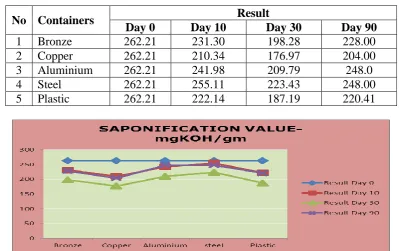
1 Bronze 262.21 231.30 198.28 228.00
2 Copper 262.21 210.34 176.97 204.00
3 Aluminium 262.21 241.98 209.79 248.0
4 Steel 262.21 255.11 223.43 248.00
5 Plastic 262.21 222.14 187.19 220.41
Table. 10: Graph showing Saponification Value of Goghrita in different Containers.
Iodine Value
Table. 11: Table showing Iodine Value of Goghrita in different Containers.
No Containers Result
Day 0 Day 10 Day 30 Day 90
1 Bronze 29.82 37.14 39.48 38.38
2 Copper 29.82 34.84 29.85 36.70
3 Aluminium 29.82 29.24 38.72 35.79
4 Steel 29.82 35.76 31.68 27.60
[image:12.595.96.496.108.359.2]5 Plastic 29.82 34.80 36.15 35.54
[image:12.595.85.503.437.698.2]FFA As Oleic Acid
Table. 12: Table showing FFA As Oleic Acid Value of Goghrita in different Containers.
No Containers Result
Day 0 Day 10 Day 30 Day 90
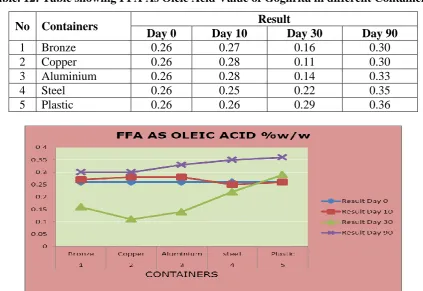
1 Bronze 0.26 0.27 0.16 0.30
2 Copper 0.26 0.28 0.11 0.30
3 Aluminium 0.26 0.28 0.14 0.33
4 Steel 0.26 0.25 0.22 0.35
5 Plastic 0.26 0.26 0.29 0.36
Table. 12: Graph showing FFA As Oleic Acid Value of Goghrita in different
Containers.
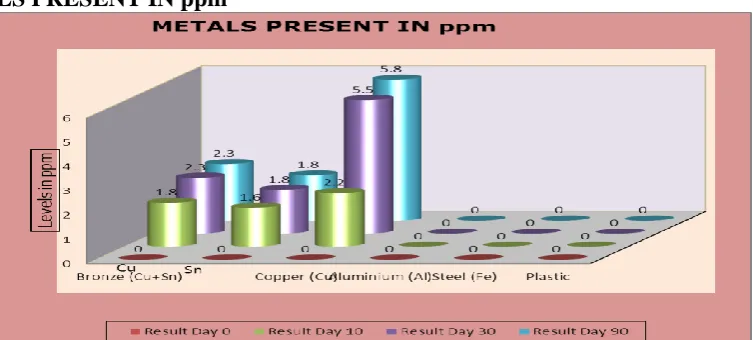
Table. 13: Table showing presence of METALS in ppm when Goghrita placed in
different Containers.
No Containers Result
Day 0 Day 10 Day 30 Day 90
1 Bronze Cu 0 1.8 2.3 2.33
Sn 0 1.6 1.8 1.86
2 Copper 0 2.2 5.5 5.8
3 Aluminium 0 0 0 0
4 Steel 0 0 0 0
[image:13.595.122.479.503.617.2]METALS PRESENT IN ppm
Table. 13: Graph showing presence of METALS in ppm when Goghrita placed in
different Containers.
The table shows that there would be gradual increase in level of metals Cu and Sn in sample
of Goghrita as duration of storage increases that means sample becomes more toxic due to
patra (container) effect. Comparing the values given in the table to the guidelines of drinking
water above the level of Cu is much higher than the maximum permissible level of Cu in
drinking water. After 10 days of observation it was slight more but after 90 days of
observation it was quite greater i.e. three times more than maximum permissible limit of Cu
in drinking water. Still, the fact of the matter is that the presence of Cu and Sn in the Goghrita
over a short period of only 10 days validates the concept of Patrasthiti –related toxicity as
narrated by Aacharya.
DISCUSSION
“The chronic diseases that now kill most of us can be traced directly to the industrialization of our food”. The oral route is a major site of entry into the body for many toxic compounds.
Humans have adapted to a multitude of food around the world. Food allergy and food
poisoning are two common problems nowadays. The different food combinations and
interaction between exogenous and endogenous food components exert antagonistic effects.
This has been explained as the viruddha concept in Ayurveda. Along with normal food intake
humans are constantly exposed to a number of chemicals that are foreign to their bodies, like
the pesticides, insecticides, additives etc. They interfere with the normal metabolic pathways
resulting in toxic actions.
Food adulteration is another age old problem. Food adulterants are cheap substitutes that
[image:14.595.110.487.80.250.2]under the purview of adulteration. Some of the adulterants are injurious to health, even
resulting in death.
Metal contaminants such as lead, mercury, arsenic, aluminium, copper and cadmium come
from factory emissions, mining operations, and metal - containing industrial products used in
food production. They tend to accumulate in the food chain, later enter the body and act as
poisonous interferences to enzyme system and metabolism to create detriment to health.
Unfortunately what we practice today is samashana, vishamaashana and adhyashana that lead
to death and other ailments. Toxins from food and its digestive by products can enter the
bloodstream when digestion is poor and once these settle into the tissues will create
immediate disease state.
Some examples of the Viruddhashana which is commonly seen now days are
-Having milk with food items containing salt (eg. Biscuit, bread),
-combination of milk with fruits (fruit salad),
-regular usage of milk preparations like paneer, malai etc,
-preserved food items irrespective of their original tastes contain excess of oil or salt for
better preservation,
-butter that is preserved by adding plenty of salt,
-consumption of extremely hot or cold beverages before or after the meals, e.g., coffee,
chilled water, cold drinks (aerated), ice creams, drinking water before or after tea, coffee etc.
These are some of the examples, but if listed it is possible to find a hundred of such things
commonly seen among the population. In Ishta desha (desired place) and Ishta sarvopakarana
(desired vessel), not only favoured but also beneficial is expected. One should take food in
proper place equipped with all the accessories. By this one not gets afflicted with such factors
which result in emotional strain.
In classics particular vessels are mentioned for particular food items like
-Ghee is taken in black iron vessel,
-Water in copper vessel,
-Juices in mud vessel etc.
So, it will be better to avoid such incompatible food for living disease free and healthy life.
After testing all samples of Goghrita it would be observed that
Test Standard FSSA
NLT NMT
MOISTURE(%w/w) 0.5
FFA AS OLEIC ACID(%w/w) 3.0
REICHERT VALUE(%w/w) 26
NLT:-Not Less Than NMT:-Not More Than
Comparing to above standard norms, these values in all samples of Goghrita would not cross
the normal limits significantly.
Slight change in
-Iodine Value
-Saponification Value
When we compare the values with research published about Ghee by National Dairy
Research Institute, Karnal, India, would be observed.
NLT NMT
Saponification Value (mgKOH/gm ) 220 -
Iodine Value (gI/100gm) 24 38
After analysis of samples of Goghrita there were gradually increase in the levels of Copper
(Cu) and Tin (Sn) would be observed as duration of storage increases in respective
containers.
After observing the guidelines given for drinking water levels of Cu was much higher.
Heavy metal According to Indian Standard Drinking Water
Specification 1991
Highest desirable level Maximum permissible limit
Copper 0.05 ppm 1.5 ppm
Observed values of Cu in Goghrita
No Containers Result
Day 0 Day 10 Day 30 Day 90
1 Bronze (Cu+Sn) Cu 0 1.8 2.3 2.33
Sn 0 1.6 1.8 1.86
2 Copper (Cu) 0 2.2 5.5 5.8
Goghrita performes multitude of functions, It is used as aahariya dravya as well as in
ayurvedic medicines. If we don’t use the better quality Goghrita for consumption or in
medicine we cant get appropriate benefits. So, for getting appropriate benifits Goghrita must
be stored or preserve in proper way.
According to our Aacharyas- when Ghrita placed in Bronze vessel for ten days it becomes
incompatible (paryushita). The study shows that there would be gradual increase in level of
metals Cu and Sn in sample of Goghrita as duration of storage increases that means sample
becomes more toxic due to patra (container) effect as narrated by Aacharya.
Abbreviations
Al Aluminium
Cu Copper
Sn Tin
Fe Iron
NLT Not less than
NMT Not more than
BDL Below Detectable Limit
SUMMARY
Human beings are today facing multitude of problems. The reason behind these problems is
rapid industrialization and commercialization of whole world. Due to the influence of
fast-paced life, fast foods, adulteration, etc. people have welcomed suffering from many angles
which one day may be a withstanding as far as their health is concerned.
In this modern era of fast food culture people often indulge in Viruddhahara, which causes
many diseases.
According to our Aacharyas- when Ghrita placed in Bronze vessel for ten days it becomes
incompatible (karma Viruddha). This study would be illustrated what changes exactly occur
in Ghrita when placed in Bronze vessel as well as in other containers.
CONCLUSION
Viruddhahara is a very important concept of Ayurveda resulting in the manifestation of
various diseases and even death. There are various mechanisms described to detail its
pathology - dosha vikriti (vitiation) and vriddhi (agitation), agnimandya and ama, ojokshaya,
rakta vikriti and srotodushti. At some places its mode of action is like that of pradhanika hetu
instantaneously. In a study (experimental) carried out at the Institute of Medical Sciences it
was found that the administration of equal quantities of Madhu (Honey) and Ghrita resulted
in harmful effects in the mice as compared to the control group. Another substantial evidence
could be the increased incidence of skin diseases in the region of West Bengal where more
consumption of milk and fish is done, may be together or on the same day. Thus this concept
is very important in the view of prevention of diseases.
In the present study, observations show that there would be gradual increase in levels of
metals (Cu and Sn) in sample of Goghrita when placed in Bronze and copper vessels. Below
detectable levels of Al and Fe would be observed after testing of Goghrita placed in
Aluminium and Steel container.
As other references show that when acidic food is placed in Aluminium container may
increase the level of Alluminium, because of this to avoid toxicity effects it will be better to
store Goghrita in stainless steel or GMP approved plastic container rather than other metal
containers. In spite of this for storage of other foods we can use the same containers. Further
study will be required to detect whether Cu and Sn levels present in sample of Goghrita
shows the toxicity effect or not.
As our Aacharya stated that Goghrita placed in bronze (kansya) vessel becomes incompatible
(paryushit) after 10 days this statement proven to be true as there would be change in physical
properties as well as increase level of Copper in both copper and bronze vessel observed.
Thus, consumption of viruddhaahara should be avoided in order to live healthier life.
REFERENCES
1. Shastri Ambikadatta, editors, Sushrutsamhita-Sutrasthana.20/14, Chaukhambha Sanskrit
Sansthan, Varanasi, Reprint, 2007; 84.
2. Shastri. Kashinath, editors, Charak Samhita, Chaukhambha Bharati Academy, Varanasi,
Reprint, 2006.
3. Garde Ganesh Krushna, editors, Ashtanghriday, Raghuvanshi Prakashan, Pune, 8th Ed. 1996.
4. Dr. Ravidatta Tripathi, editors, Ashtangsangraha, Chaukhambha Sanskrit pratisthan,
Varanasi, Reprint, 2003.
5. Govt. of India Ministry of Health and family welfare Dept. of ISM and H New Delhi,
6. Textbook of Agadatantra, Rastriya Sikshan Mandal Publication, 1st Ed. 2008.
7. Mishra Gulraj Sharma, editors, Ayurved Prakash, Chaukhambha Bharati Academy,
Varanasi, 3rd Ed. 2004.
8. Shastri Kaviraj Ambikadatta, editors, Rasaratna Samuchchaya, Chaukhamba Sanskrit
Series, Varanasi, 2nd Ed. 2008.
9. Pandit Shri.Brahma Shankara Mishra, editors, Bhavaprakasha, Chaukhambha Sanskrit
Sansthan, Varanasi, 7th Ed. 2000.
10. Shastri Durgadatta, editors, Sharandhara Samhita, Chaukhamba Vidyabhavan, Varanasi,
Reprint, 2002.
11. Sadashiv Shastri Joshi, editors, Yogaratnakara, Chaukhamba Sanskrit Series, Varanasi,
Reprint, 2010.
12. Chunekar Krushnchandra, editors, Bhavaprakasha Nighantu, Chaukhambha Bharati
Academy, Varanasi, Reprint, 2010.
13. Sidhhinandan Mishra, Ayurvediya Rasashastra, Chaukhamba Oriental, Varanasi.11th Ed. 14. Dr. Parikh C.K., Textbook of Medical Jurisprudence Forensic Medicine and Toxicology,
CBS Publishers and Distributors, New Delhi, Ed.6th , reprint, 2007.
15. Amarsimha, editors, Amarkosh, choukhamba Sanskrit series, Varanasi, (1970), 1St Ed. 16. Lawrence Wilson, MD, Article-Toxic Metals And Human Health, Oct. 2012.
17. National Dairy Research Institute, Karnal, India, Journal of Dairy Science, Publication
July 1, 1972; 56(1).
18. International Journal of Medical and Pharmaceutical Sciences (IJMPS), 2(1).