A conceptual model of packaging design for E-commerce.
HUANG, Kuo-Li.
Available from Sheffield Hallam University Research Archive (SHURA) at:
http://shura.shu.ac.uk/19839/
This document is the author deposited version. You are advised to consult the
publisher's version if you wish to cite from it.
Published version
HUANG, Kuo-Li. (2005). A conceptual model of packaging design for E-commerce.
Doctoral, Sheffield Hallam University (United Kingdom)..
Copyright and re-use policy
See
http://shura.shu.ac.uk/information.html
Sheffield Hallam University Research Archive
1 6 FEB 2006
4-/Vi
ProQuest N um ber: 10697145
All rights reserved
INFORMATION TO ALL USERS
The quality of this reproduction is dependent upon the quality of the copy submitted.
In the unlikely event that the author did not send a com plete manuscript and there are missing pages, these will be noted. Also, if material had to be removed,
a note will indicate the deletion.
uest
ProQuest 10697145
Published by ProQuest LLC(2017). Copyright of the Dissertation is held by the Author.
All rights reserved.
This work is protected against unauthorized copying under Title 17, United States C ode Microform Edition © ProQuest LLC.
ProQuest LLC.
789 East Eisenhower Parkway P.O. Box 1346
Packaging Design for eCommerce
K u o - L i HUANG
A thesis submitted in partial fulfilment of the requirements of Sheffield Hallam University
Abstract
Packaging is a “salesman” which is used as a marketing tool to assist product sales and deliver product information and attract consumers in conventional marketplaces. It also gives producers a voice in the retail environment. Since the introduction of E- commerce in the 1990’s, these functions of packaging have not yet been reproduced in the virtual environment for products sold online. This research explores the meaning by which “online packaging” can be designed and implemented.
Many researchers have identified that consumers find it difficult to buy online, due to poor product presentation and insufficient product information. They can easily obtain these functional advantages from physical packaging. Thus, the aim of this research is to explore a design guideline of online packaging for designers to better apply packaging thinking for products sold online.
This research starts with practical work which contains five tentative studies and a final “laboratory online shop" providing a continuing process of development and evaluation of the research questions and engaging design principles. Rapid ethnographic methods were employed for the data collection. The data analysis and the practical design of online packaging were informed by the theory of Elaboration Likelihood Model (ELM).
The result of the “laboratory online shop" is mainly consistent with the ELM’s prediction and the research has resulted in design guidelines for online packaging, providing a framework for designers of online packaging. The guidelines integrate packaging thinking, the rapid ethnographic approaches and applications of the ELM theory, offering an opportunity for designers to apply the functions of packaging to products sold online.
The approach helps designers to collect relevant background information before they design and evaluate developing designs. The guidelines influence designers to have a dual consideration of messages for consumers informed by the ELM’s concept of “involvement” during the development of online packaging. Finally, a successful design of online packaging will not only depend on the designers, but retailers and manufacturers will also need to establish the infrastructure of an online shop, so that designers can apply online packaging to eCommerce.
Key words: packaging design, e-commerce, rapid ethnography, ELM.
A Conceptual Model of I
I would like to express my gratitude to many people who have contributed and assisted in developing this research. I also wish to express my gratitude to supervisor team for their patience and professional knowledge; Professor Christ Rust, my direct studies supervisor who offered me weekly tutorials through these years, for both excellent support and guidance for this research; Professor Mike Press, who duly gave me his advice and emotional support; and Mr. Bill Stewart who also provided me with his professional opinions at the beginning of this research.
I would like to thank Mr. Darren Finch, for his patience in correcting my English grammar. Also, I would like to express my sincere acknowledgement to my brothers and sister for their great emotional support; to my wife for her tolerance towards my bad temper during this isolated study; and to my parents for their indescribable care and financial support. Finally I would like to devote this thesis to my parents.
A Conceptual Model of
Table of contents
Table of contents
List of figures...VIII List of appendixes... XIII
Chapter One Introduction
1.1 Aim and contributions of this research...1
1.2 Research framework...2
1.3 Research questions identification... 5
1.4 Research methods... 7
1.5 Plan of the thesis...8
Chapter Two Literature review
2.1 Introduction...112.2 Packaging design...15
2.2.1 History of packaging design...16
2.2.2 Functions of packaging... 18
2.2.3 Packaging vs. advertising... 26
2.2.4 Summary...31
2.3 The internet...32
2.3.1 The application of hypertext...33
2.3.2 Multimedia website design... 40
2.3.3 E-commerce...44
2.3.4 Summary... 48
2.4 The Elaboration Likelihood Model... 49
2.4.1 A brief history of cognitive psychology ... 52
2.4.2 Introduction to the ELM... 55
2.4.2.1 Central Route... 56
2.4.2.2 Peripheral Route ... 56
2.4.2.3 Involvement... 58
2.4.2.4 Antecedent process... 59
2.4.3 The application of the ELM...61
2.4.3.1 Social psychology... 61
2.4.3.2 Marketing research...63
2.4.3.3 Advertising research... 65
2.4.4 Summary...68
A Conceptual Model of
2.5 Online consumers’ attitudes towards product information and
presentation...69
2.5.1 Shopping agent helps online shopper?...70
2.5.2 The need of product information and presentation... 71
2.5.3 Rich information and presentation for online shoppers...72
2.5.4 Summary... 74
2.6 Preliminary conclusion and development of research questions... 75
Chapter Three Research Methodology
3.1 Introduction... 793.2 The methodology...85
3.2.1 Ethnographic research...86
3.2.2 The problem of ethnographic research for designers...88
3.2.3 Rapid ethnographic strategy... 90
3.3 The method of this research... 92
3.3.1 Interview...92
3.3.1.1 The application of interview method in this research...94
3.3.1.2 Interviews with designers and experts (Phase of tentative studies)... 95
3.3.1.3 Interviews with consumers (Phase of tentative studies)... 97
3.3.1.4 Interviews with consumers (Phase of laboratory online shop)...98
3.3.2 Questionnaire... 100
3.3.2.1 The application of questionnaire method for public viewpoint on online packaging (Phase of tentative studies)...101
3.3.3 Observation... 103
3.3.3.1 The application of observation method in this research...105
3.3.3.2 Physical and online shopping observation (Phase of tentative studies)...105
3.3.3.3 Online shopping observation (Phase of laboratory online shop)...107
3.4 Design practice oriented research... 109
3.5 Data analysis... ...113
3.5.1 Methods of data analysis... 113
3.5.2 Validity and reliability... 116
3.5.3 Sampling...119
3.6 Summary ... 124
A Conceptual Model of IV
Table of contents
Chapter Four Practical Work
4.1 Introduction...125
4.2 Phase of tentative studies... 128
4.2.1 Designers and expert interviews... 128
4.2.1.1 Interviews with designers... 128
4.2.1.2 Interviews with experts...129
4.2.1.3 Findings...130
4.2.2 Public viewpoints towards online packaging... 132
4.2.2.1 Sampling... 132
4.2.2.2 Procedure... 132
4.2.2.3 Outcomes... 132
4.2.2.4 Questions for online shoppers...133
4.2.2.5 Questions for internet users... 134
4.2.2.6 Findings... 135
4.2.3 Online packaging analysis...137
4.2.3.1 Three formats of online packaging...137
4.2.3.2 Findings...139
4.2.4 Shopping Observation... 141
4.2.4.1 Research design... 142
4.2.4.2 Procedure...143
4.2.4.3 Participants in the physical shopping trip... 143
4.2.4.4 Participants in the online shopping trip... 144
4.2.4.5 Discussion... 145
4.2.4.6 Findings... 146
4.2.5 Simulated Online Shopping...148
4.2.5.1 Overview of this study...148
4.2.5.2 Participants’ involvements with wines... 151
4.2.5.3 Procedure...152
4.2.5.4 Independent variables... 152
4.2.5.5 Outcomes...152
4.2.5.6 Discussion and Implication... 155
4.2.5.7 Findings... 158
4.3 Phase of laboratory online shop... 161
4.3.1 Overview of the experiment... 162
4.3.2 Research questions... 163
4.3.3 Structure of the laboratory...164
A Conceptual Model of V
4.3.4 The design purpose of each task... 165
4.3.5 Features of online packaging in every task... 167
4.3.5.1 Online packaging features of task one... 167
4.3.5.2 Online packaging features of task two... 173
4.3.5.3 Online packaging features of task three... 178
4.3.5.4 Online packaging features of task four...182
4.3.6 The use of theory...189
4.3.7 Procedure and data recording...190
4.4 Summary of chapter four... 193
Chapter Five Analysis and discussion of the
laboratory online shop
5.1 Introduction... 1955.2 Analysis... 197
5.2.1 Outcomes of the laboratory online shop...197
5.2.1.1 Matrixes for comparisons between tasks... 198
5.2.1.2 Conceptual mapping... 201
5.2.2 Online packaging contributions to eCommerce... ....203
5.2.2.1 Unlimited information provision... 205
5.2.2.2 To provide visual assistance... 206
5.2.2.3 To expand consumers’ consideration lists... 207
5.2.2.4 Summary... 208
5.2.3 Involvement and patterns of shopping behaviour... 210
5.2.3.1 The prediction of participants’ behaviour by the ELM... 210
5.2.3.2 Patterns of shopping behaviour... 219
5.2.4 Impulse shopping and play behaviour ... 221
5.2.4.1 Impulse shopping and low involvement participants... 222
5.2.4.2 Impulse shopping and high involvement participants... 223
5.2.4.3 Play behaviour... 224
5.2.5 Summary... 226
5.3 Discussion... 228
5.3.1 Forms of online packaging...228
5.3.2 Innovation in packaging thinking... 230
5.3.3 The design guideline of online packaging...234
5.3.3.1The use of packaging function... 236
5.3.3.2 The use of the ELM... 237
5.3.3.3 The use of interactive feature... 239
A Conceptual Mode! of V I
Table of contents
5.3.3.4 The use of rapid ethnography...240
5.3.3.5 Using the guideline... 242
5.3.3.6 To summarise briefly the design guideline... 245
5.3.4 Summary ... 247
Chapter Six Conclusion
6.1 Consequences of this research...2486.1.1 Packaging thinking in the online environment... 248
6.1.2 Research methods for designers... 250
6.1.3 The application of the ELM for designers...251
6.2 Evaluation of the design guideline...253
6.3 Criticism and limitations... 255
6.4 Recommendation for further research... 258
Reference
...259A Conceptual Model of
List of figures
_______
Chapter one
Figure 1.1: The research framework of this research...2
Figure 1.2: Plan of the thesis... 8
Chapter two
Figure 2.1: The result of database search for related literatures...11Figure 2.2: The areas of the literature review...12
Figure 2.3: Functions of packaging... 19
Figure 2.4: 1001 ’s bottle, before mid-1960s (left) and after (right)... 20
Figure 2.5: The normal turnover of a product as a function of time; Product Life Cycle (right); impact of different factors at each stage of PLC (left)...21
Figure 2.6: Examples of promotional functions using special displays to promote products... 22
Figure 2.7: Information of consumers’ concerns... 23
Figure 2.8: To communicate with consumers by using information functions 24 Figure 2.9: A poster of a wine advertisement... 27
Figure 2.10: Consumers are looking for further details... 27
Figure 2.11: An internet advertisement of wines... 28
Figure 2.12: An online shop’s shopping aisle... 28
Figure 2.13: Further details of wines by request... 28
Figure 2.14: A brief timeline of the internet... 32
Figure 2.15: An example of non-linear hypertext... 33
Figure 2.16: The development of hypertext applications... 34
Figure 2.17: The original proposal of the WWW...37
Figure 2.18: A screen shot of the hypertext in the first webpage for WWW...38
A Conceptual Model of
List of figures
Figure 2.19: A screen shot of thejfirst GUI ... ...38
Figure 2.20: A snapshot of Mosaic web browser... 40
Figure 2.21 Interactivity for different media...•...42
Figure 2.22 (Left): The increasing turnover of eCommerce and decreasing GRE in 2001...45
Figure 2.23 (Right): The decreasing money spent on online per person and decreasing EGR in 2001...45
Figure 2.24: Elaboration Likelihood Model...49
Figure 2.25: The development of cognitive psychology...52
Figure 2.26: The difference between central and peripheral route...55
Figure 2.27: The application of the ELM in social psychology...61
Figure 2.28: The application of the ELM in marketing research...63
Figure 2.29: The application of the ELM in advertising research...65
Figure 2.30: The concept of online packaging features...74
Figure 2.31: 7-11 ’s online shop...76
Figure 2.32: The website of FamilyMart convenience store... 76
Figure 2.33: Producer’s history, Peapot.com... 76
Figure 2.34: Food recipe, lceland.co.uk...76
Chapter three
Figure 3.1: Methods employed in the six studies...81Figure 3.2: Research strategy and methods of this research...83
Figure 3.3: The use of interview method in different phases of studies...94
Figure 3.4: The use of questionnaire method for telephone survey...101
Figure 3.5: The use of observation method in different phases of studies... 105
Figure 3.6: The sampling method and the number of sample for each study...119
A Conceptual Model of IX
Chapter four
Figure 4.1: This practical work was a sequence of six studies... 125
Figure 4.2: An example of pure text for products’ description...138
Figure 4.3: An example of pictorial icons description ... 138
Figure4.4: Products’ real images in “aisle” ... 139
Figure 4.5: Requested product’s information... 139
Figure 4.6: An un-labelled wine sold in a supermarket... 141
Figure 4.7: Results of the participants’ purchases... 143
Figure 4.8: Participants’ preference of online packaging in Tesco online shop..144
Figure 4.9: A stimulation online shopping aisle... 149
Figure 4.10: Requested information of Australian wine... 149
Figure 4.11: Colour changing animation of Spanish wine bottle...150
Figure 4.12: Requested information of Spanish wine... 150
Figure 4.13: Metaphor of animated pictures ... 151
Figure 4.14: Participants’ purchasing decisions...152
Figure 4.15: The second choice of the high involvement participants ...156
Figure 4.16: The progress of the “laboratory" experiment...162
Figure 4.17: The structure of the “laboratory online shop”...164
Figure 4.18: Main purpose of each task for the “laboratory”...165
Figure 4.19: Wjne 1-10 in task one... 168
Figure 4.20: Animation for wine 10...169
Figure 4.21: Style of pictures for wine 1, 4, 5, 7, 8, 9... 169
Figure 4.22: Wine 2, 360° rotatable bottle...170
Figure 4.23: A front rollover image for wine 5...170
Figure 4.24: A back rollover image for wine 5...171
A Conceptual Model of X
List of figures
Figure 4.25: A rollover image and animation mood board for wine 10...171-2
Figure 4.26: Wines in the layer 2 of task 2 ... 174
Figure 4.27: A rollover image for wine 1... 174
Figure 4.28: Front & Back image for wine 1... 175
Figure 4.29: A pop-up image for a larger label...175
Figure 4.30: A pop-up image for a larger label...176
Figure 4.31: A pop-up image for a larger label...176
Figure 4.32: A larger still image for wine 2...177
Figure 4.33: No image for wine 3... 177
Figure 4.34: Still images for wines in task 3... 179
Figure 4.35: Limited information for wine 1... 179
Figure 4.36: More relevant information for wine 2...180
Figure 4.37: More extra information for wine 3...180-1 Figure 4.38: Still images of each wine...183
Figure 4.39: Rollover images for each wine... 183
Figure 4.40: Basic information and additional links for wine 1... 185
Figure 4.41: The links have various information...185
Figure 4.42: Linked to producer’s website...186
Figure 4.43: Pop-up windows for various information... 186
Figure 4.44: Wine 2 has basic wine information, recommendation and ratings.. 187
Figure 4.45: Wine 3 has a long webpage which contains rich information... 188
Chapter five
Figure 5.1: A concise transcript of “laboratory online shop” for interviews and observation... 197A Conceptual Model of
Figure 5.2: Participants’ intuitive choices without carefully reading information and
purchase choices, after browsing information... 199
Figure 5.3: Under the same conditions of product presentation in task 3 and 4, the participants’ reasons to change or not to change their purchasing choices ... 200
Figure 5.4: The mapping... 202
Figure 5.5: Purchase behaviour of high involvement participants...214
Figure 5.6: Purchase behaviour of low involvement participants... 215
Figure 5.7 Patterns of shopping behaviour in this laboratory experiment...219
Figure 5.8: The design guideline of online packaging...234
Figure 5.9: A simplified version of the design guideline of online packaging 242
Chapter six
Figure 6.1: Some less and not natural settings were used in the studies of 4.2.5 and 4.3... 256A Conceptual Model of
List of appendixes
List of appendixes
Appendix A: Transcripts of the interviews with designers...272
Appendix B: Transcripts of the interviews with experts... 275
Appendix C: Questionnaire for the study of public viewpoints towards online packaging... 278
Appendix D: Interviews’ questions and records for the study of simulated online shopping...280
Appendix E: Pre-observation interviews’ questions for the study of laboratory online shop... 290
Appendix F: Interviews and observations’ transcripts for the study of laboratory online shop... 291
Appendix G: Drafts for the development of the mapping and the matrix 299
A Conr.«'-;::u Mode! of
Chapter one Introduction
1.1 Aim and contributions of this research
The aim of this research is to discover design guidelines to assist
designers to perform online packaging projects, allowing them to have better
understanding between eCommerce, online consumer behaviour and
packaging functions. The design guidelines will provide a framework for
designers to apply packaging thinking to online products in a digital context,
in order to fulfil the role of packaging as a “salesman”, in online shopping
environments.
This research has made three main contributions. Firstly, for packaging
thinking, this research extends the limited theoretical and empirical work in
the area of online packaging, by investigating the transfer and
transformation of packaging functions into online environments. Secondly,
this research also gives to designers a framework of research methods for
online packaging development, by providing design guidelines for online
packaging, furthermore it is very likely that it will be the first guideline for
applying packaging thinking in a digital context. Thirdly, through the
application of the Elaboration Likelihood Model (ELM) (Petty and Cacioppo,
1983), this research offers insight into theories from cognitive psychology, to
help designers to construct different cues of messages for online consumers
with different levels of product involvement, by understanding their needs
and predicting their behaviour.
A Conceptual Model of
1.2 Research framework
Chapter 1 Introduction
1.2 Research framework
N
/ Using rapid \ I ethnographic ^
\ approach j **’ "" Laboratory online shop
Preliminary conclusion
Literature review Tentative studies
The design guideline of online packaging. Packaging design for
eCommerce
The ELM, mapping and matrixes were used to analyse the field data
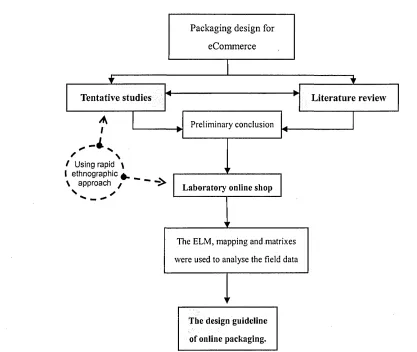
Figure 1.1: The research framework of this research
The research framework falls into four areas as follows:
1) Literature review: To understand the various purposes of packaging
and locate the drawbacks of current approaches towards online packaging
for eCommerce, as well as knowledge and theories about development of
the internet, cognitive psychology and online consumer behaviour.
2) Tentative studies: A series of practical activities to identify possible
opportunities to incorporate packaging thinking in eCommerce and refine
research questions for the final experiment of the “laboratory online shop”.
A Conceptual Model of
[image:19.613.67.484.99.451.2]3) Laboratory online shop: To build a-laboratory online shop” to test the
idea of online packaging and to evaluate the finding and research questions
from the previous phase of studies, in order to propose design guidelines for
online packaging thinking.
4) The design guideline of online packaging: Content analysis,
conceptual analysis, triangulation analysis and the ELM were used to create
matrixes and mappings in order to analyse the data gathered from the
laboratory online shop. From analysis and reflection on design and research
methods used, it was possible to develop a guideline which provides a
direction for designers to apply packaging thinking to online packaging
design.
In the research process the literature review and practical work were
concurrent, because there is not sufficient relevant published research to
support, on its own, the development of the research questions. Practical
work was employed in helping to identify online consumers’ needs and
online packaging requirements. The literature review focused on four
themes (See Fig. 2.2): 1) Packaging design, 2) The internet, especially
focusing on the use of hypertext and eCommerce, 3) Cognitive psychology,
particularly the ELM, and 4) Online consumers’ attitudes towards product
information and presentation.
The reason for focusing on these areas was that in section 2.5, many
studies show that consumers found difficulties when they were buying
products or services on the internet, and the ELM could provide
considerations for designers to enhance design thinking, in order to help
A Conceptual Model of
Chapter 1 Introduction
1.2 Research framework
online consumers out of their difficulties in online environments. Thus, this
causal relationship indicated that it was essential to understand these four
themes.
The practical work was divided into two major parts: the tentative studies
and the “laboratory online shop”. The tentative studies were a sequence of
five activities (See figure 4.1), used, together with the literature review, to
find and refine the research questions, these studies were also used to
evaluate the research methods. The “laboratory online shop” was the
final data gathering activity of this research. It was performed to evaluate the
findings of the tentative studies and gather an additional understanding of
the research topic, in order to conclude the design guidelines for online
packaging.
A C onceptual M odel of
1.3 Research questions identification
With the popularisation of the internet, online shopping is growing rapidly,
as indicated in section 2.3.3. However, there is no sense of touch and smell
in this cyber world. In section 2.5, we found that many researchers pointed
out that small, still and blurry pictures with insufficient product information
that are the current norm for eCommerce, are not helpful to consumers.
These problems increase the difficulty for online shoppers. This raises the
question, how can the marketers, manufacturers and designers create more
suitable virtual mechanisms for online shopping? This research is
developed from this proposition that packaging thinking could provide a
practical answer.
E-commerce retail continues to grow, for example, the U.S. Census
Bureau (2004) reported that eCommerce retail sales in the United States
increased 21.5% from the third quarter 2003 to the third quarter 2004. This
is a new channel for companies to distribute their products and services to
customers. A traditional retailer, such as Tesco in the U.K., is developing and
building on shopping sales through online shopping, with eCommerce
helping it not only to expand their market shares online but also to reinforce
its company’s identity to the consumers. Online shopping offers consumers
a convenient environment from where they can purchase products, whilst
providing a variety of information that can act as the consumers’ purchasing
references.
What then, is the connection between eCommerce and packaging?
A Conceptual Model of
Chapter 1 Introduction
1.3 Research questions identification
Initially it seems that there is no relation between them. However this can
be clarified if we know the functions of packaging. These can be divided into
three categories; primary, secondary and tertiary (Lung, 1982; Emblem and
Emblem, 1995; Chou, 1999). The primary function is known as industrial
packaging design and concerns the structural nature of packaging. The
secondary function is known as commercial packaging design and relates to
the issues of visual communication, with the tertiary function being about the
additional values to the product e.g., Point Of Purchase (POP) effectiveness
and reusable package.
Paine (1981: 3) defines packaging as “the art, science and technology of
preparing goods for market and sale". This means that packaging includes
all kinds of physical and visual elements which can be used for physically
packing the goods and communicating with consumers. This function is to
keep the original quality of the products, whilst attracting attention and
providing information to the end users, during the processes of transporting
and selling.
In this research, the visual function, such as the product’s presentation
and information, is more important than the other functions, because the
author considered that the concept of commercial packaging design could
be transferred to the virtual environment, in order to assist consumers in
online shopping environments. Thus, the broad research questions are: Is
the concept of “online packaging” a useful one for retailers and
manufacturers? What are the characteristics of effective online packaging?
How can designers produce effective online packaging?
A Conceptual Model of
1.4 Research methods
This study was basically a qualitative research and the data collection
employing different research methods, including literature reviews,
interviews, questionnaires, observations, and empirical design. Rapid
ethnography was a central strategy for this exploration..
A rapid ethnographic strategy was used to collect the data for practical
work. Millen (2000) proposed rapid ethnography which intends to explore a
rich understanding of users and their activities in the area of Human
Computer Interaction (HCI). He also pointed out that Blomberg et al
described that this research method can help “designers to understand the
varied and complex interrelationships between individual users within and
between work groups.” {Millen, 2000: 280). It could be explained that this
research method could be very good for designers to understand their users
and design projects. This method will be discussed further in section 3.2.
This research topic, packaging design for eCommerce, is a relatively new
area, Rubin and Babbie (2001) stated that the exploration study is normally
used to explore a newly developed research issue or a new issue which has
rarely been studied. This type of study is valuable when researchers try to
define a new issue or phenomenon into a serious research topic. This
description would fit the main theme of this study - packaging design for
eCommerce, due to the issue that too few people have an awareness of it,
in both packaging design practice and within the academia.
Other methods also are also employed for data collection, in this research
e.g. literature reviews, interviews, questionnaires, observations, and
empirical design. The ELM is used for data analysis as a starting point for
conceptual, content and triangulation analysis.
A Conceptual Model of 7
Chapter 1 Introduction
1.5 Plan of the thesis
1.5 Plan of the thesis
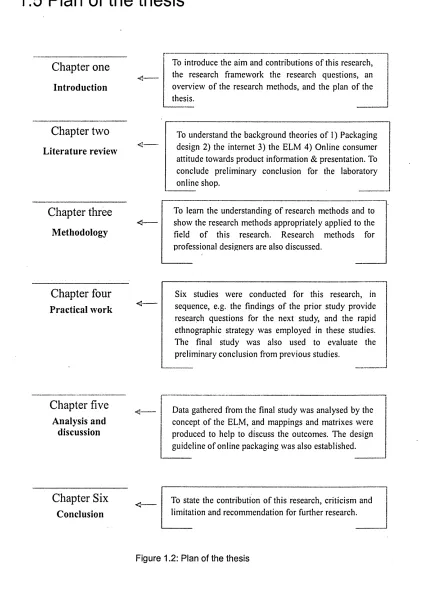
To introduce the aim and contributions of this research, the research framework the research questions, an overview of the research methods, and the plan of the thesis.
Chapter one
<—
Introduction
Chapter two
<5
-Literature review
To understand the background theories of I) Packaging design 2) the internet 3) the ELM 4) Online consumer attitude towards product information & presentation. To conclude preliminary conclusion for the laboratory online shop.
Chapter three To learn the understanding of research methods and to
<--- show the research methods appropriately applied to the
Methodology field of this research. Research methods for
professional designers are also discussed.
Chapter four Six studies were conducted for this research, in
Practical work ^ sequence, e.g. the findings of the prior study provide
research questions for the next study, and the rapid ethnographic strategy was employed in these studies. The final study was also used to evaluate the preliminary conclusion from previous studies.
Chapter five
Analysis and discussion
Data gathered from the final study was analysed by the concept of the ELM, and mappings and matrixes were produced to help to discuss the outcomes. The design guideline of online packaging was also established.
Chapter Six
Conclusion
To state the contribution of this research, criticism and limitation and recommendation for further research.
Figure 1.2: Plan of the thesis
This thesis contains six chapters.
[image:25.612.101.535.63.652.2]framework, research questions identification, research methods and the
plan of this thesis.
Chapter two literature review: Reviews the background literature
related to this research, such as packaging design, eCommerce, packaging
and advertising, the ELM, and online consumers attitudes towards product
information and presentation. These reviews provide the theoretical support
for this research. The theoretical support is also used to evaluate the
findings from the practical work. Furthermore, together with the findings of
the tentative studies, a preliminary conclusion is developed so that it can be
evaluated by the laboratory online shop (See figure 1.1 research framework)
Chapter three research methodology: Presents the research methods
applied in this research, such as the methods of data collection, data
analysis and sampling. The validity and reliability of the employed research
methods is also considered all through this study. Meanwhile, every
research method used in this research will be described in detail.
Additionally, a rapid ethnographic strategy, design practice oriented
research and methods of data analysis will also be discussed in this chapter.
Chapter four practical work: Falls into two parts, the tentative studies
phase and the laboratory online shop phase. The tentative studies present a
sequence of studies with practical online packaging design (See figure 4.1),
to gradually develop the idea of online packaging. The finding of these
studies is compared with the literature review for theoretical support, in
order to establish a preliminary conclusion for evaluation to be tested in the
laboratory online shop (See figure 1.1). The laboratory online shop used
A Conceptual Model of
Chapter 1 introduction
1.5 Plan of the thesis
fifteen participants to evaluate the preliminary conclusion, and other ideas of
online packaging design arising as the research progressed.
Chapter five analysis and discussion of the laboratory online shop:
Analyses the field data of the laboratory online shop based on the concept
of the ELM. It explains what online consumers expect from online packaging
and what online packaging can provide to fulfil consumers’ needs. The
patterns of shopping behaviour, with different levels of product involvement,
are also analysed, with the result being mainly consistent with the ELM’s
prediction. It was also discovered that impulse shopping and play behaviour
have strong relations with consumers’ physical shopping experiences. The
form of online packaging is discussed, however we found no standard form
for online packaging. It was found that designers need to develop their
thinking to include concepts of online packaging to help consumers transfer
their physical packaging thinking to create effective online packaging,
because consumers need online packaging to help them to transfer their
physical shopping experience into the virtual environment. Finally, the
design guidelines of online packaging will be established for designers, to
help them to have a complete consideration for the design process for
online packaging.
Chapter six conclusion: Describes the main consequences of this
research by emphasising the development of packaging thinking in an
online context, research methods for designers and the application of the
ELM, criticism and limitations are described and that will indicate directions
for further research.
A Conceptual Model of
Chapter two Literature Review
2.1 Introduction
This chapter is a review of literature that will offer a broad understanding
of the role of packaging and consumers’ purchasing attitudes in the online
environment. It will show where previous research could fit into the idea of
online packaging.
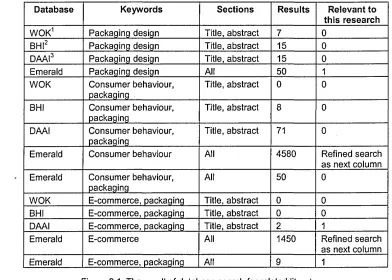
Database Keywords Sections Results Relevant to this research W O K1 Packaging design Title, abstract 7 0
BHI2 Packaging design Title, abstract 15 0 DAAI3 Packaging design Title, abstract 15 0 Emerald Packaging design All 50 1 W OK Consumer behaviour,
packaging Title, abstract 0 0 BHI Consumer behaviour,
packaging Title, abstract 8 0 DAAI Consumer behaviour,
packaging Title, abstract 71 0
Emerald Consumer behaviour All 4580 Refined search as next column Emerald Consumer behaviour,
packaging All 50 0 W OK E-commerce, packaging Title, abstract 0 0 BHI E-commerce, packaging Title, abstract 0 0 DAAI E-commerce, packaging Title, abstract 2 1
[image:28.613.89.481.287.567.2]Emerald E-commerce All 1450 Refined search as next column Emerald E-commerce, packaging All 9 1
Figure 2.1: The result of database search for related literatures
The figure 2.1 shows that there are only a few papers related to this
research topic. It was difficult to select areas for the literature review at the
1 Web of Knowledge, including Social Science Citation Index, Science Citation Index, and Art and Humanity Citation Index.
2 British Humanity Index. 3 Design and Applied Art Index.
A Conceptual Mode! of
Chapter 2 Literature Review
2.1 Introduction
beginning of this research, due to insufficient literature to suggest a
research direction. However, the author chose four areas (packaging design,
the internet, Elaboration Likelihood Model (ELM) and online consumer
attitude towards product presentation & information) which were gradually
considered relevant to the idea of online packaging, after a few tentative
studies had been conducted. Figure 2.2 shows the areas that were
considered relevant to this research.
Packaging design Hypertext &
interactivity
The ELM
Online packaging for
eCommerce
Cognitive psychology The
internet
[image:29.614.144.424.230.464.2]Online consumer attitude towards product presentation & information
Figure 2.2: The areas of the literature review
This chapter contains five sections, four sections for the literature review
and one section for the preliminary conclusion of the literature review and
the tentative studies. Each section will be briefly introduced as follows:
1) Functions of packaging: Packaging has three main functions, primary,
secondary and tertiary functions. The primary function concerns product
protection and distribution, which has been used for keeping the product in a
A Conceptual Model of
complete condition since 3000 B.C. The secondary function is for visual
communication, which has been gradually used for conveying product
presentation and information to consumers after the industrial revolution.
The tertiary function is the additional value for a product, e.g.
environmentally friendly. The secondary function is the main theme that is
considered to be transformed to the virtual environment in this research.
2) The internet: The internet originated in the 1960’s. With the
development of hypertext and the graphic user interface, the internet is
gaining popularity for helping people communicate with each other and to
acquire information. While online shopping cannot have many of the
benefits of physical packaging’s presentation, we have the opportunity to
employ these new characteristics of hypertext and interactivity to
compensate.
3) The ELM: Elaboration Likelihood Model (ELM) is a theory of cognitive
psychology and has been the main theory used to guide the design of online
packaging in this research and to evaluate the practical work. The concept
of two message routes has provided this research with a guideline to
construct persuasive information for consumers who have different levels of
product involvement. Its prediction of consumer behaviour can be used to
analyse the field data. This research has indicated that this theory can be an
effective tool for designers during their design process.
4) Online consumers’ attitudes towards product information and
presentation: This section will show that many researchers have already
discovered that consumers have difficulties when buying online, due to poor
A Conceptual Model of 13
Chapter 2 Literature Review
2.1 Introduction
product information and presentation. The author argues that this situation
can be amended by enhanced online packaging, because a product’s
packaging act as a “silent salesman” in the physical environment and
provides consumers with product presentation and information. These
functions could be transferred into the online environment to help
consumers who shop online.
5) Preliminary conclusion: Findings from the literature review and the
tentative studies assume that the secondary function of packaging could be
transferred into the online environment to continually carry on the role of a
“salesman”, in order to help consumers shop online. Research questions
are proposed for the main experiment “laboratory online shop”, which will
evaluate these questions, in order to discover not only online packaging
contributions for both online shoppers and eCommerce but also for the
design guidelines of online packaging for designers.
A Conceptual Model of
2.2 Packaging design
Packaging is widely used for a variety of purposes including, product
protection, transportation, warehousing and point of purchase (POP)
displays where it is known as a “silent salesman” (Pilditch, 1973). The
functions of packaging were originally to protect and preserve products,
prevent them from being damaged, reduce storage and transportation costs
in the distribution process, provide appealing presentation for products such
as attractive POP display, and convey information to consumers, for
example the quality labelling system. Today, the mission for packaging has
been further expanded to the utility of goods, in order to contribute to the
quality of people's lives and their shopping experiences. This section mainly
focuses on the functions of secondary packaging design, such as promotion,
information and communication functions, where the author wants to
discuss how these packaging concepts can be applied in the online
shopping environment.
A Conceptual Model of
Chapter 2 Literature Review 2.2 Packaging design, 2.2.1 A brief history of packaging
2.2.1 A brief history of packaging
The earliest forms of package were utilising raw materials such as leaves,
skin, hollowed out logs, and fur to keep food or product protected (Lung,
1982; Lox, 1992; Chou, 1999). However, these raw materials could not keep
the food or product in the best of conditions. About 3000 B.C., the Egyptians
used a specific kind of leaf as a plate and invented papyrus from a plant’s
fibre to wrap food (Chou, 1999). They also utilised glass to make bowls and
jars as containers for daily use.
The first canned package was attributed to a French industrialist Nicolas
Appert (Rouffignac, 1990; Lox, 1992) at the beginning of the 19 century. He
invented the canning process, which used a glass jar - as a way of
preserving food by heating it inside a sealed container. The development of
the technique for sterilizing packaging, by heating it in a metal container
goes back to Napoleon (Roth & Wybenga, 2000), when he needed to feed
his army during wars.
Before the industrial revolution, the storage, handling\ and protection of a
product were the main functions of packaging. After the industrial revolution,
other functions of packaging were also developed, such as branding and
visual attractions, due to the great use of machinery on mass production
goods and an increased consumption (Hine, 1995; Emblem and Emblem,
1996).
After World War II, the packaging industry has become a significant
economic force in the advanced industrial nations (Roth, 1990). The
packaging industry has a very important role in modern business activities,
as well as business functions, including marketing, advertising,
point-of-purchase, informative function and promotional materials. They
were significantly dependent on the packaging (Roth, 1990; Lox, 1992;
Stewart, 1996). Since the rise of the modern supermarket, the visual
function of packaging acts a very important role in attracting consumers’
attention in the “self-service” shopping environment. Packaging seemed to
take the place of shop assistants to provide a voice for products.
Now, we have already moved onto another new trading platform - that of
online shopping. Interestingly though, the visual role of packaging seems
not to have caught up with this new trend of shopping environment. The
internet is a “highly self-select environment” (Kathman, 2002) where the
consumers cannot usually obtain an instant answer to an enquiry and
normally do the shopping alone. Hence, they need to make decisions by
themselves, with the information in their hands. Therefore new packaging
design thinking should be different from traditional thinking for gaining a
greater market share of eCommerce. This niche of packaging for
eCommerce should be studied.
A Conceptual Model of
Chapter 2 Literature Review 2.2 Packaging design, 2.2.2 Functions of packaging
2.2.2 Functions of packaging
This research is focused on virtual packaging for internet shopping but it
is necessary to understand the functions of physical packaging, in order to
transfer packaging thinking from the real to the virtual. Packaging was
defined by the European Federation (2000) as
“all products made of any materials of any nature to be used for the
containment, protection, delivery and presentation of goods, from raw
materials to processed goods”.
As mentioned previously, Paine (1981, pp.3) defines packaging as “the
art, science and technology of preparing goods for market and sale.” These
definitions provide a perspective of packaging functions that show that
packaging functions can be physically and visually appealing to assist
products during the selling process from the manufacturers to the end users.
Packaging includes all kinds of physical and visual elements which can be
used in physically packing the goods and visually communicating with
consumers. The function is to keep the original quality of products, whilst
providing information to the end users during the processes of transporting
and selling.
The various functions of packaging can be divided into three categories;
primary, secondary and tertiary (Lung, 1982; Emblem and Emblem, 1996;
Chou, 1999). The primary functions as known as industrial packaging
design concern the structural nature of packaging. The secondary functions
as known commercial packaging design relate to the issues of visual
A Conceptual Mode! of ' 18
communication, with the tertiary functions being about the additional values
for the product. The basic requirements of physical packaging include
(Figure 2.3) containment, protection, preservation, communication,
promotion, loading and storage, as well as the convenience of use (Pilditch,
1973; Lung, 1982; Paine, 1990; Sonsino, 1990; Stewart, 1996; Morgan,
1997; Chou, 1999). In this research, the secondary functions will be the
main focus, because the idea of “online packaging” is a concept relating to
the packaging of product presentation, which transfers the functions of
physical commercial packaging, such as sales, promotion and information,
to the virtual environment, in order to assist eCommerce sales (Huang et al,
2003). The following discussions are the summaries based on the above
references, with a concentration on the secondary functions.
Functions of packaging
Prim ary functions Secondary functions Tertiary functions Protection, storage,
warehousing, transportation, distribution
Sales, promotion,
information, communication, branding
Safety, ease of use, reuse, value added, multi-functions
Figure 2.3: Functions of packaging
2.2.2.1 Sales function
The purpose of this function is to express the image of product and
describe the products’ features, giving consumers a confidence that will 1)
make a favourable impression and 2) make purchasing decisions more
efficient (Stewart, 1996). Blackwell et al (2001) also pointed out that some
buyers were shopping impulsively and in a hurry to pick it from the shelf,
additionally more than 54% of consumers often intended to employ
A Conceptual Model of
Chapter 2 Literature Review 2.2 Packaging design, 2.2.2 Functions of packaging
products’ displays as a replacement for a physical shopping list. A highly
recognisable packaging can allow consumers to efficiently identify a product
or service which can provide a specific need to the consumers.
Packaging can be distinguished from its product and deliver to the
consumer four elements: purpose, performance, quality and value (Milton,
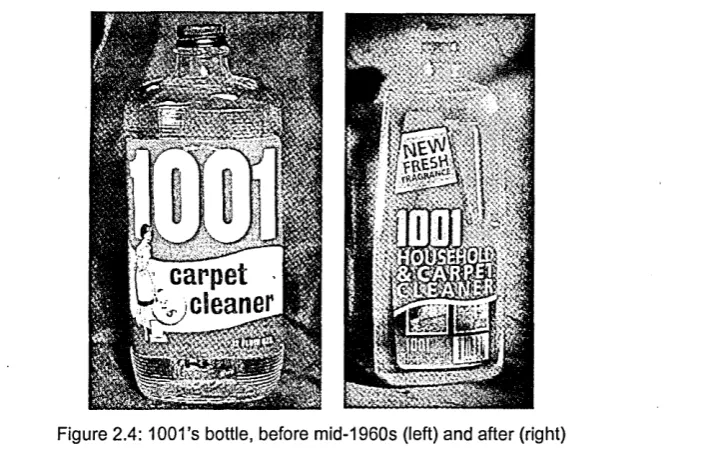
1991). An example is 1001 liquid carpet cleaner (Figure 2.4) (Milton, 1991).
i/lvlTOki
[image:37.614.135.490.203.429.2]>Gleaner
Figure 2 .4 :1001’s bottle, before mid-1960s (left) and after (right) Source: Milton (1991: pp.5)
Even though 1001 has not had any TV commercials or national
advertisements’ advertising the product since 1967, its sales are still good.
Since the 1960’s, 1001 has changed the shape of the bottle, the material of
the bottle and the colour of the liquid cleaner. However the main colours of
the labeling and the branding are almost the same. The image of 1001 is still
strong in consumers’ minds and effectively influences purchasing decisions,
which is demonstrated by its strength of sales.
Therefore the packaging has to be clearly identified. Manufacturers have
to give in depth consideration to the quality of the product and equally good
A Conceptual Model of
consideration to the packaging design. In most cases it is difficult to try or
taste the quality and standard of a product at the sales point. Hence buyers
would concentrate on the package design.
Furthermore, Lox (1992) mentioned that Kotler and Mickwitz described
that the commercial functions of packaging played an important role on
saleability and / or returns for a specific product. Especially, when the sales
of a product reach the saturation stage of the Product Life Cycle (PLC), the
packaging can obviously affect the increase of product sales in a profitable
environment (Figure 2.5).
Sale Influence
A=Introduction B=Growth C=Maturity D=Saturation E=Decline
C
A B D E Time
▲
,/p S.K. |
S 1 Vp
1 / / ^ 1 S ,/p
1 1 J J K /^ ^ i / p K=Qualityi
N=Require|ment P=Price I S=Service j IV=Package
E Time
Figure 2.5: The normal turnover of a product as a function of time; Product Life Cycle (left); impact of different factors at each stage of PLC (right). Source: Lox (1992, pp.24)
However, what if consumers cannot instantly recognise a product’s
identification in the online environment? This could mean that the retailers
might not make good sales, due to the weakness of the product’s
identification. On the contrary, if online retailers could make the online
presentation simply and clearly identify the product, it is likely to bring the
same benefits in online shopping that it gives in physical packaging.
A Conceptual Model of
Chapter 2 Literature Review 2.2 Packaging design, 2.2.2 Functions of packaging
2.2.2.5 Promotional function
The promotional function is similar to the sale function but it concentrates
on the advertising function of packaging (Stewart, 1995). In addition, it is
also intended to attract shoppers’ attention, so that it has an influence on
their purchasing decisions, especially during promotional drives (Figure
2.6). This promotional function of the packaging plays a key role for POP
packaging, as it is directly addressed to the consumer.
Figure 2.6: Examples of promotional functions using special displays to promote products.
2.2.2.6 Information function
The various pieces of information printed on the packaging provide the
consumer with details about the contents and usage of the particular
product. Consumers gather information about the product through the
label. Manufacturers need to update themselves on the packing and
labeling needs of the target markets to avoid any deceptive and unfair
methods of packaging.
A Conceptual Mode! of 22
Information Consumer’s concerns
The product itself Branding, capacity, colour, country of origin, date of made/expired, ingredients, nutrition facts, performance, the image of product, the weight, size, method of usage, meat / vegetable diet
The peripheral of product Pricing, the contact of manufacturer, manufacturer’s warranty, additional information sources, voltage input/output, method of maintenance, product’s history, material of product, accessory
Figure 2.7: Information of consumers’ concerns
Examples (Figure 2.7) include branding, pricing, the weight (both net and
gross), the specification listing of ingredients, colour, country of origin,
capacity, date of made/expired, the image of product, the contact of
manufacturer, the performance of product, nutrition facts, additional
information sources, voltage input/output, method of maintenance,
manufacturer’s warranty, method of usage, product’s history, meat /
vegetable diet, material of product, accessory and size, which all need to be
written on the label clearly. This concise information could allow consumers
to compare between different products, in order to make a more informed
purchasing decision. A recent story reported by British Broadcasting
Corporation (BBC) (2004), said that the Food Standards Agency (FSA)
suggested 26 million British people should reduce their salt intake for
preventing potential diseases, e.g. heart attack, and manufacturers should
have better labeling of salt in order to help people to change their diet. This
story shows the importance of transparent information that also plays a role
for both commercial and public justice purposes.
A Conceptual Model of
Chapter 2 Literature Review 2.2 Packaging design, 2.2.2 Functions of packaging
tluntinn
XPIRESOFT
Figure 2.8: To communicate with consumers by using information functions
How do we utilise these secondary functions on products sold online? An
advantage of online packaging is the hypertext, which can maximise the
source of information and content. The physical packaging has a limited
space to print relevant information, hence the manufacturer can only choose
specific information to print (Figure 2.8), however, the chosen information
might not be sufficient for everybody. For example, canned food does not
normally have space to print a recipe, so some supermarkets, such as
Safeway, produce a free monthly magazine with a limited number of recipes
in order to recover this disadvantage. The free magazine can both promote
the food which is shown in its pages as well as being a supplement to the
packaging that may have insufficient information printed on it. Nevertheless,
people might not normally have the magazine at home and the information
on the packaging again limits specific knowledge.
On the internet, these types of problems can be minimised. The
manufacturers and retailers can produce a total catalogue of information to
place beside any product; specific specifications on ingredients can be fully
explained as space is not as limited as it is on the packaging of a product in
a supermarket. For example, websites can contain all the vital information
A Conceptual Model of
that a consumer might need to know in order to make a well informed
purchasing decision.
Nowadays, people have many choices when they want to buy a particular
product, being able to choose from dozens of similar products. Furthermore,
research showed (Chou, 1999) that the consumers usually paid less than
one second’s attention browsing per product on shelves, when they were
shopping in supermarkets. As a consequence, it is quite hard to make a
decision. So, the manufacturers have to meet the customer’s needs and
ensure that make the packaging is distinguished from others in order to sell
their products. In these circumstances, packaging could be a powerful tool
in the marketing for the sales of the product. However, during online
shopping, consumers cannot touch products, nor can they see the
packaging clearly in cyberspace. So how can consumers be persuaded by
the online packaging?
According to a survey of 40 eCommerce websites, Visser (2002)
suggested that it is difficult to translate the existing packaging design and
marketing tactics into online retailing. He also found that information and
emotional components could not be seen within retailer’s web sites through
current online packaging. But he did not explain why this is so in his
research. Thus a new packaging design strategy that can be used for online
products must be developed for helping consumers shopping online.
A Conceptual Model of
Chapter 2 Literature Review 2.2 Packaging design, 2.2.3 Packaging vs. advertising
2.2.3 Packaging vs. advertising
Advertising campaigns sometimes link packaging and advertising
together, even though they all promote the product and attract the
consumers’ attention. However some aspects allow us to recognise subtle
differences between them.
Kotler, et al (1996) indicated that there are more than 15000 items in an
average supermarket, with 53% of customers shopping impulsively,
packaging being one of the main factors in achieving this figure. Reiner and
Rose (2002) provide us with three points to distinguish the difference
between advertising and packaging 1) 70% of impulse shopping, consumers
could not remember the advertising of the item. 2) The packaging of a
product advertises the product before and after purchase. 3) The packaging
of a product has a longer shelf life than the life of the product’s
advertisement. They also reported that Richard Linxweiller did extensive
research on this topic, showing that there were only 20% of products in
German supermarkets being promoted by conventional advertising,
conversely the other 80% of products were selling without any advertising at
all. It is obvious that packaging plays a very important role on product sales,
something advertising cannot replace.
In such a competitive environment, how is a product chosen by customers?
Branding can be an important determinant to influence consumers
purchasing decisions (Stewart, 1996; Blackwell et al, 2001), as branding
usually represents the quality of products, the trustworthiness of the brand
and the recognition of products and packaging provides one of the vehicles
A Conceptual Model of
for branding. However, this research does not focus on this aspect of
packaging. Apart from the branding issue, the packaging might be the last
chance to persuade customers before the check out point. Self-service
shopping has been very popular since modern supermarkets were
introduced. As nobody stands by the supermarket shelves to introduce the
product to the customers, it is believed that packaging is a good solution as
a sales promotional tool for this marketing problem (Oliver, 1995; Stewart,
1996). Attractive packaging could help to enhance sales, providing the
packaging gives an intangible or tangible benefit to the customer. The
benefit could be emotional or functional.
Let’s take an example of buying wines in brick-and-mortar retailers and
imagine that a person is induced with a desire to buy a bottle of wine by an
advertisement (Figure 2.9), which may be just a concept of a certain brand
of wine or may not point out a specific bottle of wine. The person writes the
wine down on his shopping list or bears the wine in her/his mind.
Out* I
. . .. — -* ■
Fig. 2.9: A poster of a wine’s ad Fig. 2.10: Consumers are looking for further details
Once the person goes to a supermarket to buy the wine (Figure 2.10), the
packaging of the product likely acts as a trigger to make a sale because the
A Conceptual Model of
Chapter 2 Literature Review 2.2 Packaging design. 2.2.3 Packaging vs. advertising
packaging is presenting at least three roles on the shelves that we have
reviewed from literatures : 1) A symbol of confirmation to tell consumers that
it is what they want to buy, such as graphic design, branding and colour, 2)
An information provider to offer consumers sufficient information for them to
make a purchasing decision, such as alcoholic consistency and type of
grape, and 3) An advertising effect to make a message repetition to those
whose attention is caught by the packaging, such as the picture of the
adverting endorser.
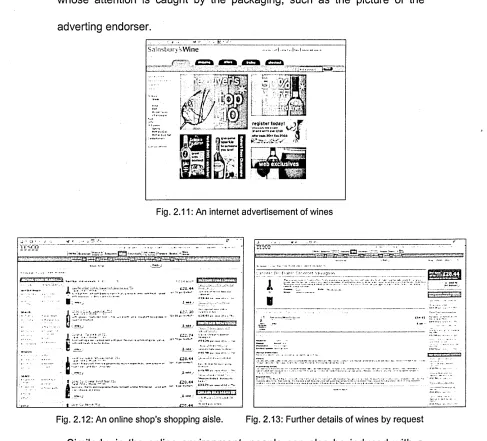
Sainsbury’sWine
[image:45.612.50.537.214.655.2]re g ltttr today!
Fig. 2.11: An internet advertisement of wines
TIH5"
Fig. 2.12: An online shop’s shopping aisle. Fig. 2.13: Further details of wines by request
Similarly, in the online environment, people can also be induced with a
desire to buy a bottle of wine through internet advertising (Figure 2.11) when
A Conceptual Model ot
they are browsing websites. If people want to buy online, they need to log
onto an online shop to be able to look for the wine. Again they need to “walk”
to the right “aisle” to look for the wine (Figure 2.12). Once they see the
“packaging” of the wine, they can either put it into the “shopping trolley”
straight away or read the information on. the “packaging” (Figure 2.13)
before making the purchasing decision.
It can be argued that people are looking at the “packaging” of the product
for confirmation and information when they are buying products in
brick-and-mortar outlets as well as in the online environment, not the
advertising of the product, because advertising does not offer those
requirements for consumers at sale points.
The aim of commercial packaging design is to provide relevant
information that can fulfil consumers’ needs as well as encouraging impulse
or planned purchasing with attractive presentation and persuasive
information. Typically this co-exists with the advertising function of the pack
that forms a powerful alliance (Stewart, 1996). However it has to emphasise
that advertising and packaging might exist together on one body,
nevertheless, they work for different purposes. The advertising can convey
an awareness of a product, a service and even a concept to consumers, but
it does not carry full information for a product.
The duty of online packaging is not only needed to provide sufficient
information for products but also to play the role of the “salesman" to
consumers. As mentioned in section 2.2.1, packaging is now facing a time
of innovation where its presentation and information functions need to be
A Conceptual Model of 29
Chapter 2 Literature Review 2.2 Packaging design, 2.2.3 Packaging vs. advertising
converted into the virtual world. Therefore the author considered that online
packaging should be able to do the same job as it would do in the real shop
environment. Even more importantly, the author thought that online
packaging could not be replaced by internet advertising, although online
packaging has not been deeply studied.
A Conceptual Mode! of
2.2.4 Summary
According to the development of commerce and the rise of supermarkets,
the role of packaging has been expanded from a role as a “silent protector”
to that of a “silent salesman”. The role of packaging is constantly developing,
according to the change of trading platform. Since the introduction of
eCommerce in the early 1990’s, online shopping has gradually caught the
consumer’s attention. We need to take a fresh look at packaging design
strategy to utilise packaging functions in the online environment.
Packaging has three main functions, primary, secondary and tertiary. The
secondary is mainly used for visual communication with consumers and is
also a very useful tool for selling products in marketplaces. This research
considers that the secondary function could be more likely transferred into
the online environment, e.g. product information and presentation than other
functions.
The advertising effect is one of the packaging functions, especially at a