www.wjpr.net Vol 6, Issue 10, 2017. 806
FORMULATION AND IN-VITRO EVALUATION OF DISSOLVING
BUCCAL FILMS OF LOVASTATIN
Manju Rani* and Bhag Chand
Department of Pharmaceutics, Delhi Institute of Pharmaceutical Sciences and Research
(DIPSAR), University of Delhi, Pushp Vihar, sector - 3, New Delhi-110017, India.
ABSTRACT
The purpose of this investigation was to develop “Dissolving muco-adhesive buccal films” of lovastatin by solvent casting technique to
deliver lovastatin into blood via buccal mucosa and to bypass its first
pass metabolim and also to improve the bioavailability of the drug
using muco-adhesive polymers and PEG400 as plasticizer.
Mucoadhesive polymer[1] such as Hydroxy Propyl Methyl Cellulose E5 (HPMC), Polyvinyl alcohol(PVA), Polyvinyl pyrollidine(PVP),
Carboxy methyl cellulose(CMC), Carbopol 934 and Chitosan were
used for the film. Prepared films were carried out for in
vitro evaluation tests such as weight variation, film thickness, folding
endurance, drug content, mucoadhesive strength[2] force of adhesion, bond strength, disintegration studies and dissolution studies.
Attenuated total reflectance (ATR), Differential Scanning Calorimetry
(DSC) and X-ray powder diffraction (XRD) analysis revealed no Interaction between drug
and polymers. Results revealed that buccal film containing HPMC 5% (w/v) and PEG400
40% (w/w of dry polymer weight) shows maximum dissolution and comply all the
characteristics of buccal films. Thus, this study suggests that “dissolving mucoadhesive buccal films” can act as a potential for buccal delivery of poorly water soluble hypolipidemic
drug lovastatin.
KEYWORDS: Mucoadhesive polymers; Lovastatin; Buccal films.
INTRODUCTION
Oral route is most preferred route of drug administration but solubility and first pass
metabolism sensitivity of drug are important characteristic to be accepted by this route.
Volume 6, Issue 10, 806-817. Research Article ISSN 2277– 7105
*Corresponding Author
Manju Rani
Department of
Pharmaceutics, Delhi
Institute of Pharmaceutical
Sciences and Research
(DIPSAR), University of
Delhi, Pushp Vihar, sector -
3, New Delhi-110017, India. Article Received on
13 July 2017,
Revised on 02 August 2017, Accepted on 23 August 2017
DOI: 10.20959/wjpr201710-9363
www.wjpr.net Vol 6, Issue 10, 2017. 807
Parental rout is painful drug administration system. Topical drugs are limited for topical or
local treatment only.
High molecular weight drugs, poor skin penetrating drugs, poor water insoluble drugs, and
extensive first pass metabolism prone drugs need alternative routes. Mucoadhesive route is
becoming popular alternative for most of the drugs.
Mucoadhesive drug delivery system through Buccal, sublingual, rectal and nasal mucosa can
be faster and systemic mode of non-invasive drug administration to bypass first pass
metabolism. Faster delivery and enhanced bio availability of drugs is observed through
mucoadhesive administration[3] Buccal route is preferred mostly for the drugs which have poor solubility, dissolution and bioavailability and for the drugs which show high hepatic first
pass metabolism. Buccal route is the most convenient route as it is noninvasive and more
patient compliance. This is because the buccal mucosa is highly vascularized and the drugs
are directly absorbed into blood stream and shows immediate action. Moreover this route can
be used for both local and systemic effects. As the drug directly reaches the blood, the dose
can be minimized.[4] Several buccal adhesive delivery devices have been developed such as tablet, wafers, gels and films. Overall, a muco-adhesive buccal film offers several benefits
due to its small size, thickness and improved patient compliance compared to tablets and gels.
Buccal films offer more surface area and offers rapid disintegration and rapid absorption. The
muco-adhesive buccal films adhere to the buccal mucosa and then the films are disintegrated
after hydrating in saliva and release the drug. As the film adhered to buccal mucosa the
released drug has more chances to get firstly absorb into the blood stream through mucosal
layer.[5]
Lovastatin is a potent cholesterol-lowering agent that belongs to the class of medications
called statins[6] According to BCS classifications it is a class II drug with low solubility and high permeability. Lovastatin is absorbed from the gastrointestinal tract and <5% of the oral
dose reaches the general circulation as active inhibitors. Lovastatin undergoes extensive
first-pass metabolism so the availability of the drug in the system is low and variable.
Enhancement of the bioavailability of Lovastatin can reduce the dose required to elicit the
same pharmacological action and hence reduce the side-effects associated with the drug.
lovastatin also causes irritation to gastric mucosa. Thus delivering lovastatin through buccal
route would increase the bioavailability as the first pass metabolism would be bypassed.
www.wjpr.net Vol 6, Issue 10, 2017. 808
by incorporating lovastatin into water soluble polymer matrix will also enhance its water
solubility, stability and bioavailability.
MATERIALS AND METHODS
Materials
Lovastatin USP was obtained as a gift sample from Sterling®Biotech Limited, Gujrat, India.
Hydroxy Propyl Methyl Cellulose E5 (HPMC), Polyvinyl alcohol(PVA), Polyvinyl
pyrollidine(PVP), Carboxy methyl cellulose(CMC), Carbopol 934, (medium viscosity)
Chitosan, Poly ethylene glycol 400 (PEG400), Ethanol were purchased from Central Drug
House, Lab Reagents, New Delhi, India.
Method
Preparation of Dissolving Buccal Films
Hydrophilic polymers was dissolved in 10ml of hot water in one beaker and Lovastatin, PEG
400 were dissolved in 7ml of 95% ethanol in another beaker, stirred continuously in
magnetic stirrer about 45mins.
Drug solution was then added to the polymeric solution was stirred for 30 min using
magnetic stirrer and was kept in undisturbed condition till the entrapped air bubbles were
removed. The aqueous solution was casted in a glass petridish and was dried at room
temperature for about 48hrs. The dried film was carefully removed from the petridish and
was cut into size required for testing. The films were stored in air tight plastic bags.
Further a series of placebo dissolving buccal films were prepared with varying concentration
of polymer, plasticizer and co-solvent. Afterwards films were gently peeled off and each of
them were evaluated for their following physical properties are Detachability from Petri
plates, Non-Stickiness, Uniformity, Flexibility, Transparency/Appearance, Tensile strength,
Brittleness
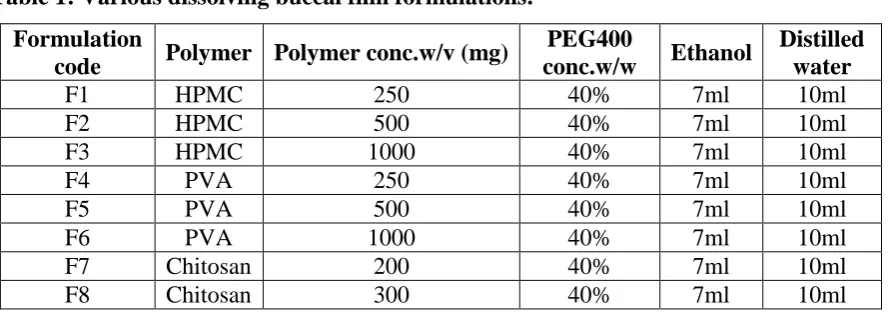
Dissolving Buccal Films Formulation
Based on the physical properties and mucoadhesive strength, a series of buccal films were
prepared with varying concentration of polymers, plasticizer and ethanol as solvent. For all
formulations the amount of Lovastatin were same i.e. 10 mg. The formulations were
summarized in the table 1.
www.wjpr.net Vol 6, Issue 10, 2017. 809 Table 1: Various dissolving buccal film formulations.
Formulation
code Polymer Polymer conc.w/v (mg)
PEG400
conc.w/w Ethanol
Distilled water
F1 HPMC 250 40% 7ml 10ml
F2 HPMC 500 40% 7ml 10ml
F3 HPMC 1000 40% 7ml 10ml
F4 PVA 250 40% 7ml 10ml
F5 PVA 500 40% 7ml 10ml
F6 PVA 1000 40% 7ml 10ml
F7 Chitosan 200 40% 7ml 10ml
F8 Chitosan 300 40% 7ml 10ml
In Vitro Evaluation of Dissolving Buccal Films
Weight variation
Ten films were randomly selected and their average weight was obtained. Individual films
were weighed and compared with the average weight for the deviation.
Thickness
The thickness of film can be measured by micrometer screw gauge at different strategic
locations (at least 5 locations). This is essential to determine uniformity in the thickness of
the film as this is directly related to the accuracy of dose in the film.
Folding endurance test
Folding endurance is determined by repeated folding of the film at the same place till the film
breaks. The number of the times of the film is folded without breaking is computed as the
folding endurance value
Surface pH
The surface pH of the films was determined in order to investigate the possible side effects
due to change in pH in vivo, since strong acidic or alkaline pH may cause irritation to the
buccal mucosa. The film to be tested was placed in a Petri dish and was moistened with 0.5
ml of distilled water and kept for 1 h. The pH was noted after bringing the electrode of the pH
meter in contact with the surface of the formulation and allowing equilibrating for 1.0 min.
Determination of Mucoadhesive Strength, Force of adhesion &Bond strength
www.wjpr.net Vol 6, Issue 10, 2017. 810 Modified Wilhelm Plate Method
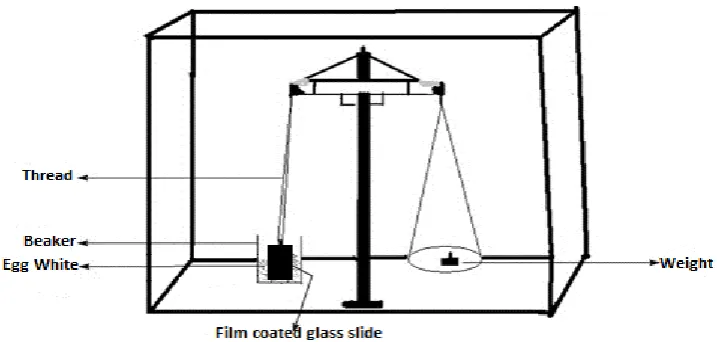
A small glass plate (2 cm) was coated by film of test mucoadhesive agent using a rubber
band. The egg white was collected from hen eggs and kept in a suitable container and the
temperature was maintained at 37 °C. The composition and viscosity of egg white is similar
to that of mucus.[3,8]
Table 2: Composition of Egg White and Mucus.
water Glycoprotein Mineral salts carbohydrate Viscosity
Mucus 95% 0.5-5% 1% 0.5-1% 12-15Pa-s
EGG White 90-95% <10% - <1% 12-18Pa-s
Nylon thread was attached at one end of the glass plate and the other end of thread was
attached to the left arm of physical balance. It was allowed undisturbed for 5 min. Provision
was given to raise the weight from the right arm of balance. At specified intervals, weight
was added to completely detach the coated glass plate from egg white and the force required
to completely pull the plate out of the egg white was determined under experimental
condition. Three plates were tested for each material and the average weights required was
calculated.
Fig. 1 Apparatus to determine mucoadhesion in vitro, using Modified Wilhemy’s
technique.
Force of adhesion and Bond strength were calculated by following equations:
Force of adhesion (N) = mucoadhesive strength (g) × 9.8/1000
[image:5.595.124.483.423.594.2]www.wjpr.net Vol 6, Issue 10, 2017. 811 Disintegration test
In-vitro disintegration time was determined visually in a petridish containing 25 ml of pH
6.8phosphate buffer with swirling every 10 sec. The disintegration time is the time when the
film starts to break or disintegrate.
Drug Content
Drug content studies were carried out for F2, F5 and F7 formulation of Dissolving buccal
films. Dissolving film of size 4cm² was taken and transferred into a graduated glass stoppered
flask containing 10ml of methanol. It is then stirred continuously to completely dissolve the
film. The solution is then suitably diluted and absorbance values were measured in a UV
spectrophotometer at 237nm. The average of three films was taken as final reading.
In vitro drug release study
The drug release studies were performed with USP dissolution test apparatus. (Paddle
method). The USP dissolution apparatus was thermo stated at the temperature of 37±10C and
stirred at rate of 75 rpm in a 500ml dissolution medium of pH 6.8 phosphate buffer. The
aliquots of 5 ml were withdrawn at the time interval of every 15mins and replaced with equal
volume of dissolution medium. The sink condition was maintained throughout the study. The
samples were analyzed at 237 nm in a UV-VIS Spectrometer and cumulative amount of drug
release at various time intervals was calculated.
Compatibility studies
The drug-polymer compatibility was confirmed by taking IR spectrum of drug, polymer and
physical mixture of drug-polymer proved that the excipients were compatible with the
Lovastatin.
RESULT AND DISCUSSION
Optimization of Polymers
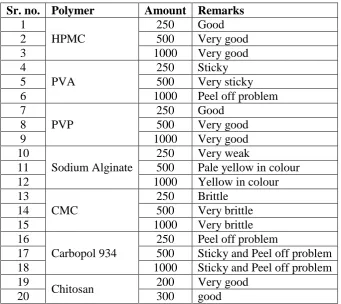
The Placebo films were prepared using HPME E5, PVP, PVA, Chitosan, Carbopol 934,
CMC, Sodium Alginate as polymers in various amounts. The characteristics of films were
www.wjpr.net Vol 6, Issue 10, 2017. 812 Table 3: characteristics of films prepared using various polymers.
Sr. no. Polymer Amount Remarks
1
HPMC
250 Good
2 500 Very good
3 1000 Very good
4
PVA
250 Sticky
5 500 Very sticky
6 1000 Peel off problem
7
PVP
250 Good
8 500 Very good
9 1000 Very good
10
Sodium Alginate
250 Very weak
11 500 Pale yellow in colour
12 1000 Yellow in colour
13
CMC
250 Brittle
14 500 Very brittle
15 1000 Very brittle
16
Carbopol 934
250 Peel off problem
17 500 Sticky and Peel off problem
18 1000 Sticky and Peel off problem
19
Chitosan 200 Very good
20 300 good
Thus films having very good and good characteristics were selected for further studies.
Preparation of film formulations
All the film formulations containing HPMC-E5, PVA, chitosan, and PEG400 as plasticizer
were readily prepared by solvent casting method.
Evaluation of Prepared Films
From the results of the tests for physical characterization conducted, it is observed that the
weight and thickness of all film samples were uniform within each formulation. Films
formulated from HPMC E5 and CHITOSAN were smooth, flexible and transparent/
translucent whereas those prepared from PVA were slightly rough in texture, heavier and
translucent. All film formulations exhibited good folding endurance. It is summarized as
www.wjpr.net Vol 6, Issue 10, 2017. 813 Table 4: Physical characteristics of films.
Formu-lation
code
Polymer Appearance
Weight Variation
(mg)±SD
Thickness (mm)
Folding Endurance
Surface pH
F1 HPMC2.5% Transparent 36.69±0.59 0.14±0.004 120±2 6.55±.036
F2 HPMC 5% Transparent 55.93±2.14 0.176±0.011 111.33±3.05 6.77±0.13
F3 HPMC10% Translucent 74.67±1.6 0.197±0.015 94.66±4.16 6.55±0.04
F4 PVA 2.5% Translucent 39.65±0.41 0.155±0.007 124±2 6.61±0.06
F5 PVA5% Translucent 59.32±0.79 0.194±0.005 115.66±2.08 6.62±0.16
F6 PVA 10% Translucent 80.1±0.38 0.22±.007 96±2 6.60±0.1
F7 Chitosan2% Translucent 31.63±0.49 0.27±0.015 143.33±2.08 6.21±0.02 F8 Chitosan3% Translucent 57.05±1.12 0.35±0.026 143.66±1.52 6.27±0.03
Surface pH
An acidic or alkaline pH of administered dosage forms can irritate the oral mucosa. The
measured surface pH was found to be close to neutral in all the formulations which means
that they have less potential to irritate the oral mucosa and therefore they should be fairly
comfortable.
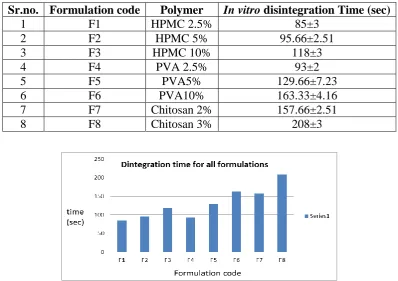
In vitro Disintegration test
All the formulations showed in vitro disintegration (table 5) within 4minutes.
[image:8.595.98.497.456.737.2]Table 5: Disintegration time of buccal film formulations.
Fig. 2: Disintegration time for dissolving buccal film formulations. Sr.no. Formulation code Polymer In vitro disintegration Time (sec)
1 F1 HPMC 2.5% 85±3
2 F2 HPMC 5% 95.66±2.51
3 F3 HPMC 10% 118±3
4 F4 PVA 2.5% 93±2
5 F5 PVA5% 129.66±7.23
6 F6 PVA10% 163.33±4.16
7 F7 Chitosan 2% 157.66±2.51
www.wjpr.net Vol 6, Issue 10, 2017. 814 Mucoadhesive Strength, Force of adhesion and Bond strength
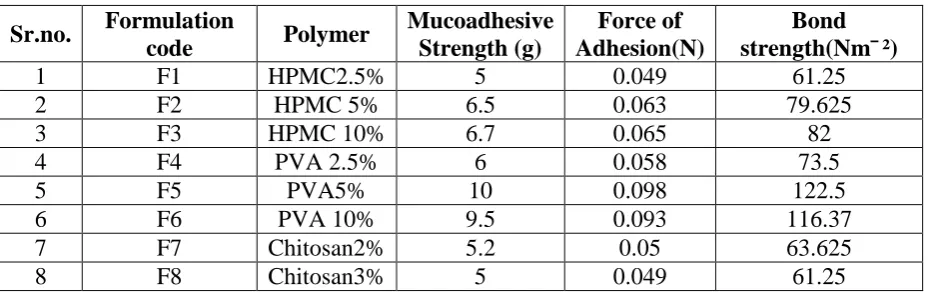
From the results it was found that the mucoadhesion of film increases with increase in
concentration of polymer. The optimize concentrations were found to be F2 (HPMC 5%), F5
(PVA 5%) and F7 (CHITOSAN 2%). Above these concentrations of respective polymer there
was no more considerable increase in mucoadhesion.
[image:9.595.67.536.242.390.2]Thus formulations F2, F5 and F7 were taken for further optimization.
Table 6: Mucoadhesive strength, Force of adhesion and bond strength.
Sr.no. Formulation
code Polymer
Mucoadhesive Strength (g)
Force of Adhesion(N)
Bond strength(Nm¯²)
1 F1 HPMC2.5% 5 0.049 61.25
2 F2 HPMC 5% 6.5 0.063 79.625
3 F3 HPMC 10% 6.7 0.065 82
4 F4 PVA 2.5% 6 0.058 73.5
5 F5 PVA5% 10 0.098 122.5
6 F6 PVA 10% 9.5 0.093 116.37
7 F7 Chitosan2% 5.2 0.05 63.625
8 F8 Chitosan3% 5 0.049 61.25
Drug content: Each buccal film formulation showed drug content more than 95%.
Table 7: % Drug content of dissolving buccal film formulations.
Formulation (dissolving buccal films) % drug content
F2(lovastatin-HPMC5%) 97.45±0.687
F5(lovastatin-PVA5%) 96.81±0.795
F7(lovastatin-Chitosan2%) 97.82±0.168
In vitro drug release study
Cumulative percentage drug release of the three dissolving buccal film formulations F2
(lovastatin-HPMC 5%), F5 (lovastatin-PVA 5%) and F7 (lovastatin-CHITOSAN 2%) at pH
6.8 were found to be 64.08, 28.7 and 19.24 respectively. And among the three dissolving
buccal film formulations; Formulation F2[lovastatin-HPMC5%] shows highest cumulative
www.wjpr.net Vol 6, Issue 10, 2017. 815 % Cumulative Drug Release Comparison between Dissolving Buccal Film
Formulations.
Compatibility Studies
Attenuated total reflectance (ATR), Differential Scanning Calorimetry (DSC) and X-ray
powder diffraction (XRD) analysis revealed no interaction between drug and polymers.
The results are shown in the figures below.
[image:10.595.79.514.72.279.2] [image:10.595.267.509.408.589.2]
www.wjpr.net Vol 6, Issue 10, 2017. 816 Fig. 6: XRD of lovastatin. Fig. 7: XRD of lovastatin-HPMC film.
[image:11.595.78.512.81.474.2]
Fig. 8: DSC of lovastatin. Fig. 9: DSC of lovastatin-HPMC film.
CONCLUSION
The in-vitro dissolution studies showed higher cumulative percentage drug release for
“Dissolving Buccal Films of Lovastatin formulations” as compared to pure drug. The results indicate that “Dissolving Buccal Films formulation” have a potential to increase release and
bypass the first pass effect of poorly water soluble drugs such as Lovastatin. However,
In-vivo studies are needed to ensure increased bioavailability. Hence “the Dissolving Buccal Films” are distinctive and commercially feasible approach for optimal delivery of the poorly
water soluble and poorly bioavailable drugs.
ACKNOWLEDGMENTS
The authors are grateful to all the faculty of Delhi Institute of Pharmaceutical Sciences and
Research (DIPSAR) who has been the guiding force and motivation behind the project. The
www.wjpr.net Vol 6, Issue 10, 2017. 817
authors are also thankful to the University Science Instrumentation Center (USIC), University
of Delhi, New Delhi, for providing necessary facilities for the conduct of study.
REFERENCES
1. Hanif M, Zaman M, Chaurasiya V. Polymers used in buccal film: a review. Des
Monomers Polym, 2015; 18(2): 105-111. doi:10.1080/15685551.2014.971389.
2. Yu T, Andrews GP, Jones DS. Mucoadhesion and Characterization of Mucoadhesive
Properties, 2014. doi:10.1007/978-1-4614-9524-6.
3. Rajaram DM, Laxman SD. Buccal Mucoadhesive Films : A Review, 2017; 8(1): 31-38.
4. B RM, Murthy VSN, A PR, Gattu DK. Molecular Pharmaceutics & Organic Process
Research Buccal Film Drug Delivery System-An Innovative and Emerging Technology,
2013; 1(3): 1-6. doi:10.4172/2329-9053.1000107.
5. P CR, Chaitanya KSC, Y MR. A review on bioadhesive buccal drug delivery systems :
current status of formulation and evaluation methods, 2011; 19(6).
6. Pushpa H, Priyata H, K ND, Onya N, Vijayalakshmi A. Screening of lovastatin
(HMG-CoA reductase inhibitor) from edible wild mushrooms, 2016; 6(6): 190-196.
doi:10.5943/cream/6/3/6.
7. Carvalho FC, Bruschi ML, Evangelista RC, Palmira M, Gremião D. Mucoadhesive drug
delivery systems, 2010; 46(2008): 1-18.
8. Ketelaere B De. PROCESSING, PRODUCTS, AND FOOD SAFETY The assessment of
viscosity measurements on the albumen of consumption eggs as an indicator for