www.wjpr.net Vol 6, Issue 16, 2017. 115
ANALYSIS OF THE MOLECULAR INTERACTION OF LEVODOPA
VS. AMINO ACID USING QUANTUM METHOD
Manuel Aparicio-Razo2,3, Oscar Sánchez-Parada1, Emmanuel Vázquez-López3, Juan
Jesús García-Mar3, Iliana Herrera-Cantú3, Karina García-Aguilar3,5, Erick
Pedraza-Gress3, Lillhian Arely Flores-González3 and Manuel González-Pérez3*,4
1
Escuela De Medicina Universidad Popular Autónoma Del Estado De Puebla.
2
Benemérita Universidad Autónoma De Puebla, Facultad De Ciencias De La Electrónica.
3
Universidad Popular Autónoma Del Estado De Puebla A.C. (UPAEP). Centro
Interdisciplinario De Posgrados (CIP). Posgrado En Ciencias De La Ingeniería Biomédica.
4
Sistema Nacional De Investigadores. Nivel 1.
5
Instituto Tecnológico Superior De Coatzacoalcos, Academia De Ingeniería Bioquímica.
ABSTRACT
The pharmacological treatment of Parkinson's disease through the drug
Levodopa (Lev) is used to control the symptoms and signs of it for as
long as possible, minimizing the adverse effects. To date, no treatment
has demonstrated modifying impact on the course of the disease. The
objective of the study is to determine, using the semi-empirical
parametric method 3 (SE-PM3), which amino acid has a higher affinity
with Lev. The Hyperchem Professional software performed a
Molecular Modeling and Analysis of Lev and different Amino Acids.
The result of the simulations shows the loss of Guanine amino acid,
which can be correlated with multiple pathologies linked with the side
effects of said drug.
KEYWORDS: Levodopa, Amino Acid, Quantum Method,
Hyperchem, SE-PM3.
INTRODUCTION
Lev is a medication for the most efficient systematic treatment available to reduce the motor
symptoms of Parkinson's disease and better tolerated.[1, 2, 3] The diet or supplements with
amino acids like Leucine or Phenylalanine compete with conveyor, altering its availability.[4]
Volume 6, Issue 16, 115-121. Research Article ISSN 2277–7105
Article Received on 10 October 2017,
Revised on 31 October 2017, Accepted on 21 Nov. 2017 DOI: 10.20959/wjpr201716-10271
*Corresponding Author
Dr. Manuel
González-Pérez
Universidad Popular
Autónoma Del Estado De
Puebla A.C. (UPAEP).
Centro Interdisciplinario De
Posgrados (CIP). Posgrado
En Ciencias De La
www.wjpr.net Vol 6, Issue 16, 2017. 116
Only 1% of an oral dose of Lev reaches the brain.[5] Due to the intense metabolic effect of the
first step and the decarboxylation of dopamine.[3]
Treatment with oral Lev long-term is complicated by the appearance of motor fluctuations
and dyskinesias, mainly due to the pulsatile stimulation of dopamine receptors.[6, 7] During the
decade from 1980 to 1990 were worrying data regarding the potential presenting the Lev to
accelerate the progression of the disease. However, the concerns raised about this amino acid
remain utterly untested today.[8]
The process of Parkinson's disease is associated with decreased levels of dopamine, tyrosine
hydroxylase, norepinephrine and serotonin.[9, 10] This decrease causes wear of the L-DOPA.
The imbalance of the amino acids can generate a disorder in the generation of vital
substances, affecting the metabolism and transport of the same and the following function of
the Central Nervous System.[11, 12]
The objective of the study is to determine, using the semi-empirical quantum method
parametric 3 (is-PM3), what amino acid has a higher affinity with the Lev. Hyperchem is a
program for molecular modeling graphic interface, which allows researchers to carry out
chemical simulations that facilitate multiple data entry. Through the program, it is possible to
analyze the electron transfer coefficient (ETC) of every interaction. The ETC is the parameter
that identifies the probability of a union between several compounds.[13, 14]
MATERIALS AND METHODS
SE-PM3 is a program for molecular modeling used by scientists to analyze the quantum
composition of molecules for HOMO-LUMO, BG, EP, ETC and other properties. These data
are used to form the table where the interaction of Lev and amino acids. Hyperchem
Professional software performed Molecular modeling and analysis of Lev and amino acids.
(Hyperchem, Hypercube, Multi On for Windows, series 12-800-1501800080. Multi On,
southern 1236-301 Col. Insurgentes Tlacoquemecatl del Valle, Benito Juárez, Mexico City,
www.wjpr.net Vol 6, Issue 16, 2017. 117 Table 1. Parameters used for quantum computing molecular orbitals-HUMO and
LUMO.[14, 15]
Parameter Value Parameter Value
Total charge 0 Polarizability Not
Spin Multiplicity 1 Geometry Optimization
algorithm
Polak-Ribiere
(Conjugate Gradient)
Spin Pairing RHF Termination condition RMS
gradient of 0.1 Kcal/Amol
State Lowest
Convergent Limit 0.01 Termination condition or
1000 maximum cycles
Interaction Limit 50 Termination condition or In vacuo
Accelerate Convergence Yes Screen refresh period 1 cycle
Table 2. Parameters used to visualize the map of the electrostatic potential of the
molecules.[14, 15]
Parameter Value Parameter Value
Molecular Property Property Electrostatic
Potential
Contour Grid
increment 0.05
Representation 3D Mapped Isosurface Mapped Function
Options Default
Isosurface Grid:
Grid Mesh Size Coarse Transparency level
A criteria
Isosurface Grid: Grid
Layout
Default
Isosurface Rendering: Total charge density contour value
0.015
Contour Grid:
Starting Value Default Rendering Wire Mesh
RESULTS AND DISCUSSION
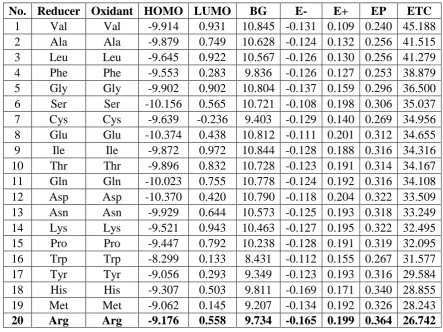
Table 3, shows the comparison between the amino acids with their own ETC´s, stressing that
the Arg (Arg) presents less than everyone else. It means that the Arg has a high possibility of
www.wjpr.net Vol 6, Issue 16, 2017. 118 Table 3: Amino Acid.
No. Reducer Oxidant HOMO LUMO BG E- E+ EP ETC
1 Val Val -9.914 0.931 10.845 -0.131 0.109 0.240 45.188 2 Ala Ala -9.879 0.749 10.628 -0.124 0.132 0.256 41.515 3 Leu Leu -9.645 0.922 10.567 -0.126 0.130 0.256 41.279 4 Phe Phe -9.553 0.283 9.836 -0.126 0.127 0.253 38.879 5 Gly Gly -9.902 0.902 10.804 -0.137 0.159 0.296 36.500 6 Ser Ser -10.156 0.565 10.721 -0.108 0.198 0.306 35.037 7 Cys Cys -9.639 -0.236 9.403 -0.129 0.140 0.269 34.956 8 Glu Glu -10.374 0.438 10.812 -0.111 0.201 0.312 34.655 9 Ile Ile -9.872 0.972 10.844 -0.128 0.188 0.316 34.316 10 Thr Thr -9.896 0.832 10.728 -0.123 0.191 0.314 34.167 11 Gln Gln -10.023 0.755 10.778 -0.124 0.192 0.316 34.108 12 Asp Asp -10.370 0.420 10.790 -0.118 0.204 0.322 33.509 13 Asn Asn -9.929 0.644 10.573 -0.125 0.193 0.318 33.249 14 Lys Lys -9.521 0.943 10.463 -0.127 0.195 0.322 32.495 15 Pro Pro -9.447 0.792 10.238 -0.128 0.191 0.319 32.095 16 Trp Trp -8.299 0.133 8.431 -0.112 0.155 0.267 31.577 17 Tyr Tyr -9.056 0.293 9.349 -0.123 0.193 0.316 29.584 18 His His -9.307 0.503 9.811 -0.169 0.171 0.340 28.855 19 Met Met -9.062 0.145 9.207 -0.134 0.192 0.326 28.243
20 Arg Arg -9.176 0.558 9.734 -0.165 0.199 0.364 26.742
Figure 1 shows the interaction between Lev and Arg, showing that Lev has a high probability
[image:4.595.132.467.486.673.2]of being an oxidative agent, while Arg plays an anti-oxidant or reducing paper.
Figure 1: Levodopa and Arginine quantum well.
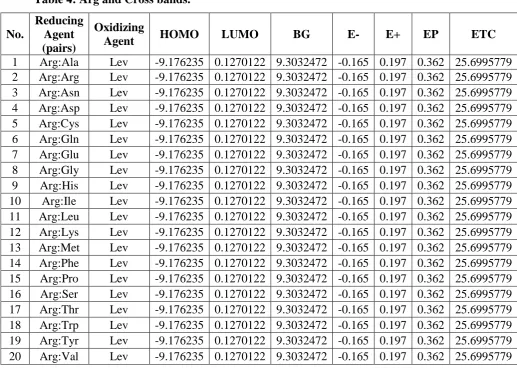
In the case of quantum grounds in cross bands, we can mention that all amino acids with the
Arg are the same ETC (25.6995779), which implies that the Arg is the amino acid with
www.wjpr.net Vol 6, Issue 16, 2017. 119 Table 4: Arg and Cross bands.
No.
Reducing Agent (pairs)
Oxidizing
Agent HOMO LUMO BG E- E+ EP ETC
1 Arg:Ala Lev -9.176235 0.1270122 9.3032472 -0.165 0.197 0.362 25.6995779 2 Arg:Arg Lev -9.176235 0.1270122 9.3032472 -0.165 0.197 0.362 25.6995779 3 Arg:Asn Lev -9.176235 0.1270122 9.3032472 -0.165 0.197 0.362 25.6995779 4 Arg:Asp Lev -9.176235 0.1270122 9.3032472 -0.165 0.197 0.362 25.6995779 5 Arg:Cys Lev -9.176235 0.1270122 9.3032472 -0.165 0.197 0.362 25.6995779 6 Arg:Gln Lev -9.176235 0.1270122 9.3032472 -0.165 0.197 0.362 25.6995779 7 Arg:Glu Lev -9.176235 0.1270122 9.3032472 -0.165 0.197 0.362 25.6995779 8 Arg:Gly Lev -9.176235 0.1270122 9.3032472 -0.165 0.197 0.362 25.6995779 9 Arg:His Lev -9.176235 0.1270122 9.3032472 -0.165 0.197 0.362 25.6995779 10 Arg:Ile Lev -9.176235 0.1270122 9.3032472 -0.165 0.197 0.362 25.6995779 11 Arg:Leu Lev -9.176235 0.1270122 9.3032472 -0.165 0.197 0.362 25.6995779 12 Arg:Lys Lev -9.176235 0.1270122 9.3032472 -0.165 0.197 0.362 25.6995779 13 Arg:Met Lev -9.176235 0.1270122 9.3032472 -0.165 0.197 0.362 25.6995779 14 Arg:Phe Lev -9.176235 0.1270122 9.3032472 -0.165 0.197 0.362 25.6995779 15 Arg:Pro Lev -9.176235 0.1270122 9.3032472 -0.165 0.197 0.362 25.6995779 16 Arg:Ser Lev -9.176235 0.1270122 9.3032472 -0.165 0.197 0.362 25.6995779 17 Arg:Thr Lev -9.176235 0.1270122 9.3032472 -0.165 0.197 0.362 25.6995779 18 Arg:Trp Lev -9.176235 0.1270122 9.3032472 -0.165 0.197 0.362 25.6995779 19 Arg:Tyr Lev -9.176235 0.1270122 9.3032472 -0.165 0.197 0.362 25.6995779 20 Arg:Val Lev -9.176235 0.1270122 9.3032472 -0.165 0.197 0.362 25.6995779
CONCLUSIONS
The physiological consequences of the oxidation of amino acids still a matter of great debate
because in the majority of cases cannot be defined with precision if oxidation is the cause or
consequence. However, this analysis helps to understand the impact of the drug Lev.
In the particular case of the oxidation of the amino acid Arg (Figure 1). The oxidation of
amino acids is correlated with various conditions in the human body, of which we can
highlight: premature aging, the death of neurons, problems of Alzheimer's disease,
inflammatory diseases, diabetes, kidney damage and cataractogenesis, among others.
The following mechanisms can relate immune function, creatine synthesis, the release of
hormone growth, insulin production, and increase in muscle mass, formation of new tissue or
healing, cardiac and arterial problems, sperm motility and impotence problems.
We can mention that Arg is an amino acid that increases the production of glucagon-like
www.wjpr.net Vol 6, Issue 16, 2017. 120
and glucose metabolism. By which its oxidation can encourage a tendency to develop
principles of Diabetes type 2 and obesity problems.
The study of the quantum grounds between substances and chemicals created by the human
body gives us the possibility to study and analyze the interactions among these. In the
particular case of the oxidation of Arg by Lev, we can conclude that such alterations are
correlated with the side effects of the drug resulting in future research.
ACKNOWLEDGEMENTS
Appreciation to the Universidad Popular Autónoma del Estado de Puebla for allowing us to
use its postgraduate facilities to conduct our research.
REFERENCES
1. Marras C, Lang A. Nuevos conceptos en la enfermedad de Parkinson. Avances tras la “década del cerebro”. En: AAN Parkinson (Edición española). Volumen 1:Patologia y
fisiología. Barcelona: Medical Trends, 2009; P. 3-10.
2. Hauser RA, Panisset M. Abbruzzese G. Mancione L. Dronamraju N. Kararieka A.;
FIRST-STEP Study Group. A double-blind trial of Levodopa/carbidopa/entacapone
versus levodopa/cardidopa in early Parkinson´s disease. Mov Disord, 2009; 24(4): 541-50.
3. Emre M. Practical guidance for the management of Parkinson´s disease with levodopa.
Proceeding of the Neuronet-PD Working Group. ACNR, 2009; 9(2): 26-29.
4. Veiga FernándeZ F. Gutiérrez Duque O. Tratamiento de la enfermedad de Parkinson
inicial en el anciano. En. Garnica Fernández A. Garcia Ruiz-Espiga P. coordinadores.
Guia de la buena práctica clínica:Enfermedad de Parkinson. Madrid: Sociedad española
de Geriatría y Gerontología Sociedad Española de Neurología y Elservier España, 2009;
P.13-26.
5. Hauser RA. Levodopa; past, present and. Eur Neurol, 2009; 62: 1-8.
6. Pilleri M, Koutsikos K, Antonini A. Is there room for new non-dopaminergic treatments
in Parkinson's disease? J Neural Transm, 2013; 120: 349-52.
7. Rascol O, Lozano A, Stern M, Poewe W. Milestones in Parkinson's Disease Therapeutics.
Movement Disorders, 2011; 26: 1072-82.
8. Mark Stacy M. Medical Treatment of Parkinson Disease. Neurol Clin, 2009; 27: 605-31
9. Charlton C, Crowell B, Parkinson’s disease-like effects of S-adenosyl- L-methionine:
www.wjpr.net Vol 6, Issue 16, 2017. 121
10.Charlton C. Depletion of nigrostriatal and forebrain tyrosine hydroxy- lase by S-adenosyl
methionine: A model that may explain the occur- rence of depression in Parkinson’s
disease. Life Sci, 1997; 61(5): 495–502.
11.Marty Hinz, Alvin Stein and Thomas Uncini, Amino acid management of Parkinson’s
disease: a case study, Int J Gen Med, 2011; 4: 165–174. Published online 2011 Feb
28. doi: 10.2147/IJGM.S16621
12.M. Zavala, H. Vildria,P.A. Ortega,O.J. Castejón,A. Marcano-de Hidalgo, N. Montiel,
Imbalance of plasma amino acids in patients with autism and subjects with attention
deficit/hyperactivity disorder, Rev Neurol, 2001 Sep 1-15; 33(5): 401-8.
13.González-Pérez, m. chemical-quantum analysis of the aggressiveness of glucose and its
appeasement with atp inside the cell and water as an excellent antioxidant, 2017.
14.Ibarra Medel, D., Meléndez Gámez, P., López Oglesby, J. M., & González Pérez, m.
molecular analysis of strychnine and the glycine receptor using quantum chemistry
methods, 2016.
15.Perez, M. G., Barrera, F. A. G., Diaz, J. F. M., Torres, M. G., & Oglesby, J. M. L.
Theoretical calculation of electron transfer coefficient for predicting the flow of electrons
by PM3, using 20 amino acids and nicotine. European Scientific Journal, ESJ, 2014;