FORMULATION AND DEVELOPMENT OF SUSTAINED RELEASE
PELLETS OF GLIPIZIDE
Ashwini R. Madgulkar*, Mangesh R. Bhalekar and Shilpa S. Shiragave
Department of Pharmaceutics, AISSMS College of Pharmacy, Pune-411001.
ABSTRACT
The present work describe development a sustained release pellets of
glipizide using solution layering technique. The goal of designing the
sustain drug delivery was to reduce the frequency of dosing. Glipizide
(BCS II) is an antidiabetic drug with short biological half life (3.4 ±
0.7 h). Hence, sustained release formulation is needed for glipizide for
better control of blood glucose levels to prevent hypoglycemia and
enhance clinical efficiency, to reduce G.I disturbances and to enhance
patient compliance. The effect of polymer (Eudragit RL100) and
binder(PVPK30) on % drug release at 2 h and % drug release at 8 h
was optimized using 32 factorial design. The effect of the variables and behavior of the system was studied using response surface plots. The pellets were evaluated
for flow properties, % drug content, % drug release, % coating efficiency, FT-IR, DSC. The
drug release optimized batch was compared with marketed product that was found to be
similar.
KEYWORDS: Glipizide, Solution layering technique, sustained release pellets, Eudragit RL
100.
1. INTRODUCTION
Oral drug delivery is the simplest and easiest way of administering drugs, because of the
greater stability, smaller bulk, accurate dosage and easy production.[1] Pelletization offers various advantages over other similar techniques; such as uniformity of dose and flexibility in
dosage form.[2] Glipizide (BCS II) is an antidiabetic that used for the treatment of non insulin dependent diabetes mellitus (NIDDM).[3] Glipizide is sparingly soluble in ethanol and acetone, and soluble in methylene chloride. Pellets help reduce GI irritation, controlling the
drug release and increasing the absoption of active ingredients. Pan coating is commonly
Volume 7, Issue 14, 709-720. Research Article ISSN 2277– 7105
Article Received on 22 May 2018,
Revised on 12 June 2018, Accepted on 02 July 2018
DOI: 10.20959/wjpr201814-12817
*Corresponding Author
Dr. Ashwini R. Madgulkar
Department of
Pharmaceutics, AISSMS
College of Pharmacy,
used for preparation of coated pellets. Previous reports on glipizide pellets by solution
layering describe use of Eudragit RS100 and Eudragit RL100 coating, which aims to extend
the release by changing the coating layer composition and coating layer.[4] Present work describes formulation of SR glipzide pellets by solution layering technique. Eudragit
RL100[5] is used as a polymer to retard the drug release[12] and optimization of the binder and polymer composition by a 2 factor 3 level design.
2. MATERIAL AND METHOD
2.1 Materials
Following materials was kind gifts, Glipizide from Intas Pharmaceutical Ltd. (Ahmedabad).
Eudragit RL100 (Evonik industries, Mumbai), Non-pareil seed of MCC (ACG worldwide
Mumbai). Other chemicals were procured from local sources and were of EP grade.
2.2 Methods
2.2.1 Drug excipient Compatiblity Studies
Compatibility of glipizide with polymer Eudragit RL100 and PVP K30 in 1:1 ratio of
physical mixture were analyzed by FT-IR spectroscopic analysis and differential scanning
calorimeter.
2.2.2 Preparation of glipizide coated pellets[4]
Pellets were coated with glipizide using Solution Layering Technique. The Glipizide and
PVP K30 solution was sprayed onto non-pareil beads using pan coater (R&D coater
INSTACOAT, IC Deluxe, Mumbai). First, Glipizide (1 g) was dissolved in 1:1 ratio solution
of Dichoromethane : Ethanol (100 ml) and PVP K-30 (0.5 g, 0.75 g, 1g) was mixed with the
above solvent separately, both the solutions were mixed and sprayed onto non-pareil beads
using pan coater (table F1-F9) . The layered pellets were dried at 40°C. The composition of
drug coating solution mentioned in Table no 1.
2.2.3 Polymer coating on drug layered pellets[4]
The polymer coating solution was prepared using ethanol. Required amount of Eudragit RL
100 was dissolved in ethanol and sonicated for 20 min. Triethyl citrate was added to the
solution as plasticizer and talc as a antisticking agent. The drug layered pellets were then
coated with the polymeric solutioun at a rate of 1ml/min. The composition of polymer
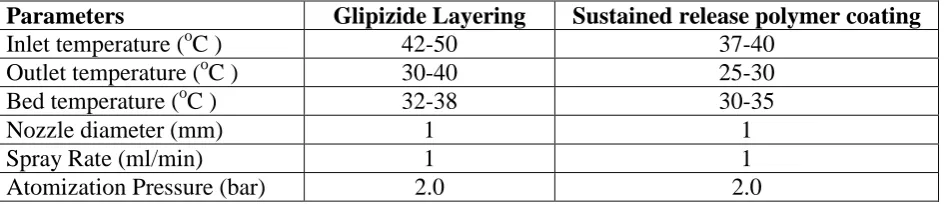
coating solution mentioned in Table. 2 and the process parameters are listed in Table.3.
Table 1: Compostion of drug Coating Solution for Glipizide.
Sr. No Ingrident Quantity
F1 F2 F3 F4 F5 F6 F7 F8 F9
1. Glipizide (g) 1 1 1 1 1 1 1 1 1
2. PVP K 30 (g) 0.5 0.75 1 0.5 0.75 1 0.5 0.75 1 3. Dichloromethane:Ethanol(1:1) (ml) 100 100 100 100 100 100 100 100 100
Table 2: Composition of Polymer Coating Solution.
Sr. No Ingridents Quantity
F1 F2 F3 F4 F5 F6 F7 F8 F9
1. Eudragit RL 100 (g) 0.15 0.15 0.15 0.2 0.2 0.2 0.25 0.25 0.25
2. Talc (g) 0.2 0.2 0.2 0.2 0.2 0.2 0.2 0.2 0.2
3. Triethyl citrate (ml) 0.1 0.1 0.1 0.1 0.1 0.1 0.1 0.1 0.1
[image:3.595.64.538.328.430.2]4. Ethanol(ml) 50 50 50 50 50 50 50 50 50
Table 3: Process Parameters Used for coating drug and Polymer.
2.2.4 % coating efficiency[6]
The % coating efficiency of coated pellets was calculated by using the formula:
Where,
a= Final weight of coated pellets in grams; b= Initial weight of pellets (Blank pellets in
grams); c= Total amount of coating material (grams).
3. Experimental design and statistical analysis
A 32 full factorial design was employed to optimize the formulation of pellets in this study. The target was to obtain the drug release for 8 h. In order to optimize the formulations, the
amount of Eudragit RL100 and the amount of PVP K-30, were chosen as independent
variables. The combination of PVP K30 and Eudragit RL100 was used for release sustaining
of glipizide. The response variables selected for evaluation of sustained release were percent
drug release at 2 h hour and 8 h and was selected as dependent variables.
Parameters Glipizide Layering Sustained release polymer coating
Inlet temperature (oC ) 42-50 37-40
Outlet temperature (oC ) 30-40 25-30
Bed temperature (oC ) 32-38 30-35
Nozzle diameter (mm) 1 1
Spray Rate (ml/min) 1 1
3.1 Analysis of data[11,12]
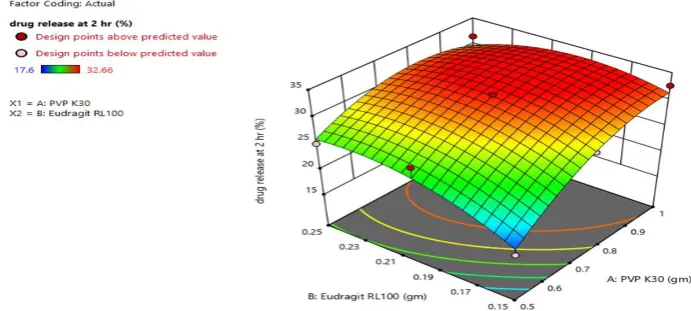
Using Design Expert 11.0 software optimization of batch was done. 3-D response surfaces
curves were constructed to study the effect of two independent variables alone and in
combination on % drug release at 2 h and 8h. All the responses were fitted to Quadratic
model and were evaluated in terms of statistical parameters. According to the given solution
the optimized batch was found.
Table 4: Independent variables and their selected levels for pellet formulation.
Coded Factor Level
Factor 1 Concentration of
PVP K30(gm)
Factor 2 Concentration of Eudragit RL 100(gm)
-1 Low 0.5 0.15
0 Medium 0.75 0.2
+1 High 1 0.25
4. Evaluation of Pellets
4.1 Flow properties of pellets
The flow properties of coated pellets were determined which included angle of repose, bulk
density, tap density, Hausner’s ratio, carr’s index, compressibility index.[7,8]
4.2 Determination of % drug content
To determine percent content of Glipizide in the pellets, accurately weighed crushed pellets
(100 mg) were dissolved in 10 ml methanol, solution was filtered and analyzed
spectrophotometrically at 276 nm after suitable dilution.
4.3 In-vitro drug release[4]
USP dissolution apparatus Type II was used to study the drug release from various
formulations prepared. Accurately weighed quantity of drug loaded pellets equivalent to 10
mg glipizide were taken in 900 ml 0.1N HCl at 37±0.5oC and drug release was studied at 50 rpm. 5 ml of dissolution medium was withdrawn periodically at regular interval of 1 hour and
was replaced with the same volume of fresh medium. The withdrawn sample were filtered
through whattmann filter and analyzed spectrophotometrically at 275 nm for drug release.
The marketed formulation was analyzed similarly.
4.4 Similarity factor
The similarity factor was calculated for the marketed formulation and the optimized batch
F2= 50log {[1+/N) ∑ (Ri-Ti) 2-0.5X100}
Where, N is the number of time points, Ri and Ti are dissolution of reference and test
products at time respectively. F2 values greater than 50 considered as two products are
similar and showed similar drug release profile.[9],[10]
4.5. Differntial Scanning Calorimetry
Differential scanning calorimetry (DSC) studies were carried out using DSC *e software.
Samples were accurately weighed and heated in sealed aluminium pans at a rate 10°C/min
between 30- 300°C temperature range under nitrogen atmosphere. Empty aluminium pan was
used as a reference.
4.6. SEM studies
Scanning Electron Microscopy was done to determine the surface Morphology of the Pellets.
Using the Instrument:FEI, Model: Nova nano SEM 450 photographs were taken and recorded
at suitable magnification.
5. RESULT AND DISCUSSION
Eudragit polymer is used in tablet and capsule dosage forms for film coating. It is highly
permeable and allows drug permeation across the film independent of pH of digestive tract.
Hence it is a polymer of choice for pellets formulation.
5.1 Fourier Transform Infrared spectroscopy
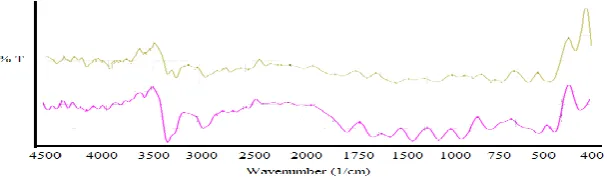
To study the compatibility of drug with excipient the IR spectra with the combination of drug
and excipient in 1:1 ratio was studied. The spectra was obtained at 4500-400cm-1. The IR spectrum was observed and the peaks of major fuctional group in glipizide were found to be
C=O amide at 1689.64, C=O urea at 1650.23, C-H stretching (aromatic) at 1528.10, C-H
bending (aromatic) 1443.49, O=S=O at 1333.41,1159.98. The IR spectrum of drug and
[image:5.595.145.449.652.740.2]physical mixture showed no physicochemical interaction in between drug and used excipient.
5.2 Differential Scanning Calorimetry
The endothermic peak obtained in thermogram of venlafaxine at 216°C can be attributed to
melting of Glipizide, same was reproduced in thermogram of pellets while the additional
endotherm at 246°C represents peak of MCC. Thus, the thermogram showed that the
Glipizide, Eudragit and PVP K-30 are compatible with each other since there is no significant
[image:6.595.172.421.213.371.2]difference in endothermic peak of pure drug (Fig. 2) and coated pellet.
Fig. 2: DSC thermogram of Glipizide and coated pellets.
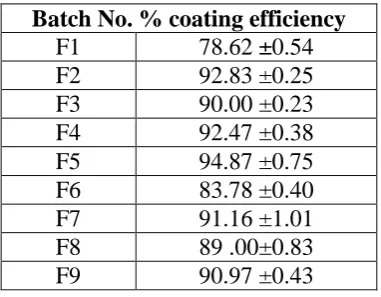
5.3 % Coating efficiency
The % coating efficiency for all batches were calculated. The limit for % coating efficiency is
90-95% for film coating. Among all the formulations F2, F3, F4, F5, F7 and F9 were in the
limit. Formulation F5 has achieved highest coating efficiency.
Table 5: % coating efficiency of formulations (F1-F9).
5.4 Optimization
32 factorial design was used for the optimization, levels were selected according to the literature, 9 formulation were prepared. Two factors were taken that is binder (PVP K30) and
[image:6.595.203.394.535.683.2]polymer(Eudragit RL100) which are responsible for the drug release. The % drug release at 2
h and % drug release at 8 h were taken as the dependent variables were determined. The
highest drug release was achieved in F5 formulation which is similar to that of marketed
product.
The equation obtained for % drug release at 2 h and % drug release at 8h for 32 factorial design are as follows,
% Drug release at 2nd hour =
- 83.0+127.21A+586.25B-173.0AB-50.74A-1070.50 …. (Equation 1)
% Drug release at 8th hour
-156087=+153.48A+1757.43B-189.60AB-69.56A-3837 …..(Equation 2)
[image:7.595.113.459.573.728.2]
Table 6: Adequate precision.
Responses f- value p- value Predicted
value
Experimental
value % Error
% Drug release at 2 hr 11.92 0.0045 32.74 32.56 0.18 % Drug release at 8th hr 5.05 0.0367 89.14 89.75 -0.61
5.5 Response surface analysis
The drug release is decreased when there is high concentration of both A(PVP K30)
B(Eudragit RL100) that is A and B is increased it shows negative effect in drug release.
When the concentration is in middle range it gives satisfactory drug release i.e when AB
together, shows positive effect in drug release and when the concentration of A and B is low
it shows small increase in drug release(Fig. 4).
Fig. 3: Response surface plot showing the influence of amount of polymer and amount
Fig. 4: Response surface plot showing the influence of amount of polymer and amount
of binder on the % drug release at 8 h of glipizide.
5.6 Flow properties
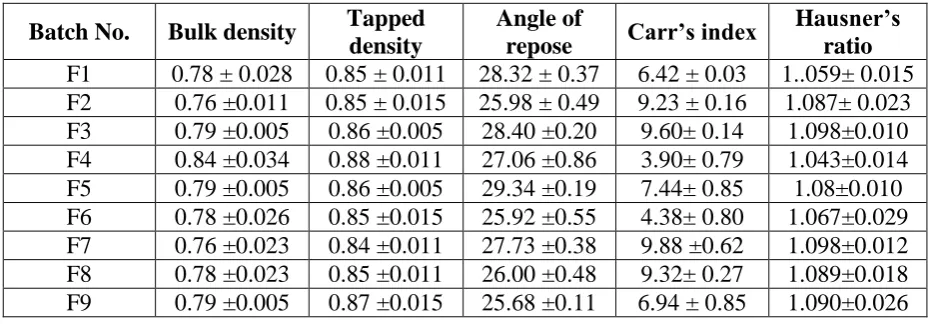
Flow properties of all the 9 batches were found to be within the I.P limit and were excellent.
The flow properties were found to be as follows:
Table 7: Flow properties for the coated glipizide pellets.
Batch No. Bulk density Tapped
density
Angle of
repose Carr’s index
Hausner’s ratio F1 0.78 ± 0.028 0.85 ± 0.011 28.32 ± 0.37 6.42 ± 0.03 1..059± 0.015 F2 0.76 ±0.011 0.85 ± 0.015 25.98 ± 0.49 9.23 ± 0.16 1.087± 0.023 F3 0.79 ±0.005 0.86 ±0.005 28.40 ±0.20 9.60± 0.14 1.098±0.010 F4 0.84 ±0.034 0.88 ±0.011 27.06 ±0.86 3.90± 0.79 1.043±0.014 F5 0.79 ±0.005 0.86 ±0.005 29.34 ±0.19 7.44± 0.85 1.08±0.010 F6 0.78 ±0.026 0.85 ±0.015 25.92 ±0.55 4.38± 0.80 1.067±0.029 F7 0.76 ±0.023 0.84 ±0.011 27.73 ±0.38 9.88 ±0.62 1.098±0.012 F8 0.78 ±0.023 0.85 ±0.011 26.00 ±0.48 9.32± 0.27 1.089±0.018 F9 0.79 ±0.005 0.87 ±0.015 25.68 ±0.11 6.94 ± 0.85 1.090±0.026
5.7 % Drug Content
The % drug content of all the 9 batches were determined it was found to be in between 63 to
[image:8.595.65.531.410.572.2]Table 8: % drug content for the formulations (F1-F9).
5.8 In – Vitro drug release
The drug release was determined from the formulated F1 to F9 batches and marketed
formulation and shown Fig 5. The in vitro percentage drug release from the pellet
formulation f1-f9 using different concentration of polymer EudragitRL100 and binder
PVPK-30 showed 63.46%, 76.39%, 77.74%, 84.40%, 89.75%, 80% 78.62% 77.52%, 84.62%
respectively. Among all the batches F5 batch was found to be the best formulation which
sustains the drug release rate of glipizide. Regression analysis of the optimized batch was
determined. The best fit model for the optimized batch was found to be first order release
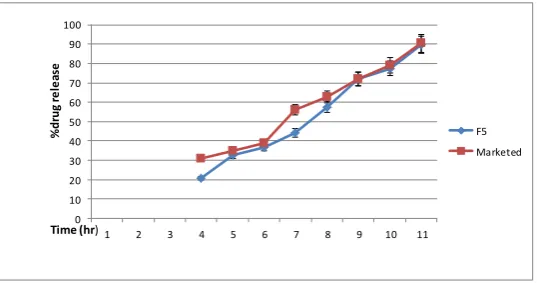
model. The formulation F5 and marketed formulation was compared and the results were
reported graphically. 0 10 20 30 40 50 60 70 80 90 100
1 2 3 4 5 6 7 8
% d ru g re le as e F1 F2 F3 F4 F5 F6 F7 F8 F9 Time (hr)
Fig. 5: In –Vitro Drug release of formulations (F1 to F9).
Comparative dissolution profile of Optimized formulation and marketed formulation
From all the 9 batches, formulation F5 was the optimized batch obtained from the in vitro
release data. The optimized batch F5 of Sustained release pellets were then compared with
the marketed formulation shown in fig 6.
Batch No. Drug
[image:9.595.155.438.488.646.2]0 10 20 30 40 50 60 70 80 90 100
1 2 3 4 5 6 7 8 9 10 11
F5 Marketed
Time (hr)
%
dr
ug
r
e
le
[image:10.595.165.434.73.215.2]ase
Fig. 6: Comparative dissolution profile of optimized and marketed formulation.
5.9 Similarity Factor
The Similarity factor was calculated between the marketed formulation and formulation F5, it
was found to be 84.6. Therefore optimized batch and marketed formulation showed similar
drug release profile.
5.10 Scanning Electron Microscopy
The surface morphology of Glipizide coated pellets and uncoated pellets was studied by
Scanning electron microscopy. It was observed that the morphology of the pellets was
spherical in shape and smooth in surface. It was also observed that the coating of the pellets
was uniform as shown in the Fig. 7.
Fig. 7: Coated pellet.
CONCLUSION
The pellets loaded with glipizide was coated with Eudragit RL 100 optimized with respect to
binder and coating agent concentration to achieve desired drug release. The pellets succeeded
in sustaining the release of the drug for 8 h. Thus, the glipizide pellets that were prepared
ACKNOWLEDGMENT
Authors are thankful to provide the following, Glipizide (Intas Pharmaceutical Ltd.
Ahmedabad), Eudragit RL100 (Evonik industries, Mumbai), Non-pareil seed of MCC (ACG
worldwide Mumbai) as a gift sample and AISSMS College of Pharmacy, Pune, for providing
necessary facilities to carry out this work.
REFERENCES
1. Gedar Shushma, Mahesh Kumar Kataria, Ajay Bilandi. Formulation and Evaluation of
Sustained Release Matrix Tablet of Glipizide. International Journal of Pharmaceutical
Sciences Letters, 2014; 4(3): 376-383.
2. Deb Ratul, Ahmed Abdul Baquee A. Pellets and pelletization techniques:a review.
International Research Journal of Pharmacy, 2013; 4(4): 90-95.
3. Kambham Venkateswarlu, A Shanthi. Formulation and Evaluation of Sustained Release
Glipizide Matrix. IOSR Journal of Pharmacy and Biological Sciences, 2012; 2(5): 17-23.
4. Mustafa Sinan Kaynak, H. Suheyla Kas, Levent Oner. Formulation of Controlled Release
Glipizide Pellets Using Pan Coating Method. Hacettepe University Journal of the Faculty
of Pharmacy, 2007; 27(2): 93-106.
5. Niranjan PC, Goutam KJ, Panigrahi KC. Pharmaceutical significance of Eudragit : A
review. Future journal of pharmaceutical sciences, 2017; 1-9.
6. Mangesh R Bhalekar, Ashwini R Madgulkar, Sumedha S Andure. Formulation and
Evaluation of sustained release pellets of venlaflaxine hydrochloride. Inernational Journal
of Applied Research, 2017; 3(5): 793-799.
7. Lachman L, Libberman HA. Theory and practice of industrial pharmacy. 3rd edition, 2009; 183-185.
8. Indian Pharmacopoeia. ministry of health and family welfare, volume 3, 7th edition: 2607-2608.
9. Kamlesh J Wadher, Rajendra B Kakde, Milind J Umekar. Study on sustained-release
metformin hydrochloride from matrix tablet: Influence of hydrophilic polymers and in
vitro evaluation, International Journal of Pharmaceutical Investigation, 2011; (1):
157-163.
10.Ehab Hamed, Adel Sakr. Application of multiple response optimization technique to
11.Kramar A, Turk S, Vercer F. Statistical optimization of diclofenac sustained release
pellets coated with polymethacrylic films. International Journal of Pharmaceutics, 2003;
256: 43-52.
12.A. Akhgari, H. Afrasiabi Garekani, F. Sadeghi, M. Azimaie. Statistical optimization of
indomethacin pellets coated with pH-dependent methacrylic polymers for possible
colonic drug delivery. International Journal of Pharmaceutics, 2005; 22-30.