Open Access
R E S E A R C H A R T I C L E
Bio
Med
Central
© 2010 Fitzpatrick et al; licensee BioMed Central Ltd. This is an Open Access article distributed under the terms of the Creative Com-mons Attribution License (http://creativecommons.org/licenses/by/2.0), which permits unrestricted use, distribution, and reproduc-tion in any medium, provided the original work is properly cited.Research article
Analysis of gene evolution and metabolic
pathways using the Candida Gene Order Browser
David A Fitzpatrick*
1,2, Peadar O'Gaora
3, Kevin P Byrne
4and Geraldine Butler*
1Abstract
Background: Candida species are the most common cause of opportunistic fungal infection worldwide. Recent
sequencing efforts have provided a wealth of Candida genomic data. We have developed the Candida Gene Order
Browser (CGOB), an online tool that aids comparative syntenic analyses of Candida species. CGOB incorporates all available Candida clade genome sequences including two Candida albicans isolates (SC5314 and WO-1) and 8 closely related species (Candida dubliniensis, Candida tropicalis, Candida parapsilosis, Lodderomyces elongisporus, Debaryomyces hansenii, Pichia stipitis, Candida guilliermondii and Candida lusitaniae). Saccharomyces cerevisiae is also included as a reference genome.
Results: CGOB assignments of homology were manually curated based on sequence similarity and synteny. In total
CGOB includes 65617 genes arranged into 13625 homology columns. We have also generated improved Candida gene
sets by merging/removing partial genes in each genome. Interrogation of CGOB revealed that the majority of tandemly duplicated genes are under strong purifying selection in all Candida species. We identified clusters of adjacent genes involved in the same metabolic pathways (such as catabolism of biotin, galactose and N-acetyl glucosamine) and we showed that some clusters are species or lineage-specific. We also identified one example of intron gain in C. albicans.
Conclusions: Our analysis provides an important resource that is now available for the Candida community. CGOB is available at http://cgob.ucd.ie.
Background
Fungal infections are the fourth most common
nosoco-mial bloodstream infection in the United States. Candida
species account for approximately 10% of all bloodstream infections [1] and worldwide are the most common cause of opportunistic fungal infection [2]. Due to their increas-ing clinical importance, recent sequencincreas-ing projects have
determined the complete sequence of ten Candida
genomes, including common pathogenic species and spe-cies rarely, if ever, associated with disease [3-7].
The term Candida was originally assigned to imperfect
yeast species, with no known sexual cycle. This term now covers a variety of species of diverse origins (both sexual and asexual), and provides little information regarding
evolutionary relationships. For example, Candida
glabrata is more closely related to Saccharomyces
cerevi-siae than it is to Candida albicans. Debaryomyces
han-senii and Pichia stipitis are close relatives of Candida
species [8]. Some species, such as C. lusitaniae, were
assigned two names, one (Candida lusitaniae) referring
to the asexual (anamorph) form, and one (Clavispora
lus-itaniae) to the sexual (teleomorph) form. Similarly,
Can-dida guilliermondii is also known as Pichia
guilliermondii, and Candida famata as D. hansenii. These
species share a relatively recent common ancestor (Figure 1), and in all cases the codon CUG is translated as serine rather than leucine [9]. For brevity, we refer to the above
as Candida species that belong to the CTG clade [5,8,10].
Previous comparative analysis of eight Candida
genomes led to the identification of gene families that are highly represented in strongly pathogenic species (such
as C. albicans, C. tropicalis, C. parapsilosis), compared to
weak pathogens such as C. lusitaniae and C.
guilliermon-dii, and very rare or non-pathogenic species such as D.
* Correspondence: [email protected], [email protected]
1 UCD School of Biomolecular and Biomedical Science, Conway Institute,
University College Dublin, Belfield, Dublin 4, Ireland
hansenii [5]. These include three cell wall families; the
ALS-like adhesins, which in C. albicans have been
associ-ated with virulence, biofilm development and acquisition of iron from the host [11-13]; the Pga30-like family [14], and the Hyr/Iff family [15]. Many families are highly enriched for gene duplications [5].
There are currently two major browsers that display
Candida genomes, CandidaDB, which contains
informa-tion for several Candida genomes, and the Candida
Genome Database, which predominantly describes C.
albicans [16,17]. The major disadvantage of these
brows-ers is that it is difficult to compare genomes to each other. They also display a to-scale representation of a chromo-somal region, which is unsuitable for analysis of gene order and evolution. To overcome these problems we developed the Candida Gene Order Browser (CGOB [18]).
CGOB incorporates all available genome sequences
from Candida species, including two isolates of C.
albi-cans (SC5314 and WO-1), its close relative and minor
pathogen C. dubliniensis, the major pathogens C.
tropi-calis and C. parapsilosis, the minor pathogens L.
elong-isporus, C. lusitaniae and C. guilliermondii, the marine
yeast D. hansenii, and P. stipitis, a xylose-digesting yeast
that is associated with beetles found in wood [3-7]. CGOB is based on the engine developed for the Yeast Gene Order Browser (YGOB) [19,20], which has been
applied to the analysis of genome duplication in the
Sac-charomyces group. To construct CGOB, all assignments
of homology were manually curated, based on sequence similarity and gene order (synteny). Partial genes in each genome were identified and removed, leading to the gen-eration of improved gene sets. CGOB was then used to analyze gene duplication, intron localization and cluster-ing of genes involved in metabolic pathways. We found that the majority of tandemly duplicated genes are under strong purifying selection and that there are both con-served and species-specific clusters of metabolically
related genes in Candida. CGOB is available at http://
cgob.ucd.ie.
Results and discussion
CGOB structure and Candida genome editing
Version 1 of CGOB includes ten Candida genomes
obtained from a variety of sequencing centers (Table 1),
together with the genome from S. cerevisiae. CGOB's
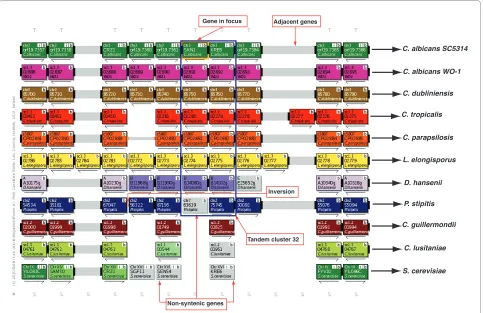
[image:2.595.57.289.95.227.2]visual display consists of horizontal tracks representing chromosomal segments and pillars (Figure 2). Pillars are the core data structures used to store list of homologies across all species represented in the gene order browser [20]. Pillars contain vacant slots when homologous genes cannot be found in a particular genome. Genes were ini-tially added to pillars based on automated assignments derived from best bidirectional BLASTP searches. The CGOB pillar dataset was manually refined by examining regions of dubious synteny and singleton genes. A combi-nation of BLASTP scores, synteny and phylogenetic data were used to confirm assignments to pillars.
Figure 1 Phylogenetic supertree of Candida species represented in CGOB. Candida glabrata and Saccharomyces cerevisiae have been selected as outgroups. Numbers on branches represent tandem dupli-cations gained along each lineage.
Pichia stipitis
Lodderomyces elongisporus Candida dubliniensis
Candida tropicalis
Candida parapsilosis
Candida lusitaniae
Candida guilliermondii Debaryomyces hansenii Candida albicans
Candida glabrata
Saccharomyces cerevisiae
21 1 62 63 33 15 34 84 44 10
8 7 16
7
0 0 9
Table 1: Candida species displayed in CGOB.
Species Citation Genes Partial ORFs Refined Gene set Singletons
C. albicans SC5314 [6] 6,185 0 6,185 43
C. albicans WO-1 [5] 6,197 91 6,148 99
C. dubliniensis CD36 [7] 5,924 0 5,924 200
C. tropicalis MYA-3404 [5] 6,258 116 6,198 737
C. parapsilosis CDC 317 [5] 5,823 28 5,809 553
L. elongisporus NRLL YB-4239 [5] 5,802 173 5,710 596
P. stipitis CBS6054 [3] 5,838 12 5,832 470
D. hansenii CBS767 [4] 6,317 12 6,311 981
C. guilliermondii ATCC6260 [5] 5,920 142 5,844 666
[image:2.595.57.545.580.747.2]Similar to YGOB, CGOB allows the user to focus the screen display on a gene of interest and to view phyloge-netic trees, sequences and BLASTP results (Figure 2). Hyperlinks to functional data can also be accessed for C. albicans SC5314 and S. cerevisiae via the Candida Genome Database [17] and the Saccharomyces Genome Database [21] respectively.
During manual editing of CGOB we observed that the original genome annotations contained a substantial number of apparently partial open reading frames, which we merged into full-length gene models. For example,
LELG_01495 and LELG_1496 in L. elongisporus are both
similar to parts of C. albicans orf19.6045 (PSD1). Closer
inspection showed that LELG_1496 aligned with the
N-terminus of orf19.6045 whereas LELG_1496 matches the
C-terminus (Additional file 1). In cases like this we deleted the partial open reading frames from CGOB's homology pillars and inserted a new "merged" gene model. Overall, we identified 709 ORFs in 8 genomes that
were subsequently merged into 335 full-length genes
(Additional file 2). The L. elongisporus genome contained
the highest number of partial ORFs (173 in total), while
the highly curated genomes of C. albicans SC5314 and C.
dubliniensis contain none (Table 1). The corrected gene
sets are available for download from CGOB [18].
Tandem Gene Duplications
Tandem gene duplication is one mechanism by which species acquire new genes, and by extrapolation, new functions. We therefore used both similarity and synteny measurements in CGOB to identify gene duplications in
all Candida genomes. We identified and numbered all
tandem clusters in each genome (Additional file 3). For some rapidly evolving genes, sequence similarity is not high enough to identify family members. For example, our initial BLAST based approach suggested that
orf19.2508 (PRM9) and orf19.2509 in C. albicans are
[image:3.595.58.541.96.409.2]tan-dem duplicates (cluster 30, Additional file 3). Their
Figure 2 Candida Gene Order Browser (CGOB) screenshot for tandem cluster 32. Each box represents a gene and each color a chromosome (horizontal tracks). The gene in focus is highlighted with an orange border. Gene identifiers in the center of each box relate to annotations from the relevant sequencing centers. The "b" button performs a BLASTP search against CGOB's sequence database. The "S" button displays all the protein se-quences in a vertical pillar. The "+" button outputs CGOB pillar data in a tabulated format. The "T" button reconstructs phylogenies on the fly. The "i"
button retrieves functional data for C. albicans SC5314 and S. cerevisiae via the Candida Genome Database and the Saccharomyces genome database
respectively. Non-syntenic genes are colored in grey. Genes lying in close proximity are joined by connectors: a solid bar for adjacent genes, two nar-row bars connect genes up to 5 genes apart (not shown) and one narnar-row bar connects genes up to 20 genes apart (not shown). Inversions are de-noted by orange connectors.
C. albicans SC5314
C. albicans WO-1
S. cerevisiae P. stipitis D. hansenii C. dubliniensis
C. tropicalis
C. parapsilosis
L. elongisporus
C. guillermondii
C. lusitaniae
Adjacent genes Gene in focus
Non-syntenic genes
Inversion
orthologs in C. dubliniensis, C. tropicalis, C. parapsilosis
and L. elongisporus are found adjacent to one another.
However, these genes were not initially identified as tan-dem duplicates in the other species because they do not
have a BLASTP E-value below our initial cut-off (See
Methods). Therefore, slower evolving tandem duplicates
in one Candida species (C. albicans SC5314 in this
exam-ple) can be used to locate rapidly evolving tandems (or
tandems with low sequence complexity) in other
Can-dida genomes.
Tandem duplicates that subsequently underwent chro-mosomal rearrangement are difficult to identify. How-ever, the ancestral arrangement can be inferred from an analysis of homologous genes in CGOB. For example, in
C. albicans SC5314, the duplicate genes orf19.7362
(SKN1) and orf19.7363 (KRE6) are located beside one
another on chromosome 3 (Figure 2, Additional file 3
(cluster 32)). Their orthologs in C. albicans WO-1, C.
dubliniensis, C. tropicalis, C. parapsilosis, L. elongisporus
and D. hansenii are also adjacent (Figure 2). However in P.
stipitis, SKN1 (PICST_63619) is located on chromosome
7 while KRE6 (PICST_75745) is located on chromosome
2 (Figure 2). The most parsimonious explanation is that a
duplication of SKN1 or KRE6 occurred in an ancestor of
all the Candida species, and this has been conserved in
most. However, relocation of SKN1 has occurred
exclu-sively in P. stipitis (Figure 2).
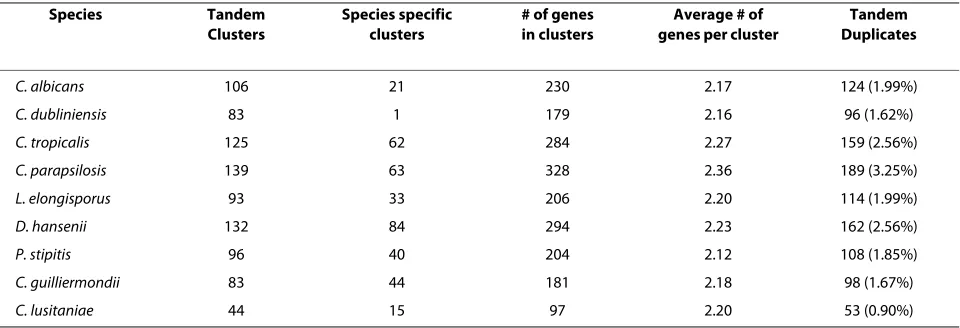
In total 901 tandem clusters were identified across all
the Candida genomes (Table 2, Additional file 3). C.
lus-itaniae has the smallest number of tandem clusters (44)
whereas C. parapsilosis has the highest number (139).
This is noticeably high, as the closest relative of C.
parap-silosis, L. elongisporus (Figure 1), contains only 93 tandem
clusters (Table 2). The average number of genes per
tan-dem cluster in all Candida species ranges is slightly
greater than 2 (Table 2).
We used CGOB to map species and lineage-specific tandem duplications (Figure 1). For example, since they
last shared a common ancestor, C. albicans has
under-gone at least 21 species-specific tandem duplications
gaining 24 paralogs, while its close relative C. dubliniensis
has undergone a single tandem duplication (Cd36_11890,
Cd36_11900) gaining 1 additional gene (Additional file 3,
cluster 463). Similarly, C. parapsilosis has undergone 63
species-specific tandem duplications gaining 78 paralogs
since diverging from its closest relative, L. elongisporus,
which has undergone 33 tandem duplication gaining 41 paralogs in the same time (Additional file 3).
Cluster 22 (Additional file 3) illustrates an ancient duplication, resulting in a family of peroxisomal acyl-CoA thioesterases that are present in 3-5 tandem copies
in all the Candida species. The cluster is particularly
large in the branch containing C. albicans, C.
dublinien-sis, C. tropicalis, C. parapsilosis and L. elongisporus,
where 5 family members are immediately adjacent to
each other. The single homolog in S. cerevisiae is likely to
be involved in fatty acid oxidation [22]. There is
signifi-cant up-regulation of fatty acid β-oxidation when C.
albi-cans cells are engulfed by macrophages [23], although
this pathway does not appear to be essential for virulence [24]. Many of the other tandem duplication clusters include members of larger gene families, such as lipases (cluster 10, Additional file 3), glucose transporters (clus-ter 15,61, Additional file 3) and ferric reductases (clus(clus-ter 57, Additional file 3). Some clusters are lineage specific,
such as the triplication of the pirin-domain genes PRN2,
PRN3 and PRN4 (cluster 6, Additional file 3) in C.
albi-cans, C. dubliniensis and C. tropicalis. The function of
these genes in unknown, but they are likely to localize to
the nucleus. There is an amplification of the FRP6 family
[image:4.595.59.539.569.733.2]in D. hansenii and P. stipitis; the S. cerevisiae orthologs are required for export of ammonia [25] (cluster 497, Additional file 3). Other clusters are species-specific,
Table 2: The total number of tandem duplicates found in each Candida species displayed in CGOB.
Species Tandem
Clusters
Species specific clusters
# of genes in clusters
Average # of genes per cluster
Tandem Duplicates
C. albicans 106 21 230 2.17 124 (1.99%)
C. dubliniensis 83 1 179 2.16 96 (1.62%)
C. tropicalis 125 62 284 2.27 159 (2.56%)
C. parapsilosis 139 63 328 2.36 189 (3.25%)
L. elongisporus 93 33 206 2.20 114 (1.99%)
D. hansenii 132 84 294 2.23 162 (2.56%)
P. stipitis 96 40 204 2.12 108 (1.85%)
C. guilliermondii 83 44 181 2.18 98 (1.67%)
C. lusitaniae 44 15 97 2.20 53 (0.90%)
such as the five adjacent 2' hydroxyisoflavone reductases (CIP1) described by Jeffries and Van Vleet [26], which our
analysis confirms is unique to P. stipitis (cluster 228).
Most of the other species have a single copy, except for C.
parapsilosis, which has two. L. elongisporus contains 5
tandem repeats of a large family with up to 13 members
in this species, which is absent from all the other
Can-dida genomes (cluster 280, Additional file 3). The
func-tion of this family is unclear but all members contain a Phosphatidylinositol Phosphate Kinase (PIPKc) domain.
We also determined whether tandem duplicates in
indi-vidual Candida species are undergoing positive selection.
Recent genome wide studies have shown that positive selection after tandem duplication can give rise to novel gene functions [27], that may help pathogens evade the human immune response [28]. At the DNA level, positive selection may be detected by comparing the rate of amino acid altering (nonsynonymous) nucleotide substitutions
with the rate of synonymous substitution (dN/dS). A dN/dS
ratio > 1 is indicative of positive selection. The average
dN/dS ratio for all tandem clusters was found to be 0.27
(not shown). Of the 901 Candida clusters examined, only
12 displayed a dN/dS ratio > 1 (Additional file 3). Five of
these are species-specific and have no homologs in any
other Candida species (or any species in GenBank). The
remaining 7 clusters under the influence of positive selec-tion do not share homology with gene families (cell wall, hyphal, pseudohyphal, filamentous growth and biofilm functions) normally associated with pathogenicity in
Candida [5]. In P. stipitis, one cluster encodes putative
ubiquitin protein ligases, one encodes zinc finger-con-taining proteins, and one encodes potential siderophore
transporters (Additional file 3). In D. hansenii, one cluster
encodes orthologs of TFS1, whose expression is induced
during filamentation in C. albicans [29]. Overall our
results suggest that the majority of Candida tandem
duplicates are under the influence of strong purifying selection, presumably to conserve gene function.
We have extended an earlier analysis of duplicate genes
in Candida genomes, which considered only members of
multigene families [5]. We also identified some clusters by manual inspection. For example, we first identified 85
tandem clusters in C. albicans SC5314 using a simple
BLAST approach, and this was increased to 106 using synteny information, whereas only 24 were reported in
Butler et al [5]. In some species (such as L.elongisporus
and C. guilliermondii) we identified a smaller number of
clusters than Butler et al [5], partly because we removed partial ORFs from the gene sets.
The Candida Paranome
Using our reannotated Candida genomes we determined
the number of multigene families (the paranome [30]) for
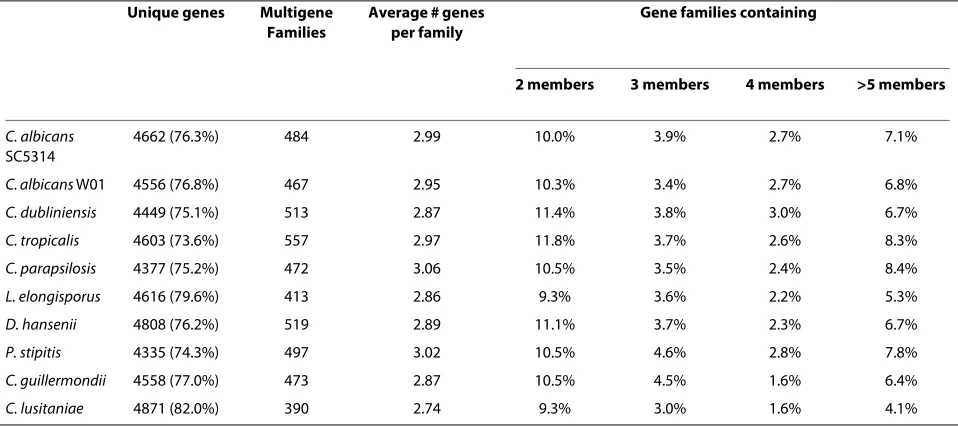
each Candida species. C. tropicalis has the highest
num-ber (557), whereas C. lusitaniae (390) has the lowest
(Table 3). In contrast, C. parapsilosis has the lowest
num-ber (4377) of genes that do not belong to families,
whereas C. lusitaniae (4871) has the highest (Table 3).
The average number of genes per multigene family is
approximately 3 for all species, although all Candida
spe-cies have larger gene families (Table 3).
The largest gene family shared by all species contains a
transporter (DIP5) annotated as a putative dicarboxylic
[image:5.595.59.538.520.733.2]amino acid permease in CGD. This family was previously suggested as a potential antifungal target, as there are no
Table 3: The Candida paranome.
Unique genes Multigene Families
Average # genes per family
Gene families containing
2 members 3 members 4 members >5 members
C. albicans
SC5314
4662 (76.3%) 484 2.99 10.0% 3.9% 2.7% 7.1%
C. albicans W01 4556 (76.8%) 467 2.95 10.3% 3.4% 2.7% 6.8%
C. dubliniensis 4449 (75.1%) 513 2.87 11.4% 3.8% 3.0% 6.7%
C. tropicalis 4603 (73.6%) 557 2.97 11.8% 3.7% 2.6% 8.3%
C. parapsilosis 4377 (75.2%) 472 3.06 10.5% 3.5% 2.4% 8.4%
L. elongisporus 4616 (79.6%) 413 2.86 9.3% 3.6% 2.2% 5.3%
D. hansenii 4808 (76.2%) 519 2.89 11.1% 3.7% 2.3% 6.7%
P. stipitis 4335 (74.3%) 497 3.02 10.5% 4.6% 2.8% 7.8%
C. guillermondii 4558 (77.0%) 473 2.87 10.5% 4.5% 1.6% 6.4%
C. lusitaniae 4871 (82.0%) 390 2.74 9.3% 3.0% 1.6% 4.1%
homologs in humans [31]. All Candida species have at
least 20 members of this family (not shown). The MEP
family, encoding three ammonium permeases in C.
albi-cans SC5314, has also suggested as an antifungal drug
target [31]. Three MEP genes are present in all Candida
species except for L. elongisporus, which is missing the
ortholog of one (orf19.4446, not shown). Drugs directed
against these families should therefore be of broad
speci-ficity and target all Candida species, and are likely to have
no undesired interactions with the human patient.
Approximately 20-25% of all Candida genes in CGOB
belong to a multigene family (Table 3), similar to what has
previously been reported for C. albicans SC5314 [31].
This figure is lower than what has been observed for S.
cerevisiae (~30%), which is unsurprising as S. cerevisiae
has undergone a whole genome duplication [32] while
Candida species have not [33].
Intron loss in Candida genes
Yeast genomes from the Saccharomycotina are known to be intron poor; introns are found in fewer than 5% of genes from most species [34]. The exact mechanisms of intron loss are not fully elucidated, but it is likely to occur via recombination of a chromosomal copy with a reverse transcript [35,36]. Introns have been predicted with some
accuracy in only three of the sequenced Candida
genomes - C. albicans, C. dubliniensis and D. hansenii.
We therefore restricted our analysis to these species. Where we observed differences in intron locations in tan-dem duplicates in any one species, the corresponding genomic sequence of the other two was manually inspected to confirm intron presence or absence.
C. albicans SC5314 has at least 381 genes containing
415 introns [37]. Of these genes, 79 (~21%) belong to a multigene family, and five are located in tandem clusters.
Cluster 5 contains three paralogs in C. albicans
(orf19.5194.1, orf19.6837 (FMA1), and orf19.6838) (Addi-tional file 3 and Figure 3A). The first two of these genes
contain introns, as do their orthologs in C. dubliniensis.
There is a single homolog in D. hansenii, which has
undergone an inversion relative to C. albicans, but still
contains an intron. However, the third gene (orf19.6838)
does not contain an intron in any of the species (Figure 3A). The most likely hypotheses are that either the pro-genitor copy contained an intron and was duplicated twice, followed by intron loss in one copy, or that the pro-genitor was first duplicated to generate a second intron-containing copy, and then duplicated again in an RNA-mediated event.
Cluster 144 (Additional file 3) contains members of a family of glutathione-S-transferases that are present in two adjacent copies in some species and three in others
(Figure 3B). Two genes in C. albicans, C. dubliniensis and
D. hansenii have introns, suggesting that they arose
through tandem duplication (Figure 3B). However, a third
member of the family (GTT1) which lies within the
clus-ter in C. parapsilosis, L. elongisporus and C.
guilliermon-dii does not contain any introns in C. albicans or C.
dubliniensis (there is no ortholog in D. hansenii). GTT1
may therefore have arisen via an RNA intermediate in an
ancestral Candida species.
We also found evidence for a species-specific intron gain in a tandem duplicate. Cluster 61 (Additional file 3)
contains two adjacent genes (HGT12 and HGT13) in C.
albicans, C. dubliniensis and P. stipitis that belong to a
large family of sugar transporters that have at least 20
members in Candida species [38] (Figure 3C). The
HGT13 homolog is not adjacent to HGT12 in the other
species (not shown). In C. albicans, HGT13 contains an
intron, whereas its paralog HGT12 does not. The HGT13
intron lies within the coding sequence, which makes it easy to identify (Figure 3D). Interestingly, although this
intron is present in HGT13 from both C. albicans
iso-lates, it is absent from all of the homologs in the other species, whether syntenic or not (Figure 3C). Intron gain
is very rare [36,39], but it appears more likely that HGT13
in C. albicans gained an intron, rather than the intron was
independently lost from all the other species. At least one
other member of the HGT family (HGT9) also contains
introns in C. albicans, but these appear to be conserved
[image:6.595.305.539.93.268.2]in C. dubliniensis only.
Figure 3 Gene order around tandem clusters 5, 144 and 61 (A, B, C respectively). The diagram is re-drawn from CGOB with some spe-cies omitted for clarity. Homologs are organized in pillars. Intron con-taining genes are indicated with a tail. A) Cluster 5. D. hansenii does not contain an ortholog of FMA1. B) Cluster 144 is represented by a broken red line. GTT1 (orf19.6998) and Cd36_85600 from C. albicans and C. dubliniensis are not part of this cluster, and are located elsewhere in the
genome. Diagonal lines indicate a gap of 2 and 4 genes in C. albicans
and C. dubliniensis respectively. C) Cluster 61. Diagonal lines indicate a gap of 23 genes in P. stipitis. D) Partial alignment around the C. albicans
HGT13 intron. The position of the intron in C. albicans is indicated with an inverted triangle.
19.5195 19.5194.1 19.6838 19.6842
04170 04180 04190 04200 04220
D14762g D14784g B08921g B08943g
Ca
Dh Cd
70500
(C)
Cluster 61
HGT13
33971 HGT12
70490
91253
70510
50236 19.7092 19.7095
64516 70480
Ca
Cd
Ps Cluster 5 (A)
Dh Cd Cp Le Ct
Ps Ca
LSTSC N WIFN FMV LS TSCN WIFNFLV LS TASNWAFNFLV L S TASNWAFNFLV
L ST ASNWAFNFMV
ISTATNWAFNFMV
VMI TPVAFQ NISYY T Y T I F
VMIT PIA F Q N ISY Y T Y T I F VMVTP VMFAN IDY Y TYC VF VMIT PA FEN IQY Y T YTI F
VMITPVGF QSIG SY T YLIF
VMIT PA FD TIG PYT YT IF
V
V
L STSC N WLF N FM V V M ITP VAF Q NIGYYTYTIF
460 470
450 480
02802
02798 02799 02800 02801 02802 02354 02353 02352 02350 02349
D17655g D17677g D17699g
83650 83610 85600 83590 83580 HBR3 19.359 GTT1 19.356 19.355 Ca
Cd
Cp
Le
Dh
Cluster 144 (B)
(D)
Other gene families that are not tandemly arranged are also likely to have arisen through both DNA-based gene duplication and via an RNA intermediate, possibly
including retrotransposition. For example in C. albicans,
the glycosylphosphatidylinositol-linked cell wall gene
ECM33 [40] has two paralogs orf19.4955 and orf19.4255
(ECM331) that are not adjacent to each other (not
shown). ECM33 and orf19.4955 both contain an intron,
as do their orthologs in C. dubliniensis and D. hansenii.
ECM331 does not contain an intron in any of the three
species. This suggests that ECM33 and orf19.4955 may
have arisen through duplication, and ECM331 is the
result of reverse transcription of one of the intron-con-taining paralogs, in an ancestor of the three species.
Clustering of adjacent genes in metabolic pathways
In bacteria the primary method of controlling gene expression is the organization of genes into operons,
which are transcribed into a single mRNA. Bacterial operons often contain genes from the same metabolic pathway. Operons are not usually found in eukaryotes, with the notable exception of nematodes [41-43]. How-ever, there is evidence for clustering of genes at the same genomic location belonging to the same metabolic path-ways in fungi. For example, genes involved in secondary metabolism are clustered in the genomes of filamentous ascomycetes [44], and many of the genes involved in metabolism of allantoin and galactose are clustered in the
genome of S. cerevisiae and related species [45,46]. Many
[image:7.595.63.540.114.514.2]functionally-related genes are co-expressed, even when they do not share sequence similarity [26]. Lee and Sonn-hammer [47] found that there is significant tendency for genes from the same metabolic pathway to cluster in the genomes of fungi, and in other organisms. However, their definition of proximity was very large, and included genes Table 4: CGD metabolic pathways that show evidence of gene clustering.
#Genes SC5314 WO1 Cdub Ctro Cpar Lelo Dhan Psti Pgui Clus
Histidine, purine and pyrimidine biosynthesis
41 7 7 7 5 4 4 - 3 4
-Aerobic respiration (cyanide sensitive) 14 3 3 3 3 2 3 3 3 2 2
Aerobic respiration (cyanide insensitive) 8 2 2 2 2 2 - - - -
-2-keto glutarate dehydrogenase complex 3 2 2 2 2 - - - 2 -
-N-acetylglucosamine degradation 3 3 3 3 3 3 3 3 3 3 3
Methylglyoxal pathway 12 2 2 2 2 2 2 - - -
-Sphingolipid metabolism 8 - - - 2
-Ergosterol biosynthesis 21 - - - 2 - 2 2
Biotin biosynthesis 4 4 4 - 3 - - 2 - -
-NAD salvage pathway 4 - - - 2 - - -
-Tetrapyrrole biosynthesis 4 2 2 2 2 - - - 2 -
-Pantothenate and coA biosynthesis 11 2 2 2 2 2 2 2 2 2 2
Starch degradation 7 - - - 2
Lipid-linked oligosaccharide biosynthesis 8 - - - 2 2 3 2 3 2
-Arginine degradation (arginase pathway) 5 2 2 2 - - - 2 2 2 2
Lysine biosynthesis 6 - - - 2 - - -
-Superpathway of glycine biosynthesis 5 - - - - 2 - - - -
-Biosynthesis of phe/tyr/trp 13 - - - 2 - - -
-Superpathway of glycine biosynthesis 5 - - - - 5 - - - -
-Acrylonitrile degradation 4 - - - 2(2T) 2(2T) 2(2T) - 2(2T) -
-Galactose degradation 5 4(2D) 4(2D) 4(2D) 4(2D) 4(2D) 4(2D) 4(2D) 4(2D) 4(2D) 4(2D) tRNA charging pathway 35 13(6D) 13(6D) 13(6D) 10(2D) 7(4D) 9(6D) 9(4D) 13(6D) 9(4D) 5(4D) Fatty acid oxidation pathway 14 4(4D) 4(4D) 2(2D) 4(4D) 4(4D) - 2(2D) 2(2D) 2(2T) 2(2T) Glutathione-glutaredoxin redox reactions 9 5(3D, 3D) 5(2D,2T)* 6(3D,3T) 3(3T) 4(4T) 3(3T) 2(2T) 2(2T) 3(3T) 2(2D) Isoleucine & phenylalanine degradation 12 2(2T) 2(2T) - - - - - - -
-Removal of superoxide radicals 7 2(2T) 2(2T) 2(2T) - - - - - -
that were separated by up to 400 other genes. Our analy-sis had a more focused approach, as we searched for evi-dence of genes involved in the same metabolic pathway
lying up to 10 genes apart in Candida species.
Currently there are 155 metabolic pathways that have
been manually curated by the Candida Genome
Data-base. However, 23 of these contain only one gene, and a further 33 are redundant. For example, the list of genes involved in the acrylonitrile and aldoxime degradation pathways are identical. Similarly the tyrosol, tryptophan, phenylalanine and chorismate biosynthesis are all subsets of the superpathway of phenylalanine, tyrosine and tryp-tophan biosynthesis. There are 99 unique pathways, con-taining 659 genes. There are 511 unique genes in total,
representing 8.2% of the C. albicans SC5314 gene set.
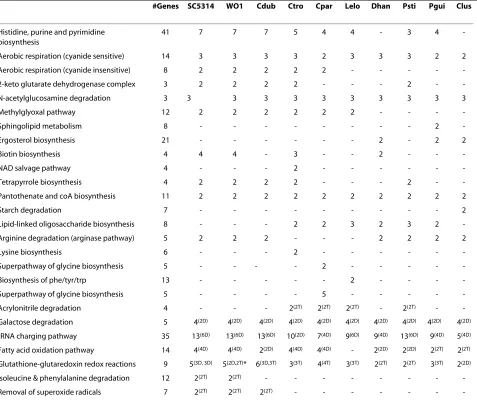
CGOB was interrogated for evidence of clustering of genes (i.e. lying within 10 genes of one another on the same chromosome) in the 99 nonredundant pathways. We identified 21 pathways that display evidence of gene
clustering in at least one Candida species (Table 4 and
Additional file 4). Some metabolic pathway clusters result
from tandem duplication; for example, AOX1 and AOX2
(encoding cyanide insensitive enzymes required for an
alternative pathway of aerobic respiration) in C. albicans,
C. dubliniensis, C. tropicalis and C. parapsilosis, were also identified as tandem cluster 9 (Additional file 3). There is evidence of species-specific clusters of unrelated genes, such as lysine biosynthesis and glycine biosynthesis,
which are clustered in one species only (C. tropicalis and
C. parapsilosis respectively, Table 4, Additional file 4).
A high proportion (48%) of the clusters identified con-tain only two genes and may not be biologically signifi-cant, as they appear at a high frequency in randomized data (see Methods). However, the metabolic clusters dis-cussed here are highly significant, particularly for the three pathways discussed below.
(i) The biotin biosynthesis pathway
Biotin or vitamin H acts as a cofactor for a set of enzymes that catalyze carboxylation, decarboxylation, and tran-scarboxylation reactions in a number of crucial metabolic processes [48]. Most multicellular eukaryotes (except for plants) are biotin auxotrophs, whereas many bacterial
species and some fungi (including Aspergillus and
Sac-charomyces species) are biotin prototrophs [49,50].
In S. cerevisiae 6 genes are involved in the production
of biotin (BIO1-6). These are located in 2 clusters (BIO1/
BIO6 and BIO3/BIO4/BIO5, with BIO2 at a different loca-tion) [49]. Hall and Dietrich [49] showed that the original eukaryotic biotin pathway was lost in the last common
ancestor of Candida and Saccharomyces species, but it
has been rebuilt through horizontal gene transfer from
bacterial species via transfers of BIO3 from
δ-proteobac-teria and BIO4 from α-proteobacteria, followed by gene
duplication and neofunctionalization.
We identified a biotin cluster of four genes (orthologs
of S. cerevisiae BIO2, BIO3, BIO4 and BIO5) in both C.
albicans strains (Figure 4). There is however an inversion
of the surrounding region between SC5314 and WO-1 (Figure 4); this appears to result from a rearrangement between two members of the oligopeptide transporter
gene family, OPT9 (a pseudogene) and OPT1.
The cluster in C. albicans is larger than the equivalent
region in S. cerevisiae as it includes BIO2. BIO2 orthologs
are in the same chromosomal region in C. albicans, D.
hansenii, C. lusitaniae and C. guilliermondii (Figure 4).
BIO3, BIO4 and BIO5 are also adjacent to each other in C.
tropicalis, and they appear to have been recruited to the
BIO2 region in C. albicans. Almost the entire cluster,
together with an adjacent OPT gene, is missing from C.
dubliniensis. Only BIO2 remains, and this is located
else-where in the genome. The absence of the biotin cluster in
C. dubliniensis has previously been reported, and it was
suggested that its presence in C. albicans may contribute
to increased prevalence and virulence [51]. The entire set
of BIO genes is also absent from C. parapsilosis and L.
elongisporus, and was probably lost in their last common
ancestor (not shown). There is some conservation of syn-teny of the surrounding genes (not shown), suggesting
the genes were lost together, as a cluster. Unlike S.
cerevi-siae, the biotin clusters in C. albicans and C. tropicalis are
not sub-telomeric.
The remaining Candida species contain some genes
involved in biotin synthesis. BIO2 is present in almost all
species, suggesting it may play a role independent of
bio-tin synthesis. BIO4 and BIO5 are clustered in D. hansenii
with BIO2 elsewhere in the genome, whereas BIO2, BIO3
and BIO4 are present in P. stipitis, but are not clustered
[image:8.595.305.539.547.662.2](not shown). It is not clear why some components of the
Figure 4 Gene order around the biotin cluster. The diagram is re-drawn from CGOB with some genes and species omitted for clarity. Blocks of color represent chromosomes. Homologs are organized in pillars. Changes in color indicate breaks in synteny. The grey triangles
indicate an inversion between the C. albicans SC5314 and WO-1
pathway are retained in some species. However, it may enable them to make biotin from some intermediates, as
was described for S. cerevisiae [52]. It is generally
assumed however that clustering of genes in biosynthetic pathways is the result of selection against toxic interme-diates produced by incomplete pathways [49]. It is likely
that the ancestral Candida species was able to synthesize
biotin, but there has been substantial gene loss in many species.
In S. cerevisiae BIO6 is believed to have arisen through
gene duplication of BIO3 followed by
subfunctionaliza-tion [49]. We cannot locate an ortholog of BIO6 in any
Candida species. Similarly we cannot locate any Candida
ortholog of BIO1 (pimeloyl-CoA synthetase), the first
enzyme involved in synthesizing biotin from pimelic acid.
In S. cerevisiae S288C, BIO1 and BIO6 are pseudogenes
[49], but there is no evidence of corresponding
pseudo-genes in any Candida species. It is therefore unlikely that
the genes are present in other unsequenced isolates of the same species.
The CGD biotin pathway data suggests that orf19.3567
(BIO32) is involved in biotin synthesis. BIO32 has a top
BLASTP hit to BIO3 in S. cerevisiae. However, BIO3
belongs to a multigene family that also contains ARG8,
CAR2 and UGA1. To determine the origin of BIO32 we
reconstructed a phylogenetic tree using the same sequences used by Hall and Dietrich [49], and included
ARG8, CAR2 and UGA1 from C. albicans and S.
cerevi-siae. Our phylogeny places the S. cerevisiae and C.
albi-cans BIO3 orthologs together with bacterial sequences,
indicating that they originated from horizontal gene
transfer as suggested by Hall and Dietrich [49]. S.
cerevi-siae BIO6 is also grouped in this clade, supporting the
hypothesis that it is a duplicate of BIO3. However, BIO32
from C. albicans is grouped with S. cerevisiae and C.
albi-cans orthologs of ARG8, CAR2 and UGA1 in a separate
clade (not shown). BIO32 is therefore most likely a
dupli-cate of one of these genes, and is more likely to be involved in arginine or glutamate metabolism than in bio-tin synthesis.
(ii) The N-acetylglucosamine regulon
It has been proposed that the ability of pathogenic strains
of Candida to utilize sugars such as glucosamine and N
-acetylglucosamine (Nag) as alternative carbon sources are
important virulence factors [53]. C. albicans mutants
incapable of utilizing Nag are less virulent in a murine model of systemic candidiasis compared to wild type iso-lates [54]. The three genes involved in the conversion of Nag to fructose-6-phosphate encode hexokinase kinase
(HXK1/orf19.2154), Nag-6-phosphate deaminase
(NAG1/orf19.2156) and Nag-6-phosphate deacetylase
(DAC1/orf19.2157). These act sequentially on Nag and
are present in C. albicans in a cluster termed the Nag
reg-ulon [53].
Our clustering analysis shows that the Nag regulon is
conserved in all Candida species, with the exception of C.
lusitaniae (Figure 5, Additional file 4). In the latter
spe-cies, there has been an insertion of 5 species-specific
genes in the region between HXK1 and NAG1, resulting
in a sequence of 19,931 basepairs (bp), whereas the inter-genic region in the other species is less than 516 bp. Sev-eral of the inserted genes encode members of a family of
cell wall genes, related to Flo1 from S. cerevisiae. The Nag
cluster is sub-telomeric in many of the Candida species,
and repeats of cell wall genes are commonly found near telomeres [55]. The conservation of the Nag regulon in
pathogens like C. albicans and nonpathogens such as P.
stipitis suggests that the ability to utilize Nag is not a
viru-lence factor. NAG3, NAG4 and NAG6, which lie close to
the NAG cluster in many Candida species (Figure 5), are
not involved in the conversion of Nag, but are more likely
to encode drug efflux pumps [56,57]. NAG3 is a tandem
duplicate of NAG4 (Additional file 3, cluster 59), which
occurred in the ancestor of C. albicans, C. dubliniensis, C.
[image:9.595.305.540.362.672.2]tropicalis, C. parapsilosis and L. elongisporus (Figure 1).
Figure 5 Gene order around the N-acetylglucosamine (NAG)
clus-ter. The diagram is re-drawn from CGOB. Blocks of color represent
chromosomes, homologs are organized in pillars and genes shown in grey boxes are not adjacent to any other gene shown. Synteny of NAG enzymes is observed in all species except for C. lusitaniae, which has 5 intervening genes displayed as an insertion loop.
C. albicans
C. dubliniensis
C. tropicalis
D. hansenii
C. guilliermondii
C. lusitaniae C. parapsilosis
L. elongisporus
P. stipitis
NAG3
65570
03729
04222
03673 DAC1
65550
03728
03674
F26048g
48829
04221
02904
00478
HXK1
65510
03726
03676
F26092g
84922
04219
02911
00480
NAG6
65490
03725
04218
03677
84922 F26114g
00481
02912
NAG1
65540
03727
03675
F26070g
62706
04220
00479
02905
NAG4
65590
03730
04223
03672
084561
03514 01704 G00847g
02906
02907
02908
02909 0291
0
The phylogenomic distribution of the Nag regulon is
intriguing. The cluster is found in the Candida species,
but NAG1 and DAC1 are missing in the Saccharomyces
lineage. Homologs are also absent from Ashbya gossypii
and Kluyveromyces waltii, suggesting the cluster is
miss-ing from the entire Saccharomycetes lineage. However, the origin of the NAG cluster may be an ancient event.
DAC1 and NAG1 are in close proximity (within two
genes) in the Aspergilli and in Neurospora crassa, which
belong to the Pezizomycotina, a sister clade to the
Sac-charomycotina. DAC1 and NAG1 also lie within 2 genes
in the Basidiomycete, Ustilago maydis. If the cluster arose
in an ancestor of the Ascomycota and the Basidiomycota, it is very ancient, and the genes have been subsequently
lost from many species (including Schizosaccharomyces).
(iii) The Leloir galactose utilization pathway
Galactose is utilized by most organisms through its con-version to glucose-6-phosphate, which then enters glycol-ysis [58]. The GAL pathway is composed of both structural and regulator elements [59]. The galactose
metabolism structural genes of S. cerevisiae and C.
albi-cans are well conserved, whereas their regulatory
compo-nents are distinct [59]. In C. albicans the structural genes
(GAL1, GAL10 and GAL7) are arranged in a cluster close
to a hexose transporter HGT2 [59]. This cluster, together
with two additional uncharacterized genes which lie
between GAL10 and GAL7, is conserved in C. albicans,
C. dubliniensis, C. parapsilosis and D. hansenii [59]. We
show that the GAL pathway cluster is conserved in all
Candida species present in CGOB (Figure 6).
Both C. albicans strains and C. lusitaniae have a gene
insertion between GAL1 and GAL10 (not shown). The C.
albicans gene (orf19.3671) is designated "dubious " by CGD, and is a pseudogene in WO-1, with no significant similarity to any other gene known from any other
organ-ism. Similarly the C. lusitaniae gene (CLUG_02293) has
no significant homologs in either GenBank or CGOB
Blast databases. The intergenic regions between GAL1
and GAL10 are 490 and 1362 nucleotides in C. lusitaniae
and C. albicans, similar to the intergenic regions in all the
other Candida species. It is likely therefore that both
orf19.3671 and CLUG_02293 are errors in annotation,
rather than real genes and so are not shown in Figure 6.
Expression of the hexose transporter HGT2 is strongly
induced by galactose in C. albicans [59]. An ortholog of
HGT2 is also very close to GAL1 in C. dubliniensis, C. tropicalis, C. guilliermondii and C. lusitaniae (Figure 6).
HGT2 belongs to a large gene family, and while multiple
homologs were located in many species, there is no
fam-ily member adjacent to the GAL cluster in C. parapsilosis,
L. elongisporus and P. stipitis. A putative ortholog in D.
hansenii was identified, although it resides on a different
chromosome to the GAL genes (Figure 6). It is possible
that even though the relative position of the hexose trans-porter is not conserved, co-expression with the GAL genes may be.
Interestingly, orf19.3674, which lies between GAL10
and GAL7, appears to be a paralog of GAL10, and is
con-served in all the Candida species. This was also noted in
the P. stipitis genome [3]. Gal10 is more than twice the
size of orf19.3674 (675 vs. 320 amino acids), and contains
two recognized protein domains, an NAD dependent epi-merase/dehydratase domain and an aldose 1-epimerase
domain. Only the first domain is present in orf19.3674
and its orthologs. Expression of this gene is not
influ-enced by galactose in C. albicans [59]. orf19.3674 may
therefore have undergone subfunctionalization after duplication. Alternatively, recombination between a
GAL10 precursor and another gene may have led to gene
with a novel function. An ortholog of the adjacent
con-served gene (orf19.3673) encodes a subunit of the
trans-port protein particle (TRAPP) of the cis-Golgi in S.
cerevisiae [60] and is unlikely to be involved in galactose
metabolism.
KEGG Analysis
We also assigned genes in each Candida species to
[image:10.595.305.540.95.320.2]indi-vidual metabolic pathways using the Kyoto Encyclopedia of Genes and Genomes (KEGG) [61]. This approach per-mitted us to investigate species-specific metabolic path-ways, as well as pathways that have been described only
Figure 6 Gene order around the Galactose (GAL) cluster. The dia-gram is re-drawn from CGOB. Blocks of color represent chromosomes and homologs are organized in pillars. Diagonal lines indicate local in-versions. Genes shown in grey boxes are not adjacent to any other
gene shown. Dubious genes (orf19.3671 and CLUG_02293) from C.
albi-cans and C. lusitaniae are not displayed. GAL cluster
C. albicans
C. dubliniensis
C. tropicalis
D. hansenii
C. guilliermondii
C. lusitaniae C. parapsilosis
L. elongisporus
P. stipitis
GAL1 GAL10 19.3673 19.3674 GAL7 HGT2 SHA3
01990 02000 02010 02020 02030 01980
01970
04617 04618 04619 04620 04621 04615 04616
04855 04856 04857 04858 04859 04854
01649 01648 01647 01646 01645 01650
82625 76750 56865 43810 57493 2758
05862 05863 05864 05865 05866 05861
05860
01725
02294 02292 02291 02289 02297 03203
C02860g C02838g C02706g C02684g C02662g C02882g
in C. albicans SC5314. Approximately 200 metabolic
pathways were reconstructed for each Candida species
(Table 5). However, ~30% of these were redundant (Table
5). For example, in C. dubliniensis, the inferred
compo-nents of the pathways for peptidoglycan and alkaloid bio-synthesis are completely contained in the alanine, aspartate and glutamate metabolism pathway (not shown). The number of gene assignments to the
non-redundant pathways is approximately 2000 for each
Can-dida species. On average close to 50% of these are
repre-sented in multiple pathways (Table 5). Therefore between
16-19% of genes from each Candida species have been
successfully assigned to a unique KEGG metabolic
path-way (Table 5), equating to 17.8% of all Candida genes
rep-resented in CGOB.
We interrogated each Candida species in CGOB for
evidence of clustering in the non-redundant KEGG path-ways (Table 5). In total we identified 62 pathpath-ways; (33-44 per species) that display some evidence of gene clustering (Table 5). There are 767 KEGG clusters (KCs) shared amongst all species, and of these 32 have arisen through tandem duplication (Additional file 5). Most of the identi-fied KCs are small, containing two or three genes. A high proportion (75%) of these may not be biologically signifi-cant (Additional file 4), as they appear at a high frequency in randomized data (see Methods).
Overall the observed KEGG metabolic pathway clusters are generally distinct from those located using the CGD pathways (Additional file 4 and Additional file 5). There is a small degree of crossover, including the CGD tRNA charging pathway, which is analogous to KEGG's aminoa-cyl-tRNA biosynthesis pathway, the CGD aerobic respira-tion pathway which is equivalent to oxidative phosphorylation in KEGG, and the galactose metabolism and histidine metabolism pathways in both. Several path-ways (such as clustering of histone protein genes (ko05322) and ribosomal protein genes (ko03010) have been described previously. It is likely that other clusters
will be identified when the assignments to pathways improve. For example, Jeffries and Van Vleet [26]
identi-fied some small clusters of functionally-related genes in P.
stipitis by visual inspection. Our approach found some of
these, but not all.
Conclusions
We describe here a unique tool for studying evolution
and gene function in Candida species. During the
devel-opment of CGOB we improved the existing annotations for several species, by identifying and removing partial open reading frames, and by manually assigning homol-ogy, based on sequence similarity and synteny. We also
provide a detailed analysis of gene clusters in Candida,
which will provide a basis for future investigation. We identified many of the clusters described in only one spe-cies [3,4,26,53,59]. However, we have also shown the ben-efits of a comparative approach; some clusters (such as
NAG) although originally described in C. albicans only
are present in all Candida species, whereas others (such
as CIP) are unique to one (P. stiptis). Our analysis
pro-vides an important resource that is now available for the
Candida community.
Methods Genome Data
The complete C. albicans (SC5314) genome (Assembly
21 [31]) was obtained from the Candida genome
data-base (CGD) [62]. Gene sets for C. albicans WO-1, C.
tropicalis, L. elongisporus, C. guilliermondii, and C.
lus-itaniae [5] were obtained directly from the Broad
Insti-tute [63] and for C. dubliniensis [7] from GeneDB at the
Wellcome Trust Sanger Institute [64]. The first assembly
of the C. parapsilosis genome was downloaded from the
Sanger Institute [65] and in-house gene annotations were called (as described in Fitzpatrick et al [8]). The resultant
gene set contains 5,809 protein-coding genes. The C.
[image:11.595.59.539.583.746.2]parapsilosis genome was also automatically annotated by
Table 5: KEGG metabolic pathways that show evidence of gene clustering in Candida species.
Species Pathways Non-Redundant
pathways
Genes in Pathways
Unique Genes in Pathways
Metabolic clusters
C. albicans 190 136 1870 991 (16.0%) 38
C. dubliniensis 196 139 1857 968 (16.3%) 39
C. tropicalis 201 139 1864 988 (15.9%) 35
C. parapsilosis 204 149 2026 1062 (18.3%) 34
L. elongisporus 202 142 1991 1048 (18.4%) 33
D. hansenii 209 152 2165 1148 (18.2%) 39
P. stipitis 205 151 2134 1114 (19.1%) 44
C. guilliermondii 210 158 2162 1126 (19.3%) 36
the Broad Institute [5], and we use these gene names where possible.
Phylogenetic relationships
Phylogenetic relationships were determined using a
supertree approach. All ten Candida genomes as well as
two outgroups (Saccharomyces cerevisiae and Candida
glabrata) were merged into a local Blast database. For a
full descriptions of the methodology used please refer to Fitzpatrick et al [8].
Homology pillars and genome editing
Sets of homologous genes are stored in CGOB's pillars (Figure 2). Pillars are the core data structures used to store homology assignments across all species [20]. All genes were integrated into homology pillars by perform-ing an automated bi-directional best BLASTP hit
(E-value cut-off of 10-5) strategy against C. albicans SC5314.
A second round of automated searching merged
single-ton pillars using a BLASTP hit (E- value cut-off of 10-5)
and synteny with at least one gene in an adjacent pillar. We then systematically manually edited CGOB by
brows-ing along each Candida chromosome validating and
refining homology pillars.
Several potential genes in the automatically called open reading frames sets are incomplete or "partial". We merged partial ORFs where possible, by aligning them
against their complete orthologs from the other Candida
genomes using Muscle [66]. The resultant alignments were manually checked and where appropriate, partial ORFs were merged and the resulting gene models were renamed, and added to CGOB's pillars. For completeness both the merged genes and the original partial ORFs have been retained in the CGOB Blast sequence database.
Duplications
Genes that have arisen through tandem duplication were located using bl2seq from the NCBI suite of Blast execut-ables. A tandem repeat was defined as adjacent genes
with an E- value cut-off of 10-10 with a highest scoring
sequence pair (HSP) more than half the length of the shortest sequence. This approach filters out genes with similarity over short regions. Tandem genes that are evolving rapidly or have low sequence complexity may not be located using sequence similarity. We therefore programmed CGOB to compare tandem duplicates in all genomes, and used synteny to locate fast evolving tan-dems (or tantan-dems with low complexity) in another genome.
Synonymous (dS) and nonsynonymous (dN)
substitu-tion rates for genes located in tandem clusters were esti-mated using the methods of Yang and Nielsen [67] as implemented in yn00 in the PAML suite [68].
To identify multigene families, every gene in a
particu-lar Candida proteome was searched against every other
gene in its cognate genome. Genes with a BLASTP
E-value less than 10-30 and a HSP more than 60% the length
of the shortest sequence were considered to be members of the same family, this is the same strategy used by Braun
et al [31].
Locating clusters of adjacent genes in metabolic pathways
Metabolic pathways for C. albicans SC5314 were
down-loaded from the Candida Genome Database [62]. The
gene identifiers for each enzymatic step were mapped on CGOB. Clusters were defined as identifiers belonging to a particular metabolic pathway that lie within a contiguous
window of 10 genes. The presence or absences of C.
albi-cans SC5314 pathway homologs were then scored in the
remaining nine Candida genomes.
For completeness we automatically inferred individual
metabolic pathways for all Candida species using the
KEGG automatic annotation server (KAAS) [69]. KAAS is based on reciprocally best BLAST similarity hits against all KEGG orthology (KO) groups of functionally related genes assigned in the KEGG GENES database.
KAAS assigned each Candida gene a KO number and
these were subsequently mapped to one of KEGG's
refer-ence metabolic pathways. All Candida KO identifiers
were mapped onto CGOB and we searched for metabolic clusters as described above.
The significance of metabolic clusters was tested using simulations where gene order was randomized to give pseudogenomes. Both CGD and KEGG pathway compo-nents were mapped onto randomized genome data and scored as described above. This process was repeated
10000 times for each pathway in each Candida genome.
Clusters are considered significant if the number of linked genes in the pseudogenome is less than that observed in the real genome 95% of the time.
Additional material
Additional file 1 Merging partial open reading frames. Section of alignment illustrating that the original automatically called gene sets con-tained partial open reading frames. In this example LELG_01496 and
LELG_01495 from L. elongisporus are merged to give a new single gene (LELG_01496*).
Additional file 2 List of partial ORFs in datasets obtained from sequencing centers. Merged genes all have a * suffix and are present in CGOB. Partial ORFs have been removed from CGOB pillars but are present in the CGOB Blast database.
Additional file 3 List of all tandem duplicates located by CGOB. a)
Clusters are labeled 1-502. Those with a dN/dS value > 1 are highlighted in
Abbreviations
CGD: Candida genome database; CGOB: Candida Gene Order Browser; YGOB: Yeast Gene Order Browser; HSP: highest scoring sequence pair; KEGG: Kyoto
Encyclopedia of Genes and Genomes; KCs: KEGG clusters; KAAS: KEGG
auto-matic annotation server; KO: KEGG orthology; ORF: open reading frame;
PIPKc: Phosphatidylinositol Phosphate Kinase; Nag: N-acetylglucosamine;
HXK1: hexokinase kinase; DAC1: Nag-6-phosphate deacetylase; bp: basepairs;
dS: synonymous substitution; dN: nonsynonymous substitution.
Authors' contributions
DAF and GB were involved in the design phase. KPB developed and installed software. POG installed software. POG and DAF sourced homologs. DAF merged partial genes and manually curated homology columns. DAF and GB examined synteny, duplication and cluster data. DAF and GB drafted the man-uscript. All authors read and approved the final manman-uscript.
Acknowledgements
We would like to acknowledge the financial support of the Health Research Board of Ireland and Science Foundation Ireland (SFI 08/I.1/B1865), and the assistance of Ken Wolfe in adapting YGOB and for reading the manuscript.
Author Details
1UCD School of Biomolecular and Biomedical Science, Conway Institute,
University College Dublin, Belfield, Dublin 4, Ireland, 2Department of Biology,
The National University of Ireland, Maynooth, County Kildare, Ireland, 3UCD
School of Medicine and Medical Science, Conway Institute, University College Dublin, Belfield, Dublin 4, Ireland and 4Smurfit Institute of Genetics, University
of Dublin, Trinity College Dublin, Dublin 2, Ireland
References
1. Wisplinghoff H, Bischoff T, Tallent SM, Seifert H, Wenzel RP, Edmond MB:
Nosocomial bloodstream infections in US hospitals: analysis of 24,179 cases from a prospective nationwide surveillance study. Clin Infect Dis
2004, 39:309-317.
2. Pfaller MA, Diekema DJ: Epidemiology of invasive candidiasis: a persistent public health problem. Clin Microbiol Rev 2007, 20:133-163. 3. Jeffries TW, Grigoriev IV, Grimwood J, Laplaza JM, Aerts A, Salamov A,
Schmutz J, Lindquist E, Dehal P, Shapiro H, Jin YS, Passoth V, Richardson PM: Genome sequence of the lignocellulose-bioconverting and xylose-fermenting yeast Pichia stipitis. Nat Biotechnol 2007, 25:319-326. 4. Dujon B, Sherman D, Fischer G, Durrens P, Casaregola S, Lafontaine I, De
Montigny J, Marck C, Neuveglise C, Talla E, Goffard N, Frangeul L, Aigle M, Anthouard V, Babour A, Barbe V, Barnay S, Blanchin S, Beckerich JM, Beyne E, Bleykasten C, Boisrame A, Boyer J, Cattolico L, Confanioleri F, De Daruvar A, Despons L, Fabre E, Fairhead C, Ferry-Dumazet H, Groppi A, Hantraye F, Hennequin C, Jauniaux N, Joyet P, Kachouri R, Kerrest A, Koszul R, Lemaire M, Lesur I, Ma L, Muller H, Nicaud JM, Nikolski M, Oztas S, Ozier-Kalogeropoulos O, Pellenz S, Potier S, Richard GF, Straub ML, Suleau A, Swennen D, Tekaia F, Wesolowski-Louvel M, Westhof E, Wirth B, Zeniou-Meyer M, Zivanovic I, Bolotin-Fukuhara M, Thierry A, Bouchier C, Caudron B, Scarpelli C, Gaillardin C, Weissenbach J, Wincker P, Souciet JL: Genome evolution in yeasts. Nature 2004, 430:35-44.
5. Butler G, Rasmussen MD, Lin MF, Santos MA, Sakthikumar S, Munro CA,
Rheinbay E, Grabherr M, Forche A, Reedy JL, Agrafioti I, Arnaud MB, Bates
S, Brown AJ, Brunke S, Costanzo MC, Fitzpatrick DA, de Groot PW, Harris D, Hoyer LL, Hube B, Klis FM, Kodira C, Lennard N, Logue ME, Martin R, Neiman AM, Nikolaou E, Quail MA, Quinn J, Santos MC, Schmitzberger FF, Sherlock G, Shah P, Silverstein KA, Skrzypek MS, Soll D, Staggs R, Stansfield I, Stumpf MP, Sudbery PE, Srikantha T, Zeng Q, Berman J, Berriman M, Heitman J, Gow NA, Lorenz MC, Birren BW, Kellis M, Cuomo CA: Evolution of pathogenicity and sexual reproduction in eight Candida genomes.
Nature 2009, 4;459(7247):657-62.
6. Jones T, Federspiel NA, Chibana H, Dungan J, Kalman S, Magee BB,
Newport G, Thorstenson YR, Agabian N, Magee PT, Davis RW, Scherer S:
The diploid genome sequence of Candida albicans. Proc Natl Acad Sci USA 2004, 101:7329-7334.
7. Jackson AP, Gamble JA, Yeomans T, Moran GP, Saunders D, Harris D, Aslett
M, Barrell JF, Butler G, Citiulo F, Coleman DC, de Groot PW, Goodwin TJ, Quail MA, McQuillan J, Munro CA, Pain A, Poulter RT, Rajandream MA, Renauld H, Spiering MJ, Tivey A, Gow NA, Barrell B, Sullivan DJ, Berriman M: Comparative genomics of the fungal pathogens Candida dubliniensis and C. albicans. Genome Res 2009 in press.
8. Fitzpatrick DA, Logue ME, Stajich JE, Butler G: A Fungal phylogeny based on 42 complete genomes derived from supertree and combined gene analysis. BMC Evol Biol 2006, 6:99.
9. Sugita T, Nakase T: Non-universal usage of the leucine CUG codon and
the molecular phylogeny of the genus Candida. Syst Appl Microbiol
1999, 22:79-86.
10. Fitzpatrick DA, Logue ME, Butler G: Evidence of recent interkingdom horizontal gene transfer between bacteria and Candida parapsilosis.
BMC Evol Biol 2008, 8:181.
11. Almeida RS, Brunke S, Albrecht A, Thewes S, Laue M, Edwards JE, Filler SG, Hube B: The hyphal-associated adhesin and invasin Als3 of Candida albicans mediates iron acquisition from host ferritin. PLoS Pathog 2008,
4:e1000217.
12. Hoyer LL, Green CB, Oh SH, Zhao X: Discovering the secrets of the
Candida albicans agglutinin-like sequence (ALS) gene family--a sticky pursuit. Med Mycol 2008, 46:1-15.
13. Yeater KM, Chandra J, Cheng G, Mukherjee PK, Zhao X, Rodriguez-Zas SL,
Kwast KE, Ghannoum MA, Hoyer LL: Temporal analysis of Candida
albicans gene expression during biofilm development. Microbiology
2007, 153:2373-2385.
14. De Groot PW, Hellingwerf KJ, Klis FM: Genome-wide identification of fungal GPI proteins. Yeast 2003, 20:781-796.
15. Bailey DA, Feldmann PJ, Bovey M, Gow NA, Brown AJ: The Candida
albicans HYR1 gene, which is activated in response to hyphal development, belongs to a gene family encoding yeast cell wall proteins. J Bacteriol 1996, 178:5353-5360.
16. Rossignol T, Lechat P, Cuomo C, Zeng Q, Moszer I, d'Enfert C: CandidaDB: a multi-genome database for Candida species and related
Saccharomycotina. Nucleic Acids Res 2008, 36:D557-561. 17. Arnaud MB, Costanzo MC, Skrzypek MS, Shah P, Binkley G, Lane C,
Miyasato SR, Sherlock G: Sequence resources at the Candida Genome
Database. Nucleic Acids Res 2007, 35:D452-456. 18. CGOB [http://cgob.ucd.ie/]
19. Byrne KP, Wolfe KH: Visualizing syntenic relationships among the hemiascomycetes with the Yeast Gene Order Browser. Nucleic Acids Res
2006, 34:D452-455.
20. Byrne KP, Wolfe KH: The Yeast Gene Order Browser: combining curated
homology and syntenic context reveals gene fate in polyploid species.
Genome Res 2005, 15:1456-1461.
21. Hong EL, Balakrishnan R, Dong Q, Christie KR, Park J, Binkley G, Costanzo MC, Dwight SS, Engel SR, Fisk DG, Hirschman JE, Hitz BC, Krieger CJ, Livstone MS, Miyasato SR, Nash RS, Oughtred R, Skrzypek MS, Weng S, Wong ED, Zhu KK, Dolinski K, Botstein D, Cherry JM: Gene Ontology annotations at SGD: new data sources and annotation methods.
Nucleic Acids Res 2008, 36:D577-581.
22. Jones JM, Nau K, Geraghty MT, Erdmann R, Gould SJ: Identification of peroxisomal acyl-CoA thioesterases in yeast and humans. J Biol Chem
1999, 274:9216-9223.
23. Lorenz MC, Bender JA, Fink GR: Transcriptional response of Candida
albicans upon internalization by macrophages. Eukaryot Cell 2004,
3:1076-1087.
24. Piekarska K, Mol E, Berg M van den, Hardy G, Burg J van den, van Roermund C, MacCallum D, Odds F, Distel B: Peroxisomal fatty acid
beta-Additional file 4 List of CGD pathways and the corresponding genes that display evidence of clustering in each Candida species. Numbers in parenthesis refer to cluster numbers and are retained across species. Clusters with "sig" in parenthesis infer that the cluster is significantly better than randomized data.
Additional file 5 List of KEGG pathways and the corresponding genes that display evidence of clustering in each Candida species. Clusters have been assigned numbers (KC) so it is possible to locate a cluster pres-ent in one species that is abspres-ent in another. Clusters denoted with a TD infer that the cluster has arisen through tandem duplication. Clusters that are significantly better than randomized data are highlighted with purple shading.
Received: 21 December 2009 Accepted: 10 May 2010 Published: 10 May 2010
This article is available from: http://www.biomedcentral.com/1471-2164/11/290 © 2010 Fitzpatrick et al; licensee BioMed Central Ltd.