FORMULATION AND EVALUATION OF BILAYER TABLETS OF A
NSAID AS AN IMMEDIATE RELEASE LAYER AND SUSTAINED
RELEASE LAYER
Swetha Gadhe*, Ashwini Rajendra, Kishori patel
Department of Pharmaceutics, National College of Pharmacy, Shivamogga, Karnataka, India.
ABSTRACT
The objective of the present study was to develop a bilayer tablet of
Indomethacin by using bilayer tablet technology. Immediate release
layer of Indomethacin was prepared by using crospovidone, mannitol
and microcrystalline cellulose. Sustained release layer of Indomethacin
was prepared by using polymers such as HPMC K4M and guar gum in
different concentration ratios of [1:1], [1:0.75] & [1:0.5]. FT-IR studies
revealed that there was no interaction between the drug and polymers
used in the study. Tablets were evaluated for post compression
parameters. In vitro dissolution studies were carried out using USP
type II (Paddle) type apparatus using phosphate buffer pH 7.4 as a
dissolution medium. In the formulations F4 & F5 drug release was
found to be 90.89±0.99% & 84.43±0.38% respectively. The in vitro
drug release data were fitted into kinetic models. It was found that the formulations F4 & F5
followed zero order kinetics. Release exponent for formulations F4 & F5 were found to be
0.279 & 0.290 respectively and thus drug release followed fickian diffusion mechanism.
MDT and %DE for formulations F4 & F5 was found to be 2.6192hrs &2.8343hrs and
70.8971% & 68.5067% respectively. Selected formulations F4 & F5 showed less variation in
stability studies when stored at 40 ± 2°C / 75 ± 5 % RH for 2 months. In this study the
formulations F4 & F5 released the drug upto 24hrs and hence can be used for extending the
drug release.
KEYWORDS: Indomethacin, Crosspovidone, HPMC K4M, Bilayer.
Volume 6, Issue 7, 952-961. Research Article ISSN 2277– 7105
*Corresponding Author
Swetha Gadhe
Department of
Pharmaceutics, National
College of Pharmacy,
Shivamogga, Karnataka,
India.
Article Received on 27 April 2017,
Revised on 17 May 2017, Accepted on 07 June 2017
INTRODUCTION
The oral route of administration has received maximum attention with respect to research on
physiological and drug constraints as well as design and testing of products. This is because
there is more flexibility in dosage form design for this route than for other routes. Patient
compliance of the oral route is quite high and it is relatively safe route of administration.[1]
Bilayer tablet is a new era for successful development of controlled release formulations
along with various features to provide successful drug delivery. Bilayer tablets consist of two
layers which are sustained release and immediate release layers.[2]
Nonsteroidal anti-inflammatory drugs (NSAIDs) have anti-inflammatory, antipyretic, and
analgesic activity, and are widely used for the treatment of inflammatory diseases such as
rheumatoid arthritis (RA) and osteoarthritis (OA). NSAIDs alleviate pain by counteracting
the cyclooxygenase (COX) enzyme. On its own, COX enzyme synthesizes prostaglandins,
creating inflammation. Indomethacin is a non-steroidal anti-inflammatory drug. Indomethacin
has suitable physico-chemical properties and biological properties which help in formulation
of sustained release drug delivery systems. The plasma half-life of Indomethacin is 2.6-4.5
hours. It is potent antipyretic, analgesic, and anti-inflammatory drug. Indomethacin is
nonselective COX inhibitor.[3, 4, 5 & 6] An attempt was made to formulate a bilayer dosage
form of Indomethacin, which could be formulated easily, using the usual tableting techniques
and usual tableting ingredients, with little modification in the method of processing of the
ingredients.
METERIALS AND METHODS
Indomethacin was obtained as a gift sample from Hetero labs, Hyderabad. Crosspovidone
obtained from Strides technology & research, Bangalore. Microcrystalline cellulose, mannitol
and magnesium stearate were obtained from S.D. Fine Chem. Ltd, Mumbai, India. Guar gum
from Loba chemie Pvt Ltd, India HPMC K4M from Colorcon Asia Pvt Ltd, Goa, India All
other chemicals used were of analytical grade.
Compatability Study
i) Fourier transform infra red spectroscopy (FTIR)[7]
The samples of drug, polymer and their mixture were prepared in the form of potassium
bromide pellets and subjected for scanning from 4000 cm-1 to 400 cm-1 using FT-IR
Preparation of Bilayer tablet
Bilayer tablets consisting of Indomethacin were prepared by direct compression method.
Here both IR and SR layers ingredients were accurately weighed and triturated in a glass
mortar and pestle, and were lubricated with magnesium stearate and talc separately. Then,
this was compressed on a single station tablet compression machine (Cadmach, Ahmedabad,
India) using 11mm flat punches. First SR blend was placed into tablet machine containing 11
mm punches and dies and pressed into position by light hand pressing. Then IR layer blend
poured on SR layer & compression was done using 11 mm punch.
Table 1: Composition of indomethacin immediate release layer
Formulation Ingredients Wt. in
mg/tablet H1
Indomethacin 25
Crosspovidone 7.2
Mannitol 45
MCC 41.8
Talc 0.5%
Mg.stearate 0.5%
Total 120
Table 2: Composition of Indomethacin bilayer tablets
Formulation Ingredients Wt. in mg/tablets
F1 F2 F3 F4 F5 F6 F7 F8
Indomethacin 75 75 75 75 75 75 75 75
Guar gum 75 25 56.25 50 18.75 37.5 14.06 42.18
HPMC K4M - 50 - 28.125 37.5 18.75 42.18 14.06
MCC 50 50 50 28.125 50 50 50 50
Talc 0.5% 0.5% 0.5% 0.5% 0.5% 0.5% 0.5% 0.5%
Mg.stearate 0.5% 0.5% 0.5% 0.5% 0.5% 0.5% 0.5% 0.5%
Formula H1 120 120 120 120 120 120 120 120
Total 321 321 302.25 302.25 302.25 302.25 302.24 302.24
EVALUATION OF TABLETS
Physical properties
Prepared tablets were evaluated for physical parameters like thickness, hardness, friability,
weight variation, drug content, in vitro drug release studies and stability studies.
Thickness
The thickness of the tablet of each formulation was determined by using screw gauge.
Hardness
The hardness of the tablets of each formulation was measured by Monsanto hardness tester.
Hardness was determined in triplicate and mean±SD was noted (n=3).
Friability
Friability of the tablets was determined by using Roche friabilator (Campbell electronics Mu
mbai, India). Pre weighed tablets were placed in the friabilator. This was operated at25 rpm
for 4 minutes. This results in the dropping of tablets at a height of 6 inches in each revolution.
The tablets were then dedusted and weighed again to check the loss in its weight. Then the
percentage friability was calculated using the following equation (n=3).
Weight variation test
Weight variation test was carried out by using an electronic weighing balance. 20 tablets
were weighed individually and the average weight was noted, and % deviation of each tablet
weight was determined by the following equation (n=3).
Where, Wavg= Average weight of tablet, W initial = individual weight of tablet.
Drug content
The drug content was determined by crushing the 5 tablets in glass mortar and pestle and
shaking the powder equivalent to weight of one tablet with 100ml of phosphate buffer pH 7.4
for 48hours and this was filtered using Whatman filter paper and suitably diluted and finally
analysed using UV spectrophotometer (1601,Shimadzu, Kyoto, Japan) using suitable blank at
320nm.
In vitro release studies
The drug release study was performed using dissolution test apparatus (Electro lab Mumbai,
India) with a paddle speed of 50 rpm. Dissolution medium consisted of 900ml phosphate
buffer pH 7.4 maintained at 37±0.50C. Then the tablet was dropped into the dissolution
medium. After this the samples were withdrawn at 0.5, 1, 1.5, 2, 3, 4, 5, 6 and 8 hours and
replaced with fresh dissolution medium. Amount of drug in each aliquot was assayed on a
Drug release kinetics and mechanism
The in vitro release data of the formulations was analysed using various models to describe the
kinetics and mechanism of drug release.
Zero order kinetics: Zero order was calculated by the following equation
Qt=Q0−K0t
Where,
Qt = Drug release at time‘t’.
Q0 = Initial drug concentration
K0 = Zero – order rate constant (hr-1).
First Order Kinetics: First–order was calculated by the following equation
log C = log C0 − Kt
Where,
C = Amount of drug remained at time‘t’.
C0 = Initial amount of drug.
Kt = First order rate constant (hr-1).
Higuchi’s model: Drug release from the matrix devices by diffusion has been described by following Higuchi’s classical diffusion equation.
Q=Kt1/2
The graph was plotted between square root of time and cumulative % drug release.
Korsmeyer-Peppa’s model
Korsmeyer-Peppa’s Model indicates the study mechanism of drug release from the matrix
tablets which also describes the drug behaviour from polymeric systems.
Mt / M∞ = Ktn
Model independent kinetics
A. Dissolution efficiency
Dissolution efficiency is used to translate the profile difference into a single value.
B. Mean dissolution time
Mean dissolution time represents the mean time for drug molecules to completely dissolve. It
is used to characterize the drug release rate from a dosage form and indicates the drug release
retarding efficiency of the polymer. MDT was calculated by using the following equation.
Stability study
Stability study of the optimized formulation was carried out by storing the formulations at 40
± 20C / 75 ± 5 % RH for 2 month.
RESULTS AND DISCUSSION
In this investigation, an attempt was made to develop bilayer tablets containing indomethacin
as a model drug.
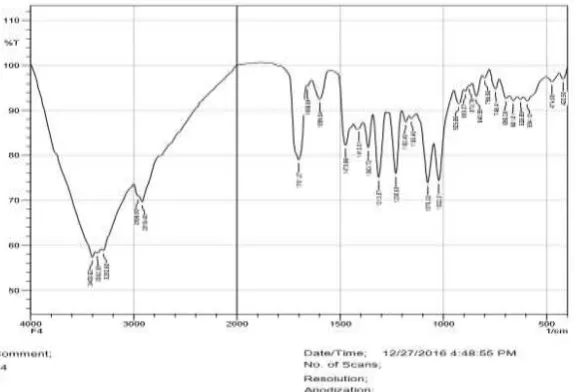
Compatibility studies were carried out to find out compatibility between drug and excipients
used in the formulations. The characteristic peaks associated with indomethacin O-H
stretching at 3477.77 cm-1, C-H(aromatic stretching) at 2968.55 cm-1, C-H(stretching) of CH3
2928.04 cm-1, C=O (stretching) at 1705.13 cm-1, C-N(stretching) at 1658.84 cm-1,
O-H(deformation) at 1406.15 cm-1& C-O(stretching) at 1313.57 cm-1 1were present in all the
FTIR spectra of pure drug & formulations.. This shows that there are no considerable changes
in the position of characteristic bands associated with drug and individual ingredients, thus
[image:6.595.159.449.548.730.2]there was no interaction between drug-polymer and polymer-polymer.
Figure 2: FTIR spectra of formulation F4.
Figure 3: FTIR spectra of formulation F5.
The physical properties of tablets like hardness, friability, thickness, diameter, drug content
and weight variation were found to be within limits indicating that the prepared matrix
[image:7.595.67.531.640.758.2]tablets were of desired specifications.
Table 3: Physical parameters of prepared tablets
Formulation
code Weight (mg)
Thickness (mm)
Hardness (Kg/cm2 )
Friability (%)
Drug content (%)
F1 320.26±0.48 4.56±1.29 5.89±0.79 0.23±0.17 95.72±0.28
F2 320.64±0.83 4.83±0.73 4.89±0.23 0.38±0.02 97.41±0.79
F3 302.87±1.38 4.26±0.59 5.26±0.65 0.64±0.15 96.73±0.37
F4 301.95±0.15 4.72±0.74 5.83±0.89 0.75±0.35 96.84±0.26
F5 302.17±1.24 4.72±1.36 5.06±0.74 0.31±0.07 96.93±0.84
F7 301.69±0.75 4.74±0.71 5.49±0.63 0.67±0.9 97.21±0.76
F8 302.35±0.63 4.68±1.65 6.08±0.81 0.83±0.51 96.48±0.38
The in vitro release of Indomethacin from immediate and sustained release layers of different
formulations in phosphate buffer 7.4 at the end of 9 hr was between 64.61± 0.12% to
101.93±0.33% drug release (figure 4). Among the prepared formulations F4 & F5 showed
release between 42.06±1.24% to 90.89±0.99% & 36.29±0.93% to 84.43±0.38% respectively,
which were prepared by using bi-layer technique. However, formulation F4 & F5 showed
[image:8.595.144.457.250.407.2]highest and satisfactory drug release among the prepared formulations.
Figure 4: In vitro drug release profile of Indomethacin of formulations F1 to F8.
The R2 values were found to be higher in zero order followed by Higuchi, which indicated
that all the formulations followed zero order release kinetics (table 4). According to
Korsmeyer-Peppas equation, the formulations F4 and F5, drug release was fickian diffusion
type.
Table 4: Drug release kinetics from F1 to F12 formulations
Formulation Correlation coefficient (r
2
) Korsmeyer-Peppa’s Model (n) Zero order First order Higuchi
F1 0.704 0.527 0.753 0.108
F2 0.931 0.796 0.949 0.171
F3 0.983 0.740 0.948 0.279
F4 0.990 0.939 0.976 0.279
F5 0.987 0.931 0.954 0.290
F6 0.800 0.74 0.756 0.192
F7 0.956 0.913 0.990 0.308
F8 0.965 0.905 0.913 0.311
Model independent parameters like MDT and % DE were evaluated for the all the
range between 1.1203hrs to 2.8343hrs. The % DE values of Indomethacin in 9 hour varied
between 63.04355 to 87.5516%. Formulations F4 & F5 prepared by bilayer technique have
satisfactory %CDR, MDT and %DE. Hence formulations F4 & F5 were selected as best
formulations.
Table 5: Model Independent Kinetics of indomethacin bilayer tablet
Formulation MDT (hr) % DE 9 hr
F1 1.3712 84.76
F2 1.692 81.2082
F3 2.8343 68.5064
F4 2.6192 70.8971
F5 2.8343 68.5067
F6 2.7263 69.7075
F7 2.4 74.3291
F8 2.3260 63.0435
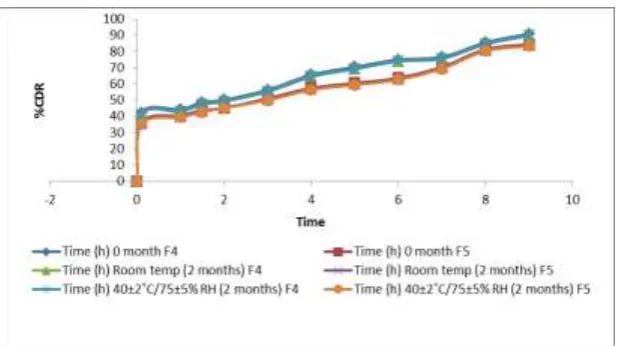
Stability study of selected formulation F4 & F5 was carried out at room temperature and at
40 ± 2°C / 75 ± 5 % RH for 2 months (table 6 & figure 5). There was less variation i n
physical appearance, drug content and in vitro dissolution profiles. It showed that the
[image:9.595.121.486.432.724.2]formulations were stable during the study period.
Table 6: Drug content of formulation F4 & F5
Formulation Drug content (%)
(F4)
Drug content (%) (F5)
0 month 96.8421±0.26 96.93±0.84
Room temperature (2 months) 96.1464±0.08 96.19±0.28
40±2˚C/75±5% RH (2 months) 96.1191±0.018 95.82±0.34
Values are mean ± SD, n=3
[image:9.595.144.457.553.726.2]CONCLUSION
The present research was carried out to develop a bilayer tablet of Indomethacin using
super disintegrant crospovidone for fast release layer & Guar gum and HPMC K4M for
sustaining layer. Bilayer tablets showed an initial burst effect to provide the loading dose of
drug, followed by sustained release for 24 hrs. This modified release bilayer tablets also
reduced dosing frequency, increase the bioavailability and provide better patient compliance.
REFERENCES
1. Borusu S, Basavaraj V, Bharath S, Deveswaran, Madhavan V, Sustained release matrix
tablets of Indomethacin using Hibiscus rosa-sinensis as release retardant, Der Pharmacia
Lettre, 2012; 4(1): 227-233.
2. Gopinath C, Hima Bindu V, Nischala M, An overview on Bilayered tablet technology,
Journal of global trends in pharmaceutical sciences, 2013; 4(2): 1077-1085.
3. www.wikepedia.in
4. Tripathi KD, Essentials of medical pharmacology, New Delhi, 2003; 5th ed: 175-176.
5. Satoskar RS, Bhandarkar SD, Ainapure SS, Pharmacology and therapeutics Mumbai:
Bhatkal R, 2000; 17th: 166.
6. Martindale W, Reynolds JEF, Martindale, The Extra Pharmacopoeia, The Pharmaceutical
Press, London, 1996; 31st: 936–937.
7. Chatwal GR, Anand SK, Instrumental methods of chemical analysis. Revised Ed.,