DEVELOPMENT AND VALIDATION OF RP-HPLC METHOD FOR
THE ESTIMATION OF AGOMELATINE IN BULK AND TABLET
DOSAGE FORM
A. Srinivas1*G. Sai2 and K. Sridhar Reddy2
1
St. John College of Pharmacy, Yellapur (V), Hasanparthy (M), Warangal (Dist), Telangana,
India.
2
SRR College of Pharmaceutical Sciences, Valbhapur(V), Elkathurthy (M), Karimnagar
(Dist), Telangana, India.
ABSTRACT
Development an accurate, simple, precise and rapid method for the
estimation of Agomelatine in bulk and Tablet dosage form. The
method uses Reverse phase High performance Liquid Chromatography
(RP-HPLC). PHENOMENEX Luna C18, (5µm, 250 x 4.6mm) column
operated with a mixture of mixed phosphate buffer of pH 6 with ortho
phosphoric acid and Acetonitrile(55:45) as mobile phase was found to
be suitable for the estimation. The flow rate was maintained at
1ml/min. Detection was carried out at 230nm using a UV detector. The
total run time was less than 10min the retention time of 2.7min for
Agomelatine. Validation of the method was performed for precision,
accuracy, linearty, ruggedness, specificity and sensitivity to confirm to
the ICH guidelines for validation of an analytical method.
KEYWORDS: Agomelatine, RP-HPLC, Method development, Validation.
INTRODUCTION
Agomelatine is chemically N-[2-(7-methoxy napthalen-1-yl) ethyl] acetamide (Fig.1). Its
molecular formula is C 15 H 17 NO 2 and its molecular weight is 243.301gm/mol.
Agomelatine, a sleep modulating antidepressant was approved by the European Medicines
Agency for the treatment of major depressive disorder (MDD) in 2009.[1] The novel antidepressant agomelatine acts as a melatonergic receptor (MT 1 /MT 2) agonist and
serotonergic receptor (5-HT 2C) antagonist. Binding studies indicate that it has no effect on
Volume 5, Issue 5, 1317-1324. Research Article ISSN 2277– 7105
*Corresponding Author
Dr. A. Srinivas
St. John College of
Pharmacy, Yellapur (V),
Hasanparthy (M),
Warangal (Dist),
Telangana, India. Article Received on 15 March 2016,
Revised on 05 April 2016, Accepted on 26 April 2016
monoamine uptake and no affinity for α, β adrenergic, histaminergic, cholinergic,
dopaminergic, and benzodiazepine receptors.[2-3] Agomelatine showed significant benefits over paroxetine due to the complete absence of side effects including the associated sexual
effect that are troublesome with some antidepressant. Because of its action upon the
melatonine receptors, agomelatine shows a marked improvement on sleep. Agomelatine has
also proven to have anxiolytic properties and thus may prove to be very useful in the
treatment of anxiety disorders.[4-5]
Methods reported in literature for analysis of Agomelatine include determination of
agomelatine by RP-HPLC[6] and HPLC method for separating and analyzing agomelatine intermediate and final product there of[7] and also Validated LC-MS/MS method for quantification of agomelatine in human plasma and its application in a pharmacokinetic
study.[8]
MATERIALS AND METHODS Materials
HPLC grade acetonitrile (Qualigens), HPLC grade Potassium dihydrogen ortho phosphate
and Di potassium hydrogen phosphate were used. Deionised HPLC grade water was used to
prepare mobile phase and diluents solutions. Agomelatine was purchased from servier
laborateries India. Dosage form was purchased from local commercial sources.
Equipments
High performance liquid chromatography SHIMADZULC 20AT reciprocating dual pump,
UV-Visible Detector (SPD-20A), a reversed-phase PHENOMENEX Luna C18, 5µm, 250 x
4.6mm (size) used for separation. Chromatographic data was acquired using Spin Chrome
software & Hamilton injector used.
Preparation of Potassium dihydrogen orthophosphate buffer pH 6
Approximately weighed 3.16g of crystalline buffer and dissolve in 500 ml of distilled water
to get 20mM buffer strength. Then pH of the buffer was adjusted to 6 using ortho phosphoric
Preparation of Mobile Phase
The two components of mobile phase; Acetonitrile (HPLC grade) and Buffer (prepared
previously) were separately filtered through a 0.45µm membrane filter. They were mixed
respectively in the ratio of 45:55% v/v and sonicated for 15min.
Preparation of Standard Solution
Accurately weighed quantity of 10 mg Agomeiatine were transferred to 100 ml volumetric
flask, dissolved in mobile phase and volume was made up to mark with same solvent. From
stock solution suitable aliquot was transferred to 10 ml volumetric flask and diluted to mark
with the mobile phase, to obtain the concentration of 10 µg/ml. A volume of 10 µl of solution
was injected.
Preparation of Sample (Tablet) Solution
Twenty tablets were weighed accurately; the average weight was determined and then
triturated to a fine powder. A quantity equivalent to 10 mg of agomelatine was weighed and
transferred to a 100 ml volumetric flask. The contents were sonicated for 20 min with mobile
phase to dissolve the active ingredients and the volume was made up to 100 ml with same
solvent and filtered through a 0.45µm membrane filter. Suitable aliquots of the solution were
further diluted with mobile phase, Then 10µl volume of each sample solutions were injected
into sample injector of HPLC three times under the chromatographic conditions. The area
under the curve of each peak was measured at 230nm.
RESULT AND DISCUSSION
Under the stated chromatographic conditions, the retention time of Agomelatine was 2.7min.
METHOD VALIDATION
The proposed method was validated as per ICH parameters and guidelines.[9]
Linearity
Appropriate aliquots of the standard stock solution of Agomelatine were pipette out and
transferred to a series of 10 ml volumetric flasks respectively. The volume was made up to
the mark with mobile phase to obtain working standard solutions of concentrations 10, 20,
30, 40, and 50µg/ml. From these solutions, 10 µl injections of each concentration of the drug
under the conditions as finalized by developed method. The peak areas were recorded. The
standard calibration curves for Agomelatine were plotted.
Accuracy
Accuracy of proposed method has been carried out by recoverystudies. Recovery studies
were carried out by applying the method to drug content analysis present in sample to which
known amount of standard Agomelatine was added at 80%, 100% and 120% levels. The
technique involves addition of standard drug to preanalysed sample solution. The resulting
sample solutions were injected onto HPLC system and chromatogram was recorded.
Precision
It is expressed as ± S.D. of series of measurements. Precision was carried out by two methods
according to ICH guidelines:
1. Repeatability studies
2. Intermediate precision – variation in days and analyst.
Repeatability
It is measured by multiple injections of a homogenous sample of 10 µg/ml of agomelatine
that indicates the performance of the HPLC instrument under conditions.
Intermediate precision
1. Variation in days: Intra–day and Inter–day Precision.
In the intra-day studies, 3 replicates of 3 different concentrations (10,15,20µg/ml) of
Agomelatine were analyzed in a day and percentage RSD was calculated. For the inter day
variation studies, 3 replicates of different concentrations were analyzed on 3consecutive days
and percentage RSD was calculated.
2. Variation in Analyst Specificity and Selectivity
The analytes should have no interference from other extraneous components and be well
resolved from them. Specificity is a procedure to detect quantitatively the analyte in presence
of component that may be expected to be present in the sample matrix, while selectivity is the
procedure to detect qualitatively the analyte in presence of components that may be expected
to be present in the sample matrix. The method is quite selective. There was no other
Sensitivity (LOD and LOQ)
Sensitivity of the proposed method was estimated in terms of Limit of Detection (LOD) and
Limit of Quantitation (LOQ). LOD was found to be 4.7µg/ml for agomelatine. LOQ was
found to be 7.5µg/ml.
Robustness
Robustness of the proposed method was assessed by making deliberate changes in flow rate,
pH and proportion of mobile phase which was performed by injecting sample solution
containing 10µg/ml of Agomelatine.
RESULTS AND DISSCUSION
After several experiments with different mobile phase combination and flow rates, the
optimised mobile phase composition and flow rate were determined as 45:55(ACN: mixed
beffer with pH6) and 1ml/min. under these conditions Aomelatine eluted at 2.76mins. The
typical chromatograms obtained using above mentioned mobile phase at 1ml/min are
illustrated ain figures 1 and 2.
Fig.1: Chromatogram of standard solution of Agomelatine
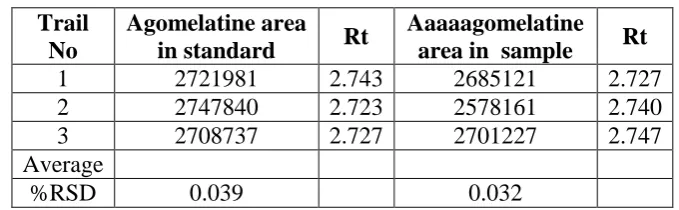
Table 1: Results of three repetitions of the analysis Trail
No
Agomelatine area in standard Rt
Aaaaagomelatine area in sample Rt
1 2721981 2.743 2685121 2.727
2 2747840 2.723 2578161 2.740
3 2708737 2.727 2701227 2.747
Average
%RSD 0.039 0.032
The lower percentage relative standard deviation of assay for test of accuracy (table 2)
testifies the methods accuracy. From the mean recoveries, which were within the range of
98-102%. its clear that the excipients do no interfere with the method. The peak area
concentration data of the agomelatine shown in figure.3.
Table 2: Recovery studies of Agomelatine by standard addition method Concentration
(% at specification Level) Area
% recovery
50 2775309 98.89
100 3285082 100.5
150 356431 100.49
%Mean recovery
The concentration range of agomelatine was 10-50µg/ml. the correlation coefficient values
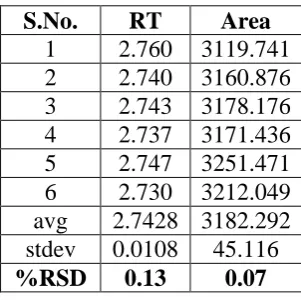
for agomelatine was found to be 0.998. The assay values obtained for the precision are shown
in table 3. the relative standard deviation obtained for agomelatine was 0.13, thus, confirming
the method's precision.
small changes were made in the flow rate and pH for the purpose of ascertaining robustness,
Also, the flow rate was changed to0.8ml/min and 1.2ml/min from the actual 1ml/min, The %
RSD of retention time ,area and assay values of agomelatine was within the+_2%. The LOQ
of Agomelatine was found to be 0.09 and Te LOD was found to be 0. 102. The method
developed here was utilized for estimation of agomelatine in tablet dosage form.
[image:6.595.178.418.636.743.2]Table 3: Results of precision
S.No. RT Area
1 2.760 3119.741 2 2.740 3160.876 3 2.743 3178.176 4 2.737 3171.436 5 2.747 3251.471 6 2.730 3212.049 avg 2.7428 3182.292 stdev 0.0108 45.116 %RSD 0.13 0.07
CONCLUSIONS
Hence, it may be concluded that a new RP-HPLC method for the estimation of Agomelatine
in tabiet dosage form has been developed. the Accuracy, precision, sensitivity and robustness
of method were confirmed. This method, Which can be run 7mins, may be suitable for
analysis in quality control units of pharmaceutical industries.
REFERENCES
1. Singh SP, Singh, V, Kar N. Efficacy of agomelatine in major depressive disorder meta-
analysis and appraisal. International Journal of Neuropsychopharmacology, 2012; 15:
417-428.
2. Girish, MB, Bhuvana K, Nagesh RG, Sarala, N. A novel atypical antidepressant drug:
Agomelatine – A review. International Journal of Pharmaceutical and Biomedical
Research, 2010; 1(3): 113-116.
3. Girstaute D, Paul L, Tim J, Cecilia G, Elisabeth M, Johan D. Chronic Stress and
Antidepressant Agomelatine Induce Region-Specific Changes in Synapsin I Expression in
the Rat Brain. Journal of Neuroscience Research, 2011; 89: 1646-1657.
4. Patil SR, Nerukar KK, Kalamkar AM, Pukale V, Mangaonkar KV, Pingale SG. Validated
LC-MS/MS method for quantification of agomelatine in human plasma and its
application in a pharmaceutical study. Journal of Mass Spectrometry, 2012; 47: 23-28.
5. Rao VP, Prabhakar T, Naveen RC, Ramakrishna S, Trinath G. Clinical and
pharmacological review on novel melatonergic antidepressant: Agomelatine. Research
Journal of Pharmaceutical, Biological and Chemical Sciences, 2010; 1(2): 446-450.
6. Xue-jun H, Ren Z, Wang J, Liu J, Du Y, Quio H. Determenation of Agomelatine by
7. Ning M. HPLC method for separating and analyzing agomelatine intermediate and final
product thereof. Faming Zhuanli Shenquing Gongkai Shuomingshu, 2008; CN
101206200 A 20080625.
8. Kher GJ, Ram VR, Dubal KD, Bapodra AH, Joshi HS. Validation of a Stability-
Indicating LC Method for Assay of Lefunomide in Tablets and for Determination of
Content Uniformity. International Journal of ChemTech Research, 2011: 3(2): 523-530.
9. ICH. ICH-Q2 (R1) In Validation of Analytical Procedures: Text and Methodology,