PREPARATION AND EVALUATION OF FLOATING TABLET OF
METFORMIN HCL
Rehana Parveen1* and Ranjeet Kumar Bhargav2
*1, 2
Spectrum Institute of Pharmaceutical Sciences & Reasearch, Greater Noida (U.P.), India.
ABSTRACT
The objective of the research work was to provide a gastroretentive
system for sustained release of metformin HCl in proximal part
gastrointestinal tract (GIT) in the form of oral floating tablet.
Metformin HCl is an anti-diabetic biguanid with poor bioavailability
and absorption window at the upper part of GIT. Floating tablets were
prepared by wet granulation method incorporating natural polymers
guar gum and k-Carrageen and a synthetic polymer HPMC K100
(HPMC) either alone or in combination. Sodium bicarbonate and citric
acid was used as gas generating agent. Floating tablets were evaluated
for weight variation, hardness, and friability, drug content, swelling
index, in vitro buoyancy and in vitro drug release study. The formulation optimized based on
floating ability, matrix integrity, and in vitro drug release in simulated gastric fluid pH 1.2.
Formulation prepared with combination of 6% w/w k-carrageen and 11%w/w guar gum
showed good gel strength, stable and persistent buoyancy for 12h, least floating lag time of
58 sec with good matrix integrity throughout dissolution period. The mechanism of drug
release was appears to be diffusion mechanism. Stability studies indicated absence of any
drug degradation on storage for 3 months at 40oC.
KEYWORDS: Floating, Buoyancy, Gastro retentative, Sustained Release.
INTRODUCTION
The oral route considered as the most promising route of drug delivery. Effective oral drug
delivery may depend upon the factors such as gastric emptying process, gastrointestinal
transit time of dosage form, drug release from the dosage form and site of drug absorption.
Most of the oral dosage forms possess several physiological limitations such as inability to
restrain and locate the controlled drug delivery system within the desired region of the GIT
Volume 5, Issue 6, 1477-1488. Research Article ISSN 2277– 7105
*Corresponding Author
Rehana Parveen
Spectrum Institute of
Pharmaceutical Sciences &
Reasearch, Greater Noida
(U.P.), India Article Received on 27 March 2016,
Revised on 18 April 2016, Accepted on 09 May 2016
due to variable gastric emptying and motility; shorter residence time of the dosage form in
the stomach and incomplete absorption of drugs having absorption window especially in the
upper part of the small intestine. As once the drug passes down the absorption site, the
remaining quantity goes unabsorbed. The gastric emptying of dosage form in human is
affected by several factors because of which wide inter and intra-subject variations are
observed.[1] Hence, a beneficial delivery system would be one, which possesses the ability to control and prolong the gastric emptying time and can deliver drugs in higher concentrations
to the absorption site. The controlled gastric retention of solid dosage forms may be achieved
by the mechanism of mucoadhesion[2, 3] floatation[4], sedimentation[5, 6], expansion[7, 8], modified shape systems[9,10] or by the administration of pharmacological agents[11, 12] that delaying gastric emptying. Based upon these approaches, floating drug delivery systems
seems to be the promising delivery systems for control release of drugs. Floating drug
delivery system (FDDS) possesses a bulk density lower than gastric fluids and thus remain
buoyant in the gastric fluids for a prolonged period without affecting the gastric emptying
rate. While the system is floating on the gastric content, the drug released slowly at desired
rate from the system.[13] Based on the mechanism of buoyancy, two distinctly different technologies, non-effervescent and effervescent systems have been utilized in the
development of FDDS. Thus produces an upward motion of the system maintaining
buoyancy.[14] Metformin hydrochloride, a BCS class III drug, has taken as the model drug for the present study. It is an antihyperglycemic agent, which improves glucose tolerance in type
II diabetes. It has been reported that the absolute bioavailability of metformin when given
orally is 50–60%. Biological half‐life of metformin is 1.5 to 1.6h and the main site of its
absorption is proximal small intestines.[15, 16] This would lead to improvement in the bioavailability of the drug. In this way, it stands an advantage over conventional dosage form,
which needs to be administered twice or thrice a day.[17]
MATERIALS AND METHODS
Materials: Metformin HCl was supplied by Ranbaxy Pharmaceuticals Ltd, Gurgaon. -Carrageenan was procured from Aquagri Processing Pvt. Ltd.Tamil Nadu. Gaur gum was
purchased from SD Fine Chemicals, Mumbai. HPMC obtained as a gift sample from
Colorcon Asia Pvt. Ltd. Goa. All other chemicals were of analytical grades as required.
Methods: Floating tablets were prepared by effervescent technology.[18] Each floating tablet containing metformin HCl500mg was prepared by conventional wet granulation method
employing sodium bicarbonate and citric acid as gas generating agents. Preliminary studies
for optimizing the floating timewere carried out. Once floating was optimized\ the same
concentration of sodium bicarbonate and citric acid was used in all other formulations. The
compositions of the formulations are given in the Table 1. Weighed quantities of all the
ingredients were sifted through stainless steel sieve (#40). Sifted materials were dry mixed in
geometric dilution by spatulation without addition of magnesium stearate and talc. Distilled
waterwas added to dry-mixed blend of drug and excipients, slowly and the wet mass was
mixed to get desired doughy consistency. The doughy mass passed through stainless steel
sieve (#16) to form granules. Granules were dried in hot air oven at 50°C for 30 min and
mixed with lubricant magnesium stearate and glidant talc. The lubricated granules were
compressed on a ten station tablet mini press (Rimek, India) using a 13 mm flat punch.
Compression force adjusted to obtain hardness in the range of 3-5 kg/cm2.
Table 1: Composition Of Floating Tablets Of Metformin Hcl
Ingredients F1 F2 F3 F4 F5 F6 F7 F8
Metformin HCL 500 500 500 500 500 500 500 500
HPMC 166 - 106 60 - - - 34
K-Carrageenam - - 60 106 60 132 34 132
Guar GUM - 166 - - 106 34 132 -
Sodium Bicarbonate 230 30 230 230 230 230 230 230
Citric ACID 10 10 10 10 10 10 10 10
Magnesium Stearate 7 7 7 7 7 7 7 7
Talc 7 7 7 7 7 7 7 7
Total Weight of Tablets 920 920 920 920 920 920 920 920
Infrared Spectra Analysis: FTIR studies were carried out in order to determine any possible interaction between drug and excipients used. IR absorption spectrum of metformin HCl was
determined using FTIR spectrophotometer (Jasco-V-530).Briefly, about 2 mg of sample of
was ground thoroughly with previously dried KBr at 120ºC for 30 min; uniformly mixed with
400-4000cm-1. IR spectrums of pure drug, physical mixture of ingredients of the formulation and
optimized tablet wererecorded. Pure, completely dried KBr used as blank and before running
the sample.
Evaluation of Granules: The angle of repose of the granules was determined by using funnel method. Bulk density (BD) and tapped density (TD) were calculated by formulae:BD
= Bulk mass / Bulk Volume; TD=Bulk density = Bulk mass / Bulk Volume. Compressibility
index and Hausner’s ratio of the granules was determined by using the formula: CI(%) =
[(TDBD/ BD)] ×100 and HR=TD/BD, respectively. The experiments were performed in
triplicate and average value with SD werenoted. 3, 10
Evaluation of Tablets: Uniformity of weight was determined according to method reported in I. PWeight variation was determined by weighing 20 tablets using an analytical balance
and the deviation of individual tablet from the average weight of the tablets was determined.
Hardness of the tablets tested using a Monsanto hardness tester. Friability of the tablets was
determined in a Roche friabilator. Thickness and diameter measured by vernier caliper.[19, 20]
Drug content: Twenty tablets weighed and powdered. The stock solution was prepared by dissolving powder equivalent to 10 mg of drug in 10 mL water. Stock solution was sonicated
for 20 min. The resulting solution was further diluted with water to achieve concentration
10μg/mL and the absorbance measured at the 233 nm by UV spectrophotometer.
In -vitro buoyancy study: In vitro buoyancy was characterized from floating lag time and total floating timedescribed by Rosa et al.[21, 22] The test was performed using a USP dissolution test type II apparatus (Electro lab) using 900 mL of 0.1 N HCl at rotation of 50
rpm at 37±0.5oC. The time required for the tablet to rise to the surface of the dissolution
medium and the duration of time the tablet constantly floated on the dissolution medium
wasrecorded as floating lag time and total floating time, respectively.
Water uptake study: The swelling properties of floating tablets were determined by placing the tablet in the dissolution test apparatus, in 900 mL of 0.1 N HCl at 37 ± 0.5⁰C. After a
specified time intervals, the tablet was withdrawn, blotted to remove excess water and
In vitro dissolution studies: In vitro dissolution studies were performed using USP type- II dissolution test apparatus (TDT 08L, Electro lab Pvt. Ltd., Mumbai, India). The test was
performed using 900Ml of 0.1N HCl at 37±0.5°C at 50 rpm. Accurately 5 mL sample of
dissolution medium was withdrawn from the vessel hourly for total 12h and the withdrawn
sample was replaced with equal amount of fresh dissolution medium. The sample was filtered
through 0.45μ membrane filter and diluted to a suitable concentration with 0.1N HCl.
Absorbance of these solutions were measured at _max 233nm using UV spectrophotometer
(JASCO UV530). Analysis of data done was performed using PCP Disso V-3 software.[24]
Stability Studies: The optimized metformin hydrochloride floating tablets (batch F5) were packed and subjected to accelerated stability studies as per ICH guidelines (40°C ± 2 °C /75
% ± 5 % RH).[25] The sample were withdrawn periodically at the end of 30, 60, 90 days, respectively and evaluated for the different parameters.
Comparative study: Dissolution profile of optimized formulation (F5)compared with that of marketed formulation (Glycomet® SR-500mg)
ADVANTAGES OF EFFERVESCENT FLOATING DRUG DELIVERY SYSTEM Increases the oral bioavailability of drug.
Enhanced first pass biotransformation.
Sustained drug delivery/ reduced frequency of dosing. Reduced fluctuations of drug concentration.
Improved receptor activation selectivity. Reduced counter-activity of body.
Extended time over critical (Effective) concentration. Minimized adverse activity at the colon.
RESULTS AND DISCUSSION Infrared Spectra Analysis
FTIR studies revealed that fundamental peaks of the metformin HCl retained in the optimized
tablet and physical mixture. The results, Fig. 1, indicated absence of any significant
interactions between the drug and polymers used in the formulation and hence, these can be
Fifure: 2 Overlain FTIR spectrums
Table 2: Granule Properties of all the batches
Batch Bulk
density(g/cm3)
Tapped density
(g/cm3) Carr’s index
Hausner’s ratio
Angle of repose (°) F1 0.0471±0.003 0.4591±0.001 11.32±0.36 1.09±0.04 27.37±0.43 F2 0.3758±0.001 0.4269±0.002 11.96±0.24 1.13±0.03 22.63±0.41 F3 0.3998±0.002 0.4698±0.003 14.87±1.88 1.17±0.02 26.42±0.12 F4 0.4033±0.003 0.4505±0.009 11.10±1.55 1.36±0.04 24.80±0.17 F5 0.4031±0.006 0.4598±0.003 12.32±1.13 1.14±0.06 20.83±0.13 F6 0.4202±0.007 0.4798±0.004 12.69±1.77 1.75±0.02 27.43±0.12 F7 0.4133±0.009 0.4681±0.001 11.36±0.55 1.14±0.01 24.51±0.14 F8 0.3333±0.007 0.4166±0.006 19.99±0.45 1.25±0.07 25.31±0.21 Evaluation of Granules: The bulk density of granules was in the range 0.3333±0.007 to 0.4202±0.007 g/cm3 and tap density in the range 0.4166±0.006-0.4798±0.004 g/cm3 as
shown in Table 2. The observation indicates good packing capacity of granules.Carr’s index
was in the range of 11.10±1.55 to 19.99± 0.45% whereas Hausnerratio was in the range of
1.09±0.04to 1.75±0.02indicating good flowability. The angle of repose was within the range
of 25º to 30°. The observations suggest good flow ability of the granules.
Evaluation of Tablets: The weights of the tablet were varied between 917±0.79to 921±0.84 mg. The variation in weight was within the range of ±5%, complying with pharmacopoeial
specifications. Thickness was in range of 4.30± 0.07 to 4.95±0.07mm. The hardness of found
in the range 4.39 ± 0.17 to 4.73±0.39Kg/cm2 indicating satisfactory mechanical strength. All
formulations, Table 3, exhibited a weight loss of <1% and the loss were in the range of 0.49 ±
0.05 to 0.89±0.02. It ensures that the tablets can withstand mechanical impacts during
packing, transportation and other processing operations.The drug content was in the range of
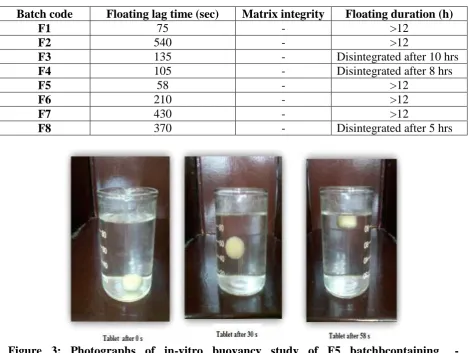
In Vitro Buoyancy Studies: All the tablets prepared by effervescent approach. Sodium bicarbonate was added as a gas-generating agent. Sodium bicarbonate induced CO2
generation in the presence of dissolution medium (0.1 M HCl). Generated gas was trapped
and protected within the gelformed by hydration of polymer, decreasing the density of the
tablet. As density of the tablet falls below one the tablet became buoyant. Floating lag times
were in the range of 58 to 540 sec. Formulations F3, F4, F8 prepared as combination of
HPMC and _-Carrageen showed floating lag time of 135, 105, 370 sec, respectively, and
remain buoyant for 10, 8, 5h, respectively, Table 4, till completely eroded. On the other hand,
formulation F5, F6, F7 prepared with combination of _-Carrageenan and guar gum showed
decrease in floating lag time and increased floating duration time. This might be due to
viscous nature of guar gum, which maintains the integrity of the tablets for longer duration by
reducing the effect of erosion thus resulting in increase in floating time. The selected
formulation F5 showed floating lag time 58 sec, Fig. 2, with floating duration time >12 h.
Hence, Batch F5 with floating lag time <1 was optimized batch.
Table 3: Floating Properties of metformin HCl tablets
Batch code Floating lag time (sec) Matrix integrity Floating duration (h)
F1 75 - >12
F2 540 - >12
F3 135 - Disintegrated after 10 hrs
F4 105 - Disintegrated after 8 hrs
F5 58 - >12
F6 210 - >12
F7 430 - >12
F8 370 - Disintegrated after 5 hrs
[image:7.595.64.536.390.743.2]
Swelling Characteristics: The swelling indices were calculated with respect to times. As time increases, the swelling index was increased, because weight gain by tablet increased
proportionally with rate of hydration. Later on, it was decreased gradually due to dissolution
of outermost-gelled layer of tablet into dissolution medium. Formulation F1 showed
maximum swelling in 12h with sharp increase up to 5h, this might due to higher
concentration of HPMC, which has higher water absorption capacity and form thick swollen
mass. From observed swelling indices of batches F5, F6 and F7, Fig. 3, it was revealed that
swelling indices were increased as the concentration of Carrageenan increased.
_-Carrageenan binds with water extensively and get hydrated because of the high mobility of
water molecules between polymer chains and sulphategroups24. The optimized formulations
F5 show maximum swelling up to 5h followed by decrease in swelling index, Fig. 3. Reason
behind this may be erosion process initiation at the end of 5h attributing gradual decrease in
percent swelling after 5h.
Dissolution Studies: In vitro drug release studies performed as per procedure described in methodology section. The percentage drug release plotted against time to obtain drug release
profile, Based on the dissolution profiles the formulations can be arranged in the following
order of their controlling efficiency as F4>F5>F8>F1>F7>F2>F3>F6. The mean diffusion
exponent values (n) for batches F1, F3, F4, F6, F8 were in the range of 0.3509 to 0.4265,
Table 5, indicating the drug release govern by Fickian diffusion mechanism. On the other
hand, batch F2 and F5 showed n values in the range of 0.6127 and 0.9480; indicating the drug
release governed by Anomalous transport mechanism. By comparing the r-values of different
models, Korsmeyer- Peppas model found to be the best fit with higher values of correlation
coefficient. In-vitro dissolution data gave us information about the effect of change in
polymer type and concentration on drug release and swelling capability of formulation.
Formulation F1 and F2 released 95.80% and 85.14% of drug, respectively, in 12h.This
difference may be due to lack of enough gelling strength of HPMC to control the drug release
and less water permeability of guar gumcompared to HPMC. Dissolution data of formulation
F3, F4, F5, F6, F7 and F8 revealed increase in drug release with concentration of
_-Carrageenan and further decreases at its highest concentration employed._-_-Carrageenan-guar
gum combination imparts good matrix integrity compared to _- Carrageenan-HPMC.
Formulation F5 showed better drug release than other formulations with least floating lag
time, persistent buoyancy, and good matrix integrity throughout dissolution period. Hence,
Table 4: Dissolution data and release kinetics of Korsmeyer-Peppas model
Batch % Drug release after 12h n k r Best fit model
F1 95.80 0.4265 34.1116 0.9811 Matrix
F2 85.14 0.6127 20.7729 0.9815 Matrix
F3 81.76 0.3713 34.1381 0.9782 Peppas
F4 s99.35 0.3897 37.1290 0.9783 Matrix
F5 98.76 0.9480 10.0109 0.9906 Peppas
F6 79.94 0.3626 35.0946 0.9546 Peppas
F7 85.64 0.3509 38.1292 0.9091 Matrix
F8 96.69 0.8736 8.6181 0.9810 Zero order
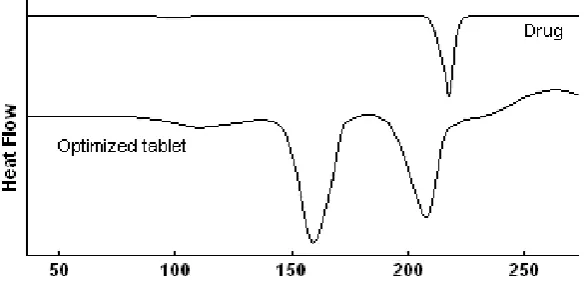
DSC Studies: DSC thermogram of pure metformin HCl, Fig. 5, showed sharp endothermic peak starting at 209ºC with melting peak at 225.1ºC and in the thermogram of optimized
batch the endothermic peak appeared at 208.1ºC. Shifting of endothermic peaks to left side
with decrease in its intensity indicates amorphization of drug. Another peak observed in
formulation at 160.3ºC may be due to polymer.
Figure 4: DSC thermograms.
PXRD Studies
The overlay of PX-RD pattern of Metformin HCl, physical mixture and optimized
formulation F5 showed in Fig.6. It reveals that the intensity of the peaks for the pure drug
was sharp, but when it was incorporated into the polymer matrix, the intensities of the peaks
decreases due to decreased crystallinity of the metformin HCl.
Stability Study of Batch F5
The results of stability studies, shown in Table 6, indicate no evident change in the physical
properties of formulations after subjecting them to 30, 60 and 90 days accelerated stability
[image:9.595.148.441.363.513.2]Overlain Powder X-ray diffractograms. Key: (A)
Physical mixture (B) Optimized batch F5 and (C) Metformin HCl
Comparison of Optimized Formulation with Marketed Product
The marketed product had showed 94.8% drug release in 12h, where as the optimized
formulation F5 showed 98.7% drug release in 12h. Comparison study with marketed product
of Glutamet® SR 500mg,has showed that the optimized formulation F5 has better drug
release in comparison to the marketed product as showed in Fig. 8. The optimized
formulation F5 remained floatable in the stomach for 12h. Hence, it has one of the
advantages over marketed formulation that it increases absorption of metformin HCl drug. It
is, thus concluded that effervescent floating tablet containing metformin HCl (F5) gives
better and but complete drug release over 12h.
CONCLUSION
Metformin HCl floating tablets were prepared by combination of HPMC and _- Carrageenan
and guar gum in different concentration. Formulation F5 made by combination of natural
polymers, _-Carrageenan (6%) and guar gum (11%) exhibited the best results in terms of the
required in vitro buoyancy study, good matrix integrity and drug release in sustained release
manner. There was absence of any significant change in nature of drug or any interaction
between drug and polymers. Scanning electron microscopy revealed drug release from matrix
was by diffusion mechanism. Stability studies indicated absence of degradation on storage.
Comparative study with marketed tablet formulation showed better and complete release
characteristics. Natural polymers areadventitious over synthetic ones. Finally, it can be
considered as one of the promising formulation technique for preparing floating drug delivery
systems of metformin HCl in the management of diabetes mellitus.
REFERENCES
1. Prabhu P. Formulation and in vitro evaluation of gastric oral floating tablets of glipizide.
Indian Journal of Pharmaceutical Education and Research. 42(2): 174-183.
2. Ponchel G, Irache JM. Specific and non-specific bioadhesive particulate system for oral
delivery to the gastro intestinal tract. Advanced Drug Delivery Reviews, 1998; 34:
191-219.
3. Lenaerts VM, Gurny R. Gastrointestinal tract – physiological variables affecting the
performance of oral sustained release dosage forms, Bioadhesive Drug Delivery system,
Bola Raton, FL: CRC Press; 1990.
4. Amit KN. et al Gastroretentive drug delivery systems: a review. Asian Journal of
Pharmaceutical Research. 2010; 3(1): 235- 238.
5. Gyseghem E. et al. Solid-state characterization and crystal structure from X- ray powder
diffraction of two polymorphic forms of ranitidine base. Journal of Pharmaceutical
Sciences, 2009; 98: 146-158.
6. Davis S. S, Stockwell A. F, Taylon M. J. et al. The effect of density on the gastric
emptying of single and multiple unit dosage forms. Pharmaceutical Research. 1986; 3:
205-213.
7. Garg R, Gupta G. Progress in controlled gastroretentive delivery systems: A Review.
Tropical Journal of Pharmaceutical Research. 2008; 7(3): 45-49.
8. Deshpande AA. et al. Controlled release drug delivery systems for prolonged gastric
residence: An overview. Drug Development and Industrial Pharmacy. 1996; 22: 531-539.
9. Zaware SR. et al. Floating drug delivery system: A review. International Journal of
Pharmaceutical Sciences. 2010; 2(3): 834-884.
10.Sharma V. Floating drug delivery system a novel approach to combatregional variability:
A Review. International Journal of Pharmacy and Pharmaceutical Science. 2009; 8(2):
134-167.
11.Groning R, Heun G. Oral dosage forms with controlled gastro intestinal transit.Drug
Development and Industrial Pharmacy. 1984; 10: 527-539.
12.Desai S, Botton SA. Floating controlled release drug delivery system; In vitro – In vivo
13.Gopalakrishnan S, Chenthilnathan A. Floating drug delivery systems: A Review. Journal
of Pharmaceutical Science and Technology. 2011; 3(2): 548-554.
14.Basak SC, Rahman J. Ramalingam M. Design and in vitro testing of a floatable
gastroretentive tablet of metformin hydrochloride. Pharmazie. 2007; 62(2): 145- 148.
15.Marget C. et al. Formulation and evaluation of bilayer floating tablet of metformin HCl.
International Research Journal of Pharmacy. 2012; 3(2): 786-790.
16.Ali J. et al. Formulation and development of hydrodynamically balanced System for
metformin: In vitro and in vivo evaluation. European Journal Pharmaceutics and
Biopharmaceutics. 2007; 1(3): 67.
17.Patel VF, Patel NM. Statistical evaluation of influence of xanthan gum and guar gum
blends on dipyridamole release from floating matrix tablets. Drug Development and
Industrial Pharmacy. 2007; 33(3): 322-334.
18.Kshirsagar RV. et al. Effect of different viscosity grade HPMC polymers on
gastroretentive drug delivery of metformin HCl. International Journal of Applied
Pharmaceutics. 2009; 1(3): 43-56.
19.Government of India, Ministry of health and family welfare, Indian Pharmacopoeia. The
controller of publication New Delhi. 2007; 2: 1358-1359.
20.Lachman L. et al. Theory and practices of industrial pharmacy. 3rd ed. Bombay:
Varghese publication, 1987: 293-294.
21.Rosa M. et al. Dosing and testing in vitro of a bioadhesive and floating drug delivery
system for oral application. International Journal Pharmaceutics. 1994; 105: 65-70.
22.Aulton ME. Pharmaceutics: The Science of Dosage Form Design. Churchill Livingstone.
2002; 2nd ed: 133-134.
23.Rouge N, Allemann E. Buoyancy and drug release patterns of floating minitablet
containing piretanide and atenolol as model drugs. Pharmaceutical Development and
Technology. 1998; 3: 73-84.
24.Parmar R. et al. Development and in-vitro evaluation of effervescent floating tablets using
guar-gum as natural hydrocolloid. International Journal of pharmaceutical Research and
Development. 2009; 2: 132-135.
25.Mathews BR. Regulatory aspects of stability testing in Europe. Drug Development and