Table of Contents
Table of Contents
Acknowledgements
Version 3.0, 2015
Version 2.0, 2014
Version 1.0 – 2009
About the standard
Copyright and License
Preface
What’s new in 3.0?
Using the Application Security Verification Standard
Application Security Verification Levels
How to use this standard
Level 1: Opportunistic
Level 2: Standard
Level 3: Advanced
Applying ASVS in Practice
Case Studies
Case Study 1: As a Security Testing Guide
Case Study 2: As a secure SDLC
Assessing software has achieved a verification level
OWASP’s stance on ASVS Certifications and Trust Marks
Guidance for certifying organizations
The role of automated penetration testing tools
The role of penetration testing
As detailed security architecture guidance
As a replacement for off the shelf secure coding checklists
As a guide for automated unit and integration tests
As secure development training
OWASP Projects using ASVS
Security Knowledge Framework
OWASP Zed Attack Proxy
OWASP Cornucopia
Detailed Verification Requirements
V1: Architecture, design and threat modelling
Control objective
Requirements
References
V2: Authentication Verification Requirements
Control objective
Requirements
References
V3: Session Management Verification Requirements
Control objective
Requirements
References
V4: Access Control Verification Requirements
Control objective
Requirements
References
V5: Malicious input handling verification requirements
Control objective
Requirements
References
V6: Output encoding / escaping
V7: Cryptography at rest verification requirements
Control objective
Requirements
References
V8: Error handling and logging verification requirements
Control objective
Requirements
References
V9: Data protection verification requirements
Control objective
Requirements
References
V10: Communications security verification requirements
Control objective
Requirements
References
V11: HTTP security configuration verification requirements
Control objective
Requirements
References
V12: Security configuration verification requirements
V13: Malicious controls verification requirements
Control objective
Requirements
V14: Internal security verification requirements
V15: Business logic verification requirements
Control objective
Requirements
References
V16: Files and resources verification requirements
Control objective
Requirements
References
V17: Mobile verification requirements
Control objective
Requirements
References
V18: Web services verification requirements
Control objective
Requirements
References
V19. Configuration
Control objective
Requirements
References
Appendix A: What ever happened to
…
Appendix B: Glossary
Appendix C: References
Appendix D: Standards Mappings
Acknowledgements
Version 3.0, 2015
Project Leads Lead Authors Contributors and reviewers
Andrew van der Stock Daniel Cuthbert
Jim Manico Boy Baukema
Ari Kesäniemi Colin Watson François-Eric Guyomarc’h Cristinel Dumitru James Holland Gary Robinson Stephen de Vries Glenn Ten Cate Riccardo Ten Cate Martin Knobloch Abhinav Sejpal David Ryan
Steven van der Baan Ryan Dewhurst Raoul Endres Roberto Martelloni
Version 2.0, 2014
Project Leads Lead Authors Contributors and reviewers
Daniel Cuthbert Sahba Kazerooni
Andrew van der Stock Krishna Raja Antonio Fontes Colin Watson Jeff Sergeant Pekka Sillanpää Archangel Cuison Dr Emin Tatli Jerome Athias Safuat Hamdy Ari Kesäniemi Etienne Stalmans Jim Manico Scott Luc Boy Baukema Evan Gaustad Mait Peekma Sebastien Deleersnyder
Version 1.0 – 2009
Project Leads Lead Authors Contributors and reviewers
Mike Boberski Jeff Williams Dave Wichers
Andrew van der Stock Dr. Sarbari Gupta John Steven Pierre Parrend Barry Boyd Dr. Thomas Braun Ken Huang Richard Campbell Bedirhan Urgun Eoin Keary
Ketan Dilipkumar Vyas Scott Matsumoto Colin Watson Gaurang Shah
Liz Fong Shouvik Bardhan Dan Cornell
George Lawless Mandeep Khera Stan Wisseman Dave Hausladen Jeff LoSapio Matt Presson Stephen de Vries Theodore Winograd Jeremiah Grossman Nam Nguyen Steve Coyle Dave van Stein John Martin Paul Douthit Terrie Diaz
About the standard
The Application Security Verification Standard is a list of application security requirements or tests that can be
used by architects, developers, testers, security professionals, and even consumers to define what a secure
application is.
Copyright and License
Copyright © 2008 – 2015 The OWASP Foundation. This document is released under the Creative
Commons Attribution ShareAlike 3.0 license. For any reuse or distribution, you must make clear
to others the license terms of this work.
Preface
Welcome to the Application Security Verification Standard (ASVS) version 3.0. The ASVS is a community-effort to
establish a framework of security requirements and controls that focus on normalising the functional and
non-functional security controls required when designing, developing and testing modern web applications.
ASVS v3.0 is a culmination of community effort and industry feedback. In this release, we felt it was important to
qualify the experiences of real world use cases relating to ASVS adoption. This will help newcomers to the
standard plan their adoption of the ASVS, whilst assisting existing companies in learning from the experience of
others.
We expect that there will most likely never be 100% agreement on this standard. Risk analysis is always subjective
to some extent, which creates a challenge when attempting to generalize in a one size fits all standard. However,
we hope that the latest updates made in this version are a step in the right direction, and respectfully enhance
the concepts introduced in this important industry standard.
What’s new in 3.0?
In version 3.0, we have added several new sections, including Configuration, Web Services, Modern (Client) based
applications, to make the Standard more applicable to modern applications, which are commonly responsive
applications, with an extensive HTML5 front end or mobile client that calls a common set of RESTful web services
using SAML authentication.
We have also deduplicated the standard, for example, to ensure that a mobile developer does not need to re-test
the same items multiple times.
We have provided a mapping to the CWE common weakness enumeration (CWE) dictionary. The CWE mapping
can be used to identify information such as likelihood of exploitation, consequence of a successful exploitation
and broadly speaking to gain insight on what could go wrong if a security control is not used or implemented
effectively and how to mitigate the weakness.
Lastly, we reached out to the community and held peer review sessions at AppSec EU 2015 and a final working
session at AppSec USA 2015 to include a massive amount of community feedback. During peer review, if edits to
the meaning of a control changed substantially, we created a new control and deprecated the old one. We have
deliberately chosen to not reuse any deprecated control requirements, as this could be a source of confusion. We
have provided a comprehensive mapping of what has changed in Appendix A.
Taken together, v3.0 is the single largest change to the Standard in its history. We hope that you find the update
to the standard useful, and use it in ways we can only imagine.
Using the Application Security Verification Standard
ASVS has two main goals:
1. to help organizations develop and maintain secure applications
2. to allow security service, security tools vendors, and consumers to align their requirements and offerings
Figure 1 - Uses of ASVS for organizations and tool/service providers
Application Security Verification Levels
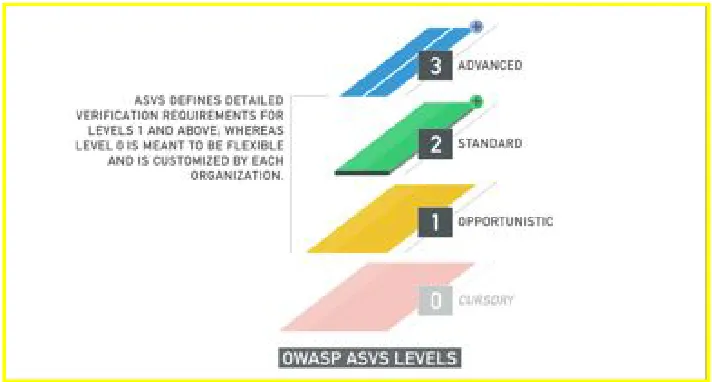
The Application Security Verification Standard defines three security verification levels, with each level increasing
in depth.
ASVS Level 1 is meant for all software.
ASVS Level 2 is for applications that contain sensitive data, which requires protection.
ASVS Level 3 is for the most critical applications - applications that perform high value transactions, contain
sensitive medical data, or any application that requires the highest level of trust.
[image:12.612.127.483.291.482.2]Each ASVS level contains a list of security requirements. Each of these requirements can also be mapped to
security-specific features and capabilities that must be built into software by developers.
Figure 2 - OWASP ASVS Levels
How to use this standard
One of the best ways to use the Application Security Verification Standard is to use it as blueprint create a Secure
Coding Checklist specific to your application, platform or organization. Tailoring the ASVS to your use cases will
increase the focus on the security requirements that are most important to your projects and environments.
Level 1: Opportunistic
An application achieves ASVS Level 1 (or Opportunistic) if it adequately defends against application security
vulnerabilities that are easy to discover, and included in the OWASP Top 10 and other similar checklists.
Level 1 is typically appropriate for applications where low confidence in the correct use of security controls is
required, or to provide a quick analysis of a fleet of enterprise applications, or assisting in developing a prioritized
list of security requirements as part of a multi-phase effort. Level 1 controls can be ensured either automatically
by tools or simply manually without access to source code. We consider Level 1 the minimum required for all
applications.
Threats to the application will most likely be from attackers who are using simple and low effort techniques to
identify easy-to-find and easy-to-exploit vulnerabilities. This is in contrast to a determined attacker who will
spend focused energy to specifically target the application. If data processed by your application has high value,
you would rarely want to stop at a Level 1 review.
Level 2: Standard
An application achieves ASVS Level 2 (or Standard) if it adequately defends against most of the risks associated
with software today.
Level 2 ensures that security controls are in place, effective, and used within the application. Level 2 is typically
appropriate for applications that handle significant business-to-business transactions, including those that
process healthcare information, implement business-critical or sensitive functions, or process other sensitive
assets.
Threats to Level 2 applications will typically be skilled and motivated attackers focusing on specific targets using
tools and techniques that are highly practiced and effective at discovering and exploiting weaknesses within
applications.
Level 3: Advanced
ASVS Level 3 is the highest level of verification within the ASVS. This level is typically reserved for applications that
require significant levels of security verification, such as those that may be found within areas of military, health
and safety, critical infrastructure, etc. Organisations may require ASVS Level 3 for applications that perform
critical functions, where failure could significantly impact the organization's operations, and even its survivability.
Example guidance on the application of ASVS Level 3 is provided below. An application achieves ASVS Level 3 (or
Advanced) if it adequately defends against advanced application security vulnerabilities and also demonstrates
principles of good security design.
An application at ASVS Level 3 requires more in depth analysis, architecture, coding, and testing than all the other
levels. A secure application is modularized in a meaningful way (to facilitate e.g. resiliency, scalability, and most of
all, layers of security), and each module (separated by network connection and/or physical instance) takes care of
its own security responsibilities (defense in depth), that need to be properly documented. Responsibilities include
controls for ensuring confidentiality (e.g. encryption), integrity (e.g. transactions, input validation), availability
(e.g. handling load gracefully), authentication (including between systems), non-repudiation, authorization, and
auditing (logging).
Applying ASVS in Practice
Different threats have different motivations. Some industries have unique information and technology assets and
domain specific regulatory compliance requirements.
Below we provide industry-specific guidance regarding recommended ASVS levels. Although some unique criteria
and some differences in threats exist for each industry, a common theme throughout all industry segments is that
opportunistic attackers will look for any easily exploitable vulnerable applications, which is why ASVS Level 1 is
recommended for all applications regardless of industry. This is a suggested starting point to manage the easiest
to find risks. Organizations are strongly encouraged to look more deeply at their unique risk characteristics based
on the nature of their business. At the other end of the spectrum is ASVS Level 3, which is reserved for those
cases that might endanger human safety or when a full application breach could severely impact the organization.
Industry Threat Profile ASVS L1 Recommendation ASVS L2 Recommendation ASVS L3 Recommendation
Finance and Insurance
Although this segment will experience attempts from opportunistic attackers, it is often viewed as a high value target by motivated attackers and attacks are often financially motivated. Commonly, attackers are looking for sensitive data or account credentials that can be used to commit fraud or to benefit directly by leveraging money movement functionality built into applications. Techniques often include stolen credentials, application-level attacks, and social engineering.
Some major compliance considerations include Payment Card Industry Data Security Standard
All network accessible applications.
Applications that contain sensitive information like credit card numbers, personal information, that can move limited amounts of money in limited ways. Examples include:
(i) transfer money between accounts at the same institution or
(ii) a slower form of money movement (e.g. ACH) with transaction limits or
(iii) wire transfers with hard transfer limits within a period of time.
Applications that contain large amounts of sensitive information or that allow either rapid transfer of large sums of money (e.g. wire transfers) and/or transfer of large sums of money in the form of individual
transactions or as a batch of smaller transfers.
(PCI DSS),Gramm Leech Bliley Act and
Sarbanes-Oxley Act (SOX). Manufacturing, professional, transportation, technology, utilities, infrastructure, and defense
These industries may not appear to have very much in common, but the threat actors who are likely to attack organizations in this segment are more likely to perform focused attacks with more time, skill, and resources. Often the sensitive information or systems are not easy to locate and require leveraging insiders and social engineering techniques. Attacks may involve insiders, outsiders, or be collusion between the two. Their goals may include gaining access to intellectual property for strategic or
technological
advantage. We also do not want to overlook attackers looking to abuse application functionality influence the behaviour of or disrupt sensitive systems.
Most attackers are looking for sensitive data that can be used to directly or indirectly profit from to include personally identifiable information and
payment data. Often the data can be used for identity theft,
fraudulent payments, or a variety of fraud schemes.
All network accessible applications.
Applications containing internal information or information about employees that may be leveraged in social engineering. Applications containing nonessential, but important intellectual property or trade secrets.
Applications containing valuable intellectual property, trade secrets, or government secrets (e.g. in the United States this may be anything classified at Secret or above) that is critical to the survival or success of the organization. Applications controlling sensitive functionality (e.g. transit, manufacturing equipment, control systems) or that have the possibility of threatening safety of life.
Healthcare Most attackers are looking for sensitive data that can be used to directly or indirectly profit from to include personally identifiable information and
payment data. Often the data can be used for identity theft,
fraudulent payments, or a variety of fraud schemes.
For the US healthcare sector, the Health Insurance Portability and Accountability Act (HIPAA) Privacy, Security, Breach Notification
Rules and Patient Safety Rule
(http://www.hhs.gov/oc r/privacy/=.
All network accessible applications.
Applications with small or moderate amounts of sensitive medical information (Protected Health Information), Personally Identifiable Information, or payment data.
Applications used to control medical equipment, devices, or records that may endanger human life. Payment and Point of Sale systems (POS) that contain large amounts of
transaction data that could be used to commit fraud. This includes any administrative interfaces for these applications.
Retail, food, hospitality
Many of the attackers in this segment utilize opportunistic "smash and grab" tactics. However, there is also a regular threat of specific attacks on applications known to contain payment information, perform financial transactions, or store personally identifiable information. Although less likely than the threats mentioned above, there is also the possibility of more advanced threats attacking this industry segment to steal intellectual property, gain competitive intelligence, or gain an advantage with the target organization or a
All network accessible applications.
Suitable for business applications, product catalogue information, internal corporate information, and applications with limited user information (e.g. contact information). Applications with small or moderate amounts of payment data or checkout functionality.
Payment and Point of Sale systems (POS) that contain large amounts of
transaction data that could be used to commit fraud. This includes any administrative interfaces for these applications. Applications with a large volume of sensitive information like full credit card numbers, mother's maiden name, social security numbers etc.
business partner in negotiations.
Case Studies
Case Study 1: As a Security Testing Guide
At a private university in Utah, USA, the campus Red Team uses the OWASP ASVS as a guide when performing
application penetration tests. It is used throughout the penetration testing process, from initial planning and
scoping meetings to guidance for testing activities, and as a way to frame the findings of the final report to
clients. The Red Team also organizes training for the team using the ASVS.
The campus Red Team performs network and application penetration testing for various departments on campus
as part of the overall university's information security strategy. During initial planning meetings, clients are often
reticent to give permission for their application to be tested by a team of students. By introducing the ASVS and
explaining to stakeholders that testing activities will be guided by this standard, and that the final report will
include how the application performed against the standard, many concerns are immediately resolved. The ASVS
is then used during scoping to help determine how much time and effort will be spent on the test. By using the
predefined verification levels of the ASVS, the Red Team explains risk-based testing. This helps the client,
stakeholders, and the team to come to an agreement on an appropriate scope for the application in question.
Once testing begins, the Red Team uses the ASVS to organize activities and divide up the workload. By tracking
which verification requirements have been tested and which are still pending, project managers for the team can
easily see how the test is progressing. This leads to improved communication with clients and gives project
managers the ability to better manage resources. Because the Red Team is composed primarily of students, most
team members have multiple demands on their time from different courses. Well-defined tasks, based on
individual verification requirements or entire categories, help team members know exactly what needs to be
tested and allow them to provide accurate estimations on how long a task will take to complete. Reporting also
benefits from the clear organization of the ASVS, as team members can write up a finding before moving on to
the next task, effectively performing the majority of report writing concurrently with the penetration test.
The Red Team organizes the final report around the ASVS, reporting the status of each verification requirement
and providing further details where appropriate. This gives clients and stakeholders a good idea of where their
application stands as measured by the standard, and is extremely valuable on follow-up engagements because it
allows them to see how security has improved or regressed over time. Furthermore, stakeholders interested in
how the application performed a specific category or categories can easily find out that information because the
report format aligns so closely with the ASVS. The clear organization of the ASVS has also made it easier to train
new team members on how to write a report when compared to the previous report format.
Finally, training of the Red Team has improved after adopting the ASVS. Previously, weekly trainings were
centered on a topic chosen by the team lead or project manager. These were selected based on requests by team
members and perceived need. Training based on these criteria had the potential to broaden the skills of team
members, but did not necessarily relate to core Red Team activities. In other words, the team did not get
significantly better at penetration testing. After adopting the ASVS, team training now focuses on how to test
individual verification requirements. This has led to a significant improvement in the measurable skills of
individual team members and the quality of final reports.
Case Study 2: As a secure SDLC
A startup looking to provide big data analytics to financial institutions realises that security in development is on
top of the list of requirements in order to obtain access to and process financial metadata. In this instance, the
startup has chosen to use the ASVS as the basis of their agile secure development lifecycle.
The startup uses the ASVS to generate epics and use cases for functional security issues, such as how best to
implement login functionality. The startup uses ASVS in a different way than most - it looks through ASVS, picking
the requirements that suit the current sprint, and adds them directly to the sprint backlog if it’s a functional
requirement, or as a constraint to existing use cases if non-functional. For example, adding TOTP two factor
authentication was selected, along with password policies and a web service regulator that doubles as a brute
force detection and prevention mechanism. In future sprints, additional requirements will be selected based
upon a “just in time”, “you ain’t gonna need it” basis.
The developers use the ASVS as a peer review checklist, which ensures unsafe code does not get checked in, and
in retrospective plans to challenge developers who have checked in a new feature to ensure that they have
considered likely ASVS requirements and if anything can be improved or reduced in future sprints.
Lastly, the developers use the ASVS as part of their automated verification secure unit and integration test suites
to test for use, abuse, and fuzz testing cases. The aim is to reduce the risk from waterfall methodology
“penetration testing at the end” causing expensive refactoring when delivering milestone builds into production.
As new builds could be promoted after every sprint, it is not sufficient to rely upon a single assurance activity, and
so by automating their testing regime, there should be no significant issues that can be found by even a skilled
penetration tester with weeks to test the application.
Assessing software has achieved a verification level
OWASP’s stance on ASVS Certifications and Trust Marks
OWASP, as a vendor-neutral not-for-profit organisation, does not certify any vendors, verifiers or software.
All such assurance assertions, trust marks, or certifications are not officially vetted, registered, or certified by
OWASP, so an organization relying upon such a view needs to be cautious of the trust placed in any third party or
trust mark claiming ASVS certification.
This should not inhibit organizations from offering such assurance services, as long as they do not claim official
OWASP certification.
Guidance for certifying organizations
The Application Security Verification Standard can be used as an open book verification of the application,
including open and unfettered access to key resources such as architects and developers, project documentation,
source code, authenticated access to test systems (including access to at least one account in each role),
particularly for L2 and L3 verifications.
Historically, penetration testing and secure code reviews have included issues “by exception” – that is only failed
issues appear in the final report. A certifying organization must include in any report the scope of the verification
(particularly if a key component is out of scope, such as SSO authentication), a summary of verification findings,
including passed and failed tests, with clear indications of how to resolve the failed tests.
Keeping detailed work papers, screenshots or movies, scripts to reliably and repeatedly exploit an issue, and
electronic records of testing, such as intercepting proxy logs and associated notes such as a cleanup list, is
considered standard industry practice and can be really useful as proofs of the findings for the most doubts
developers. It is not sufficient to simply run a tool and report on the failures; this does not (at all) provide
sufficient evidence that all issues at a certifying level have been tested and tested thoroughly. In case of dispute,
there should be sufficient assurance evidence to demonstrate each and every verified requirement has indeed
been tested.
The role of automated penetration testing tools
Automated penetration tools are encouraged to provide as much as possible coverage and to exercise as many
parameters as possible with many different forms of malicious inputs as possible.
It is not possible to fully complete ASVS verification using automated penetration testing tools alone. Whilst a
large majority of requirements in L1 can be performed using automated tests, the overall majority of
requirements are not amenable to automated penetration testing.
Please note that the lines between automated and manual testing have blurred as the application security
industry matures. Automated tools are often manually tuned by experts and manual testers often leverage a wide
variety of automated tools.
The role of penetration testing
It is possible to perform a manual penetration test and verify all L1 issues without requiring access to source
code, but this is not a leading practice. L2 requires at least some access to developers, documentation, code, and
authenticated access to the system. Complete penetration testing coverage at Level 3 is not possible, as most of
the additional issues involve review of system configuration, malicious code review, threat modelling, and other
non-penetration testing artifacts.
As detailed security architecture guidance
One of the more common uses for the Application Security Verification Standard is as a resource for security
architects. The two major security architecture frameworks, SABSA or TOGAF, are missing a great deal of
information that is necessary to complete application security architecture review. ASVS can be used to fill in
those gaps by allowing security architects to choose better controls for common problems, such as data
protection patterns and input validation strategies.
As a replacement for off the shelf secure coding checklists
Many organizations can benefit from adopting the ASVS, by choosing one of the three levels, or by forking ASVS
and changing what is required for each application risk level in a domain specific way. We encourage this type of
forking as long as traceability is maintained, so that if an app has passed requirement 4.1, this means the same
thing for forked copies as the standard as it evolves.
As a guide for automated unit and integration tests
The ASVS is designed to highly testable, with the sole exception of architectural and malicious code requirements.
By building unit and integration tests that test for specific and relevant fuzz and abuse cases, the application
becomes nearly self-verifying with each and every build. For example, additional tests can be crafted for the test
suite for a login controller, testing the username parameter for common usernames, account enumeration, brute
forcing, LDAP and SQL injection, and XSS. Similarly, a test on the password parameter should include common
passwords, password length, null byte injection, removing the parameter, XSS, account enumeration, and more.
As secure development training
ASVS can also be used to define characteristics of secure software. Many “secure coding” courses are simply
ethical hacking courses with a light smear of coding tips. This does not help developers. Instead, secure
development courses can use the ASVS with a strong focus on the proactive controls found in the ASVS, rather
than the Top 10 negative things not to do.
OWASP Projects using ASVS
Security Knowledge Framework
https://www.owasp.org/index.php/OWASP_Security_Knowledge_Framework
Training developers in writing secure code - SKF is a fully open-source Python-Flask web-application that uses the
OWASP Application Security Verification Standard to train you and your team in writing secure code, by design.
OWASP Zed Attack Proxy
https://www.owasp.org/index.php/OWASP_Zed_Attack_Proxy_Project
The OWASP Zed Attack Proxy (ZAP) is an easy to use integrated penetration testing tool for finding vulnerabilities
in web applications. It is designed to be used by people with a wide range of security experience and as such is
ideal for developers and functional testers who are new to penetration testing. ZAP provides automated scanners
as well as a set of tools that allow you to find security vulnerabilities manually.
OWASP Cornucopia
https://www.owasp.org/index.php/OWASP_Cornucopia
OWASP Cornucopia is a mechanism in the form of a card game to assist software development teams identify
security requirements in Agile, conventional and formal development processes. It is language, platform and
technology agnostic. Cornucopia suits were selected based on the structure of the OWASP Secure Coding
Practices - Quick Reference Guide (SCP), but with additional consideration of sections in the OWASP Application
Security Verification Standard, the OWASP Testing Guide and David Rook’s Principles of Secure Development.
Detailed Verification Requirements
V1.
Architecture, design and threat modelling
V2.
Authentication
V3.
Session management
V4.
Access control
V5.
Malicious input handling
V7.
Cryptography at rest
V8.
Error handling and logging
V9.
Data protection
V10.
Communications
V11.
HTTP security configuration
V13.
Malicious controls
V15.
Business logic
V16.
File and resources
V17.
Mobile
V18.
Web services (NEW for 3.0)
V19.
Configuration (NEW for 3.0)
V1: Architecture, design and threat modelling
Control objective
Ensure that a verified application satisfies the following high level requirements:
●
At level 1, components of the application are identified and have a reason for being in the app
●
At level 2, the architecture has been defined and the code adheres to the architecture
●
At level 3, the architecture and design is in place, in use, and effective
Note: This section has been re-introduced in version 3.0, but is essentially the same architectural controls as
version 1.0 of the ASVS.
Requirements
# Description 1 2 3 Since
1.1 Verify that all application components are identified and are known to be needed. ✓ ✓ ✓ 1.0
1.2 Verify that all components, such as libraries, modules, and external systems, that are
not part of the application but that the application relies on to operate are identified. ✓ ✓ 1.0
1.3 Verify that a high-level architecture for the application has been defined. ✓ ✓ 1.0
1.4 Verify that all application components are defined in terms of the business functions
and/or security functions they provide. ✓ 1.0
1.5 Verify that all components that are not part of the application but that the application relies on to operate are defined in terms of the functions, and/or security functions, they provide.
✓ 1.0
1.6 Verify that a threat model for the target application has been produced and covers off risks associated with Spoofing, Tampering, Repudiation, Information Disclosure, and Elevation of privilege (STRIDE).
✓ 1.0
1.7 Verify all security controls (including libraries that call external security services) have
a centralized implementation. ✓ 1.0
1.8 Verify that components are segregated from each other via a defined security
control, such as network segmentation, firewall rules, or cloud based security groups. ✓ ✓ 3.0
1.9 Verify the application has a clear separation between the data layer, controller layer and the display layer, such that security decisions can be enforced on trusted systems.
✓ ✓ 3.0
1.10 Verify that there is no sensitive business logic, secret keys or other proprietary
information in client side code. ✓ ✓ 3.0
References
For more information, please see
●
Threat Modeling Cheat Sheet
https://www.owasp.org/index.php/Application_Security_Architecture_Cheat_Sheet
●
Attack Surface Analysis Cheat Sheet:
https://www.owasp.org/index.php/Attack_Surface_Analysis_Cheat_Sheet
V2: Authentication Verification Requirements
Control objective
Authentication is the act of establishing, or confirming, something (or someone) as authentic, that is, that claims
made by or about the thing are true. Ensure that a verified application satisfies the following high level
requirements:
●
Verifies the digital identity of the sender of a communication.
●
Ensures that only those authorised are able to authenticate and credentials are transported in a secure
manner.
Requirements
# Description 1 2 3 Since
2.1 Verify all pages and resources by default require authentication except those
specifically intended to be public (Principle of complete mediation). ✓ ✓ ✓ 1.0
2.2 Verify that all password fields do not echo the user’s password when it is entered. ✓ ✓ ✓ 1.0
2.4 Verify all authentication controls are enforced on the server side. ✓ ✓ ✓ 1.0
2.6 Verify all authentication controls fail securely to ensure attackers cannot log in. ✓ ✓ ✓ 1.0
2.7 Verify password entry fields allow, or encourage, the use of passphrases, and do not
prevent long passphrases/highly complex passwords being entered. ✓ ✓ ✓ 3.0
2.8 Verify all account identity authentication functions (such as update profile, forgot password, disabled / lost token, help desk or IVR) that might regain access to the account are at least as resistant to attack as the primary authentication mechanism.
✓ ✓ ✓ 2.0
2.9 Verify that the changing password functionality includes the old password, the new
password, and a password confirmation. ✓ ✓ ✓ 1.0
2.12 Verify that all suspicious authentication decisions are logged. This should include
requests with relevant metadata needed for security investigations. ✓ ✓ 2.0
2.13 Verify that account passwords make use of a sufficient strength encryption routine
and that it withstands brute force attack against the encryption routine. ✓ ✓ 3.0
2.16 Verify that credentials are transported using a suitable encrypted link and that all pages/functions that require a user to enter credentials are done so using an encrypted link.
✓ ✓ ✓ 3.0
2.17 Verify that the forgotten password function and other recovery paths do not reveal
the current password and that the new password is not sent in clear text to the user. ✓ ✓ ✓ 2.0
2.18 Verify that information enumeration is not possible via login, password reset, or
forgot account functionality. ✓ ✓ ✓ 2.0
2.19 Verify there are no default passwords in use for the application framework or any
components used by the application (such as “admin/password”). ✓ ✓ ✓ 2.0
2.20 Verify that request throttling is in place to prevent automated attacks against common authentication attacks such as brute force attacks or denial of service attacks.
✓ ✓ ✓ 3.0
2.21 Verify that all authentication credentials for accessing services external to the
application are encrypted and stored in a protected location. ✓ ✓ 2.0
2.22 Verify that forgotten password and other recovery paths use a soft token, mobile
push, or an offline recovery mechanism. ✓ ✓ ✓ 3.0
2.23 Verify that account lockout is divided into soft and hard lock status, and these are not mutually exclusive. If an account is temporarily soft locked out due to a brute force attack, this should not reset the hard lock status.
✓ ✓ 3.0
2.24 Verify that if knowledge based questions (also known as "secret questions") are
required, the questions should be strong enough to protect the application. ✓ ✓ ✓ 2.0
2.25 Verify that the system can be configured to disallow the use of a configurable
number of previous passwords. ✓ ✓ 2.0
2.26 Verify re-authentication, step up or adaptive authentication, two factor authentication, or transaction signing is required before any application-specific sensitive operations are permitted as per the risk profile of the application.
✓ ✓ 2.0
2.27 Verify that measures are in place to block the use of commonly chosen passwords
and weak passphrases. ✓ ✓ ✓ 3.0
2.28 Verify that all authentication challenges, whether successful or failed, should respond
in the same average response time. ✓ 3.0
2.29 Verify that secrets, API keys, and passwords are not included in the source code, or
online source code repositories. ✓ 3.0
2.30 Verify that if an application allows users to authenticate, they use a proven secure
authentication mechanism. ✓ ✓ ✓ 3.0
2.31 Verify that if an application allows users to authenticate, they can authenticate using two-factor authentication or other strong authentication, or any similar scheme that provides protection against username + password disclosure.
✓ ✓ 3.0
2.32 Verify that administrative interfaces are not accessible to untrusted parties ✓ ✓ ✓ 3.0
References
For more information, please see
●
OWASP Testing Guide 4.0: Testing for Authentication
https://www.owasp.org/index.php/Testing_for_authentication
●
Password storage cheat sheet
https://www.owasp.org/index.php/Password_Storage_Cheat_Sheet
●
Forgot password cheat sheet
https://www.owasp.org/index.php/Forgot_Password_Cheat_Sheet
●
Choosing and Using Security Questions at
https://www.owasp.org/index.php/Choosing_and_Using_Security_Questions_Cheat_Sheet
(See LoA)
V3: Session Management Verification Requirements
Control objective
One of the core components of any web-based application is the mechanism by which it controls and maintains
the state for a user interacting with it. This is referred to this as Session Management and is defined as the set of
all controls governing state-full interaction between a user and the web-based application.
Ensure that a verified application satisfies the following high level session management requirements:
●
Sessions are unique to each individual and cannot be guessed or shared.
●
Sessions are invalidated when no longer required and timed out during periods of inactivity.
Requirements
# Description 1 2 3 Since
3.1 Verify that there is no custom session manager, or that the custom session manager
is resistant against all common session management attacks. ✓ ✓ ✓ 1.0
3.2 Verify that sessions are invalidated when the user logs out. ✓ ✓ ✓ 1.0
3.3 Verify that sessions timeout after a specified period of inactivity. ✓ ✓ ✓ 1.0
3.4 Verify that sessions timeout after an administratively-configurable maximum time
period regardless of activity (an absolute timeout). ✓ 1.0
3.5 Verify that all pages that require authentication have easy and visible access to
logout functionality. ✓ ✓ ✓ 1.0
3.6 Verify that the session id is never disclosed in URLs, error messages, or logs. This includes verifying that the application does not support URL rewriting of session cookies.
✓ ✓ ✓ 1.0
3.7 Verify that all successful authentication and re-authentication generates a new
session and session id. ✓ ✓ ✓ 1.0
3.10 Verify that only session ids generated by the application framework are recognized as
active by the application. ✓ ✓ 1.0
3.11 Verify that session ids are sufficiently long, random and unique across the correct
active session base. ✓ ✓ ✓ 1.0
3.12 Verify that session ids stored in cookies have their path set to an appropriately restrictive value for the application, and authentication session tokens additionally set the “HttpOnly” and “secure” attributes
✓ ✓ ✓ 3.0
3.16 Verify that the application limits the number of active concurrent sessions. ✓ ✓ ✓ 3.0
3.17 Verify that an active session list is displayed in the account profile or similar of each
user. The user should be able to terminate any active session. ✓ ✓ ✓ 3.0
3.18 Verify the user is prompted with the option to terminate all other active sessions
after a successful change password process. ✓ ✓ ✓ 3.0
References
For more information, please see
●
OWASP Testing Guide 4.0: Session Management Testing
https://www.owasp.org/index.php/Testing_for_Session_Management
●
OWASP Session Management Cheat Sheet:
https://www.owasp.org/index.php/Session_Management_Cheat_Sheet
V4: Access Control Verification Requirements
Control objective
Authorization is the concept of allowing access to resources only to those permitted to use them. Ensure that a
verified application satisfies the following high level requirements:
●
Persons accessing resources holds valid credentials to do so.
●
Users are associated with a well-defined set of roles and privileges.
●
Role and permission metadata is protected from replay or tampering.
Requirements
# Description 1 2 3 Since
4.1
Verify that the principle of least privilege exists - users should only be able to access functions, data files, URLs, controllers, services, and other resources, for which they possess specific authorization. This implies protection against spoofing and elevation of privilege.
✓ ✓ ✓ 1.0
4.4
Verify that access to sensitive records is protected, such that only authorized objects or data is accessible to each user (for example, protect against users tampering with a parameter to see or alter another user's account).
✓ ✓ ✓ 1.0
4.5
Verify that directory browsing is disabled unless deliberately desired. Additionally, applications should not allow discovery or disclosure of file or directory metadata, such as Thumbs.db, .DS_Store, .git or .svn folders.
✓ ✓ ✓ 1.0
4.8 Verify that access controls fail securely. ✓ ✓ ✓ 1.0
4.9 Verify that the same access control rules implied by the presentation layer are
enforced on the server side. ✓ ✓ ✓ 1.0
4.10 Verify that all user and data attributes and policy information used by access controls
cannot be manipulated by end users unless specifically authorized. ✓ ✓ 1.0
4.11 Verify that there is a centralized mechanism (including libraries that call external
authorization services) for protecting access to each type of protected resource. ✓ 1.0
4.12 Verify that all access control decisions can be logged and all failed decisions are
logged. ✓ ✓ 2.0
4.13 Verify that the application or framework uses strong random anti-CSRF tokens or has
another transaction protection mechanism. ✓ ✓ ✓ 2.0
4.14
Verify the system can protect against aggregate or continuous access of secured functions, resources, or data. For example, consider the use of a resource governor to limit the number of edits per hour or to prevent the entire database from being scraped by an individual user.
✓ ✓ 2.0
4.15
Verify the application has additional authorization (such as step up or adaptive authentication) for lower value systems, and / or segregation of duties for high value applications to enforce anti-fraud controls as per the risk of application and past fraud.
✓ ✓ 3.0
4.16 Verify that the application correctly enforces context-sensitive authorisation so as to
not allow unauthorised manipulation by means of parameter tampering. ✓ ✓ ✓ 3.0
References
For more information, please see
●
OWASP Testing Guide 4.0: Authorization
https://www.owasp.org/index.php/Testing_for_Authorization
●
OWASP Cheat Sheet: Access Control
https://www.owasp.org/index.php/Access_Control_Cheat_Sheet
V5: Malicious input handling verification requirements
Control objective
The most common web application security weakness is the failure to properly validate input coming from the
client or from the environment before using it. This weakness leads to almost all of the major vulnerabilities in
web applications, such as cross site scripting, SQL injection, interpreter injection, locale/Unicode attacks, file
system attacks, and buffer overflows.
Ensure that a verified application satisfies the following high level requirements:
●
All input is validated to be correct and fit for the intended purpose.
●
Data from an external entity or client should never be trusted and should be handled accordingly.
Requirements
# Description 1 2 3 Since
5.1 Verify that the runtime environment is not susceptible to buffer overflows, or that
security controls prevent buffer overflows. ✓ ✓ ✓ 1.0
5.3 Verify that server side input validation failures result in request rejection and are
logged. ✓ ✓ ✓ 1.0
5.5 Verify that input validation routines are enforced on the server side. ✓ ✓ ✓ 1.0
5.6 Verify that a single input validation control is used by the application for each type of
data that is accepted. ✓ 1.0
5.10
Verify that all SQL queries, HQL, OSQL, NOSQL and stored procedures, calling of stored procedures are protected by the use of prepared statements or query parameterization, and thus not susceptible to SQL injection
✓ ✓ ✓ 2.0
5.11 Verify that the application is not susceptible to LDAP Injection, or that security
controls prevent LDAP Injection. ✓ ✓ ✓ 2.0
5.12 Verify that the application is not susceptible to OS Command Injection, or that
security controls prevent OS Command Injection. ✓ ✓ ✓ 2.0
5.13 Verify that the application is not susceptible to Remote File Inclusion (RFI) or Local
File Inclusion (LFI) when content is used that is a path to a file. ✓ ✓ ✓ 3.0
5.14 Verify that the application is not susceptible to common XML attacks, such as XPath
query tampering, XML External Entity attacks, and XML injection attacks. ✓ ✓ ✓ 2.0
5.15
Ensure that all string variables placed into HTML or other web client code is either properly contextually encoded manually, or utilize templates that automatically encode contextually to ensure the application is not susceptible to reflected, stored and DOM Cross-Site Scripting (XSS) attacks.
✓ ✓ ✓ 2.0
5.16
If the application framework allows automatic mass parameter assignment (also called automatic variable binding) from the inbound request to a model, verify that security sensitive fields such as “accountBalance”, “role” or “password” are protected from malicious automatic binding.
✓ ✓ 2.0
5.17 Verify that the application has defenses against HTTP parameter pollution attacks,particularly if the application framework makes no distinction about the source of request parameters (GET, POST, cookies, headers, environment, etc.)
✓ ✓ 2.0
5.18 Verify that client side validation is used as a second line of defense, in addition to
server side validation. ✓ ✓ 3.0
5.19
Verify that all input data is validated, not only HTML form fields but all sources of input such as REST calls, query parameters, HTTP headers, cookies, batch files, RSS feeds, etc; using positive validation (whitelisting), then lesser forms of validation such as greylisting (eliminating known bad strings), or rejecting bad inputs (blacklisting).
✓ ✓ 3.0
5.20
Verify that structured data is strongly typed and validated against a defined schema including allowed characters, length and pattern (e.g. credit card numbers or telephone, or validating that two related fields are reasonable, such as validating suburbs and zip or post codes match).
✓ ✓ 3.0
5.21
Verify that unstructured data is sanitized to enforce generic safety measures such as allowed characters and length, and characters potentially harmful in given context should be escaped (e.g. natural names with Unicode or apostrophes, such as ねこ or O'Hara)
✓ ✓ 3.0
5.22
Make sure untrusted HTML from WYSIWYG editors or similar are properly sanitized with an HTML sanitizer and handle it appropriately according to the input validation task and encoding task.
✓ ✓ ✓ 3.0
5.23 For auto-escaping template technology, if UI escaping is disabled, ensure that HTML
sanitization is enabled instead. ✓ ✓ 3.0
5.24 Verify that data transferred from one DOM context to another, uses safe JavaScript
methods, such as using .innerText and .val. ✓ ✓ 3.0
5.25 Verify when parsing JSON in browsers, that JSON.parse is used to parse JSON on the
client. Do not use eval() to parse JSON on the client. ✓ ✓ 3.0
5.26 Verify that authenticated data is cleared from client storage, such as the browser
DOM, after the session is terminated. ✓ ✓ 3.0
References
For more information, please see
●
OWASP Testing Guide 4.0: Input Validation Testing
https://www.owasp.org/index.php/Testing_for_Input_Validation
●
OWASP Cheat Sheet: Input Validation
https://www.owasp.org/index.php/Input_Validation_Cheat_Sheet
●
OWASP Testing Guide 4.0: Testing for HTTP Parameter Pollution
https://www.owasp.org/index.php/Testing_for_HTTP_Parameter_pollution_%28OTG-INPVAL-004%29
●
OWASP LDAP Injection Cheat Sheet
https://www.owasp.org/index.php/LDAP_Injection_Prevention_Cheat_Sheet
●
OWASP Testing Guide 4.0: Client Side Testing
https://www.owasp.org/index.php/Client_Side_Testing
●
OWASP Cross Site Scripting Prevention Cheat Sheet
https://www.owasp.org/index.php/XSS_%28Cross_Site_Scripting%29_Prevention_Cheat_Sheet
●
OWASP Java Encoding Project
https://www.owasp.org/index.php/OWASP_Java_Encoder_Project
For more information on auto-escaping, please see
●
Reducing XSS by way of Automatic Context-Aware Escaping in Template Systems
http://googleonlinesecurity.blogspot.com/2009/03/reducing-xss-by-way-of-automatic.html
●
AngularJS Strict Contextual Escaping
https://docs.angularjs.org/api/ng/service/$sce
V6: Output encoding / escaping
This section was incorporated into V5 in Application Security Verification Standard 2.0. ASVS requirement 5.16
addresses contextual output encoding to help prevent Cross Site Scripting.
V7: Cryptography at rest verification requirements
Control objective
Ensure that a verified application satisfies the following high level requirements:
●
That all cryptographic modules fail in a secure manner and that errors are handled correctly.
●
That a suitable random number generator is used when randomness is required.
●
That access to keys is managed in a secure way.
Requirements
# Description 1 2 3 Since
7.2 Verify that all cryptographic modules fail securely, and errors are handled in a way
that does not enable oracle padding. ✓ ✓ ✓ 1.0
7.6
Verify that all random numbers, random file names, random GUIDs, and random strings are generated using the cryptographic module’s approved random number generator when these random values are intended to be not guessable by an attacker.
✓ ✓ 1.0
7.7 Verify that cryptographic algorithms used by the application have been validated
against FIPS 140-2 or an equivalent standard. ✓ ✓ ✓ 1.0
7.8 Verify that cryptographic modules operate in their approved mode according to their
published security policies. ✓ 1.0
7.9
Verify that there is an explicit policy for how cryptographic keys are managed (e.g., generated, distributed, revoked, and expired). Verify that this key lifecycle is properly enforced.
✓ ✓ 1.0
7.11
Verify that all consumers of cryptographic services do not have direct access to key material. Isolate cryptographic processes, including master secrets and consider the use of a hardware key vault (HSM).
✓ 3.0
7.12 Personally Identifiable Information should be stored encrypted at rest and ensure
that communication goes via protected channels. ✓ ✓ 3.0
7.13 Verify that where possible, keys and secrets are zeroed when destroyed. ✓ ✓ 3.0
7.14 Verify that all keys and passwords are replaceable, and are generated or replaced at
installation time. ✓ ✓ 3.0
7.15
Verify that random numbers are created with proper entropy even when the application is under heavy load, or that the application degrades gracefully in such circumstances.
✓ 3.0
References
For more information, please see
●
OWASP Testing Guide 4.0: Testing for weak Cryptography
https://www.owasp.org/index.php/Testing_for_weak_Cryptography
●
OWASP Cheat Sheet: Cryptographic Storage
https://www.owasp.org/index.php/Cryptographic_Storage_Cheat_Sheet
V8: Error handling and logging verification requirements
Control objective
The primary objective of error handling and logging is to provide a useful reaction by the user, administrators,
and incident response teams. The objective is not to create massive amounts of logs, but high quality logs, with
more signal than discarded noise.
High quality logs will often contain sensitive data, and must be protected as per local data privacy laws or
directives. This should include:
●
Not collecting or logging sensitive information if not specifically required.
●
Ensuring all logged information is handled securely and protected as per its data classification.
●
Ensuring that logs are not forever, but have an absolute lifetime that is as short as possible.
If logs contain private or sensitive data, the definition of which varies from country to country, the logs become
some of the most sensitive information held by the application and thus very attractive to attackers in their own
right.
Requirements
# Description 1 2 3 Since
8.1 Verify that the application does not output error messages or stack traces containing sensitive data that could assist an attacker, including session id, software/framework versions and personal information
✓ ✓ ✓ 1.0
8.2 Verify that error handling logic in security controls denies access by default. ✓ ✓ 1.0
8.3 Verify security logging controls provide the ability to log success and particularly
failure events that are identified as security-relevant. ✓ ✓ 1.0
8.4 Verify that each log event includes necessary information that would allow for a
detailed investigation of the timeline when an event happens. ✓ ✓ 1.0
8.5 Verify that all events that include untrusted data will not execute as code in the
intended log viewing software. ✓ 1.0
8.6 Verify that security logs are protected from unauthorized access and modification. ✓ ✓ 1.0
8.7 Verify that the application does not log sensitive data as defined under local privacy laws or regulations, organizational sensitive data as defined by a risk assessment, or sensitive authentication data that could assist an attacker, including user’s session identifiers, passwords, hashes, or API tokens.
✓ ✓ 3.0
8.8 Verify that all non-printable symbols and field separators are properly encoded in log
entries, to prevent log injection. ✓ 2.0
8.9 Verify that log fields from trusted and untrusted sources are distinguishable in log
entries. ✓ 2.0
8.10 Verify that an audit log or similar allows for non-repudiation of key transactions. ✓ ✓ 3.0
8.11 Verify that security logs have some form of integrity checking or controls to prevent
unauthorized modification. ✓ 3.0
8.12 Verify that the logs are stored on a different partition than the application is running
with proper log rotation. ✓ 3.0
References
For more information, please see
●
OWASP Testing Guide 4.0 content: Testing for Error Handling
https://www.owasp.org/index.php/Testing_for_Error_Handling
V9: Data protection verification requirements
Control objective
There are three key elements to sound data protection: Confidentiality, Integrity and Availability (CIA). This
standard assumes that data protection is enforced on a trusted system, such as a server, which has been
hardened and has sufficient protections. The application has to assume that all user devices are compromised in
some way. Where an application transmits or stores sensitive information on insecure devices, such as shared
computers, phones and tablets, the application is responsible for ensuring data stored on these devices is
encrypted and cannot be easily illicitly obtained, altered or disclosed.
Ensure that a verified application satisfies the following high level data protection requirements:
●
Confidentiality: Data should be protected from unauthorised observation or disclosure both in transit and
when stored.
●
Integrity: Data should be protected being maliciously created, altered or deleted by unauthorized
attackers.
●
Availability: Data should be available to authorized users as required.
Requirements
# Description 1 2 3 Since
9.1 Verify that all forms containing sensitive information have disabled client side
caching, including autocomplete features. ✓ ✓ ✓ 1.0
9.2
Verify that the list of sensitive data processed by the application is identified, and that there is an explicit policy for how access to this data must be controlled, encrypted and enforced under relevant data protection directives.
✓ 1.0
9.3 Verify that all sensitive data is sent to the server in the HTTP message body or
headers (i.e., URL parameters are never used to send sensitive data). ✓ ✓ ✓ 1.0
9.4
Verify that the application sets appropriate anti-caching headers as per the risk of the application, such as the following:
Expires: Tue, 03 Jul 2001 06:00:00 GMT
Last-Modified: {now} GMT
Cache-Control: no-store, no-cache, must-revalidate, max-age=0
Cache-Control: post-check=0, pre-check=0
Pragma: no-cache
✓ ✓ ✓ 1.0
9.5
Verify that on the server, all cached or temporary copies of sensitive data stored are protected from unauthorized access or purged/invalidated after the authorized user accesses the sensitive data.
✓ ✓ 1.0
9.6 Verify that there is a method to remove each type of sensitive data from the
application at the end of the required retention policy. ✓ 1.0
9.7 Verify the application minimizes the number of parameters in a request, such as
hidden fields, Ajax variables, cookies and header values. ✓ ✓ 2.0