https://www.scirp.org/journal/ce ISSN Online: 2151-4771
ISSN Print: 2151-4755
DOI: 10.4236/ce.2019.1012228 Nov. 29, 2019 3041 Creative Education
Reliability and Validity of Online Individualized
Multimedia Instruction Instrument for
Engineering Communication Skills
Atef F. Mashagbh1, Rosseni Din2*, M. Khalid M. Nasir2, Lilia Halim2, Rania Ahmad Al-Batainah1
1Al al-Bayt University,Mafraq, Jordan
2UniversitiKebangsaan Malaysia, Selangor, Malaysia
Abstract
The utilization of Multimedia Instruction (MI) in teaching and learning is growing rapidly. The combination of various media assists educational reform, and is important to the improvement of education outputs. The MI use has been a challenge to educators especially in Jordan. This study aimed to re-calculate the reliability and validity of online individualized MI instru-ment in a new Online Individualized Multimedia Instruction (OIMI) frame-work for engineering communication skills. In this study, this model desig-nates the multimedia instruction as one of the latent variables, to be meas-ured by six observed variables, which are modality, contiguity, personaliza-tion, coherence, redundancy, and signaling. Data collected and tested from 166 engineering learners. Confirmatory factor analysis using AMOS was conducted to obtain three best-fit measurement models. The results showed evidence of a five-dimension measurement model for MI except for cohe-rence. This result enlightens the model, which includes explanations of May-er’s Cognitive Theory of MI and multimedia instructional in Practice.
Keywords
Multimedia Instruction, Learning Style, OIMI
1. Introduction
Engineering field is accountable for major industrial, technological, and eco-nomical progress in human history. The engineer who design and build things plays a major role in keeping the society running smoothly. Well qualified engi-neers are always needed in a growing society. The format of engineering com-munications can vary widely, from summaries of calculations, to short technical How to cite this paper: Mashagbh, A. F.,
Din, R., Nasir, M. K. M., Halim, L., & Al-Batainah, R. A. (2019). Reliability and Validity of Online Individualized Multime-dia Instruction Instrument for Engineering Communication Skills. Creative Education, 10, 3041-3048.
https://doi.org/10.4236/ce.2019.1012228
Received: October 18, 2019 Accepted: November 26, 2019 Published: November 29, 2019
Copyright © 2019 by author(s) and Scientific Research Publishing Inc. This work is licensed under the Creative Commons Attribution International License (CC BY 4.0).
http://creativecommons.org/licenses/by/4.0/
DOI:10.4236/ce.2019.1012228 3042 Creative Education messages, to oral presentations, to drawings describing data or machinery.
In Jordan, a number of engineering branches and specializations are taught by the public and private universities. Each university tries to offer unique speciali-zations to attract students enrolment. Nevertheless, studying abroad continued even after the establishment of the engineering colleges in Jordan(Aqlan et al.,
2010).These issues due to the reality where engineering education traditionally
relies more on technical skills and less communication skills (Corrello 2012). En-gineering instructors seem to conduct inappropriate teaching techniques in order to develop engineering student communication skills (Nasir et al., 2018; Baharu-din et al., 2018). The study sought to examine the reliability and validity of an in-strument use to measure Multimedia Instruction (MI) constructs. MI is used to deliver communication skills course for engineers. A research question of whether the measurement scale for MI is construct-valid was formed to guide the study.
2. Past Study
2.1. Multimedia Instruction (MI)
Multimedia learning is the learning that “occurs when people build mental re-presentations from words (such as spoken text or printed text) and pictures (such as illustrations, photos, animation, or video)” (Mayer, 2009). Mayer had investigated a number of instructional design principles, which had suggested ways of creating multimedia presentations intended to promote multimedia learning. Mayer’s Cognitive Theory of MI acknowledged that for successful learning to occur, information must be synthesized into a coherent model of knowledge and integrated into long-term memory all within the working mem-ory store.
Multimedia has remarkable impact on learning (Zainal et al., 2018; Gabarre et al. 2018; Ahmad et al. 2016; Azizul & Din, 2016). It has emerged in various form of recourses and equipment which can be use to aid the instructor and learner effort in ensuring effective learning environment (Ahmad et al., 2016). When meeting all these conditions, there would be an opportunity to increase efficien-cy and effectiveness of engineering communication skills specifically in Al al-Bayt University in Jordan.
DOI: 10.4236/ce.2019.1012228 3043 Creative Education 2.2. Learning Styles
According to Romanelli at el., (2009) “learning styles” are “characteristic cogni-tive, effeccogni-tive, and psychosocial behaviors that serve as relatively stable indica-tors of how learners perceive, interact with, and respond to the learning envi-ronment”. Mismatches exist between common learning styles of engineering students and traditional teaching styles of engineering professors. In conse-quence, students become bored and inattentive in class, and do poorly on tests. According to Felder (2002), learning-style model classifies students according to the ways they receive and process information on a number of scales pertaining. A model intended to be particularly applicable to engineering education. Sensing and intuitive learners, visual and verbal learners, active and reflective learners sequential and global learners are describe in engineering student learning styles model (Felder & Silverman, 1988; 2002). Din (2010, 2017) also acknowledged that learning style can be divided into social and sensory learning style.
3. Methodology
This study uses a quantitative research approach via a survey distributed at a University in Jordan. It is about measuring engineering students’ level of MI. It was constructed based on reviewed literature specifically grounded on Mayer’s Cognitive Theory of Multimedia Learning (Mayer 2010; 2009).
3.1. Respondents
The sample was 166 engineering learners from Al-Bayt University in Jordan who enrolled in the first semester of an academic year. They were selected purposive-ly from four major engineering courses: communication skills course; the provi-sions of the building; skills practice of the profession course; technical skills course. The sample size was still within the acceptable range(Hoyle, 1995).
3.2. Instrument
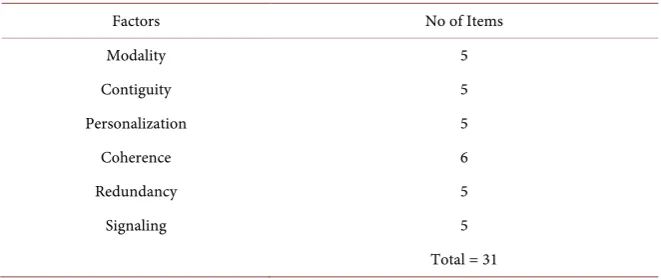
The MI item was developed specifically based on Mayer’s Cognitive Theory of Multimedia Learning (Mayer 2010; 2009). The instrument consists of thirty-one items; five Items for each indicator (modality, contiguity, personalization, re-dundancy, signaling), while six items were for coherence measure. The mea-surements scale is a Likert-type scale, which has 1 to 5 scales; 1 equals “strongly disagree” and 5 equals “strongly agree.” 1 represents the lowest and most nega-tive impression on the scale, 3 represents an adequate impression, and 5 represents the highest and most positive impression. In addition, a response category for “Not Applicable” was added for each Likert item. Table 1 shows the contents of the MI measure after the content validation.
DOI:10.4236/ce.2019.1012228 3044 Creative Education Table 1. MI factors.
Factors No of Items
Modality 5
Contiguity 5
Personalization 5
Coherence 6
Redundancy 5
Signaling 5
Total = 31
observed variables (modality, contiguity, personalization, coherence, redundan-cy, and signaling). The construct MI was indicated by six measured indicators and was identified. It had more degrees of freedom than the paths to be esti-mated.
To assess the fit of the measurement model, the analysis relied on a number of descriptive fit indices, which included the 1) relative chi-square (χ2/df), 2)
com-parative fit index (CFI), 3) Tucker-Lewis coefficient (TLI), and 4) root mean square error approximation (RMSEA). Hair et al. (2006) suggest the use of rela-tive chi-square (chi-square/df) as a fit measure.
4. Results
The estimated six-factor model for MI using the data drawn from 153usable and completed responses. A value of approximately .08 or less for RMSEA shows a reasonable error of estimation. The items from each scale were assumed to load only on the respective latent variable. The results indicate that the parameters ranging from .11 to .97. In the MI case, all of the coefficients were acceptable (>.7) except for the Coherence indicator which was .11 (Hair et al. 2006; Ar-buckle 1997; James et al. 2006). The CFI (.922) exceed the threshold of .90 indi-cating a good fit (Hair et al. 2006, Arbuckle 1997, James et al. 2006), while the TLI (.870) fit indicators did not exceed the threshold of .90, indicating a poor fit (Hair et al. 2006; Arbuckle 1997; James et al. 2006). The root-mean square error of approximation (RMSEA = .160) was >.08, Chi-square (χ2) was 44.083 with
degree of freedom (9) and p value = 0 (normally acceptable at p > .05) reflecting a possible fit problem (Hair et al. 2006; Arbuckle 1997; James et al. 2006).
DOI: 10.4236/ce.2019.1012228 3045 Creative Education loading where the “coherence” factor was dropped.
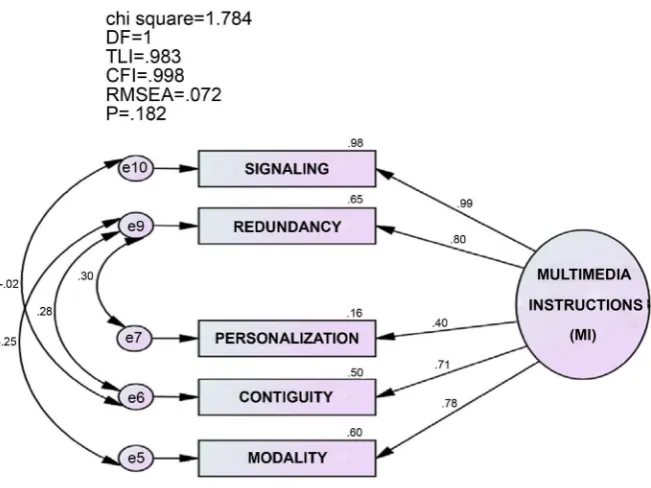
To validate the likelihood of the revised five-factor model, another CFA was applied on the same sample. The magnitude of the factor loadings in the revised model was substantially significant with CFI = .997, TLI =. 986 and chi-square = 3.971. The parameters were free from offending estimates, ranging from .72 to. 99. The CFI (.998) and TLI (.983) fit indicators exceeded the threshold of .90, indicating a very good fit (Hair et al. 2006, Arbuckle 1997). The root-mean square error of approximation (RMSEA = .72) also indicated a good fit (Hair et al. 2006).
In this revised model, the chi-square (χ2) with a value of 1.784, with degree of
freedom (1) successfully met the required threshold of <5, indicating a high goodness-of-fit value. The p value of .182 (acceptable at p > .05) hence indicates that the test failed to reject the hypothesized model. The procedures established the model in Figure 1 as the validated confirmatory measurement model. The cronbach alphas for the five sub-constructs after CFA are range from .814 to .879 (Modality = .839, Contiguity = .814, Personalization = .879, Redundancy = .873 and Signaling = .813) while cronbach alpha for the whole section meas-ures = .927. It is worth to mention cronbach alpha for coherence” factor which was dropped was .651. Overall result indicates that the test failed to reject the hypothesized model. Thus, the procedures established that the model in Figure 1 was a validated confirmatory measurement model.
5. Discussion
[image:5.595.211.537.465.709.2]The study was able to validate the MI model, which is measured by five observed variables: modality, contiguity, personalization, redundancy, and signaling. As
DOI:10.4236/ce.2019.1012228 3046 Creative Education proposed in literature, the study offered evidence that (five out of the six dimen-sions excluding the coherence indicator) the five-dimension measurement mod-el did generate from data collected from Al al-Bayt university engineering learn-ers. The result did not establish any basis, which can be used to claim that the MI model is incorrect. Thus, MI measurement model can be explained by five fac-tors namely, redundancy, contiguity, personalization, modality, and signaling. This result was consistent with several literatures on MI (Gerjets at el. 2004; Ibrahim & Callaway, 2012a; 2012b; Sorden, 2012; Clark & Mayer, 2011).
This conception represents a major adjustment in the way engineering facul-ties have usually developed engineering communication skills. The results of the present study are relevant to give insights for theorists, learners, academic staff and knowledge management system designers and developers towards the goal of achieving effective learning and teaching environment for engineering com-munication skills. In addition, these findings would assist engineering learners with differentiated learning style preferences to learn and practice engineering communication skills knowledge by integrating MI theories into the learning environment via Blackboard Course Management System especially in Jordan higher learning education.
Acknowledgements
This publication and research were funded by the Faculty of Education and Universiti Kebangsaan Malaysia under the project code GG-2019-046 and PP-FPEND-2019, DCP-2017-202/3, GG2018-011 respectively. The authors would also like to express special thanks to all personalized education research team members, students, researchers, graduate and research assistants for their help and contribution in conducting this project.
Conflicts of Interest
The authors declare no conflicts of interest regarding the publication of this paper.
References
Ahmad, M., Badusah, J., Mansor, A. Z., Abdul Karim, A., Khalid, F., Daud, M. Y., Din, R., & Zulkefle, D. F. (2016). The Application of 21st Century ICT Literacy Model among Teacher Trainees. Turkish Online Journal of Educational Technology, 15, 151-161. Aqlan, F., Al-Araidah, O., & Al-Hawari, T. (2010). Quality Assurance and Accreditation
of Engineering Education in Jordan. European Journal of Engineering Education, 35, 311-323.https://doi.org/10.1080/03043797.2010.483608
Azizul, S. M. J., & Din, R. (2016). Teaching and Learning Geometry Using Geogebra Software via Mooc. Journal of Personalized Learning, 2, 39-50.
Baharudin, H., Nasir, M. K. M., Yusoff, N. M. R. N., & Surat, S. (2018). Assessing Stu-dents’ Course Satisfaction with Online Arabic Language Hybrid Course. Advanced Science Letters, 24, 350-352. https://doi.org/10.1166/asl.2018.12005
DOI: 10.4236/ce.2019.1012228 3047 Creative Education San Francisco, CA: Pfeiffer. https://doi.org/10.1002/9781118255971
Di Gironimo, G., Mozzillo, R., & Tarallo, A. (2013). From Virtual Reality to Web-Based Multimedia Maintenance Manuals. International Journal on Interactive Design and Manufacturing, 7,183-190. https://doi.org/10.1007/s12008-013-0185-0
Din, R. (2010). Development and Validation of an Integrated Meaningful Hybrid E-Training (I-Met) for Computer Science: Theoretical-Empirical Based Design and Development Approach. Bangi, Malaysia: Faculty of Technology and Information Science, Universiti Kebangsaan Malaysia.
Din, R. (2017). Asas Pendidikan dan Kejurulatihan ICT: Integrasi Teori, Media, Teknolo-gi dan Reka Bentuk Pembelajaran. RanTeknolo-gi: Penerbit UKM.
Felder, R. M. (2002). Designing Tests to Maximize Learning. Professional Issues in Engi-neering Education and Practice, 128, 1-3.
https://doi.org/10.1061/(ASCE)1052-3928(2002)128:1(1)
Felder, R. M., & Silverman, L. K. (1988). Learning and Teaching Styles in Engineering Education. Engineering Education, 78, 674-681.
Gabarre, S., Gabarre, C., & Din, R. (2018). Personalizing Learning: A Critical Review of Language Learning with Mobile Phones and Social Networking Sites. Journal of Ad-vanced Research in Dynamical and Control Systems, 10, 1782-1786.
Gerjets, P., Scheiter, K., & Catrambone, R. (2004). Designing Instructional Examples to Reduce Intrinsic Cognitive Load: Molar versus Modular Presentation of Solution Pro-cedures. Instructional Science, 32, 33-58.
https://doi.org/10.1023/B:TRUC.0000021809.10236.71
Hair Jr., J. F., Black, W. C., Babin, B. J., Anderson, R. E., & Tatham, R. L. (2006). Multiva-riate Data Analysis (Vol. 6). Prentice, NJ: Prentice Hall.
Hoyle, R. H. (1995). Structural Equation Modeling: Concepts, Issues, and Applications, an Introduction Focusing on AMOS. Thousand Oaks, CA: Sage Publications.
Ibrahim, M., & Callaway, R. (2012a). Assessing the Correlations among Cognitive Over-load, Online Course Design and Student Self-Efficacy. In Society for Information Technology & Teacher Education International Conference.
Ibrahim, M., & Callaway, R. (2012b). Implications of Designing Instructional Video Us-ing Cognitive Theory of Multimedia LearnUs-ing. Vancouver, Canada: American Educa-tional Research Association (AERA).
Khalid, N. M., & Quick, D. (2016). Teaching Presence Influencing Online Students’ Course Satisfaction at an Institution of Higher Education. International Education Stu-dies, 9, 62. https://doi.org/10.5539/ies.v9n3p62
Mayer, R. E. (2009). Multimedia Learning (Vol. 2). New York: Cambridge University.
https://doi.org/10.1017/CBO9780511811678
Mayer, R. E. (2010). Applying the Science of Learning. Upper Saddle River, NJ: Pearson. Nasir, M. K. M., Surat, S., Maat, S. M., Abd Karim, A., & Daud, M. Y. (2018).
Confirma-tory Factor Analysis on the Sub-Construct of Teaching Presence’s in the Community of Inquiry. Creative Education, 9, 2245-2253. https://doi.org/10.4236/ce.2018.914165
Romanelli, F., Bird, E., & Ryan, M. (2009). Learning Styles: A Review of Theory, Applica-tion, and Best Practices. American Journal of Pharmaceutical EducaApplica-tion, 73, 1-5.
https://doi.org/10.5688/aj730109
Sorden, S. (2012). The Cognitive Theory of Multimedia Learning, Handbook of Educa-tional Theories.
DOI:10.4236/ce.2019.1012228 3048 Creative Education (2018). Primary and Secondary School Students Perspective on Kolb-Based STEM Module and Robotic Prototype. International Journal on Advanced Science, Engineer-ing and Information Technology, 8, 1394-1401.