0196/0202/2014/355-0e204/0 • Ear & Hearing • Copyright © 2014 by Lippincott Williams & Wilkins • Printed in the U.S.A. e204
Objectives: Although directional microphones on a hearing aid provide a signal-to-noise ratio benefit in a noisy background, the amount of benefit is dependent on how close the signal of interest is to the front of the user. It is assumed that when the signal of interest is off-axis, users can reorient themselves to the signal to make use of the directional micro-phones to improve signal-to-noise ratio. The present study tested this assumption by measuring the head-orienting behavior of bilaterally fit hearing-impaired individuals with their microphones set to omnidirec-tional and direcomnidirec-tional modes. The authors hypothesized that listeners using directional microphones would have greater difficulty in rapidly and accurately orienting to off-axis signals than they would when using omnidirectional microphones.
Design: The authors instructed hearing-impaired individuals to turn and face a female talker in simultaneous surrounding male-talker babble. Participants pressed a button when they felt they were accurately ori-ented in the direction of the female talker. Participants completed three blocks of trials with their hearing aids in omnidirectional mode and three blocks in directional mode, with mode order randomized. Using a Vicon motion tracking system, the authors measured head position and com-puted fixation error, fixation latency, trajectory complexity, and propor-tion of misorientapropor-tions.
Results: Results showed that for larger off-axis target angles, listen-ers using directional microphones took longer to reach their targets than they did when using omnidirectional microphones, although they were just as accurate. They also used more complex movements and frequently made initial turns in the wrong direction. For smaller off-axis target angles, this pattern was reversed, and listeners using directional microphones oriented more quickly and smoothly to the targets than when using omnidirectional microphones.
Conclusions: The authors argue that an increase in movement complex-ity indicates a switch from a simple orienting movement to a search behavior. For the most off-axis target angles, listeners using directional microphones appear to not know which direction to turn, so they pick a direction at random and simply rotate their heads until the signal becomes more audible. The changes in fixation latency and head ori-entation trajectories suggest that the decrease in off-axis audibility is a primary concern in the use of directional microphones, and listeners could experience a loss of initial target speech while turning toward a new signal of interest. If hearing-aid users are to receive maximum directional benefit in noisy environments, both adaptive directionality in hearing aids and clinical advice on using directional microphones should take head movement and orientation behavior into account.
Key words: Hearing aids, Directional microphones, Head movement, Sound localization.
(Ear & Hearing 2014;35;e204–e212)
INTRODUCTION
Modern hearing aids often incorporate directional micro-phones that can provide a substantial signal-to-noise ratio (SNR) improvement—and typically a corresponding speech-intelli-gibility benefit—over omnidirectional microphones (Bentler 2005). To obtain the maximal benefit, however, requires an ideal set of conditions (Valente et al. 1995): the listening environ-ment should have no more than moderate reverberation (i.e., the level of the direct and reflected sound should be at least equal), the background noise should be at the side or the rear of the listener, and the listener should be more or less facing the signal of interest (Ricketts & Dhar 1999; Hornsby & Rick-etts 2007). Thus for signals and noises in a spatially complex environment, the potential benefit of a directional hearing aid is critically dependent on the listener’s head already being pointed in the correct direction. The typical assumption is that a listener using directional hearing aids in a complex environment such as a restaurant will simply orient toward each signal of interest in turn. This study examines how capable listeners are of this orientation movement.
On-axis listening with directional microphones (i.e., with the head pointed at the signal source) has been shown to increase intelligibility relative to omnidirectional microphone listening (for a review, see Ricketts & Dittberner 2002). This difference is termed the directional benefit. In addition to the increase in intelligibility afforded by correct head orientation while using directional microphones, orientation of the head to a sound makes it easier to see cues such as lip movements that have been shown to aid speech detection (Grant & Seitz 2000; Grant 2001) as well as speech intelligibility (MacLeod & Sum-merfield 1987; Middelweerd & Plomp 1987). Modest off-axis orientation still results in directional benefit: speech intelligibil-ity can increase for signals up to 30° off-axis when using direc-tional microphones (Ricketts 2000; Henry & Ricketts 2003). But when the angle between the listener and signal of interest is larger than about 60°, depending on the directional pattern, intelligibility drops substantially below omnidirectional perfor-mance. This is a directional deficit. Fully off-axis orientation between 90 and 135° leads to dramatic directional deficits in word recognition scores in quiet as well as decreases in pure-tone detectability (Kuk et al. 2005).
Given that head angle can result in a loss of intelligibility and detectability, it is important that a listener be able to ori-ent themselves with respect to signals of interest. In order for this to be possible, however, listeners must first be capable of determining the direction of the signal. Hearing impairment is associated with a decrease in the accuracy and consistency of localization judgments (Angell & Fite 1901; Tonning 1975), particularly in the presence of background noise (Lorenzi et al. 1999). The use of hearing aids can improve localization, but any benefit is highly dependent on the user’s type and degree
The Effect of Hearing Aid Microphone Mode on
Performance in an Auditory Orienting Task
W. Owen Brimijoin, William M. Whitmer, David McShefferty, and Michael A. Akeroyd
MRC Institute of Hearing Research (Scottish Section), Glasgow Royal Infirmary, Glasgow, Lanarkshire, United Kingdom.
of hearing loss, mould-type, and fitting procedure (Byrne et al. 1992), with completely-in-the-canal aids offering a better local-ization benefit (Best et al. 2010). Discrimination of front/back location can be improved with directional microphones, as the front-back level difference caused by the directional pattern provides a highly salient cue; for instance, Keidser et al. (2006) found front/back discrimination was significantly better with directional microphones than with an omnidirectional fitting. Directional microphones, in contrast, have not been shown to improve general localization ability; the same study found that mean left/right error was equivalent across omnidirectional and directional modes. Van den Bogaert et al. (2006) showed that users of bilateral behind-the-ear hearing aids performed worse when using adaptive directional microphones than when using omnidirectional microphones. In favorable conditions of +10 dB SNR, Chung et al. (2008) found that directional micro-phones did not degrade localization performance and helped hearing impaired (HI) listeners localize sounds from the rear both in quiet and in noise.
Because directional microphones and head orientation nec-essarily interact with each other, it is important to know whether and how hearing aid wearers using a directional program ori-ent themselves to a signal of interest. While localization errors in orienting tasks have been previously characterized, the head movements used by hearing aid users remain unstudied. Fur-thermore, while it has been shown that head movements increase the accuracy of sound localization (Noble 1981; Perrett & Noble 1997a, 1997b), contribute to resolving front/back confusion (Wightman & Kistler 1999; Brimijoin & Akeroyd 2012), and play a role in auditory externalization (Brimijoin et al. 2013), it is unclear how hearing aids interact with these movements.
The purpose of the present study was to examine the head movements of bilaterally fitted HI listeners in both omnidirec-tional and direcomnidirec-tional modes while undertaking an orientation task. We expected that performance in omnidirectional mode would be similar for on-axis and off-axis signals. Conversely, given the large drop in audibility associated with off-axis lis-tening in directional mode, we expected to observe dramatic changes in the complexity and duration of head orientation movements with listeners using the directional mode.
MATERIALS AND METHODS Apparatus
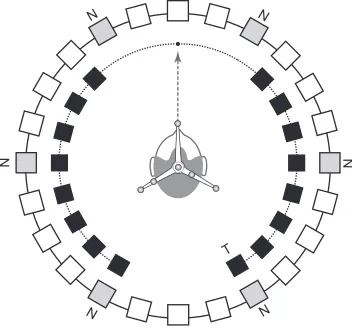
Participants were seated in the center of a circular 24-loud-speaker (Phonic Sep207) ring with a 0.9 m radius in a sound-dampened chamber. Sound presentation was controlled in Matlab using a MOTU 2408 Mk3 and a set of three 8-channel Fostex DA converters. The dB (A) level of each loudspeaker was calibrated to within 0.5 dB at 1 kHz using 80 dB pink noise.
Motion tracking was performed using an infrared cam-era system (MX3+; Vicon, Los Angeles, CA) using methods described previously (Brimijoin et al. 2010). A set of six cam-eras tracked 9 mm diameter reflective spheres; these markers were placed on four of the loudspeakers (at angles of 0°, −90°, +45°, and +90°), a head-mounted “crown” worn by the listen-ers and a wand. The loudspeaker marklisten-ers provided reference directions, and the wand was used to determine the location of the ears and nose relative to the crown. A custom Matlab program recorded three-dimensional Cartesian coordinates of all markers on all objects at a sample rate of 50 Hz. Subsequent
coordinate translation and rotation allowed us to determine the orientation of the listener’s head relative to the loudspeaker ring to within 0.1° regardless of the placement of the crown on the head.
Following standard measurement techniques (ANSI 3.22 1997), the directionality of the experimental hearing aids was measured in situ using a ½″ reference microphone (GRAS, Holte, Denmark), preamp (GRAS), and Zwislocki coupler mounted in a manikin (KEMAR) with artificial pinnae. The manikin was rotated in 10° increments using a stepper-motor turntable (LD360; LinearX, Tualatin, OR) at a distance of 1 m from the face of a loudspeaker (JBL Control 1G) in a sound-dampened chamber. Responses to swept sinusoids were mea-sured using a time-window approach (Listen Inc. SoundCheck, Boston, MA) and smoothed with a three-point sliding Gaussian window to offset any potential distortions due to the reflections of the room. A modified version of the Articulation Index-weighted Directivity Index (AIDI) was used as a measure of the directional performance of each participant’s hearing aids (Ricketts & Dittberner 2002), although it should be noted that our directional measurements were only made in the horizontal plane unlike more complete characterizations found elsewhere (Dittberner 2003). To compute the AIDI, first the frequency-specific directivity indices were computed as the ratio of power at 0° to the average power off-axis (10°–350°) for each third-octave band. These values were then weighted by the Articu-lation Index in third-octave bands from 250 to 6300 Hz and averaged (Mueller 1990). Because the measurements were made in situ on a manikin, the accompanying head shadow resulted in responses different from conventional free-field AIDI measure-ments. We thus refer to our directivity measurements as In-Situ Directivity Index (ISDI). ISDI values were computed for both the omnidirectional and directional settings of each hearing aid.
The directivity patterns from a representative hearing aid were used to estimate the SNR that a listener would experience as their head turned during a simplified version of the orient-ing task. For this computation, we used a noise source at +60°, a signal source at +120°, and a 3.5 sec sigmoidal orientation movement from 0° to +120°. Directivity patterns for both omni-directional and omni-directional microphones were used to deter-mine the Articulation Index (AI) weighted level of the signal and noise source in turn as a function of head angle over time. This process yielded the AI-weighted SNR that would be expe-rienced as a function of time over the course of the orienting movement.
Stimuli
present sounds from angles that were between two loudspeakers, we used equal-power panning based on a sine/cosine crossfade between the two nearest loudspeakers. The signals consisted of concatenated female-talker sentences from the BKB corpus (Bench et al. 1979). Signal position on each trial was also specified relative to the partici-pant’s head angle at the beginning of the trial: signals were presented from 45° to 150° relative to the listener’s acoustic midline in 15° increments. These locations were repeated eight times each, and the order of all trials was randomly shuffled. The first signal in a block began 5 sec after babble started; this was to ensure that any long-term (slow attack) compression in the hearing aids was engaged before the start of the signal. Signal duration was determined by the participant; a 50 ms cosine2 onset gate was applied to each signal, and when the participant pressed a button (see later) to signal when they were fac-ing the target signal the correspondfac-ing offset gate was applied. The long-term average level of the babble measured at the center of the ring was 59 dB (A). The long-term average signal level was 65 dB (A), so the average SNR was +6 dB.
Procedure
Participants were instructed to continually listen for, and ori-ent their head to, the female voice (i.e., the signal) regardless of the locations of the male talkers (i.e., the babble). Participants were told to press a key on a small wireless numeric keypad in their hand when they considered their head to be aligned with the target signal position. The next trial began 250 ms after the previous trial (i.e., after the button was pressed) to avoid reset-ting any adaptive hearing aid processing. Participants were randomly selected to first perform the experiment either in directional mode or in omnidirectional mode. The mode selec-tion in both devices was verified for each block by an experi-menter. Between directional and omnidirectional trial blocks, the listener was given a short break during which the micro-phone response of the hearing aids was measured.
Participants
Full data sets were recorded for 15 listeners. All partici-pants were fitted bilaterally with hearing aids at least 6 months before testing. All listeners reported that they were aware of
their devices had multiple programs but were not asked to esti-mate their experience with each program. All hearing aids were programmable dual-microphone behind-the-ear devices from various manufacturers (Microtech, Phonak, GN ReSound, and Siemens). In order not to tamper with each listener’s hearing aid and to ensure we knew the precise settings of each, we replicated each listener’s exact gain structure and compres-sion settings on a new device of the identical make and model. We then programmed these experimental hearing aids to have program one set to omnidirectional mode and program two to non-adaptive directional mode. Listeners used their own hear-ing-aid moulds.
Statistical Analysis
Based on measurements of the directionality of their hearing aids (while set to directional mode), the subjects were separated into two groups for data analysis: low directionality (n = 7) and high directionality (n = 8). The cutoff point was an ISDI (see earlier) of 2 dB, which delineated the measured ISDIs into two clusters and conveniently divided the subject pool into similarly sized groups. Figure 2A shows the ISDI and hearing impair-ment of each listener. The listeners with high-ISDI hearing aids are henceforth referred to as high-ISDI listeners and the oth-ers as low-ISDI listenoth-ers. The mean omnidirectional and direc-tional polar patterns of the hearing aids for these two groups are shown in Figure 2B. The gains at 0° for both patterns were normalized to a value of 0 dB before averaging.
Listener’s head movements were most often characterized by a trajectory with a roughly sigmoidal shape, accelerating from rest, reaching a peak velocity halfway through the movement, and slowing upon approach to the target. We analyzed four features of the movement trajectories for both groups: fixation error, fixation latency, trajectory complexity, and proportion of misorientations. Fixation error was defined as the absolute difference in degrees between the target angle and the listen-er’s head orientation angle at the time of the response-button press. Fixation latency was defined as the time a listener took to complete their movement and indicate they were finished by pressing a button. Trajectory complexity was computed by cal-culating the root mean square (RMS) difference between each listener’s movement trajectory and a logistic fit to this trajectory (before this curve-fitting, raw trajectories were offset to start at 0°, unfolded in cases where the trajectory exceeded 180°, smoothed with a 0.1 sec Hann window, and sign-reversed as necessary to ensure the net movement was to the right). Trajec-tory complexity is thus reported in degrees RMS and quantifies the departure of the listener’s trajectory from a simple, sigmoi-dal trajectory. Note that this method of measuring complexity is different from the polynomial used in our previous study (Brimijoin et al. 2010). The reason for this is that the move-ment trajectories analyzed in the present study were far longer in duration than the simple orienting responses in our previous work. We found that fitting these long trajectories with a poly-nomial was more vulnerable to noise than a comparison with a sigmoid. Finally, the proportion of misorientations was defined as the fraction of trials during which the listener initially turned more than 3° in the wrong direction.
All statistical analyses were performed in SPSS 18. We per-formed separate statistical analyses on low-ISDI and high-ISDI listeners. Each analysis consisted of two-way repeated measures analysis of variance on the main effects of microphone mode
N
N
N
N
[image:3.585.73.249.69.233.2]N T N
and target angle and the interaction between the two factors. In those cases for which the data were nonspherical according to Mauchly’s test, we report the Greenhouse–Geisser adjusted F ratio, p, and degrees of freedom.
RESULTS Example Trajectories
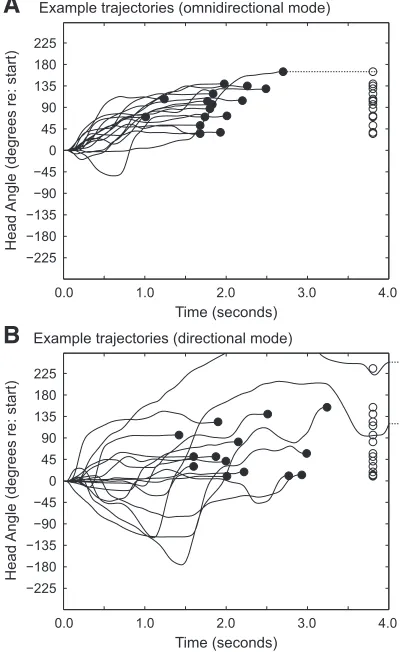
Figure 3 shows the movement trajectories of an example listener orienting while using omnidirectional microphones (Fig. 3A) and while using directional microphones (Fig. 3B). These trajectories are plotted after the process of unfolding, smoothing, and sign reversal detailed in Section 2.3. The circles indicate the endpoints of the trajectories (the angle values of which are repeated as open circles on the right of each panel). This figure is intended to provide an example demonstrating the average findings for all subsequent analy-ses described in this section: (1) fixation points (open circles, right-hand side) did not greatly differ between the omnidirec-tional and direcomnidirec-tional modes; (2) latency (filled circles at tra-jectory end points) was longer for listeners using directional microphones; (3) trajectory complexity (overall variability in the lines) was greater when using directional microphones; and (4) listeners using directional microphones more fre-quently turned in the opposite direction of the target (trajecto-ries dropping below 0°).
Fixation Error
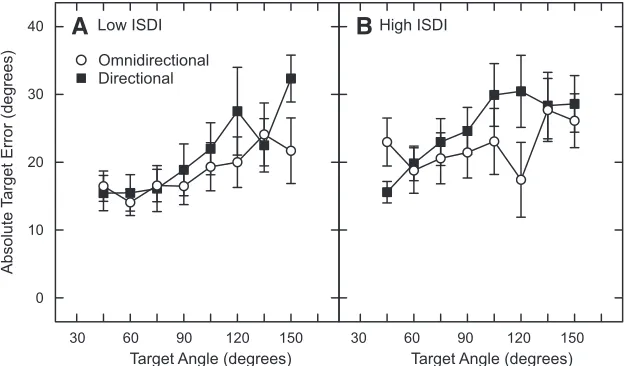
Figure 4 shows the mean fixation error for all listeners as a function of absolute target angle; target angles to the left (nega-tive) were reflected about the zero point and the error values averaged together with the right-side (positive) angles. The fixa-tion error of the low-ISDI listeners (Fig. 4A) was not affected by microphone mode (F statistic and p value for this, and all subsequent analyses are listed in Table 1) but increased signifi-cantly as a function of target angle. There was no interaction between microphone mode and target angle.
For the high-ISDI listeners (Fig. 4B), there was a significant increase in fixation error as a function of target angle. We found
neither a significant interaction between microphone mode and
angle nor a main effect of microphone mode. These results
−225 −180 −135 −90 −45 0 45 90 135 180 225
0.0 1.0 2.0
Time (seconds)
Head
Angle (degrees re: start)
Head
Angle (degrees re: start)
3.0 4.0
B
Example trajectories (directional mode)−225 −180 −135 −90 −45 0 45 90 135 180 225
0.0 1.0 2.0
Time (seconds) 3.0 4.0
A
Example trajectories (omnidirectional mode)Fig. 3. Representative movement trajectories toward a target at +60° while using omnidirectional mode (A) and directional mode (B). Individual lines represent head angle over time and the filled circles represent the endpoints (fixation angle and response latency) of these trajectories. The open circles are the fixation angles replotted to the right to more clearly show their distribution. R² = -0.02
R² = 0.27
Omnidirectional Mode Directionality versus hearing impairment
A
B
Mean Polar PatternsDirectional Mode
Low Directionality High Directionality
0 -2
0 2 4 6
20 40
4FA Hearing Threshold (dB HL)
In Situ Directivity Index (ISDI)
60 80 100
High-ISD
I
Low-ISDI
Omni
Directional 30°
60°
90° 0°
±180°
-150° 150°
-120° 120°
-30°
-60°
-90°
+5 dB
0 dB -5 dB
30°
60°
90° 0°
±180°
-150° 150°
-120° 120°
-30° -60°
-90°
+5 dB
[image:4.585.142.450.70.263.2]0 dB -5 dB
[image:4.585.324.524.360.686.2]suggest that hearing aid directionality has no effect on a lis-tener’s final orienting accuracy.
Fixation Latency
Figure 5 shows fixation latency, the time it took listeners to complete their orientation toward a target, as a function of that target’s angle. Low-ISDI listeners (Fig. 5A) showed a tar-get angle-dependent increase in response latency. There was no effect of microphone mode, nor was there an interaction between microphone mode and target angle.
For high-ISDI listeners (Fig. 5B), we found no main effect of microphone mode. There was a significant effect of target angle, indicating that listeners took longer to orient toward the most off-axis targets. There was a significant interaction between microphone mode and angle. This suggests that, compared with omnidirectional mode, when using the directional mode of their hearing aids, listeners took less time to orient to nearby targets, but more time to orient to more distant targets. The cross-over in these results was at about 90º, a target angle that corresponded to a rapid dropoff in the directional polar pattern (Fig. 2B).
It should be noted that the mean fixation latency in omnidi-rectional mode was different (t(104) = 7.69, p < 0.001) across the two groups of listeners (compare the white circles in Fig. 5A versus 5B); this suggests that the two groups were different
from one another in some way. This difference may be due to the positive correlation between ISDI and average hearing loss, in that the high-ISDI listeners were also more hearing impaired (Fig. 2). This correlation may be related to the observed across-group differences in the omnidirectional mode results, but this association was not explicitly tested.
Trajectory Complexity
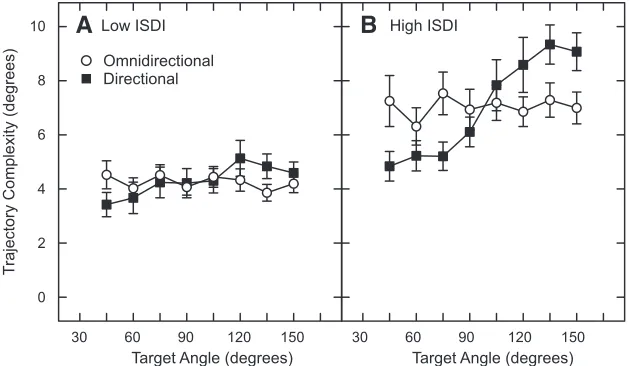
Figure 6 shows trajectory complexity as a function of target angle. For trajectory complexity in low-ISDI listeners (Fig. 6A), we found no effect of microphone mode or target angle, nor did we find a significant interaction effect between the two. This suggests that low-ISDI listeners oriented smoothly and consis-tently toward a target regardless of the mode of their hearing aids or the off-axis angle of the target sound.
The results were different for high-ISDI listeners (Fig. 6B). We found a significant interaction between microphone mode and target angle, suggesting that hearing aid directionality affects the smoothness of a listener’s head movements during the process of orienting toward a target sound. We also found a main effect of target angle but no main effect of microphone mode. As with fixation latency, we again observed for omni-directional mode a substantial difference in average trajectory complexity between the two ISDI groups.
A
Low ISDIDirectional Omnidirectional
B
High ISDI30 0 10 20 30 40
60 90
Target Angle (degrees)
Absolute
Ta
rget Error (degrees
)
120 150 30 60 90
[image:5.585.137.451.68.251.2]Target Angle (degrees)120 150
Fig. 4. Mean fixation error as a function of target angle for low In-Situ Directivity Index (ISDI) listeners (A) and high ISDI listeners (B). Both groups show an increase in error as a function of target angle for both omnidirectional (open circles) and directional modes (closed squares).
Table 1. analysis of variance results
Microphone Mode Target Angle Microphone/Angle Low ISDI Listeners
Fixation error F(1,5) = 1.12, p = 0.34 F(7,35) = 2.50, p < 0.05* F(7,35) = 1.72, p = 0.14 Fixation latency F(1,5) = 2.27, p = 0.19 F(7,35) = 20.55, p < 0.05* F(7,35) = 1.29, p = 0.28 Trajectory complexity F(1,5) = 0.05, p = 0.84 F(7,35) = 0.65, p = 0.71 F(7,35) = 1.98, p = 0.09 Proportion of misorientations F(1,5) = 0.24, p = 0.65 F(7,35) = 3.87, p < 0.05* F(7,35) = 0.20, p = 0.98 High ISDI listeners
Fixation error F(1,7) = 0.50, p = 0.50 F(2.2,15.0) = 2.27, p < 0.05* F(1.9,13.5) = 1.90, p = 0.09 Fixation latency F(1,7) = 0.73, p = 0.42 F(2.6,18.1) = 7.74, p < 0.05* F(3.1,21.9) = 3.65, p < 0.05*
Trajectory complexity F(1,7) = 0.35, p = 0.57 F(7,49) = 4.33, p < 0.05* F(7,49) = 4.30, p < 0.05* Proportion of misorientations F(1,7) = 44.99, p < 0.05* F(2.3,16.1) = 27.46, p < 0.05* F(7,49) = 9.11, p < 0.05*
[image:5.585.45.544.590.721.2]Proportion of Misorientations
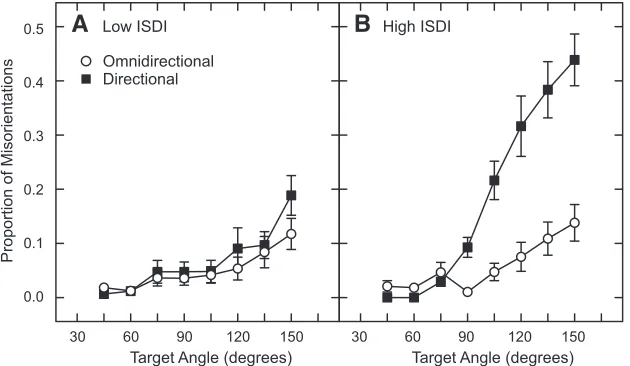
There were many trials during which a listener turned ini-tially in the incorrect direction, sometimes taking the long way around the loudspeaker ring to orient to the signal. These mis-orientations were quantified and plotted as a function of target angle in Figure 7. For low-ISDI listeners, the further off-axis the target, the more likely they were to misorient, but misori-entations were not significantly affected by microphone mode. No significant interaction between microphone mode and target angle was found.
For high-ISDI listeners, we found significant main effects of target angle and microphone mode. There was also a significant interaction between microphone mode and target angle.
DISCUSSION Summary of Main Results
Whether the microphone was in omnidirectional or direc-tional mode did not affect orientation behavior in listeners with low-ISDI hearing aids. This is understandable given that this
group was defined as those listeners whose hearing aids’ direc-tional mode was no more than 2 dB more direcdirec-tional than its omnidirectional mode (and for two participants, the omnidirec-tional mode was more directional in situ than the directional mode). As an aside, given that nearly half of our participants arrived with devices that had less than 2 dB of directionality as measured in situ, we believe that audiologists may wish to actually test the directionality of a given hearing aid at the time of dispensing (a suggestion also raised by Bell et al. 2010). The directional mode of a hearing aid should in principle have an ISDI of 3 dB at minimum; to have a smaller ISDI suggests a corresponding reduction in potential SNR benefit. Neverthe-less, because we wished to test what effects microphone direc-tionality had on orienting responses, the subsequent discussion will focus exclusively on the group of listeners whose devices had ISDI values greater than 2 dB.
For high-ISDI listeners, the switch to directional micro-phones was not associated with any systematic changes in a lis-tener’s final fixation angle. This suggests that at the completion of an orienting movement, a listener’s overall orienting accuracy
Low ISDI
A
B
Directional Omnidirectional
High ISDI
30 0 2 4 6 10
8
60 90
Target Angle (degrees)
Tr
ajectory Complexity (degrees
)
120 150 30 60 90
[image:6.585.136.452.68.250.2]Target Angle (degrees)120 150
Fig. 6. Trajectory complexity as a function of target angle for low In-Situ Directivity Index (ISDI) listeners (A) and high ISDI listeners (B). Only the high ISDI group showed an increase in complexity as a function of target angle and only in directional mode (closed squares), not in omnidirectional mode (open circles).
Low ISDI
Directional Omnidirectional
High ISDI
30 3 4 5 6 7
60 90
Target Angle (degrees)
Fixation Latency (sec)
120 150 30 60 90
Target Angle (degrees)120 150
[image:6.585.136.452.532.715.2]A
B
was not affected by the particular microphone mode they are using. In contrast, directional microphones were associated with large changes in the movement phase of orienting behav-ior, namely the fixation latency and trajectory complexity. The consistent pattern for both is that listeners benefitted from direc-tional microphones for small target angles, but for large target angles directionality was associated with more complex and longer-duration trajectories. The cross-over point for both mea-surements was around 90º; this is likely related to the substan-tial drop in audibility relative to omnidirectional microphones that occurred between 60° and 90° (Fig. 2B). Directional micro-phones were also associated with what appears to be a target-angle dependent linear increase in the number of initial turns in the wrong direction, increasing to nearly half the trials at target angles of ±150°; we believe this is most likely due to a large loss in off-axis audibility.
The Causes of Increased Movement Complexity
We suggest the observed effects of directional microphones on latency and complexity are due to two primary factors. The first is a target angle-dependent change from a simple orienting behavior to a search behavior. For small target angles, direc-tional microphones aid the listener in initiating an orienting turn in the correct direction with a good estimate of the angle of the target sound. Thus in these situations, the movements of listeners are simple, rapid, and accurate in that they require little correction at the end of the trajectory. For very large angles, the listener appears to adopt a search behavior in which he or she turns until the signal of interest is found. The large number of initial misorientations suggests that depending on the polar pattern of the directional microphone, the signal may even be below detection threshold at its onset, requiring a listener to turn in a randomly chosen direction until he or she can hear it. The movement trajectories observed for our directionally aided listeners are not unlike those seen in search-task experiments using ear protection devices such as ear muffs and plugs (Simp-son et al. 2005), suggesting that bilaterally fitted directional microphones interfere with the availability of viable spatial cues for off-axis signals of interest. We have previously shown that
hearing-impaired listeners exhibited more complex orientation movements to sentences presented in quiet in comparison with normal hearing listeners (Brimijoin et al. 2010). The complex movement trajectories seen with directional microphones in the present study are similar, suggesting that the reversals, accelera-tions, and decelerations that characterize the movement trajec-tories for far off-axis angles may be seen as behavior resulting from the listener engaging in a search task rather than an orien-tation response.
The second potential factor contributing to change in ori-entation behavior associated with directional microphones is a fluctuation in the SNR during a head turn. We have previously demonstrated that the SNR for spatially separated targets and noises at one ear is dependent on head angle (Brimijoin et al. 2012). In an environment consisting of a signal and multiple sources of noise, directional microphones create a situation in which SNR changes in a complex fashion as a function of head angle. Figure 8 is a plot of the AI-weighted SNR that would be experienced during a sigmoidal orientation movement for a simplified version of the task with a noise source at +60° and a signal at +120°. In this example, the SNR remains relatively constant during head movement when using omnidirectional microphones. For directional microphones, in contrast, when the polar pattern of a directional microphone was swept across the distractor, the SNR decreased dramatically as the listener began to orient toward the signal source, only to subsequently increase again as the listener approached the signal location. Consider a listener turning toward a new signal of interest: a precipitous drop in SNR could suggest to listeners that they were turning in the wrong direction, causing them to initiate a reversal. We suggest that some of the observed complexity in orienting responses is due to the idiosyncratic effect that direc-tional microphones have in complex environments where the SNR is highly dependent on orientation.
A Potential Confound With Hearing Impairment The amount of directionality for a given device was sig-nificantly correlated with the user’s level of hearing impair-ment (Fig. 2A). It is unknown whether this pattern occurred by Low ISDI
A
B
Directional Omnidirectional
High ISDI
30 0.0 0.1 0.2 0.3 0.5
0.4
60 90
Target Angle (degrees)
Proportion of Misorientations
120 150 30 60 90
[image:7.585.137.452.68.251.2]Target Angle (degrees)120 150
chance, given our small sample, or whether there are system-atic differences in the directionality of hearing aids supplied to listeners with different levels of hearing impairment. Nev-ertheless, there exists the possibility that some of the observed behavioral effects were due not to microphone directional-ity per se but rather a general effect of hearing impairment. While this confound is to some extent intractable given our listener pool, no differences in either fixation error or propor-tion of misorientapropor-tions were seen between the low ISDI and high ISDI listeners when using omnidirectional microphones (compare the open circles in Figs. 4A versus B and 7A versus B). If hearing impairment were the sole cause of any observed differences, we would expect to see a difference in perfor-mance for both directional and omnidirectional microphones. That said, an upward shift was observed for fixation latency and trajectory complexity (Figs. 5 and 6). The key finding of the study, however, was not that directionality introduced a linear offset in performance, but that microphone directional-ity introduced an interaction with target angle: performance was better for small target angles and worse for large target angles across a range of metrics. We argue that this change in slope was not induced by hearing impairment but most likely by microphone mode.
Directionality and Behavior
In a realistic auditory environment consisting of a num-ber of sources of noise and a single source of interest, direc-tional microphones can provide an increase in SNR and a corresponding increase in speech intelligibility. This benefit, however, is predicated on the assumption that the listener is already facing in the correct direction. In typical social situa-tions, listeners tend to turn to look at the person talking (Ken-don 1967), although not always: for example, Ching et al. (2009) observed that aided children oriented to a primary talker less than half the time. When seated at a table with sev-eral people, the orienting movements necessitated by direc-tional microphones can be very large, at times requiring the listener to turn up to 90° to either side. In such circumstances, directionality could be a hindrance to speech understanding,
and it may be unreasonable to suggest that head orientation offers the solution to this problem.
Summary of Results
In terms of fixation latency, movement complexity, and proportion of initial misorientations, directional microphones provided a benefit over omnidirectional microphones for small target angles and a deficit for large target angles. Directional microphones, however, did not affect fixation error. Thus while the movements listeners made in orienting toward the most off-axis targets suggested more initial localization uncertainty, once they located the target signal they were no less able to point their heads at the target. We suggest that for large target angles, the observed difference in movement trajectories between omnidirectional and directional microphones is a change from a simple orientation movement to a search behavior. In this situation, listeners may not know what direction to turn in and will simply rotate their heads until the signal becomes more audible. Because a highly directional microphone rejects much of the off-axis signal, in a typical multitalker conversation at, for example, a large table in a restaurant, these longer, more complex orienting trajectories could result in more of a new target signal being lost. Adaptive directionality in hearing-aid design and clinical advice both need to account for orientation as a dynamic process if the wearer is to receive the full benefit of directional microphones in noisy environments.
ACKNOWLEDGMENTS
The authors thank Patrick Howell for programming the hearing aids used in the study.
This work was supported by the intramural funding from the Medical Research Council (grant number U135097131) and the Chief Scientist Office of the Scottish Government.
The authors declare no other conflict of interest.
Address for correspondence: W. Owen Brimijoin, MRC/CSO Institute of Hearing Research, Glasgow Royal Infirmary, 10–16 Alexandra Parade, Glasgow G31 2ER, United Kingdom. E-mail: [email protected] Received November 22, 2012; accepted March 23, 2014.
Directional Omnidirectional
0 -12 -10 -8 -6 -4 0 -2
AI-weighted SNR (dB)
1.0 2.0 3.0
[image:8.585.136.453.68.249.2]Time (seconds) 4.0
REFERENCES
ANSI, (1997). Methods for calculation of the speech intelligibility index. ANSI S3.5 – 1997. New York, NY: American National Standards Institute. Angell, J. R., & Fite, W. (1901). The Monaural Localization of Sounds.
Psy-chol Rev, 8, 225–246.
Bell, S. L., Creeke, S. A., Lutman, M. E. (2010). Measuring real-ear signal-to-noise ratio: Application to directional hearing aids. Int J Audiol, 49, 238–246.
Bench, J., Kowal, A., Bamford, J. (1979). The BKB (Bamford-Kowal-Bench) sentence lists for partially-hearing children. Br J Audiol, 13, 108–112.
Bentler, R. A. (2005). Effectiveness of directional microphones and noise reduction schemes in hearing aids: A systematic review of the evidence. J Am Acad Audiol, 16, 473–484.
Best, V., Kalluri, S., McLachlan, S., et al. (2010). A comparison of CIC and BTE hearing aids for three-dimensional localization of speech. Int J Audiol, 49, 723–732.
Brimijoin, W. O., & Akeroyd, M. A. (2012). The role of head movements and signal spectrum in an auditory front/back illusion. Iperception, 3, 179–182.
Brimijoin, W. O., Boyd, A. W., Akeroyd, M. A. (2013). The contribution of head movement to the externalization and internalization of sounds. PLoS One, 8, e83068.
Brimijoin, W. O., McShefferty, D., Akeroyd, M. A. (2010). Auditory and visual orienting responses in listeners with and without hearing-impair-ment. J Acoust Soc Am, 127, 3678–3688.
Brimijoin, W. O., McShefferty, D., Akeroyd, M. A. (2012). Undirected head movements of listeners with asymmetrical hearing impairment during a speech-in-noise task. Hear Res, 283, 162–168.
Byrne, D., Noble, W., LePage, B. (1992). Effects of long-term bilateral and unilateral fitting of different hearing aid types on the ability to locate sounds. J Am Acad Audiol, 3, 369–382.
Ching, T. Y., O’Brien, A., Dillon, H., et al. (2009). Directional effects on infants and young children in real life: Implications for amplification. J Speech Lang Hear Res, 52, 1241–1254.
Chung, K., Neuman, A. C., Higgins, M. (2008). Effects of in-the-ear micro-phone directionality on sound direction identification. J Acoust Soc Am, 123, 2264–2275.
Dittberner, A. B. (2003). Misconceptions when estimating the directivity index for directional microphone systems on a manikin. Int J Audiol, 42, 52–4; author reply 55.
Grant, K. W. (2001). The effect of speechreading on masked detection thresholds for filtered speech. J Acoust Soc Am, 109(5 Pt 1), 2272–2275. Grant, K. W., & Seitz, P. F. (2000). The use of visible speech cues for
improving auditory detection of spoken sentences. J Acoust Soc Am, 108(3 Pt 1), 1197–1208.
Henry, P., & Ricketts, T. (2003). The effects of changes in head angle on auditory and visual input for omnidirectional and directional microphone hearing aids. Am J Audiol, 12, 41–51.
Hornsby, B. W., & Ricketts, T. A. (2007). Effects of noise source configura-tion on direcconfigura-tional benefit using symmetric and asymmetric direcconfigura-tional hearing aid fittings. Ear Hear, 28, 177–186.
Keidser, G., Rohrseitz, K., Dillon, H., et al. (2006). The effect of multi-channel wide dynamic range compression, noise reduction, and the directional microphone on horizontal localization performance in hear-ing aid wearers. Int J Audiol, 45, 563–579.
Kendon, A. (1967). Some functions of gaze-direction in social interaction. Acta Psychol (Amst), 26, 22–63.
Kuk, F., Keenan, D., Lau, C. C., et al. (2005). Performance of a fully adap-tive directional microphone to signals presented from various azimuths. J Am Acad Audiol, 16, 333–347.
Lorenzi, C., Gatehouse, S., Lever, C. (1999). Sound localization in noise in hearing-impaired listeners. J Acoust Soc Am, 105, 3454–3463.
MacLeod, A., & Summerfield, Q. (1987). Quantifying the contribution of vision to speech perception in noise. Br J Audiol, 21, 131–141. Middelweerd, M. J., & Plomp, R. (1987). The effect of speechreading on
the speech-reception threshold of sentences in noise. J Acoust Soc Am, 82, 2145–2147.
Mueller, H. G. (1990). An easy method for calculating the articulation index. Hear J, 43, 14–17.
Noble, W. G. (1981). Earmuffs, exploratory head movements, and horizon-tal and vertical sound localization. J Aud Res, 21, 1–12.
Perrett, S., & Noble, W. (1997a). The contribution of head motion cues to localization of low-pass noise. Percept Psychophys, 59, 1018–1026. Perrett, S., & Noble, W. (1997b). The effect of head rotations on vertical
plane sound localization. J Acoust Soc Am, 102, 2325–2332.
Ricketts, T. (2000). The impact of head angle on monaural and binaural per-formance with directional and omnidirectional hearing aids. Ear Hear, 21, 318–328.
Ricketts, T., & Dhar, M. S. (1999). Aided benefit across directional and omni-directional hearing aid microphones for behind-the-ear hearing aids. J Am Acad Audiol, 10, 180–189.
Ricketts, T., & Dittberner, A. (2002). Directional amplification for improved signal-to-noise ratio: Strategies, measurements and limitations. In M. Valente (Ed). Hearing aids: Standards, Options and Limitations. New York, NY: Thieme.
Rothauser, E., Chapman, W., Guttman, N., et al. (1969). IEEE recom-mended practice for speech quality measurements. IEEE Trans. Audio Electroacoust, 17, 225–246.
Simpson, B. D., Bolia, R. S., McKinley, R. L., et al. (2005). The impact of hearing protection on sound localization and orienting behavior. Hum Factors, 47, 188–198.
Tonning, F. M. (1975). Auditory localization and its clinical applications. Audiology, 14, 368–380.
Valente, M., Fabry, D. A., Potts, L. G. (1995). Recognition of speech in noise with hearing aids using dual microphones. J Am Acad Audiol, 6, 440–449.
Van den Bogaert, T., Klasen, T. J., Moonen, M., et al. (2006). Horizontal localization with bilateral hearing aids: Without is better than with. J Acoust Soc Am, 119, 515–526.