1 | P a g e
Experimental study of the hydrodynamic behaviour of slug flow in a vertical riser
M. Abdulkadir*1, V. Hernandez-Perez1, I. S. Lowndes1, B. J. Azzopardi1 and S. Dzomeku2
1Process and Environmental Engineering Research Division , Faculty of Engineering, University of Nottingham
University Park, Nottingham, NG7 2RD, United Kingdom
2Petroleum Engineering Department, African University of Science and Technology (AUST), Abuja, Nigeria
*Email of the corresponding author: [email protected]
Abstract: This paper presents an investigation of the hydrodynamics of slug flow in a vertical 67 mm internal
diameter riser. The slug flow regime was generated using a multiphase air-silicone oil mixture over a range of
gas (0.42< USG< 1.35 m/s) and liquid (0.05<USL< 0.38 m/s) superficial velocities. Electrical Capacitance
Tomography (ECT) was used to determine: the velocities of the Taylor bubbles and liquid slugs, the slug
frequencies, the lengths of Taylor bubbles and the liquid slugs, the void fractions within the Taylor bubbles and
liquid slugs and the liquid film thicknesses. A differential pressure transducer was used to measure the pressure
drops along the length of the riser. It was found that the translational velocity of a Taylor bubble (the structure
velocity) was strongly dependent on the mixture superficial velocity. As the gas superficial velocity, was
increased, the void fraction and the lengths of the liquid slugs and the Taylor bubbles were observed to increase.
The increase in gas superficial velocity causes an increase in the frictional pressure drop within the pipe, whilst
the total pressure drop (which is a sum of the hydrostatic and frictional pressure drop) along the length of the
riser decreases. In addition, the frequencies of the liquid slugs were observed to increase as the liquid superficial
velocity increases, but to be weakly dependant on the gas superficial velocity. The manual counting method for
the determination of slug frequency was found to be in good agreement with the power spectral density (PSD)
computed method.
Key words: ECT, Taylor bubble, liquid slug, slug unit, frequency, void fraction
1.0 Introduction:
Slug flow occurs in horizontal, inclined and vertical pipes over a wide range of liquid and gas flow rates. It is
the dominant flow pattern in upward inclined flow. The flow is associated with operational problems such as
operation, erosion-corrosion enhancement, and structural problems occurring most especially in bends. Slug
2 | P a g e
pressure distributions. Therefore, the predictions of the liquid holdup, pressure drop, heat transfer, mass transfer
are difficult and challenging.
The power, nuclear and chemical industries have provided a platform for strong interest in multiphase flow
study. Examples of such studies are steam-water flow for power generation and flow reactors for heat and mass
transfer. Additionally, applications in the petroleum industry provide another strong motivation for multiphase
flow research. The transportation of multiphase involving, oil and gas in pipes is significantly reducing the cost
of reservoir development. However, the main challenge confronting them is the development of multiphase
technology for the transportation of oil and gas from subsea production units at large water depths to processing
facilities at nearby platforms or onshore facilities. The flows in the subsea pipelines usually contain multiple
phases, like oil, water and /or gas, whose composition is not known priori. The variation in the composition of
fluids inside the long subsea network can lead to serious operational problems, ranging from non -continuous
production or shut-down to damage equipment.
Gas with large amounts of water and or oil-water mixtures may be produced simultaneously, resulting in
multiphase flow conditions in the transporting pipe system between the source and the production platform. As
the fields grow older, the produced gas contains an increasing amount of water, giving rise to different mixture
compositions, which affect the flow pattern and flow characteristics (Zoeteweij (2007)). For upward inclined
and vertical pipe flow, s lug flow can be considered as the dominant flow pattern, Hernandez-Perez (2008). This
can enhance corrosion, as Kaul (1996) noted that the corrosion rate is accelerated when the flow pattern is slug
flow. This flow pattern is usually characterised by an alternating flow of gas pockets and liquid slugs. Mos t of
the gas-phase is concentrated in large bullet-shaped gas pockets, defined as Taylor bubbles. The Taylor bubbles
are separated by intermediate liquid slugs, which may contain small entrained gas bubbles. A major
characteristic of slug flows are their inherent unsteadiness. As this kind of flow occurs over a wide range of
intermediate flow rates of gas and liquid, it is of major interest to a wide range of industrial processes that
employ pipeline transport systems.
The presence of liquid slugs in the flow system gives an irregular output in terms of gas and liquid flow at the
outlet of the system, or at the next processing stage. This can pose problems to the designer and operator of two
-phase flow systems. Pressure drop is substantially higher in slug flow as compared to other flow regimes, and
3 | P a g e
Abdulkadir (2011). In the 67 mm facility used in the current study, slugs were observed to be of about 10 pipe
diameters in length, i.e. long enough for the rise velocity to be independent of the length Griffith and Wallis
(1961). For large capacity systems in industry, these liquid slugs can even grow longer, carrying large
momentum. Often, slug catching devices are used to collect the slugs, and avoid any damage to the downstream
equipment. For the design of such slug catchers, it is important to know what kind of slugs to anticipate. The
important question of when, and how, these slugs are formed has rece ived much attention from research workers
Abdulkadir (2011). However, reports on the study of the behaviour of these slugs in more industry relevant
fluids are limited. For that reason, it is important to study the behaviour of slug flow in great detail for the
optimal, efficient and safe design and operation of two -phase gas-liquid slug flow systems .
An analysis of the ECT data enabled the characterisation of the slug flow. This enabled the measurement of the
instantaneous distribution of the flow phases o ver the cross -section of the pipe. The use of two such
circumferential rings of sensor electrodes , 89 mm apart (also known as twin-plane sensors), enabled the
determination of the translational velocity of the observed Taylor bubbles and liquid slugs. With this
information, a more fundamental approach is used for improving the general knowledge on slug flow.
1.1 Background:
The occurrence of slug flow in a vertical riser is a very common phenomenon under normal operating conditions
within a two-phase flow facility, such as in an oil production riser. Over the past thirty years there have been a
large number of research studies in this field in the peer review literature.
One of the earliest contributions to slug flow characterization was carried out by Nic klin et al. (1962), who proposed an empirical relationship to describe the rise velocity of single Taylor air bubble in a static water
column. Nicklin’s empirical relationship, given by equation (1), describes the translational velocity of a Taylor
bubble, UN, it is the sum of the Taylor bubble rise velocity, or drift velocity, which is the velocity of a Taylor
bubble in a stagnant liquid, plus the contribution of the mixture superficial velocity in the preceding slug . For
the air-water system in a 26 mm bore tube considered the values of the constants Coand
k
were determined tobe 1.2 and 0.35, respectively.
gD k U C
4 | P a g e
Where C0 is a flow distribution coefficient, k is drift coefficient, UM is the mixture superficial velocity and
gD
k
is the drift velocity.Moissis (1963) agreed that N
U predicted by equation (1) fitted his data well. Akagawa and Sakaguchi (1966)
confirm the applicability of equation (1) to the air-water system in a 26 mm diameter pipe and pointed out the
effect of the term k gDis negligible except at low gas and liquid velocities. They suggested that the presence
of small bubbles in the liquid slug has a slight effect on the translational velocity of a Taylor bubble and that
their data indicated that 0
C is in the range of 1.25 - 1.35.
Brown (1965) found experimentally that the analytical solutions for the translational velocity of a Taylor bubble
derived by Dumitrescu (1943) and Davies and Taylor (1950) described the behaviour of gas bubbles in low
viscosity liquids well, however they were not suitable for high viscosity liquids.
Vince and Lahey (1982) claimed that excellent correlation between the translational velocity of a Taylor bubble,
N
U and the mixture superficial velocity, UMwas given by the equation (2):
15
.
0
29
.
1
MN
U
U
(2)Following an analysis of experimental data in a 50 mm diameter tube, Fernandes et al. (1983) determined a
slightly higher value of 1.29 for
C
0. They ascribed the increase in the constantC
0to diameter effect or to thecontribution made by heading and trailing Taylor bubbles. Barnea and Shemer (1989) verified equation (1),
using their own measurements on a 50 mm diameter tube, and used it in their calculations. A more physically
based interpretation of the proposed increase in the constant was later provided by Mao and Dukler (1985).
They used an aqueous electrolytic solution and air in a 50.8 mm diameter tube. They took into consideration the
fact that the liquid slug in front of a Taylor bubble is aerated, and coalescence takes place between the small
bubbles and the Taylor bubbles . This results in an increase of the velocity of the Taylor bubble. They derived a
mathematical relationship to determine the translational velocity of a Taylor bubbles , equation (3).
N LLS
o
N CU gD U
U 0.35 (3)
5 | P a g e
ULLS is the liquid superficial velocity in liquid slug,
UN is an increment of UN as defined in equation (1). Thevalue of the constant
C
ois based upon the assumption that the propagation or the front velocity of the slug, orthe velocity of the interface between the gas and the liquid phases follows the maximum local velocity, Umax in
front of the nose tip and thus
M o
U
U
C
max (Nicklin et al. (1962), Bendiksen (1984), Shemer and Barnea (1997),Polonsky et al. (1999). The value of
C
oaccording to them is approximately 1.2 for fully developed turbulentflow and 2.0 for fully developed laminar flow.
TB gs GLS N
N U U
U
) ( (4)
gs
LLS L G L LLS o GLSU
g
U
U
U
1/24 / 1 2
1
)
(
53
.
1
(5)Defining
as the ratio of the void fraction in the liquid slug and Taylor bubble:TB gs
(6))
1
(
gs LLS gs GLS SG SLM
U
U
U
U
U
(7)By performing a substitution of equation (5) into (7) we obtain the expressions
LLS O gs LLS gs LLS LLS gs O gs
M
U
U
U
U
U
U
U
(8)O gs M
LLS U U
U
And following a substitution of equations (4) and (8) into (3) and rearranging yields,
[( )( ) 0.35 )] 1 1 O gs O M oN C U U gD U
U
(9)
The value of
is determined experimentally or from existing correlations. The values of
gsand TB weredetermined as the maximu m void fraction in the liquid slug and Taylor bubble respectively from experiments.
Over the range of flow conditions studied, they confirmed that the parameters
Sand
TBwere nearly constant6 | P a g e
gD U
UN 1.29 M 0.35 (10)
In their detailed study of liquid slugs, van Hout et al. (1992) evaluated N
U from equation (1); and Legius et al.
(1995) also found excellent agreement with their air-water data in a 50 mm diameter tube.
White and Beardmore (1962) have carried out an extensive experimental investigation of the rise velocity of a
Taylor bubble in a variety of liquids covering a wide range of properties. They found out that three
dimensionless parameters are required to describe the buoyant rise of Taylor bubbles rising buoyantly in
liquid-filled tubes in different systems. These are the:
Froude number:
gD U
Fr o (11)
Morton number:
3 4
g
Mo (12)
Eotvos number:
2
gD
Eo (13)
where,
o
U
represents the terminal ascent velocity of the slug,g
is the gravitational acceleration constant, Dis theinternal diameter of the tube and
,
,
and
are the viscosity, density, and surface tension of the liquid,respectively. In the region given by Mo< 106and Eo>100, the effects of the viscous and surface tension forces are negligible. Therefore, slugs are inertially controlled and rise at their maximum velocity in vertical tubes,
given byFr0.35. According to Wallis (1969), when
Eo
>100, the surface tension plays little role indetermining the slug ascent velocity.
In a later critical review of the literature, Fabre and Line (1992) concerned with the modelling of two-phase slug
7 | P a g e
Reynolds number. They proposed the following relationship between the motion of Taylor bubbles and the
viscosity: 4
1 3 2 / 1 2 / 3
Mo
Eo
g
D
N
f
(14)In which they concluded that the viscosity acts essentially to develop the liquid velocity profile far ahead of the
bubbles, but has no influence near the front where the inertia dominates. This condition is satisfied provided
f
N > 300. They claimed that for surface tension forces to be relevant, Nf< 2. This occurs at Reynolds numbers
for which the upstream liquid flow can be either laminar or turbulent. Collins et al. (1978) used the Poisson equation to obtain an approximate solution for both the laminar and the turbulent flow regimes. The solution
they obtained using equation (1) are C02.27for laminar flow and
1
.
2
<C0<1.4for turbulent flows , dependingon the value of the Reynolds number. The value they obtained for laminar flow
C
0
2
.
27
was found to be ingood agreement with the results first obtained by Taylor (1961).
As the most general parameter of two-phase flow, the void fraction, in vertical slug flow, has also been
investigated. Akagawa and Sakaguchi (1966) studied the fluctuation of the void fraction in air-water two-phase
flow in vertical pipes. They examined the relationship between the void fraction in liquid slug and the mean
void fraction. They concluded that the void fraction present in a liquid slug was a function of the mean void
fraction, which can be represented by the relationship:
8 . 1
g gs
(15)where,
gs
is the void fraction in the liquid slug and
g, the mean cross-sectional void fraction.Later, Sylvester (1987) proposed an empirical equation to represent the void fraction in a liquid slug as a
function of the liquid and gas superficial velocities:
)
(
2
1 SG SL
SG gs
U
U
C
C
U
(16)8 | P a g e
Following an analysis of the experimental observations made for air water flows up a 10 mm diameter riser, de
Cachard and Delhaye (1996) concluded that the void fraction in the liquid slug is zero. In a previous study, Ros
(1961) had shown that the condition for a non-aerated liquid slug is given by:
140
)
(
2
L GgD
(17)
More recently, Mori et al. (1999) extended the work of Akagawa and Sakaguchi (1966) to study the interfacial structure and void fraction of a liquid slug present in an upward flow of an air water mixture. They proposed an
alternative linear correlation to predict the void fraction in liquid slug as follows:
g
gs
0
.
523
(18)The length of the liquid slug is one of the most important parameters in slug flow. It is important in determining
the average pressure drop. The knowledge of the length of the liquid slugs exiting the pipe is very essential for
the design of slug catchers. Akagawa and Sakaguchi (1966); Fernandes et al. (1983) and Van Hout et al. (2002) determined that the minimum stable slug length is between 10 and 20 pipe diameters. Khatib and Richardson
(1984) proposed a mathematical method for determining the length of the liquid slug. They achieved this by
taking a balance over the length of a pipe, containing
N
liquid slugs andN
gas slugs and found out that, thelength of the liquid slug,
L
Scan be determined in terms of the length of the slug unit,L
SUas:(19)
They made an assumption that the void fraction in the liquid slug is negligible. However, the equation they
presented took into consideration the influence of the void fraction in the liquid slug. Akagawa and Sakaguchi
(1966) have pointed out that in many cases 10 to 20 % of the total gas volume fraction is contained in the liquid
slug, and that this volume should not be neglected.
In addition, complete physically based models using the conservatio n of gas and liquid fluxes have been
developed (Fernandes et al. (1983), Nydal (1991) and Brauner and Ullmann (2004)).
It is clear from the results of the air-water multiphase studies presented above that there are many parameters
that influence the multiphase flow phenomena observed. Therefore, to characterise the conditions that result in
9 | P a g e
the onset of slug flows in more industry relevant fluids, an experimental study was conducted using air and
silicone oil flow in a vertical riser. This paper reports the results of an analysis of the experimental data to
determine the range of the physical parameters that characterise the vertical slug flow phenomena observed. A
comparative analysis of the experimental data obtained against previously published empirical relationships is
presented.
2. Experimental facility
The experiments described in this paper were carried out on an inclinable pipe flow rig within the Chemical
Engineering Laboratories of University of Nottingham. Figure 1 shows a schematic diagram of t he experimental
facility. This rig has been employed for a series of earlier published two-phase flow studies by Azzopardi
(1997), Geraci et al. (2007a) and Geraci et al. (2007b), Azzopardi et al (2010), Hernandez-Perez et al (2010), and Abdulkadir et al. (2011). The experimental test section of the facility consists of a transparent acrylic pipe of 6 m length and 0.067 m internal diameter to allow for the development of the injected flow over the length of
the test section. The test pipe section may be rotated on the rig to allow it to lie at any inclination angle of
between -5to 900 to the horizontal. For the experiments reported in this paper the rig test pipe section was
mounted as a vertical riser (an inclination of 900 to the horizontal). It is worth mentioning that according to Liu
(1993), the flow can considered to be fully developed when L/D > 60 – 100. In this work L/D = 90, suggesting that the experiments carried were for a fully developed flow.
At the base of the test section, air is supplied at 3.2 bar (g) from the laboratory compressed air mains. This inlet
section design ensures that the injected air is well mixed and equally distributed across the cross section of the
pipe. The compressed air injection flow rate to the riser is controlled by valves. The flow rate through these
valves was measured by the use of two parallel air flow rotameters as shown in Figure 1. The range of the
compressed air flow rates that may be delivered and measured by the two rotameters are in the ranges 100 -
1000 l/min. The compressibility of the gas phase was accounted for by expressing QG, and hence USG, as the
volume or velocity corrected from the inlet pressure and temperature conditions to the pressure and temperature
at section under consideration.
The rig was charged with air-silicone oil mixture to study the flow regimes created by the circulation of various
air-oil mixtures created by the controlled pumped circulation of the oil from the reservoir and the co mpressed
10 | P a g e
laboratory temperature of
20
0
.
5
oC and a pressure of 1 bar. The resultant flow patterns created for the rangeof air-silicone oil injection circulation flow rates studied were recorded using electrical capacitance tomography
(ECT) as shown in Figure 2. The data were obtained at an acquisition frequency of 1000 Hz over 60 seconds for
each run. A detailed description of theory behind this technology is described by Hammer (1983), Huang
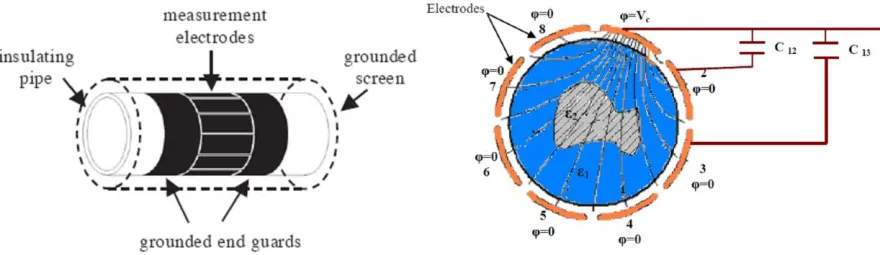
(1995), Zhu et al. (2003) and Azzopardi et al. (2010). The method can image the dielectric components in the pipe flow phases by measuring rapidly and continually the capacitances of the passing flow across several pairs
of electrodes mounted uniformly around an imaging section. Thus, the sequential variation of the spatial
distribution of the dielectric constants that represent the different flow phases may be determined. In this study,
a ring of electrodes were placed around the circumference of the riser at a given height above the injection
portals at the bottom of the 6 m riser section. This enabled the measurement of the instantaneous distribution of
the flow phases over the cross -section of the pipe. The use of two such circumferential rings of sensor
electrodes, located at a specified distance apart (also known as twin-plane sensors), enabled the determination of
the rise velocity of any observed Taylor bubbles and liquid slugs . The twin-plane ECT sensors were placed at a
distance of 4.4 and 4.489 m upstream of the air-silicone oil mixer injection portal located at the base of the riser.
Pressure drop is the driving force for flow transport and is therefore a key parameter in terms of flow rates,
stability of pipes, sizing of pumps and overall design of any two-phase system. In order to measure the pressure
drop, a differential pressure transducer (DP cell) (Rosemount 1151 smart model) with a range of 0 – 37.4 kPa
and an output voltage of 1 to 5 volts was mounted on the pipe to record the press ure drop along the vertical pipe
flow test section. The exact axial locations of the tappings are 4.5 m and 5.36 m (67 and 80 pipe diameters,
respectively) from the bottom of the test pipe flow section. Thus, the pressure drop using the DP cell was
measured simultaneously together with void fraction using ECT. The output of the DP cell was recorded
through a computer using LABVIEW 7 software (National Instruments), and was taken at a sampling frequency
of 1000 Hz over 60 seconds for each run.
The experiment was repeated two times to check measurement repeatability . The average standard deviation of
the data was2%.
The experimental data reported refer to conditions in which the rise velocity of the bubble is determined solely
11 | P a g e
properties of the air-silicone oil system and the values of the dimensionless numbers ,
Eo
,N
f andMo
arepresented in Table 1.
Table 1: Properties of the fluids and dimensionless numbers at 1 bar and at the operating temperature of
5
.
0
20
oCFluid Density (kg/m3) Viscosity (kg/ms) S urface tension (N/m)
Air 1.18 0.000018
S ilicone oil 900 0.0053 0.02
Dimensionless numbers
Eotvos number
Eo
1981
.
67
Dimensionless inverse
viscosity
N
f
9311
.
72
Morton’s number 6
10
035
.
1
Mo
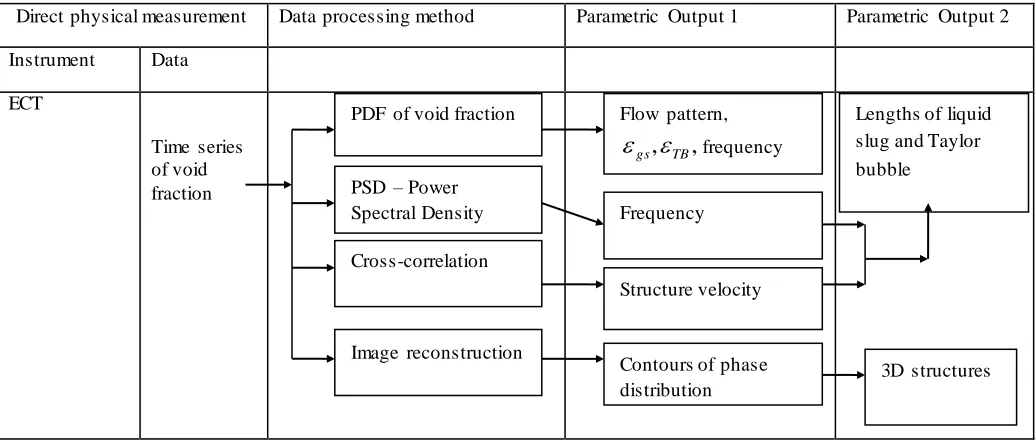
A flow chart of the various experimental measurements recorded and the parameter calculations performed to
characterise the observed slug flows are presented in Table 2.
Table 2: Table of the flowchart for experimental measurement used to obtain the parametrical characterisation of the slug flow regime
Direct physical measurement Data processing method Parametric Output 1 Parametric Output 2
Instrument Data
ECT
Time series of void fraction
PDF of void fraction
PSD – Power Spectral Density
Cross-correlation
Flow pattern,
,
,
TBgs
frequencyFrequency
Structure velocity
Lengths of liquid slug and Taylor
bubble
Image reconstruction
Contours of phase distribution
[image:11.596.79.530.167.347.2] [image:11.596.45.563.472.695.2]12 | P a g e
DifferentialPressure
transducer
Time series of pressure drop
Figure 1: A schematic diagram of the experimental riser rig. The physical measurements recorded on this rig were used to determine parameters that could subsequently be used to characterise the flow regime observed within the vertical pipe section when the flow rates of both the silicone oil and the air streams were varied.
Figure 2: The electrical capacitance tomography (ECT) sensor. The ECT uses capacitance data measured between any two of a multiple set of electrodes mounted at the periphery of the pipe of a two-component flow to be imaged. An image reconstruction algorithm then translates the measurement data into the cross -sectional data into the cross-sectional concentration map.
Total pressure drop between the two tappings of the differential pressure transducer
[image:12.596.68.519.88.424.2] [image:12.596.78.519.510.638.2]13 | P a g e
2.1 Gas-liquid mixing section:
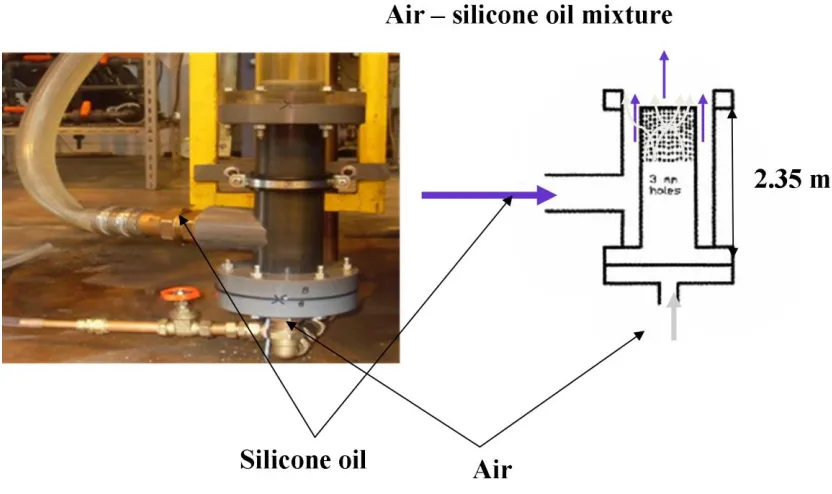
In the design of the physical experimental rig, it was ensured that the mixing section of the air and silicone oil
phases took place in such a way as to reduce flow instability. Flow stability was achieved by using a purpose
built mixing device, to provide maximum time for the two-phase flow to develop. The mixing device is made
from PVC pipe as shown in Figure 3. The silicone oil enters the mixing chamber from one side and flows
around a perforated cylinder through which the air is introduced through a large number of 3 mm diameter
orifices. This arrangement ensures that the gas and liquid flows were well mixed at the entry to the test section.
The inlet volumetric flow rates of the liquid and air were determined by a set of rotameters located above a set
of valves on the two inlets feed flow pipes.
Figure 3: Air-silicone oil mixing section
2.2 Measurement uncertainties :
Using the propagation of error analysis, the maximum uncertainties in the liquid and gas superficial velocities,
void fraction and pressure drop are summarized in Table 3. It should be noted that the uncertainties changed
based on the flow conditions and the uncertainties presented in Table 3 show the minimum to maximum ranges.
Table 3: Measurement uncertainties
Measurement Uncertainty range
[image:13.596.89.505.294.541.2] [image:13.596.64.532.690.766.2]14 | P a g e
Liquid superficial velocity (m/s)
10 %Gas superficial velocity (m/s)
0.5 – 5 %Void fraction
10 % of the readingPressure drop
0.44 of scale3. Determination of the characterisation parameters :
3.1 Translational velocity of a Taylor bubble orRise velocity of a Taylor bubble (Structure velocity):
A cross-correlation was performed between the time varying void fraction data measured by the twin ECT-
planes located at 4.4 and 4.489 m above the mixer section at the base of the riser. This allows the determination
of the time for individual slugs to travel between the two ECT-planes, and hence the calculation of the structure
velocity,UN. A typical void fraction time trace from the two ECT probes is shown in Figure 4.
Figure 4: Void fraction time series from the two ECT probes . The bold and thin lines represent time series of void fraction from ECT-plane 1 and ECT-plane 2, respectively.
The cross-correlation operation gives the degree of linear dependence between two time series data sets, a and b.
It was calculated as the average product of
a
a andb
b. This average product gave the covariance of aand b in the limit as the sample approaches infinity. For any time delay
, the covariance function between a (t) [image:14.596.137.457.335.587.2]15 | P a g e
ab a bT
b a
b a
ab
a
t
b
t
dt
R
T
t
b
t
a
E
C
(
)
(
)
lim
1
[
(
)
(
)
]
(
)
0
(20)
Where
Tab
a
t
b
t
dt
T
R
0)
(
)
(
1
lim
)
(
(21)The correlation coefficient is defined as:
)
)(
)
0
(
(
)
(
)
0
(
)
0
(
)
(
)
(
2 2 b bb a aa b a ab bb aa ab abR
R
R
C
C
C
(22)Details may be found in Bendat and Piersol (1980).These equations were then programmed as a computational
MACRO program to determine the structure velocity of the liquid slug body.
3.2 Liquid film thickness :
The liquid film thickness could not be measured directly using the ECT. However, t he expression proposed by
Fernandes et al. (1983) to describe the thickness of the falling liquid film in the Taylor bubble region,
TB
D
1
2
(23)was used to determine it, where,
, represents the liquid film thickness in mm, Dinternal pipe diameter in mmand
TBis the experimental measured void fraction in Taylor bubble.3.3 Slug frequency:
The slug frequency is defined as the number of slugs passing through a defined pipe cross -section in a given
time period. To determine the frequency of periodic structures (slugs) the methodology of Power Spectral
Density (PSD) as defined by Bendat and Piersol (1980) was applied. PSD is a measure of how the power in a
signal changes over frequency and therefore, it describes how the power (or variance) of a time series is
distributed with frequency. Mathematically, it is defined as the Fourier Transform o f the autocorrelation
sequence of the time series. The method presents the power spectrum density functions in terms of direct
16 | P a g e
d
e
R
f
S
ab(
)
ab(
)
j2f (24)Equation (24) is the cross -spectral density function between a (t) and b (t). For the special case where a (t) =b (t),
R
e
d
f
S
j fbb ab 2
)
(
)
(
(25)Equation (25) represents the power spectral density (PSD) function.
3.4 Lengths of the slug unit, the Taylor bubble and the liquid slug:
Khatib and Richardson (1984) determined the lengths of the liquid slug and Taylor bubble as follows:
S TB
SU
L
L
L
(26)They took a volume balance over the slug unit
gs S TB TB g
SU
L
L
L
(27)gs S TB S SU g
SU
L
L
L
L
(
)
gs S TB S TB SU g
SU
L
L
L
L
TB S gs S TB SU g
SU
L
L
L
L
)
(
)
(
g TB S gs TBSU
L
L
(28)TB gs TB g SU S
L
L
(29)Equation (29) above is the equation for determining the overall length of the liquid slug based on the knowledge
of the overall velocity of the slugs. However, the interest is in determining the lengths and velocities of
individual slugs. This therefore necessitated a new method of achieving this. The following section will look at
17 | P a g e
A slug unit is a Taylor bubble and the following liquid slug. The length of a slug unit is determined from the
knowledge of the structure velocity of the Taylor bubble and the slug frequency. The length of the slug unit was
obtained as shown in equation (31). The lengths of the different zones of the individual slug unit have been
determined for a range of different liquid and gas flow rates. The time of passage of the individual slug unit,
Taylor bubble and liquid slug have been determined from an analysis of the output time series from the twin
-planes of the ECT signals. The time of passage for the slug unit, the Taylor bubble and the liquid slug, were then
assumed to be proportional to the lengths of the slug unit, Taylor bubble and liquid slug, respectively.
Relationships were then obtained to estimate the lengths of the individual Taylor bubble and the liquid slug as
described below. Equations (31), (38) and (39) are employed to determine the lengths of the slug unit, liquid
slug and Taylor bubble, using parameters evaluated from the recorded measurements.
SUN
L
U
(30)where,
is a time for a slug unit to pass the probe. If the slug/Taylor bubble are uniformf
1
. Where, f isthe slug frequency.
Therefore,
f U
L N
SU (31)
For an individual slug unit, assuming steady state so that the front and back of the slug have the same velocity
SUi SUi kt
L (32)
TBi Ni TBi
U
t
L
(33)Si Ni Si
U
t
L
(34)Dividing equation (33) by (34) yields the expression
c kt kt L L
Si TBi Si
18 | P a g e
Si TBi
cL
L
(36)However,
Si TBi
SUi
L
L
L
(37)Substituting equation (36) into (37) and rearranging yields the expressions
1
c
L
L
Si SUi (38)Si SUi
TBi
L
L
L
(39)4. Results and discussion
Khatib and Richardson (1984) and Costigan and Whalley (1997) proposed that twin peaked probability density
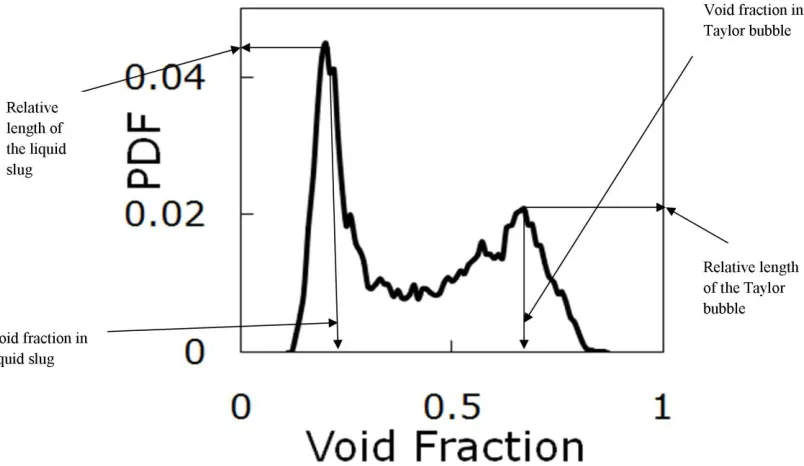
function (PDFs) of recorded void fractions represent slug flow as shown in Figure 7. The low void fraction peak
corresponds to liquid slug while the high void fraction peak is for Taylor bubble. Following the PDF approach,
it has been determined that the experimental flow rates that create a slug flow regime within the riser are a liquid
superficial velocity of 0.05 to 0.38 m/s and a gas superficial velocity of between
0
.
42
U
SG
1
.
35
m
/
s
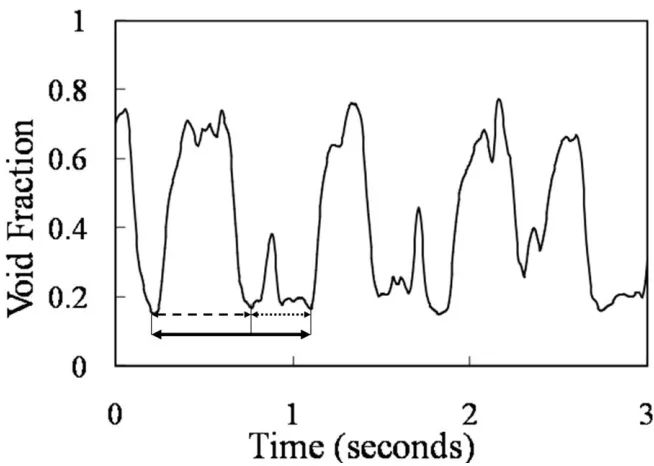
.This is also depicted on Shoham’s flow pattern map, Figure 5. The time trace of void fraction showing liquid
slug, Taylor bubble and slug unit is also shown in Figure 6. The PDF was determined by counting the number of
data points in bins of width 0.01 centred on void fractions from 0.005, 0.015....0.995, and then dividing each
sum by the total number of data points . They confirm the dominant void fractions which are observed at each
19 | P a g e
Figure 5: Shoham (2006) flow pattern map showing experimental data points . All experimental conditions lie in the slug flow region.
Figure 6: Time trace of void fraction showing liquid slug , Taylor bubble and slug unit. Dash line represents Taylor bubble, dotted line represents liquid slug and bold line, slug unit.
The structure velocity, liquid film thickness, slug frequency, lengths of liquid slug, Taylor bubble and slug unit,
determined using the methods above, were arranged over the total number of slugs for the given experimental
[image:19.596.149.445.71.312.2] [image:19.596.133.460.361.594.2]20 | P a g e
Figure 7: PDF of cross-sectional average void fraction for the case of slug flow measured from the experiments using air-silicone oil. The location of the peak in the low void fraction region represents the average void fraction in liquid slug, while its height represents the relative length of the liquid slug section.
4.1 Validation (Testing) of ECT Data:
In order to validate the ECT data, the results are compared against wire mesh senso r (WMS) results. The
capacitance WMS technology, placed at 4.92 m away from the mixing section (73 pipe diameters), described in
detail by da Silva et al. (2010), can image the dielectric components in the pipe flow phases by measuring rapidly and continually the capacitances of the passing flow across several crossing points in the mesh. It should
be noted that it was not possible to mount the WMS upstream of the ECT sensor, since a visual examination
concluded that the intrusive wire mesh of the WMS chang ed the nature of the flow completely by breaking up
large bubbles and temporarily homogenizing the flow immediately downstream of the device. The large bubbles
were observed to re-form within approximately one pipe diameter.
In this study, the ECT measurement transducer was used to give detailed information about air-silicone oil flows
whilst the WMS as a check on the void fraction measurement accuracy. It presents results of validation (testing)
carried out to give ourselves confidence in the results pres ented by the instruments. Experimental
measurements have been recorded with the aid of the above instrumentation at a liquid superficial velocity of
0.05 – 0.38 m/s and for air flow rates in the range 0.05 – 4.73 m/s. The flow patterns covering these liqu id and
gas flow rates are spherical cap bubble, slug flow and churn flow as shown in Figure 8. The electronics
21 | P a g e
enable simultaneous recordings. The sampling frequencies of the ECT and WMS measurement transducers were
1,000 Hz. A great deal of information may be extracted from an examination of the time series of the cross
-sectionally averaged void fractions. In particular, the probability density function (PDF) of the observed void
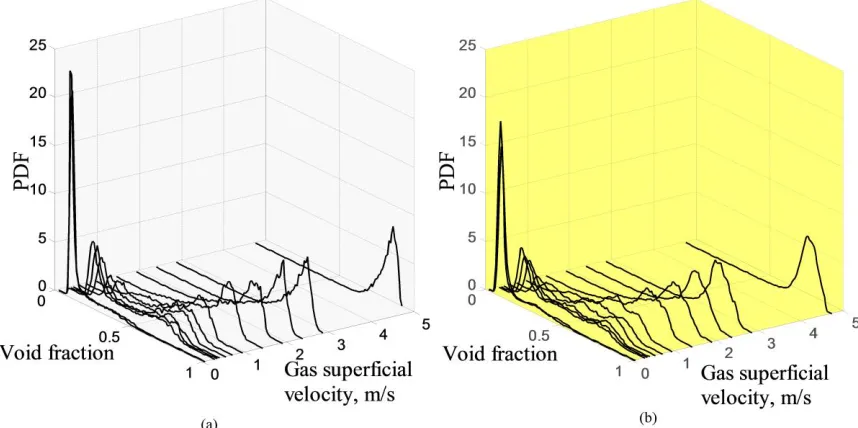
fractions can have characteristic signatures. Figure 8 shows a 3-D plot of the PDF of the void fractions recorded
by the ECT and WMS measurement transducers. The data presented on the figure illustrates the good agreement
between the two methods of measurements. Some of the minor differences may be due to the fact that the ECT
measures over larger axial distances than that of the WMS.
Figure 8: Comparison of 3-D plot of PDFs of void fraction obtained from the (a) ECT and (b) WMS. Liquid superficial velocity = 0.05 m/s
4.2 Structure velocity of the Taylor bubble:
The structure velocity of the Taylor bubble is considered to be made up of two main components, namely, the
maximum mixture superficial velocity in the slug body and the drift velocity. Figure 9 shows a plot of the
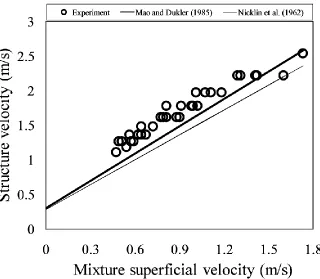
structure velocity as a function of the mixture superficial velocity. As expected, a linear relationship is obtained
between them. The drift velocity for the experimental data can be taken as the y -intersection of a line that fits
the data, while the flow distribution coefficient is given by the slope of the line. The empirical equations
[image:21.596.82.511.246.460.2]22 | P a g e
Figure 9: Experimentally measured s tructure velocity versus mixture superficial velocity. The empirical equations proposed by Nicklin et al. (1962) and Mao and Dukler (1985) were recalculated using the physical properties of air and silicone oil.
It can be observed that the Nicklin et al. (1962) relation, with flow distribution coefficients of 1.2, under predicts the Taylor bubble velocity over the range of flow conditions of the present work. From the present data,
the value obtained for the flow distribution coefficient is 1.16. However, the experimental drift velocity is higher
than the values predicted by the correlations. This could be due to the assumptions made by Nicklin et al. (1962) regarding the condition of single Taylor bubble moving in static liquid which is in contrast with the s ituation in
the present experiment, where continuous moving liquid has been used. In addition, the drift velocity obtained
by them did not consider the effect of surface tension and viscosity. The predictions of Mao and Dukler (1985)
also differ from the present experimental results, but over predict the flow distribution coefficient as compared
to that of Nicklin et al. (1962). This can be because Mao and Dukler (1985) have considered that the liquid slug in front of the Taylor bubble is aerated, and coalescence takes place between the small bubbles and the Taylor
bubbles, as the Taylor bubbles move through them at a higher velocity. Therefore, this results in an increase in
the structure velocity of the Taylor bubble. Mao and Dukler (1985) also did not co nsider the role of surface
tension and viscosity in obtaining their drift velocity.
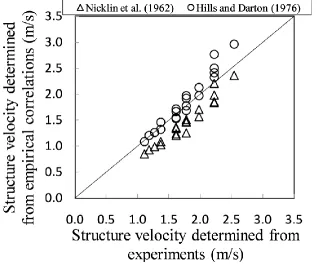
Another comparison made here is concerned with comparing experimentally measured structure velocity,
[image:22.596.138.458.72.351.2]23 | P a g e
between experiment and Hills and Darton (1976) correlation. Hence, in the absence of experimental data, the
Hills and Darton (1976) correlation should be used for predicting structure velocity as evidenced in Figure 9.
Figure 10: Experimentally measured structure velocity, Nicklin et al. (1962) and Hills and Darton (1976) correlations against mixture superficial velocity
[image:23.596.158.435.128.400.2] [image:23.596.141.458.444.711.2]24 | P a g e
4.3 Void fraction in liquid slug, Taylor bubble and liquid film thickness :
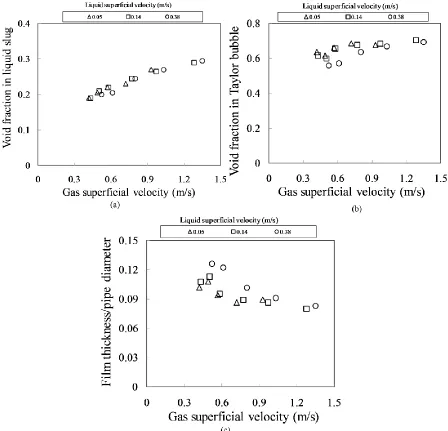
The plot in Figure 12a shows that the void fraction in the liquid slug increases linearly with an increase in the
gas superficial velocity for a constant liquid superficial velocity. This may be explained by the fact
that an
increase in gas superficial velocity may increase bubble population and as such provoke an increase in
void fraction.
This is similar to the conclusion reported by other authors such as Ma o and Dukler (1991) andNicklin et al. (1962). However, it is also observed that the liquid flow rate has a less noticeable effect on the void fraction in the liquid slug.
Figure 12b presents a plot of the void fraction in the Taylor bubble against the ga s superficial velocity. It is
observed that the void fraction in the Taylor bubble increases as the gas velocity increases. At liquid superficial
velocities of between 0.14 - 0.38 m/s, an exponential relationship is established between the void fraction in the
Taylor bubble and the gas superficial velocity. Contrary to this, at a liquid superficial velocity of 0.05 m/s, the
void fraction in the Taylor bubble decreases a little and then increase from 0.62 to 0.68 m/s, until the terminal
gas superficial velocity is reached and then it drops to about 0.92 m/s. As the gas flow rate is increased, there is
an increase in the bubble population observed in the liquid slug, which may then coalesce with the Taylor
bubble. It is proposed that this phenomenon may be res ponsible for the increase in the void fraction of the
Taylor bubble. The drop in the void fraction in the Taylor bubble may be explained by a collapse of the Taylor
bubble and may then be regarded as a transition towards a spherical cap bubble.
Since, the measured void fractions in the liquid slugs and Taylor bubbles have been found to increase with an
increase in gas superficial velocity for a constant liquid superficial velocity, the liquid film thickness, shown in
25 | P a g e
[image:25.596.73.521.85.516.2]
26 | P a g e
Figure 13: A plot of the relationship between the void fraction in the liquid slug and the mean void fraction
Figure 13 shows a plot of the void fraction in the liquid slug against the mean void fraction. The values of the
mean void fractions were obtained by averaging the time-series of the cross -sectional void fraction recorded by
the ECT. A comparison of this data with the data measured by Akagawa and Sakaguchi (1966) and Mori et al. (1999) concludes that the current experimental data shows good agreement with the model proposed by Mori et al. (1999). However, the data does not fit well the empirical model propose d by Akagawa and Sakaguchi (1966) for medium mean void fractions, whilst the experimental data are greater than those predicted by the empirical
models for the lower mean void fractions, and lower than the higher mean void fractions.
It is interesting to observe from the plot that for
0
0
.
25
, the flow pattern is bubbly flow whilst for65
.
0
25
.
0
and0
.
65
0
.
80
, the flow patterns are slug and churn flows, respectively.4.4 Total pressure and frictional pressure drop:
The total pressure drop was measured with a differential pressure transducer (DP cell) whose taps were placed
around the twin-plane ECT, whilst the frictional pressure drop was obtained by subtracting the gravity term
27 | P a g e
Figures 14a shows a decrease in the total pressure drop due to an increase in gas superficial velocity. On the
contrary, in Figure 14b the frictional pressure drop is observed to increase.
The observed decrease in the total pressure drop can be explained by the fact that the flow in the riser is gravity
dominated, i.e., the major contributor to total pressure drop in a vertical pipe is static pressure drop (mg). In
addition, an increase in gas superficial velocity, will promote an increase in the void fraction, thereby reducing
the mixture density as a consequence of a decrease in the liquid hold up. However, the velocities encountered
are not high enough to cause high frictional pressure drops. Consequently, the total pressure drop decreases with
an increase in gas superficial velocity.
On the other hand, the frictional pressure drop increases with gas superficial velocity, but the rate of increase at
higher gas superficial velocities is lower compared to that at lower gas superficial velocity. These observations
support the phenomena recently reported by Mandal et al. (2004), who worked on a vertical 51.6 mm internal diameter pipe using an air-non-Newtonian liquid system in co-current downflow bubble column. It is also
interesting from Figure 14b that lower pressure drops are observed at higher liquid superficial velocities for the
same gas superficial velocity. These phenomena may be explained by considering the increa sing drag
experienced by the bubbles and the coalescence of gas bubbles. At higher liquid superficial velocities,
the
liquid hold-up,
H
L, increases whilst on the other hand, the liquid true velocity (
L SLH
U
) decreases. These
therefore bring about a corresponding decrease in frictional pressure drop.
Similar observation andconclusion was previously reported by Mahalingam and Valle (1972) (liquid -liquid system), Friedel (1980)
28 | P a g e
Figure 14: The influence of the gas superficial velocity on the total and the frictional pressure drop. The total pressure drop was measured with a differential pressure cell connected around the twin-plane ECT. : Refers to liquid superficial velocity of 0.05 m/s; : liquid superficial velocity of 0.14 m/s; : liquid superficial velocity
of 0.38 m/s
It is concluded that the lower the mixture density, the lower will be th e measured total pressure drop. It is
further concluded that the rate of increase in the frictional pressure drop at lower gas superficial velocities is
much higher than that recorded within the higher gas superficial velocity region. This increase can be explained
by the fact that an increase in gas superficial velocity causes higher production of gas bubbles, which in turn
increases the true liquid velocity due to a decrease in the liquid holdup.
4.5 Frequency:
Here, individual slug frequency was determined using the methodology of:
1) Power spectral density (PSD)
2) Manual counting of visible slugs as can be observed on the void fraction time series using a threshold
value
1. Slug frequency determination using PSD:
The slug frequency is found to increase with th e liquid superficial velocity, Figure 15. Slug frequency varies
between 3.2 to 1.4 Hz. The liquid superficial velocity strongly affects the frequency of the periodical structures
in intermittent flows such as spherical cap bubbles and Taylor bubbles. For t he lowest liquid superficial
[image:28.596.76.547.75.276.2]29 | P a g e
increased to 0.14 m/s, the frequency is observed to show a low influence of gas superficial velocity. However, at
the highest liquid superficial velocity, the frequency decreased and then increased a little, having a minimum at
0.8 m/s, gas superficial velocity. This behaviour might be attributed to the observed changes in the flow pattern
associated with a change in the liquid superficial velocity. These observations supported the findings of previous
studies in horizontal gas -liquid flow including Hubbard (1965), Taitel and Dukler (1977), Jepson and Taylor
[image:29.596.148.446.223.493.2](1993), Manolis et al. (1995).
Figure 15: Variation of slug frequency with gas superficial velocity at different liquid superficial velocities. The error bar represents standard deviation
2. Slug frequency determination using the manual counting method:
Visible slugs were manually counted from the void fraction t ime series plots and their respective frequencies
determined. The determined slug frequencies are then compared with those obtained using the PSD method in
order to determine the degree of agreement. However, it is worth mentioning here that with the manual counting
method, it is not always clear which peaks from the time series of void fraction are clear enough to be counted
as slugs. In order to circumvent this challenge, the criterion p roposed by Nydal (1991) was used which involved
30 | P a g e
observe from Figure 16 that using different values for the threshold will result in different number of slugs;
[image:30.596.103.495.133.365.2]hence different frequencies will be obtained.
Figure 16: Threshold of the void fraction used in counting slugs . The dotted line represents threshold criterion for identifying liquid slugs as suggested by Nydal (1991).
[image:30.596.113.480.408.719.2]31 | P a g e
It can be observed from Figure 17 that there is a reasonably good agreement between the slug frequencies
obtained using PSD and manual counting method. The observed small variations can be attributed to the
threshold void fraction value of 0.3 used as a bench mark for counting.
Comparison of experimentally determined slug frequency against slug frequency obtained from empirical correlations:
Here, the measured slug frequency is compared with correlations proposed by Gregory and S cott (1969),
Zabaras (1999) and Hernandez-Perez et al. (2010). Zabaras (1999) suggested a modification to the Gregory and Scott (1969) correlation for horizontal pipes, where the influence of pipe inclination angle was built -in.
Hernandez-Perez et al. (2008) on the other hand, modified the Gregory and Scott (1969) correlation to adapt it to vertical frequency data. This they achieved via the examination of data from 38 and 67 mm internal diameter
pipes using air-water as the model fluids. They showed that for the vertical case, the most suitable values for the
power and pre-constant are 0.2528 and 0.8428, respectively. The slug frequency correlations proposed by
Gregory and Scott (1969), Zabaras (1999) and Hernandez-Perez et al. (2010), equations (40), (41) and (42), respectively are as follows:
2 . 1
75
.
19
026
.
0
M M SL sU
U
gD
U
f
(40)
Sin
U
U
gD
U
f
M M SLs
0
.
836
2
.
75
75
.
19
026
.
0
2 . 1
(41)25 . 0
75
.
19
8428
.
0
M M SL sU
U
gD
U
32 | P a g e
[image:32.596.81.511.67.472.2]33 | P a g e
Figure 19: Comparison between the experimental data and the other considered empirical correlations
From Figure 18, it can be observed that the Zabaras (1999) correlation show a wide disagreement with the
current data at all liquid superficial velocities considered compared to the Hernandez-Perez et al. (2010) correlation. This may be due to the fact that Zabaras (1999) con sidered only small angles of inclination from the
horizontal. For this reason, using this correlation in determining slug frequency in order to obtain slug length
may result in astronomical deviation. It is interesting to conclude based on Figures 18 and 19 that the
Hernandez-Perez et al. (2010) correlation gave the best agreement with the current experimental data and hence more satisfactory to predict slug frequency in the absence of experimental data.
For the analysis of oscillating unsteady fluid flow dynamics problems, a dimensionless value useful is the
Strouhal number. It represents a measure of the ratio of inertial forces due to the unsteadiness of the flow to the
inertia forces due to changes in velocity from one point to another (Abdulkadir (2011)).
34 | P a g e
SL
U
fD
St
(43)In Figure 20a, the Strouhal number based on the liquid superficial velocity is shown as a function of liquid
quality on a log-log plot. The liquid quality is defined as the ratio of liquid superficial velocity to mixture
superficial velocity.
Liquid quality,
SG SL
SL
U
U
U
X
(44)The relationship between Strouhal number and the Lockhart -Martinelli parameter is shown in Figure 20b again
on a log-log plot. The Lockhart-Martinelli parameter is defined as the square root of the pressure drops for the
liquid part of the flow flowing alone in the pipe divided by that for the gas and it is approximately equal to the
ratio of liquid and gas superficial velocities times the square root of the liquid to gas density ratio (Abdulkadir
(2011)):
Lockhart-Martinelli parameter,
SG SL G L
U
U
X
(45)Each plot exhibits a decrease in the Strouhal as the liquid quality or the Lockhart -Martinelli parameter increases.
Figure 20a shows the existence of three distinct regions of the Strouhal number for different values of the liquid
quality in the range 0.1<liquid quality< 0.5. The lower frequency Strouhal number is attributed to the large
scale instability of the liquid slug region. The higher frequency Strouhal number is caused by small scale
instabilities from the separation of the shear layer. The same trend can be observed for the variation of Strouhal
35 | P a g e
Figure 20: Log-log plot of the dimensionless Strouhal number versus (a) the liquid quality (b) the Lockhart-Martinelli parameter.
4.6 Lengths of the liquid slug, the Taylor bubble and the slug unit:
The lengths of the Taylor bubble and the slug unit are found to increase with a corresponding increase in the gas
superficial velocity, for a constant liquid superficial velocity as a parameter. It is observed that the lengths of the
Taylor bubbles and the slug units exhibit similar trends, showing a maximum stable length before a break up
(collapse). Therefore this suggests that the breakup could be a transition to churn flow as suggested by Hewitt
[image:35.596.84.513.70.281.2]36 | P a g e
[image:36.596.74.505.69.467.2]
Figure 21: Influence of gas superficial velocity on the ratio of average lengths of the liquid slug, Taylor bubble and slug units to pipe diameter. The error bar represents standard deviation. These lengths were determined for an experimental measurement averaging period of 60 seconds.
The average lengths of the liquid slugs as a function of the gas superficial velocity at various liquid flow rates
are shown on Figure 21(a). It can be concluded that there is no clearly defined trend for the variation of the
liquid slug with gas superficial velocity. However, it is interesting to note that at liquid superficial velocity of
0.38 m/s, the length of the liquid slug increases from approximately 6 to 9 pipe diameters and then decreases
finally to about approximately 6 pipe diameters. According to Moissis and Griffith (1962), the mean slug length
for the case of vertical pipe is almost in the range of 8 – 25 pipe diameters. The qualitative shape of the best fit
curve is a triangle, with a maximum at the top vertex. The stable liquid slug length is reported to be between 10
to 20 D (Moissis and Griffith (1962); Akagawa and Sakaguchi (1966); Fernandes (1981); Barnea and Shemer