ISSN Online: 2151-4771 ISSN Print: 2151-4755
DOI: 10.4236/ce.2019.1012207 Nov. 28, 2019 2804 Creative Education
Framework of “No-Show Phenomenon” for
Admission Offers to Higher Institutions
among Students
Mohd Effendi Ewan Mohd Matore
1*, Nordin Abd Razak
21Centre of Educational Planning and Policy, Faculty of Education, Universiti Kebangsaan Malaysia, Bangi, Malaysia 2School of Educational Studies, Universiti Sains Malaysia, Penang, Malaysia
Abstract
Every year there are many students who get admission to higher education institutions. However, there are many factors that influence the choice of students to higher education. These factors can be explained through several models or theories. This paper aims to discuss the theories that explain the “No-Show Phenomenon”. The theory chosen is the Choice Theory and is supported by several models that can be used namely Economic Model, Social Model and Combined Model. This model is supported by the applications of Push and Pull Theory. This study contributes to the extent to which this “No-Show Phenomenon” framework model to explain the factors influencing the failure of the candidate to study at the first degree of enrollment as a Higher Educational Institutions student, despite being offered a place of study at the university after going through several test and qualification processes to determine the merits and qualifications of the student.
Keywords
No-Show Phenomenon, Admission, Higher Institutions, Framework
1. Introduction
Excellent student generally has many types of intelligence. Previous studies show-ing associations between intelligence have been made in the local context (Mohd
Effendi Ewan, 2019a,2019b;Mohd Effendi Ewan & Ahmad Zamri, 2016). This
intelligence helps students overcome the challenges of life has been exposed in previous studies in the context of higher education (Ahmad Zamri & Mohd
Ef-fendi Ewan, 2017;Mohd Effendi Ewan et al., 2017). Other than this type of
intel-How to cite this paper: Matore, M. E. E. M., & Razak, N. A. (2019). Framework of “No-Show Phenomenon” for Admission Offers to Higher Institutions among Stu-dents. Creative Education, 10, 2804-2814. https://doi.org/10.4236/ce.2019.1012207
Received: October 21, 2019 Accepted: November 25, 2019 Published: November 28, 2019
Copyright © 2019 by author(s) and Scientific Research Publishing Inc. This work is licensed under the Creative Commons Attribution International License (CC BY 4.0).
DOI: 10.4236/ce.2019.1012207 2805 Creative Education ligence, students also need the intelligence to make choices in life. One of the important decisions that vital for them is a decision to pursue their study to higher educational institutions. The students’ decisions about pursuing study in higher education are based on a number of issues.
Firstly, students who finish high school need to decide whether to pursue higher education. Secondly, students who choose to pursue their studies must make choices about programs or areas of higher education and institutions. There are also choices and criteria that influence the choice of students of insti-tutions of higher learning. Some models or theories try to explain the factors that influence students’ choice to study at a higher education institution.
This study aims to focus on issues related to the failure of candidates to pur-sue their first degree at the Institution of Higher Learning (IPT) and to enroll as students despite being offered a place at the HEIs after undergoing various test-ing and qualification processes to determine merit and eligibility the student. Therefore, the question is what factors are causing these students to not register at the HEIs even though they have been offered a place based on their applica-tion to the HEIs. What are the factors that cause them to stay or leave university? This paper aims to discuss the theories that explain the “No-Show Phenome-non”. The theory chosen is the Choice Theory and is supported by several models used in this study namely Economic Model, Social Model and Combined Model. This model is supported by the use of Push and Pull Theory.
2. Choice Theory
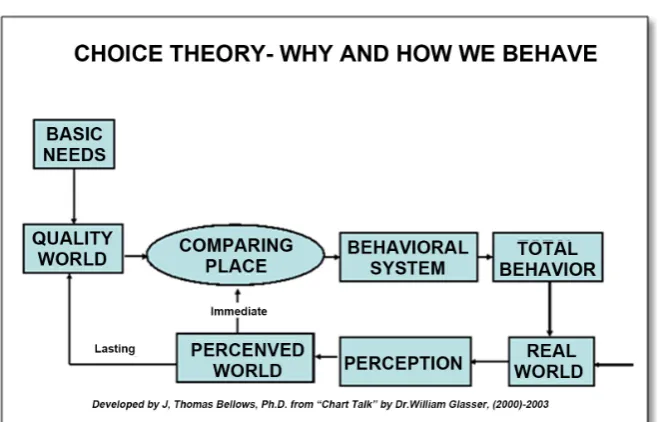
There are many theories categorized under cognitive theories such as Cognitive Theory of Behavior, Emotional Reasoning Theory of Behavior, Reality Therapy Theory and others. One of the theories that can explain how a person makes choices is Choice Theory introduced by William Glasser (1998). This theory ex-plains that although a human being generally shares the same needs, the beha-vior of an individual in meeting the needs they are different. From the very be-ginning of life or birth, each person has his or her own life that can be either fun or sad. With it, we begin to know how to meet our needs. Because of each per-son’s experience is different, they will apply different ideas and learn them diffe-rently to meet their needs.
DOI: 10.4236/ce.2019.1012207 2806 Creative Education Figure 1. Choice theory—why and how we behave.
behavior builds on successful identities and ineffective behavior builds on failed identities.
Glasser (2000) sees human problems as a result of unmet basic needs. Basic
needs include five basic needs that are 1) to love and to be loved; 2) to gain pow-er and keep respect; 3) fun; 4) desire for freedom and 5) to survive and be se-cured. According to Glasser (1986) psychological desire includes an individual who loves and wants to be loved by others, wants honor from others, wants freedom and wants happiness. This loving and caring aspect includes the needs of love, intimacy, sense of belonging to family, friends, employers and others. The desire to reward includes the need for achievement, skill, efficiency, influ-ence. Choice Theory also emphasizes the nature of individual responsibility.
Glasser (1965) defines responsibility as the ability to meet a need, and willing to
face obstacles to meet the needs. Glasser (1998) also rejects the concept of dreams without relying on reality.
DOI: 10.4236/ce.2019.1012207 2807 Creative Education want freedom, to want happiness and to want to live. We will be satisfied after choosing to fulfill all our wishes. In the event of a conflict between self-will, it affects behavior, thinking, feeling and physiology.
3. Selection Models to the IPT
The model choices for institutions of higher learning is as follows: a) Economics model; b) Sociology models and c) Combined models.
3.1. Economics Model
The economic model for human capital development emphasizes rational deci-sion-making when studying student selection. Individuals are expected to act ra-tionally in ways that maximize their utility, through their own personal choices. Students choose institutions based on the level and value that each institution offers through cost comparisons with perceived benefits. The assumption of an economic model is that students will choose a particular institution when the advantages gained by enrolling in that institution are greater than the benefits they receive when enrolling in another institution.
Some recent studies have focused on the effects of financial factors such as family income, low tuition, scholarships and financial aid (Azarcon, Gallardo, Anacin, & Velasco, 2014; Kitsawad, 2013; Koe & Siti Noraisah Filaring, 2012;
Kusumawati, 2013; Mehboob, Shah, & Bhutto, 2012; Ojo & Raja Nerina Raja
Yusofu, 2013). However, Paulsen (2001) states that students’ perceptions of
economic benefits and higher education costs are different because financial factors are less significant. These include differences in expectations of benefits and costs that may be based on differences in access to college information or differences in contextual aspects, including factors related to family, school, or community, higher educational contexts, and/or social, economic, and basic contexts.
3.2. Sociology Model
The sociological model is different from the economic model. The economic model assumes that students rationally decide which higher education institu-tion offers the highest value. The sociological model describes the process that considers the elements of decision making that develop throughout a student’s life. The sociological approach to college choice often emphasizes the ways in which socio-economic characteristics influence student decisions. According to sociological approaches, student behavior variables (e.g., academic perfor-mance); interact with background variables (for example, parental social status) to determine student educational aspirations.
DOI: 10.4236/ce.2019.1012207 2808 Creative Education The model suggests that educational aspirations are determined by academic achievement and achievement and socio-economic status (Hossler, Schmit, &
Vesper, 1999). Recent research focuses on the ways in which sociological
con-structs in cultural and social development affect students’ choice of college. Like human capital, cultural and social capital also increases productivity. Cultural capital refers to a system of attributes such as language skills, cultural know-ledge, and decency, derived partly from parents and which determine an indi-vidual’s class status (Bourdieu, 1986). Simple and upper-class individuals have the most important form of cultural capital (McDonough, 1997).
Individuals who do not have the cultural capital needed may underestimate their educational aspirations because they do not know certain cultural norms. Social capital is closely linked to cultural capital and focuses on social networks and the ways in which it is maintained. Coleman (1988) suggested that parents play a major role in promoting their children’s social capital while Bourdieu
(1986) argues that social capital comes from social networks.
Sociological approaches are useful in understanding the ways in which struc-tural constraints and opportunities shape individuals’ perspectives and orienta-tions toward college choices. Sociological approaches are also useful for explor-ing the differences between college and group choices. Bourdieu (1986) argues that barriers are based on race/ethnicity, class, and gender that impede access to institutional resources. Individual systems such as thoughts, beliefs, perceptions, as well as the types of cultural and social capital they possess, partly reflect an individual’s race/ethnicity, class, and gender (Horvat, 2001). The sociological approach also does not offer a framework for studying how individuals ulti-mately decide whether to pursue higher education, apply for colleges, or enroll in specific colleges or universities (Manski & Wise, 1983).
3.3. Combined Model
The Combined Model includes the most important indicators or indicators of the Economic Model and the Sociological Model in the decision-making process
(Joseph & Joseph, 1998, 2000). This model allows for a great deal of analytical
power, a combination of sociological perspectives and rational decision-making. The discussion will involve three types of combined models: a) Jackson Model; b) Chapman’s model; and c) Hanson and Litten models.
3.3.1. Jackson Model (1982)
This model proposes that students’ choice of college includes three levels of priority, exclusion and evaluation.
a) Priority Level
Jackson explained that priorities include student aspirations and views of col-lege enrollment, which are shaped by the student’s academic achievement, fami-ly background and social context (for example, peer influence, neighborhood, and school).
DOI: 10.4236/ce.2019.1012207 2809 Creative Education In the second stage of this exclusion phase, students will go through the process of removing some institutions from the potential list. Tuition fees, loca-tion, and academic quality are among the factors to be considered in eliminating higher education institutions.
c) Evaluation Level
In the final stage of the evaluation phase, students are faced with a set of in-stitutional choices; they make their final choice using a rating scheme.
3.3.2.Chapman (1981) Model
This model emphasizes that college choice by students is influenced by a set of student characteristics in combination with a series of influences—external in-fluences. External influences can be classified into three categories: a) significant individual influence; b) the permanent features of the institution; and c) the in-stitution’s own efforts to communicate with prospective students. Both student characteristics and external influences contribute to the formation of general expectations of college life.
3.3.3. Hanson (1989) Dan Litten Model
This model explains that college selection is an ongoing process. The process consists of five steps: a) college aspirations; b) initiate the search process; c) col-lecting information; d) submit an application; and finally, e) sign up. Hanson and Litten identified a set of variables that influence college choice processes, in-cluding:
a) Background features (for example, parental income, education, gender); b) Personal characteristics (e.g., academic ability, class rank, and self-image); c) High school characteristics (e.g., social composition, programs, and curri-culum);
d) College features (e.g., cost, size, program, timeliness in answering ques-tions).
They also introduced public policies, such as financial support, as interme-diary variables. The Hanson and Litten models are a mix between the stu-dent-based model Jackson and the more institutional-based model Chapman.
4. Push and Pull Model
The push and pull theory in this study is used as a theoretical framework in de-termining the factors that influence a student’s choice of educational institution to pursue further studies. Dissociation factors mean internal motives that influ-ence students to study at an institution while factors of attraction explain exter-nal motives that determine that student’s choice. A study by Mazzarol & Soutar
(2002) concluded that push factors mean that a country’s resources are the
driv-ing factor in students’ decision to study abroad, while pull factors mean that factors in the host country attract foreign students to a particular country.
McMahon (1992) conducted a preliminary study of the factors that influence
DOI: 10.4236/ce.2019.1012207 2810 Creative Education States in the 1960s and 1970s. The first model involves push factors from a country’s resources, including higher education and economic strength of each country. The second model focuses on economic, political, and social factors as a pull factor for the United States as a destination for higher education.
Almost all research on international student motivation and decision-making has been conducted since McMahon adopted the “push-pull” framework. One of the most cited studies is Mazarrol & Soutar (2002). They studied the motivations of 2485 students who had traveled from four different Asian countries to Aus-tralia to pursue postgraduate studies. Mazzarol and Soutar (2002) conclude that push factors function in a resource-rich country to initiate students’ decision to study abroad, while pull factors operate in a host country to attract students to a particular country compared to other countries.
Factors commonly cited in the literature are lack of capacity and opportunities in the home country of the student, lower quality of education, employer prefe-rence for overseas education, lack of specific subjects, and political and econom-ic problems in the home country. The most frequently cited factors in the litera-ture include the quality of education and reputation of the country or institu-tion, high ranking, better job opportunities, opportunities to improve English language skills and opportunities for different cultural experiences. Personal and humanitarian factors are also important in determining student choices, such as individual attitudes to religion and safety, and the influence of suggestions from family, friends, teachers and agents. Students are increasingly being influenced by networks and users of social sites, such as Rate MyProfessors.com (Wilkins &
Epps, 2011). Although the push-pull model is most commonly used for students
choosing to study in Western countries such as Australia, the United Kingdom and the United States, studies have found that the trend is also emerging recently in other countries, particularly in Asia (for example Li & Bray, 2007; Padlee,
Kamaruddin, & Baharun, 2010). The push-pull model was originally developed
to explain the factors that influence human movements for migration (Lee,
1966) but it has become the most commonly used tool by educational
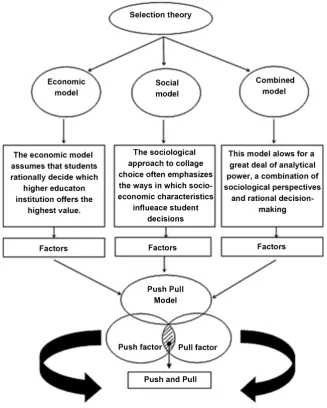
research-ers to assist in the examination and description of international student selection patterns for a given institution. This model has been used to understand interna-tional student flows, decisions or motivations for study abroad and internainterna-tional student choice for a country and institution (Chen, 2007a). Although the basic model of push and pull for an international student’s selection mechanism is useful as an explanatory mechanism, it has limitations (Li & Bray, 2007). Figure 2 illustrated the “No-Show Phenomenon” framework that included three models that involved the “No-Show Phenomenon” emphasizing on factors that influ-ence the choice of students to higher education.
DOI: 10.4236/ce.2019.1012207 2811 Creative Education Figure 2. “No-Show Phenomenon” framework.
choice based on the push and pull model. For example, a study by Cubillo,
Sán-chez, & Cerviño (2006) considers personal reasons, city and country image,
in-stitutional image and program evaluation. Chen’s (2007b) model also includes student characteristics such as socio-economic background, personal criteria and academic ability. Other significant factors include family, teachers and em-ployers.
5. Conclusion
DOI: 10.4236/ce.2019.1012207 2812 Creative Education The models selected needs to be tested in our local context. Future research can be done with focusing on the different setting of institutions and cultural con-text. Or else, the researcher also can investigate the diversity of reasons with qu-alitative approach and in depth interviews. In a nutshell, this “No-Show Pheno-menon” framework will benefit future researchers to produce empirical research in a larger scale.
Funding
This research was supported by the Universiti Kebangsaan Malaysia under grant of UKM PP-FPEND-2019.
Conflicts of Interest
The authors declare no conflicts of interest regarding the publication of this pa-per.
References
Ahmad Zamri, K., & Mohd Effendi Ewan, M. M. (2017). Assessing Challenges among University Undergraduates: A Case of University Sains Malaysia. Advanced Science Letters, 23, 2894-2897. https://doi.org/10.1166/asl.2017.7597
Azarcon, D. E., Gallardo, C. D., Anacin, C. G., & Velasco, E. (2014). Attrition and Reten-tion in Higher EducaReten-tion InstituReten-tion: A Conjoint Analysis of Consumer Behavior in Higher Education. Asia Pacific Journal of Education, Arts and Sciences, 1, 107-118. Bourdieu, P. (1986). The Forms of Capital. In J. G. Richardson (Ed.), Handbook of
Theory and Research for the Sociology of Education (pp. 241-258). New York: Green-wood Press.
Chapman, D. W. (1981). A Model of Student College Choice. Journal of Higher Educa-tion, 52, 490-505. https://doi.org/10.1080/00221546.1981.11778120
Chen, L. H. (2007a). East-Asian Students’ Choice of Canadian Graduate Schools. Interna-tional Journal of EducaInterna-tional Advancement, 7, 271-306.
https://doi.org/10.1057/palgrave.ijea.2150071
Chen, L. H. (2007b). Choosing Canadian Graduate Schools from Afar: East Asian Stu-dents’ Perceptions. Higher Education, 54, 759-780.
https://doi.org/10.1007/s10734-006-9022-8
Coleman, J. S. (1988). Social Capital in the Creation of Human Capital. American Journal of Sociology, 94, 95-120. https://doi.org/10.1086/228943
Cubillo, J. M., Sánchez, J., & Cerviño, J. (2006). International Students’ Decision-Making Process. International Journal of Educational Management, 20, 101-115.
https://doi.org/10.1108/09513540610646091
Glasser, W. (1965). Reality Therapy: A New Approach to Psychiatry. New York: Harper & Row.
Glasser, W. (1986). Control Theory in the Classroom. New York: Harper & Row.
Glasser, W. (1998). Choice Theory: A New Psychology of Personal Freedom. New York: Harper Perennial.
Glasser, W. (2000). Reality Therapy in Action. New York: HarperCollins.
DOI: 10.4236/ce.2019.1012207 2813 Creative Education on Women, Men and College Selection Process. In P. Perun (Ed.), The Undergraduate Woman: Issues in Education (pp. 73-98). Lexington, KY: Lexington Books.
Hearn, J. C. (1984). The Relative Roles of Academic, Ascribed and Socioeconomic Cha-racteristics in College Destinations. Sociology of Education, 57, 22-30.
https://doi.org/10.2307/2112465
Horvat, E. M. (2001). Understanding Equity and Access in Higher Education: The Poten-tial Contribution of Pierre Bourdieu. In J. C. Smart (Ed.), Higher Education: Handbook of Theory and Research (Vol. 16, pp. 158-171). New York: Agathon Press.
Hossler, D., Schmit, J., & Vesper, N. (1999). Going to College: How Social, Economic and Educational Factors Influence the Decisions Students Make. Baltimore, MD: John Hopkins University Press.
Joseph, M., & Joseph, B. (1998). Identifying Needs of Potential Students in Tertiary Edu-cation for Strategy Development. Quality Assurance in Education, 6, 90-96.
https://doi.org/10.1108/09684889810205741
Joseph, M., & Joseph, B. (2000). Indonesian Students’ Perceptions of Choice Criteria in the Selection of a Tertiary Institution: Strategic Implications. International Journal of Educational Management, 14, 40-44. https://doi.org/10.1108/09513540010310396 Kitsawad, K. (2013). An Investigation of Factors Affecting High School Student’s Choice
of University in Thailand. Doctoral Thesis, Wollongong: University of Wollongong. Koe, W.-L., & Saring, S. N. (2012). Factors Influencing the Foreign Undergraduates’
In-tention to Study at Graduate School of a Public University. Jurnal Kemanusiaan, 19, 57-68.
Kusumawati, A. (2013). A Qualitative Study of the Factors Influencing Student Choice: The Case of Public University in Indonesia. Journal of Basic and Applied Scientific Re-search, 3, 314-327.
Lee, E. S. (1966). A Theory of Migration. Demography, 3, 47-57. https://doi.org/10.2307/2060063
Li, M., & Bray, M. (2007). Cross-Border Flows of Students for Higher Education: Push- Pull Factors and Motivations of Mainland Chinese Students in Hong Kong and Macau. Higher Education, 53, 791-818. https://doi.org/10.1007/s10734-005-5423-3
Manski, C. F., & Wise, D. (1983). College Choice in America. Cambridge, MA: Harvard University Press. https://doi.org/10.4159/harvard.9780674422285
Mazzarol, T., & Soutar, G. N. (2002). Push-Pull Factors Influencing International Student Destination Choice. International Journal of Educational Management, 16, 82-90. https://doi.org/10.1108/09513540210418403
McDonough, P. M. (1997). Choosing Colleges: How Social Class and Schools Structure Opportunity. Albany, NY: State University of New York Press.
McMahon, M. E. (1992). Higher Education in a World Market: An Historical Look at the Global Context of International Study. Higher Education, 24, 465-482.
https://doi.org/10.1007/BF00137243
Mehboob, F., Shah, S. M. M., & Bhutto, N. A. (2012). Factors Influencing Student’s Enrollment Decisions in Selection of Higher Education Institutions (HEI’S). Interdis-ciplinary Journal of Contemporary Research in Business, 4, 558-568.
Mohd Effendi Ewan, M. M. (2019a). Structural Equation Model (SEM) in Assimilating EQ, SQ and AQ for Mechanical Students’ Context. In Proceedings of the Mechanical Engineering Research Day (pp. 230-231). Melaka: Universiti Teknikal Malaysia Mela-ka.
DOI: 10.4236/ce.2019.1012207 2814 Creative Education Path Analysis and Rasch Logit for Modelling Purpose among Mechanical Engineering Students. In Proceedings of the Mechanical Engineering Research Day (pp. 225-256). Melaka: Universiti Teknikal Malaysia Melaka.
Mohd Effendi Ewan, M. M., & Ahmad Zamri, K. (2016). Correlation between Adversity Quotient (AQ) with IQ, EQ and SQ among Polytechnic Students Using Rasch Model. Indian Journal of Science and Technology, 9, 1-8.
https://doi.org/10.17485/ijst/2015/v8i1/108695
Mohd Effendi Ewan, M. M., Ahmad Zamri, K., Nordin, A. R., & Maslawati, M. (2017). Improving the Psychometric Properties of the Mooney Problem Checklist by Using Rasch Measurement Model. Journal of Fundamental and Applied Sciences, 9, 408-428. https://doi.org/10.1016/S0040-1951(06)00452-5
Ojo, B. Y., & Raja Nerina, R. Y. (2013). Edutourism: International Student’s Decision Making Process in Selecting a Host University in Malaysia. European Journal of Busi-ness and Management, 5, 51-57.
Padlee, S. F., Kamaruddin, A. R., & Baharun, R. (2010). International Students’ Choice Behaviour for Higher Education at Malaysian Private Universities. International Jour-nal of Marketing Studies, 2, 202-211. https://doi.org/10.5539/ijms.v2n2p202
Paulsen, M. B. (2001). The Economics of Human Capital and Investment in Higher Edu-cation. In M. B. Paulsen, & J. C. Smart (Eds.), The Finance of Higher Education: Theory, Research, Policy and Practice (pp. 55-94). New York: Agathon Press.
Sewell, W. H., Hauser, R. M., & Wolf, W. C. (1986). Sex, Schooling and Occupational Status. American Journal of Sociology, 86, 551-583. https://doi.org/10.1086/227281 Wilkins, S., & Epps, A. (2011). Student Evaluation Web Sites as Potential Sources of