https://www.scirp.org/journal/wjet ISSN Online: 2331-4249 ISSN Print: 2331-4222
DOI: 10.4236/wjet.2019.74042 Oct. 21, 2019 583 World Journal of Engineering and Technology
Development of Path Planning Algorithm Using
Probabilistic Roadmap Based on Modified Ant
Colony Optimization
Firas A. Raheem, Mohammed I. Abdulkareem
Control and Systems Department, University of Technology-Iraq, Baghdad, Iraq
Abstract
In this paper, a unique combination among probabilistic roadmap, modified ant colony optimization, and third order B-spline curve has been proposed to solve path planning problems in complex and very complex environments. This proposed approach can be divided into three stages. First stage involves constructing a random roadmap depending on the environment complexity using probabilistic roadmap algorithm. Roadmap can be constructed by dis-tributing N nodes randomly in complex and very complex static environ-ments then pairing these nodes together according to some criteria or condi-tions. The constructed roadmap contains a huge number of possible random paths that may lead to connecting the start and the goal points together. Second stage includes finding path within the pre-constructed roadmap. Modified ant colony optimization has been proposed to find or to search the best path between start and goal points, where in addition to the proposed combination, ACO has been modified to increase its ability to find shorter path. Finally, the third stage uses B-spline curve to smooth and reduce the total length of the found path in the previous stage. The results of the pro-posed approach ensure the feasible path between start and goal points in complex and very complex environments. Also, the path is guaranteed to be short, smooth, continuous and safe.
Keywords
Path Planning, Probabilistic Roadmap, Ant colony Optimization, B-Spline Curve
1. Introduction
Path planning is a process of obtaining reasonable, collision free route between How to cite this paper: Raheem, F.A. and
Abdulkareem, M.I. (2019) Development of Path Planning Algorithm Using Probabilis-tic Roadmap Based on Modified Ant Colo-ny Optimization. World Journal of Engi-neering and Technology, 7, 583-597. https://doi.org/10.4236/wjet.2019.74042
Received: August 29, 2019 Accepted: October 18, 2019 Published: October 21, 2019
Copyright © 2019 by author(s) and Scientific Research Publishing Inc. This work is licensed under the Creative Commons Attribution International License (CC BY 4.0).
http://creativecommons.org/licenses/by/4.0/
DOI: 10.4236/wjet.2019.74042 584 World Journal of Engineering and Technology start and goal point, where the need for path planning becomes important for fully or partially automated process. There are two types of environments ac-cording to how much information is known about environment. The environ-ment considered as known when the location of obstacle(s) is defined pre-viously while considered as unknown when there is no information about it [1]. Path planning can be divided into two categories: First category, according to time: On-line and Off-line. In On-line path planning, path computed during motion according to data coming from sensors but, in Off-line planning, the path computed according to environment model. Second category, according to environment: dynamic environment in which, environment contains moving and static obstacles while in static, environment contains only static obstacles [2]. Another category can be added depending on the type: global planning in which the path may be found from start to goal point before robot starts to move. Therefore, the information has to be fully known about the environment. Second type is local planning in which path cannot be fully obtained before robot starts to move because knowledge about environment is partially known or unknown. It is important to know path planning categories and environments types because good path planning leads to good robot navigation.
Global path planning starts from 1980 till these days and many algorithms have been proposed by researchers. Research leads to improve global planning year by year. At the beginning, path planning was focusing on finding path to goal only. Then it became bigger issue by not only reaching the goal but also considering optimization criteria [3]. There are a lot of algorithms used to solve path planning problems such as heuristic methods, meta-heuristic, and rando-mized method. A*, D*, and Dikstra can be considered as heuristic methods. A* algorithm is considered as a greedy, graph, and heuristic search algorithm that is able to find sub optimal but, not optimal path [4]. D* algorithm can be consi-dered as dynamic A* which is able to reform the path according to new informa-tion coming from sensors [5]. Meta-heuristic methods include particle swarm optimization (PSO), and ant colony optimization (ACO) [6]. Also there are in-telligent methods, like artificial potential field (APF), genetic algorithm (GA). APF is used in different types of robots where the field of forces is applied on robot. These forces are attractive force to goal and repulsive force from obstacles [7]. Randomized methods can be divided into two categories: rapidly exploring random tree (RRT) which is more suitable for dynamic environment and proba-bilistic roadmap (PRM) for static environment.
PRM algorithm has been applied successfully to very complex static environ-ments. PRM computation can be divided into two phases: the preprocessing (construction) phase and the query phase. In the construction phase, a random roadmap constructed that contains many possible paths that can reach to goal point. On the other hand, the objective of the query phase is to select suitable path from the pre-constructed roadmap. In the next sections, each phase will be explained in detail.
DOI: 10.4236/wjet.2019.74042 585 World Journal of Engineering and Technology 1) A new approach has been proposed which consists of combining a random grid of roadmap, modified ant colony optimization, and third order B-spline curve to solve path planning problem in complex known environment.
2) Ant colony optimization has been modified to increase its ability to find shorter path.
3) The path found by modified ACO enhanced using B-spline curve to reduce the total length and also, to smooth the path.
The general organization of this paper will be divided into eight sections in-cluding current section. The Second section gives brief description about related works and some related algorithms and methods, while the third section shows the general idea of the proposed algorithm. The fourth section explains the con-struction of the random roadmap and its algorithm. The fifth section shows the theories and modification of ant colony optimization (ACO), while the sixth sec-tion explains B-spline curve and how it can be used to enhance the path. The Seventh section shows simulation results of this paper, and finally the eighth sec-tion gives conclusions of the presented work
2. Related Work
In order to overcome path planning problems, many algorithms have been stu-died extensively. One of these algorithms is probabilistic roadmap (PRM) algo-rithm. Starting with L. E. Kavraki who used PRM to find path in high dimen-sional space. In other words PRM used with a robot has many degree of freedom in know static environment. L.E. Kavraki used uniform sampling to distribute nodes [8]. Valerie Boor proposed another strategy for sampling node called Gaus-sian sampler. The new strategy proposed to grantee better coverage of difficult part of space (narrow passage) [9]. Steven A. Wilmarth proposed another strategy for sampling nodes in narrow passages called medial axis. The basic concept of medial axis sampling is to sample a node randomly. The sampled node retracted to the medial axis between two obstacles, regardless if the sampled node is collision free or not [10].
DOI: 10.4236/wjet.2019.74042 586 World Journal of Engineering and Technology Generally, probabilistic roadmap (PRM) used with static environment but, Yunfei Zhang proposed a method to plan a path for mobile robot in unstructured and dynamic environment. The algorithm based on two phases: first phase, con-struct collision free roadmap and store it as graph; second phase is Q-learning, reinforcement learning method, is collaborated with PRM to obtain good path to catch goal. In this way, the robot use past experience to improve its performance in avoiding dynamic and static obstacles. This method called PRM-Q method [13].
3. Proposed Approach
In this paper, a new combination between probabilistic roadmap algorithm, ant colony optimization, and B-spline curve has been proposed as shown in Figure 1. Mainly, the proposed approach divide path planning solution into three stag-es. First stage is construction of probabilistic roadmap which will be clarified in Section 4. Second stage is searching path by modified ant colony optimization, where Section 5 will show the theory and equations of ACO and how ACO has been modified, while the last stage is smoothing and enhancing path using B-spline curve. The third stage is discussed in detail in Section 6. At the end of the presented work, A comparison has been made between ACO and modified ACO as path search technique.
4. Probabilistic Roadmap
[image:4.595.291.458.571.710.2]In this section, the preprocessing phase (construction of roadmap) has been explained in details. The main two element of roadmap (R) are edges and nods R = (N, E). N is a set of nodes distributed randomly to be collision free with obstacle while E is edge which can be defined as very simple, straight, and feasible (collision free) path. These edges or paths called local paths founded by not powerful planner but very fast planer called local planner. At the beginning, the roadmap R = (N, E) is empty. Frequently, random nodes are sampled and added to N if it is collision free. Now, for each new node q some nodes q’ selected from previously sampled nodes to connect them with new node by local planner. This process leads to find new edge E = (q, q’). The neighbors nodes Nq specified
DOI: 10.4236/wjet.2019.74042 587 World Journal of Engineering and Technology according to Equation (1) [8]. if the distance between current node and any node in R is less than or equal to pre-defined threshold, the node considered as neighbor otherwise; node can be neglected as shown in Figure 2 and the process repeated again for all nodes.
(
)
{
| , max}
Nq= q′∈N D q q′ ≤D (1)
where Dmax is predefined threshold, q is new generated node, q’ is neighbor node, and D(q, q’) is Euclidean distance Equation (2) [8].
(
,)
D q q′ = q−q′ (2)
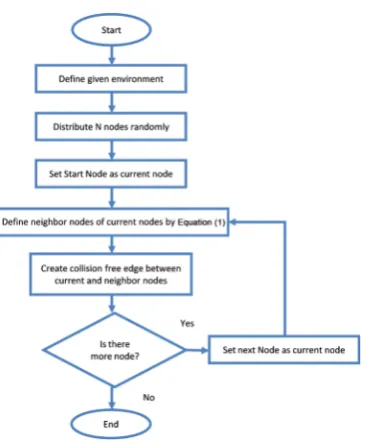
[image:5.595.315.428.341.457.2]Another way can be used to specify node neighbors is to choose nearest K number of nodes to the current node. The last step in roadmap construction is related to local planner to check if the edge is collision free or not. Edge divided into X steps starting from start point to end point and with each step the colli-sion checked with obstacles. Figure 3 shows the flow chart of random roadmap construction. After roadmap construction, a path search technique is needed to find suitable path from constructed roadmap. Next section proposes a technique that can find suitable path.
Figure 2. Selecting neighbor nodes.
[image:5.595.283.466.485.708.2]DOI: 10.4236/wjet.2019.74042 588 World Journal of Engineering and Technology
5. Ant Colony Optimization ACO
In the world of ants, it is well known that ants are capable to obtain the shortest path to food using swarm intelligence. In 1992, ant colony optimization (ACO) has been proposed by M. Dorigo to simulate behavior of the ants to find solution for optimization problems. When the ants travel to find food, they deposit chemical matter called pheromones. Pheromones attract other ants to food source. When more ants travel to specific food source, the quantity of pheromones on the path increased. The shortest path to food source contains more pheromones, be-cause more ants travel through this path. The pheromone is chemical matter that evaporates over time, thus it reduces the chance of taking path with low phero-mone level, where pherophero-mone level in shortest path will increase because, depo-sition process of pheromone overcome evaporations process [14].
Consider a network, which is in our case the constructed roadmap, the proba-bility that ant K travels from node i to next node j can be calculated by Equation (3) [14].
( ) ( )
( ) ( )
if0 if
k i
k k
ij ij k
i
k k k
ij ij ij
i N k i j N p j N α β α β τ η τ η ∈ ∈ = ∉
∑
(3)k ij
τ refers to pheromone levels, while k ij
η represents Euclidean distance be-tween node i (current node) and node j (next possible node). α and β is weight of pheromone level and distance respectively between two nodes. When β equal to zero then the probability of choosing node j depends on nothing but pheromone level. In other words, when α equal to zero then the probability depends only on heuristic distance (the closest node to current node). K is ant number while k
i N
is set of neighboring nodes. As mentioned before, the pheromone evaporate overtime and this process can be expressed in Equation (4) [14]. Evaporation rate denoted by ρ (0 ≤ ρ < 1) where
(
1)
ij ij
τ = −ρ τ (4) It is clearly that when ρ equal to zero, no evaporation happens, on the other hand, when ρ equal to one, pheromone is fully evaporated. After evaporation process, the pheromone level updated by additional levels deposited by ants ac-cording to Equation (5) [14]
1Δ
m k
ij ij k ij
τ =τ +
∑
= τ (5) where m is population, and Δ kij
τ can be calculated by Equation (6) where Ck
reward of ant k for choosing path [14]. 1 Δ k
ij k
C
τ = (6)
Modified Ant Colony Optimization
phero-DOI: 10.4236/wjet.2019.74042 589 World Journal of Engineering and Technology mones (τij) and Euclidian distance from current node to next possible node
(ηij ) as noticed in Equation (3). The new modification is that the probability of
the next possible node depends on another factor which is the length of virtual path from next possible node to goal node. The length of virtual can be meas-ured by Euclidean distance. Equation (3) can be rewritten again involving new term where the new Equation (7) is shown below:
( ) ( )
( ) ( )
if0 if
k i
k k
ij ij k
i
k k k
ij ij ij
i N k i j N p j N α β α β τ σ τ σ ∈ ∈ = ∉
∑
(7)where k ij
σ can be defined by Equation (8):
ij ij Edjg
σ =η + (8) where Edjg is Euclidian distance of virtual path between next possible node j
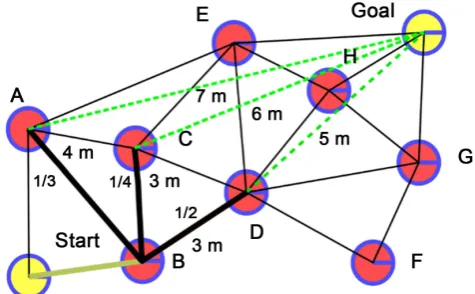
and goal node. The virtual distance added to probability equation to make the selection of the next node to be more intelligent. All remaining steps and equation of ACO stay as it without any changing. Figure 4 shows simple exam-ple of possible case can be solved by modified ACO. If it is assumed that node B has been already chosen then there are three possible nodes can be selected D, C, and A. The integer numbers beside thick black lines are the distance (ηij), while
the fractional numbers are pheromone level (τij). The dashes green lines present
the distance of virtual paths from next possible node to goal node.
6. B-Spline Curve
[image:7.595.253.491.555.702.2]Generally, the output of the most path planning algorithm is straight lines seg-ment. Actually, path with straight line segments is undesirable because of dis-continuity issue, robot mechanical wear, localization error, and slipping. Also, robot needs to stop at each turning edge, then turn, and lastly move forward again which can be considered as another disadvantage. Moreover Dubin’s, Reed, and Shepp’s paths, generate smooth paths by combining lines and circles but, the path was discontinuous [15].
DOI: 10.4236/wjet.2019.74042 590 World Journal of Engineering and Technology B-Spline and Bezier curve, as shown in Figure 5, are the most famous spline curve used in computer aided design. Each type of those curve use control points to control their shape and they were studied to use them in path planning. Bezier curve has unwanted properties like, number of control point will de-termine curve order. In other words, high number of control points leads to increase order complexity. Whereas B-spline curve order independent on number of control points which give advantage over Bezier curve [16]. The control points of B-spline curve are extracted from the basic path found by ACO or modified ACO, where basic path is nothing but selected node from roadmap connected together by straight lines. A B-spline curve has n control points P ii
(
=0,1,,n)
and k order may be defined by Equation (9) [17].( )
0 ,( )
, 1 1n
i i k k n
i
p t =
∑
= p N t t − ≤ ≤t t+ (9)where Ni k,
( )
t is basis function of B-spline with k order defined over the knot vector T ={
t t0, ,1, ,tk , ,tn ,tn k+}
. Basis function can be obtained by the fol-lowing recursive de Boor-Cox Equation (10) [16].( )
1,1
1,
0, otherwise
i i
i
t t t
N t = ≤ ≤ +
(10a)
( )
( )
( )
, , 1 1, 1
1
i i k
i k i k i k
i k i i k i
t t t t
N t N t N t
t t t t
+
− + −
+ + +
− −
= +
− − (10b)
0,
1 ,
2 ,
i
i k
t i k k i n
n k i n
<
= + − ≤ ≤
+ − >
(10c)
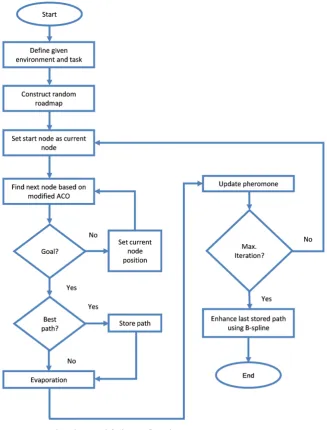
At the end of this section, all needed theories and equation for proposed ap-proach has been explained. Figure 6 shows the flow chart of the proposed com-bination of these methods.
7. Simulation and Results
[image:8.595.271.470.575.703.2]In this section the proposed approach is applied on given environment and task. Environment range X = [−10 10], Y = [−10 10] and start point = [−9 9], while goal point = [9 −9]. Start and goal points are placed diagonally to force the path face larger possible number of obstacles as shown in Figure 7.
DOI: 10.4236/wjet.2019.74042 591 World Journal of Engineering and Technology
Figure 6. PRM based on modified ACO flow chart.
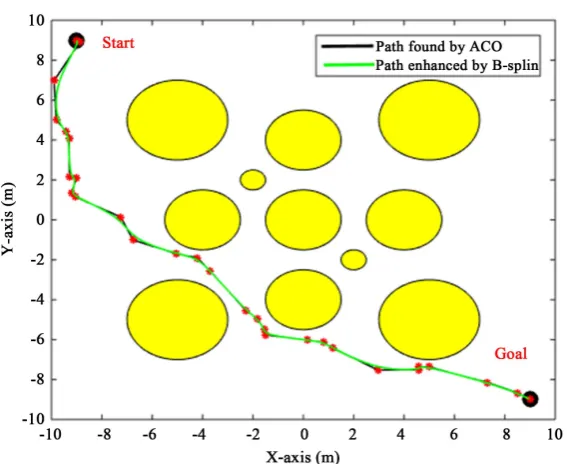
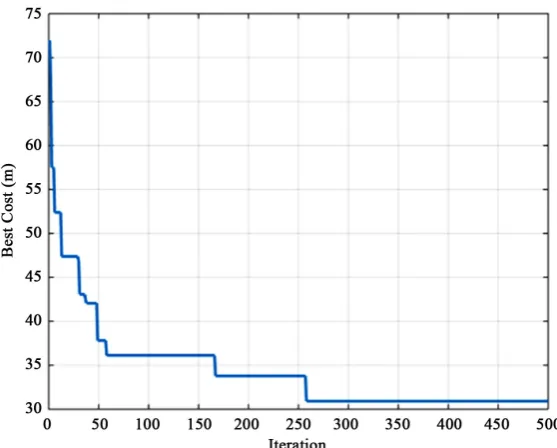
DOI: 10.4236/wjet.2019.74042 592 World Journal of Engineering and Technology Firstly, a random roadmap has been constructed for the given environment. As explained previously, this roadmap contains huge number of paths that can connect start and goal points. Two path search methods have been used to find best path. First search method is ACO while the second one is modified ACO. After finding basic path either by ACO or modified ACO, the path is enhanced using B-spline curve. The length of the path obtained by ACO is found to be 30.92 m and the constructed road map is shown in Figure 8 while, the length of the enhanced path by B-spline curve is equal to 29.7264 m as shown Figure 9. The convergence to the best path using ACO is shown in Figure 10.
[image:10.595.232.516.473.705.2]Figure 8. Constructed roadmap.
DOI: 10.4236/wjet.2019.74042 593 World Journal of Engineering and Technology
Figure 10. Convergence to the best solution using ACO.
For the same environment and constructed roadmap, modified ACO is used to find basic path within pre-constructed roadmap. The length of the path found by modified ACO is equal to 29.1711 m and the constructed roadmap is shown in Figure 11, while the length of the enhanced path by B-spline curve is 27.9639 m as shown in Figure 12. The convergence to the best path using modified ACO is shown in Figure 13.
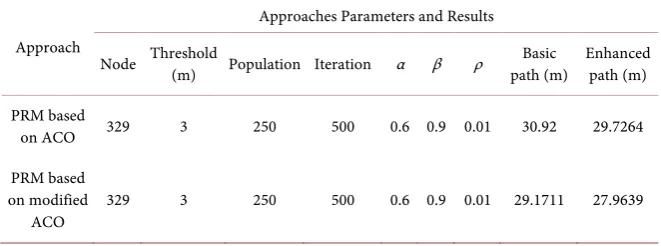
From the results it can be noticed that modification of ACO increases the ability of classical ACO to find better path, where modified ACO found a path shorter than the path found by ACO by 1.7489 m. Also, path enhancement reduce the total length of the path, where the length of the path found by ACO reduced by 1.1936 m. in the other hand, the length of the path found by mod-ified ACO has been enhanced by 1.2072 m. Table 1 summarizes all results and shows parameters of PRM, ACO, Modified ACO.
8. Conclusions
DOI: 10.4236/wjet.2019.74042 594 World Journal of Engineering and Technology
[image:12.595.245.500.266.468.2]Figure 11. Constructed roadmap.
Figure 12. Path found by modified ACO and enhanced path by B-spline curve.
[image:12.595.246.500.502.704.2]DOI: 10.4236/wjet.2019.74042 595 World Journal of Engineering and Technology
Table 1. Summerized results.
Approach
Approaches Parameters and Results
Node Threshold (m) Population Iteration α β ρ path (m) Basic Enhanced path (m)
PRM based
on ACO 329 3 250 500 0.6 0.9 0.01 30.92 29.7264
PRM based on modified
ACO 329 3 250 500 0.6 0.9 0.01 29.1711 27.9639
therefore, the path needs to be enhanced. Third stage is shortening and smooth-ing the path found by modified ACO. To prove the effectiveness of modification, both ACO and modified ACO have been used as path search method.
From results, following points can be noticed:
1) The modification of ACO has been approved, where the length of the path found by modified ACO is shorter than the length of the path found by ACO by 6%.
2) Path has been effectively enhanced in both cases, ACO case and modified ACO case using B-spline curve. The effect on the path’s length in enhancement stage is increased or decreased depending on the quality of the path found in second stage.
The main advantage of merging a random roadmap with the modified ACO is to increase the possibilities of obtaining shorter path, where using ACO with traditional square grid reduces the possibilities to cover all possible paths specially, in critical regions. In addition to enhancing the length of found path, producing smooth path using B-spline curve is much better for robot navigation due to discontinuity issue.
It is clear that the proposed method can be used in static known environment and the path is globally planned before robot moves. Also, it is noticed that the quality of the path depends on probability of the node distribution. But, at the same time, probabilistic roadmap algorithm can ensure to find several paths to the goal regardless of the complexity of the environment. The complexity of the roadmap depends on complexity of the environment. In other words, when the environment is complex, more nodes should be distributed, which leads to the increase number of ways that may be selected to reach the goal. So, the complex-ity of roadmap is increased at this case. In the end, the approach has been simu-lated and the path has been approved to be short, smooth, continuous, and collision free.
Finally some points or ideas can be suggested as future work such as: 1) Apply proposed method in the presented work on a real mobile robot. 2) Enhance construction of roadmap by making construction of roadmap more intelligent.
DOI: 10.4236/wjet.2019.74042 596 World Journal of Engineering and Technology
Conflicts of Interest
The authors declare no conflicts of interest regarding the publication of this paper.
References
[1] Raheem, F.A. and Hameed, U.I. (2019) Interactive Heuristic D* Path Planning So-lution Based on PSO for Two-Link Robotic Arm in Dynamic Environment. World Journal of Engineering and Technology, 7, 80-81.
https://doi.org/10.4236/wjet.2019.71005
[2] Safa, H.S. and Alia, K. (2014) Probabilistic Roadmap, A*, and GA for Proposed De-coupled Multi-Robot Path Planning. Iraq Journal for Applied Physics, 10, 3. [3] Sariff, N.B. and Buniyamin, N. (2010) Ant Colony System for Robot Path Planning
in Global Static Environment. 9th WSEAS International Conference on System Science and Simulation in Engineering, Iwate, 4-6 October 2010, 192.
[4] Raheem, F.A. and Hussain, A.A. (2017) Applying A* Path Planning Algorithm Based on Modified C-Space Analysis. Al-Khwarizmi Engineering Journal, 13, 125. [5] Raheem, F.A. and Hameed, U.I. (2018) Path Planning Algorithm Using D*
Heuris-tic Method Based on PSO in Dynamic Environment. American Scientific Research Journal for Engineering, Technology, and Sciences, 49, 258.
[6] Gigras, Y. and Gupta, K. (2014) Metaheuristic Algorithm for Robotic Path Plan-ning. International Journal of Computer Applications, 85, 26-29.
https://doi.org/10.5120/14822-3056
[7] Raheem, F.A. and Badr, M.M. (2017) Development of Modified Path Planning Al-gorithm Using Artificial Potential Field (APF) Based on PSO for Factors Optimiza-tion. American Scientific Research Journal for Engineering, Technology, and Sciences, 37, 317-328.
[8] Kavraki, L., Svestka, P. and Overmars, M.H. (1996) Probabilistic Roadmaps for Path Planning in High-Dimensional Configuration Spaces. IEEE Transaction on Robot-ics and Automation, 12, 566-570.https://doi.org/10.1109/70.508439
[9] Boor, V., Overmars, M.H. and Van Der Stappen, A.F. (1999) The Gaussian Sam-pling Strategy for Probabilistic Roadmap Planners. IEEE International Conference on Robotics and Automation, Detroit, 10-15 May 1999, 1018.
[10] Wilmarth, S.A., Amato, N.M. and Stiller, P.F. (1999) MAPRM: A Probabilistic Roadmap Planner with Sampling on the Medial Axis of the Free Space. IEEE Inter-national Conference on Robotics and Automation, Detroit, 10-15 May 1999, 1024. [11] Geraerts, R. and Overmars, M.H. (2006) Sampling and Node Adding in
Probabilis-tic Roadmap Planners. Robotics and Autonomous Systems, 54, 165-173. https://doi.org/10.1016/j.robot.2005.09.026
[12] Hsu, D., Sánchez-Ante, G. and Sun, Z. (2005) Hybrid PRM Sampling with a Cost-Sensitive Adaptive Strategy. Proceedings of the 2005 IEEE International Con-ference on Robotics and Automation, Barcelona, 18-22 April 2005, 3874.
[13] Zhang, Y., Fattahi, N. and Li, W. (2013) Probabilistic Roadmap with Self-Learning for Path Planning of a Mobile Robot in a Dynamic and Unstructured Environment. IEEE International Conference on Mechatronics and Automation, Takamatsu, 4-7 August 2013, 1074.https://doi.org/10.1109/ICMA.2013.6618064
DOI: 10.4236/wjet.2019.74042 597 World Journal of Engineering and Technology and Applications, Qinhuangdao, 25-27 June 2010, Vol. 3, 436-437.
https://doi.org/10.1109/ICCDA.2010.5541300
[15] Elbanhawi, M., Simic, M. and Jazar, R.N. (2014) Continuous-Curvature Bounded Trajectory Planning Using Parametric Splines. Frontiers in Artificial Intelligence and Applications, Chania, Volume 262, 514.
[16] Elbanhawi, M., Simic, M. and Jazar, R.N. (2015) Continuous Path Smoothing for Car-Like Robots Using B-Spline Curves. Journal of Intelligent & Robotic Systems, 80, 25-26.https://doi.org/10.1007/s10846-014-0172-0