ISSN Print: 2151-4755
DOI: 10.4236/ce.2019.1010160 Oct. 23, 2019 2219 Creative Education
United Nations Education Program in Space
Science and Technology 1988-2018
Lewis Pyenson
1, Arak M. Mathai
2, Hans J. Haubold
31Department of History, Western Michigan University, Kalamazoo, MI, USA
2Department of Mathematics and Statistics, McGill University, Montreal, Canada
3Office for Outer Space Affairs, United Nations, Vienna International Centre, Vienna, Austria
Abstract
Based on resolutions of the United Nations General Assembly, UN-affiliated Regional Centres for Space Science and Technology Education were estab-lished in China, India, Morocco, Nigeria, Brazil/Mexico, and Jordan. Simul-taneously, education curricula at the university level were developed for the core disciplines of remote sensing, satellite communications, satellite meteor-ology, space and atmospheric science, and global navigation satellite systems. In 2017, these education curricula were supplemented by the publication of two open access books covering full university courses in linear algebra and probability & statistics.
Keywords
Regional Education Centres, Education Curricula, Space and Atmospheric Science, Remote Sensing and Geographic Information System,
Satellite Communications, Satellite Meteorology and Global Climate, Global Navigation Satellite Systems, Linear Algebra, Probability and Statistics
1. Introduction
Space science and technology education can be pursued at the elementary, sec-ondary, and university levels. In spacefaring nations, elements of space science and technology have been introduced into science curricula at those levels. Such an innovation has not taken place in many developing countries, partly because the benefits of space science and technology have not been appreciated enough and partly because the facilities and resources for teaching space science and technology at educational institutions are not yet comprehensively developed. Education in space science and technology in industrialized countries has be-How to cite this paper: Pyenson, L.,
Ma-thai, A. M., & Haubold, H. J. (2019). United Nations Education Program in Space Science and Technology 1988-2018. Creative Edu-cation, 10, 2219-2231.
https://doi.org/10.4236/ce.2019.1010160
Received: August 29, 2019 Accepted: October 20, 2019 Published: October 23, 2019
Copyright © 2019 by author(s) and Scientific Research Publishing Inc. This work is licensed under the Creative Commons Attribution International License (CC BY 4.0).
http://creativecommons.org/licenses/by/4.0/
L. Pyenson et al.
DOI: 10.4236/ce.2019.1010160 2220 Creative Education
come highly interactive; the World Wide Web and other information technolo-gies have become useful tools in education programs at all levels. The incorpora-tion of elements of space science and technology into university-level science curricula can serve a dual purpose for countries. It can enable all countries to take advantage of the benefits inherent in the new technologies, which, in many cases, are spin-offs from space science and technology. It can revitalize the edu-cational system, introduce the concepts of high technology in a non-esoteric fa-shion and help create national capacities in science and technology in general. In that regard, Pyenson and Sheets-Pyenson (Pyenson & Sheets-Pyenson, 1999) emphasized in his work entitled “Servants of Nature” that:
“Both geographical decentralization and interdisciplinary innovation have become watchwords in academic science. Electronic information processing to some extent obviates the necessity for a scientist or scholar to reside at an an-cient college of learning. Universities everywhere have adapted to new socioe-conomic conditions by expanding curricula. They have always responded in this way, although never as quickly as their critics would like. Measured and delibe-rate innovation is one of academia’s heavy burdens. It is also a great strength. Emerging fields of knowledge become new scientific disciplines only after they have found a secure place in universities. We look to universities for an authori-tative word about the latest innovations. New scientific ideas emerge in a variety of settings, but they become the common heritage of humanity only when processed by an institution for advanced instruction like the modern university”.
There are many challenges in the teaching of science at university level, in any country, but the challenges are of a higher magnitude in developing countries. The general problem confronting science education is the inability of students to see or experience the phenomena being taught, which often leads to an inability to learn basic principles and to see the relationship between two or more con-cepts and their practical relevance to problems in real life. Added to those lems are a lack of skills in the relevant aspects of mathematics and in prob-lem-solving strategies. There are also language problems in countries in which science is not taught in the national language(s). Over the years, industrialized countries have overcome most of the basic problems, except perhaps a psycho-logical problem, namely that students may consider science to be a difficult sub-ject. In developing countries, however, basic problems linger, exacerbated by the fact that there are not enough academically and professionally well-trained teachers.
2. Regional Centres
Since 1988, the United Nations (United Nations General Assembly Document
A/AC.105/749, 2017;United Nations General Assembly Document A/AC.105/1174,
2000), through its Program on Space Applications, supported the establishment
DOI: 10.4236/ce.2019.1010160 2221 Creative Education
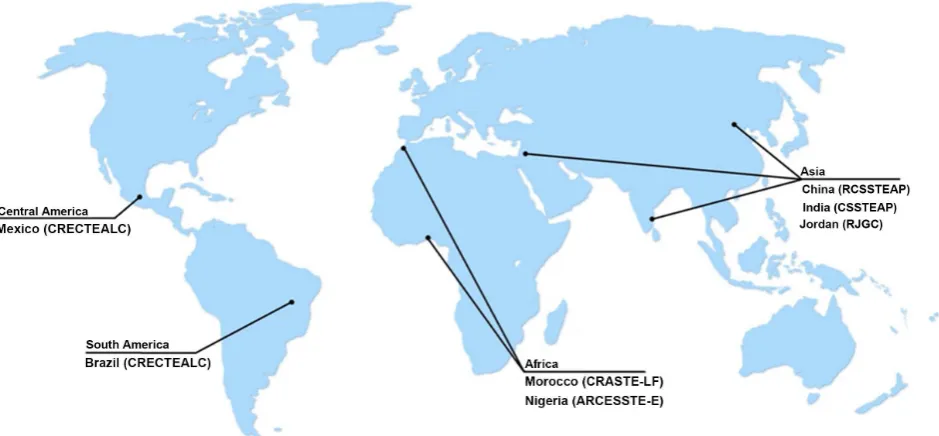
Asia (Agbaje, Alabi, & Offiong, 2019; Agbaje, 2017) (Figure 1,
http://www.unoosa.org/oosa/en/SAP/centres/index.html).
Regional centres were established in India (https://www.cssteap.org/) and China (http://rcssteap.org/Index/index.html) for Asia and the Pacific, in Nigeria (http://arcsstee.org.ng/home/) and Morocco (http://www.crastelf.org.ma/) for Africa, in Mexico and Brazil (http://www.crectealc.org) for Latin America and the Caribbean, and in Jordan (no website available) for Western Asia, under the auspices of the UN Programme on Space Applications.
Since 1996 the centres implement nine-month postgraduate courses in the five areas based on the model curricula that emanated from United Nations Meet-ings of Experts on the Development of Education Curricula for the Regional Centres for Space Science and Technology Education, held in Dundee, UK, in 1989, Granada, Spain, in 1995, and in Frascati, Italy, in 2001.
Gradually, the Regional Centre for Space Science and Technology in Asia and the Pacific, located in India, comprehensively revised and updated all education curricula to take into account advanced topics in space science and technology now teaching standard at universities around the world
(https://www.cssteap.org/information).
3. Education Curricula
Simultaneously, detailed education curricula at the university level were devel-oped and published for 1) remote sensing and geographic information systems; 2) satellite communications; 3) satellite meteorology and global climate; 4) space and atmospheric science; and 5) global navigation satellite systems (positioning, navigation, timing)
(http://www.unoosa.org/oosa/en/SAP/centres/education-curriculum.html).
4. Space and Atmospheric Science (Figure 2)
L. Pyenson et al.
[image:4.595.63.533.107.325.2]DOI: 10.4236/ce.2019.1010160 2222 Creative Education
Figure 1. World map showing the geographical location of the Regional Centres for Space Science and Technology Education in four economic regions.
Figure 2.
http://www.unoosa.org/documents/pdf/psa/reg_centr es/curricula/Space_and_Atmospheric_Science.pdf.
[image:4.595.278.468.373.622.2]sta-DOI: 10.4236/ce.2019.1010160 2223 Creative Education tions. Although space and atmospheric science may use spacecraft and space sta-tions as carriers of space experiments, it is not the primary user of those vehicles and does not involve the management of them; c) Biological and physical re-search programs are responsible for materials science and life science rere-search done aboard spacecraft and space stations; d) Aerospace technology programs work on technologies for better airplanes and future launch vehicles (rockets).
5. Remote Sensing and the Geographic Information System
(Figure 3)
All life on Earth depends on the thin layer of gas that surrounds the globe; it is called the atmosphere, taken from the Greek word atmos (vapour) and the Latin word sphaera (sphere). Remote sensing of the atmosphere attempts to quantify numerous variables: cloud coverage and identity, water vapour concentration and precipitation rate, wind speeds, atmospheric aerosol and trace gas concen-trations, and even lightning in storms. The term atmosphere has led to the crea-tion of several other words to describe various divisions of the Earth’s environ-mental systems:
• The hydrosphere, encompassing oceans, rivers, lakes and snow and ice on both land and sea;
• The biosphere, referring to the living things that inhabit the Earth, which for remote-sensing purposes primarily means land vegetation and oceanic phy-toplankton;
• The geosphere, covering such areas as the Earth’s radiation budget, the phys-ical topography of the continents, geologphys-ical processes that modify the land surface, the dynamic activity of volcanoes and the movement of the Earth’s continental plates;
• The anthroposphere, meaning the influence of humanity on the surface of the Earth through structures and activity that have the potential to signifi-cantly alter the Earth’s climate.
The primary processes that remote sensing seeks to measure in each of these spheres and the technical aspects of remote-sensing observations for each of these systems in terms of educational modules are described in the education curriculum.
6. Satellite Communications (Figure 4)
L. Pyenson et al.
[image:6.595.280.463.77.315.2]DOI: 10.4236/ce.2019.1010160 2224 Creative Education
Figure 3.
[image:6.595.282.465.372.601.2]http://www.unoosa.org/documents/pdf/psa/reg_ce ntres/curricula/Remote_Sensing_and_GIS.pdf.
Figure 4.
http://www.unoosa.org/documents/pdf/psa/reg_c entres/curricula/Satellite_Communications.pdf.
DOI: 10.4236/ce.2019.1010160 2225 Creative Education the ability to cover large distances of the terrain. Satellite communications sys-tems consist of several different segments, including a space segment, a ground control segment and ground infrastructure equipment. The space segment con-tains the satellites, which act as nodes in space, routing the communication sig-nal from an Earth termisig-nal to either a fisig-nal or an intermediate destination point on the Earth’s surface. The ground control segment is responsible for monitor-ing the health and status of each satellite as well as for keepmonitor-ing the satellites in their appropriate locations in space. The infrastructure equipment controls the networking aspect of the entire communication system, keeping track of the du-ration of a communication session for billing purposes as well as assigning communication channels to the various users.
7. Satellite Meteorology and Global Climate (Figure 5)
L. Pyenson et al.
DOI: 10.4236/ce.2019.1010160 2226 Creative Education
Figure 5.
http://www.unoosa.org/documents/pdf/psa/reg_centre s/curricula/Satellite_Metorology_and_Global_Climate. pdf.
influences would be enormously valuable in formulating strategies to mitigate the social and economic consequences of global environmental change.
8. Global Navigation Satellite Systems (Figure 6)
Satellite navigation has become a component of national infrastructure and therefore one of the pillars of modern civilization. This inevitably requires knowledgeable, skilled and competent professionals who will be able to advance, modernize, develop, and operate satellite navigation systems and their applica-tions and services. Capacity development in the GNSS segment and attracting talented people to the field of satellite navigation has been recognized as an im-portant subject. However, education in the satellite navigation discipline still suffers from a number of both inherited and emerging challenges.
[image:8.595.273.474.68.320.2]DOI: 10.4236/ce.2019.1010160 2227 Creative Education
Figure 6.
http://www.unoosa.org/pdf/icg/2013/Ed_GNSS_eB ook.pdf.
Establishing satellite navigation as a separate applied science discipline with its own philosophy based on the foundations of fundamental scientific discip-lines (mathematics and statistics, in particular), and new common-interest dis-ciplines (such as computer science) will facilitate recognition of satellite naviga-tion and allows for identificanaviga-tion of common capacity requirements regardless of satellite navigation sub-specialization.
Satellite navigation has significantly and rather quickly changed the scope of its application. Considered a technology merger that will foster and advanced navigation, satellite navigation now encounters the fact that a majority of GNSS applications belong to the non-navigation category. Generation of massive posi-tioning data sets that are further processed using statistical and machine learning methods to reveal the hidden patterns and knowledge, time stamping of finan-cial transactions, taming vulnerabilities and shortcomings to create robust and resilient PNT services, synchronization of large spatially distributed networks (internet, mobile communication networks, public broadcast networks, power networks, intelligent transport systems etc.) and artificial intelligence and robot-ics together overtake massively the traditional navigation-related GNSS applica-tions. Making advancements and developments in such a variety of new scena-rios of usage requires new and advanced capacity in methods and techniques for statistical/machine learning, modelling, management of spatial data and compu-ting in general.
L. Pyenson et al.
DOI: 10.4236/ce.2019.1010160 2228 Creative Education
development, and resilient GNSS development already face a shortage of profes-sionals with the appropriate knowledge and skills, competing with numerous similar fields. However, the structured offer for academic education in satellite navigation is still sparse.
A proper GNSS academic education and professional advancement are essen-tial for sustainable development of satellite navigation. Resolving issues related to GNSS deployment in steadily growing number of GNSS-based applications and services requires highly-capable GNSS professionals with broad knowledge and skills. Consequently, the GNSS academic education and professional ad-vancement need a re-structuring reform that will assure the competent GNSS scientific and development community for the decades to come.
9. Mathematics and Statistics
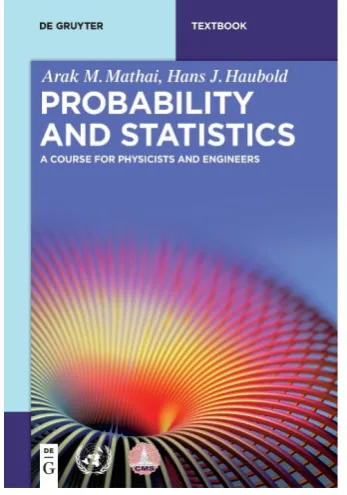
To supplement all education curricula of the centres with the necessary mathe-matics and statistics, De Gruyter published two books (Figure 7 and Figure 8) with Open Access available on the Internet free of charge that form the basis of the mathematics foundations courses within the curricula of the centres Both are designed for physicists and engineers
(https://www.degruyter.com/dg/newsitem/256/de-gruyter-and-united-nations-c ooperate-on-open-access-book-project).
In the book titled “Linear Algebra” (Figure 7), basic properties of vectors, matrices, determinants, eigenvalues and eigenvectors are discussed. Applications of matrices and determinants to areas of statistical problems such as principal components analysis, model building, regression analysis, canonical correlation analysis, and design of experiments are examined. Applications of vector/matrix derivatives in the simplification of Taylor expansions of functions of many real scalar variables are considered. Jacobians of matrix transformations of real-valued scalar functions of matrix argument, maxima/minima problems, optimizations of linear forms, quadratic forms, bilinear forms with linear and quadratic con-straints are examined. Matrix sequences and series, convergence of matrix series and applications in physical sciences, chemical sciences, social sciences, in-put-analysis, linear programming problem, non-linear least squares and dynam-ic programming problems are studied in this book.
The book titled “Probability and Statistics” (Figure 8) consists of two parts. Chapters 1 to 9 cover the topics of random experiments, sample space, probabil-ity, how to assign probabilities to individual events, random variables, expected values, statistical distributions, collections of random variables and the central limit theorem. Part 2 dealing with statistics consists of chapters 10 to 16 covering the topic of sampling distributions, point estimation, interval estimation, tests of hypotheses, prediction, regression and model building problems, design of expe-riments and analysis of variance, some non-parametric tests, questions and an-swers.
DOI: 10.4236/ce.2019.1010160 2229 Creative Education
Figure 7. The book on linear algebra is available Open Access at
[image:11.595.289.461.74.317.2]https://www.degruyter.com/view/product/495839.
Figure 8. The book on probability and statistics is available Open Access at
https://www.degruyter.com/view/product/495845.
[image:11.595.288.462.375.623.2]L. Pyenson et al.
DOI: 10.4236/ce.2019.1010160 2230 Creative Education
10. Conclusion
Students at the UN-affiliated Regional Centres for Space Science and Technolo-gy Education have a number of advantages, among them:
1) One advantage is freedom from being confined to disciplinary units. The disciplinary walls are especially tall at many of the large and prestigious univer-sities. People at the UN-affiliated Regional Centres may easily take full advan-tage of scientific ideas generated in all laboratories and institutions, even ideas from the human sciences (Humanities).
2) Another advantage is that they are not constrained by firm distinctions between practical needs and highly abstract theoretical science. As space scien-tists, they may freely adopt ideas and methods from engineering. This freedom is one of the signs of the past 30 years, but at many large institutions where engi-neering is separated from the science departments, it has been difficult to im-plement.
3) A third advantage is that they move between the language of the “litera-ture” (often what is called International English) and their everyday language, which can be distinct from what they read. They are able to add new concepts and original interpretations to accepted knowledge which come from their daily experience; they see science with fresh eyes. This multilingual advantage has of-ten appeared in the past (for example, among immigrant scientists in the North-ern Hemisphere).
Disclaimer
The views expressed in this paper are solely those of the authors and do not nec-essarily reflect the views of any company or organization.
Conflicts of Interest
The authors declare no conflicts of interest regarding the publication of this pa-per.
References
Agbaje, G. I. (2017). United Nations Regional Centre for Space Science and Technology Education in Africa: Achievements, Opportunities, Challenges, and the Future. Envi-ronment and Ecology Research, 5, 386. https://doi.org/10.13189/eer.2017.050508
Agbaje, G., Alabi, O., & Offiong, E. (2019). Education and Training in Applied Remote Sensing in Africa: The ARCSSTE-E Experinece. International Journal of Geo-Information, 8, 350. https://www.mdpi.com/2220-9964/8/8/350
https://doi.org/10.3390/ijgi8080350
Mathai, A. M., & Haubold, H. J. (2018). United Nations Basic Space Science Initiative (UNBSSI) 1991-2012 and Beyond. Creative Education, 9, 141.
https://file.scirp.org/pdf/CE_2018021215593617.pdf
https://doi.org/10.4236/ce.2018.92015
DOI: 10.4236/ce.2019.1010160 2231 Creative Education United Nations General Assembly Document A/AC.105/1174 (2017).
http://www.unoosa.org/oosa/oosadoc/data/documents/2018/aac.105/aac.1051174_0.html
United Nations General Assembly Document A/AC.105/749 (2000).